
Padres, Jared Koenig Agree To Minor League Deal
The Padres are in agreement with Jared Koenig on a minor league contract, as first announced on Twitter by Matthew Rossignol. The left-hander seems likely to head to Triple-A El Paso to open the season.
Koenig, an undrafted player in 2017, spent a couple years in independent ball to open his professional career. He eventually landed a minor league deal with the A’s heading into 2021. Koenig pitched well for their Double-A affiliate that season and got a bump to Triple-A Las Vegas to open last year. He went on to throw 107 innings of 4.71 ERA ball — deceptively solid production considering the Pacific Coast League’s extreme hitter-friendly nature — over 20 Triple-A outings.
That upper minors production earned Koenig a major league call last June. He’d make ten appearances (five starts) in green and gold, allowing a 5.72 ERA in 39 1/3 innings. He only struck out 12.4% of opponents on a minuscule 6.4% swinging strike percentage. Yet he induced grounders at a strong 48.5% clip and kept his walk rate to a manageable 8.5% mark.
Oakland non-tendered Koenig at the start of the offseason, sending him directly to free agency without first going through waivers. The 29-year-old now joins the second affiliated organization of his career. Koenig adds a strike-throwing rotation depth arm to the San Diego system. He doesn’t brandish a power arsenal, averaging only 89.2 MPH on his sinker and 77.6 MPH on a curveball during his major league look. Koenig found success in spite of the lack of velocity in the upper minors, mixing five pitches and throwing a decent number of strikes.
San Diego looks set to open the season with a six-man rotation of Yu Darvish, Joe Musgrove, Blake Snell, Michael Wacha, Nick Martinez and Seth Lugo. Depth options on the 40-man roster include Jay Groome, Brent Honeywell Jr., Adrián Morejón, Reiss Knehr and Ryan Weathers. Koenig will slot in behind that group. He joins Julio Teheran, Cole Hamels, Wilmer Font and Aaron Brooks among non-roster rotation options who have some big league experience.
MLB Planning To Reemphasize Enforcement On Foreign Substances
League officials are informing teams this spring that umpires are being encouraged to more diligently monitor pitchers for foreign substances, reports Jayson Stark of the Athletic. It’ll involve more thorough checks on pitchers as part of MLB’s quest to enforce the ban on sticky stuff.
That crackdown came in response to concern among league officials (and some players) that pitchers were using increasingly complex substances to enhance their grip on the baseball. The league’s rationale was that many pitchers had gone beyond the long accepted practice of using substances like rosin to maintain control of the ball and were instead using sticky stuff as a means of artificially enhancing the quality of their arsenals by increasing spin and movement. The crackdown came in response to league concerns about the ever-increasing rise of strikeouts in the sport.
The substance checks led to some controversy early on, with pitchers like Tyler Glasnow and Garrett Richards blasting MLB’s decision to implement it midway through the 2021 season. Within a few weeks, however, the focus on those checks generally faded into the background. Umpires continued to inspect every pitcher (some hurlers multiple times within a game) but there were only two ejections for pitchers whom umpires determined violated the foreign substance rule during the 2021 season. There wasn’t a single ejection related to a failed foreign substance check last year, although D-Backs southpaw Madison Bumgarner was thrown out for insulting umpire Dan Bellino during an inspection (an ejection for which Bellino later apologized).
The process came back to the forefront on the national stage last fall when Mets manager Buck Showalter requested umpires examine Padres starter Joe Musgrove during the deciding game of the clubs’ Wild Card Series. Musgrove passed the inspection, remained in the game, and finished with seven scoreless innings to lead San Diego to a clinching win.
While the Musgrove incident ultimately turned out to be inconsequential, the league apparently has concerns that pitchers have found ways around the substance checks in general. Eno Sarris of the Athletic noted last September that league spin rates on four-seam fastballs had risen throughout the 2022 campaign after an initial precipitous decline upon the start of inspections in mid-summer 2021. According to Stark, the league has token note of that trend. MLB had expressed similar concerns about a rise in spin rate last Spring Training, but league officials’ plans to enhance enforcement last season evidently didn’t have the desired effect.
Stark writes that umpires are expected to again examine pitcher equipment like hats and belts, a process they used in 2021 but shied away from last season as they focused more attention on players’ hands. Stark adds that checks of pitchers’ hands — which obviously will also continue — are expected to be more thorough than they had been and that umpires could potentially conduct mid-inning checks if they identify a reason to believe the pitcher could be using a foreign substance.
Whether the tighter enforcement will have any tangible effects on gameplay in 2023 remains to be seen. It comes as part of the league’s ongoing efforts to increase the number of balls in play. MLB is implementing various rule changes (i.e. infield shift limitations, larger bases, a pitch clock) with an eye towards decreasing whiffs and/or accelerating pace of play.
Tigers, Ashton Goudeau Agree To Minor League Contract
The Tigers are in agreement with right-hander Ashton Goudeau on a minor league deal, according to his transactions log at MLB.com. The right-hander adds some pitching depth to the upper levels of the Detroit system.
Goudeau, 30, has appeared at the major league level in three consecutive seasons. Aside from five innings with the Reds in 2021 as part of some shuffling around on the waiver wire, Goudeau has spent his entire MLB career with the Rockies. He’s worked 63 innings over 32 relief outings, compiling a 5.57 ERA with a modest 14.6% strikeout rate and somewhat lofty 10.6% walk percentage.
That included 20 1/3 innings over 12 outings fairly early into the year for Colorado last season. Goudeau surrendered a little over seven earned runs per nine frames and lost his spot on the 40-man roster in early August. He went unclaimed on waivers and finished out the season in Triple-A before reaching minor league free agency at year’s end.
Goudeau had a brutal year with the Rox’s top affiliate in Albuquerque. He started 15 of 20 appearances there and compiled 64 1/3 innings. He was tagged for a 9.51 ERA in one of affiliated ball’s toughest environments for pitchers. Goudeau’s 7.3% walk rate there was solid but he didn’t miss many bats and allowed over two home runs per nine.
He’ll look to put that nightmarish season behind him in a new organization. Goudeau has had a tough time in hitter-friendly atmospheres at both the MLB and Triple-A levels, but his lower minors track record is more solid. He carries a 4.25 ERA in 279 1/3 career Double-A frames. He’s shown a three-pitch mix at the big league level, backing up a low-90s fastball with a curveball and changeup. He’ll add some rotation or multi-inning relief depth to the Detroit system and figures to open the season with Triple-A Toledo.
NL Notes: Song, Lee, Hamels
The Phillies and right-hander Noah Song are going to attempt something unprecedented, as he is now in camp after spending the past three years in the Navy. Both Song and Phillies president of baseball operations Dave Dombrowski spoke to reporters about the unusual situation today, including Alex Coffey of The Philadelphia Inquirer.
“The reality is it’s a gamble,” Dombroski said of taking Song from the Red Sox in November’s Rule 5 draft. “That’s what it is. I do not know when he picks up a ball and he starts throwing off the mound and puts something into it, once his arm is in good enough shape, I don’t know if he’s going throw 85 or 95. But we think it’s worth the risk.”
Dombrowski is certainly familiar with Song’s past pedigree as a prospect, since he was with the Sox when Song was drafted. Some evaluators considered the youngster to be a first-round talent at that time, but Boston was able to take him in the fourth because clubs were concerned about his commitment to the military. Dombrowski said that taking the gamble this winter was worth it, even though Song was still committed to the Navy at the time, since he could be a “top-of-the-rotation type pitcher” or a “star major leaguer,” the type of player that’s not usually available in the draft. “For us, the [Rule 5] draft price is $100,000, and if we return him [to the Red Sox], it’s $50,000, so that’s not much of a risk, financially,” Dombrowski said. “He’s not counted on our roster, so we haven’t even lost a player to put him on the 40-man roster. We thought it was worth the gamble with the high upside that he could bring.”
For now, the gamble has paid off, in the sense that Song has been transferred from active duty to the reserves. That’s allowed him to pursue baseball but it doesn’t seem he’s completely without limits, as Coffey relays that his transfer to reserve status means he’ll be putting in 12 years of part-time duty instead of six years of full-time. As part of that part-time duty, he’ll still have to serve one weekend per month and two full weeks per year. The logistics of how that will play out during the season remain to be seen.
Song last pitched professionally in High-A in 2019 and will now have to try to get back on track quickly. As a Rule 5 draftee, he has to stick on an active roster all season long or else be put on waivers and offered back to the Sox if he clears. “It felt rough,” Song said of his first bullpen since the news of his transfer. “It felt like I was trying to walk again. Trying to learn new things. But as far as expectations go, just trying to manage expectations, really. I don’t really know what my future or ceiling might be. But just trying to figure out what it is, what the new one is, I guess.”
Song’s journey has already been a unique one and his next stage will be one of the more fascinating spring stories to watch.
Some other notes from the Senior Circuit…
- Nationals left-hander Evan Lee will be treated strictly as a reliever this spring, manager Dave Martinez tells Mark Zuckerman of MASNsports.com. Lee, 26 in June, came up primarily as a starter in his time in the minors, including a 2021 season where he pitched 77 innings in High-A with a 4.32 ERA, 31.4% strikeout rate, 9.7% walk rate and 47.8% ground ball rate. He was added to the club’s 40-man in November of that year to protect him from being selected in the Rule 5 draft. He was able to make his MLB debut in June of last year, putting up a 4.15 ERA over four appearances, but he then went to the injured list with a flexor strain. He made some minor league appearances on a rehab assignment as the season was winding down but didn’t return to the majors and was outrighted off the roster in November. The Nats only have four lefties on their 40-man, with Patrick Corbin and MacKenzie Gore slated to the in the rotation, while Matt Cronin and Jose Ferrer have yet to reach the majors. Perhaps there is a path for Lee to get back to the big leagues but he’ll be competing with non-roster invitees like Sean Doolittle and Anthony Banda.
- The Padres brought veteran lefty Cole Hamels aboard on a minor league deal recently but he won’t factor into their starting pitching depth immediately. Kevin Acee of The San Diego Union-Tribune reports that the southpaw won’t pitch in games until extended Spring Training and will then head to the minors. If he progresses to game readiness and isn’t given a spot on the big league roster, he has monthly opportunities to opt-out of the contract. Hamels missed the past two seasons primarily due to shoulder injuries, in addition to other ailments. He also only made a single start in 2020. Prior to that, however, he was one of the best pitchers in the league for over a decade. “As an athlete, we know we can compete and we’ve done it for a long time,” he tells Acee. “It’s just a matter of (whether) your body will allow you to do it. I think that’s the part that we all battle as our careers kind of come towards those ending points. The body and will you be able to get out there and will you be able to get results? Will you be able to recover? And that’s where we’re at in this stage, and that’s what I’m trying to do.”
Tim Anderson Hoping For Extension Talks With White Sox
White Sox shortstop Tim Anderson is hoping for a healthier season after a torn tendon in his left middle finger ended his 2022 campaign at the beginning of August. Now healthy and back in camp, the two-time All-Star also expressed a desire to sort out his long-term contractual status.
Speaking with Scott Merkin of MLB.com, Anderson noted he “kind of (wants) to know where (his) feet are going to be at the next whatever years it is.” The former batting champion said he’s “so comfortable” in Chicago and hopeful of getting another deal done as quickly as possibly. “I have a lot of things that are going on with kids and just family. Being comfortable is huge for me,” he told Merkin. “No, I’m not promoting ‘pay me.’ It’s just that’s what’s really going on. Everybody knows I want to be here. It’s no secret.”
Whether the organization has a similar level of urgency isn’t known. Chicago is not facing Anderson’s imminent departure. The sides have already worked out one long-term deal, guaranteeing him $25MM back in March 2017 at a time when he had less than one year of major league service. He’s under contract for $12.5MM for the upcoming season and has a $14MM club option (or a $1MM buyout) for the 2024 campaign. It’d take a disastrous season for the club to consider the buyout, as the net $13MM decision is well below Anderson’s present open market value.
With Anderson far more established and much closer to free agency than he was at the time of his first extension, any new deal would be at a completely different level financially. Anderson told Merkin he’s not interested in signing a below-market pact to ensure an agreement gets done. “No discounts. That’s not to … put anything out there that might seem negative or think I want the most money. I just want to be treated fair and want both ends to be happy like we did last time, whichever way it goes,” he said. “This has been home. This is all I know. I would be disappointed if that came to an end. But at the end of the day, I understand the process.”
If he were to simply play out his current deal (assuming the ’24 option is exercised), Anderson would first reach free agency in advance of his age-31 season. That’s two years older than Trevor Story and Javier Báez were when signing their free agent deals over the 2021-22 offseason and two years older than Dansby Swanson was this winter. Anderson would be the same age as Marcus Semien was two offseasons back.
Each of those players secured deals of six-plus years with guarantees in the $140MM to $180MM range. Anderson isn’t the same style of hitter as those other players, hitting for a little less power but more consistently running excellent batting averages than each. He’s been similarly effective overall though.
Since the start of the 2019 season, Anderson owns a .318/.347/.473 line in over 1600 plate appearances. His 123 wRC+ indicates that production checks in 23 percentage points above that of the league average batter. His 2022 campaign was a little down relative to his previous three seasons, with a .301/.339/.395 line before his season-ending hand injury. Nevertheless, the broader track record at the dish is in line with those of Semien, Story and Báez and a little above Swanson’s. Semien, Story and Báez each had a wRC+ between 113 and 119 over the four-year stretch preceding their free agent deals, while Swanson had a cumulative 104 mark but had posted his three best seasons leading up to free agency.
Anderson is perhaps not the same caliber of defender as Báez or Swanson, though he typically rates as a slightly above-average shortstop by public metrics like DRS and Statcast’s Outs Above Average. Story and Semien each came with questions about whether they were better suited for second base in the relatively near future. There aren’t expected to be those same concerns with Anderson.
Those comparisons lend a rough idea to the kind of range Anderson and his reps could target in free agency. There’s additional risk with Anderson considering he’s still two years from the open market, and the ChiSox may be reluctant to offer true market value prices to buy out his mid-30’s this far in advance. That said, any extension would require the largest investment in franchise history by a wide margin. The White Sox have never guaranteed above $75MM to an individual player — on their five-year deal with Andrew Benintendi this winter — and Anderson could reasonably look to more than double that amount.
If the Sox don’t get an extension done this spring, there’s at least some chance Anderson’s future with the organization could come into doubt by the middle of the season. Chicago showed no interest in trading him this offseason, an unsurprising stance for a club counting on a return to contention after an injury-marred year that culminated in an average showing. If they struggle early in the upcoming season and fall out of the playoff mix, the organization could have to consider larger-scale changes as the deadline nears. The Sox have arguably the game’s worst farm system and key players like Anderson, Lucas Giolito and Lance Lynn are all within two years of free agency. Another non-competitive season could lead the front office to consider a reboot during the summer.
Chicago is certainly hoping it doesn’t come to that, either because a long-term deal for Anderson takes a trade firmly off the table or the club is in strong enough position to buy at the deadline. The Sox have a decent amount of payroll flexibility past the 2024 campaign, with only Benintendi ($16.5MM) and Luis Robert ($15MM) under guaranteed deals. Dylan Cease, Michael Kopech, Andrew Vaughn and Garrett Crochet will be deep into their arbitration seasons by then, however, and the organization will have to retain or replace Giolito, Yoán Moncada and Eloy Jiménez. There’s opportunity but a decent number of decisions facing general manager Rick Hahn and his staff as things play out.
AL West Notes: Brown, Whitley, Astros, Pache
It was reported yesterday that the Astros would start the season without Lance McCullers Jr. in the rotation, since he’s out with an injury to his throwing arm. The club will still have a strong front four in Framber Valdez, Cristian Javier, Luis Garcia and José Urquidy, and it was assumed by most observers that Hunter Brown would now step into the fifth slot.
“It’s consensus in the organization that Hunter Brown has a chance to be big-time for us,” general manager Dana Brown told Chandler Rome of the Houston Chronicle. “I think he knows it and feels it. When I saw him throw, I was like, ‘This guy has electric stuff.’ The ball is coming out really good. There’s a comfort with Brown that, hey, Brown could take a step and really log some innings this year.”
The general manager didn’t go so far as to crown the young pitcher as winning the job, but it seems like he’s the frontrunner at the moment. That’s fairly logical given the strong season he had last year. He tossed 106 innings in Triple-A, both starting and in multi-inning relief stints, with a 2.55 ERA, 31.5% strikeout rate, 10.6% walk rate and 54.2% ground ball rate. He was also able to make his major league debut, posting a 0.89 ERA in 20 1/3 innings over seven appearances.
Other options on the 40-man include Brandon Bielak, J.P. France and Forrest Whitley. “We’re hoping Whitley takes a jump this year,” Dana Brown said. “It’s time for Whitley.” Whitley, 25, was once one of the most highly-regarded young players in the game, with Baseball America ranking him the #5 prospect in the league in 2019. Unfortunately, he still hasn’t made his major league debut due to various factors, the most prominent being injuries such as 2021 Tommy John surgery. He was able to return to health last year and toss 40 innings in the minors but with a 6.52 ERA in that time. He’ll look to get back on track this season to the form he showed in 2018 when he posted a 3.76 ERA in Double-A at the age of 20. He still has an option remaining and can be kept in the minors until he proves himself ready.
Of course, the Astros could always add a player from outside the organization, but it doesn’t seem like anything is imminent. “I’m not in the panic mode, but I also will keep my eyes open because I’m always looking for depth,” Dana Brown said.
Other notes from the American League West…
- Sticking with the Astros and their rotation depth, Rome asked manager Dusty Baker about the situation today. “You got to ask the powers that be,” Baker said. “I got the power, but not the authority. That was always a consideration for me … we didn’t have a general manager in place in order to make that move.” That last comment is a reference to the fact that the club surprisingly parted ways with now-former general manager James Click in November and operated with that job vacant until Brown was hired in late January. It’s not true that the empty position prevented the club from making any moves whatsoever, as owner Jim Crane took an active role in baseball operations alongside some assistant general managers. Between Click’s dismissal and Brown’s hiring, the club signed José Abreu, re-signed Rafael Montero and Michael Brantley, in addition to various minor league deals and waiver claims. Still, it’s possible that the front office was a bit short-handed while transitioning to a period without Click and assistant GM Scott Powers. It’s not too late to add pitching depth, as the club could still make a trade or reach out to free agents like Chris Archer, Dylan Bundy or Aníbal Sánchez.
- The Athletics will have a tough choice to make at the end of spring since outfielder Cristian Pache is out of options and can’t be sent to the minors without first being exposed to waivers. The prospect hype on him was strong enough that he got to #7 on BA’s top 100 in 2021, though his bat hasn’t developed to match his strong defense. Traded to Oakland in the Matt Olson deal about a year ago, he hit a paltry .166/.218/.241 last season. His 35 wRC+ indicates he was 65% below league average, the lowest such mark in the majors last year among those with at least 250 plate appearances. “For Pache, he’s in a difficult situation,” manager Mark Kotsay tells Matt Kawahara of the San Francisco Chronicle. “Not only is he competing for a roster spot here, but he’s going to showcase himself for 29 other teams. So it’s an important spring for Pache, no question, from an individual standpoint, for his career going forward.” The club has collected many outfielders in its recent deals and currently has a mix that includes Seth Brown, Ramón Laureano, Esteury Ruiz, JJ Bleday, Conner Capel, Brent Rooker, Cal Stevenson and others. Many of those players can be optioned to the minors but Kawahara suggests that Pache’s lack of options might not be enough to get him a roster spot.
NL Central Notes: Reynolds, Pirates, Brewers, Cubs
Jason Mackey of the Pittsburgh Post-Gazette said yesterday that he expects star Pirates outfielder Bryan Reynolds and club officials to resume discussions regarding a possible extension at some point soon. That Reynolds and the Pirates would resume talks is of little surprise. While the sides were around $50MM apart in previous discussions and Reynolds went as far as to request a trade back in December, since reporting to camp last week Reynolds has reiterated that he would still be interested in extending his stay in Pittsburgh, so long as a deal that’s fair for all parties is presented.
Whether Reynolds ultimately signs an extension with the Pirates or departs, either by trade or as a free agent following the 2025 season, he seems likely to find his payday somewhere. The 28-year-old outfielder has largely looked the part of an All Star-caliber player since his debut in 2019, barring the shortened 2020 campaign where Reynolds struggled thanks in large part to a deflated .231 BABIP and an anomalous uptick in strikeout rate. The 2021 season in particular was a stellar one for Reynolds, as he slashed .302/.390/.522 (good for a 141 wRC+) while playing strong defense in center field and accumulating 6.1 fWAR throughout a campaign that would ultimately see him garner down-ballot MVP votes. That could prove to be a ceiling, particularly if defensive metrics continue to sour on his glovework in center (as was the case in 2022), but the widespread trade interest in Reynolds and the Buccos’ own interest in extending him speak to the caliber of player he’s become in his four big league seasons.
More from around the NL Central…
- Sticking with the Pirates, Mackey discussed right-hander Johan Oviedo‘s role ahead of the coming season, indicating it’s likely he will begin the season as a member of the starting rotation in Pittsburgh. Following his arrival in the deal that sent lefty Jose Quintana to the Cardinals at the trade deadline last season, Oviedo made seven starts for the Pirates, pitching to a 3.23 ERA that was 30% better than league average by ERA+ in 30 2/3 innings of work. While the Pirates added both Rich Hill and Vince Velazquez over the offseason, both of who seem likely to join Mitch Keller, Roansy Contreras, and JT Brubaker in the rotation this year, Mackey notes that it’s possible that Pittsburgh will opt for a six man rotation to begin the year rather than bump Oviedo or Brubaker either to Triple-A or the bullpen.
- Brewers left-hander Ethan Small is set to start the season in a relief role, manager Craig Counsell tells reporters, including Todd Rosiak of the Milwaukee Journal Sentinel. Small, the club’s first round pick in the 2019 draft, has spent his whole career as a starter to this point, but is now being looked at as an option for the Opening Day bullpen due to Milwaukee’s depth in terms of starting options and the club’s lack of lefty bullpen options beyond Hoby Milner, particularly given the fact that Aaron Ashby is set to begin the season on the injured list. A move to relief could be helpful for Small, who faced struggles with his control last season. The lefty posted a 13% walk rate in Triple-A en route to a 4.48 ERA in 103 innings at that level while walking eight batters in his 6 1/3 big league innings during a brief MLB debut last year.
- Cubs manager David Ross spoke to reporters yesterday, including MLB.com’s Matthew Ritchie, regarding youngster Christopher Morel‘s role as he heads into what will be his second season in the majors. While Morel seemed to be a potential front-runner to start at third base for the Cubs this season, Ross seems more focused on Morel’s versatility, noting he could serve as a fourth outfielder for the club behind starters Ian Happ, Cody Bellinger, and Seiya Suzuki, or act as a utility player, combining his experience in the outfield with his ability to play every infield position besides first base. Chicago’s recent signing of third baseman Edwin Rios might factor into this thinking, as the lefty Rios has the potential to form an effective platoon with incumbent third baseman Patrick Wisdom, who mashed lefties to a line of .250/.336/.556 (147 wRC+) in 141 plate appearances against opposite-handed pitching last year.
Twins Sign Donovan Solano
12:16pm: The Twins formally announced the signing. Right-hander Chris Paddack, who’s recovering from Tommy John surgery performed last May, was placed on the 60-day injured list to open a spot on the 40-man roster.
Feb. 23, 8:40am: The New York Post’s Jon Heyman reports that Solano’s deal guarantees him $2MM, with up to $250K in additional incentives available.
Feb. 21: The Twins are in agreement with infielder Donovan Solano on a one-year, major league contract, reports Ken Rosenthal of The Athletic. The deal is pending a physical and the financial terms are not yet publicly known.
Solano, 35, has had a unique journey in his baseball career. He played in the big leagues from 2012 to 2016 but didn’t impress much and wound up mired in the minors for two years after that. He was able to claw his way back to the show and has been a solid major league player over the past few years. With the Giants from 2019 to 2021, he hit .308/.354/.435, with his wRC+ of 113 indicating he was 13% better than the league average hitter in that time.
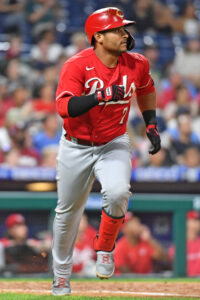
He signed with the Reds last year and took a bit of a step back at the plate, finishing the season with a .284/.339/.385 line and a 98 wRC+. Despite the slight drop, he was still a useful piece for the Reds, since he was able to spend significant time at the three non-shortstop infield positions and was generally considered around average at them, though his work at third was graded the weakest and his work at first the strongest.
Solano could be a good fit for a platoon role given his right-handed bat has fared well against left-handed pitchers, something that MLBTR’s Steve Adams recently highlighted. Solano has hit .289/.342/.397 against righties over the past four seasons but has crushed lefties to a .321/.363/.461 line. That split largely continued last year, even though he was less productive overall. He hit .301/.348/.422 with the platoon advantage but .277/.335/.369 without it.
For the Twins, they’ve seen some notable changes to their infield mix this offseason, though Carlos Correa and Jorge Polanco should still be in the middle. Gio Urshela was traded to the Angels, freeing up the hot corner for José Miranda after he saw significant time at first last year. Luis Arraez was traded to the Marlins while Miguel Sanó had his option declined. All of that has left left-hander Alex Kirilloff potentially the top option at first base. Since Solano fared well at first last year, he could perhaps platoon with Kirilloff some. In addition to the normal platoon strategy, it might make sense to monitor Kirilloff’s workload given his nagging wrist injuries over the past few years.
The club also has a number of left-handed hitters in its outfield mix. Right-hander Byron Buxton will be in center, but the options for the corners include lefties Joey Gallo, Max Kepler, Nick Gordon, Trevor Larnach, Matt Wallner and Kirilloff. The club doesn’t have a strict designated hitter and will likely be rotating those players through that slot, with Solano potentially spelling them against lefties from time to time as well. Solano’s ability to play second could also allow him to give Polanco the occasional day off, though the club also has Kyle Farmer and Gordon available for that duty as well.
It’s unknown what kind of salary Solano will earn, but it’s unlikely to be a huge investment for this move that will add some depth and versatility to the team. They have a full 40-man roster and will need to make a corresponding move, though that will likely be moving one of Chris Paddack or Royce Lewis to the 60-day injured list, since both are expected to be out of action until at least midseason.
Image courtesy of USA Today Sports.
Offseason In Review Chat: Pittsburgh Pirates
MLBTR will be hosting live chats specific to each of the 30 teams in conjunction with our Offseason in Review series. Darragh McDonald chatted about the Pirates’ offseason today and you can read the transcript here!
Angels Notes: Pujols, Guyer, Rodriguez, Canning
Despite his time as a player in the organization ending on a rather sour note, future Hall of Famer Albert Pujols is rejoining the Angels organization that designated him for assignment early in the 2021 season as a special assistant to honor his ten-year personal services contract with the club, per Rhett Bollinger of MLB.com. Pujols signed the personal services contract he is now set to fulfill for the Angels in conjunction with his ten-year, $240MM deal he signed with the club prior to the 2012 season.
Following that DFA, Pujols looked revitalized with the Dodgers before returning to the Cardinals for a final season that saw him hit his 700th career home run. Though he finished his career elsewhere and had an unceremonious exit from the Angels organization, Pujols emphasized that there is no bad blood between himself and an Angels organization with which he’s set to spend the next decade. He plans to serve as a special instructor in Angels camp this spring and also spend time in the Dominican Republic working with prospects at Anaheim’s international complex there.
“It’s just part of the business, that’s how it is… I’m really happy to be back here.” Pujols told reporters, including Bollinger. “What happened two years ago, I don’t hold any grudges on anything. That’s part of the business.”
More on the Angels…
- Sam Blum of The Athletic reports that former outfielder Brandon Guyer is in Angels camp after the club hired him as a mental strength coaching consultant. Guyer began his big league career with the Rays in 2011 and was eventually traded to Cleveland midway through the 2016 season. Guyer last played in the majors in 2018 but continued his playing career into 2020 before retiring with a career slash line of .250/.339/.388 in 517 games, good for a 104 wRC+. He’s been working as a mental strength coach for professional athletes since his retirement, having launched a program titled Major League Mindset, and he’ll take his newfound experience in that field into camp with the Halos this spring.
- Blum also notes that right-hander Chris Rodriguez will begin ramping up this spring more slowly than other starting options as he works toward a return from shoulder surgery that caused him to miss the entire 2022 campaign. While Rodriguez isn’t considered particularly far behind other pitchers, given the club’s added rotation depth since he last pitched in 2021, any missed time could impact the chances of making the Opening Day roster for Rodriguez, who has options remaining. The 24-year-old Rodriguez pitched well in 29 2/3 big league innings in 2021, recording a 3.64 ERA and 3.14 FIP while striking out 21.6% of his opponents in that time.
- Right-hander Griffin Canning, meanwhile, was described by manager Phil Nevin as “full go,” notes Jeff Fletcher of the Orange County Register. The Angels plan to be cautious with the former second-rounder and top prospect after he missed the 2022 season due to a back injury, but Nevin says he’ll throw live batting practice this week. Now 26 years old, Canning was a consensus top-100 prospect prior to the 2019 season who turned in 146 2/3 frames of 4.36 ERA ball with a 24.4% strikeout rate and 8.5% walk rate to begin his career in 2019-20. He was tagged for an ugly 5.60 ERA in 62 2/3 innings in 2021, however, and he didn’t pitch in the minors or big leagues in ’22 due to that back issue. He still has a minor league option remaining, so he can be sent to Triple-A if he doesn’t win a roster spot in the next few weeks.