
Rangers Sign Robbie Grossman
The Rangers announced agreement with veteran outfielder Robbie Grossman on a one-year major league contract. The deal will reportedly guarantee him $2MM and can max out at $5MM via performance bonuses. Grossman is an Alliance Sports Management client.
To create a spot on the 40-man roster, Texas placed reliever Brett Martin on the 60-day injured list. He underwent shoulder surgery last month and the club announced he’ll miss “a majority” of the upcoming season.
Grossman, 33, joins the sixth team of his big league career. He’s played parts of ten MLB seasons, suiting up with the Astros, Twins, A’s, Tigers and Braves going back to 2013. A switch-hitter, Grossman has carved out an outfield role at various stops thanks in large part to his quality production from the right-handed batter’s box. For his career, he owns a .279/.377/.413 line with an excellent 13.1% walk rate and modest 19.6% strikeout percentage against left-handed pitching.
The former sixth-round draftee continued in his lefty-masher capacity last season. He hit .320/.436/.443 in 149 trips against southpaws. He paired that with just a .163/.253/.256 showing over 328 plate appearances versus right-handed pitching. That resulted in a modest .209/.310/.311 line over 120 games overall, with Grossman performing at a below-average level both before and following a midseason trade from Detroit to Atlanta.
That points to Grossman taking on more of a situational platoon role, though he’s not typically a liability against right-handed pitching. While he’s consistently better against lefties, he owns a career .232/.335/.363 line against righties that isn’t too far below league average. Grossman has never hit for much power and strikes out more often from the left side of the plate, though he’s typically adept at working deep counts and drawing plenty of walks no matter the pitcher’s handedness.
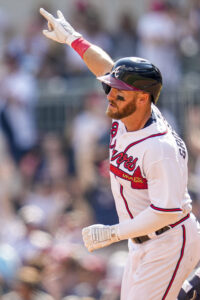
Defensively, Grossman is limited to the corner outfield. He’s logged more experience in left field but has an extensive body of work at both spots, with public metrics rating him as a roughly average gloveman. He’ll primarily factor into the left field mix in Arlington, with Adolis García penciled into everyday work in the other corner position. Left field is much more of a question mark, one Texas GM Chris Young has suggested on a number of occasions he was hoping to plug externally.
Rangers’ left fielders combined for a .186/.253/.255 line last season. They finished at the bottom of the league in all three rate stats, with their slugging mark checking in nearly .080 points below that of the 29th-ranked Mariners. Grossman isn’t a huge power threat but should help the club rebound from an on-base perspective, particularly if manager Bruce Bochy deploys him more frequently in friendly platoon situations.
Left-handed hitting utilityman Brad Miller is going into the second season of a $10MM free agent deal. He had an awful first year in Texas, hitting just .212/.270/.320 while missing half the team’s games due to a hip injury. Miller posted a much stronger .250/.344/.487 line against right-handed pitching between 2018-21, however. Texas figures to give him a chance to rebound in left field, with Grossman on hand to take some at-bats against lefty arms.
Speedster Bubba Thompson and former infield prospects Josh Smith and Ezequiel Durán could all play their way into left field reps as well. None of that group made much of an offensive impact last season. That’s also true of Grossman on the whole, though he’ll at least add a solid career track record to a hodgepodge of left field possibilities. It’s certainly possible Texas looks to augment the group with a more established veteran in a midseason trade — particularly if they’re in the playoff hunt by July — but they figure to mix and match out there in the season’s early going.
Tacking on Grossman’s modest salary brings Texas’ 2023 payroll commitments around $198MM, as calculated by Roster Resource. That’s well into franchise record territory already, with owner Ray Davis and the front office kicking off consecutive offseason spending sprees to try to vault back to competitiveness. They’re currently sitting on a six-year playoff drought, tied with Baltimore for the fourth-longest active streak in the American League. Grossman’s deal takes them around $221MM in luxury tax commitments. That’s $12MM shy of the $233MM base threshold, leaving a decent amount of space for midseason acquisitions even if they want to dodge any overage fees.
Signing Grossman looks likely to take the Rangers out of the mix for any of the remaining free agent corner outfielders. Jurickson Profar is the top player still unsigned and his market now looks as clouded as ever. Ben Gamel and Tyler Naquin are among lower-profile role-playing corner outfielders still looking for jobs.
Jon Heyman of the New York Post first reported Grossman and the Rangers were in agreement. Joel Sherman of the New York Post reported it was a one-year, $2MM guarantee with $3MM in additional incentives.
Image courtesy of USA Today Sports.
The Angels’ Catching Competition
The Angels have made a number of acquisitions this offseason. GM Perry Minasian and his staff addressed virtually every area of the roster in some capacity. Hunter Renfroe came in via trade to bolster the outfield. Gio Urshela and Brandon Drury were brought aboard as infield help. Tyler Anderson signed a three-year deal for the rotation. Carlos Estévez and Matt Moore step into the bullpen mix.
The primary exception is behind the plate. While the Halos were tied to top free agent backstop Willson Contreras at the start of the winter, they ultimately head into Spring Training with a trio of catchers who were on the roster to finish last season. That’s not especially surprising — catcher never looked like the biggest area of concern for the group — but it represents one of the areas that’s least solidified at the moment.
Manager Phil Nevin told reporters this week he views the catching situation as an open competition going into camp (via Sam Blum of the Athletic). With that in mind, it’s worth examining the options at his disposal.
Acquired from the Phillies last summer in a surprising deadline deal that sent center fielder Brandon Marsh to Philadelphia, O’Hoppe is one of the sport’s top catching prospects. He’s been a minor leaguer of some regard for a few years running but took things to a new level last season. O’Hoppe spent the vast majority of 2022 with the Double-A affiliates for the respective clubs. He combined for a .283/.416/.544 line with 26 home runs, a massive 15.7% walk percentage and a modest 16.6% strikeout rate during his age-22 campaign.
At the very end of last season, the Halos rewarded O’Hoppe with his first MLB call. He appeared in only five games, far too small a sample upon which to draw any conclusions. The move was more about giving him an opportunity to get acclimated to an MLB atmosphere than in providing useable data for the front office to determine his readiness for 2023.
O’Hoppe is widely praised by prospect evaluators. Baseball America considers him the top young talent in the organization, placing him 42nd among prospects overall. The Athletic and ESPN each slot him towards the back half of their respective top 100 lists. All three outlets credit him for a well-rounded game with solid expected contributions on both sides of the ball.
He’s clearly far too advanced for Double-A. He has zero Triple-A experience and only a cup of coffee in the majors, though, so there’s certainly risk in turning over the primary job on a club that hopes to compete for a playoff spot right out of the gate. O’Hoppe is the organization’s hopeful catcher of the future. They’ll need to determine whether he’s ready to take that mantle immediately. He still has a full slate of minor league option years remaining.
Stassi is much more of a known quantity. 32 next month, he’s played in parts of 10 big league campaigns. Stassi only started garnering legitimate playing time in 2018, his sixth year logging some MLB action. Between 2018-21, he looked like one of the sport’s more underrated catchers. Over that stretch, Stassi hit .222/.306/.382. That’s roughly average output for a catcher, though the cumulative slash is weighed down by an atrocious 2019 season. He was an above-average hitting catcher in the other three years, including a .241/.326/.426 showing for the Halos in 2021.
The veteran paired that solid offense with consistently excellent marks from public defensive metrics. He wasn’t especially adept at controlling the running game but garnered glowing reviews from pitch framing evaluations. The Halos signed him to a $14.5MM extension covering the 2023-24 seasons (with a ’25 club option) last spring. It seemed a firm commitment he’d be their primary catcher for the next few years, though that predated an underwhelming 2022 showing.
Stassi hit just .180/.267/.303 with nine homers in a career-high 375 plate appearances last year. His formerly excellent defensive grades slipped to almost exactly league average. His bat-to-ball skills and hard contact percentage each took steps back. It obviously wasn’t the kind of season he or the club had envisioned, meaning he’ll need a rebound showing if he’s to secure regular reps again. Stassi can’t be optioned to the minors, so he’ll be on the big league roster in some capacity. Whether that’s as the starter or reserve is up in the air.
Thaiss was a catcher at the University of Virginia. A bat-first player, he was selected in the first round in 2016 and immediately moved to first base. Scouts questioned whether he’d have the receiving skills to stick behind the plate. The Angels didn’t give him the chance to work on his defense, instead hoping his bat would launch him quickly through the minor leagues.
The lefty-hitting Thaiss proved a fine but not exceptional minor league hitter. He paired quality plate discipline with above-average contact skills but never made the kind of power impact one would expect from a first baseman. In 2021, the Angels started giving him reps back behind the plate with Triple-A Salt Lake. He’s played 99 games there the past two years and started 11 MLB contests at catcher last season.
Thaiss owns just a .205/.299/.373 line over 278 MLB plate appearances, striking out at an uncharacteristic 30.6% clip. He only fanned in 18.4% of his trips with a robust 13% walk rate for the Bees last season, hitting .268/.364/.451 over 77 Triple-A games. He’s an interesting depth player but comes with questions about both his offensive impact and receiving ability behind the plate. Thaiss has exhausted his option years; the Halos have to keep him in the majors or make him available to other teams via waivers or trade.
Outlook
Anaheim will also get looks at Chad Wallach, José Godoy and minor leaguer Anthony Mulrine in camp this spring as non-roster players. Mulrine has never hit in the minors and looks to be an organizational depth piece. Wallach and Godoy have played in the big leagues but typically function as third/fourth options on a depth chart.
The initial playing time will almost certainly be divided among some combination of O’Hoppe, Stassi and Thaiss. Carrying O’Hoppe in a reserve capacity feels unlikely. He should play regularly, either in the majors or at Salt Lake. Whether the Halos deem him ready out of the gate — and if they do, whether they feel there’s room to keep both Stassi and Thaiss on the bench — are key questions for the front office and coaching staff over the next month and a half.
Brewers’ Jason Alexander Out Until May Due To Shoulder Injury
Brewers righty Jason Alexander is expected to miss more than a month to begin the season, reports Adam McCalvy of MLB.com (Twitter link). The 29-year-old righty experienced discomfort in his shoulder when he was ramping up for spring training last month, and he’s likely to be sidelined into the second half of May. Alexander becomes the second Brewers pitcher who’ll miss substantial time due to shoulder trouble; left-hander Aaron Ashby will miss at least two months due to shoulder trouble of his own.
Alexander made his big league debut in Milwaukee last season, tossing 71 2/3 innings for the Brewers over the course of 11 starts and another seven relief appearances. He posted a strong 3.21 ERA over his first five starts before beginning to falter, ultimately finishing out his rookie campaign with a 5.40 ERA and a lowly 14.7% strikeout rate. Alexander’s 8.7% walk rate was generally solid, however, and he induced grounders at a strong 50.6% clip. The lack of punchouts and a susceptibility to home runs (1.51 HR/9) worked against him, but the righty had posted a 2.84 ERA in 63 1/3 Triple-A frames before being called to the big leagues.
Neither Alexander nor Ashby was guaranteed a rotation spot heading into 2023, but their absences will thin out Milwaukee’s depth a fair bit. It’s not clear whether the Brewers knew the full extent of either player’s shoulder issues when signing Wade Miley to a one-year deal last month, but what was once at least a somewhat surprising deal for a pitching-rich club could now prove pivotal. Regardless of whether Miley’s addition was made with the knowledge that Ashby and Alexander were ailing or whether it’s mere serendipity, the Brewers are surely glad to have the veteran southpaw on the staff.
The Brewers’ rotation heading into 2023 will feature Corbin Burnes, Brandon Woodruff, Freddy Peralta, Eric Lauer and the aforementioned Miley. Righty Adrian Houser, a rotation staple the past couple seasons, is still on hand as a sixth option, but both Ashby and Alexander would’ve also been starting candidates in the event of injuries elsewhere on the staff. Trade acquisition Janson Junk, prospect Ethan Small and DFA reclamation Bryse Wilson give Milwaukee further depth, though Wilson is out of minor league options and isn’t necessarily a lock to make the Opening Day roster.
Pirates Win Arbitration Hearing Against Ji-Man Choi
The Pirates won their arbitration hearing against first baseman Ji-Man Choi, reports Jason Mackey of the Pittsburgh Post-Gazette (Twitter link). He’ll earn the $4.65MM salary submitted by the team, as opposed to the $5.4MM salary his camp submitted on exchange day last month.
Acquired in a November trade that sent minor league pitcher Jack Hartman back to the Rays, Choi is heading into his final season of control before he’ll reach the free-agent market. The 31-year-old turned in a .233/.341/.488 batting line with Tampa Bay in 2022, swatting 11 home runs and 22 doubles while operating primarily as a platoon bat at first base and designated hitter. That’s a role with which Choi is familiar; just 16% of his career plate appearances have come against lefties (278 of 1724), and he’s a lifetime .203/.288/.301 hitter against them. Conversely, he’s hit righties at a .247/.356/.454 pace in 1446 plate appearances.
With the Pirates, Choi will pair with fellow offseason acquisition Carlos Santana to split time between first base and designated hitter. He’ll add some thump to a Pirates lineup that mustered only a .224/.296/.362 batting line against righties in 2022 — resulting in an ugly 86 wRC+ that ranked 26th among all MLB clubs.
Choi underwent elbow surgery shortly after the trade, but the Pirates were aware of the injury and confident that he’d be ready to go for spring training. By all accounts, that’s still the expectation. Mackey notes that Choi arrived at Pirates camp this morning but has yet to speak with the media.
With Choi’s salary now set, the Pirates’ payroll is finalized, barring any late additions via the free-agent or trade markets (or any possible extensions this spring). As it stands, they’ll head into the year with just north of $75MM committed to their roster. Small as that number may be, it represents a leap of nearly $20MM over last year’s Opening Day mark of $55.7MM, which ranked 28th among baseball’s 30 teams.
Tigers Claim Tyler Holton, Place Casey Mize On 60-Day Injured List
The Tigers announced Friday that they’ve claimed lefty Tyler Holton off waivers from the Diamondbacks, who’d designated him for assignment earlier in the week. In order to open a spot on the 40-man roster, Detroit transferred right-hander Casey Mize to the 60-day injured list. Mize underwent Tommy John surgery and back surgery last year and wasn’t expected to be ready within the season’s first two months anyhow, so his eventual placement on the 60-day IL was a foregone conclusion.
The 26-year-old Holton made his MLB debut in 2022, pitching nine innings and allowing three runs on right hits and a pair of walks with six strikeouts during that brief cup of coffee. The rest of his season was spent in Triple-A Reno, where he logged a 4.43 ERA in 44 2/3 innings, fanning 23.5% of his opponents against a 9.3% walk rate.
It was a rebound effort for Holton, who’d previously limped to a 6.72 ERA between Double-A and Triple-A in 2021. Even amid those struggles, he notched a strong 26.5% strikeout rate, however, and his 6.5% walk rate was similarly encouraging. Solid strikeout, walk and ground-ball rates have been the norm for Holton since being selected in the ninth round of the 2018 draft. He doesn’t throw hard and has never ranked among the D-backs’ best prospects, but his track record of performance, MLB readiness and pair of remaining minor league option years all surely held appeal to the Tigers.
Prior to claiming Holton, the only left-handed bullpen option on the 40-man roster had been Tyler Alexander (assuming the club wants to keep Joey Wentz in a starting role). Non-roster veterans Chasen Shreve, Jace Fry and Miguel Del Pozo will all be in camp competing for a job as well. Holton will have a chance to land an Opening Day roster spot, though the Tigers can freely option him to Triple-A Toledo if one of the non-roster options outperforms him (or, if the team simply opts to carry one left-hander to begin the season). Wherever he starts the year, Holton figures to log some action in the big league bullpen in 2023, given the lack of certainty that permeates the Detroit bullpen following offseason trades of Gregory Soto and Joe Jimenez.
As for Mize, he underwent Tommy John surgery last June, so he’s unlikely to be an option until the season’s second half. The Tigers only recently revealed that Mize also underwent back surgery around that same time, however. Mize told reporters about the procedure earlier this week, explaining that his back issues have been slowly escalating over the past several years. Knowing he’d be off the mound for a year-plus anyhow, he opted for surgery aimed at alleviating the issue so he could truly be at full strength once he returns to the mound later this year.
Rangers Have Had Talks With Robbie Grossman
The Rangers have had discussions with free-agent outfielder Robbie Grossman about a potential contract, reports ESPN’s Buster Olney (Twitter link). The 33-year-old would give them another option to jump into their currently unsettled left field mix.
Pitching has been the overwhelming focus for the Rangers throughout the 2022-23 offseason, as they’ve signed Jacob deGrom, Nathan Eovaldi and Andrew Heaney while also acquiring Jake Odorizzi in a trade with the Braves. Two of the three spots in the team’s outfield seem generally spoken for, with slugger Adolis Garcia likely ticketed for everyday work in right field and defensive standout Leody Taveras slated for regular work in center field.
Left field is another story entirely. The position has gone unaddressed this winter even though Rangers left fielders were the least-productive unit of all 30 MLB clubs in 2022, when they ranked dead-last in the Majors in batting average, on-base percentage and slugging percentage. Texas left fielders combined to post an almost unfathomably feeble .186/.253/.255 batting line. That translated to a 47 wRC+, or roughly 53% worse than league-average production after weighting for home park and the league run-scoring environment. Rangers left fielders also struck out at a 29.6% clip (28th in MLB), hit 11 home runs (27th), and managed only five doubles (last in the Majors) and no triples.
There’s no clear, MLB-ready top prospect looming, either. The Rangers’ hope, to this point, has seemingly been that some combination of former top prospect Josh Smith, veteran utilityman Brad Miller, former first-round pick Bubba Thompson, infielder/outfielder Mark Mathias and a slate of minor league signees (e.g. Clint Frazier, Travis Jankowski, Elier Hernandez) can patch the position together.
However, Texas general manager Chris Young said last week that he’s still open to the possibility of adding an outfielder from outside the organization. Grossman obviously fits that bill, and while he might not be ticketed for everyday work himself, the veteran switch-hitter could at the very least occupy the short half of a potential platoon arrangement.
Grossman was an above-average bat in five of six seasons from 2016-21, with 2019 being the lone exception. He slipped to a .209/.310/.311 output in 477 plate appearances this past season between the Tigers and Braves, but he maintained his long track record of production against left-handed pitching. He mashed southpaws at a .320/.436/.443 pace in 2022 and is a career .279/.377/.413 hitter against lefties.
Grossman has had productive stretches against righties, too, though he’s been inconsistent in that regard. He’s batted .232/.335/.363 in his career against righties and walked at a hefty 12.7% clip, but over the past two seasons, Grossman has looked overmatched when batting from the left side of the dish: .196/.308/.331 (82 wRC+) in 793 plate appearances. Among the Rangers’ in-house options in left field, both Miller and Smith bat from the left side of the dish, making Grossman a somewhat natural platoon partner for either.
While Grossman was a defensive liability early in his career, he’s improved his glovework over time. Over the past four seasons, he’s tallied 2422 innings in left field and been a scratch defender per Defensive Runs Saved (0), while Ultimate Zone Rating (6.2) and Statcast’s Outs Above Average (2) feel he’s been a bit better.
Rays Void Prior Selection Of Trevor Kelley’s Contract
Feb. 17: The Rays have voided yesterday’s transaction selecting Kelley to the 40-man roster and transferring Kittredge to the 60-day injured list, tweets Neil Solondz of Rays Radio. Voiding the transaction is largely a technicality; the league flagged the transaction, citing a rule that non-roster invitees are ineligible to be selected to the 40-man roster until March 15. The move can still formally be processed at that time. It’s surely discouraging for Kelley, however, as he’ll now be exposed to some injury or performance-based risk over the next month that wouldn’t have been the case had he been immediately added to the 40-man roster.
Feb. 16: The Rays announced Thursday that they’ve selected the contract of right-hander Trevor Kelley, who’d been in camp on a minor league deal. Fellow righty Andrew Kittredge, who’s recovering from Tommy John surgery, was transferred to the 60-day injured list in order to open a spot on the 40-man roster. Marc Topkin of the Tampa Bay Times suggested earlier that Kelley could be selected to the 40-man roster sooner than later.
Kelley, 30, has seen Major League time with the Red Sox, Phillies and Brewers but has yet to find much big league success. He tallied a career-high 23 2/3 innings with Milwaukee last season but also was knocked around to the tune of a 6.08 ERA. The sidearmer posted a below-average 21.5% strikeout rate but a solid 8.4% walk rate. Home runs have been a major issue for Kelley, however, evidenced by a whopping 11 round-trippers surrendered in just 35 1/3 MLB frames (2.8 HR/9).
Those big league struggles notwithstanding, Kelley possesses an exceptional 1.81 ERA in a much larger sample of 164 1/3 innings at the Triple-A level. He’s also punched out 25.7% of his opponents there against an 8.7% walk rate. Kelley has a minor league option remaining as well, so he’ll give the Rays some flexibility with their bullpen. He’s not yet up to a year of MLB service, so if the Rays can coax some of that Triple-A performance out at the Major League level, the Rays can control him for as many as six seasons.
As for Kittredge, he was one of the Rays’ top relievers, pitching to a 2.17 ERA in 99 2/3 innings dating back to 2020. However, the 32-year-old Kittredge was limited to just 20 innings this past season, as a June IL placement due to discomfort in his right elbow ultimately proved a precursor to Tommy John surgery. It’s possible he’ll make it back to the big leagues at some point in the season’s second half, but there’s no way Kittredge was going to be ready within the season’s first couple months, so moving him to the 60-day IL amounts to little more than a formality. If the Rays need another 40-man roster spot, they can do the same with right-hander Shane Baz, who’s also on the mend from Tommy John surgery.
The Opener: Arbitration, Lefty Relief, Rays
With all pitchers and catchers for all 30 clubs set to report for Spring Training by the end of today, here are three things we’ll be keeping an eye on around the baseball world throughout the day:
1. Arbitration Hearings End Today
Arbitration hearings are set to come to a close today. Yesterday, Ji-Man Choi went to a hearing against the Pirates, according to the Associated Press. Choi’s hearing comes on the heels of decisions in favor of Luis Rengifo and Harold Ramirez, but against Ryan Helsley and Josh Rojas. Choi filed for a salary in 2023 of $5.4MM while Pittsburgh countered with $4.65MM. Choi is a free agent after the 2023 season, so the coming decision won’t have much impact on his future earnings beyond 2023. Choi joins four other players in waiting for a decision on their 2023 salary, while two final hearings are set to take place today for Cardinals lefty Genesis Cabrera and Mariners outfield Teoscar Hernandez.
2. What’s next for the lefty relief market?
Yesterday Matt Moore landed with the Angels on a one-year deal, just a few days after Andrew Chafin signed with the Diamondbacks. Even with the top two lefty relief free agents now off the board, though, there’s plenty of interesting options remaining for clubs seeking lefty relief help. Both Will Smith and Brad Hand have faced some struggles in recent years, though each still touts years of late-inning experience and encouraging recent performance. Hand enjoyed a bounce-back season with the Phillies last year following a difficult 2021 season, while Smith improved considerably down the stretch in 2022 following a trade to the Astros.
Zack Britton is another name of particular interest, given his legacy as one of the longest-standing best relievers in baseball, but injuries have held him back in recent years. Since Opening Day 2021, Britton has thrown just 19 innings with an ERA of 6.16 (72 ERA+). Britton held a January showcase for interested teams and then worked out for six specific clubs earlier this week. The teams in attendance were the Angels, Cubs, Dodgers, Giants, Mets, and Rangers, though with the Angels landing Moore, it’s possible their interest has waned.
3. Rays FanFest Tomorrow
The Rays are hosting Rays FanFest at Tropicana Field tomorrow. The free fan event is set to run from 11am to 3pm local time, with Rays players in attendance, games, and a stage show. The FanFest comes at the end of what was a somewhat quiet offseason for the Rays, with Zach Eflin standing as their lone major addition. Meanwhile, longtime center fielder Kevin Kiermaier departed for the division rival Blue Jays, Choi was traded to the Pirates, and Ryan Yarbrough was non-tendered. Despite minimal roster turnover, the Rays did add a bright spot to their offseason in recent weeks by agreeing to extensions with Yandy Diaz, Jeffrey Springs, and Pete Fairbanks.
Phillies Extend Jose Alvarado
The Phillies have signed lefty reliever Jose Alvarado to a three year contract, per a team announcement. The deal keeps Alvarado in Philadelphia through at least the 2025 season, and includes a club option for 2026. Alvarado is represented by OL Baseball Group.
According to Daniel Alvarez-Montes of El Extrabase, Alvarado will earn $9MM in each of the 2024 and 2025 seasons, with a $50K signing bonus. The 2026 club option is for $9MM, with a $500k buyout. Alvarado and the club already agreed to a $3.45MM salary for 2023 to avoid arbitration, effectively making this three-year, $22MM contract a two-year, $18.55MM extension. Still, it’s a three-year contract for luxury tax purposes, meaning the Phillies will be taxed on a $7.33MM AAV for 2023, as opposed to the previous $3.45MM figure. On the other hand, this also lowers the tax figure for 2024 and 2025 seasons compared to the $9.275MM figure it would have been if structured as a two year deal.
Alvarado, 28 in May, is coming off a phenomenal 2022 season that saw him post a 3.18 ERA across 51 innings of work. While that figure is good for a solidly above-average ERA+ of 129, digging a little deeper reveals that Alvarado posted a dazzling 1.92 FIP last season, the fourth best in baseball, minimum 50 innings pitched. The discrepancy between Alvarado’s run prevention and his underlying metrics likely comes from an inflated .340 BABIP that stands well above his career .302 mark. The rare lefty who can touch triple digits with his fastball, Alvarado’s success came in large part from a 37.9% strikeout rate, which stood as 7th in baseball among those with at least 50 IP.
Alvarado’s success came from more than just strikeouts, however. As a sinkerballer, Alvarado also managed to keep the ball on the ground at and impressive 56.1% clip. Only Jhoan Duran of the Twins had a higher groundball rate while striking out at least 30% of batters faced, while no pitcher who struck out batters at a higher clip than Alvarado induced grounders at a rate of even 50%. That mix of strikeouts and groundballs is a strong recipe for success, and by signing Alvarado long term, the Phillies are indicating confidence in his ability to continue his success past his 30th birthday.
Early in the offseason, the top end of the free agent market exploded, with Robert Suarez and Rafael Montero signing early for surprising guarantees in re-signing with their previous clubs. Suarez secured $46MM from the Padres, while Montero received $34.5MM from the Astros. Taylor Rogers, meanwhile, landed a $33MM guarantee in San Francisco. Those figures all outstrip Alvarado’s guarantee by a considerable amount, but the $18.55MM in new money surpasses the guarantees of free agent lefties who signed later this offseason such as Matt Strahm ($15MM), Andrew Chafin ($6.25MM), and Matt Moore, ($7.55MM). Given how Alvarado’s deal stacks up well against fellow relievers in his service bracket like Ryan Pressly, Huston Street, and Daniel Bard, taking this deal is an understandable decision for him. While there’s risk he continues to dominate as he did in 2022, the Phillies are risking that his struggles with injuries and command resurface from earlier in his career and limit his abilities going forward.
This is the second extension at the back of the Phillies’ bullpen in as many days, as the club agreed to a deal Seranthony Dominguez yesterday that could keep Dominguez in Philadelphia through the 2025 season. With these deals, the Phillies have locked up a pair of exciting, high-octane arms who can be penciled in for late inning duties alongside Strahm and Gregory Soto for the next few seasons. Having also also added Craig Kimbrel to their late inning mix for the 2023 season last month, the Phillies appear to have turned a bullpen that has long been considered an area of weakness for the club into a strength as they attempt to return to the World Series after last year’s surprise postseason run.
Phillies Extend Seranthony Dominguez
The Phillies and right-handed reliever Seranthony Dominguez are in agreement on a two-year contract to avoid arbitration, according to a team announcement. The deal includes a club option for the 2025 season, which extends Philadelphia’s window of club control on Dominguez by one year. The deal guarantees him $7.25MM, MLBTR has learned. He’ll be paid $2.5MM in 2023, $4.25MM in 2024 and has a $500K buyout on an $8MM club option for the 2025 season. Dominguez is represented by Epitome Sports Management.
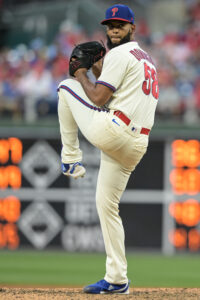
The 28-year-old Dominguez and the Phillies had faced a relatively wide gap in the arbitration figures they exchanged, with the team submitting a $2.1MM figure to Dominguez’s $2.9MM submission. He’ll now have his salaries for the next two seasons locked in, gaining some financial security in exchange for control over what would’ve been his first arbitration season.
It’s an understandable trade to make in Dominguez’s case, given the electric right-hander’s lengthy injury history. Dominguez’s sheer talent has never been in doubt. He debuted as a 23-year-old back in 2018 and immediately thrust himself into the mix for leverage innings with the Phillies, pitching to a 2.95 ERA with a huge 32% strikeout rate against a 9.5% walk rate in 58 innings. Brandishing a four-seamer that averaged a whopping 97.8 mph (and a sinker that sat 98.3 mph), Dominguez dominated opposing lineups, yielding a woefully anemic .157/.251/.250 batting line during his rookie campaign.
However, an elbow strain in June of 2019 shelved Dominguez, eventually leading to the discovery of damage in his right elbow’s ulnar collateral ligament. After a visit to Dr. James Andrews, Dominguez followed the recommended treatment of a platelet-rich plasma injection and rehab. After all, given that his UCL injury occurred in the summer, he’d likely have missed the entire 2020 campaign (or close to it) whether he underwent surgery immediately or whether he first attempted to rehab.
The treatment appeared to work at first. Dominguez reported to camp in 2020 and was expected to be ready early in the season, if not by Opening Day. He suffered a setback early in camp, though, at which point a Tommy John procedure was recommended. Unfortunately, the Covid-19 pandemic delayed the timing of the procedure, pushing the surgery back into late July. He returned to throw just one inning late in the 2021 season.
By the time Dominguez took the mound in 2022, he was more than 18 months removed from surgery and nearly three calendar years removed his original elbow injury. The operation and the time off appeared to do wonders, as the flamethrowing righty looked like his 2018 self, pitching 51 innings of 3.00 ERA ball with a 29.5% strikeout rate and 10.6% walk rate while averaging 97.8 mph on his four-seamer and 98.4 mph on his sinker. Dominguez’s 14% swinging-strike rate wasn’t quite back to its 2018 levels (an outstanding 15.5%), but he induced chases on pitches off the plate more frequently (32.3% in 2022, 29.6% in 2018) and was nearly every bit as stingy when it came to surrendering home runs (0.71 HR/9).
Now a locked-in member of the Philadelphia relief corps for at least the next two seasons, Dominguez will have the peace of mind both of having pitched a full season since undergoing surgery and also having secured the first life-changing guarantee of his career. He’ll be in the mix for saves alongside lefty Jose Alvarado, free-agent signee Craig Kimbrel and trade acquisition Gregory Soto — a quartet that will give Philadelphia one of the hardest-throwing bullpens — if not the hardest-throwing bullpen — in the sport. And, with Alvardo entering his final season of club control and Kimbrel playing the 2023 season on a one-year deal, it’s possible that Dominguez could emerge as the go-to option in the ninth inning by the time 2024 rolls around.
Even if the Phillies pick up their club option on Dominguez, he’ll still reach free agency in advance of his age-31 season. That’d still put him on the market early enough to land a sizable multi-year deal in free agency, and he’d have that opportunity after already banking $14.75MM over the course of this current contract.
Dominguez’s two-year contract will carry a slightly larger luxury-tax hit than he’d have cost the club by just inking a one-year deal. The Phils are already into the second tier of luxury penalization, meaning they’re being taxed at a 45% clip for any dollars spent between the $253MM and $273MM endpoints on the luxury scale. The $3.625MM average annual value on Dominguez’s deal comes with a $1.63MM luxury hit, rather than the $1.125MM hit he’d have cost them had he inked a one-year deal at the $2.5MM midpoint between their exchanged figures. Nevertheless, the Phillies are nowhere close to the $273MM barrier for the third tier of penalization, which is the most onerous of the luxury tiers, as that’s the point at which a team sees its top pick in the following year’s draft dropped by 10 places.