
Red Sox Notes: Casas, Rotation, Monasterio
Red Sox first baseman Triston Casas is working his way back from last year’s knee injury but his path may be delayed. Tim Healey of The Boston Globe was among those to relay today that Casas has a strained left intercostal muscle. He’ll be shut down from hitting for a few days as the Sox see how he progresses.
It’s been a frustrating few years for Casas on the health front. Torn cartilage in his ribcage limited him to 63 games in 2024. He only got into 29 games last year before rupturing the patellar tendon in his left knee, an injury that he’s still working back from. At this point, there’s nothing to suggest this latest injury is serious, but it’s not as though Casas needs another bump in the road.
Given all his injury troubles, the Sox decided not to rely on him for 2026. They acquired Willson Contreras to cover first base. That means there’s no strict rush to get Casas back but he would ideally be on the field as soon as possible to get some reps and get back in game shape. He slashed .253/.365/.477 for a 129 wRC+ over the 2022 and 2023 seasons.
It’s unclear how the Sox will proceed once Casas is back. In addition to having Contreras at first, they have a crowded designated hitter spot as they try to spread playing time around to outfielders Jarren Duran, Roman Anthony, Wilyer Abreu, Ceddanne Rafaela and Masataka Yoshida. Casas could be optioned to the minors to serve as depth or perhaps put on the trade block if there’s no room for him in the big leagues. Decision day will come at some point but this latest injury provides another delay.
Turning to the rotation, left-hander Patrick Sandoval will begin a rehab assignment on Sunday, per Healey. Sandoval hasn’t pitched in a big league game since June of 2024, almost two years ago. He required surgery on his ulnar collateral ligament that year and then was non-tendered by the Angels. The Red Sox gave him a two-year, $18.25MM deal but didn’t get him back on the mound last year and he’s still recovering.
Rehab assignments for pitchers are normally capped at 30 days. However, when a pitcher is recovering from UCL surgery, a ten-day extension can be given a maximum of three times. That effectively means Sandoval could potentially be rehabbing for 60 days.
Time will tell how much rotation space the Sox have for Sandoval when he’s ready to return. They currently have a rotation consisting of Garrett Crochet, Sonny Gray, Ranger Suárez, Brayan Bello and Connelly Early, with Johan Oviedo having pitched in long relief a couple of days ago. Payton Tolle is on optional assignment and could earn a spot in that mix.
Speaking of Oviedo, he allowed four earned runs in 3 2/3 innings in his one outing so far this year, with diminished velocity. Manager Alex Cora downplayed any possibility of Oviedo being injured, per Christopher Smith of MassLive. “We had a conversation with him today and there’s a few things that the pitching department has noticed,” Cora said. “And just gotta keep working. That’s the most important thing. Obviously with his injuries in the past, something that we have to be very careful in this new role. But I think he’s gonna be OK.”
As Smith points out, Oviedo does have an option remaining and could be sent to the minors if the Sox so choose. That might be a bit of an awkward conversation, as Oviedo was a key offseason pick-up for them. The Sox acquired him from the Pirates with Jhostynxon García being the main piece going the other way, though that was before Suárez was signed.
Turning back to the position player mix, Healey relays that infielder Andruw Monasterio has been doing some outfield work lately to see if can be a viable option out there. His outfield track record currently consists of just four innings in left field. The Sox don’t really need outfield help with their aforementioned crowded group but extra versatility could always come in handy in the event of an injury or a late-game substitution.
Photo courtesy of Brian Fluharty, Imagn Images
Blue Jays Return Rule 5 Pick Angel Bastardo To Red Sox
The Blue Jays have returned Rule 5 pick Angel Bastardo to the Red Sox, according to announcements from both clubs. Toronto designated him for assignment a week ago when setting their Opening Day roster. This announcement indicates the other 28 clubs passed on grabbing Bastardo via waivers. The Sox do not need to put Bastardo on their 40-man roster.
Bastardo, 24 in June, was an international signing of the Red Sox out of Venezuela in 2018. He reached Double-A in 2023 and was still at that level in 2024 when he required Tommy John surgery. Since he was likely going to miss the 2025 season, the Sox left Bastardo off their roster in the fall of 2024, therefore leaving him exposed in the Rule 5 draft. The Blue Jays grabbed him in that draft and kept him on the injured list all throughout the 2025 season, hoping that Bastardo could perhaps earn a spot on their 2026 club.
Though he had already been on the roster for a whole year, a Rule 5 pick is still bound by the restrictions of that draft until he spends 90 days on the active roster. That meant the Jays would need to keep him in the big leagues for at least the first three months of the schedule.
Bastardo is now recovered from his surgery but showed some rust in camp. He faced 33 batters in spring training and walked seven of them, a 21.2% clip which is close to three times the regular season league average. He also threw four wild pitches in there. The Jays decided it couldn’t work and designated Bastardo for assignment. Another club could have grabbed him off waivers and absorbed the same Rule 5 situation but they all decided against it.
The Red Sox will now get to plug him back into their system, so Bastardo could be back at the Double-A level soon or perhaps get bumped up to Triple-A. It may have been strange for Bastardo to switch organizations for a year while rehabbing but he benefited by earning a year of big league pay and service time while on the IL in 2025.
Photo courtesy of Jim Rassol, Imagn Images
Dodgers Acquire Jake Eder
11:07am: The two teams have announced the trade. Los Angeles is sending cash back to Washington. Righty Jake Cousins, who’s recovering from Tommy John surgery, heads to the 60-day IL to open a 40-man roster spot.
10:37am: The Dodgers are set to acquire left-hander Jake Eder from the Nationals, according to Spencer Nusbaum and Ken Rosenthal of The Athletic. Eder was designated for assignment this past weekend when Washington acquired infielder Curtis Mead from the White Sox.
A fourth-round pick by the Marlins in 2020, the now-27-year-old Eder was a touted prospect in Miami’s system before requiring Tommy John surgery at the Double-A level. He was flipped from the Marlins to the White Sox in exchange for Jake Burger at the 2023 trade deadline, but things didn’t pan out in Chicago.
Eder only briefly made the majors with the ChiSox, tossing two innings of relief and allowing one run. He was sitting on a 3.94 ERA in 29 2/3 Double-A frames with the Marlins at the time of that swap before being shelled for 22 runs in 17 1/3 innings with the White Sox’ Double-A affiliate in Birmingham. Eder made another 24 starts with Birminham in 2024 but was torched for a 6.61 ERA.
The Sox traded Eder to the Angels for cash one year ago yesterday. He pitched 18 1/3 MLB frames (4.91 ERA, 19.2 K%, 11.5 BB%) before being traded to the Nationals as part of Washington’s return for veteran relievers Andrew Chafin and Luis Garcia. He pitched only seven innings in Washington’s system following that swap. Eder allowed only two earned runs in 6 2/3 spring innings with the Nats (2.70 ERA) but walked six batters in that time.
Eder has typically sat 92-94 mph with his four-seamer and complemented the pitch with a slider and changeup. His slider has graded out well in limited big league time, but opponents have teed off on that changeup, which is part of the reason righties have a .289/.407/.422 line against him in 54 plate appearances. During this spring’s small sample of work, he noticeably ramped up his slider usage and scaled back the frequency of his changeups.
Eder has a minor league option remaining, so the Dodgers don’t have to plug him right onto the big league roster. He can head to Oklahoma City and serve as Triple-A depth. Los Angeles currently has four lefties in its major league bullpen — Tanner Scott, Alex Vesia, Jack Dreyer, Justin Wrobleski — but Eder can provide some length, should the need arise. Of course, it also shouldn’t come as a surprise if the Dodgers try to quickly run Eder through waivers themselves the next time they need a 40-man roster spot, hoping that they can pass hum through unclaimed and retain him as non-roster depth.
White Sox Designate Rule 5 Pick Jedixson Páez For Assignment
The White Sox announced Wednesday that they’ve designated right-hander Jedixson Páez for assignment, clearing a spot on the roster for veteran reliever Lucas Sims, whose contract has been selected from Triple-A Charlotte. Páez was a Rule 5 Draft selection out of the Red Sox organization.
Páez, 22, appeared in three games for the White Sox. He retired the only batter he faced in one of the three, but in each of the other two he was tagged for three earned runs in 1 1/3 innings with a home run allowed and multiple walks. Overall, Páez yielded six runs on four hits (two homers) and three walks without a strikeout in a total of three innings.
It’s not exactly a surprise to see Páez struggle. He’d never pitched above the High-A level when the White Sox scooped him up in December’s Rule 5 Draft, and he was knocked around for eight earned runs in 11 1/3 spring innings.
Chicago understandably was intrigued by Páez despite his lack of upper-level experience. He’s shown plus command in the minors, and he draws average or better grades for both his changeup and slider. Páez sits between 91-92 mph with both his sinker and his four-seamer, so the velocity is below average, but he’s posted terrific numbers up through High-A when healthy and would likely have spent considerable time at Double-A last year, were it not for a partial calf tear that sidelined him for around four months.
Now that he’s been designated for assignment, Páez will be placed on waivers and made available to the 28 clubs other than the White Sox and Red Sox. If another club claims him, he’ll have to go right onto the active roster. Páez’s Rule 5 restrictions would transfer over to that new club, and he would not be able to be optioned to the minors at any point.
If Páez passes through waivers unclaimed, Chicago will have to offer him back to Boston for a nominal sum of $50K. Boston would not need to put Páez on its 40-man roster and could assign him directly to a minor league affiliate (likely Double-A Portland).
The 31-year-old Sims signed a minor league deal over the winter and had a nice spring, firing six shutout innings with three hits, three walks and eight strikeouts. He’s fired one scoreless inning so far in Charlotte.
A veteran of nine partial major league seasons, Sims comes to the South Siders with more than six years of service time. He was a useful middle relief and eventual setup arm at his peak in Cincinnati, pitching to a combined 3.93 ERA in 183 1/3 innings from 2019-23. Sims punched out a hearty 31.9% of opponents in that time but was far too prone to free passes, issuing walks at a 12.2% clip.
Sims collected 39 holds and four saves in 2023-24, but a 2025 stint with the Nationals saw his shaky command erode to untenable levels. Sims walked more than 19% of his opponents (14 of 72) and plunked another seven batters in his short time with the Nats before being cut loose last year.
Orioles Transfer Jordan Westburg To 60-Day IL
The Orioles announced this morning that infielder Jordan Westburg has been transferred to the 60-day injured list. That opens a spot on the 40-man roster for righty Albert Suarez, whose contract has been selected from Triple-A Norfolk — a move first reported to be in the works last night. Right-hander Zach Eflin heads to the 15-day IL, as expected. He and the O’s are awaiting MRI results to determine the source of Eflin’s elbow discomfort.
Westburg himself is dealing with a severe elbow issue. Baltimore’s third baseman experienced elbow discomfort early in spring training and was found to have a partial tear of the ulnar collateral ligament in his right elbow. He received a platelet-rich plasma injection and is attempting to rehab the injury without surgery. The Orioles had previously indicated that Westburg would miss all of April, but the move to the 60-day IL pushes his earliest possible return date out to May 21. (Westburg’s original IL placement on March 25 was backdated the maximum three days to March 22.)
Today’s move to the 60-day IL doesn’t necessarily represent a setback, nor does it indicate that surgery is any likelier now than it was at the time of Westburg’s original diagnosis back in February. To the contrary, manager Craig Albernaz tells the O’s beat that Westburg is continuing his rehab progression and has been cleared to swing a bat and begin playing catch (via Jacob Calvin Meyer of the Baltimore Sun). That’s a fairly encouraging update, though Westburg obviously isn’t out of the woods entirely.
The injury to Westburg has opened the door for former top prospect Coby Mayo to get a legitimate look at his original position. Westburg’s presence in the infield had previously pushed Mayo across the diamond to first base, and that spot was filled over the winter when Baltimore signed Pete Alonso to a five-year deal. Entering camp, it wasn’t clear that Mayo would have a path to regular at-bats — at least not until news of Westburg’s elbow dropped.
Mayo had a big spring showing but has started slowly, going 2-for-13 in four games — all at third base. Utilityman Blaze Alexander has also logged one game at the hot corner. They’ll continue as the primary options at third base. It’s conceivable that Alexander could leapfrog Mayo for playing time there if Mayo struggles once Jackson Holliday returns from the IL and bumps Alexander out of the mix for playing time at second base. For now, the O’s are hoping that Mayo can make good on his productive Triple-A track record and tap into the form he showed this spring (.378/.405/.622 in 42 plate appearances).
The Opener: Orioles, DeLauter, Skenes
Here are three things we’ll be keeping an eye on around the baseball world today:
1. Eflin injury spurs Orioles roster moves:
Orioles right-hander Zach Eflin is expected to land on the injured list as he undergoes imaging to determine the cause of his elbow discomfort, which has prompted the team to select the contract of veteran righty Albert Suarez. Baltimore will need to make a 40-man roster move, as Suarez is currently in Triple-A on a minor league deal. He’s been effective for the O’s when called upon over the past two years, with a 3.59 ERA and 4.07 FIP across 145 1/3 innings of work. While Eflin’s rotation spot eventually figures to go to Dean Kremer, Suarez can provide length out of the bullpen for a few days until Eflin’s spot in the rotation comes up, at which point Kremer can take over. Details on both Eflin’s MRI and the corresponding move for Suarez could be available as soon as today.
2. DeLauter nursing foot injury:
Guardians outfielder Chase DeLauter has kicked off his rookie season in a big way, slashing .273/.304/.818 with an MLB-best four home runs. Unfortunately, last night’s game against the Dodgers put a bit of a damper on his torrid start. DeLauter fouled a pitch from Shohei Ohtani off his foot in the first inning, forcing him to leave the game. Jacob Gurvis of MLB.com notes that x-rays came back negative. DeLauter was already scheduled to have today’s game off according to manager Stephen Vogt. With the Guardians off Thursday, the first big test for DeLauter’s injury will be whether he’s in the starting lineup against the Cubs on Friday. C.J. Kayfus replaced DeLauter in the outfield yesterday and would likely continue filling in until he’s ready to return to the field.
3. Skenes looks to move past rough first start:
Reigning NL Cy Young winner Paul Skenes kicked off the 2026 season with a rare clunker when he allowed five runs in the first inning while recording just two outs before being pulled. It was just the second start of Skenes’ career where he’s surrendered five earned runs, and the first one saw the righty go six innings despite those struggles. Skenes had no help from his defense during last week’s start, of course, and far fewer than five runs would have scored if not for defensive lapses from center fielder Oneil Cruz. Even so, Skenes wasn’t at his best; he faced a total of nine hitters, walking two of them and plunking another. He’ll look to rebound today against lefty Andrew Abbott and the division-rival Reds in a game scheduled for 12:40pm local time in Cincinnati.
Mariners Sign Colt Emerson To Eight-Year Extension
The Mariners announced the signing of top shortstop prospect Colt Emerson to an eight-year extension that includes a club option for the 2034 campaign. Emerson, an ACES client, is reportedly guaranteed $95MM — a record for a player who has yet to make his MLB debut.
The signing comes with a full no-trade clause and includes another $35MM+ in escalators. There’s reportedly an $8MM signing bonus. Emerson will make $1MM and $2MM respective salaries over the next two seasons. That’ll climb to $9MM in 2028 and between $12-18MM per season from 2029-32. The club option is valued at $25MM.
Emerson will remain in Triple-A, where he has nine games of experience. Seattle needed to select him onto the 40-man roster to finalize his major league contract but immediately optioned him back to the Triple-A level. The 20-year-old’s deal tops the previous record guarantee for a player without any MLB service time (previously held by Jackson Chourio) by $13MM.
It’s not hard to see why the Mariners are giving him a guarantee that nearly reaches nine-figures before even seeing him take a single MLB at-bat, however. The youngster is a consensus top-15 prospect in the sport and rocketed through the minors last year. After starting 2025 at the High-A level, he walked at an excellent 13.1% clip and swatted 32 extra-base hits in just 90 games. That forced the issue enough to earn him a promotion to the upper minors and, across 40 games between Double-A Arkansas and Triple-A Tacoma, Emerson slashed .293/.383/.470 in 188 plate appearances. That would be an impressive slash line for any player, but even more so for a 19-year-old who plays quality defense all over the infield.
The Mariners made the decision to let Eugenio Suarez and Jorge Polanco depart in free agency over the offseason, and Emerson’s emergence was surely part of that calculus. For now, the club has an infield mix that appears full on paper, with J.P. Crawford at shortstop, Cole Young at second base, and the recently-acquired Brendan Donovan at third base.
Crawford is currently on the injured list with a bout of shoulder inflammation, but he’s expected to return relatively quickly from that injury. The Mariners preferred to use utilityman Leo Rivas as a fill-in rather than call Emerson up for a week or two only to option him back to Tacoma. With Crawford on track to hit free agency after the 2026 season, the position will probably belong to Emerson in the long term.
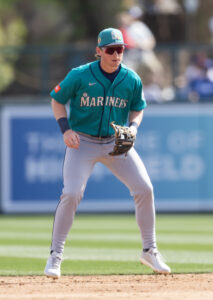
That’s not to say he’ll need to wait until 2027 to make his MLB debut. Young is a former top prospect himself and is well-regarded by the Mariners, but he’s ultimately unproven at the big league level and could open up playing time at the keystone if he struggles or sits against tough lefties. Donovan was acquired in no small part thanks to his elite versatility. The super-utility man is primarily an infielder but has plenty of experience on the outfield grass as well. Emerson could assume the regular third base job at some point this season. That would bump Donovan to right field, thereby displacing either Dominic Canzone or Luke Raley from the starting lineup.
While a spot could be made for Emerson in the majors, it’s understandable that the club is holding off on promoting him for now. This extension is a big bet on his ability and removes the consideration of service time from the equation, but Emerson’s development must still be considered. While MLB Pipeline notes that his defensive metrics last year suggested he was an above-average defender at short, he has just 111 1/3 innings of work at third base for his career and just 75 at the keystone, so it would be understandable if the team wanted to get him additional looks at those positions before giving him a full-time role in the majors.
As for his offense, Emerson has just 43 total games in the upper minors. That’s not a lot of time afforded for his development, and while some top prospects are able to jump right in at the big league level with minimal minor league experience, the Mariners should remember all too well the struggles that outfielder Jarred Kelenic faced when he was promoted to the majors after just 51 games in the upper minors (including 30 at Triple-A). The front office surely has no interest in risking Emerson’s development on calling him up before he’s ready, particularly given the fact that Emerson is now slated to receive the fourth-largest guarantee on Seattle’s entire roster behind Julio Rodriguez, Luis Castillo, and Cal Raleigh.
Regardless of when Emerson ultimately reaches the majors, this deal locks up a key piece of Seattle’s core for the future. With Emerson now under club control through the end of the 2034 season, he joins Raleigh, Rodriguez, Josh Naylor, and Young as key players under control through at least 2030. That positional core is complemented by impact pieces like Donovan, star closer Andres Munoz, and of course the club’s vaunted starting rotation of Castillo, Logan Gilbert, George Kirby, Bryan Woo, and Bryce Miller. All five of those starters are set to hit free agency between the 2027-28 offseason and the 2029-30 offseason, so perhaps the club’s long-term planning can now focus on the future of the rotation now that key positional assets like Raleigh and Emerson are locked up for the long haul.
Robert Murray of FanSided first reported that Emerson and the Mariners had agreed to an eight-year, $95MM contract with a club option, more than $35MM in escalators, and a no-trade clause. ESPN’s Jeff Passan reported that Emerson would be optioned back to Triple-A. Adam Jude of The Seattle Times had the signing bonus and salary range. Daniel Kramer of MLB.com reported the $25MM option value and more salary specifics.
Image courtesy of Mark J. Rebilas, Imagn Images.
Cardinals Have Shown Interest In JJ Wetherholt Extension
The Cardinals have interest in an extension with JJ Wetherholt, reports Jon Heyman of The New York Post. There’s no indication talks have gotten far, though it’s understandable that St. Louis would like to keep the rookie beyond his six-year window of club control.
Wetherholt was the seventh overall pick in the 2024 draft. The University of West Virginia product mashed throughout his first full minor league season, batting .306/.421/.510 between the top two levels. He’s a consensus top prospect whom the Cardinals carried on the Opening Day roster and have immediately plugged in as their leadoff hitter. Wetherholt can play shortstop but is ticketed for second base work in St. Louis thanks to Masyn Winn.
The 23-year-old has had a nice first week in the big leagues, collecting six hits (including a homer) with two walks and three strikeouts through 23 plate appearances. A five-game sample isn’t going to have much bearing on extension talks. The Cardinals’ interest in a long-term deal is rooted more in his college and minor league excellence. By and large, there’s a strong track record for elite position player prospects who have performed as well as Wetherholt has at every stop.
Colt Emerson set a new record for the largest pre-debut extension in MLB history this morning. The Mariners shortstop/third base prospect signed an eight-year, $95MM guarantee with a club option for a ninth season. It’s not a perfect parallel to Wetherholt, who is already at the MLB level. That said, Wetherholt’s camp at Covenant Sports Group is surely aware of the Emerson deal establishing a new standard for an early-career contract. The two are in a similar prospect tier. As a college draftee, Wetherholt is a couple years older.
Emerson’s deal handily beat the $60MM extension that Kristian Campbell signed during his first week in the majors last April. Roman Anthony signed for $130MM last August when he had a little under 200 big league plate appearances. The Cardinals are probably reluctant to go that far a week into Wetherholt’s career, but his camp may already look for nine figures.
The Prospect Promotion Incentive is among the reasons Wetherholt broke camp. St. Louis would receive a bonus draft choice after the first round if he wins Rookie of the Year or finishes top three in MVP voting within his first three seasons. The PPI does not apply to players who sign extensions before their debut (e.g. Emerson) but would remain in place if the Cards get a long-term deal done with Wetherholt now that he has MLB time under his belt.
Orioles To Select Albert Suárez
The Orioles will select swingman Albert Suárez onto the big league roster, reports Jacob Calvin Meyer of The Baltimore Sun. Manager Craig Albernaz confirmed this evening that the O’s expect Zach Eflin to land on the injured list after he left tonight’s start with elbow discomfort.
Suárez will need to be added to the 40-man roster. That’s at capacity, so they’ll either designate someone for assignment or place an injured player on the 60-day injured list. Jordan Westburg is a borderline 60-day IL candidate. Eflin could be as well depending on the results of tomorrow’s MRI. Otherwise, recent DFA trade pickups Johnathan Rodríguez and Jayvien Sandridge probably occupy the final two spots on the 40-man roster.
Dean Kremer seems likely to step into the open rotation spot. Baltimore can operate with a four-man rotation in the interim. Trevor Rogers goes tomorrow opposite Nathan Eovaldi as they look to avoid a sweep at the hands of the Rangers. The O’s are off on Thursday before heading to Pittsburgh for a weekend series. They’ll need to replace Eflin in the rotation by next week’s series against the White Sox.
Suárez adds a multi-inning arm to Albernaz’s bullpen. The O’s used three relievers — Dietrich Enns and Rico Garcia for multiple innings — after Chris Bassitt was knocked out by the fifth inning on Monday. Grant Wolfram, Yennier Cano, Yaramil Hiraldo and Anthony Nunez all pitched tonight due to Eflin’s fourth-inning injury. Closer Ryan Helsley is their only reliever who hasn’t been called upon yet in the series.
The 36-year-old Suárez will be appearing in his third straight season with the Orioles. He was a nice find out of the KBO and turned in a 3.70 ERA across 133 2/3 innings two years ago. Shoulder and elbow injuries limited him to five appearances and 11 2/3 frames last season.
That cost him his 40-man roster spot at season’s end, but the O’s brought him back on a minor league deal. Suárez had a tough spring, allowing 10 runs (nine earned) with nine strikeouts and five walks through 10 2/3 innings. He began the season with Triple-A Norfolk but hasn’t made an appearance through their first four games.
Zach Eflin Going For MRI With Elbow Discomfort
8:36pm: Manager Craig Albernaz confirmed the O’s anticipate placing Eflin on the 15-day injured list (via Andy Kostka of The Baltimore Banner). The team will know more after he goes for imaging tomorrow. Baltimore is off Thursday and could operate with an extra reliever for a few games. They’ll presumably recall Kremer to step into the rotation by the middle of next week.
8:31pm: Orioles righty Zach Eflin left his season debut tonight in the fourth inning after a visit from the trainers. The team announced the issue as elbow discomfort and will surely have more details over the next few days.
The injury seemingly occurred on a 76 mph curveball to Texas third baseman Ezequiel Duran. Eflin had pitched well before the injury, striking out seven while allowing one run across 3 2/3 frames. His velocity was fine throughout the appearance and there was no indication the veteran righty was struggling physically until his last pitch. Baltimore’s bullpen would give up seven runs over the final 4 1/3 innings and take an 8-5 loss.
Eflin has unfortunately battled a number of injuries throughout his career. Knee issues were the main concern during his early days with the Phillies. Over the past couple seasons, he had been bothered more frequently by back and arm issues. Eflin had brief injured list stints related to his lower back in both 2023 and ’24. He had three trips to the IL last year, a season in which he was limited to 14 starts.
The 31-year-old suffered a lat strain in April, knocking him out for a month. The back flared up not long after he returned. A second back injury resulted in a lumbar microdiscectomy that ended his season. Eflin returned to the O’s on a one-year, $10MM free agent deal midway through the rehab. That went without issue, but his return for the start of the season is clouded by possible concern about the elbow.
If Eflin hits the injured list, the O’s would presumably turn to Dean Kremer to round out the rotation. Baltimore optioned him to Triple-A to begin the season. It was a numbers game more than anything, as they would have needed to go to a six-man rotation if they didn’t want to use Kremer out of the bullpen. He’s a perfectly capable fifth starter who’d slot behind Trevor Rogers, Kyle Bradish, Shane Baz and Chris Bassitt.