
Zack Wheeler Discusses Pending Free Agency
In what could be his final week in a Mets uniform, pending free-agent right-hander Zack Wheeler spoke about his future with Mollie Walker of the New York Post, Anthony DiComo of MLB.com and other reporters Wednesday. Unsurprisingly, the 29-year-old Wheeler doesn’t sound like someone who’s ready to commit to his current team with what could be a lucrative trip to the open market looming.
“I think you have to weigh your options when it gets to this point,” said Wheeler, who’s just over a month from becoming a free agent. “I love it here and I definitely would listen to these guys. But I think you have to weigh all your options and see what’s best for me personally at that point.”
Wheeler was both a trade and an extension candidate as recently as July, but the Mets neither dealt him nor locked him up. And there haven’t been any rumors regarding a new contract between the sides since then, so it appears increasingly likely Wheeler will test the market.
Considering the wide interest he drew prior to the trade deadline, the Mets probably could have gotten something for Wheeler back in July (though he was coming off shoulder issues at the time). However, even if he walks in free agency, they’ll still have a chance to land draft compensation for Wheeler – who looks like a surefire candidate to receive the qualifying offer. Wheeler would then have the option of accepting the one-year offer (which should be worth in the $18MM-$19MM neighborhood) and sticking with the Mets. As you’d expect, though, Wheeler prefers more security than the QO presents.
On the prospect of signing a multiyear pact, Wheeler stated: “Hopefully, yeah. Time will tell.”
Although Wheeler’s a former Tommy John patient who sat out for almost all of 2015-17 with arm injuries, he has spent the past two seasons making a strong case for a considerable multiyear payday. After firing 182 1/3 innings of 3.31 ERA/3.25 FIP ball in 2018, Wheeler has notched 187 1/3 frames of 3.99 ERA/3.47 FIP pitching this year. During that two-year span, Wheeler has struck out just under a hitter per inning while walking fewer than three per nine. Moreover, Wheeler boasts elite fastball velocity – the pitch clocks in at just under 97 mph – which should only make it easier for him to cash in during the coming months.
In the event Wheeler pitches for a different team in 2020, the top of the Mets’ rotation could still be in enviable shape. Ace Jacob deGrom might be a back-to-back NL Cy Young winner by then, while Noah Syndergaard and Marcus Stroman make for fine complements. Then again, with all the trade rumors that have surrounded Syndergaard since last winter, perhaps he – like Wheeler – isn’t a lock to don a Mets uni next year.
Eric Hosmer’s 2019: More Of The Same
Clearly dissatisfied with yet another season well below the .500 mark, the Padres fired manager Andy Green last weekend. It didn’t come off as an unreasonable decision by the Padres, who didn’t make real progress in the standings in four years under Green (albeit during a rebuild) and who’d surely like to turn around their fortunes in 2020.
Green may have deserved his fate, but it’s difficult to lay all the blame at his feet when the club’s highest-paid players haven’t pulled their weight over the past couple years. Third baseman/shortstop Manny Machado, whom general manager A.J. Preller and the Padres stunningly reeled in for $300MM, has been good but not great in the first season of his 10-year contract. Outfielder Wil Myers received a six-year, $83MM extension after a career season in 2016, but his production has declined to a noticeable extent since. And then there’s first baseman Eric Hosmer, whose contract looks like the most regrettable of the three.
Even though they obviously weren’t going to contend in 2018, and even though there weren’t a lot of clear suitors for him, the Padres handed Hosmer an eight-year, $144MM guarantee prior to that season. At the time, it seemed you either loved the Padres’ bold choice or you hated it. To be sure, Hosmer had his high points as a Royal from 2011-17 – a span in which he helped the team to a pair of AL pennants, won a World Series, picked up an All-Star nod and took home four Gold Gloves. Along the way, the well-regarded Hosmer became one of the faces of baseball for the many who place a great deal of value on intangibles.
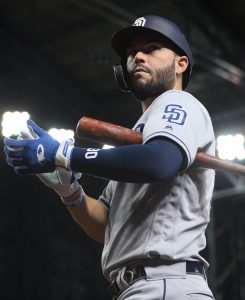
On the other hand, Hosmer was far from a consistent producer as a Royal. While Hosmer put up two seasons of 3.5 fWAR or better with the Royals, the other campaigns weren’t nearly as successful. Hosmer posted two years in the negatives in that category while a member of the Royals, and unfortunately for the Padres, that’s the version they’ve gotten since awarding him his payday.
Hosmer began his Padres career with a whimper in 2018, hitting .253/.322/.398 in 677 plate appearances. He managed minus-0.1 fWAR in the process, thanks in large part to his subpar batting line. Hosmer’s wRC+ (95) fell a good distance below the league average of 105 for his position.
This season has been more of the same for Hosmer. With less than a week to go, the soon-to-be 30-year-old has accounted for minus-0.2 fWAR and hit .271/.317/.430 in 649 trips to the plate. Hosmer’s OPS is better than it was a year ago, but his wRC+ (95) hasn’t improved (league average for first basemen in 2019 is 106). That isn’t where the similarities in output end, though, as you’ll see below…
Home runs – 2018: 18; 2019: 21
Isolated power – 2018: .145; 2019: .159
Weighted-on base average – 2018: .309; 2019: .315
Expected wOBA – 2018 – .310; 2019: .318
Hosmer has taken a somewhat different path in arriving at his near-identical production in 2019. He’s swinging a bit more, striking out more, walking less and making less contact. When Hosmer has made contact, he has hit more liners and fly balls, though his launch angle (minus-1.2 in 2018, plus-2.4 this year) remains extraordinarily low. In an era where more and more hitters have focused on elevating the ball (and in what many suspect is a juiced ball era), grounders continue to win the day for Hosmer. While his GB rate (55.9) has fallen by almost 5 percent since 2018, it’s nonetheless the second-highest figure among all qualified hitters.
Hosmer’s struggles putting the ball in the air have somewhat offset the gains he has made in the hard-contact department. He ranks in the league’s 78th percentile in average exit velocity (90.6) and its 87th percentile in hard-hit percentage (45.9), according to Statcast. But a well-struck grounder still typically leads to an out, and it doesn’t help matters that Hosmer’s lacking speed (this could be his first zero-steal season).
A quarter of the way into his expensive union with the Padres, it would be difficult to classify Hosmer’s San Diego tenure as anything other than a disappointment. Hosmer will still be entrenched in the club’s lineup going into 2020, but the Padres are likely going to need far more from their big-money first baseman if they’re going to make a noticeable jump in the standings.
Photo courtesy of USA Today Sports Images.
Jeff McNeil Diagnosed With Fractured Wrist
Mets infielder/outfielder Jeff McNeil has been diagnosed with a fracture in his right wrist that was sustained when he was hit by a pitch in tonight’s game, the team announced (Twitter link via Deesha Thosar of the New York Daily News). Specifically, McNeil has suffered a right distal ulnar fracture. That puts an end to his 2019 season — on the same night the Mets were mathematically eliminated from postseason contention by a Brewers victory.
It’s a sour note on which to finish an exceptional season for the 27-year-old McNeil, who hit .318/.384/.531 with 23 home runs, 37 doubles and a triple in his first full big league season. McNeil leads Mets regulars in batting average and on-base percentage, and only 12 qualified hitter in all of baseball have posted a lower strikeout rate than his minuscule 13.2 percent.
While it’s been a disastrous year for the Mets in some regards — Robinson Cano, Edwin Diaz and Jeurys Familia have all struggled; Jed Lowrie has taken seven plate appearances — McNeil and likely Rookie of the Year Pete Alonso have been among the club’s brightest spots. The position(s) at which McNeil is deployed in 2020 will depend somewhat on the team’s offseason maneuverings, but he’ll assuredly be in the lineup with regularity now that he’s cemented himself as a late-blooming building block in Queens. He’s seen action at second base, third base and in both outfield corners this season but could have a clearer path to regular reps at third base with Todd Frazier set to become a free agent. Then again, McNeil looked destined for regular second base work in 2019 before the Mets stunned the baseball world with the ill-fated Cano/Diaz blockbuster.
Regardless of where he lines up defensively, McNeil’s bat has proven to be among the most potent in the National League. Barring an offseason extension, he’ll continue to give the Mets an extreme bargain, playing out the 2020 campaign at scarcely more than the league minimum, given his standing as a pre-arbitration player. McNeil won’t even be eligible for arbitration until the completion of the 2021 season, and he’s under club control all the way through 2024.
Three Needs: Los Angeles Angels
We’re continuing with our “Three Needs” series, in which we take a look at the chief issues to be addressed for clubs that have fallen out of contention. We’ve already focused on the Mariners, Tigers, White Sox, Marlins, Rangers and Pirates. Now we’ll turn to the Angels. Despite the presence of the transcendent Mike Trout, they’ve posted their fifth straight non-playoff season and their fourth sub-.500 campaign in a row during what has been a year filled with adversity.
[Los Angeles Angels Depth Chart]
1. Pour Significant Resources Into The Rotation
Let’s be fair to the Angels right off the bat: Their rotation (and their franchise as a whole) is still reeling from the passing of left-hander Tyler Skaggs back in July. Not only was Skaggs a beloved teammate to those on the club, but he was one of the Angels’ top pitchers. That’s an irreplaceable combination, though the Angels have no choice but to carry on and try to improve their starting staff heading into 2020.
The good news for the Angels is that two-way phenom Shohei Ohtani should return to the mound next year. He threw just over 50 innings as a rookie in 2018 and then couldn’t pitch at all this season as a result of Tommy John surgery. Ohtani recently underwent another procedure – a left knee operation – but it shouldn’t prevent him from rejoining the Angels’ rotation at the beginning of the season. The flamethrowing Ohtani, Andrew Heaney and Griffin Canning (who enjoyed a respectable rookie season, albeit one that ended in August because of elbow issues) give the Halos’ starting staff at least a few legitimate reasons for hope heading into 2020. It’s harder to find obvious causes for optimism otherwise, though, evidenced in part by the AL-worst ERA and fWAR Angels starters have recorded this year.
In clear need of starters, the Angels figure to aggressively target help during the offseason. General manager Billy Eppler already spoke on the upcoming free-agent starter market back in August, saying, “I’m sure we’ll be sitting with [free agents] and seeing if something can be worked out.” Furthermore, although the Angels haven’t won any recent high-priced bidding wars for starters, Eppler didn’t close the door on bucking that trend.
So … enter Gerrit Cole? Not necessarily, but the Houston Cy Young candidate, Southern California native and pending free agent looks like a plausible target for the Angels. While the 29-year-old Cole could command $200MM–plus on his upcoming contract, the Angels have shown a willingness to make sizable long-term commitments under owner Arte Moreno (deals for Trout, Albert Pujols, Josh Hamilton and Justin Upton spring to mind). And Cole would give the Angels’ injury-laden, underperforming rotation something it desperately needs: a workhorse ace who can provide 200 innings of top-line production.
It doesn’t have to be Cole or bust for the Angels, though he should be the franchise’s No. 1 target going into the offseason. If they can’t get him, though, there will be other worthy starters available in free agency. Stephen Strasburg (if he opts out of his Nationals deal), Madison Bumgarner, Zack Wheeler, Dallas Keuchel (whom the Angels pursued last winter), Jake Odorizzi and Kyle Gibson represent several other possibilities. The Angels could also explore a trade(s), but whether Eppler will want to make notable subtractions from a farm system he has focused on improving over the past few years remains to be seen. Either way, the Angels have to perform far better than they did in free agency a year ago, when they spent a combined $20MM on one-year contracts for starters Matt Harvey and Trevor Cahill. Those pacts proved to be miserable failures for the team.
2. Upgrade Behind The Plate
The Angels went the one-year deal route to try to bolster their rotation last winter, and they did the same behind the plate. But the $3.35MM guarantee for Jonathan Lucroy went down as yet another regrettable move, as he struggled before the club released him in August. Lucroy, Max Stassi (who needs hip surgery), Anthony Bemboom, Kevan Smith and Dustin Garneau (who, like Lucroy, is out of the organization) have combined for negative-0.4 fWAR this year, making the Angels just one of five teams whose backstops have registered a minus number in that category.
It’s time for the Halos do better at the position. To their credit, the Angels at least made an attempt last offseason, courting the likes of Yasmani Grandal and Wilson Ramos before those two went elsewhere. Grandal will be back on the market this winter, but the Brewer should do a lot better than the one-year, $18MM-plus guarantee he raked in during his previous stay in free agency. Would the Angels make such a commitment? It could depend on how much they dole out on starting help. There’s only so much money to go around, after all.
Free-agent options beyond Grandal are much less enticing. However, the likes of Jason Castro, Travis d’Arnaud and Robinson Chirinos could be upgrades over the catchers the Angels have leaned on this year. And Yankees backup Austin Romine might be a name to watch as a soon-to-be free agent who shouldn’t cost much. Eppler was in New York’s front office for the early stages of Romine’s major league career.
3. Determine Kole Calhoun‘s Future
The Angels are facing a tough decision on Calhoun, a career-long Angel who has been with the franchise since it spent an eighth-round pick on him in 2010. Now 31, Calhoun has evolved into a defensive standout who also offers capable offense. He has been solid in both regards this year en route to his fifth season with at least 2.0 fWAR, but that doesn’t mean the Angels will welcome him back in 2020. They could pick up Calhoun’s option for $14MM or buy him out for $1MM. For an Angels team with major issues to address elsewhere, it may be tempting to wave goodbye to Calhoun and spend the $13MM they’d save on him to address other areas of the roster. The club has a potential short-term replacement on hand in Brian Goodwin, who could occupy right field until super prospect Jo Adell is ready for a promotion next season.
Adalberto Mondesi To Undergo Shoulder Surgery
Royals shortstop Adalberto Mondesi will undergo surgery next week to repair a tear near the joint of his left shoulder, the team announced to reporters Wednesday (Twitter link via Jeffrey Flanagan of MLB.com). Mondesi will recover five to six months to recover from the operation, per team trainer Nick Kenney, which could obviously impact his ability for the start of the 2020 season.
It’s a discouraging development for the ultra-talented Mondesi, who has displayed a tantalizing combination of extra-base pop, blistering speed and strong defensive ratings at shortstop over the past two seasons. Mondesi only just turned 24 but has already amassed 26 home runs and 89 stolen bases in just 943 plate appearances at the MLB level. His questionable plate discipline and penchant for punching out will likely lead to persistent on-base issues, but the blend of speed, power and glovework makes him a clear foundational piece for the rebuilding Royals.
The tear and subsequent shoulder surgery may call into question the Royals’ decision to bring Mondesi back into the fold at all. Mondesi missed two months with a subluxation of his left shoulder this summer but returned to the lineup on Sept. 1. At the time of his activation, manager Ned Yost suggested that Mondesi had been instructed not to dive for balls in the field or dive headfirst into bases for the remainder of the season (Twitter link via Flanagan). Mondesi, however, reinjured his shoulder doing precisely that: diving to his right for a hard grounder off the bat of Twins slugger Nelson Cruz (video link).
Dating back to Opening Day 2018, Mondesi has hit at a .268/.297/.454 clip while generating 5.6 rWAR and 5.2 fWAR in a total of 177 games. He won’t be eligible for arbitration until next winter and is under club control through the 2023 season.
Domingo German’s Administrative Leave Extended Through World Series
Sept. 25: The league announced today that German’s administrative leave has been extended through the conclusion of the World Series. He officially will not pitch in the postseason.
Sept. 20: Yankees right-hander Domingo German, who was placed on administrative leave under the MLB-MLBPA Joint Domestic Violence Policy, won’t pitch another inning in 2019, ESPN’s Buster Olney reports (via Twitter). That includes both the regular season and the postseason. Olney notes that the case is not yet “fully resolved administratively.” SNY’s Andy Martino further reports that there is a “strong possibility” of a “significant” suspension being issued to German within the next week.
Per Martino, the domestic incident in question involved German’s girlfriend and took place late Monday/early Tuesday after CC Sabathia‘s charity gala. Bob Klapisch of the New York Times tweeted yesterday that German had allegedly slapped his girlfriend and that an official from the Commissioner’s Office had witnessed the incident. Martino’s report suggests that it was not an MLB official who witnessed the incident, but the evidence presented to both the league and player’s union was substantial enough that the MLBPA opted not to exercise its right to challenge German’s placement on administrative leave.
The length of any potential suspension for German seemingly has yet to be determined. Prior examples of suspensions under the league’s policy have come with a wide range depending on the severity of the incidents in question. On one end of the spectrum, former Padres left-hander Jose Torres received a 100-game suspension in 2018 following an arrest, and Phillies center fielder Odubel Herrera was suspended 85 games earlier this summer under the policy. Meanwhile, Red Sox right-hander Steven Wright received a lighter 15-game ban early in the 2018 season.
The most extreme punishments under the still relatively new policy have both come on the heels of arrests and criminal charges, neither of which exist in the case of German. The very manner in which MLB was made aware of the allegations against German make his case unique, and that lack of precedent makes it difficult to speculate on the duration of a potential suspension.
Athletics Reinstate Frankie Montas, Designate Beau Taylor For Assignment
The Athletics announced Wednesday that they’ve reinstated right-hander Frankie Montas from the restricted list now that his 80-game PED suspension has been completed. Oakland had a full 40-man roster, so catcher Beau Taylor was designated for assignment in order to open a spot for Montas’ return. Montas won’t be postseason-eligible because of that suspension, but he’ll take the ball and start tonight’s game against the Angels.
Montas, 26, hasn’t pitched since June 20 after testing positive for the banned substance Ostarine. As with virtually all players who fail a drug test, Montas claimed to have been unaware he’d taken a banned substance, blaming the positive test on a “contaminated supplement” which he “purchased over-the-counter at a nutrition store here in the United States.” Regardless of intent (or lack thereof), he served out the full 80-game ban that first-time offenders face.
It’s not clear what type of workload Montas will be able to handle, although general manager David Forst indicated earlier this month that the A’s have kept Montas stretched out with a series of simulated games. Whatever volume of innings Montas can handle, they’ll all be pivotal at this point; the A’s are in the thick of a three-team AL Wild Card race with the Indians and Rays.
If the A’s get anything close to the form Montas displayed from March until late June, then they’ll be in excellent shape for tonight’s contest. Through 90 innings earlier this season, Montas pitched to a pristine 2.70 ERA with a similarly strong 2.91 FIP and a 3.42 xFIP. He averaged 9.7 strikeouts, 2.1 walks and 0.7 homers per nine innings pitched while keeping the ball on the ground at a healthy 50.8 percent clip.
Of course, skeptics will attribute that apparent breakout to Montas’ failed drug test, and there’ll be nowhere near enough time in 2019 for him to prove that he’s capable of sustaining that level of pace post-suspension. He’ll surely have a place earmarked in Oakland’s 2020 rotation, at which point he’ll strive to continue upon this year’s breakout and distance himself from that suspension as best he can. He’ll presumably be joined by Sean Manaea and Mike Fiers in that regard. Righties Chris Bassitt, Daniel Mengden and Jharel Cotton will compete with top left-handed pitching prospects Jesus Luzardo and A.J. Puk for the final spots in Oakland’s rotation.
Montas, who’ll turn 27 next March, lost more than half a season’s worth of service time but will still ever-so-narrowly eek out enough service to reach two full years of big league service in 2019. As such, he’s still controlled through the 2023 season and remains on track to be arbitration-eligible following the 2020 campaign.
As for the 29-year-old Taylor, this won’t be the first time he’s been cut loose by the A’s. Oakland outrighted him off the 40-man roster following the 2018 season but re-signed him to a minor league deal, and the Athletics also designated Taylor for assignment earlier this year. He landed with the Blue Jays via a waiver claim but was eventually DFA’ed by Toronto and returned to Oakland on a second waiver claim.
Taylor is 5-for-30 with a pair of homers in a tiny sample of 36 MLB plate appearances. He’s spent parts of three seasons at the Triple-A level and batted a combined .256/.373/.385 there. He’s been about a percentage point below average in terms of caught-stealing rate for his pro career and has drawn average or better pitch-framing grades in the past few seasons.
Blue Jays Select Ryan Dull
The Blue Jays have selected the contract of right-hander Ryan Dull and recalled right-hander Yennsy Diaz for the final few games of the season, tweets Shi Davidi of Sportsnet. Dull and Diaz will give the Blue Jays some extra arms to serve as reinforcements for a bullpen that has thrown 27 innings across the past three games thanks to a 15-inning marathon Monday and a series of openers being utilized. In order to make room for Dull on the 40-man roster, the Jays put Lourdes Gurriel Jr. on the 60-day injured list. Gurriel underwent an appendectomy this week and wasn’t expected to return before Sunday’s season finale.
This marks the latest roster move for Dull in a roller coaster couple of months. The veteran righty has bounced from Oakland to San Francisco to New York to Toronto on waivers since the beginning of August and finally cleared waivers within the past week after he was designated by the Jays. Dull didn’t appear in the big leagues with Toronto before being designated for assignment and sent outright off the 40-man roster. He’ll now have a chance to suit up as a Blue Jay and log a few extra days of big league service to close out the year, though he’ll quite likely be removed from the 40-man roster once again when the season concludes.
J.T. Realmuto Will Have Surgery To Repair Meniscus
Phillies catcher J.T. Realmuto will undergo a procedure to clean up the meniscus in his right knee, manager Gabe Kapler announced Wednesday (Twitter link via Jim Salisbury of NBC Sports Philadelphia). With the Phillies formally eliminated from postseason contention, he’ll go under the knife now rather than play out the season’s final series. There are no long-term concerns associated with the operation, and Realmuto is expected to be ready to go for Spring Training.
The surgery means that Realmuto’s season will come to a close with a strong .275/.328/.493 batting line in his first year with the Phils. Realmuto slugged 25 homers, 36 doubles and three triples over the course of 538 plate appearances while serving as something of an iron man behind the dish; no one in baseball has caught more than the 1139 innings that Realmuto did in 2019. The volume of that workload makes his output at the plate all the more impressive and heightens the value of his superlative defense. Realmuto threw out a ridiculous 47 percent of base thieves in 2019 and ranked among the best in the league in terms of pitch blocking and pitch framing.
Put simply, Realmuto is arguably the game’s best catcher. Phillies general manager Matt Klentak recently lauded Realmuto’s overall contributions and was rather candid in suggesting that an extension for the 28-year-old All-Star will be one of the organization’s priorities over the winter. The Phils control Realmuto through the 2020 season, at present, and he’ll command a sizable raise on this year’s $5.9MM salary in arbitration over the winter. Realmuto has voiced his own interest in signing a long-term pact to remain with the Phillies, so it shouldn’t be a surprise if the two sides ultimately hammer out a deal between now and Opening Day 2020.
Sam Dyson Out Up To 12 Months Following Shoulder Surgery
Twins right-hander Sam Dyson underwent capsule repair surgery on his right shoulder yesterday, manager Rocco Baldelli revealed to reporters Wednesday (Twitter link via Do-Hyoung Park of MLB.com). It’s a brutal development for both Dyson and the organization, as the recovery period associated with that procedure could span a full 12 months. It’s not clear whether Dyson will be able to take the ball at all in 2020, which seemingly makes an offseason non-tender of the righty a necessity.
At the time of the trade that sent Dyson from San Francisco to Minnesota, the Twins looked to be acquiring one of the more effective relievers who’d been made available. Dyson posted a 2.69 ERA with 7.2 K/9, 2.6 BB/9, 0.64 HR/9 and a 61.3 percent ground-ball rate in 70 1/3 innings with the 2018 Giants and had followed that up with 51 innings of 2.47 ERA ball to open the 2019 campaign. He’d improved both his strikeout and walk rates while continuing to allow fewer than one homer per nine innings pitched.
Minnesota sent three prospects — Jaylin Davis, Prelander Berroa and Kai-Wei Teng — to the Giants in order to acquire Dyson for this season and for 2020, which would be his final arbitration-eligible season. However, Dyson was shelled in his first outing as a Twin and quickly landed on the injured list. He returned and actually pitched fairly well (2.53 ERA in 10 2/3 innings) before again being shut down due to ongoing discomfort in his biceps/shoulder.
More troubling than the quick IL placement, for the Twins, was the fact that Dyson revealed to the club that he’d been dealing with some discomfort since mid-July — before he was ever traded to the Twins. Medical records at the time of the swap checked out, as Dyson had not even divulged the pain he was feeling to the Giants (and, thus, the Giants had no way of documenting said red flags).
The Twins reportedly investigated whether there was any possibility that the Giants might’ve had some inkling of Dyson’s shoulder troubles — as any team would — but there’s no evidence of any efforts to withhold information. In the end, it appears to be a simple case of miserable luck for the Twins, who almost certainly won’t commit to a raise on Dyson’s $5MM salary for the 2020 season and now seem likely to cut him loose for nothing.
If there’s any silver lining for Minnesota, it’s that the need for Dyson is less acute than it was at the time of the trade to acquire him. Tyler Duffey hasn’t allowed a run since the trade and has a 38-to-5 K/BB ratio over his past 22 2/3 scoreless innings. Closer Taylor Rogers remains an excellent weapon, and hard-throwing righty Trevor May has been largely excellent over the past two months as well. The Twins’ other deadline pickup, Sergio Romo, has been terrific since his acquisition as well. Rookies Zack Littell, Cody Stashak and Ryne Harper have emerged as solid options, and flamethrowing top prospect Brusdar Graterol is making a push for a spot on the postseason roster as well.
That’s not to downplay the loss of Dyson, of course. A healthy Dyson would give the Twins an even more formidable back of the bullpen, which has become a necessity for postseason play given the evolution of pitcher usage (particularly in short series). But the overall state of Baldelli’s relief corps is much stronger than it was even two months ago, with more questions now seemingly focused on the Twins’ sputtering rotation.