
Mark Appel Stepping Away From Baseball
In a candid, must-read interview with Bleacher Report’s Joon Lee, former No. 1 overall pick Mark Appel reveals that he’s stepping away from professional baseball at the age of 26. Appel didn’t use the word “retirement” and suggested that perhaps, somewhere down the line, he’d give baseball another shot. However, for the time being, he won’t be reporting to Spring Training with the Phillies (who will retain his rights, tweets Matt Gelb of The Athletic).
“I’m 26, I have a Stanford degree, I have many interests beyond baseball, which I still love, but I have a lot of things I care about,” Appel tells Lee. “I enjoy challenging my mind. My last four years in baseball have challenged my mind.”
Appel, clearly, has dealt with his share of disappointment in professional baseball. The former Stanford ace was twice projected to be the top overall pick in the draft, falling to the Pirates at No. 8 in 2012 and then ultimately being selected No. 1 overall by Houston the following year after returning to Stanford for his senior season. As Joon explores in detail, Appel posted respectable numbers in his debut season but never really hit his stride after the fact, struggling through injuries and oftentimes inexplicable ineffectiveness from 2014-17.
Appel bluntly states that he was “maybe the worst pitcher in professional baseball” in 2014 and recalls a story where, after arguably the worst start of his career, frustration boiled over to the point that he destroyed a particle-board panel in the clubhouse by throwing upwards of 80 baseballs through it. (Appel purchased supplies to repair the damages at Home Depot out of his own pocket and handled the project himself the following day.) The right-hander obviously feels some disappointment about never reaching the Majors and says he would “absolutely” have loved to be pitching in the World Series alongside his friends and former Astros teammates.
As Lee points out, if Appel never makes the decision to return to pro ball, he’d become just the third No. 1 overall pick ever to retire without logging a single game in the Majors. Appel is aware of that unflattering context but seems to be at peace with the fact.
“I had high expectations,” says Appel, who is still rehabbing from his 2017 shoulder troubles. “I didn’t live up to those for a number of reasons. If you want to call me the biggest draft bust, you can call it that. … If I never get to the big leagues, will it be a disappointment? Yes and no. That was a goal and a dream I had at one point, but that’s with stipulations that I’m healthy, I’m happy and doing something I love. If I get to the big leagues, what’s so great about the big leagues if you’re in an isolated place, you’re hurt and you’re emotionally unhappy? How much is that worth to you?”
For the time being, Appel says he’s planning on pursuing an internship and attending business school, perhaps at Stanford but also with several other prospective universities in mind. He speaks with a certain level of excitement about the opportunity to spend more time with friends and family, as well as the possibility of traveling. Perhaps most important of all, Appel sounds like a man with an unexpected and impressive level of perspective on the struggles he’s had in professional baseball: “Some people have real struggles. I played baseball. I thought I was going to be great, and I wasn’t.”
Brewers Recently Contacted Rays About Chris Archer
Seeking an upgrade for the front of their rotation, the Brewers recently circled back with the Rays to inquire on the availability of Chris Archer, reports Ken Rosenthal of The Athletic (Twitter link). A deal appears unlikely, though, Rosenthal adds, as Tampa Bay may not hold Domingo Santana or Brett Phillips in high enough regard to serve as a centerpiece.
After speaking with Rays GM Erik Neander, Archer recently expressed confidence to Marc Topkin of the Tampa Bay Times that he’d remain with the Rays to open the season. The Rays understandably have a huge asking price on Archer, who is on one of the more team-friendly contracts in all of baseball. Tampa Bay controls Archer $33.75MM over the next four seasons, and only the first two years are even guaranteed; his deal contains club options for the 2020 and 2021 campaigns. Archer is only guaranteed $15.5MM over the next two seasons, so in the event of a catastrophic injury, the team that controls him could cut ties and be off the hook without even needing to pay the entire $33.75MM sum remaining on his deal.
While Archer’s ERA over the past two seasons is a hair above 4.00, fielding-independent metrics like FIP (3.60), xFIP (3.38) and SIERA (3.47) all feel he’s been considerably better than his bottom-line run prevention would suggest. Archer has, after all, averaged 10.8 K/9 against 2.8 BB/9 with a 44.9 percent ground-ball rate in that span. He’s gotten in trouble with home runs at times — particularly in August and September of last season — but also possesses one of baseball’s best swinging-strike rates (12.8 percent) and lowest contact rates (72.5 percent) in that two-year stretch. Beyond that, he’s made 32 or more starts in each of the past four seasons, averaging 202 innings per year along the way.
It stands to reason that Tampa Bay would have interest in either Santana or Phillips on the surface, as each could potentially be a long-term cog in the outfield. But, while Santana is coming off a strong season (.875 OPS, 30 homers, 3.3 fWAR, 3.0 rWAR), he’s controllable for the same four-year term as Archer and figures to be compensated handsomely in arbitration if he continues to hit for this type of power.
Phillips has six years of control and is not far removed from ranking as one of MLB’s best overall prospects. (Baseball America still ranked him 80th this offseason, in fact.) However, he struck out at a 30 percent rate in Triple-A last year and a 35 percent pace in the Majors. His overall offensive output in Triple-A (.305/.377/.567) and in the Majors (.276/.351/.448) both look strong on the surface, but both were buoyed by a BABIP north of .400 that is assuredly due for regression.
Finding a slugging corner outfielder, especially in today’s game, and a strikeout-prone center fielder with speed and power isn’t as difficult as finding a durable, 200-inning arm who ranks among the game’s best swing-and-miss artists — especially when said pitcher can affordably sit near the top of a rotation from his age-29 through age-32 campaigns.
Certainly, the Brewers have other top-ranked talent that could be added to any theoretical package. In addition to Phillips, second baseman Keston Hiura, third baseman Lucas Erceg, and right-handers Corbin Burnes and Brandon Woodruff have all placed on various top 100 rankings early in 2018, and their system possesses enviable depth beyond those top few names. Rosenthal, however, suggests that Milwaukee may be reluctant to further deplete its farm after parting with three of its better prospects in Lewis Brinson, Monte Harrison and Isan Diaz to acquire Christian Yeilch. (The team also punted its third-round pick and the associated slot money in the 2018 draft to sign Lorenzo Cain.)
The Brewers figure to be connected to just about every pitching upgrade on the market in the weeks leading up to Spring Training, having already made an offer to Yu Darvish while also showing various degrees of interest in fellow free agents Jake Arrieta and Alex Cobb. One would imagine they’ve checked in with the Royals on Danny Duffy and the Tigers on Michael Fulmer as well, given the rebuilding efforts taking place in Kansas City and Detroit, for instance.
AL Central Notes: Martinez, Cobb, Darvish, Twins, Starling, Greene
The Indians announced today that non-roster invitee Michael Martinez suffered a ruptured Achilles tendon during his offseason workout (specifically, agility exercises), which required surgical repair and will sideline the veteran utilityman for the next six months. The 35-year-old Martinez was a long shot to make the big league roster out of Spring Training, but he’s found his way onto Cleveland’s Major League roster in each of the past three seasons, helping to fill in for various injuries. He’s batted .257/.289/.331 over the life of 145 plate appearances with Cleveland. That six-month timeline will put Martinez on track for an August return, so it’s still possible that he could at least return to the club’s Triple-A team late in the season.
Elsewhere in the AL Central…
- Minnesota’s interest in Alex Cobb has been “overstated,” reports MLB.com’s Rhett Bollinger in his latest Twins Inbox column. (MLBTR recently explored the market for Cobb as part of our Free Agent Profile series.) Yu Darvish remains the Twins’ top priority, but they’re reluctant to go beyond a five-year deal in order to land any free agent. The Twins still have some interest in Chris Tillman as a possible rebound candidate, Bollinger adds. He also notes that chief baseball officer Derek Falvey wouldn’t rule out a reunion with Jaime Garcia, whom the Twins acquired from the Braves this summer, only to flip him to the Yankees roughly a week later.
- A reinvigorated Bubba Starling tells MLB.com’s Jeffrey Flanagan that he believes he can compete for an outfield job with the Royals this spring. Starling, a former first-round pick and lauded top prospect, candidly tells Flanagan that he nearly walked away from baseball entirely in 2017 after getting off to a brutal start to the season, hitting .121/.205/.182 through his first 21 games (a slump that came on the heels of a .534 OPS the year prior). Starling struck out at a 30 percent clip through those 21 games, but he stuck with it at the urging of his family and soon made some mechanical alterations after a chat with hitting coach Tommy Gregg. The tweaks paid dividends, as Starling slashed .288/.335/.443 with just an 18.5 percent strikeout rate over his next 230 PAs before an oblique injury cut his season short in August.
- Shane Greene expects to be the Tigers‘ closer in 2017, writes George Sipple of the Detroit Free Press. “I feel like I’m the closer and I’ve earned that job and it’s my job to lose,” said the 29-year-old Greene, who pitched to a 2.66 ERA with 9.7 K/9, 4.5 BB/9, 0.8 HR/9 and a 47.4 percent ground-ball rate in 67 2/3 innings for Detroit in 2017. New pitching coach Chris Bosio spoke positively of Greene’s stuff and makeup, and Sipple notes that the team’s decision to allow setup man Alex Wilson to compete for a starting job this spring only enhances Greene’s grip on the ninth inning. Speculatively, young Joe Jimenez will eventually be the biggest on-paper threat to Greene’s chances, but he was torched for a 12.32 ERA in 19 innings last year. Jimenez, though, turned 23 just two weeks ago and has a career 1.56 ERA with 13.0 K/9 and 2.8 BB/9 in the minors. He’ll need to prove himself in the Majors, though he could find himself in high-leverage situations sooner rather than later if he’s able to do so early in the year.
Phillies, Adam Rosales Agree To Minor League Deal
The Phillies have signed infielder Adam Rosales to a minor league contract, reports Bob Nightengale of USA Today (Twitter link). The veteran utilityman will earn a $1.75MM base salary if he makes the roster and will be in Major League camp this spring. He’s represented by Hilliard Sports Management.
The 34-year-old Rosales (35 in May) split the 2017 campaign between the Athletics and Diamondbacks, batting a combined .225/.260/.353 with seven homers in 312 plate appearances. While that clearly marked a rough season for the versatile Rosales, he’s just a year removed from a considerably more heartening .229/.319/.495 slash and a career-best 13 home runs (through just 248 plate appearances) with the Padres.
Rosales can play all four infield positions, having logged more than 550 innings at each of first base, second base, third base and shortstop in a decade-long MLB career. A right-handed hitter, Rosales’ career OPS is nearly 100 points higher when facing left-handed pitching, and he was especially effective with the platoon advantage in the aforementioned 2016 campaign, posting an .843 OPS with six homers in 115 PAs against southpaws.
The Phillies don’t have a clearly defined utility infielder at present, so Rosales will head to the camp and compete with prospect Jesmuel Valentin and fellow non-roster invitee Pedro Florimon for a bench job.
Cardinals, Edward Mujica Agree To Minor League Deal
The Cardinals have agreed to a minor league contract with one of their former closers, bringing righty Edward Mujica back to the organization on a minor league contract, reports Derrick Goold of the St. Louis Post-Dispatch (Twitter link). The contract doesn’t contain an invitation to big league Spring Training, so Mujica will head directly to the Cardinals’ Triple-A affiliate in Memphis. SB Nation’s Chris Cotillo tweets that the Octagon client would earn a pro-rated $750K base salary in the event that he does return to the Majors.
Mujica, 33, has thrown just 6 1/3 innings in the Majors since the end of the 2015 season — all coming with the Tigers last year. The results weren’t exactly pretty, as he served up four homers and seven runs overall, though he did strike out seven without issuing a walk. The right-hander’s work with Detroit’s Triple-A affiliate last season was sound, as he delivered 56 innings of 2.57 ERA ball with 7.4 K/9 against a minuscule 1.4 BB/9 with a 39.5 percent ground-ball rate.
That said, Mujica hasn’t shown much in the Majors since a strong run from 2011-13 with the Marlins and Cardinals. Pristine control helped him to a 2.93 ERA through 206 innings in that frame, but Mujica’s pedestrian strikeout tendencies always led metrics like FIP, xFIP and SIERA to forecast some regression in his future — and that proved to be the case in 2014.
After signing a two-year deal with the Red Sox, Mujica turned in a solid but unspectacular 3.90 ERA with 6.5 K/9, 2.1 BB/9 and a 43 percent grounder rate in 2014. The 2015 season proved far worse, as he averaged just 5.7 K/9 against 1.3 BB/9 with a career-worst 1.9 HR/9 en route to a 4.75 ERA in 47 1/3 innings. Boston cut ties with Mujica early in the season, and he wasn’t much better after being picked up by the A’s.
At his best, Mujica induces an average or better number of grounders with elite control and limited punchouts. If his Triple-A work in 2018 mirrors that of his fine output with Toledo in 2017, then it’s not hard to imagine him getting some innings in the Cardinals’ bullpen as injuries around the big league relief corps inevitably crop up. Mujica is hardly teeming with upside, but he’ll bring some experience to the Redbirds’ depth chart and can be reasonably expected to help keep their Triple-A bullpen competitive.
MLBTR Chat Transcript: CarGo, Lucroy, Nats Rotation, Rosario, Towers
Click here to read the transcript for MLBTR Chat With Jason Martinez: January 31, 2018
White Sox, Jeanmar Gomez Agree To Minor League Deal
The White Sox are in agreement with right-hander Jeanmar Gomez on a minor league contract, tweets SB Nation’s Chris Cotillo. The Magnus Sports client will vie for a bullpen role with the South Siders in Spring Training.
Gomez, 30 in February, got off to a strong start with the Phillies in 2016 and emerged as their closer, saving 37 games for the Phils over the course of that season. However, his ERA and save total never matched up with his secondary numbers, and he was tattooed for 17 runs in eight innings that September.
The Phils held onto Gomez despite pedestrian peripheral marks, but his struggles took a turn for the worse in 2017. Gomez was torched for a 7.25 ERA in 22 1/3 innings with the Phillies this past season and ultimately cut loose in late June. He latched on with the Mariners and Brewers on minor league contracts and threw well with their Triple-A affiliates, though he never resurfaced in the Majors.
Chicago GM Rick Hahn has been active in bringing in experienced bullpen options this offseason, hoping to create depth and perhaps to catch lightning in a bottle — as he did with minor league signee Anthony Swarzak last offseason. The Sox took on Joakim Soria (and cash) and Luis Avilan in a three-team trade with the Royals and Dodgers, and they’ve added several veterans on minor league deals as well. In addition to Gomez, the Pale Hose will have Xavier Cedeno, Rob Scahill, T.J. House and Chris Volstad in camp this spring, among others. Beyond that, they swung a trade with the Mariners to acquire hard-throwing young righty Thyago Vieira, giving them yet another arm to compete for relief innings in 2018.
Diamondbacks Designate Rey Fuentes For Assignment
The D-backs announced that outfielder Rey Fuentes has been designated for assignment in order to clear a spot on the 40-man roster for catcher Alex Avila, whose previously reported two-year contract with Arizona is now official.
Fuentes, 27 next month, logged a career-high 145 plate appearances with Arizona last season and batted .235/.278/.338 with three homers and four stolen bases while spending time at all three outfield spots. The former first-rounder has, at times, been considered among the best prospects in both the Red Sox and Padres organizations and was one of four players sent from Boston to San Diego in the 2010 Adrian Gonzalez blockbuster.
Through 225 plate appearances in the Majors, Fuentes has just a .595 OPS, but hit at a .300/.361/.397 clip in 1154 plate appearances in parts of five seasons at the Triple-A level.
Diamondbacks Sign Alex Avila
5:25pm: The D-backs have now announced the signing.
3:45pm: Rosenthal tweets that Avila has already passed his physical, making the deal official. The D-backs have yet to announce the signing, though, which will require a corresponding 40-man roster move.
Jan. 31, 1:19pm: Avila will receive a two-year contract worth $8.25MM, The Athletic’s Ken Rosenthal reports (via Twitter). Another $250K per season will be available to Avila in incentives, according to Heyman.
Jan. 30, 6:44pm: The two sides have a deal, pending a physical, Jon Heyman of FanRag tweets.
6:36pm: The Diamondbacks are nearing an agreement with free agent catcher Alex Avila, Nick Piecoro of the Arizona Republic reports on Twitter. Terms are unknown, but MLBTR predicted a two-year, $16MM contract for Avila at the outset of free agency.
The 31-year-old Avila will add an offensively capable backstop to an Arizona club whose catchers batted a paltry .219/.306/.404 last season. That was with a very good performance from Chris Iannetta, who joined the NL West rival Rockies in free agency, leaving the Diamondbacks with Jeff Mathis and Chris Herrmann as their top options. Mathis, the team’s likely starter prior to the Avila agreement, is known for his defensive prowess. However, his bat has never come close to keeping up with his work behind the plate.
[RELATED: Updated D-backs Depth Chart]
Unlike Mathis, defense is not Avila’s calling card – in fact, he was among the game’s worst pitch framers in 2017, according to both Baseball Prospectus and StatCorner. But the lefty-swinger did his best to make up for it at the plate, where he slashed an outstanding .264/.387/.447 with 14 home runs and a .183 ISO in 376 plate appearances divided between the Tigers and Cubs. Avila’s numbers dropped off after the Cubs acquired him prior to the July 31 non-waiver trade deadline (.274/.394/.475 versus .239/.369/.380), though he still offered the North Siders above-average offensive production relative to his position.
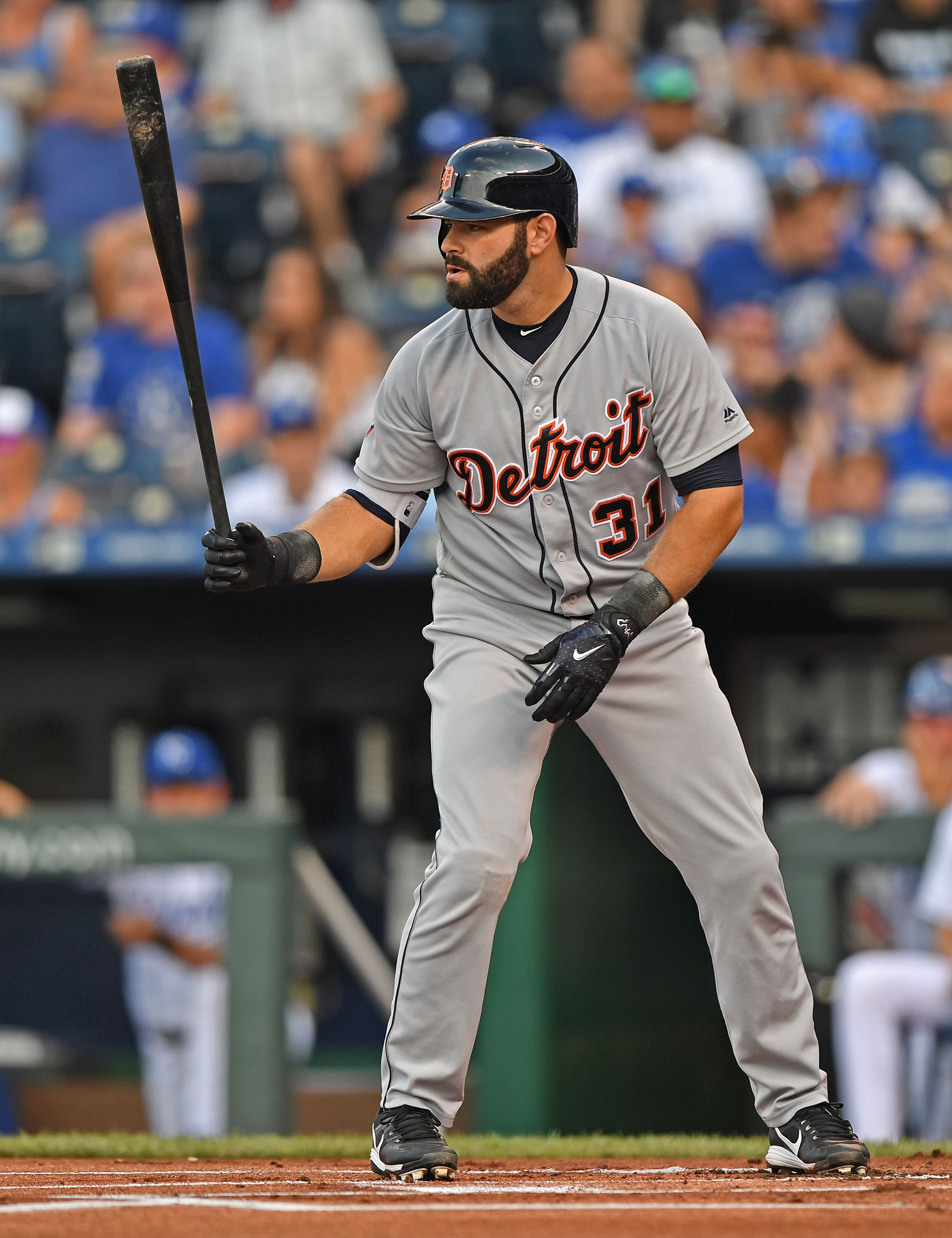
While Avila managed a hard-to-sustain .382 batting average on balls in play last season and struck out in 31.9 percent of PAs, he helped his cause significantly with scorching contact. Among those with at least 300 PAs, Avila ranked second in the majors in hard-hit rate (48.7 percent, compared to a career mark of 36.6). And out of 387 hitters who put at least 100 balls in play, he finished tied for 18th in average exit velocity (90.4 mph) and tied for 21st in barrels per PA (7.4). Consequently, he posted a tremendous xwOBA (.395) that easily outpaced his still-high wOBA (.368).
Last year’s offensive outburst was Avila’s most impressive showing since 2011, when the then-Tiger earned his lone All-Star nod, but success with the bat isn’t anything new for the lifetime .243/.351/.401 hitter. He comes with notable platoon splits, though, having held his own against right-handed pitching (.250/.362/.426) while failing to present a threat versus southpaws (.212/.306/.305) since debuting in 2009. He also brings durability concerns, having gone on the disabled list several times in his career, including twice during a 57-game season with the White Sox in 2016.
After his lone campaign with the ChiSox, Avila returned to the Tigers last winter for a $2MM guarantee. Avila’s sure to do better this time around, but it’ll be interesting to see how much the Diamondbacks will guarantee him. With an estimated $122MM-plus in commitments at the moment, the D-backs are known to have limited payroll flexibility, which is seemingly standing in the way of a reunion with free agent slugger J.D. Martinez – Avila’s former teammate in Detroit – and may lead to cost-cutting trades (they could deal $7.5MM left-hander Patrick Corbin, for instance). The club has only opened a season beyond the $100MM mark twice, including when it spent a franchise-record $112MM-plus in 2014.
Photo courtesy of USA Today Sports Images.
Brandon Moss Weighs In On Offseason Pace, CBA
Newly reacquired Athletics slugger Brandon Moss appeared on MLB Network’s Hot Stove with Harold Reynolds, Matt Vasgersian and Ken Rosenthal earlier today and discussed not only his return to the A’s but also his candid views on the slow free-agent market (video link, CBA/free agency talk beginning around the 6:20 mark). Acknowledging that it might not be a popular opinion, Moss said that the players have no one but themselves to blame.
“Everything that happens in the game of baseball, as far as how things are done financially, is bargained into a collective bargaining agreement,” says Moss. “The way free agency runs, the way draft money is allotted, the way international signing bonus is allotted. Everything is bargained.”
The link between free agency and draft picks is hardly new to the current CBA, of course, as the previous iteration of the CBA actually had stricter penalization for teams that signed qualified free agents; prior to that, the old Elias Ranking System of Type A/Type B free agents also caused teams to forfeit draft picks, even allowing the team losing the player to effectively acquire a forfeited pick in the case of Type A free agents.
But, the CBA has also increasingly limited the avenues in which teams can acquire amateur talent, and the newest iteration ties that to free agency arguably more than ever before. The fact that signing qualified free agents can now force teams to forfeit international bonus allotments, plus the hard cap on international spending are new to the 2017-21 CBA.
Additionally, exceeding the luxury tax by a wide enough margin will eventually cause teams to see their top pick pushed back 10 slots. The new CBA also added surcharges of 12 percent and 42.5 percent for exceeding the CBT by $20MM and $40MM, respectively. Those trends, Moss continues, are troublesome more so for future generations of players than the current crop:
“My career’s almost finished, so I don’t have to deal with this much longer, but the worry is there for me for players in the future that enough attention is not being paid to the way we allow our system to be run. I feel like we put more things that are of less value at the forefront. I feel like we’re starting to have to walk a little bit of a tightrope that we’ve created for ourselves. I think that we have given the owners and we have given the people who are very, very business savvy the opportunity to take advantage of a system that we created for ourselves.”
The increases of penalization, relative to the shrinking means of amateur talent acquisition — hard slotting system in the draft, hard cap on international spending — has tipped the scales decidedly in favor of the owners, Moss suggests. Whereas teams once felt the need to meet or even exceed previously established market values in free agency, the more recent iterations of the CBA have done the opposite — pushing teams away from spending at previous market standards.
“…[W]e have the right to bargain and set our price, just like the owners have the right to meet that price,” Moss says. “But what we’ve done is we have incentivized owners, we have incentivized teams to say ‘We don’t want to meet that price. It costs us too much to meet that price. It costs us draft picks. It costs us international signing money. … We’re going to have to pay a tax if we go over a certain threshold’ that we (the players) set ourselves. … And the only reason those things are there is because we bargained them in. If I’m an owner, my goal is to have the bottom line be in black — to put a winner on the field and the bottom line to be in black. The more opportunity you give me to do those things, the better off I’m going to be.”
Moss is eminently cognizant of the manner in which he has benefited from the previous efforts of the MLBPA, citing prior labor stoppages and hard-line negotiation tactics from the union that paved the way for today’s generation of players to be compensated at such a lofty level. The gratitude he feels for those efforts is almost as palpable in his comments as the concern he feels for future generations.
“I feel like, as players, we have to watch out for our own interest,” he continues. “If you run too good of a deal out there in a bargaining agreement, then of course the owners are going to jump on it. You have to be willing to dig your heels in a little bit — fight for the things the guys in the past have fought for. … I just hate to see players like me taking advantage of a system that was set up for me, by other players, and not passing it along to the next generation of players. Everybody wants to look up and scream collusion … sooner or later, you have to take responsibility for a system you created for yourself. It’s our fault.”
While Moss, clearly, hasn’t had to wait out this winter’s abnormally slow market, it’s worth reminding that he’s hardly unfamiliar with the process. The slugger was a free agent last offseason and was part of a class of first basemen/corner outfielders/designated hitters that developed never fully developed. He did manage to eventually secure a two-year deal that guaranteed him $12MM (on the heels of a .225/.300/.484 season and 28 homers with the Cardinals), though he waited until Feb. 1 for that contract to be finalized.
Although wholesale changes to free agency and draft/international compensation likely won’t be implemented any time in the near future — the CBA runs through the 2021 season — the unrest among free agents and their representatives this offseason figures to be a definitive talking point in that next wave of negotiations, even if this doesn’t prove to be an ongoing trend in the future.
That, of course, is something that can’t be determined for several years; it’s possible that this winter is somewhat anomalous in nature given the facts that a large number of teams are in rebuild mode, several typical big spenders (Yankees, Dodgers, Giants, Rangers) are looking to cut back on spending and some teams are holding out for a top-heavy crop of stars next winter.
Could the large number of rebuilding teams lead to an uptick in the number of contending clubs looking to spend in free agency in two years? Will the return of the Yankees, Giants, Dodgers and possibly the Rangers to their big-spending ways next offseason have a trickle-down effect on open-market spending? Or, will a large number of free agents settle for one-year deals in the coming weeks, setting the stage for an even more saturated class of solid-but-not-elite free agents next winter, thus creating an even larger logjam?
Given the lack of data at present and all of those variables, we may not have a true ability to contextualize the changing pace of free agency until the 2019-20 offseason. Regardless, it’s difficult to imagine that the concerns voiced by Moss aren’t being felt by other players and won’t priorities for the union next time around. Those interested in the matter are encouraged to watch the full interview with Moss, whose candid and insightful comments bring a new perspective to what has been the largest story of the 2017-18 offseason.