
Projected Super Two Cutoff
OCTOBER 26: The precise cutoff will be 2.131 years, Dierkes tweets. That means that most of the players noted below will fall short of qualifying, with Kiermaier representing one of the last to sneak into the arb process.
OCTOBER 10: We just published this year’s arbitration projections for all 30 teams this morning, and MLBTR’s Tim Dierkes follows that up with a report (Twitter link) that the projected Super Two cutoff for this year’s class is expected to fall between two years, 127 days of MLB service time (2.127) and two years, 131 days (2.131). Players who qualify for “Super Two” designation — that is, the top 22 percent of MLB players with between two and three years of service time — will be eligible for arbitration four times as opposed to the standard three that the rest of the league will qualify. That can have significant financial implications for both teams and players, and one needs only to look to this morning’s arbitration projections for proof of that point.
For instance, players such as David Peralta (2.120 years of service, $1.6MM projected salary), Rougned Odor (2.121, $4MM) and Dan Straily (2.126, $3.9MM) would fall a bit shy, as would Jesus Sucre ($600K) and Chase Whitley ($900K). In the case of a team like the Reds or Rangers, there’s already in the vicinity of $4MM at stake, and because future all future arbitration salaries are based on prior earnings, there’s a compounding effect at play as well. Super Two status also impacts extension talks, which the Rangers have reportedly explored with Odor’s camp. With Odor likely to fall shy of Super Two status, the Rangers needn’t offer quite as much as they would have had to were Odor slated to be arbitration-eligible four times, as his year-to-year earnings will be a bit lesser with only three trips through the arbitration process.
Meanwhile, players like Brett Oberholtzer (2.127, $1MM) and Kevin Kiermaier (2.131, $2.1MM) will see their earnings increase at least twofold in 2017 (if the lower end of the spectrum holds true, with regards to Oberholtzer). In Kiermaier’s case, he’d stand to roughly quadruple his salary by virtue of qualifying as a Super Two player.
This year’s cutoff, then, will fall pretty closely in line with the cutoffs we’ve seen over the past two years:
- 2015: 2.130
- 2014: 2.133
- 2013: 2.122
- 2012: 2.140
- 2011: 2.146
- 2010: 2.122
- 2009: 2.139
Last year’s Super Two class took players like Kole Calhoun ($3.4MM), Didi Gregorius ($2.425MM), Anthony Rendon ($2.8MM) and, most notably, Nolan Arenado ($5MM), and jump-started their earning power in significant fashion. As can be seen in the above-linked projections, the largest beneficiaries of this year’s Super Two cutoff figure to be George Springer, Kevin Gausman, Danny Salazar, Matt Shoemaker, Sam Dyson and Marcus Stroman — each of whom is projected to take home north of $3.5MM in his first of what will now be four trips through arbitration eligibility.
MLBTR Chat Transcript
Click here to view MLBTR Chat Transcript With Jason Martinez: October 26, 2016
Offseason Outlook: Milwaukee Brewers
MLBTR is publishing Offseason Outlooks for all 30 teams. Click here for the other entries in this series.
Their rebuild underway, the Brewers will spend the offseason entertaining offers for Ryan Braun and trying to find players capable of filling spots until reinforcements arrive from the minors.
Guaranteed Contracts
- Ryan Braun, OF: $76MM through 2020 (includes $4MM buyout on $15MM mutual option for 2021)
- Matt Garza, SP: $12.5MM through 2017 (plus club/vesting option for 2018)
Arbitration Eligible Players (service time in parentheses; projections via MLB Trade Rumors)
- Chris Carter (4.159) – $8.1MM
- Martin Maldonado (4.156) – $1.6MM
- Carlos Torres (4.114) – $2.0MM
- Wily Peralta (3.160) – $4.4MM
- Kirk Nieuwenhuis (3.112) – $1.6MM
- Scooter Gennett (3.071) – $3.0MM
- Tyler Thornburg (3.057) – $2.2MM
- Chase Anderson (2.146) – $3.1MM
- Non-tender candidates: Carter, Gennett, Peralta
Free Agents
Brewers Depth Chart; Brewers Payroll Information
The Brewers spent 2016 taking advantage of the biggest asset rebuilding teams have that contending teams don’t: the ability to use playing time to evaluate players on the fringes. That process got them good seasons from infielder Jonathan Villar, outfielder Keon Broxton and pitchers Junior Guerra and Zach Davies, as well as lesser but still productive years from infielders Hernan Perez and Chris Carter and pitchers Jacob Barnes and Jhan Marinez.
The Brewers therefore appear to have options that are at least reasonable at many key positions. Guerra and Davies look set for the Brewers’ rotation, with the team also having Jimmy Nelson, Matt Garza, Chase Anderson and Wily Peralta in tow. (Peralta could be a non-tender candidate following an underwhelming season in which he posted a 4.86 ERA, 6.6 K/9 and 3.0 BB/9, but he performed well in the big leagues down the stretch after a stint in the minors, so it might be more likely the Brewers keep him.) In the bullpen, there’s new closer Tyler Thornburg, along with Carlos Torres, Rob Scahill and Corey Knebel.
That isn’t the core of a good team, but GM David Stearns and the Brewers likely don’t expect to be good right now. Instead, they’ll wait on new arrivals from their highly regarded farm system, and continue to try to sort out who among their current big-leaguers will be able to help their higher-upside young players.
At catcher, the Brewers will likely retain Martin Maldonado, who batted .202 and slugged .351 but with a respectable .332 OBP last season. Maldonado profiles as a backup, but the team still likely won’t pursue an established starter at the position, instead likely preferring to get looks at Andrew Susac, who they acquired when they shipped Will Smith to the Giants. The 26-year-old Susac struggled to get his big-league career going, but he’s generally hit well in the minors and still only has 1,660 career professional plate appearances since being drafted in 2011. He could benefit from more regular playing time.
In the infield, the Brewers will probably keep Carter at first, although it’s not out of the question they’ll trade or even non-tender him, since the arbitration process will value him more for his gaudy home run totals than his obvious weaknesses. Considering non-tendering a player coming off a 41-homer season may seem crazy, but Carter’s 2016 was worth just 0.9 fWAR, and his career 31.9% strikeout rate, .218 batting average and -29 Defensive Runs Saved mean he has to hit home runs at a furious pace to be more valuable than the $8.1MM salary we project he’ll receive. The Brewers have suggested Carter will return, although that isn’t yet certain.
Assuming Carter is back, he’ll presumably have the speedy Villar next to him at second base, since the team has said it prefers not to use Villar at third. That could leave Scooter Gennett without a job. Gennett’s .263/.317/.412 line in 2016 placed him near replacement level for the second consecutive year, partially because of his defense, which advanced metrics rate as mediocre. Perhaps the team could retain him and shift him to third, but it’s probably more likely he’ll be traded to a team with a big hole at second base, or perhaps non-tendered. Villar spent much of 2016 at shortstop, but well-regarded youngster Orlando Arcia will likely man the position next season.
The Brewers’ plans for third base are less clear. Perez played well while manning third part-time last year, batting .272/.302/.428 with 34 steals. His track record, though, suggests that a repeat of those numbers is unlikely, and he might profile better as a super-utility type anyway (which would still mean he’ll wind up with plenty of playing time).
That could leave the Brewers hunting for someone to play the hot corner. An up-market player like Justin Turner seems highly unlikely. Someone like Luis Valbuena (who was previously in the Astros organization with Stearns and several current Brewers players) would make sense, particularly given that he bats left-handed and would help balance the Brewers’ very righty-heavy lineup. The team could also pursue a short-term veteran option like Kelly Johnson or old friend Aaron Hill. Johnson would make a certain amount of sense, since he and Perez could potentially form an effective platoon. Alternately, the Brewers could hunt for a trade option, or a non-tendered player, hoping to find a bit of upside, just as they did last season when they signed Will Middlebrooks to a minor league pact.
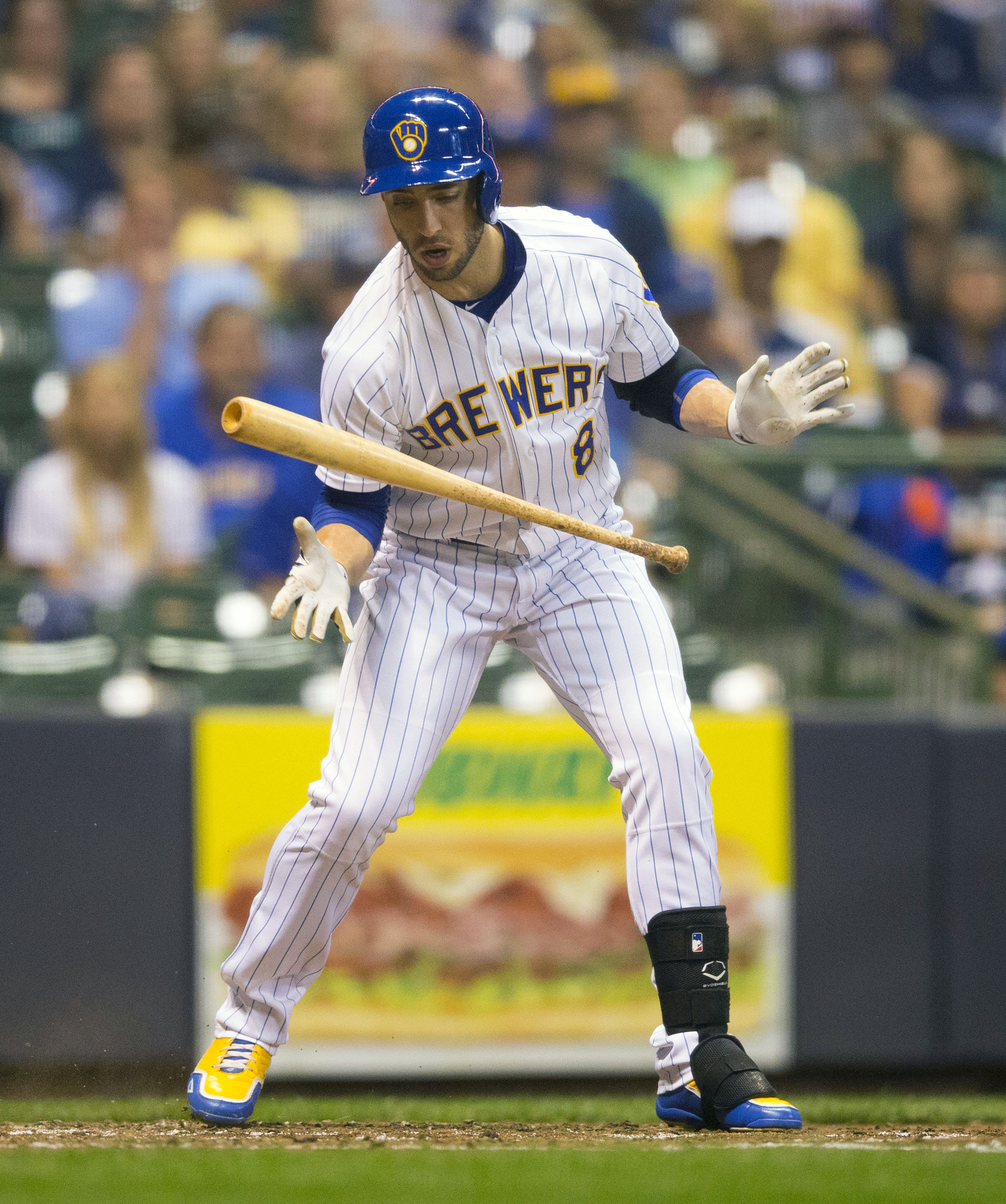 The complexion of the Brewers’ 2017 outfield will depend in large part on the potential Braun deal — the move, or non-move, that will define their offseason. Following their trades of Yovani Gallardo, Aramis Ramirez, Carlos Gomez, Mike Fiers, Jonathan Broxton, Gerardo Parra, Francisco Rodriguez, Adam Lind, Jean Segura, Khris Davis, Aaron Hill, Jeremy Jeffress, Jonathan Lucroy and Smith in recent years, Braun is one of the few valuable veterans the Brewers have left. Their return if, or when, they do finally trade him could go a long way to determining how they fare in the near future.
Braun batted .305/.365/.538 last season in his best offensive performance since 2012, so this winter would seem like an ideal time for a deal. Last summer, the Brewers and Dodgers reportedly seriously discussed a swap involving Braun, with Yasiel Puig, Brandon McCarthy and prospects heading to Milwaukee. It’s unclear how close that trade was to actually occurring, but it seems the two sides will revisit the deal this offseason, and it wouldn’t be a shock to see Braun in Dodger blue in 2017.
The value of the Brewers’ side of the deal would, of course, depend fairly heavily on the prospects involved, but the inclusion of Puig and McCarthy already makes the trade an interesting one from the Brewers’ perspective. Part of the Dodgers’ likely intention in including those players was to offset Braun’s salary, since Puig and McCarthy are set to make a combined $39.5MM through 2018. But neither Puig nor McCarthy fits the usual profile of a salary dumpee. The Brewers would get to gamble on the 25-year-old Puig’s upside, which remains considerable despite his trip to the minors last season. They would also get a solid veteran arm (albeit one who’s only recently come back from Tommy John surgery) for their rotation. McCarthy is only two years removed from pitching 200 innings with a terrific 2.85 xFIP and 52.6% ground-ball rate.
Should the Brewers be unable to consummate a Braun deal with the Dodgers, they would have no shortage of other trade suitors (although Braun’s limited no-trade clause could be a problem — as of earlier this year, he could block deals to all teams except the Dodgers, Angels, Padres, Giants, Diamondbacks and Marlins). The Giants and Braves have reportedly also had interest in Braun, and it’s likely other teams would as well. While acquiring someone like Puig in return for Braun makes sense, the Brewers don’t need to get an outfielder in a Braun deal, since they have a remarkable group of outfield prospects (including Lewis Brinson, Brett Phillips, Ryan Cordell and, lower in the minors, Corey Ray and Trent Clark).
Elsewhere in the Brewers outfield, Broxton had an outstanding second half, demonstrating plus speed and defense while batting a remarkable .294/.399/.538 before missing the last two weeks of the season due to a fractured wrist. At 26, Broxton was old for a rookie. His minor league record doesn’t suggest he can maintain the level of productivity he demonstrated in 2016, and it’s possible the wrist injury could affect him going forward. Nonetheless, his legs and glove give him a high floor, and he should be an easy choice to start in center field for the Brewers next season.
In right field, the Brewers will likely continue to give looks to Domingo Santana, with Perez potentially filling in the gaps if Santana struggles. Santana batted a respectable .256/.345/.447. Like Carter, he’s a big man who strikes out excessively and has no defensive value. Nonetheless, he warrants continued playing time, since he’s only 24 and has shown significant power potential.
It makes sense for the Brewers to keep Kirk Nieuwenhuis as a backup outfielder, given that he’ll likely cost less than $2MM in his first year of arbitration eligibility. Like many Brewers, Nieuwenhuis piles up his share of whiffs and has low batting averages. He’ll take a walk, though, and he plays all three outfield positions well and hits left-handed.
The Brewers could also aim to acquire a bit of rotation help this offseason. Of their current rotation options, only Guerra and Nelson look like much more than back-of-the-rotation types, and it’s not clear what even Nelson will become following a disappointing 2016. Nelson led the NL in walks in 2016, and if his control problems continue, it’s not hard to imagine he could wind up back at Triple-A at some point next season, since he’s optionable.
While the Brewers do have some starting pitching prospects (topped by lefty Josh Hader) who could make an impact at some point in 2017, their current group possesses limited upside and considerable downside — it’s easy to imagine the Brewers’ rotation becoming a real mess if, say, the physically slight Davies got hurt and Garza had a season more like 2015 than 2016. With Sean Nolin out for 2017 following Tommy John surgery, their depth is somewhat limited, too. The organization almost certainly won’t pursue a high-end starting pitcher, but an innings-eater might make sense. The team could also look for a high-risk, high-upside option (someone like Andrew Cashner, perhaps) in an attempt to emulate the Athletics’ success flipping Rich Hill last season. The addition of McCarthy in a potential Braun trade would also obviously help.
The Brewers already have plenty of bullpen arms to sort through, including several, like Marinez, Barnes and Knebel, who possess considerable velocity. They do, however, look likely to pursue a left-hander or two, perhaps on a minor league deal. The only healthy southpaw currently on their 40-man roster is Brent Suter, who has just 21 2/3 career innings of big-league experience and who’s mostly a starter anyway.
Whatever happens, the Brewers don’t appear likely to contend in 2017. There is, however, plenty of evidence that their rebuild is going well. They won 73 games last season, not a bad total for an organization mostly trying to address long-term goals. Their farm system is now much stronger than it was just a year and a half ago, when Baseball America rated it 19th-best in the game — thanks to a couple years of high draft picks and trades for young talent, the organization now has enviable prospect depth, and Arcia is just the first of what should be a long series of high-upside Brewers rookies. 2017 won’t be a pretty season for the Brewers, but there’s talent in Milwaukee, and more on the way.
Photo courtesy of USA Today Sports Images.
Athletics Claim Left-Hander Giovanni Soto From Cubs
The Athletics announced that they’ve claimed left-handed reliever Giovanni Soto off waivers from the Cubs. Soto was designated for assignment four days ago when the Cubs needed to clear a 40-man roster spot to send Kyle Schwarber to the Arizona Fall League in preparation for his improbable World Series return.
The 25-year-old Soto, not to be confused with the catcher that was the 2008 NL Rookie of the Year with Chicago (Geovany Soto), has pitched just 3 1/3 innings in the Majors — all of which came in 2015 as a member of the Indians. The southpaw spent the 2016 season with Chicago’s Triple-A affiliate, pitching to a 5.14 ERA with 10.1 K/9, 5.7 BB/9 and a 56.6 percent ground-ball rate in 49 innings out of the Iowa bullpen. Soto’s ERA was the result of his poor control more than opponents hitting him especially hard; though he allowed slightly more than a hit per inning, only three of those hits left the yard. Opponents hit .274 against Soto but slugged just .387. In 111 innings of Triple-A ball, Soto has a 3.96 ERA with with a 114-to-69 K/BB ratio.
Certainly, it’s not a given that Soto will survive the winter on Oakland’s 40-man roster. Players that are claimed early in this manner often bounce around the league over the course of the offseason, but the left-hander does have minor league options remaining, so if he makes it to Spring Training with the A’s, he can be sent down without the risk of first exposing him to outright waivers.
Aaron Barrett Elects Free Agency
The Nationals announced on Wednesday that right-hander Aaron Barrett has cleared waivers and elected free agency rather than accepting an outright assignment to Triple-A Syracuse. The 28-year-old, who underwent Tommy John surgery in 2015, was placed on outright waivers over the weekend.
Barrett is now more than a year removed from Tommy John surgery, but he also suffered a setback in late July when he fractured his elbow and required a second surgery to repair that injury. Prior to suffering the ligament tear that preceded his initial operation, Barrett looked to be an emerging piece in the Nationals’ bullpen. In 70 Major League innings from 2014-15, he pitched to a 3.47 ERA with 10.8 K/9, 3.5 BB/9, a 44.9 percent ground-ball rate and a fastball that averaged 93.8 mph. The 2010 ninth-rounder was effective against both right-handed hitters and lefties alike, limiting righties to a paltry .225/.299/.294 while holding opposite-handed opponents to a .239/.333/.337 slash.
There aren’t yet specifics on Barrett’s timeline to return to the mound, though considering the second procedure took place just over three months ago, there’s probably a fair bit of time left in his rehab process. Nonetheless, it’s easy to envision Barrett attracting interest on a minor league pact and possibly working his way back to the Majors sometime in 2017. Certainly, given the nature of his injuries, a full comeback is no sure thing, but there’s little harm in a team taking a chance on a once-effective reliever that still has fewer than three years of Major League service time under his belt.
Had he remained on the Nationals’ 40-man roster, Barrett would’ve been arbitration eligible as a Super Two player and been in line for a nominal raise; MLBTR contributor Matt Swartz projected him for a salary of just $700K next season. If he is ultimately able to return to the Majors, his new team would be able to control him for four years (including next season) based on the two years and 144 days of MLB service Barrett has accrued thus far.
AL Notes: Mariners, Moncada, Zimmer, Orioles
Bob Dutton of the Tacoma News Tribune writes that Mariners GM Jerry Dipoto has a hard-throwing lefty reliever — “a legit late-inning presence” — on his offseason wishlist. It’s not the first time that Dutton has reported Seattle’s interest in adding such an arm to its relief mix, and a flamethrowing southpaw would indeed be an imposing complement to sensational rookie Edwin Diaz late in the game. Previously, Dutton noted that the team’s search wasn’t likely to be focused on Aroldis Chapman, whose free-agent price tag will be staggering. The trade market may not be flush with readily available late-inning southpaws, though from a purely speculative standpoint I’d personally wonder if Seattle might match up with San Diego in a deal for either Brad Hand or Ryan Buchter. While neither possesses the velocity of a Chapman or Andrew Miller, each sat at better than 92 mph with his heater this season (92.8 mph for Hand) and delivered a breakout season. Hand proved capable of pitching multiple innings while also showing better control and ground-ball tendencies than his teammate — ultimately tossing 89 1/3 frames with a 2.92 ERA, 11.2 K/9, 3.6 BB/9 and a 46.7 percent ground-ball rate.
A few more notes from around the American League…
- Red Sox prospect Yoan Moncada suffered a thumb injury while batting in the Arizona Fall League recently, per Evan Drellich of the Boston Herald. Moncada didn’t suffer any fractures but has been out for a few days already and could undergo further testing today. President of baseball operations Dave Dombrowski tells Drellich that while it’s the same hand that Moncada has injured in the past, the issue isn’t believed to be serious at this time. Maintaining his health will be a key for Moncada as he looks to force his way back onto Boston’s roster in 2017. The 21-year-old struggled tremendously in his brief September call-up, collecting four hits and striking out 12 times in 20 plate appearances.
- Royals right-hander Kyle Zimmer completed a four-week throwing program as part of his rehab protocol following thoracic outlet syndrome surgery back in July, tweets MLB.com’s Jeffrey Flanagan. The former top five overall pick has battled shoulder problems throughout his minor league career, though the hope is that the TOS operation can help Zimmer return to health. Selected fifth overall in 2012, Zimmer has been a mainstay on Top 100 prospect lists even as he’s battled through injuries, but he tossed just 5 2/3 innings this season and has logged just 222 1/3 total innings since the 2012 draft. Only 67 2/3 of those innings have come at the Double-A level, so even if the 25-year-old is healthy next year, he’ll need further seasoning in the minors before he can be considered a Major League option in Kansas City. Flanagan notes that Zimmer is expected to be ready for Spring Training.
- An Orioles official tells MASNsports.com’s Roch Kubatko that he doesn’t believe any of Wade Miley, Ubaldo Jimenez or Yovani Gallardo is well-suited to handle a bullpen role. Kubatko writes that while it’s something of an overstatement to imply that the O’s have a surplus of rotation arms, the team could consider dealing one of that trio this offseason. Each is a change-of-scenery candidate after struggling greatly this year, and Baltimore only has two open rotation spots behind Chris Tillman, Kevin Gausman and Dylan Bundy.
Minor MLB Transactions: 10/26/16
Here are the day’s minor moves from around the league…
- The Brewers announced that they’ve re-signed right-hander Stephen Kohlscheen to a minor league contract and invited him to Major League Spring Training. The 28-year-old spent the 2016 season with Milwaukee’s Double-A affiliate and logged a 2.54 ERA with strong rates of 12.1 K/9 and 3.0 BB/9 in 49 2/3 innings of work. The former Mariners farmhand found himself traded from Seattle to San Diego alongside Abraham Almonte back in July 2014 — a trade that netted the M’s outfielder Chris Denorfia. Kohlscheen latched on with the Brewers after being cut loose by the Padres last March, and he’ll look to build off this past season’s impressive work and force his way into a Brewers bullpen picture that lacks certainty following the trades of established relief arms Jeremy Jeffress and Will Smith.
Leonys Martin Switches Agencies
Mariners center fielder Leonys Martin has changed agencies and will now be represented by Wasserman, according to a tweet from his new representation.
Martin, 29 next March, slumped badly over the final two months of the 2016 season but still enjoyed a nice all-around year in his debut campaign with the Mariners. Acquired from the division-rival Rangers in a trade that sent Tom Wilhelmsen to Texas (Wilhelmsen would return to Seattle after being designated for assignment mid-season by the Rangers), Martin hit .247/.306/.378 in 576 plate appearances. That slash is below the league average overall, but Martin clubbed a career-best 15 home runs despite moving to a pitcher-friendly ball park and also swiped 24 bags while making strong overall contributions on the basepaths (4.6 runs above average, per Fangraphs). His typically outstanding defense took a step back, per Ultimate Zone Rating and especially according to Defensive Runs Saved, but he was still a serviceable defender out there that comes with a strong enough reputation that a rebound in those metrics next season wouldn’t be a surprise.
The agency switch for Martin will come on the brink of his second trip through the arbitration process. The Cuban defector played the final season of his initial five-year, $15.5MM contract in 2015 but remained arbitration eligible and signed for a salary of $4.15MM. He now stands to earn a raise over that figure for the ’17 season, as MLBTR contributor Matt Swartz projects him to earn $6.3MM next year. The Mariners can control him through the 2018 season.
Martin will now join an agency that, as can be seen in MLBTR’s Agency Database, represents a large number of notable clients. Kendrys Morales, Bartolo Colon, Mark Trumbo and Edinson Volquez are among Wasserman’s free agents this offseason, and the agency also reps the likes of Giancarlo Stanton, among others. Martin’s shift is already reflected in our database, which features representation information on more than 2,500 Major League and Minor League players. If you see any errors or omissions, please let us know via email: mlbtrdatabase@gmail.com.
Offseason Outlook: Kansas City Royals
MLBTR is publishing Offseason Outlooks for all 30 teams. Click here for the other entries in this series.
After a pair of World Series appearances in 2014-15, the 2016 Royals fell shy of a postseason berth and now face considerable payroll questions as the core of their championship-winning roster stands one year from free agency.
Guaranteed Contracts
- Ian Kennedy, RHP: $62.5MM through 2020 (can opt out of contract after 2017)
- Alex Gordon, LF: $60MM through 2020 (including buyout of 2021 mutual option)
- Salvador Perez, C: $46.5MM through 2021
- Yordano Ventura, RHP: $20.25MM through 2019 (including buyout of 2020 club option)
- Joakim Soria, RHP: $18MM through 2018 (including buyout of 2019 mutual option)
- Lorenzo Cain, CF: $11MM through 2017
- Mike Moustakas, 3B; $8.7MM through 2017
- Jason Vargas, LHP: $8MM through 2017
- Chris Young, RHP: $7.25MM through 2017 (including buyout of 2018 mutual option)
- Mike Minor, LHP: $5.25MM through 2017 (including buyout of 2018 mutual option)
Arbitration-Eligible Players (service time in parentheses; projections by MLB Trade Rumors)
- Eric Hosmer (5.146) – $13.3MM
- Dillon Gee (5.108) – $3.6MM
- Tim Collins (5.097) – $1.5MM
- Jarrod Dyson (5.088) – $2.5MM
- Danny Duffy (5.085) – $8.2MM
- Daniel Nava (5.024) – $1.5MM
- Kelvin Herrera (4.157) – $5.3MM
- Tony Cruz (4.147) – $1.0MM
- Non-tender candidates: Gee, Collins, Nava, Cruz
Contract Options
- Kendrys Morales, DH/1B: $11MM mutual option ($1.5MM buyout)
- Wade Davis, RHP: $10MM club option ($2.5MM buyout)
- Edinson Volquez, RHP: $10MM mutual option ($3MM buyout)
- Kris Medlen, RHP: $10MM mutual option ($1MM buyout)
- Luke Hochevar, RHP: $7MM mutual option ($500K buyout)
- Alcides Escobar, SS: $6.5MM club option ($500K buyout)
- Predictions: Team exercises option on Morales, but Morales declines; team exercises option on Davis; team declines option on Volquez; team declines option on Medlen; team declines option on Hochevar; team exercises option on Escobar
Other Financial Commitments
- Omar Infante, 2B: $10MM through 2017 (was released in 2016)
Free Agents
Royals Depth Chart; Royals Payroll Information
The Royals’ back-to-back World Series appearances revitalized Kansas City baseball, but as is often the case, success proved difficult to sustain. With an 81-81 finish on the season and players like Lorenzo Cain, Mike Moustakas, Eric Hosmer, Wade Davis and Alcides Escobar all set to hit free agency following the 2017 season, the Royals have a plethora of questions on their hands.
First and foremost is whether the team can afford to make any significant additions this winter. General manager Dayton Moore flatly said that his expectation was that the team’s payroll would “regress” in 2017 after opening the 2016 campaign with a franchise-record mark of nearly $132MM. Meanwhile, team owner David Glass was less definitive when asked about reducing payroll, somewhat nebulously suggesting that it’s impossible to know where the 2017 payroll will sit because no one yet knows what opportunities will be presented in the coming offseason. As noted in the above-linked payroll breakdown at Roster Resource, though, the Royals already project to have a $139MM payroll to open next season. The notion of adding any significant pieces is somewhat difficult to anticipate, then, unless Glass is comfortable with the ledger rising into the $140MMs and possibly the $150MMs.
As such, the question becomes one of whether the Royals will actually subtract some pieces from the 2016 roster. Davis’ name was mentioned frequently in July before a forearm strain shelved him through the non-waiver trade deadline, and Kansas City has reportedly already received some early interest in its closer. Late-inning relief help is one of the few commodities that is in relatively large supply this winter — Aroldis Chapman, Kenley Jansen and Mark Melancon are all free agents, and the market also bears some quality setup options as well — but Davis’ contractual status is likely an attractive feature. Many teams will be reluctant to pay the record-breaking prices that the top names will command. Acquiring Davis would yield a premium relief arm with only a one-year, $10MM commitment required. Of the core pieces that could potentially leave after the 2017 season, Davis arguably has the most trade appeal if Moore and his staff do shed some big league talent/payroll.
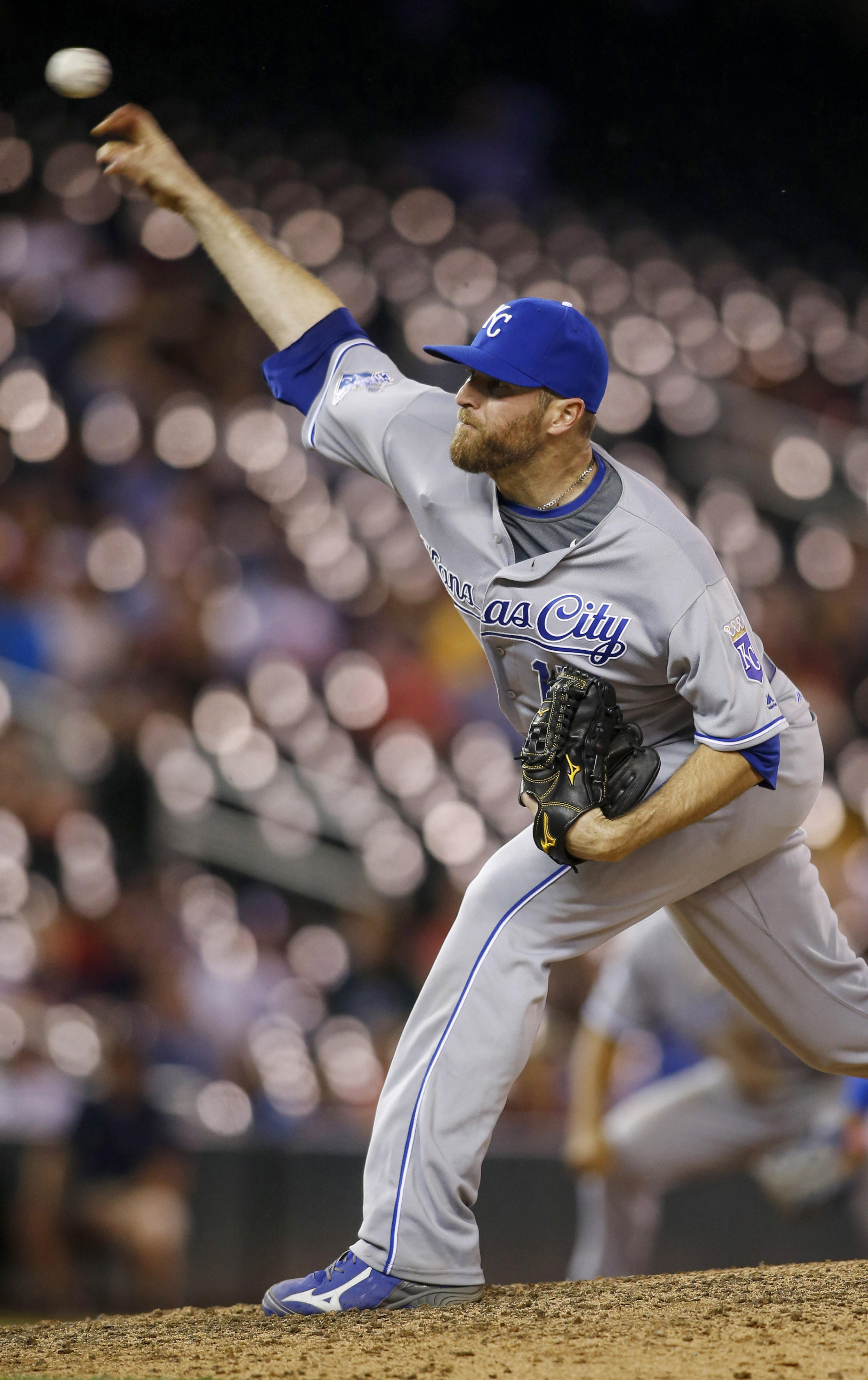
Certainly, teams would have interest in Cain, Moustakas, Hosmer and Escobar, but there are concerns across the board with that quartet. Cain missed more than two months of the season and ended the year on the shelf with a wrist strain. Moustakas didn’t play the final four months due to a torn ACL. Hosmer’s productivity tanked in the second half, and he’s projected to earn a hefty $13.3MM next year. Escobar continued to impress with the glove and on the bases, but he’s a defense-first player with no power and sub-.300 OBP skills. Looking elsewhere, Ian Kennedy had a strong finish but is on a contract that is teeming with downside (he can opt out after the 2017 season if he performs well but would be owed a total of $62.5MM over the next four years if he struggles and forgoes that opportunity). Jason Vargas’ $8MM salary is fairly manageable, but he missed the majority of 2016 recovering from 2015 Tommy John surgery.
Those names could all come up in trade talks this winter, but it’s also important to note that a full-on fire sale doesn’t seem to be in the cards for the Royals. After all, improved performance from Alex Gordon and returns to health for any combination of Cain, Davis, Moustakas and Vargas would represent an immediate means of improvement in Kansas City. And with the Tigers suggesting that they’ll trim payroll while the White Sox and Twins continue to struggle to put contending teams on the field, there’s certainly reason for Moore and his staff to believe that this core is capable of a final push for the division in 2017. If it doesn’t go as planned, plenty of those names would make appealing deadline chips, after all.
On that note, there’s no more obvious area of need for the 2017 Royals than in the rotation. Breakout star Danny Duffy figures to lead that group, and he’ll be joined by Yordano Ventura, Kennedy, Vargas and one of Chris Young, Mike Minor or sophomore Matt Strahm, who wowed in the bullpen but is viewed as a starter in the long haul. Dillon Gee, too, could factor into the mix, but he’s coming off thoracic outlet syndrome surgery and could be a non-tender candidate.
Unfortunately for the Royals, they’re faced with the same dilemma that is facing most other clubs; everyone needs starting pitching, but the free-agent market is relatively barren. Despite that fact, Kansas City reportedly plans to opt against investing an additional $7MM into Edinson Volquez and will elect a $3MM buyout over exercising his $10MM option. That may indicate that the team doesn’t plan to spend big money on starting pitching, so minor league deals or lower-cost targets like Tommy Milone, Bud Norris or Jhoulys Chacin could be in order. Alternatively, the Royals could look to sign a pitcher to a two-year pact but heavily backload the deal so as to only commit a few million in 2017 while saving the bulk of the payout for the 2018 season, when the books clear up.
The other half of the pitching staff will need some work, too — especially if the Royals do ultimately find an offer for Davis that is to their liking. Kelvin Herrera is a dominant late-inning arm, but Joakim Soria’s return to the team has been somewhat of a flop so far. Strahm could reprise his role if the Royals feel they have ample rotation depth, and the Kansas City Star’s Rustin Dodd recently highlighted fast-rising prospect Josh Staumont as a potential midseason factor from the right side. Brian Flynn proved a useful southpaw (2.60 ERA in 55 1/3 innings), but the Royals are going to need to find some arms either within their system or late in the offseason. From Kansas City’s vantage point, there’s merit to the idea of waiting out the market and snatching up one or even two of the middle relievers/setup men that fall through the cracks while waiting for bigger deals that never materialize. It’s also worth noting that there’s reportedly been mutual interest between the Royals and righty Peter Moylan about a new contract, so he could return on a one-year deal.
Looking around the diamond, the Royals are more set. Salvador Perez remains one of the best catchers in baseball, Hosmer is locked in at first base despite his second-half collapse, Moustakas will return to the hot corner and Escobar is penciled in at shortstop (once his option is exercised). Gordon will hope for better results at the plate in the second season of his now-troublesome-looking four-year, $72MM deal, and Cain will continue to hold down the fort in center field (though there’s been some talk of occasional time in right to help keep his hamstring healthier). With Jarrod Dyson and Paulo Orlando representing options for the remaining outfield spot, the Royals don’t necessarily need to look there, although an upgrade to the right-handed side of the platoon wouldn’t hurt. Orlando is one baseball’s least disciplined hitters and owes his solid batting line almost entirely to a .380 BABIP that he can’t be expected to repeat. Dyson, meanwhile, doesn’t hit much but is a defensive wizard and provides huge value on the bases, which led to 3.1 rWAR and fWAR. If he can maintain 2016’s K/BB improvements, he’s a solid and affordable option.
Second base and DH are the other two potential spots to add some talent, but the Royals do have options at second in Christian Colon, Whit Merrifield and Raul Mondesi Jr. (though the latter of that group seems likely to head to Triple-A for continued work at shortstop so he can prepare to take over for Escobar at shortstop in 2018). Like Orlando, Merrifield got by with some significant BABIP fortune (.361) but showed little plate discipline and virtually no power. Colon’s glove can handle the job, but his bat looked an awful lot like that of Omar Infante last season, whom the Royals released midway through his ill-fated four-year deal. Kansas City would be a nice fit for Chase Utley on a one-year deal, but the Royals could also hope to snatch a veteran second baseman late in the winter on a minor league deal or a lower-cost one-year pact.
As for the DH slot, the first question facing the Royals will be whether to tender a qualifying offer to Kendrys Morales. Given the financial uncertainties surrounding the roster, that seems unlikely, as adding a $17.2MM commitment for a strict DH would shoot the team’s estimated 2017 payroll to nearly $160MM. The free-agent market does feature a number of somewhat redundant first base/DH types; Brandon Moss, Pedro Alvarez, Mitch Moreland, Adam Lind, Logan Morrison and even Ryan Howard are all available, and it’s unlikely that they’ll all find lucrative deals. Grabbing one of those players on an affordable one-year pact makes some sense, but the DH spot could simply be kept open to help Moustakas and others get some days off from fielding. That would not only help to keep them healthier and also give the Royals a means by which Cheslor Cuthbert could get into the lineup, though the 24-year-old did fade down the stretch.
Ultimately, the Royals are in a somewhat unenviable spot — stuck in the middle between contention and a need to rebuild. They probably feel this is their last shot at contending with this core, but there are myriad holes throughout the lineup and few ways to patch them without sending payroll soaring into uncharted and unsustainable territory. The Royals reportedly operated at a loss this season, so tacking on tens of millions more to the payroll isn’t a sound business decision. But, their means of plugging holes with homegrown talent took a hit when they used a solid-but-not-overly-deep farm system to acquire Johnny Cueto and Ben Zobrist in 2015. Those trades subtracted four pitchers — Sean Manaea, Brandon Finnegan, Cody Reed and John Lamb — that could otherwise be immediate rotation options for a club that now finds itself with an unreliable mix of starters. You’ll never hear the Royals or their fans complain about it, of course, as the 2015 World Series outweighs any long-term troubles for the franchise. Nonetheless, a poor start to the 2017 season could be the precursor for a summer sale, and even if the Royals are able to contend in the AL Central next year, this is a franchise that is destined for a significant amount of turnover beginning next winter, at the latest, when its core hits the open market.
Photo courtesy of USA Today Sports Images.
NL Central Notes: Schebler, Cora, Cardinals
As the Cubs kick off their first World Series game in 71 years, here’s a look around the division at some of the teams that will be chasing them next season…
- Scott Schebler appears to have the inside track on the Reds‘ right field job next year, Mark Sheldon of MLB.com writes. The 26-year-old bounced back after some early struggles and showed enough promise to think he’s deserving of a larger opportunity. Acquired in last winter’s Todd Frazier trade, Schebler hit .265/.330/.432 in 282 plate appearances with the Reds, tallying nine homers and a dozen doubles in that limited exposure. MLBTR’s Jason Martinez looked at the subject in his recent piece previewing the Cincinnati offseason, suggesting that the organization give him a shot while also looking to bring in some competition. Top prospect Jesse Winker could eventually push for a corner outfield spot in the Majors as well, although the 23-year-old’s power numbers dipped in Triple-A this season.
- The Pirates are set to name Joey Cora as their new third base coach, reports Cory Giger of the Altoona Mirror (Twitter link). Cora managed Pittsburgh’s Double-A affiliate in Altoona this season and has several years of experience as a Major League bench coach and third base coach. He’ll replace Rick Sofield, who served as Pittsburgh’s third base coach from 2013-16 but was fired over the weekend, according to a club announcement. Cora, like his younger brother Alex, enjoyed a lengthy Major League career as an infielder and has previously been considered for managerial vacancies at the Major League level.
- MLB.com’s Jenifer Langosch tackles a number of offseason questions in her latest Cardinals inbox piece, noting that despite a lackluster performance from the pitching staff this season, a significant addition seems unlikely. The free-agent market is, as has been well-documented, stunningly thin in terms of quality arms. And as far as the trade market is concerned, the team likely feels satisfied enough with its depth that it won’t feel compelled to meet the escalated asking prices that will perpetuate the trade market for rotation help. Langosch also looks at how the Cards stack up with the Rockies in potential trades and again emphasizes that the team is likely to focus on upgrading its up-the-middle defense this winter.