
Adam Liberatore To Undergo Left Elbow Surgery
Dodgers lefty Adam Liberatore will undergo a debridement procedure tomorrow on his left elbow, the team announced. He is expected to be able to recover in time for a full 2017 season, per the team’s statement.
Liberatore, 29, was a revelation for the Dodgers in the first half of the campaign. He had only ever appeared in the majors previously in 2015 for L.A., but allowed just two earned runs over his first 33 innings on the season.
That pace proved difficult to keep up, especially as injury issues crept in. Liberatore ended up struggling through August and September, and ended the year with a 3.38 ERA ovr 42 2/3 frames, with an excellent 9.9 K/9 versus 3.6 BB/9.
Given his difficulties, Liberatore likely wasn’t slated to appear in the postseason for the Dodgers even before today’s news, as Andy McCullough of the Los Angeles Times tweets. Still, it’s disappointing that he won’t even have a chance to appear if a need arises.
The Dodgers are no strangers to managing pitchers with health issues, so they’ll no doubt value Liberatore as a potential contributor next year. Still, he’ll need to earn his opportunities and prove his health next spring in order to claim a major role in the Los Angeles pen in 2017.
Tony La Russa Won’t Run D-Backs’ Baseball Ops; Future With Org Uncertain
The Diamondbacks continued a massive organizational overhaul today, firing GM Dave Stewart and manager Chip Hale after previously parting ways with VP DeJon Watson. Chief Baseball Officer Tony La Russa remains with the team at this point, but as MLB.com’s Steve Gilbert reports, he’ll no longer run the team’s baseball operations department.
A new decisionmaker — whether a president of baseball operations, general manager, or both — will take over the reins in molding the team’s roster. At this point, it’s not known when or how the organization will go about filling the void, but president and CEO Derrick Hall says that the new hire will be expected to put greater emphasis on analytics.
Statistical analysis was one of several areas that observers have cited in criticizing the most recent iteration of the D-Backs’ oft-changing front office mix. La Russa was brought on as CBO in hopes that he’d oversee a successful organizational decisionmaking structure, but things haven’t turned out as hoped (as detailed in the post on the firing of Stewart and Hale). In the statistical arena, La Russa has been openly skeptical of the role of analytics, and raised many eyebrows with his hiring of long-time acquaintance — and first-time baseball front office man– Ed Lewis as director of baseball analytics and research.
Arizona’s top brass — Hall, who just inked an eight-year extension, and managing general partner Ken Kendrick — claimed a share of the responsibility for the failings. But they suggested that it was necessary “to turn the page and hit reset and see if we can’t get going in the right direction,” as Hall put it, by starting fresh with a new GM and manager. Per Kendrick, the organization “did not see the trend line at present moving in the right direction.”
Whether La Russa will be a part of the reshaped front office is an open question that was apparently not fully resolved in a lengthy meeting this morning (as Jon Heyman of Fan Rag notes on Twitter). Talks will continue as to what, if any, role may make sense for the Hall of Fame manager, whose foray into the D-Backs’ front office was his first in that capacity.
Jeff Luhnow On Trade Deadline, 2017 Needs & Payroll, Rasmus
Astros GM Jeff Luhnow says that he recognizes in retrospect that the team would’ve been better served to be more active at the trade deadline, as Angel Verdejo of the Houston Chronicle reports. But that wasn’t entirely apparent at the time, he stressed.
In particular, the losses of starters Dallas Keuchel and Lance McCullers Jr. left a difficult void for Houston down the stretch. But Luhnow says that he “didn’t have that perspective at that point,” referring to the August 1st trade deadline and its run-up. He also noted that, “over the long term, [foregoing additions] does sometimes turn out to be the right decision;” obviously, striking significant deals typically requires the sacrifice of young talent.
The “jury’s out” on whether the ‘Stros should have been more aggressive this summer, says Luhnow, who does note that there are lessons to be learned from the 2016 experience. “I can’t control what happened after the deadline,” he said. “But we’re certainly going to continue to look at every opportunity going forward to give ourselves maybe a little more breathing room so if we do lose a player or we have some underperformance, that we’ve got more of a margin to still have a successful campaign.”
The Houston GM also addressed a variety of other important topics for the organization as it moves forward after missing the postseason.
In Appreciation Of Vin Scully
Many have shared their appreciation of legendary Dodgers broadcaster Vin Scully as he steps away from the microphone after 67 magical seasons. MLBTR joins them in honoring one of the most uniquely compelling figures in sports history.
Chances are, you didn’t first fall in love with baseball by reading about it on the internet. More than likely, it happened as you sat amidst the peanut shells at a ballpark; smelled the leather of a new mitt; stumbled onto a Wrigley day game on WGN while flipping through the channels one summer; heard your dad grumbling about a blown call in last night’s contest; picked up the glorious tones of a golden-voiced announcer through an intermittently-fading radio signal.
However it happened, what led you here was likely something quite different from the statistics, money, and rules that we discuss on a daily basis. Probably, the reason you care about the player transactions that shape Major League Baseball is that you first found yourself intoxicated by the intricate details of the game itself, while absorbing it as a fan and amateur participant.
Baseball is cherished by those who have found it because it is exponentially rewarding in its repetitive, utterly simple details. Look closer and you’re drawn further in. The punctuating moments have such meaning only because they emerge from a layered canvas, with all its patina.
And that is why Vin Scully, the now-former Dodgers broadcaster, is so important and so meaningful — and not just because he calls a good game. For all his great calls, which we’ve enjoyably relived in recent weeks, his singular excellence resided in the mundane.
Just how is that batter digging in? Where’s the happiest kid in the stands and what is it about this pleasant good evening that he’s enjoying so much? Who, really, is this mop-up pitcher who’ll handle the eighth inning of a meaningless, late-season blowout? What is the count, and the score, and how does that relate to the standings and the [insert memory/history lesson/interesting fact] and oh look! just what are those brawling players shouting at each other (give or take)?
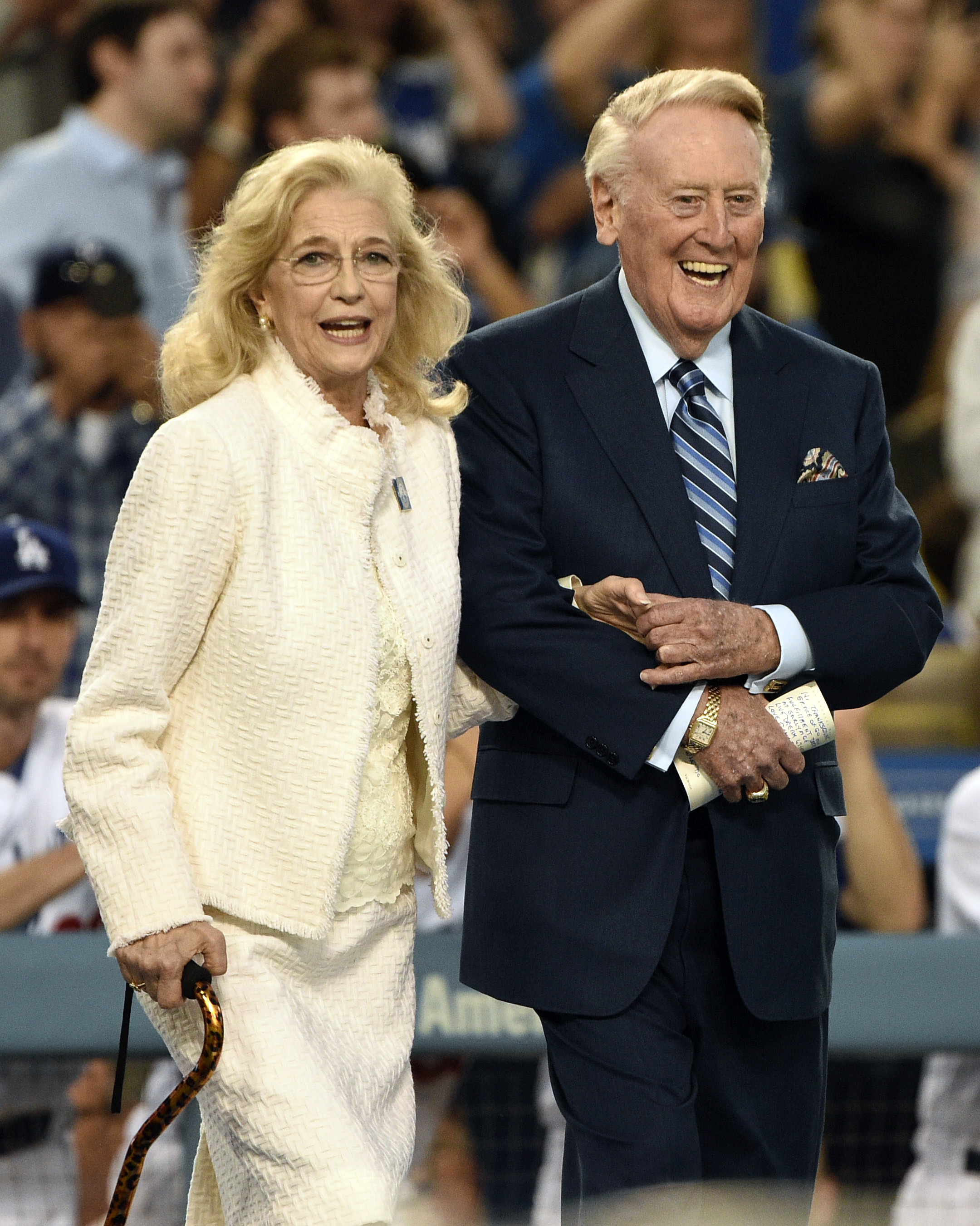
Baseball by Vin is sharing memories, imparting and receiving wisdom, experiencing an event with the like-minded while seeking out and valuing different perspectives, exhibiting vigorous curiosity, accumulating and disseminating knowledge, building standing in a community with (and through) humility and gratitude, deriving meaning from the commonplace — whether times or moments are good or bad.
He didn’t just provide us with the best way to take in a ballgame. Broader lessons reside in the countless hours that Scully spoke into a microphone — often from the words themselves, but also from the steady cheer of the man who delivered them and the sheer fact that he did it for so long and with such obvious care. In a way, if we listened closely, he showed us how to navigate our lives, with all their ups and downs but also their sometimes-monotonous routines and easily-overlooked opportunities for appreciation.
It is bittersweet to think these thoughts now, and not just because we’ll no longer hear Scully’s perfect narration of yet another 9 innings — never again listen to his gentle cadence guide us through the game — but because baseball and life intersected more jarringly last Sunday.
The loss of Jose Fernandez was an unthinkable tragedy, a gut punch not only to his loved ones, but also — in a different but still-meaningful way — to most anyone who follows the game of baseball. That devastating blow reinforces Scully’s essential meaning, because Fernandez — whose immigrant journey was every bit as quintessentially American as Scully’s New York-to-Los Angeles epic — possessed an infectious joi de vivre different in form, but not in kind, from Scully’s.
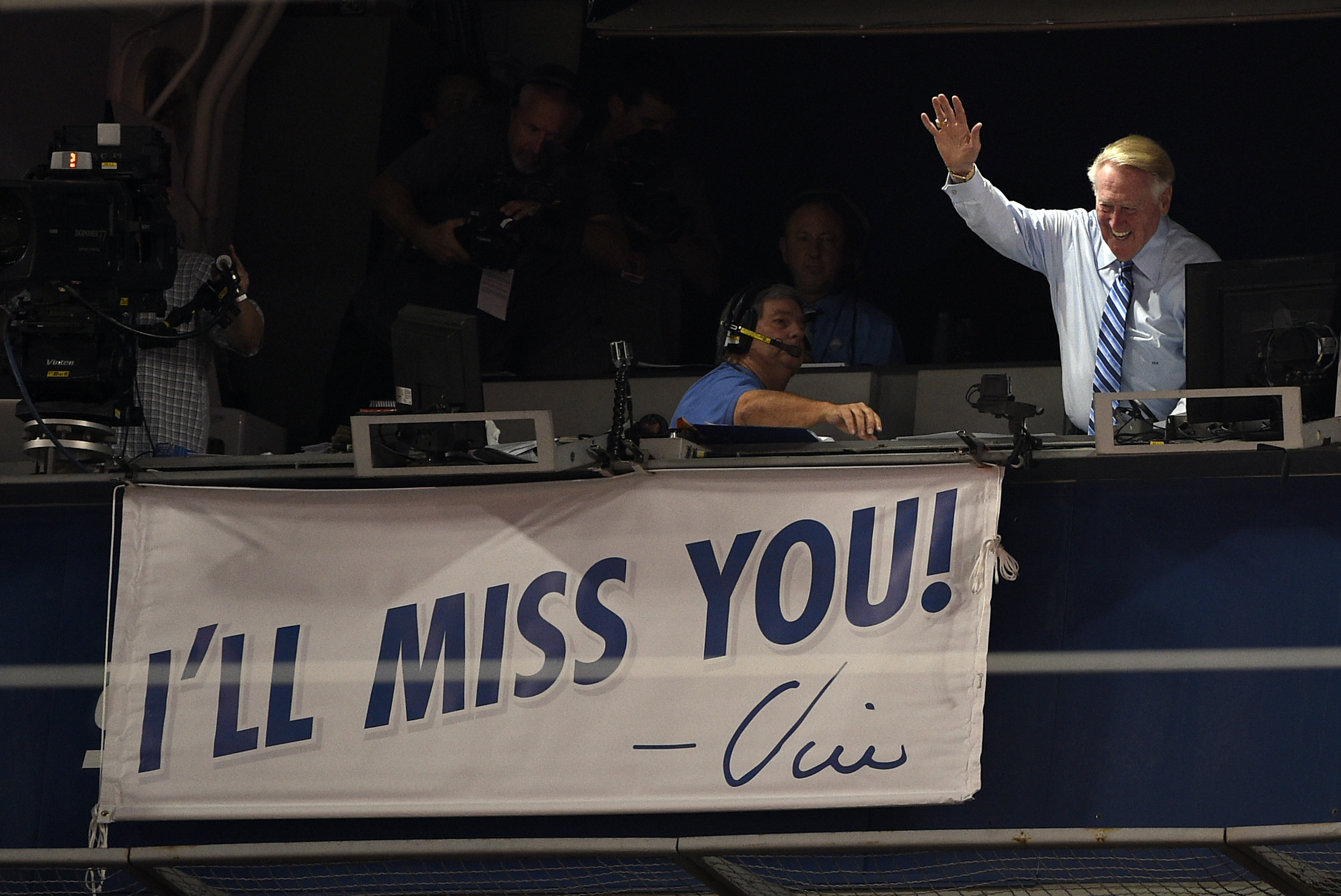
Scully’s dependability and longevity, and Fernandez’s fleeting brilliance and flair, speak to the same fundamental messages: Life is best lived buoyantly. Its many splendors, great and meager, ought to be treasured daily. Celebrating our differences as well as our commonalities is our bond. There’s zen to be found in a ballgame, and just about anywhere else, with observation and appreciation. And the way to cope with the stultifying or the unfortunate things that life throws at us is not to despair or retreat, but to double down on joy.
Thanks, Vin, for letting us listen in. If we truly heard you, we might just end our days with only two regrets: that we didn’t absorb your life’s wisdom sooner, and that we didn’t catch enough ballgames with you at the mic.
Photos courtesy of USA Today Sports Images.
Burke Badenhop: Free Agency, A Decade In The Making
As a professional baseball player, you deal with a lack of autonomy throughout your career. At the onset you don’t choose who you work for, they choose you. You can’t request a transfer, but instead are subject to being traded. If you don’t like your current situation, well, you can’t just up and leave and join another team that might present a better opportunity. These situations are entirely unique to your chosen profession, but you deal with them nonetheless. It’s simply part of the territory. You’re forced to play the cards you’re dealt, but at the same time, you’re happy to have cards to play. The one way to gain some limited freedom in our game is to reach free agency. For the select few, that chance is just around the corner.
Reaching free agency is not a reality for the average player, unfortunately. A player’s service time determines when they reach free agency. Service time is literally how many days you have been on the big league roster. Every day that service time clock ticks. One. Day. At. A. Time. It takes six full years of that clock ticking to be granted free agency. Six years is a long time. I made my debut in 2008 along with 238 other players that year. Of those 238, only 58 of us earned enough service time to reach free agency, roughly 24%.
If you do happen to be one of the guys to make it, though, it’s rare to earn six years of service time over six consecutive seasons. Players tend to shuffle from the big leagues to the minor leagues at the start of their careers, resulting in partial service time that counts toward your overall time. It might take seven or eight seasons for a player to earn six years of service. Throw in the two or three (and that’s on the short end) years in the minor leagues before reaching the bigs, and you’re looking at about ten years from the time a player is drafted until he can make any kind of decision that relates to his career. And the same rules apply to everyone. Perennial All-Stars have to wait just as long as tossed-around right handed middle relievers like myself.
Most players who reach free agency aren’t bombarded by all thirty teams, either. Having ten teams courting you is actually a lot. I was pumped that four or so teams were heavily involved once I reached free agency. The teams calling also might not be the most personally desirable or ideal situations. You could have family in a certain area that you’d like to be near, but have no teams interested for thousands of miles. Maybe you’ve only been offered platoon roles when you’ve always been a regular starter. Regardless of the options presented, it’s the presence of options at all that excites a player.
Now, the rules governing free agency aren’t unfair. They are what they are. While baseball is a business, it’s an extremely unique business, especially as it relates to the players. And know that when a player leaves your team as a free agent this off season, it’s nothing personal. It’s just a decision he has probably been waiting ten years to make.
Marlins Will Not Retain Barry Bonds As Hitting Coach
The Marlins have decided to part ways with hitting coach Barry Bonds, as Jon Heyman of Fan Rag reports. This was his first season in that role, which he shared with Frank Menechino.
Bonds’s time in Miami seemed to go rather smoothly from the outside, but it appears that the arrangement may not have worked out quite as hoped behind closed doors. Manager Don Mattingly “called out” Bonds at some point in the middle of the year, after which time the latter’s “commitment level dwindled,” per Craig Mish of MLB Network Radio (via Twitter).
The major league lifetime leader in home runs for a career and for a single season, Bonds came to Miami in hopes of reclaiming a place in the game. He had seemingly been frozen out of Major League Baseball after his career with the Giants wrapped up following the 2007 season. At the time, Bonds still represented a fearsome presence at the plate, but was viewed as a major symbol of the steroid era.
It appears as if owner Jeffrey Loria was the chief supporter of Bonds, as Barry Jackson of the Miami Herald reports (Twitter links), but some players also viewed him favorably. Ultimately, it was Mattingly who seemingly drove the decision to make a change.
Bonds isn’t alone in departing the Marlins’ staff. Third base coach Lenny Harris and bullpen coach Reid Cornelius have also been cut loose, per Andy Slater of 940 AM WINZ (via Twitter).
Diamondbacks Fire Dave Stewart, Chip Hale
The Diamondbacks have announced that they’ve fired GM Dave Stewart and manager Chip Hale. There was no immediate word on whether the Snakes intended to retain chief baseball officer Tony La Russa. “We are still discussing what the appropriate role for Tony La Russa will be going forward,” Kendrick said in a statement.
The decision on Stewart comes as little surprise, as it had previously been reported that owner Ken Kendrick was slated to meet with La Russa today to discuss the statuses of both Stewart and La Russa, both of which seemed to be in jeopardy. Hale’s departure, meanwhile, will allow Stewart’s successor to be involved in choosing a replacement.
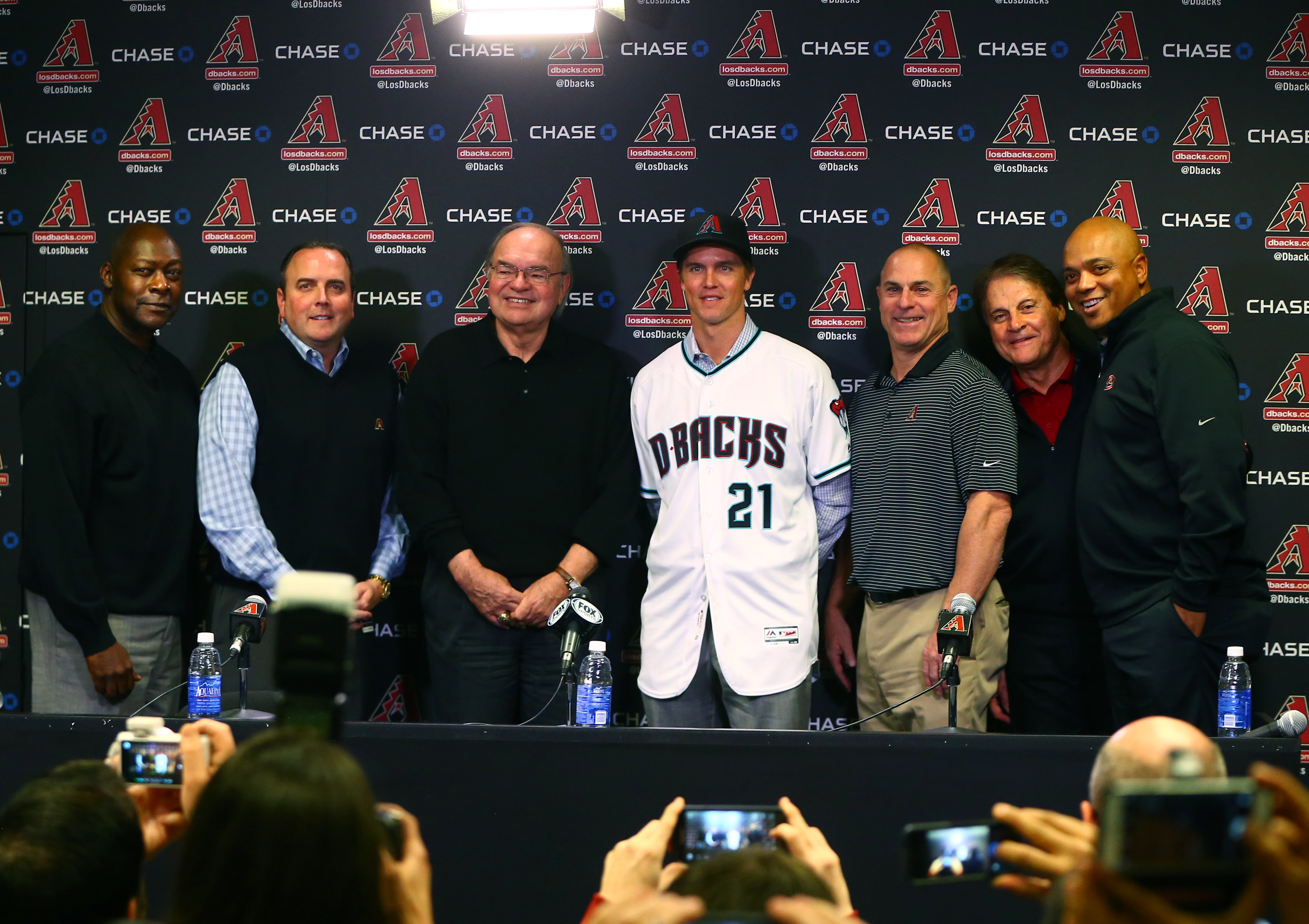
The Diamondbacks hired Stewart in September 2014, so his tenure with the team was very short for a GM. During that time, however, the team’s front office made a number of questionable moves, chief among them the trade that sent 2015 first overall pick Dansby Swanson, along with outfielder Ender Inciarte and pitcher Aaron Blair, to Atlanta for starter Shelby Miller and minor leaguer Gabe Speier. Miller has struggled terribly thus far in Arizona, posting a 6.15 ERA, 6.2 K/9 and 3.7 BB/9 in 101 Major League innings in 2016. Swanson, meanwhile, made it all the way to the big leagues in just his second pro season and played well, batting .302/.361/.442 down the stretch for the Braves.
Perhaps just as important as the actual result of the deal was the view of player valuation it represented. Swanson alone would been a very steep price to pay for Miller, since Swanson was a premium prospect who had done nothing to sully his status as a former top overall pick. Stewart’s approach was also widely questioned earlier in his tenure after a less consequential deal in which he traded Bronson Arroyo and another former first-round pick, Touki Toussaint, to Atlanta for Phil Gosselin in a deal designed to clear about $10MM in Arroyo’s salary from the Diamondbacks’ books.
The Diamondbacks hoped to position themselves as contenders for 2016, not only acquiring Miller but also signing Zack Greinke to a massive $206.5MM deal. Greinke was serviceable but underwhelming for Arizona, posting a 4.37 ERA, 7.6 K/9 and 2.3 BB/9 in his first season there. The Diamondbacks also suffered a number of other setbacks (beginning with a costly injury to star outfielder A.J. Pollock) and they won just 69 games, miles below expectation. (Stewart himself had gone so far as to say preseason projections that the team would win 78 or 79 games were “a joke.”)
Earlier in his tenure, Stewart’s Diamondbacks also signed Yasmany Tomas to a $68.5MM deal that, so far, has led to underwhelming results. The 25-year-old Tomas did bat .272/.313/.508 this season, but struggled so much defensively that his value was limited. For his career in the big leagues, Tomas has -1.2 fWAR.
Not all of Stewart’s moves have been unsuccessful. He acquired shortstop Jean Segura in a swap that has worked out well so far, and his trade for Robbie Ray has also mostly been a success. On balance, though, his decisions have arguably left the organization in worse shape than when he took office. While others share significant responsibility for some of those moves — the Greinke signing, in particular — there are many questions with the organization’s direction.
The process, even more than the decisions themselves, has come under fire since La Russa took command and hired Stewart. Arizona took a notably different approach from the get-go, but increasingly it seemed that the unique operating philosophy was not only potentially problematic in its own right, but also came with other concerns. ESPN.com’s Keith Law detailed a long list of missteps, some of which reflected an apparent failure to grasp rules and contemporary valuation principles. That includes the mismanagement of draft and international funds, such as the bonus pool-busting signing of Yoan Lopez — which cost Arizona a chance to acquire other talent to add a prospect who outside observers aren’t terribly fond of.
Now that change is afoot, a new dugout chief will also be sought — presumably, after the baseball ops department is sorted out. Hale, after all, was the hand-chosen skipper of La Russa and Stewart, though they may not have ended up being supporters. Reports suggested that Arizona’s ownership group intervened to prevent La Russa and Stewart from sending the now-former skipper out of town earlier this summer.
That proved only to be a temporary hold, though, and Hale will wrap up his first stint in charge of a dugout after a rough 2016 campaign. His original contract only promised two years — both of which are now in the books with a 148-176 overall record — but also included an option year. The organization exercised that provision at the outset of spring camp this year, so Hale will be entitled the guaranteed money.
It isn’t immediately clear what led to Hale’s dismissal beyond the fact that it affords a clean slate. But whatever the particular internal considerations were in this case, it’s not often that a manager survives the kind of season that the D-Backs just wrapped up — in which sky-high expectations (whether or not they were reasonable) went entirely unmet.
Photo courtesy of USA Today Sports Images.
West Notes: Scioscia, Padres, Athletics
Angels GM Billy Eppler has confirmed today that Mike Scioscia will manage the team in 2017, Jeff Fletcher of the Orange County Register tweets. The news comes as no surprise, since both Eppler and owner Arte Moreno suggested in August that Scioscia would return. The Angels had a poor 74-88 record in 2016, although that was in large part because of a number of injuries to key starting pitchers. Scioscia still has two years and $12MM remaining on the $50MM deal he signed with the team all the way back in 2009. Here’s more from the West divisions.
- Wil Myers and Yangervis Solarte are the only Padres guaranteed starting spots in 2017, manager Andy Green tells MLB.com’s AJ Cassavell. The Padres have had other position players who did well in 2016, such as second baseman Ryan Schimpf and outfielder Travis Jankowski, but it appears they’ll all have to fight, at least to some degree, for starting spots. “I can’t look at another position on the field and say, ‘That guy’s going to start at second base,’ or, ‘That guy’s going to start at shortstop,’ or, ‘That guy’s going to start in center field,'” says Green. “Some guys have made some strong cases — Schimpf has, Jankowski has. But we’ll let it play out in Spring Training.” Cassavell suggests the team could look outside the organization for rotation, relief and shortstop help this winter.
- Athletics exec Billy Beane is happy about the team’s young pitching depth, but he could still look outside the organization for a veteran starter, Comcast SportsNet California’s Joe Stiglich tweets. The team figures to have a healthy Sonny Gray leading its rotation in 2017, and Sean Manaea and Kendall Graveman took steps this season to establish themselves as reliable big-league starters. Jharel Cotton also got good results down the stretch. There are any number of other options on the Athletics’ 40-man roster, but injuries and performance issues cloud the picture. The team’s success last season with Rich Hill last season could perhaps also help convince them to add a veteran as a low-risk, high-reward proposition. The Athletics signed Hill for just $6MM, and he (along with Josh Reddick) ultimately landed them Cotton, plus low-level prospect Grant Holmes and the hard-throwing Frankie Montas (who missed most of the season with a rib issue but could become a 2017 rotation option if he’s healthy).
Quick Hits: Gomes, Cozart, Henderson
Veteran outfielder Jonny Gomes hasn’t yet retired, he tells WEEI.com’s Rob Bradford. “I guess to be retired you have to file your papers,” says Gomes. “Before you file your papers you have to mentally be there. I’ll tell you what, 10 or 15 years from now, when I’m on my third job description and you asked me if I wanted to play I would probably say, ‘Yes.’ Painters paint, firefighters fight fires and baseball players play baseball.” Gomes played for the Braves and Royals in 2015, then briefly appeared with the Rakuten Golden Eagles in 2016. He says that, if his playing career were to come to an end, he might have interest in a job elsewhere in the game, be it in coaching, managing, scouting or in a front office position. Here are more quick notes from around the league.
- Reds shortstop Zack Cozart missed the end of the season due to a knee injury, but says he expects to be healthy to start offseason workouts next month, Mark Sheldon of MLB.com writes. It’s not clear whether he’ll be returning to the Reds, however. “You know there are going to be rumors,” Cozart says. “I dealt with it at the Trade Deadline, and it was weird. Just like with [Jay Bruce], the Reds are all I’ve ever known. Hearing your name in rumors or possible trade scenarios is weird.” The 31-year-old Cozart has one year remaining before he’s eligible for free agency, and the Reds might benefit from clearing a regular spot for Jose Peraza to play. Cozart’s consistently strong defense and modest pop (he batted .252/.308/.425 with 16 homers in 508 plate appearances in 2016) ought to attract at least some trade interest, should the Reds go that route.
- The Phillies have officially announced that they’ve parted ways with hitting coach Steve Henderson, as CSNPhilly.com’s Jim Salisbury tweeted yesterday. They will retain all their other big-league coaches. Henderson had been the Phillies’ hitting coach for the last four seasons, having previously served as hitting coach for the Astros and Rays. The Phillies struggled offensively in 2016, batting just .240/.301/.385 as a team and getting especially poor seasons from Cody Asche, Tyler Goeddel, Aaron Altherr, Ryan Howard and Jimmy Paredes.
Rob Manfred On A.J. Preller’s Suspension: “I Know Where A.J. Is”
Major League Baseball has had to deal with a number of situations recently in which it’s had to punish teams or front offices, rather than players. Those include the Padres’ failure to disclose some medical information in trades, which led to the suspension of GM A.J. Preller; the Red Sox’ manipulation of international signing practices; and hacking of the Astros’ database by a Cardinals front office employee. Evan Drellich of the Boston Herald explores those issues an excellent article that includes new tidbits from commissioner Rob Manfred. (We also highlighted some of Manfred’s other thoughts on the Preller matter yesterday.)
Some throughout the game have wondered whether Preller’s 30-day suspension is enforceable. He would, surely, only need his phone and computer to continue to influence over the Padres’ decision-making. Manfred, though, says that the league has mechanisms in place to ensure Preller stays away.
“I know where A.J. is,” Manfred says. “We’ve also told the Padres that we will be making investigatory undertakings to verify that there has been no contact. They’re very, very explicit rules about what he can and can’t do. I think given the circumstances, I am comfortable we can enforce the penalty.”
The Red Sox, of course, were victims of Preller’s handling of medical information, having been deprived of relevant records in the Drew Pomeranz / Anderson Espinoza swap. The Sox could have rescinded the deal in either July or August, Drellich reports. When the Red Sox learned that the Padres had withheld information, they informed the league, but took the position that they wanted to keep Pomeranz, even after receiving the results of an MRI that increased their frustration with the situation. (The exact results of the MRI are not publicly known, although Pomeranz is currently struggling with left forearm soreness.)
“For a very, very long time, there has been a rule in baseball that if something happens in terms of lack of complete information or disclosure with respect to the trade that the remedy is to rescind the trade, and you saw that baseball rule operate,” Manfred says, referring to the partially-rescinded trade between the Padres and Marlins involving now-injured Colin Rea. (Rea originally headed from the Padres to the Marlins with Andrew Cashner and Tayron Guerrero for Carter Capps, Jarred Cosart, Josh Naylor and Luis Castillo, then headed back to the Padres for Castillo alone.) “Once that happens the rule in baseball has always been that we do not reconfigure trades. Figuring out exactly what happened when is extraordinarily difficult if not impossible. And even if we can figure that out, we are not institutionally capable of deciding who would have traded what for what.”