
Indians Designate Kirby Yates
The Indians have designated righty Kirby Yates for assignment, per a club announcement (via MLB.com’s Jordan Bastian, on Twitter). His roster spot was needed for Mike Napoli, whose signing was made official today.
Yates, 28, was acquired from the Rays for cash earlier this winter. He has still yet to pitch for another organization. The righty surrendered a remarkable 30.3% HR/FB rate (and 18 earned runs) in his 20 1/3 MLB frames last year. There’s almost certainly some poor luck baked in there — he’s shown a propensity for the flyball in the majors, but has never allowed double-digit homers in a minor league season — but it’s certainly an issue he’ll need to overcome.
That being said, there’s a reason that Cleveland added Yates in the first place, and he figures to get another shot at the bigs at some point. After all, he’s long registered double-digit strikeout-per-nine rates in the minors and tossed 36 frames of 3.75 ERA ball in 2014, with 10.5 K/9 vs. 3.8 BB/9.
Paul DePodesta Leaves Mets For NFL
Mets executive Paul DePodesta is leaving the franchise, according to Ken Rosenthal of FOX Sports (Twitter link). In fact, he’ll be leaving baseball entirely and will join the NFL’s Cleveland Browns, per Joel Sherman of the New York Post (via Twitter). Cleveland has announced DePodesta’s hiring as its “Chief Strategy Officer.”
[RELATED: Visit ProFootballRumors.com to read more about the move from the Browns’ perspective.]
DePodesta had served in New York as the VP of player development and amateur scouting. He was considered one of the top advisors to Mets GM Sandy Alderson, and perhaps factored as a long-term GM candidate for the franchise. Both Sherman (via Twitter) and MLB.com’s Anthony DiComo (Twitter links) suggest that he was viewed previously as a potential successor to Alderson. That, obviously, no longer appears to be a likely outcome. As Dicomo adds, New York will need to overhaul its draft approach, as that was one area in which DePodesta exercised broad authority.
The long-time baseball executive served as the Dodgers’ GM in 2004-05, taking on the position at just 31 years of age. Of course, he’s best known for his stint with the Athletics, as depicted in the Moneyball book and film. While those sources are said to present something of a caricature of the man, DePodesta is widely credited for his intelligence and data-saavy approach to the sport.
A graduate of Harvard University, where he played both football and baseball, DePodesta broke into the sports world with a Canadian Football League internship. It wasn’t long thereafter, however, that he earned a chance with the Indians, and he quickly gained a rising profile in the Cleveland front office.
Interestingly, DePodesta is reportedly not the only MLB exec who was pursued by the Browns. The organization also made an offer to former Indians and current Blue Jays president Mark Shapiro before he went to Toronto, per Tony Grossi of ESPNCleveland.com (via Twitter).
The Dollar Value Of Recent Opt-Out Clauses
Following a wave of multi-year club options attached to deals, players and their agents have begun to request and receive player options in recent years as well. David Price, Johnny Cueto, and Jason Heyward have each received them this winter, meaning that quantification of such deals is essential for careful team building. (Editor’s note: this article was written before the Dodgers reached an agreement with Scott Kazmir.) Everyone up to the commissioner has expressed concern that these “opt-out” clauses have been included in deals, and some feel teams simply should not give them. However, this is akin to saying that teams should not pay players above the league minimum salary—of course teams would like to do this, but you need to give players compensation to sign them. An opt-out is a way to lower the cost in dollars to the team, because the player will want more money otherwise.
Each of these three deals would be substantially more expensive without opt-out provisions—each opt-out clause is worth around $20MM, by my calculations. To test this, I looked at how a rough weighting of previous years’ WAR would affect a future projection, and compared this to how that projection would crystalize as it got closer. This led to an estimate that a very rough projection of future value 2-3 years in advance would change by about 1.0 WAR over the following 2-3 years. A more sophisticated system would probably change by about 0.7 WAR as it gets closer—and dollar value would probably change by about $7MM per year after accounting for overall uncertainty in salary levels. (The relationship between dollars and WAR utilized in this post is explained at this link.)
Given that potential level of variation, there are still a wide band of possibilities in terms of what a given player’s expected future value will be at the point of decision on an opt-out. But at base, an opt out is a binary choice: yes or no. Based on what we know now, and based on reasonable projections, we can estimate a given player’s future expected value at that point of decision by weighting different possible outcomes.
In other words, if Player X opts out, we can assume it is because his anticipated value at the point of that decision is higher than that which he would have earned through the remaining portion of the contract. But we don’t know exactly how much higher. So, to arrive at a value for the scenario in which a player does opt out, I’ve weighted all of those possibilities and reduced them to a single dollar value. The same holds true of the situations in which the player does not opt out.
We’ll get into each player’s situation further below, but this table shows the results of the exercise. (App users can click on this link to see the table image.)
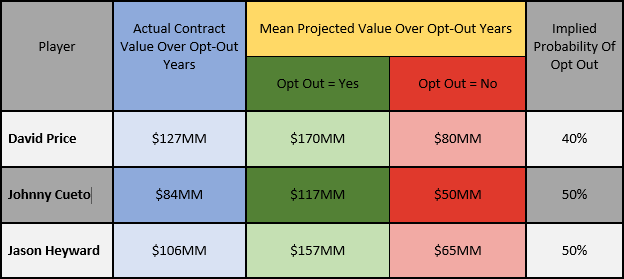
David Price received a contract for seven years at $217MM, but it was really a three-year contract for $90MM with a player option of four years and $127MM. If Price only held teams to a three-year commitment, he would probably get close to $120MM—but this is not what he did. Instead, he will require $127MM for 2019-22, only on the condition that he looks to be worth less than that by then. Although $127MM is not a terrible estimate of his 2019-22 production as of January 2016, this value will probably change drastically by October 2018, one way or the other. If he does not opt out, he probably will have performed worse, and conditional on the assumption that he will not have opted out, I estimate his expected value for his 2019-22 seasons to be $80MM. If he does opt out, he probably will have performed better, and conditional on the assumption that he will have opted out, I estimate his expected value for those seasons to be $170MM. Given that this corresponds to roughly a 40% chance of opting out, his opt-out clause is worth about $17MM, meaning that his seven-year $217MM contract is roughly equivalent to a seven-year $234MM contract with no opt-out clause.
Johnny Cueto’s contract is somewhat trickier, but it essentially amounts to a deal of two years for $46MM, with a player option of four years and $84MM, followed by a club option of one year for $16MM. Cueto would probably be worth $17MM above his salary for 2016-17. But for 2018-21, he is likely to be worth $50MM if he does not opt out and $117MM if he does. With roughly even odds of opting out, this makes his opt-out worth about $17MM. While the club option for 2022 makes the deal somewhat more attractive for the Giants, the odds that he will be worth much more than this are low. Overall, Cueto’s six-year deal for $130MM would probably cost about $147MM with no opt-out clause.
Jason Heyward’s contract is even trickier, but it mostly boils down to a three-year deal for $78MM, followed by a five-year player option for $106MM—except that the first player option (if exercised) is only certain to include one more year for $20MM. That’s because there’s a vesting provision that, if triggered—by Heyward reaching 550 plate appearances in the season following the initial option decision—would give him yet another player option for four years and $86MM. (If he exercises the initial option but then doesn’t reach that PA threshold, then both sides would be stuck with the remaining four years of the contract.) Heyward’s value is further complicated by the fact that signing him required forfeiting a draft pick, which is worth around $9MM.
Although Heyward’s contract contains two opt-outs, it is not all that likely that he opts out after 2019 if he does not after 2018. Players’ values do change substantially, but he is likely to be either much more valuable than his five-year player option after 2018, or much less valuable. It is not that we expect his value to look similar after 2018 and 2019—it is that he will probably already be way above or way below the current expected value near $20MM per year, and is likely to remain way above or way below this line through 2019.
For the first three years of Heyward’s contract, I estimate that he is worth about $22MM more than his contract will pay him. With five years of player option, there is a wide range of potential values afterward. I estimate that he also has about even odds of opting out, but if he does not opt out then he is probably only worth $65MM, while if he does he would be worth $157MM. If he doesn’t opt out after 2018 and does after 2019, he is likely near the middle and the value of the second opt-out is small. The net effect is that his opt-out clauses are worth about $25MM, and he would probably have received $209MM for eight years instead of $184MM had no opt-out been included in the deal.
With values of $17MM for each of the two pitchers and $25MM for Heyward’s pair of opt-outs, these opt-outs help keep costs down for teams. While they contain more downside and less upside than typical free agent contracts, they cost less money as well. As teams move forward in this new market, they should be careful to properly consider the true cost of these player options. If teams are willing to expose themselves to some downside risk, they can lower the cost of acquiring elite players.
Stewart: D’Backs Won’t Sacrifice Another Draft Pick
After giving up the 13th overall pick in this summer’s draft to sign Zack Greinke, the Diamondbacks are not interested in parting with another choice, GM Dave Stewart tells MLB.com’s Steve Gilbert. That would appear to take Arizona out of the running for any of the remaining free agents who would require draft picks to sign since they rejected qualifying offers earlier at the outset of the offseason.
The D’Backs’ top remaining selection is a Competitive Balance Round A choice that currently rates as the 37th overall choice, though that number will change as QO-bound free agents pick their destinations. “We’re not going to give up the pick,” Stewart said. “It’s just tough after we’ve already given up our first pick. To give up our top two picks, that would be difficult for us to do.”
That stance would appear to put a damper on a report earlier today suggesting that the club was still in talks with infielder Howie Kendrick, who rejected a qualifying offer from the Dodgers. Stewart said there was appeal to adding a veteran infielder, “only just for the security of it,” but noted that the team still feels good about what it well get out of its younger position players. Notably, though he made clear that the team has no inclination to punt a pick, he did not rule out other avenues to acquiring an established player from that mold.
While it is not surprising to hear that the club values the draft pick, it is frankly somewhat surprising to hear Stewart rule out its sacrifice so conclusively. After all, that choice is far less valuable than the one already parted with. And while any other free agent would likely pale in comparison to Greinke in terms of expectations, Arizona has already sought to push up its competitiveness timetable by signing him and giving up a big haul for fellow righty Shelby Miller. There’s always a place to draw a line, of course, but this does seem like a somewhat curious place to make a firm stand.
It’s worth noting, in that regard, that this is the same team that arguably did not maximize its draft and international spending capacity last year. Arizona also traded its first-round choices from 2014 (Touki Toussaint) and 2015 (Dansby Swanson) in recent months. Of course, the organization has gone against the grain in numerous ways, and seen many of its decisions called into question, yet certainly looks to be in a stronger overall position than many would have anticipated this time last year.
Stewart went on to add that the Snakes are still looking for relievers, though he said there are some intriguing young in-house options that could compete for a spot. The Diamondbacks have been connected to a variety of names in trade scenarios, but it appears that the current asking prices are too high. “I can tell you it will be difficult to do it by a trade,” Stewart said. “So we’re going to look through the free-agent market and see what else is left. I think that’s the way it’s going to have to happen if we’re going to do it at all.”
NL Central Notes: Engel, Cervelli, Rodriguez, Bruce
Former Blue Jays scouting director Bob Engel is heading to the Reds organization as the new international cross-checker, according to reports from Jonathan Mayo of MLB.com (via Twitter) and Bob Elliott of the Toronto Sun (on Twitter). Cincinnati has made some notable international signings in recent years with Raisel Iglesias and Aroldis Chapman.
Here are a few more notes from the NL Central:
- Pirates catcher Francisco Cervelli is coming off of a breakout campaign in which he contributed in all facets and stayed on the field, as MLB.com’s Adam Berry writes. Cervelli says he’d love to stay with Pittsburgh for the long term, though he added that he has not been contacted by the front office regarding extension talks and would let his agent handle any such matters. Certainly, it would be interesting to see how negotiations would progress if they do occur, as Cervelli could be a highly sought-after free agent if he can repeat his 2015 campaign. But there’s also plenty of downside, as that was the first time he put it all together over a full season.
- Young outfielder Yorman Rodriguez could find a chance with the Reds this spring, MLB.com’s Mark Sheldon writes. The out-of-options 23-year-old will likely compete with other inexperienced players like Scott Schebler and Adam Duvall. Rodriguez put up a .269/.308/.429 slash last year over 326 Triple-A plate appearances.
- All of those outfielders would benefit, of course, if the Reds end up trading Jay Bruce, of course, although it would stand to reason that the organization will bring in some low-cost veterans once the market shakes out. As for Bruce, Sheldon reports that the Indians have replaced the Blue Jays on his limited no-trade list — likely a reflection of the fact that Cleveland has been pursuing outfield help this winter. The other clubs to which Bruce can block a deal are the Yankees, Red Sox, Athletics, Rays, Marlins, Twins, and Diamondbacks. Sheldon breaks down the possible suitors for the left-handed hitting veteran.
Padres, Ian Desmond Having Ongoing Discussions
TODAY: Discussions between the two sides are “very preliminary,” according to Jon Heyman (via Twitter). While there is an expectation that the Pads will have talks this week with Desmond’s camp, Heyman says the purpose will be “to see if there’s anything to talk about.”
YESTERDAY: The Padres and free agent shortstop Ian Desmond are having ongoing discussions, according to major league sources who spoke with Jon Paul Morosi of FOX Sports. Even though that match would make a lot of sense, no deal appears to be imminent between Desmond and San Diego, Morosi adds.
Morosi notes that Desmond hit 88 home runs over the past four seasons and in that same span the Padres scored the second-fewest runs in the majors. Meanwhile, their 2015 shortstop Alexi Amarista had the worst OPS (.544) of any National League player with at least 300 at-bats last season. Financials and, perhaps, their timeline for contention aside, the Padres sound like the perfect landing spot for Desmond.
Desmond picked up three straight Silver Slugger awards from 2012 through 2014, and owns a .264/.317/.443 since he began his breakout in 2012. While that line was down overall in 2015, his .307 BABIP did fall shy of his career .322 mark and he showed more life at the plate at times later in the season. The 30-year-old’s calling card is his ability to deliver power from a middle infield position, but his reps have also been highlighting his defensive ability when meeting with teams. The Padres would slot Desmond in as their starting shortstop without hesitation, but Desmond appears to be open to playing other positions in an effort to broaden his market.
Desmond declined his qualifying offer from the Nationals back in November, but San Diego’s top pick (8th overall) is protected. The team also stands to add two compensatory picks if and when Justin Upton and Ian Kennedy land elsewhere. At the outset of the offseason, MLBTR’s Tim Dierkes predicted that Desmond would land a five-year, $80MM deal.
Minor MLB Transactions: 1/4/16
Here are the day’s minor moves:
- The Angels have agreed to a minor league deal with infielder Gregorio Petit, MLB.com’s Alden Gonzalez reports on Twitter. He’ll receive an invitation to major league camp this spring. Petit, 31, has appeared in 82 big league games in parts of four seasons, including a brief stint last year with the Yankees. He’s spent quite a bit of time at Triple-A, compiling a .267/.320/.370 batting line in 3,029 plate appearances spread over eight years. Petit has mostly played shortstop, but has also compiled over 1,000 frames at second and third. He figures to provide some depth and a possible utility option for a Halos club that is still looking to fill out its infield.
Free Agent Notes: Orioles, Gallardo, Marlins, Pearce
The Orioles appear poised to once again do quite a bit of their offseason shopping after the New Year, tweets ESPN’s Buster Olney. According to Olney, the Orioles remain engaged on a number of free agents, which isn’t a surprise given the holes permeating the roster. While the O’s have addressed catcher (perhaps unexpectedly in the form of Matt Wieters accepting the qualifying offer), one corner outfield spot (Hyun-soo Kim) and first base/DH (Mark Trumbo), the team still has needs in the rotation and in right field, to say nothing of a potential reunion with Chris Davis (which would move Trumbo to DH or right field).
Here are a few notes on the market’s remaining free agents…
- One of those free agents appears to be Yovani Gallardo, as SB Nation’s Chris Cotillo tweets that the the Orioles, Astros and Royals remain the primary suitors for the right-hander. All three of those teams, of course, have been prominently linked to Gallardo in the past, so this isn’t necessarily a new development in his market. However, it’s been awhile since we’ve heard much on the Gallardo front, and the news that all three remain interested is still noteworthy. Any of the three clubs would have to part with a draft pick to sign Gallardo, which might make Kansas City the best fit, as their current pick, No. 24, is the worst of the three teams said to have interest. Additionally, the Royals will gain a draft pick if Alex Gordon signs elsewhere, as many expect, thus softening the blow of parting with the 24th overall selection. The O’s could conceivably land two picks in the event that Davis and Wei-Yin Chen sign with new clubs, but parting with the No. 14 pick would still sting, even if they could recoup much of that slot value via the potential comp picks.
- If and when the Marlins finalize their near-agreement with right-hander Edwin Jackson, the team will continue its search for starting pitching, writes MLB.com’s Joe Frisaro. Among the names that could interest the Marlins are Cliff Lee, Doug Fister, Ian Kennedy and Cuban right-hander Yaisel Sierra, writes Frisaro. However, he notes that the draft pick compensation attached to Kennedy could prevent the Marlins from a strong pursuit of Kennedy. That would seem an odd hold-up for Miami — an organization that has been perfectly willing to trade its Competitive Balance draft selections for seemingly underwhelming returns in past seasons (although their addition of right-hander Bryan Morris in such a trade does now appear to have been a shrewd one). It should also be noted that Kennedy is represented by Scott Boras, with whom Marlins owner Jeffrey Loria and Marlins president David Samson have clashed on numerous occasions over the past year (most notably regarding Boras-represented Marlins players Marcell Ozuna and Jose Fernandez).
- Infielder/outfielder Steve Pearce is seeking a two-year deal, Rich Dubroff of CSN Mid-Atlantic tweets. He still looks like an interesting bat, and his market remains an interesting one to watch, but Pearce could be forced to wait for more action at the higher end before things clear up for his own outlook. MLBTR’s Tim Dierkes predicted that Pearce would ultimately get a two-year deal with $14MM in guaranteed money.
D-Backs Having “Ongoing Discussions” With Howie Kendrick
Last week, GM Dave Stewart told the Arizona Republic’s Nick Piecoro that his Diamondbacks have been in contact with second baseman Howie Kendrick, and today, FOX’s Jon Morosi characterizes discussions between the two sides to be “ongoing.” Nothing is close between the two sides, per Morosi, and it should be noted that Piecoro wrote last week that the D-backs seem reluctant to sign a player that would require draft pick forfeiture, as Kendrick would.
Arizona has a number of infield options already, though presumed starter Chris Owings certainly doesn’t have Kendrick’s track record and is, in fact, coming off a dreadful season that was submarined by shoulder problems. Other internal options for the Diamondbacks at second base include prospect Brandon Drury (though he can also play third base) and struggling veteran Aaron Hill, who has one season remaining on his deal.
Despite the presence of in-house alternatives — at least one of whom, Owings, was recently viewed as a core player in the future — this isn’t the first instance of the D-backs being connected to second base upgrades. Arizona was also said to have discussed a swap of Hill and Reds second baseman Brandon Phillips. While that may appear curious at first glance, such a move would’ve saved the Reds quite a bit in terms of salary and relieved some burden from their payroll in the nearer future; Arizona, in turn, would reallocate Hill’s salary to a more productive veteran player. Ultimately, Piecoro reported last week that the D-backs weren’t comfortable with the salary that the Reds wanted them to assume in a Phillips/Hill swap. (And, of course, there’s the question of the trade veto ability that comes with Phillips’ 10-and-5 rights.)
Digression aside, Kendrick would seem to represent an upgrade over what the D-backs have in house. The 32-year-old has batted .295/.340/.414 over the past three seasons despite playing in considerably more pitcher-friendly environments than Arizona’s Chase Field. Kendrick has been remarkably consistent throughout his Major League tenure, providing offense that rates anywhere from a shade below to considerably above the league average when looking at league- and park-adjust metrics such as OPS+ and wRC+. Kendrick has never batted lower than .279 in a full season and never posted an OBP south of .313. His career .293/.333/.423 batting line is impressive and a reflection of his repeated seasons of quality at-bats.
However, Kendrick isn’t without his red flags, either. Much of his value has come from his quality defense over the years, and he took a significant step backwards in that regard last season. Ultimate Zone Rating and Defensive Runs Saved pegged Kendrick at -4.5 and -12 runs, respectively, despite his longstanding history of solid glovework. Kendrick, who has also been highly durable, missed more than a month on the disabled list due to a hamstring strain as well. While that incident could very well be isolated in nature, one can’t blame any team for hesitating to surrender a draft pick in order to sign a 32-year-old second baseman with a good-but-not-great bat and possibly deteriorating defensive skills to a long-term pact.
Morosi also notes that the Angels could potentially fit the description of a contending team with a need at second base, though I’d add that owner Arte Moreno’s aversion to the luxury tax would make that a tough fit. If the Angels were to sign Kendrick, from my view, they may as well sign an impact left field bat to upgrade the lineup at that point, shifting Craig Gentry and/or Daniel Nava into backup roles.
Doug Fister Has Received One- And Two-Year Offers
Doug Fister is one of many intriguing names still available on the free-agent market, and according to ESPN’s Buster Olney, the right-hander has received offers of one and two years in length from multiple clubs (Twitter link). To this point, it’s been a quiet offseason in terms of rumors pertaining to the PSI Sports client, although the Tigers, Phillies and, more recently, the Marlins have all been connected to Fister in media reports. (Detroit’s interest was mentioned in November, so he’s probably off the Tigers’ radar now. The same may be true of the Phillies, who were linked to Fister in early December.)
Entering the 2015 season, Fister was part of what looked to be a star-studded class of elite and second-tier arms that were slated to hit the open market this winter. However, the 2015 campaign was the worst of his career by nearly any measure. Fister, of course, began the season in one of the game’s deepest rotations (Nationals), but he surprisingly struggled to the point where he lost his starting job and was moved to the bullpen. While he’s never thrown hard in the past, Fister opened the season averaging just over 86 mph on his fastball and eventually landed on the disabled list in mid-May with a bout of forearm tightness. He returned about a month later but didn’t see much in the way of improved results. All told, the 31-year-old (32 in February) recorded an uncharacteristic 4.60 ERA across 15 starts in his second (and presumably final) season with the Nats. In those 15 starts, Fister logged 86 innings (about 5 2/3 innings per outing) and struck out just 48 hitters — an average of 5.01 per nine innings. Fister’s 4.63 FIP, 4.60 xFIP and 4.70 SIERA all matched his unsightly ERA, and his 42 percent ground-ball rate out of the rotation this season was the lowest of his career.
While there’s clearly a long list of red flags surrounding Fister, the upside he brings to the table is also tantalizing. From 2011-14, Fister was one of baseball’s most underrated player, recording a pristine 3.11 ERA with 6.5 K/9, 1.7 BB/9 and a 50.5 percent ground-ball rate across 750 2/3 innings. He landed on the DL a few times in that stretch for a strained lat muscle and a pair of strained muscles in his side — nothing arm-related — and averaged 188 innings per season in that time (201 per season when factoring in the playoffs, where he owns a 2.60 ERA in 55 1/3 innings).
Fister is entering his age-32 season, and the significant drop in his velocity could be the beginning of a decline phase for the right-hander. However, it’s also worth noting that he handled relief work exceptionally well (2.12 ERA, 15-to-6 K/BB ratio in 17 2/3 innings) and maintained his usual brand of strong control in 2015 (2.1 BB/9). If Fister can reestablish some velocity or learn to alter his style to succeed with diminished heat, he could prove to be an excellent value on a one- or two-year contract. And, if he goes the one-year route, he could re-enter the free-agent market next winter in a definitively thinner starting pitching class.