
Valuing A Chris Sale Extension
As he closes in on his 30th birthday and the start of his tenth season of action in the big leagues, Chris Sale (through his reps at Jet Sports Management) is engaged in at least some level of discussion with the Red Sox regarding an extension. The upcoming season is the final year of control under the deal Sale originally signed with the White Sox, adding some impetus to discussions.
It’s a fascinating situation to consider, owing to a variety of considerations. From a narrative perspective, the club’s whiff on Jon Lester years ago provides obvious fodder for comparisons. And an otherwise quiet winter from the defending World Series champs also makes for an intriguing backdrop.
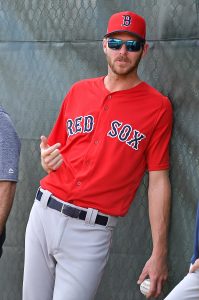
The really interesting part, though, is the valuation itself. Starting pitchers have found a fair bit of success at prying monster deals from clubs entering a walk year. Clayton Kershaw‘s original extension (seven years, $215MM plus opt-out) is the largest, but Stephen Strasburg‘s recent $175MM deal also makes for a notable recent data point. Both of those pitchers were more youthful than Sale, but Justin Verlander‘s second extension (which added five years and $140MM to his existing deal) was signed at a comparable age point (and two seasons in advance of his free agency).
That’s not to say that any of those particular deals really looks to be a perfect comp for Sale. Rather, they go to show that Sale can and should be looking for a contract that values his would-be free agent seasons at their anticipated market value.
On the other hand, there’s also no small amount of risk to be priced in here. That was the case with those other contracts, to be sure, but in this case the team will no doubt be particularly wary. After all, Sale missed five starts last year with still-mysterious shoulder issues. Though he’s said not to have exhibited structural problems, he showed some potentially worrisome velocity changes (with a correspondingly wandering release point) last year.
Both the team and Sale himself surely know quite a bit more than we do about his health. Certainly, his overall track record is one of excellent durability. While Sale’s funky delivery and big velocity readings have long led to predictions of physical ailments, he averaged 30 starts and 205 frames annually from 2012 through 2017.
Whatever the health risk may be relative to other pitchers, there’s little denying that Sale’s recent performance track record is quite free of red flags. All told, Sale has a 2.89 ERA in nearly 1500 career MLB innings and currently sits as the all-time leader in K/9 and K/BB ratio.
Importantly, too, he was in top form last year. Sale was deployed judiciously in the 2018 postseason but did record 24 strikeouts in 15 1/3 frames. Before that, he handled 158 regular-season innings, over which he allowed just 37 earned runs on 102 hits and 34 walks while racking up a whopping 237 strikeouts. When you smooth out the ups and downs in the radar readings, Sale threw harder overall last year than he ever has as a starter (95.7 mph average four-seamer). He also generated more swinging strikes than ever before (15.8%).
Those facts seem to distinguish Sale from Kershaw, who recently provided another notable contractual point to consider. The Dodger star’s new deal was hammered out in a near-open-market scenario, in the window before he had to decide whether to opt out of the final two years and $65MM of the aforementioned contract. The sides came up with a rather unique arrangement: three years, $93MM, with $12MM in total incentives that are achievable in full if Kershaw is at full health throughout the deal. Kershaw turns 31 in March, just before his new deal begins, so that contract covers almost the exact same age period as Sale’s next contract will. Not unlike Sale, Kershaw missed a few outings last year but still generated impressive results. Unlike Sale, Kershaw has exhibited more significant and long-lasting concerns in terms of his stuff and peripherals. The Dodger stalwart averaged 162 innings annually in the three seasons preceding his deal, with a series of back issues limiting his availability, tamping down his velocity, and reducing him from the game’s best pitcher to “merely” one of its best.
In the Kershaw scenario, it seems fair to say that the Dodgers mostly took a health discount by limiting the length of the commitment and including a hefty, easily achievable, but health-dependent incentives structure. It’s the kind of contract we might have expected, in the not-so-distant past, for an outstanding pitcher of an older age. That Kershaw took it at a relatively youthful stage is testament both to the level of concern with his long-term outlook and perhaps also the newfound market commitment of many teams to avoid obligating payroll space too far into the future (particularly for players in their mid-30s).
It seems easy to say that Sale won’t need to settle for the Kershaw deal to get something done. The latter has had the more impressive overall career, but his recent red flags are impossible to ignore. Still, it’s an interesting general scenario to contemplate when imagining what a deal could look like.
How’s it look for players who hit free agency under more favorable circumstances? The approach long has been to chase the biggest and lengthiest deal on the open market. David Price ($217MM) and Max Scherzer ($210MM) were each a bit younger when they secured their seven-year mega-deals — both turned 31 during the first seasons of their new contracts — than Sale will be when he hits the open market. Zack Greinke, the only other pitcher to top $200MM, turned 32 just before reaching free agency, so he was a fair bit older. He got six years and $206.5MM, easily setting a Major League record (which he still holds) with an average annual value north of $34MM.
There’s little question that Sale could position himself for massive earnings in the 2019-20 offseason with a performance that mirrors his 2018 in quality and his prior career in durability. Sale could be joined by some big names on the open market, but he almost surely possesses the greatest earning upside of any possible free-agent starter. Price’s total guarantee and Greinke’s AAV marks both seem theoretically achievable, though it’s arguable whether that kind of coin will still be available in today’s market. Even if we could accurately gauge Sale’s true earning ceiling, which would depend upon quite a few market factors, reaching it represents only one of several conceivable scenarios. With something less than full health, or declines in velocity and/or effectiveness, Sale’s earning power would obviously begin to slide.
So, where might we anticipate the price tag landing in extension talks? Sale will earn $15MM in 2019 regardless of any new deal, so we’ll consider only the future seasons. Presumably, the Red Sox will look for some kind of discount (in salary, years, or both) to account for the health uncertainty — both that of any pitcher separated from free agency by a full season and whatever added questions come with Sale. Might the Boston organization seek to cabin the length of the contract? Or would it be amenable to a lengthier deal that spreads the guarantee over a longer span, thus reducing the annual luxury tax hit? And what about Sale’s own preferences?
Supposing the Sox are willing to go to Greinke levels on the AAV but not on the term, it’s possible to imagine a five-year extension in the range of $175MM. That figure would also match the recent Strasburg deal, albeit over a shorter duration (his was for seven years) — arguably a fair result for a more accomplished and consistent, but also less youthful starter. But is that really the most sensible approach? Perhaps the team would rather stretch things out, even if it means committing to additional seasons. Adding six years at $190MM would not greatly expand the Red Sox’ overall commitment. For one thing, it’s reasonable to anticipate that Sale will still be a useful-enough pitcher at the end of that deal to warrant his salary. There’s a risk he won’t be, certainly, but there’s also real upside (see, e.g., Verlander) as well as the promise of continued inflation driving down the effective price.
Interestingly, the club’s luxury tax situation also increases the value of spreading the AAV. Let’s do a bit of math to see how this looks. Sale’s original extension, signed before the 2013 season, will have paid him a total of $59MM over seven seasons, but option years are treated as one-off seasons for purposes of the competitive balance tax calculation. That means that Sale’s hit to the Sox’ books this year will be his current salary of $15MM. Modifying his forward-looking contract rights, though, would change that number by adding the new years and dollars and then re-running the AAV. As MLBTR’s Steve Adams examined recently with regard to a hypothetical re-signing of Craig Kimbrel, any new money added to the Boston luxury ledger is going to be taxed at a hefty rate. A new deal for Sale would not only trigger a drop in draft placement but would also mean a big tax bill increase. You can find the details there; for our purposes, since a new deal would certainly be of sufficient magnitude to push the club into the top tax bracket, the Red Sox would pay 75 cents for every additional dollar of AAV they take on. And that’s just for the 2019 season. If the organization continues to exceed the luxury line, it’ll keep getting hit with bills — every one of which will be impacted by Sale’s AAV.
It’s not hard to see how adding a season or even two at a relatively lesser salary might begin to make sense, particularly when one includes the concept of the time-value of money. Here are a few scenarios to kick around (all dollars in millions):
| Extension Years | Extension Money | Extension AAV | Cumulative AAV | 2019 Tax Increase |
| 5 | $150 | $30.00 | $27.50 | $7.83 |
| 5 | $175 | $35.00 | $31.67 | $10.96 |
| 6 | $160 | $26.67 | $25.00 | $5.96 |
| 6 | $180 | $30.00 | $27.86 | $8.10 |
| 6 | $192 | $32.00 | $29.57 | $9.39 |
| 6 | $207 | $34.42 | $31.64 | $10.94 |
| 7 | $175 | $25.00 | $23.75 | $5.02 |
| 7 | $200 | $28.57 | $26.88 | $7.37 |
| 7 | $217 | $31.00 | $29.00 | $8.96 |
These are, of course, largely random price points (some of which connect to contract comps noted above, others of which are simply round numbers). But they serve to show how much cash the Red Sox could in theory be forced to take on right now if they really want to avoid paying Sale past his mid-30s. That hit, as noted already, would potentially be repeated in future seasons in which the club nears or passes the luxury line. Those considerations may well factor into the organization’s approach, whatever level of health-related discount is deemed necessary to make a contract appealing.
If a lengthier, more spread-out deal might make greater sense for the ballclub, what about Sale? As my colleague Steve Adams reminded me, the southpaw hinted recently that he could go looking to set new high-water marks of some kind. As Sale put it: “You want to do right by the guys who are coming next year, two years, 10 years down the road because you kind of set the bar and the next guy who comes along either gets to that bar or sets it a little more.”
If he intends to raise the bar in an extension scenario, one full season removed from the open market, there’s no realistic way he’s going to top the line set by Price. Breaking the overall guarantee record (seven years, $217MM) would almost certainly mean pitching in 2019 before negotiating his next contract. On the other hand, Sale could take aim at Greinke’s AAV mark. In that case, though, it’s awfully tough to see the Red Sox making a commitment past five additional seasons (if they’re willing to make such a deal in the first place).
Perhaps Sale’s bar-raising sentiments shouldn’t be taken too literally. He no doubt appreciates that an extension situation necessarily involves other considerations (and lacks competitive bidding). A hurler of his age reaching the $200MM mark in new money, say, would represent a notable achievement even if it came with a relatively less-impressive AAV and didn’t really set any recognizable records. In terms of maximizing his own career earnings (without taking the risk of first pitching another season), there’s not a whole lot of downside to going for the biggest total guarantee possible at this stage, even if it effectively means taking a cheaper valuation for the last season or two of the new contract. Even if Sale were to hit the open market on the upswing in his later years — as may well occur next winter for Verlander — the additional earning ceiling at that point would be fairly limited, at least in terms of contract length.
If there’s a deal to be made here, then, the sweet spot could actually be on a longer term than might be anticipated at first glance. As the foregoing discussion shows, though, there’s also quite a lot for both sides to think about — and quite a lot we don’t know. The major wild card, perhaps, is the sides’ respective levels of concern with Sale’s shoulder. It’ll be fascinating to see how things proceed if Sale and the Red Sox end up making a concerted effort over the coming weeks to work out a deal.
Photo courtesy of USA Today Sports Images.
Red Sox Have Discussed Extensions With Sale, Bogaerts
1:17pm: Werner and principal owner John Henry met with the Boston media today and indicated that they’ve not only discussed a long-term deal with Sale but also with Xander Bogaerts (link via the Globe’s Peter Abraham). Like Sale, Bogaerts is slated to become a free agent at the end of the 2019 season. The ownership reps noted that while they’d love to be able to keep each of Sale, Bogaerts and Mookie Betts in Red Sox uniform for the long haul, such a scenario probably isn’t realistic.
Perhaps of note, when asked about the last top-tier lefty the Sox had on the cusp of free agency, Henry candidly acknowledged that the Red Sox “blew it” when trying to work out an extension with Jon Lester prior to 2014 — Lester’s last in Boston.
8:38am: The Red Sox and ace Chris Sale have had “private” discussions about a contract extension, chairman Tom Werner said in an appearance on WEEI’s Mut & Callahan show this morning (Twitter link, with audio). Sale is currently slated to earn $15MM in 2019 and will become a free agent next offseason. He said last week that the Red Sox had not yet initiated extension negotiations.
Clearly, whether it’s in the form of an extension or in an open-market setting, Sale is in position to command a substantial raise — likely one that would at least double his salary. The seven-time All-Star, who will turn 30 years old in March, has finished in the top five in American League Cy Young voting in each of the past six seasons and has never turned in an ERA higher than 2015’s mark of 3.41. It’s somewhat surprising that Sale has never actually taken home the Cy Young hardware, though his excellence and consistency still make him a solid bet to do so at some point in his career; Sale’s 10.88 K/9 and 5.31 K/BB ratio are both the best all-time marks for any pitcher to ever have thrown 1000 MLB innings.
A new contract for Sale would begin in his age-31 season, so the length of the pact could be a potential sticking point in talks. Teams throughout the league have shown increasing resistance to guaranteeing money to players into their late 30s, and it’s been fairly rare to see five-, six- and seven-year deals that guarantee pitchers into their age-37 seasons. That said, assuming a healthy year from Sale, he could have a case to to top Zack Greinke‘s current $34.4MM annual salary record. While he hasn’t previously called that a goal, Sale did recently express the importance of furthering the market for future players.
“You want to do right by the guys who are coming next year, two years, 10 years down the road because you kind of set the bar and the next guy who comes along either gets to that bar or sets it a little more,” Sale said in his own appearance on Mut & Callahan last week. “That’s kind of the brotherhood of being a Major League Baseball player.”
A healthy 2019 season will be of particular importance for Sale in 2019. While he’s long been a consistent force in the rotation with both the White Sox and Red Sox, he was limited to 27 starts last year — his fewest since 2015 — and went through a pair of stints on the disabled list as a result of inflammation in his left shoulder. Sale certainly looked healthy when striking out the side to close out Boston’s World Series win over the Dodgers. though, and he’s now had the benefit of a full offseason to rest that mildly problematic shoulder.
It’s worth noting that an extension for Sale would push the Red Sox into the top luxury tax penalization bracket. As I explored recently when looking at what it’d actually cost the Sox to re-sign Craig Kimbrel — the taxes on any such signing could top $10MM — Boston is only about $6MM south of that $246MM barrier. Viewed through that lens, the Sox may actually prefer to wait until the end of the season, although in doing so they’d also be running the risk of allowing Sale to test the open market.
Red Sox Notes: Bogaerts, Betts, Sale, Porcello, Bullpen, Catchers
Evan Drellich of NBC Sports Boston reported earlier this month that the world champion Red Sox had been discussing a contract extension with an unnamed player. It turns out that player was shortstop Xander Bogaerts, according to Drellich, though he adds that the two sides never came close to an agreement during their talks. The 26-year-old Bogaerts is now slated to make $12MM in 2019, potentially his last season with the Red Sox. Meanwhile, outfielder Andrew Benintendi – who, according to industry speculation, was an extension target for the Red Sox earlier this offseason – said Saturday he and the team haven’t talked about a new pact, Drellich relays. The 24-year-old Benintendi still has another pre-arbitration season remaining, meaning the Red Sox aren’t in danger of losing him for a while.
- As with Bogaerts, the Red Sox are at risk of losing outfielder and reigning AL MVP Mookie Betts in the near future. Betts, 26, is entering his penultimate year of arbitration control, in which he’ll earn $20MM (a record for a player in Year 2 of arb eligibility). Unsurprisingly, though, the Red Sox want to keep Betts in the fold for the long haul. CEO Sam Kennedy stated Saturday (via Drellich) that “we’ve made it crystal clear that we want him a part of the Red Sox organization long term.” Betts, for his part, said: “Contract things are kind of tough to come up with, especially with both sides and kind of how the economics and all those things work. I love Boston, love my teammates, love the fans and all those types of things, so we’ll just continue to see what happens.” While Betts does appear open to signing an extension with the Red Sox, he doesn’t seem averse to testing the open market, per Drellich.
- Two key members of Boston’s starting staff, left-hander Chris Sale and righty Rick Porcello, could each hit free agency a year from now. The soon-to-be 30-year-old Sale suggested Saturday that he’s willing to discuss an extension, but the Red Sox haven’t broached the subject yet. “My phone is on if they call me,” he said (via Ian Browne of MLB.com). “Obviously nothing has happened up until this point. If they call, I’d answer.” Sale also indicated that his left shoulder – which was a problem at times late last season, when he dealt with a massive drop in velocity – is no longer an issue. As for Porcello, 30, he also revealed that no extension talks have taken place, though he’d “love to” discuss a new contract with the club, Chris Cotillo of MassLive.com tweets. For now, Porcello’s on track to wrap up the four-year, $82.5MM pact he signed with the Red Sox in April 2015.
- Having lost Joe Kelly to the Dodgers and Craig Kimbrel to the open market, Boston’s “actively engaged with multiple free-agent relievers,” Cotillo writes. While Cotillo doesn’t rule out a Kimbrel re-signing, he notes an addition could come in the $2MM to $3MM neighborhood. Kimbrel will certainly earn far more than that, though there are several other free agents who could be possibilities for the Red Sox in that price range.
- Red Sox president of baseball operations Dave Dombrowski said Thursday he doesn’t expect that all three of the team’s catchers – Christian Vazquez, Sandy Leon and Blake Swihart – will be on its Opening Day roster, Sean McAdam of BostonSportsJournal.com reports (subscription required). Because all of those players are out of options, a trade is likely coming. Dombrowski noted that “there’s interest, but we still haven’t made a deal we feel comfortable making.” All three catchers had abysmal offensive seasons over 200-plus plate appearances in 2018, but if defense is Boston’s main concern, the odd man out may be Swihart. After all, the former high-end prospect has accrued little playing time as a backstop over the past few years.
Red Sox Notes: Bogaerts, Payroll, Sale, Catchers
Following a startling afternoon report that the Red Sox would “listen” to offers on franchise cornerstones Xander Bogaerts, Rick Porcello, and Jackie Bradley Jr., presumably in order to clear payroll space for upgrades elsewhere on the diamond, the BoSox brass spent much of the evening in equivocation. Indeed, NBC Sports Boston’s Evan Drellich reports that the defending champs would need to be “blown away” to deal their star shortstop, and the notion that they’re “actively shopping” these players is “overblown.” Replacing the 26-year-old Bogaerts, who’s posted an exceptional 17.4 fWAR over the last four seasons, would be nearly impossible, and the rental market, at least in recent times, leaves little to be desired. Boston, though, will face a number of tough decisions with core players in the upcoming seasons: after all, nearly half of the team’s projected 25-man roster is set to hit free agency by the conclusion of 2020 season.
In other news from Beantown . . .
- Both Alex Speier of the Boston Globe and Chad Jennings of The Athletic offer insight into the potential mass exodus set to hit the club after the 2019 and 2020 seasons. Each of Bogaerts, Porcello, Chris Sale, and possibly J.D. Martinez (if he elects to exercise his opt-out) are free agents after next season, with Bradley and Mookie Betts set to hit the market the following year. Though the club’s annual reserves match (and often surpass) that of any other MLB team, keeping all these players in the fold seems altogether unlikely: “I do caution, and the one thing I keep talking about, is that it’s just from a financial perspective and rule perspective, it’s not going to be possible to keep everybody that we have,” GM Dave Dombrowski said. “You have to realize that if anybody is signed long term now, it may have an effect on some other things that you may do later on.” It seems prudent, then, to cull from at least two of the lower-profile members of the group (which includes a half-dozen or so other contributors), though Porcello, with his $21.1MM salary for next season, and Bradley, with declining performance in the box, may not yield the assets the BoSox desire.
- Drellich, in a separate report, cites sources claiming that lefty Chris Sale would be “open” to extension talks, and perhaps more so than “most players of his caliber.” The 29-year-old, of course, just completed one of the most impressive seasons in AL history and is on a surefire hall-of-fame trajectory; the figures, then, are sure to be astronomical, but neither the team nor Dombrowski have shied away from huge starting-pitcher payouts in the past.
- Christopher Smith of MLB.com reports that the Sox “prefer to trade” one of their three catchers before Spring Training but “are willing” to hold on to each. Blake Swihart, long the subject of trade rumors across the baseball landscape, continued to disappoint at the plate in 2018, while platoon mates Christian Vazquez and Sandy Leon combined for a dreadful -1.7 fWAR. The position seems a clear target of upgrade for the defending champs, though dealing from their current surfeit may be challenging, to say the least.
AL East Notes: Sale, Swihart, Yankees, Chang, Blue Jays
Some items from around the AL East…
- Chris Sale is only under contract through the 2019 season, and his potential future in Boston “could be the key to the entire offseason” for the Red Sox, Jason Mastrodonato of the Boston Herald writes. The Sox are sure to discuss an extension with Sale this winter, though if they don’t feel the southpaw will be staying beyond the coming season (or the team is wary of spending big money on Sale over the long term), then Mastrodonato believes landing another frontline pitcher will become an immediate priority. If the Red Sox are able to extend Sale or believe they’ll be able to re-sign him next offseason, starting pitching likely won’t be a pressing priority this winter. In my opinion, I’d guess the Red Sox would pursue some type of controllable starter regardless of what happens with Sale, given that Rick Porcello will also be a free agent next winter and Eduardo Rodriguez‘s injury history makes him a bit of a question mark for 2019.
- Also from Mastrodonato’s piece, he notes that the Red Sox will be bringing Blake Swihart to Spring Training as a catcher. With Christian Vazquez and Sandy Leon ahead of Swihart on the catching depth chart, the team experimented with Swihart as a utility player last season in an attempt to get him into the lineup, with unremarkable results. While Swihart will continue to get some work at multiple positions, his trade value would be maximized if he could stick behind the plate. Swihart has been the focus of trade rumors for well over a year, and the Red Sox were known to have a very high asking price in talks with other teams as of last May. Those demands seemed high at the time, given Swihart’s struggles to break through as a Major League player, and he did little to raise his stock over the rest of the season.
- The Yankees “pushed hard” to acquire infield prospect Yu Chang from the Indians when the two teams were discussing the Andrew Miller trade in the summer of 2016, Terry Pluto of the Cleveland Plain Dealer reports. Chang has made steady progress since, with MLB.com currently ranking him as the sixth-best prospect in the Tribe’s system following a .256/.330/.411 performance over 518 PA at Triple-A last season. It isn’t known if New York still has Chang on its radar, though with the Yankees recently showing interest in trading for one of Cleveland’s top starters, Chang could become a target again if the two clubs expand talks into a multi-player trade. Pluto also notes that other teams have called the Indians about Chang in trade discussions.
- Tuesday is the deadline for teams to set their 40-man rosters in advance of the Rule 5 Draft, and the Blue Jays are one of several teams that face losing at least one player, Sportsnet.ca’s Shi Davidi writes. With newly-acquired Tyler Thornton requiring Rule 5 protection, Toronto currently has 36 players on its 40-man, with Davidi figuring that pitching prospects Hector Perez, Patrick Murphy, and Yennsy Diaz will account for three of the four open spots. This leaves multiple Rule 5-eligible prospects vying for just one roster spot, though the Jays could also create more space with trades or releases before Tuesday’s deadline. Yangervis Solarte is a likely non-tender candidate, for instance, and there has been speculation has the Jays could part ways with former top prospect Dalton Pompey, who is out of options and seemingly buried on Toronto’s depth chart. Davidi’s piece also contains a broader overview of the challenges that teams face when they have a surplus of minor league talent at one or more positions, as a club can risk losing or overlooking someone simply due to lack of playing time, only to see that player blossom elsewhere.
Dombrowski On Red Sox Offseason
The Athletic’s Jen McCaffrey was one of many who tweeted out comments from Dave Dombrowski on the Red Sox offseason this morning. Among the notable tidbits, the Red Sox are apparently prepared to send out qualifying offers to some of their free agents, though Dombrowski couldn’t speak to the specifics until MLB releases the names on Friday.
Presumably, this list includes only one name: closer Craig Kimbrel. Boston could look to replace him with in-house options, the top candidates being Matt Barnes and Ryan Brasier (twitter links). If Kimbrel does depart, bolstering the bullpen could very well become a focus of the Boston offseason – especially if fellow free agent Joe Kelly follows Kimbrel out the door.
One player who definitely won’t be receiving a qualifying offer is Nathan Eovaldi – he is ineligible after being acquired mid-season from the Rays. Competition for the right-hander is expected to be fierce after his gutsy playoff performance with the Red Sox. Fellow mid-season acquisitions Steve Pearce and Ian Kinsler are also ineligible to receive qualifying offers.
On the health front, MLB.com’s Ian Browne was among those to confirm that Chris Sale is not expected to undergo offseason surgery (via Twitter). The lanky left-hander needs only rest to be ready for Spring Training. Jason Mastrodonato of the Boston Herald adds (via Twitter) that the team is hopeful that Dustin Pedroia will be ready in time for Spring Training, though that is far less certain.
The catching situation in Boston remains a crowded, but capable field. It is unlikely that Boston will head into next season with all three of Christian Vazquez, Sandy Leon and Blake Swihart on the active roster – but it’s not an impossibility (Twitter link). Boston experimented with using Swihart in a superutility role last season, but it’s unclear whether or not Boston believes that’s a sustainable solution moving forward.
On the whole, Dombrowski is understandably pleased with the current state of the Red Sox and would be happy to bring back the entire squad as currently constituted for 2019, per the Boston Globe’s Alex Speier. Thus far, the Red Sox have kept David Price in the fold after he forewent his opt-out clause, as well as Eduardo Nunez, who picked up his $5MM option for 2019. It will obviously be expensive to keep this core together long-term, but as of now, Boston ownership has not mentioned staying under the luxury tax as a priority for 2019.
Red Sox Exercise Club Option Over Chris Sale
In one of the easiest option decisions in baseball, the Red Sox announced today that they have picked up their option over lefty Chris Sale for the 2019 season.
His contract originally called for a $13.5MM salary for the upcoming campaign, with a $1MM buyout. Owing to his prior Cy Young placement, though, it was boosted to a $15MM final value. When the deal wraps up after the 2019 campaign, Sale will have earned a total of $58MM over a seven-year term.
Acquired from the White Sox before the start of the 2017 season, the 29-year-old Sale has continued to excel since swapping his pale hose for crimson stockings. He has thrown 372 1/3 regular-season innings of 2.56 ERA ball thus far in Boston.
If there are any questions, they relate not to the quality of Sale’s work on the mound, but his ability to stay there. It would be unfair to make too much of five-start absence in 2018, as he has mostly been an exceptionally durable pitcher, but the shoulder woes that cropped up this year certainly represent something to watch moving forward. Hopefully, an offseason of rest will allow Sale to enter Spring Training at full speed.
Playoff Notes: Wright, Barnes, Hicks
Steven Wright won’t pitch again in the ALDS, per Evan Drellich of NBC Sports Boston via Twitter. Wright, arbitration eligible for the second time this winter, returned in 2018 to post a 2.68 ERA (4.37 FIP) in sixteen relief appearances and four starts after losing most of 2017 to invasive surgery that repaired cartilage in his knee. The knuckleballer had an MRI after feeling discomfort in the surgically repaired knee before the game, making him a last minute scratch from Alex Cora‘s bullpen in Friday’s ALDS game one, and he will see a knee specialist when the team arrives in New York. In an earlier piece, Drellich noted that Wright’s replacement on the ALDS roster would likely come from a pool of Bobby Poyner, Heath Hembree, Hector Velazquez or Brian Johnson. For last night at least, even Rick Porcello was surprised to hear his name called, per this fun peak behind the curtain from Bob Nightengale of USA Today. Boston manager Alex Cora recognized the need for improvisation during the playoffs – as using Porcello in relief was plan “C and a half.” The injury likely affects Boston’s playoff rotation, as mid-season acquisition Nathan Eovaldi could slide up a day to take Porcello’s scheduled start in game three if the latter isn’t ready to go on two days rest.
More from the Red Sox, Yankees ALDS…
- Drellich also writes that now might be the time for Matt Barnes to step up as the potential stopper the Red Sox need. With Craig Kimbrel an impending free agent, Barnes’ moment could extend through next season. Boston’s offseason decisions do not probably hinge on playoff performance – he’s been in the organization since 2011 and they likely have a sense for his abilities – but it’s an interesting narrative to track. The 28-year-old reliever would certainly be a cheaper option over Kimbrel – he’s arb eligible for the first time this offseason – and his stuff compares – Barnes’ 14.01 K/9, 4.52 BB/9, 53 GB% to Kimbrel’s 13.85 K/9, 4.48 BB/9, 28.2 GB % in 2018. Collecting saves in 2019 would certainly net Barnes a larger pay bump his second time through arbitration. For next season, however, he provides Boston with a lower-cost option to close out games.
- Across the diamond, MLB.com’s Bryan Hoch reports Aaron Hicks aggravated his bothersome right hamstring Friday. Hicks was forced to leave the game after singling off Chris Sale in the fourth and was scheduled for an MRI. Hicks has struggled with a series of nagging injuries during his Yankees tenure, to his oblique, intercostal muscle and now his hamstring – which he injured on September 24th before being cleared of a tear two days later. Brett Gardner is likely to get the start in game two if Hicks can’t go. More concernedly for Hicks, hamstring injuries are notoriously tricky as they often lead to overcompensation and further injury down the line if tested too early. One hopes Hicks can get healthy and stay healthy, lest he earn the ever-ominous label of “injury prone” leading up to his 2019 free agency. Hicks will be arbitration eligible for the final time this offseason and due a raise after hitting .247/.368/.465 with a 127 wRC+.
AL East Notes: Sabathia, Sale, Yankees Pen, Showalter
Yankees lefty C.C. Sabathia cost himself a $500K bonus during today’s matchup against the Rays after he was ejected for plunking catcher Jesus Sucre in retaliatory fashion. As Steve Gardner of the USA Today details, Sabathia’s contract included incentive bonuses in the amount of $500K for eclipsing each of the 155, 165, 175, and 185 inning plateaus. As it stood, Sabathia, who sat at 54 pitches in the 6th inning of game in which the Yankees led 11-0, was a near sure bet to hit the first mark, standing just six outs from the total at the time of the incident, though later he confessed ignorance regarding the matter in a soirée with reporters. The 38-year-old, who’s earned upwards of $250MM in his MLB career, turned in another solid campaign for the Bombers this season, comfortably outperforming his peripheral marks (4.22 FIP, 4.28 SIERA) for the third consecutive year on the way to 3.77 ERA, all while posting his highest strikeout rate since 2012. Sabathia has already expressed a desire to pitch next season, and figures to be in line for a similar (one year, $10MM) deal to the one he inked before the ’18 campaign, should he choose to continue.
In other news from around the division…
- Chris Sale‘s radar gun readings are sounding alarm bells in Boston, where the left-hander sat at a career low 90.1 MPH with his fastball in Wednesday’s outing against the Orioles, the fourth in a series of diminished-velocity starts since his return from the DL after a bout with left shoulder inflammation. For his part, Sale insists that a balky shoulder is not to blame, placing much of the onus on an out-of-sync lower body, as Alex Speier of the Boston Globe explains in an information-packed overview of the situation. As Speier notes, Sale’s extension toward home plate has lessened a bit since his return from the disabled list, and is a good deal lower than the 6.19 ft average he established during his lights-out run of mid-summer. A correlation between the extension figures and Sale’s overall performance is somewhat murky, though it’s certainly a mark worth monitoring as the Red Sox enter the 2018 postseason on the heels of their most successful campaign in franchise history. Sale, whose $13.5MM option for 2019 will almost certainly be picked up before he hits Free Agency the following offseason, appears to have capped off a sensational 2018 campaign that saw the hurler post otherworldly marks across the board – his 1.97 FIP and 48 FIP- each rank in the top three in AL history during the live-ball era, and his 13.5 K/9 stands as the best total for a starter (min. 150 IP) since stats were first compiled in 1871.
- Marc Carig of the The Athletic dives deep into the Yankees bullpen and the manner in which it’s deployed in a fabulously detailed piece that’s unquestionably a must-read for all Pinstripe fanatics. The Yankee pen of ’18 ranks, per fWAR and K/9, as the best in baseball history, a fact that likely comes as little surprise to anyone who’s followed the incredible collection of talent assembled in the unit over the last few seasons. Notably, Carig also canvasses the depths to which the unit is influenced by new analytics, making particular mention of rookie manager Aaron Boone‘s number-crunching preferences: Boone, it seems, has bucked convention by eschewing previous batter/pitcher history and platoon advantages in favor of new-wave proprietary data based primarily on pitch types, spin rates, and recent velocity totals while aiming to deploy the best possible arm for the situation. Though the Bombers have a firmly entrenched reputation as one of the league’s most data-hungry franchises, it no doubt helps to feature a cavalcade of relievers capable of setting down batters from both sides at almost any point throughout the game.
- Orioles manager Buck Showalter, whose contract is set to expire at the end of a disastrous 2018 campaign, addressed his future status for the first time in an interview with reporters (link via Rich Dubroff of BaltimoreBaseball.com), praising the team for “how good they’ve been” and claiming that the uncertainty regarding his future job status is “[not that] difficult.” Showalter, who led the club through a series of overachieving campaigns in the middle part of the decade, sports a 668-681 record with the O’s since his start in 2010, and figures to be in high demand this offseason should the club decide to move on.
Red Sox Activate Chris Sale
The Red Sox have activated ace lefty Chris Sale, as Evan Drellich of NBC Sports Boston was among those to report on Twitter. He is expected to pitch tonight, but only in a limited capacity, as Jason Mastrodonato of the Boston Herald recently explained.
Sale hit the DL in mid-August after experiencing ongoing shoulder inflammation. With a healthy lead in the division, the focus has long been on ensuring the star southpaw’s postseason availability.
The expectation is that Sale will build back arm strength while pitching at the MLB level. With the end of the minor-league season, it’s the only way to get him game action. Skipper Alex Cora and his staff will be keeping a close eye to ensure Sale doesn’t push too hard, too fast.
It’ll certainly be fascinating to see whether Sale can pick up where he left off and enter the playoffs as a dominant force. He has pitched 146 innings of 1.97 ERA ball this year, with a ridiculous 13.5 K/9 against 2.0 BB/9, so his own standard is a lofty one.