
Loria Reportedly Open To Trading Marcell Ozuna This Winter
Marcell Ozuna has been the source of some controversy this season, and that, paired with his disappointing offensive output, could have him on the trade block this winter. Barry Jackson of the Miami Herald reports that while many in the organization would like to hold onto Ozuna given his considerable upside, team owner Jeffrey Loria is “disappointed” in Ozuna and “very much open to trading him” in exchange for pitching help.
Ozuna, still just 24 years old, broke out in 2014 when he hit .269/.317/.455 with 23 homers in 153 games. Ozuna coupled that above-average production with solid play in center field to deliver a season valued at roughly 3.5 wins above replacement, per both Fangraphs and Baseball Reference. Entering the season, he was expected to contribute to what many (myself included) regarded as the best young outfield in all of baseball.
Five months later, Ozuna is hitting .249/.296/.368 with eight homers. He spent more than a month in Triple-A earlier this season after floundering through a prolonged 1-for-36 slump, and upon his return, he likened the time in Triple-A to a jail sentence. Agent Scott Boras accused the Marlins of manipulating Ozuna’s service time, as the length of his demotion perhaps uncoincidentally appears to have been enough to prevent the outfielder from reaching Super Two designation and being eligible for arbitration a fourth time. Beyond that, he drew some criticism from decision-makers within the organization, as some questioned his conditioning early in the year (also via Jackson).
Shortly after the drama surrounding Ozuna’s demotion subsided, I profiled him at length as a trade candidate. Since that examination, Ozuna has looked better at the plate, hitting .258/.290/.494 with four homers in 93 plate appearances. He’s showing signs of another possibly extended slump, though, as he’s collected just one hit in his past 15 trips to the plate.
If Ozuna is indeed dangled in trade offers this winter, plenty of clubs would figure to have interest. He’s unlikely to be arbitration eligible until next offseason and can be controlled through the 2019 season. The Indians reportedly showed interest prior to the non-waiver trade deadline and certainly have the young pitching the Marlins would seek. From a speculative standpoint, the Giants, Padres, Mariners, Reds, Tigers, Angels, A’s and Orioles could all use outfield help in some capacity (though not necessarily in center field in each case). Of course, not all of those organizations are currently rife with young pitching options to send to Miami in return.
NL East Notes: Gordon, Hech, Stanton, Nats, Phils, Braves
The Marlins‘ top two extension priorities over the offseason are middle infielders Dee Gordon and Adeiny Hechavarria, Joe Frisaro of MLB.com reports. It remains to be seen whether Miami will be able to gain traction in talks with the pair, which it already controls through the 2018 campaign. But, per Frisaro, the club is more concerned with striking new deals with Gordon and/or Hechavarria than it is with acquiring any particular player on the open market. A deal with Jose Fernandez still seems unlikely, he writes, and the same holds true of Marcell Ozuna.
More from Miami and the rest of the NL East:
- While it remains unclear whether Fernandez will make it back to the Marlins this year, slugger Giancarlo Stanton appears to be on track to return to action at some point, as the Associated Press reports (via ESPN.com). Stanton began hitting yesterday, though his precise timetable remains unclear. The club will surely be cautious given its place in the standings and massive commitment to the 25-year-old.
- Nationals ownership is “unhappy” with the team’s performance this year, writes Ken Rosenthal of FOX Sports. It would be hard to imagine any other general reaction to a club that suddenly finds itself below the .500 mark despite a big payroll and high expectations, of course, and it’s not at all clear whether that sentiment will manifest itself in any modification in the decisionmaking structure. Rosenthal goes on to discuss the team’s front office situation, but it all seems to boil down to one key point: change is unlikely unless the Lerner family no longer wishes to place its trust in GM and president of baseball operations Mike Rizzo. (For what it’s worth, from my perspective, it seems difficult to blame him for the sudden fall-off of numerous key contributors, and the organization appears well-prepared for a coming offseason that will feature roster turnover at multiple key positions.)
- The insurance policy on Matt Harrison‘s contract — which was acquired by the Phillies in the Cole Hamels deal — could still pay out to Philadelphia, Rosenthal suggests, though there is plenty of uncertainty. As he notes, too, the Phils would need to use at least some of any savings to fill in innings that might otherwise be occupied by the veteran lefty.
- The future for the Phillies, of course, will depend less on freeing some extra cash than it will on the development of the team’s best young players. Ryan Lawrence of the Philadelphia Daily News profiles one if the organization’s most important assets: 20-year-old shortstop J.P. Crawford.
- Braves reliever Chris Withrow, who was acquired along with Juan Uribe earlier this year, is progressing but likely won’t pitch this year, David O’Brien of the Atlanta Journal-Constitution tweets. Withrow is still working back from Tommy John and back surgeries. Meanwhile, another Atlanta upside grab — Rule 5 pick Daniel Winkler — is on track to take the bump in fall or winter league action, O’Brien adds on Twitter. Once activated from the DL, Winkler will need to stick on the active roster next year for the club to retain his rights.
Trade Candidate: Marcell Ozuna
A year ago, Marcell Ozuna was hitting .255/.312/421 with 16 homers on the season, and a strong finish to the 2014 campaign would boost those numbers to .269/.317/.455. Paired with above-average center field defense, that production made the then-23-year-old Ozuna look like a core piece in a dynamic young Marlins outfield that could be controlled for the next five seasons.
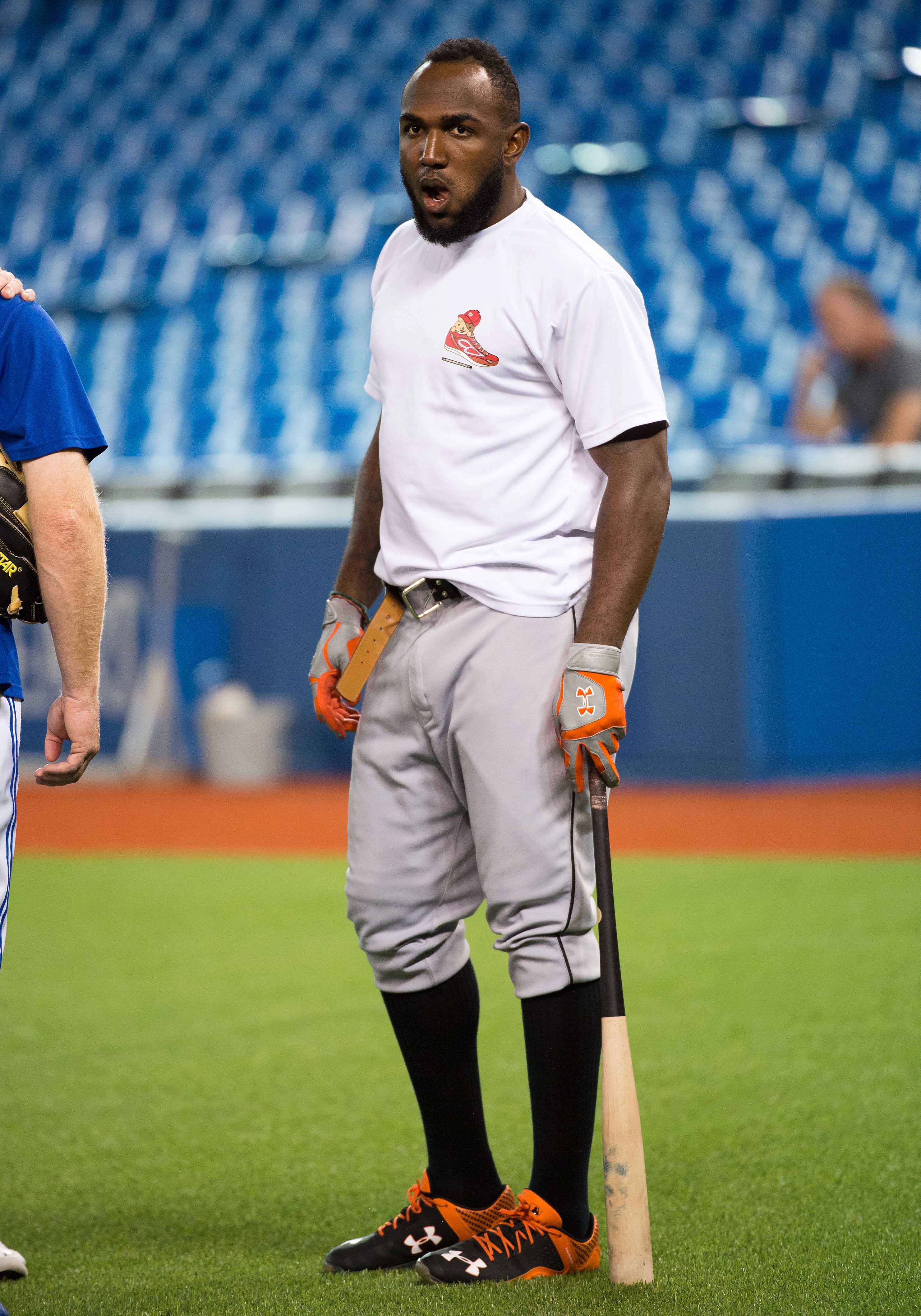
The 2015 season, though, hasn’t been kind to Ozuna. Through his first 79 contests this season, Ozuna batted .249/.301/.337, including a staggering 1-for-36 slump that saw him strike out 14 times in 37 plate appearances. At that point, the Marlins felt it best for Ozuna to collect himself in the minors and sent him to Triple-A.
Ozuna was excellent in his minor league stint — .317/.379/.558, five homers in 21 games — but he didn’t sound overly thrilled with the fairly lengthy nature of his stay. Ozuna recently returned from that 33-day stint at Triple-A and likened his demotion to a jail sentence. Previously, agent Scott Boras had accused the Marlins of holding Ozuna down in the minor leagues in order to limit his service time and prevent him from reaching arbitration. Additionally, Barry Jackson of the Miami Herald reported early in the year that there was some frustration over a dip in Ozuna’s speed, leading some in the organization to question his conditioning.
Ozuna’s name crept up in trade rumors prior to the non-waiver deadline, with the Indians surfacing as one team with particular interest. And, just yesterday, Jackson reported that “at least one prominent Marlins person” is open to dangling Ozuna in trades this winter, though there are others in the front office who are more inclined to hang onto him.
Trading Ozuna would be selling low on a player that could certainly blossom into a premium talent, but that same upside would probably be enough to net the Marlins an enticing return. The Marlins are expected to seek two starting pitchers this winter, and for a team with a limited budget, using Ozuna as a trade chip could help to add a cost-controlled young arm to a rotation that will be fronted by a (hopefully) healthy Jose Fernandez.
Because he spent 33 days in the minor leagues this season, Ozuna will accrue 150 days of Major League service time, placing him at two years, 131 days of service. The early projection for Super Two eligibility this season was two years, 140 days, making it easy to see why Boras was upset with the demotion (though questioning the motives for the demotion and the length of stay in the minors would carry more weight if Ozuna hadn’t been playing so poorly prior to being sent down). Ozuna has a chance to be arbitration eligible this winter but could very well fall just shy, meaning any team that acquires him could get one season near the league minimum plus three arbitration years before Ozuna qualifies for free agency after the 2019 season.
The upside of those four years is significant; Ozuna was worth roughly four wins above replacement last season as a 23-year-old, and there hasn’t been an enormous change in his approach this season with the exception of a dip in power. Ozuna’s strikeout rate has actually improved, and his line-drive rate has increased while his walk rate has remained a steady, if unspectacular 6.4 percent. The loss of power is a concern, but if a team feels the decline to be mechanical in nature or feels that its hitting instructors can restore the lost pop, Ozuna could be a well above-average player for a team for at least the next four seasons.
Miami could conceivably trade him to address part of its need in the rotation and either continue using Christian Yelich in center field (perhaps with Derek Dietrich manning left field) or seek a different center field acquisition. The Indians still make sense as a team to revisit talks, while the Mariners, Giants, Brewers and Padres are just a few clubs that could have a need for a long-term center field option this winter (speculatively speaking, of course).
Photo courtesy of USA Today Sports Images.
NL East Notes: Ozuna, Marlins, Collins, Utley
Marcell Ozuna‘s 33-game stint in Triple-A was “like a jail” to the outfielder, as he tells Adam Zuvanich of the Miami Herald. The Marlins demoted Ozuna in July ostensibly due to his early-season struggles, though agent Scott Boras believed the Fish were keeping Ozuna in the minors to deny his client MLB service time and prevent his arbitration eligibility. “I know what happened when they sent me down. I knew that’s coming,” Ozuna said. “I don’t go there for work, because they know me. I don’t need the work. One for 36, 1 for 100, every big-league player has it. I have it and everybody has it.” Ozuna rejoined the Marlins this weekend after Christian Yelich went on the disabled list.
Here’s more from Miami and elsewhere around the NL East…
- Some in the Marlins front office want to keep Ozuna rather than explore trades for him this offseason, the Miami Herald’s Barry Jackson reports, though “at least one prominent Marlins person is open” to moving the outfielder. Ozuna drew trade interest from several teams (including the Indians) prior to the deadline.
- Also from Jackson’s column, he writes that the Marlins want to wait until after the season to make their intended managerial change so that they know the full pool of candidates before making a decision. This will allow the team to include any current managers in their search should those skippers be fired; Jackson cites the Dodgers’ Don Mattingly as an example. Jackson adds that there’s no front-runner for the job, though previous managing experience will be an important criteria.
- Mets manager Terry Collins isn’t concerned about his contract status, telling Newsday’s Steven Marcus that he has “no idea” if the club will discuss an extension with him while the season is still going. “I’m telling you, I don’t think about it. I think about playing golf in November. That’s the only thing on my mind right now,” Collins said. Collins’ deal expires at the end of the season though the Mets hold an option on his services for 2016. A team spokesman tells Marcus that the Mets will “address [a possible extension] at the proper time,” which I would presume refers to after the season is over.
- Assuming the Mets make the postseason or fall just short, Matthew Cerrone of Metsblog.com suspects the team will exercise their 2016 option on Collins and extend his deal through the 2017 season. It would “border on disrespectful,” Cerrone feels, if the Mets didn’t have Collins extended before next Spring Training given how the skipper has exceeded expectations since being hired as somewhat of a transitional manager.
- The Mets need to acquire yet another bullpen arm to address their still-struggling relief corps, Joel Sherman of the New York Post opines.
- Phillies interim manager Pete Mackanin admitted that it’s difficult to find playing time for trade candidate Chase Utley, as Andrew Gruman of MLB.com writes. “I mean, yeah, we like ‘Ut’. It is an issue for me, because I have to try to play everybody, and the guys that deserve to play, like [Cesar] Hernandez and so forth, I want them to play. But I want Utley to play, too. It is not an easy task for me, but we’ll do what we can,” Mackanin said.
- Nationals assistant GM Doug Harris is profiled by James Wagner of the Washington Post. Harris oversees the club’s farm system and manages the Nats’ pro scouting department in addition to other duties, and is seen as a potential future general manager by many around baseball; just earlier today, the Boston Globe’s Nick Cafardo tabbed Harris as a contender to be the Brewers’ next GM.
NL East Notes: Marlins, Ozuna, Phillies, Mets
Agent Scott Boras says the Marlins are leaving outfielder Marcell Ozuna at Triple-A New Orleans to potentially delay his arbitration eligibility, Barry Jackson of the Miami Herald writes. The agent claims that Marlins players are upset about the situation and this “is not what Marlins fans deserve.” The Marlins, meanwhile, deny that Ozuna is being kept in the minors for financial reasons. Here’s more out of the NL East..
- Phillies interim manager Pete Mackanin is doubtful that new acquisition Matt Harrison will be on the mound in 2015, Matt Breen the Philadelphia inquirer writes. “I said, ‘I know you feel bad, but we’re looking at you for what we’re about to become rather than this year,’ ” Mackanin said. “Because, we’re really not playing for a whole lot this year.” Harrison came to the Phillies from Texas as part of the Cole Hamels deal last week.
- The development of Jorge Alfaro could dictate the final verdict on the Phillies‘ return in the Cole Hamels trade, Jake Kaplan of the Philadelphia Inquirer writes. Alfaro, who could miss the rest of this season because of a left-ankle injury suffered June, was labeled “one of the minors’ best catching prospects” recently by ESPN’s Keith Law.
- Several Marlins players were not happy about the club’s trades last week, Barry Jackson of the Miami Herald writes. “Can we go home now? Can we go home now? They got rid of everybody,” one prominent player said loudly in Miami’s clubhouse on Friday, according to Jackson. Other players expressed disappointment privately about the roster moves, he writes.
- In order to open up a roster spot for Yoenis Cespedes, the Mets demoted top prospect Michael Conforto, as Anthony Rieber of Newsday writes. Conforto previously impressed at Double-A, now he’ll experience Triple-A for the first time.
Marlins Seeking Controllable Pitching
The latest on the Marlins, who have already shipped Dan Haren to the Cubs…
- About eight teams are interested in Capps, tweets MLB.com’s Joe Frisaro.
- At least a dozen teams have checked in on Capps, tweets Yahoo’s Jeff Passan, and the reliever could very well move. The Marlins are also getting calls on reliever Sam Dyson, according to Clark Spencer of the Miami Herald.
Earlier Updates
- Jon Heyman of CBS Sports says the Marlins are looking for controllable young pitching, with names such as Tyson Ross of the Padres, Carlos Carrasco of the Indians, and Nate Karns of the Rays in play.
- A number of teams are calling on recently-demoted outfielder Marcell Ozuna, tweets Frisaro. The Marlins have no urgency to move the 24-year-old, who hit 23 home runs last year.
- The Marlins are shopping for starting pitching today, tweets MLB.com’s Joe Frisaro, in what he expects to be a busy day for the club. Frisaro notes that Dan Haren is drawing interest from several teams. Also, reliever Carter Capps was linked to the Yankees earlier.
- Earlier this week, the Marlins sent impending free agent Mat Latos to the Dodgers in a 13-player deal, but the move seemed mostly about salary relief for Miami. The assumption is the Fish are seeking young, controllable starting pitching, since both Latos and Haren will be eligible for free agency after the season.
Marlins Fielding Interest In Marcell Ozuna; Indians Have Inquired
The Marlins have been getting calls on outfielder Marcell Ozuna, Clark Spencer of the Miami Herald reports (Twitter links). According to his colleague, Barry Jackson (via Twitter), the Marlins front office is gathering today to decide how to proceed with Ozuna.
One club that’s placed a call is the Indians, says Spencer, who adds that Miami has sent scouts to watch Cleveland’s starters. While it may be too soon to tell whether there’s serious interest between the two clubs, it’s certainly an intriguing possibility.
Both the Marlins and the Indians have been expected to hold onto controllable talent, but obviously there’s a possibility that similar assets could be swapped to better meet each club’s needs. Miami pulled off just such a deal last summer when it acquired Jarred Cosart.
Ozuna, 24, rebuffed Miami’s efforts over the winter to make him the third young outfielder to reach a long-term extension. He’s since been demoted to Triple-A after a .249/.301/.337 start to the season. Of course, Ozuna showed much more last year, putting up a .772 OPS with 23 home runs and contributing strong defense in center. And he’s done nothing but rake since going back to the minors.
We’ve addressed the Indians’ rotation chips several times in recent days, as reports have emerged suggesting that the team will at least listen on its various interesting pieces. A young player with Ozuna’s upside and control would obviously hold significant appeal, and he’s probably the kind of piece that would need to be involved to get something done. It remains unclear which particular pitchers would prove most enticing to the Fish, but names like Carlos Carrasco, Danny Salazar, and Trevor Bauer could all conceivably hold significant appeal.
NL Notes: Strasburg, Mozeliak, Boras, Fernandez
Stephen Strasburg left the mound during the fourth inning of today’s Giants/Nationals game with an injury in his left side. The Nats ace wanted to keep pitching but “given his season, so far, I don’t want to take a chance there,” manager Matt Williams told reporters, including MLB.com’s Bill Ladson. Strasburg has already had one extended DL stint to recover from a strained left trapezius and he’s been dealing with neck and back soreness all year, which has undoubtedly contributed to his 5.16 ERA over 61 innings (though an ungainly .365 BABIP also hasn’t helped). Here’s the latest from around the senior circuit…
- Cardinals GM John Mozeliak tells Bernie Miklasz of the St. Louis Post-Dispatch that he’s targeting starting pitching depth and a left-handed bench bat. While the Cards’ rotation has been one of the best in the game this season, it’s also a pretty young staff with some pitchers who have had checkered injury histories, so Mozeliak said he has to “be aware of the potential hazards” and that “my job is to make sure if it doesn’t last, then how do you answer it?”
- Derrick Goold of the St. Louis Post-Dispatch looks the July 2 prospects already signed by the Cardinals (righty Alvaro Seijas and shortstop Raffy Ozuna, both 16 years old) and how the team has evolved its forays into the international market.
- Scott Boras tells Barry Jackson of the Miami Herald that he sees no reason why the Marlins couldn’t afford to keep Jose Fernandez, even with Giancarlo Stanton already locked up on a historically large deal. “With TV rights and the general fund contribution and everything — every club, before they sell a ticket, they’re making $120 million,” Boras said. “There’s a lot of revenue in this game to pay a lot of players and keep players at home.” The Marlins believes that Fernandez and Marcell Ozuna both declined to pursue extensions last winter under Boras’ advice, but the agent said that his players make those decisions.
- Cubs president Theo Epstein cautioned that his team may not make any huge moves at the trade deadline, telling reporters (including Paul Sullivan of the Chicago Tribune) that “if you look at the history of teams that go on and play in the World Series, very rarely is it (because of a) deadline deal. We know what we’d like to do, but we’re realistic about what we might be able to do.” Epstein also noted that some teams who are solely in the wild card hunt may not favor making a big push just to get into a one-game playoff; while he was “just speaking generally,” Epstein’s comments could relate to the Cubs themselves, who are 8.5 games back of the Cardinals in the NL Central.
Marcell Ozuna Will Not Pursue Extension With Marlins
The Marlins have already reportedly locked up two outstanding young outfielders in Giancarlo Stanton and Christian Yelich, but do not appear to be in position to do the same with regard to center fielder Marcell Ozuna, as MLB.com’s Joe Frisaro reports. Ozuna, 24, says that he is heeding the advice of his agent Scott Boras to wait on exploring a long-term deal.
Of course, that hardly means that Ozuna is going anywhere, as he is under team control through 2019 and plenty of time remains to explore an extension. But Ozuna and his camp do not believe the time is right to do so at present. “[Boras] tells me ‘Don’t hurry,'” said Ozuna. “Be waiting for the moment, and let’s see what happens in a couple of years.” He continued to say that Boras has advised him to focus on his game rather than his next contract. “Let’s see what happens next year,” said Ozuna. “I don’t want something in my head, like a distraction. I’m just going to play the game, and that’s it.”
Miami reportedly approached Ozuna, among other promising young Marlins players, earlier in the offseason. As Frisaro writes — and as he explained further in an appearance on today’s MLBTR Podcast, “preliminary contact” with Ozuna’s representatives did not result in any traction. Whether or not the team is still interested in making a lengthy commitment after its other spending is not clear, though surely it would entertain talks were Ozuna himself inclined to do so.
Unlike Yelich, Ozuna has enough service time (1.153 years) to make Super Two qualification next season a near certainty. That certainly affords him additional protection, to say nothing of the fact that the team committed to him by dealing away fellow center fielder Jake Marisnick at last year’s trade deadline.
Ozuna broke out in 2014, slashing .269/.317/.455 with 23 home runs in 612 plate appearances. With solid to excellent marks on his defense in center, that made him a roughly four-win player. Some swing-and-miss propensities and a relatively high BABIP create some cause for concern, though projection systems still like him to be at least a solid regular moving forward — and the Marlins obviously feel the same way.
Marlins Make Long-Term Offers To Fernandez, Yelich, Hechavarria
The Marlins have already locked up Giancarlo Stanton to a record-setting 13-year deal, and they’re now focusing on extending the rest of their young core. Jon Heyman of CBS Sports reports that the Fish have made long-term offers to ace Jose Fernandez, left fielder Christian Yelich and shortstop Adeiny Hechavarria, with an offer to center fielder Marcell Ozuna expected to come this week.
Heyman doesn’t have specifics on all four of the deals, but he reports that the Fernandez proposal is said to be for six years and about $40MM. It also contains two club options. While that payday may seem light in comparison to Stanton’s contract, it’s worth noting how different the situations of Fernandez and Stanton are. Both are cornerstone players, but Stanton signed his deal with just two years of team control remaining when he was due to earn roughly $13MM in 2015 already. Fernandez is not yet even arbitration eligible (he’ll earn close to the league minimum next year) and is also coming off a season cut short by Tommy John surgery. Stanton, on the other hand, was coming off a second-place MVP finish.
According to Heyman, the offer to Fernandez would be the largest ever for a pitcher with his service time, though there appears to be a bit of disconnect there. Heyman notes that the offer is for “close to” $40MM. Fernandez currently has exactly two years of MLB service, and Gio Gonzalez‘s six-year, $42MM contract is the biggest extension ever signed by a pitcher with two to three years of MLB service (as can be seen in MLBTR’s Extension Tracker). It’s possible that Heyman is simply referring to a player with exactly two years of service or even a player in the low two-year range, but in terms of service class, anything short of $42MM in guaranteed money would fall a bit shy of a record.
The offer to Yelich, according to Heyman, is said to be modeled after Starling Marte‘s six-year, $31.5MM contract, but it contains a smaller guarantee than that deal. There’s still some work to do before the two sides are close to an agreement, he notes. Yelich, who quietly posted roughly a four-WAR season, has just one year and 69 days of MLB service time. Marte’s contract is the second-largest ever for an outfielder with one to two years of service (Ryan Braun‘s $45MM deal is king), but as the Extension Tracker shows, recent extensions for Paul Goldschmidt (five years, $32MM), Jedd Gyorko (five years, $35MM), Anthony Rizzo (seven years, $41MM) and Andrelton Simmons (seven years, $58MM) have all topped the Marte deal in terms of guarantee.
General manager Dan Jennings wouldn’t comment on specific situations, but he expressed confidence to Heyman in locking up his young stars, even Fernandez, who is represented by Scott Boras. “We’ll get it done,” said Jennings. “We’ll get it done with Scott, too; we’ll just have to rassle a little harder.” Boras, of course, is typically averse to advising his young talents to accept extensions before hitting free agency, though there are notable exceptions (including recent cases of Carlos Gonzalez and Carlos Gomez).
To this point, Heyman writes, there’s yet to be an inclination that Fernandez is amenable to a long-term contract with such little experience under his belt and given his injury status. The pair of proposed club options, in particular, would seem to go against Boras’ typical philosophy. However, Jennings maintained optimism and felt that extension talks with all four of his young players are going well: “We’ve had some great exchanges. I feel like we’re moving in the right direction.”