
Latest On Mason Miller’s Trade Market
There’s no bigger target on the relief market than A’s breakout closer Mason Miller. The All-Star righty begins the second half with a 2.27 earned run average through 39 2/3 innings. He has punched out 70 of 150 opponents (an absurd 46.7% rate) while locking down 15 of 17 save chances. Miller might be the most dominant relief force in the league at the moment.
Oakland general manager David Forst will receive no shortage of trade calls over the next week and a half. Jon Heyman of the New York Post wrote last night that the Orioles are among the teams with interest in Miller. Heyman adds that Baltimore also remains connected to old friend Tanner Scott, to whom they’ve been linked for the better part of two months. The O’s are generally expected to land a high-leverage reliever who can either supplant Craig Kimbrel as closer or bridge the gap to the ninth inning.
The Marlins will almost certainly deal Scott, an impending free agent, by July 30. It’d be significantly harder to pry Miller from the A’s. He’s under club control for five seasons after this one. Even a rebuilding team is under no pressure to move him. Robert Murray of FanSided wrote this evening that executives outside of Oakland remain skeptical that the A’s will deal Miller. They’ll have an exorbitant asking price, at the very least.
Miller’s injury history is the main argument for the A’s to move him this summer. The 25-year-old missed most of the 2022 season battling shoulder problems. He lost the bulk of the ’23 campaign to a UCL sprain in his elbow. Miller throws as hard as anyone in baseball and has had a pair of extended arm-related absences within the last three years. There’s clearly some level of risk that he suffers another injury. The A’s are unlikely to be competitive before the 2026 season at the earliest, so Miller could make more of an immediate impact on a team with nearer playoff aspirations.
Yet as appealing as Miller already is as an elite closer, there’s a chance he improves his value even more in the next year or two. Miller was a starting pitcher in the minors and for his first few weeks in the big leagues. Oakland moved him to the bullpen this year as a means of keeping his innings in check. Forst said at the time of the bullpen transfer that the A’s might stretch Miller back out as a starter in 2025. It’d be tempting to keep him in the bullpen now that the team has seen how dominant he is in that role, but no one has ruled out a return to starting. Miller told USA Today’s Bob Nightengale last week that he’s not closing off the possibility of moving back to the rotation in ’25 or beyond.
Garrett Crochet has dramatically elevated his trade value with three months of ace production. There’s no guarantee Miller would take to a rotation move the way that Crochet has, of course, but it’s not hard to see the potential for him to be an impact starter. If he ran with a rotation opportunity next season, he’d further elevate his stock both within the organization and on the trade market.
Mason Miller Open To Returning To Rotation In Future
Athletics right-hander Mason Miller has broken out as one of the most dominant relievers in the world this year, which will lead to an interesting decision about his future role. He tells Bob Nightengale of USA Today that he’s open to returning to the rotation down the line but also appears somewhat tempted to stick where he’s having success.
“I don’t think I want to close that opportunity,” Miller said of possibly starting someday. “If the opportunity presents itself, maybe, but with the success I’ve had [as a closer], I think it’s a difficult decision to say I want to get away from that.”
Miller, 25, was primarily a starter in college but wasn’t able to stay healthy in his first few professional seasons. He was drafted in 2021 but then was held back by a shoulder strain in 2022, limited to just 14 innings over six minor league starts. Last year, he made two minor league starts and four in the majors before landing on the injured list with forearm tightness. He was eventually diagnosed with a sprained UCL in his throwing elbow and avoided surgery but wasn’t able to return until September.
In December, general manager David Forst discussed Miller’s situation, with Martín Gallegos of MLB.com relaying his sentiments on X. Forst said the club was planning to have Miller serve in a relief role in 2024, with a return to starting a possibility down the road, but they wanted him to stay healthy for a full season first.
As mentioned, 2024 has been a banner year for Miller so far in that relief role. He already has 15 saves and a 2.27 earned run average in 39 2/3 innings. He has struck out an incredible 46.7% of batters faced. Among pitchers with at least 20 innings pitched this year, Josh Hader is second in the strikeout rate category but well behind Miller at 40.4%. He has been selected to his first All-Star team this year.
If Miller stays healthy in the second half, the question will turn to what comes next and it appears the A’s don’t yet have a firm decision. “I don’t know,” A’s manager Mark Kotsay said to Nightengale. The skipper added that he didn’t want to rule anything it out but they are still focused on keeping Miller healthy in 2024, before addressing the inherent pros and cons of the decision. “There’s more value there in the innings, but obviously there’s more impact with the opportunity for us to win a game at the back end with him being the closer.’’
This season, various players have attempted to the reliever-to-starter move, with varying degrees of success. MLBTR’s Steve Adams recently took a look at the results, with Garrett Crochet and Reynaldo López two of the best success stories with A.J. Puk on the other end of the spectrum.
The A’s control Miller for another five seasons after this one and are currently rebuilding. That gives them some leeway to experiment if they and Miller decide that they want to, but there would also be an argument for simply continuing with what’s working. Many closers around baseball are former starters who were put into late-inning roles due to health issues or workload concerns, then were simply kept there because it was working.
Miller is one of the hardest throwers in baseball, averaging 100.9 miles per hour. He already has the UCL sprain and the significant shoulder strain on his track record. He would likely have to pull back on the velocity a bit if he were to move into a starter’s role but it would still be a new challenge keeping his body healthy for the marathon of starting for a full season, as opposed to the high-octane relief role he’s been in this year.
Broadly speaking, having an effective starting pitcher give a club 150 to 200 quality innings is more valuable than 50 to 60 innings of relief work. That’s why the best starting pitchers are paid more than the best relievers, both in arbitration and in free agency. Controllable starters also tend to bring back larger returns when traded, as compared to their relief counterparts. Miller has been speculated as a trade candidate this season, reportedly drawing lots of interest, though with the A’s setting a high asking price. They would likely have to be blown away to trade five-plus years of such a dominant pitcher and the possibility of him returning to a rotation down the line could conceivably give him even more trade value at some point.
Both the A’s and Miller would stand to benefit if he could successfully take on a rotation role, but whether they pursue it or not could depend on the comfort level from both sides, as well as the ongoing monitoring of his health.
What’s Mason Miller Worth On The Trade Market?
To say Mason Miller's start to the season has the baseball world buzzing would be an understatement. The second-year A's hurler, whom Oakland selected with the No. 97 overall pick in 2021, has emphatically asserted himself into the conversation for baseball's top reliever. Standing at 6'5" and averaging a comical 101.3 mph on his heater, Miller is the quintessential power pitcher. He's burst out of the gates with a 2.05 ERA in 22 innings, going 9-for-9 in save opportunities and striking out an outrageous 51.9% of his opponents on the year. Eighty-one hitters have had the misfortune of facing Miller. Forty-two of them have gone down on strikes.
Miller allowed two runs in his first outing of the season and was just finally scored upon again yesterday, yielding three earned runs in 1 2/3 frames. Between those two appearances? The right-hander pitched 19 1/3 shutout innings with a 40-to-4 K/BB ratio, fanning an impossible 60.6% of his opponents.
Unsurprisingly, between his dominant performance and the current state of the Athletics, he was quickly speculated upon as a trade candidate -- despite entering the year with six full seasons of club control remaining. As one would expect, teams have inquired. And as you'd also imagine, the asking price is reported to be stratospheric. Miller is going to generate considerable buzz between now and the July 30 trade deadline. Given the massive amount of club control he has remaining, it's a stretch to call him a "likely" trade candidate, but it's a guarantee that teams are going to try. The big question will be how much Oakland will need to be offered to genuinely consider moving him.
Before we dive too far in, let's be clear: this is an exercise without a clear answer. There's no precedent for a pitcher -- or a player -- with this level of early-career dominance and a nearly full slate of six years of control even being available. That we're even talking about it underscores the current state of the A's: a rebuilding team in the midst of relocation whose rebuild has stalled because of nearly universal misses on returns for their top stars. If Oakland were competitive right now or at least seeing enough encouraging returns in the rebuild to think they could be a Wild Card club in 2025-26, this wouldn't even be as serious a topic of discussion.
That's not the world we live in, though. The A's have MLB's fourth-worst run differential and fifth-worst winning percentage. Their farm system ranks near the bottom of the league even after trading Matt Olson, Matt Chapman, Frankie Montas, Sean Murphy, Sean Manaea, Chris Bassitt, Lou Trivino, Sam Moll and more. The A's have painted themselves into a corner that's problematic enough that their juggernaut closer is already being floated as a trade candidate despite barely having a year of service time.
So maybe this is indeed an exercise in futility, but let's take a look at some of the most recent trades for big-name relievers and see what we can glean.

Unlock Subscriber-Exclusive Articles Like This One With a Trade Rumors Front Office Subscription
- Access weekly subscriber-only articles by Tim Dierkes, Steve Adams, and Anthony Franco.
- Join exclusive weekly live chats with Anthony.
- Remove ads and support our writers.
- Access GM-caliber tools like our MLB Contract Tracker
Mason Miller Drawing Trade Attention
The A’s are receiving early trade calls on closer Mason Miller, writes Ken Rosenthal of the Athletic. While the team is at least broadly open to discussions, Rosenthal reports that no one has come close to what is understandably a huge ask.
Miller has been one of the league’s breakout players in 2024. It certainly didn’t come out of nowhere — he has been widely regarded as a Top 100 prospect in each of the last two years — but the second-year righty is already one of the best relievers in the game. Miller gave up two runs in his first appearance of the season against the Guardians. He hasn’t been scored on in 12 games since, and that understates his dominance.
The 25-year-old has recorded multiple strikeouts in all but two of his outings. He has fanned 33 of the 60 batters who have stepped in against him. That’s a laughable 55% rate. Among pitchers with at least 10 innings, Cincinnati’s Fernando Cruz ranks second with a 47.3% strikeout percentage. Only four qualified relievers — Devin Williams (during the abbreviated 2020 schedule), Aroldis Chapman (2014), Craig Kimbrel (2012) and Edwin Díaz (2022) — have ever maintained a strikeout rate north of 50% over a full season. Miller has induced swinging strikes on more than 21% of his pitches, a mark only narrowly topped by Cruz. He has paired that overwhelming stuff with strong control, issuing just four walks without hitting a batter.
[Related: The A’s Overpowering Closer]
It’s not difficult to understand why opponents haven’t had any success making contact. Miller’s stuff is off the charts. His fastball is averaging 100.8 MPH and can run into the 103-104 MPH range at its high end. He has paired it with an upper-80s slider that drew plus or better reviews from prospect evaluators and has been nearly unhittable. Opponents are coming up empty almost half the time they swing at both offerings.
Every bullpen would be massively upgraded with Miller at the back end. It’s entirely unsurprising that teams would look to pry him from Oakland and that the A’s would need a massive haul to consider it. On top of Miller’s dominance, he’s under affordable club control for years to come. He entered 2024 with less than one season of MLB service. He’s not on track to reach free agency until the end of the 2029 campaign. Miller is a lock to go through arbitration four times as a Super Two player, but that won’t begin until after next season.
The A’s are still deep into a rebuild despite a reasonable 18-21 start. They’re very unlikely to hang in the playoff mix this year, although they surely anticipate being a legitimate contender well within Miller’s window of team control. A player of this caliber who still has five-plus years of control being traded is essentially unheard of.
However, Miller’s status is at least somewhat clouded by an alarming injury history. He barely pitched in the minors in 2022 because of shoulder troubles. The A’s nevertheless called him up early last season to work from the rotation. Miller made four starts before being diagnosed with a UCL sprain in his elbow. He was shelved into September. The A’s used him out of the bullpen for 2-3 inning stints once he returned.
GM David Forst announced early last offseason the A’s would move Miller to late-inning relief this year in an effort to keep him healthy. They’ve maintained they’re not opposed to stretching him back out as a starter in ’25, although he may wind up being so impressive as a reliever the team chooses not to mess with success.
There’s no small amount of stress put on the arm of a pitcher who throws as hard as Miller does. The front office presumably has some concern about the possibility he suffers another significant injury. That would be the main argument for genuinely considering trade offers, though Miller also clearly has the talent to be a franchise building block. That’s particularly true if the A’s are serious about potentially moving him back to the rotation in 2025.
Significant trades this early in the season are rare, although the Padres and Marlins lined up on the Luis Arraez swap last week. Teams will certainly continue trying to tempt the A’s as the deadline gets closer. Miller would be their most valuable trade chip, while players like Paul Blackburn, Brent Rooker, Ross Stripling and Alex Wood could draw attention.
Speculatively speaking, Lucas Erceg could also emerge as one of the more intriguing relievers on the deadline market. A former third baseman, Erceg was a late convert to pitching whom the A’s acquired from the Brewers in a minor trade nearly a year ago. While he struggled to a 4.75 ERA over 55 innings as a rookie, he has been a key high-leverage arm for skipper Mark Kotsay in 2024. Erceg has managed 22 strikeouts over 15 frames of 3.60 ERA ball. His fastball is sitting in the 98-99 MPH range.
Erceg also has six years of team control, so there’s no urgency for the A’s to move him. He’s already 29 years old and not as overpowering as Miller, though, so he’s less likely to be a major long-term piece coming out of the rebuild.
The A’s Overpowering Closer
In what’ll be another rough season for the A’s, the front office is looking for young players to establish themselves as key long-term pieces. In the first few weeks, no one has shown more promise in that regard than Mason Miller.
Miller was a third-round pick in 2021. His stuff had taken a major step forward during his final collegiate season. As The Athletic’s Stephen Nesbitt wrote last week, Miller had a hard time keeping on weight and maintaining his strength until he was diagnosed with Type 1 diabetes in 2018. While the primary concern was in allowing Miller to navigate a serious health condition, learning how to manage the issue permitted the 6’5″ righty to rapidly bulk up. His velocity spiked into the mid-upper 90s, leading the A’s to roll the dice on his upside.
Injuries essentially robbed Miller of traditional minor league development. He lost almost all of the 2022 season to shoulder issues. He had pitched all of 28 2/3 professional innings before the A’s called him up last April. He had an impressive four-start debut before reporting forearm soreness. Testing revealed a mild UCL sprain and the A’s shut him down for a few months. Miller returned in September, working 2-3 inning stints to finish the year. He closed his rookie campaign with a 3.78 ERA in 33 1/3 innings.
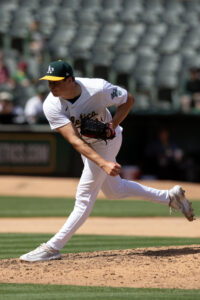
Oakland GM David Forst announced early in the offseason that Miller would work out of the bullpen in 2024. Forst suggested it wasn’t a permanent switch. Rather, the A’s were using the 25-year-old in shorter stints in an effort to keep him healthy before a move back to the rotation in 2025. While they certainly had high hopes that his power arsenal would translate, Miller has surpassed even the loftiest expectations in the first few weeks.
Including tonight’s four-out save in the Bronx, Miller is up to 11 1/3 innings of two-run ball. He has successfully locked down all six of his save chances. After allowing two runs in his season debut against the Guardians, he has rattled off eight straight scoreless outings. Four of those have been perfect innings in which he has recorded multiple strikeouts.
Miller has punched out 23 of 45 opposing hitters, the highest strikeout rate in the majors. His already eye-popping stuff has leveled up in short bursts. Miller’s fastball is sitting in the 100-101 MPH range. Both the heater and his upper-80s slider have been essentially untouchable.
Even in a minuscule sample, it doesn’t seem outlandish to call Miller one of the top relievers in MLB. The quality of the arsenal is self-evident. He’s missing bats at the levels we’ve seen from the likes of Edwin Díaz, Félix Bautista and Andrés Muñoz. Given his injury history, one can question whether he’ll be able to stay healthy all season. There’s no reason to doubt his talent.
Miller fell just shy of the cutoff for a full service year in 2023. The A’s control him for six seasons. He’ll qualify for early arbitration as a Super Two player during the 2025-26 offseason. That’ll allow him to go through the arb process four times instead of the standard three, yet Miller could stick with the A’s through the ’29 campaign.
Opposing teams will probably try to convince Forst to put Miller on the trade block this summer, but it’s hard to see any realistic way that he gets moved. Even rebuilding clubs rarely trade relievers with the kind of talent that he possesses when they’re in their pre-arbitration seasons. That’s before considering that the A’s presumably still intend to give him a chance to compete for a rotation spot next year. If Miller turns in a full season as a top 3-5 reliever in the sport, perhaps they’d consider him too valuable to take out of the bullpen, but there’s nothing to suggest their long-term plans have changed at this point.
Image courtesy of USA Today Sports.
A’s Don’t Expect To Trade Paul Blackburn, Seth Brown
A’s general manager David Forst chatted with reporters on Monday evening, discussing a few areas of the roster. Perhaps most notably, the GM said he didn’t expect to trade either starter Paul Blackburn or outfielder Seth Brown this offseason (relayed by John Shea of the San Francisco Chronicle).
Blackburn has been the subject of trade speculation as far back as the 2022 deadline. The right-hander has turned in serviceable back-of-the-rotation numbers for the past two seasons, combining to post a 4.35 ERA in 215 innings. That has arguably made him Oakland’s most reliable starter, although he battled some injuries on his throwing hand late in 2022 and early in the ’23 campaign.
The A’s control Blackburn, who turned 30 on Monday, for two additional seasons. MLBTR contributor Matt Swartz projects him for a $3.2MM arbitration salary. Brown, who is controllable for three years, is projected at $2.4MM. The lefty-swinging corner outfielder had a down season in 2023, hitting .222/.286/.405 in 378 plate appearances. He’d posted a more robust .230/.305/.444 showing — albeit mostly in favorable platoon situations — the year before.
Those are modest salaries by MLB standards, but there’d been some speculation that the A’s could look to tear spending down even further. Forst suggested that’s not the case, telling reporters he anticipates opening next season with a higher payroll than they ran to end the 2023 campaign.
Of course, that’s not exactly portending massive spending. The A’s ended last year with a payroll in the $59MM range, as calculated by Roster Resource. That was the lowest mark in MLB. Forst estimated their current commitments for next season sit around $43MM, a little north of the $40MM which Roster Resource projects.
That leaves some amount of flexibility to dip into free agency, although they’d surely be for players in the lower tiers. Last offseason’s acquisitions of Aledmys Díaz, Jace Peterson, Trevor May, Drew Rucinski, Jesús Aguilar and Shintaro Fujinami were all one- or two-year commitments that tallied a little over $40MM in overall spending.
Forst suggested that adding to a rotation without many clear candidates behind Blackburn and JP Sears was likely (link via Martín Gallegos of MLB.com). The GM made clear they’re looking to wait out the market for what is likely to be a low-cost veteran flier. “This time of year, the market is peaking,” Forst said. “It’s expensive, nowhere more than starting pitching, which is something we’re out there talking about. We are trying to be patient. I think we know with what we have to spend and what we need to do, patience is probably our friend here.”
One player who doesn’t seem likely to be part of the rotation competition: right-hander Mason Miller. Forst suggested the A’s were planning to move him to the bullpen, potentially as a closer, for the ’24 season (via Gallegos). One of the hardest throwers in the sport, Miller has been limited by injuries as a professional. He pitched only 39 1/3 innings over parts of three minor league seasons and was limited to 33 1/3 frames during his MLB debut this year, missing a good chunk of time with forearm tightness. A relief role will allow the A’s to keep a close watch on his workload next season, although Forst left open the possibility of stretching him back out as a starter in 2025.
Big Hype Prospects: Holliday, Caminero, Carter, Lawlar, Miller
A hearty welcome to Pete Crow-Armstrong. We discussed his case for promotion last week. Though he had seven hits in 10 plate appearances over the weekend, this promotion is all about his glove. Anything he adds with his bat is gravy.
We’ll cover more recent and potential call-ups in today’s edition of Big Hype Prospects.
Five Big Hype Prospects
Jackson Holliday, 19, SS, BAL (AAA)
(A/A+/AA) 520 PA, 10 HR, 23 SB, .326/.444/.504
As I noted last week, Holliday’s promotion to Triple-A means we finally get access to public exit velocities. Those go a long way to influencing when a prospect earns his first promotion to the Majors. His 89.6 mph average and 103.7 mph max EVs in 30 plate appearances aren’t particularly impressive. They suggest the Orioles are better off with their existing middle infielders. Overall, he’s hitting just .200/.333/.280 in Triple-A. One silver lining, he’s posted more walks than strikeouts. Of course, we’re also talking about a tiny sample. That should go without saying.
Before anyone frets about his lack of pop in 30 plate appearances, an acquaintance was nice enough to pass along his Double-A data. His 109.7 mph max EV is excellent for a 19-year-old at any level. The chart I received doesn’t list an average, but it’s visually somewhere between 90 and 93 mph – also excellent.
Junior Caminero, 20, 3B/SS, TBR (AA)
(A+/AA) 486 PA, 30 HR, 5 SB, .330/.391/.604
Wander Franco left the Rays in a tough spot, relying on the soft-hitting Taylor Walls and Osleivis Basabe to handle shortstop. Caminero represents a “go-for-power” alternative. Though he mostly plays third base these days, that decision was at least partly in deference to his expected future role. Caminero might not be much of a downgrade defensively – Walls isn’t exactly a superstar defender. Caminero is still athletic enough to cover shortstop at present. Since August 25, he batted .354/.436/.917 with eight home runs in 55 plate appearances.
Evan Carter, 21, OF, TEX (MLB)
(AA/AAA) 513 PA, 12 HR, 25 SB, .288/.413/.450
An injury to Adolis Garcia opened the door for Carter to join the Rangers roster. He was reportedly already under consideration, the injury merely turned “when” to “now.” Oft-compared to Brandon Nimmo (they’re eerily similar), Carter plays within himself. Not all scouts appreciate this – the current meta is all about chasing extreme outcomes. In particular, he looks like he should be able to hit for power, but he maximizes for on base percentage rather than slugging. That’s just the first of many commonalities with Nimmo. The Rangers have a reputation for forcing their prospects to produce pulled, fly ball contact. That Carter reached the Majors despite eschewing organizational preferences suggests there’s an interesting behind-the-scenes tale to tell.
Jordan Lawlar, 21, SS, ARI (MLB)
(AA/AAA) 490 PA, 20 HR, 36 SB, .278/.378/.496
Questions about Lawlar’s hit tool mostly fly under the radar thanks to heady results and plus shortstop defense. He’s considered one of the best athletes in the sport. The most optimistic scouts consider him a 70 overall on the 20-80 scale. Aside from consistency of contact, Lawlar offers the total package. He’s an above-average runner, fields and throws well, and already flashes 30 homer upside as part of a discipline-forward approach. Though he’s not as extreme as Anthony Volpe, there’s a chance Lawlar’s early outcomes follow a similar track.
Mason Miller, 25, SP, OAK (MLB)
23.1 IP, 9.64 K/9, 2.70 BB/9, 3.09 ERA
Miller returned from injury on September 6. He’s scheduled to make his first start since April on Monday. A hard-thrower with a limited repertoire and a long injury history, Miller has rare potential to overpower Major League hitters. Developed as a starter, evaluators remain split on his ultimate role. A proactive conversion to relief could help to lengthen his career – or at least improve his effectiveness. As a starter, the range of outcomes looks something like Tyler Glasnow to Michael Kopech with a real chance that he’s usually too hurt to contribute.
Three More
Jackson Ferris, CHC (19): I knew there was a fifth Jackson I forgot last week. Ferris is the also-ran among the prominent Jacksons in baseball, but he still tracks as a potential Top 100 prospect within the coming years. The southpaw has a repertoire of four average or better offerings backed by presently poor command. He’s posted a 3.38 ERA with 12.38 K/9, 5.30 BB/9, and a 53.4 percent ground ball rate in Low-A.
Brooks Lee (22): The Twins are relatively deep in the middle infield or else Lee would be on the shortlist for a promotion. He’s a well-rounded player who lacks standout tools or notable shortcomings. He’s posted above-MLB-average EVs in Triple-A.
Luisangel Acuna, NYM (21): Since joining the Mets organization, Acuna has cut his swinging strike rate nearly in half. He also cut his power in half. The net result is a sharp decline in offensive value. For now, this has the look of a step back for (hopefully) two steps forward.
Did I miss a detail or nuance? DM me on Twitter @BaseballATeam to suggest corrections.
A’s Designate Spencer Patton For Assignment, Select Easton Lucas
The Athletics announced today that they have reinstated right-hander Mason Miller from the injured list, selected left-hander Easton Lucas and recalled right-hander Devin Sweet from Triple-A Las Vegas. In corresponding moves, left-hander Sam Long and right-hander Zach Neal were optioned to Triple-A and righty Spencer Patton was designated for assignment.
Patton, 35, signed a minor league deal with the club in April and has twice now been selected for short stints with the big league club. He got into four games in May before being designated for assignment. He cleared waivers and accepted an outright assignment, which allowed him to return a few weeks ago, having made another eight appearances since then. Between those two stints, he has a 5.11 earned run average in 12 1/3 innings, striking out just 12.7% of hitters while walking 10.9%.
The A’s will place him on waivers in the coming days. It’s possible the same sequence of events plays out as earlier in the season, with Patton going unclaimed. He will again have the right to elect free agency at that time. In 113 career games in the majors dating back to 2014, he has a 5.11 ERA. He also spent 2017 to 2020 in Japan’s Nippon Professional Baseball with a 3.68 ERA in that league.
Lucas, 26, gets selected to a big league roster for the first time and will be making his major league debut as soon as he gets into a game. Selected by the Marlins in 14th round of the 2019 draft, he was traded to the Orioles that December for infielder Jonathan Villar. He was then involved in another swap, going to the A’s a few months back as the return in the deal that sent right-hander Shintaro Fujinami to Baltimore.
Between the two organizations, he’s tossed 46 2/3 innings this year at Double-A and Triple-A. He has a combined 3.86 ERA, along with a 25.8% strikeout rate and 8.6% walk rate. He will join Sean Newcomb and Francisco Pérez as the club’s left-handed relievers for the time being and try to earn his way into the club’s plans for next year.
A’s Announce Series Of Roster Moves
The A’s made a number of transactions before tonight’s series opener with the White Sox. Oakland activated reliever Kirby Snead from the 60-day injured list while recalling Rico Garcia and Jordan Diaz from Triple-A Las Vegas.
Right-handers James Kaprielian and Yacksel Ríos are headed to the 15-day IL, while infielder Jonah Bride was optioned to Vegas. To clear space on the 40-man roster for Snead’s return, the A’s transferred Mason Miller from the 15-day to the 60-day IL.
Snead is back in Mark Kotsay’s bullpen for the first time this year. He strained his throwing shoulder in Spring Training. One of four players acquired from the Blue Jays in the Matt Chapman deal, Snead tossed 44 2/3 innings of 5.84 ERA ball during his first season in Oakland. He has allowed four runs in five innings in Triple-A on a rehab stint.
Kaprielian has a shoulder strain of his own, Kotsay told reporters (including Martín Gallegos of MLB.com). Ríos is battling Raynaud’s syndrome, a condition in which blood flow to a person’s hand can be diminished, thereby leading to numbness. The return timetable on both pitchers is unclear.
Miller has already missed just under two months with a sprain of the UCL in his throwing elbow. That makes his transfer a formality, though his long-term prognosis is still up in the air. Kotsay said Miller will soon go for follow-up examination (via Gallegos). The hard-throwing rookie has been throwing off flat ground for a few weeks and will continue his throwing program pending that evaluation.
In other injury news, catcher Manny Piña has reported to Low-A Stockton for a rehab stint, according to his transaction log at MLB.com. Acquired from the Braves to offset salary in the Sean Murphy deal, Piña has missed the entire season with a left wrist issue. He underwent surgery on the same wrist last May and hasn’t played an MLB game in 14 months.
A’s Mason Miller Shut Down With Mild UCL Sprain
A’s rookie starter Mason Miller has been diagnosed with a mild sprain of the ulnar collateral ligament in his throwing elbow, the team informed reporters (including Martín Gallegos of MLB.com). He’ll be shut down from throwing for an indeterminate period of time until he’s no longer feeling discomfort.
Miller landed on the 15-day injured list with forearm tightness last week. It was almost immediately clear he’d be out beyond two weeks and the team announced yesterday that he was going for a second opinion. That raised some concern about a possible surgery. Miller will fortunately avoid going under the knife, though he seems likely to be out of action for an extended stretch. Gallegos notes the A’s are hopeful he’ll be able to pitch again at some point this season.
Injuries have unfortunately been a theme of Miller’s professional career. A third round pick in 2021, the 6’5″ righty pitched only six rookie ball innings during his post-draft summer. He lost most of the 2022 campaign to a shoulder injury, tallying only 14 innings between three minor league levels. Miller returned to log 16 2/3 frames in the Arizona Fall League to close out the year.
After two minor league starts in 2023, the A’s called him to the big leagues for the first time. It was an aggressive promotion but the 24-year-old had shown well early on. He tallied 21 2/3 innings of 3.38 ERA ball over his first four starts, striking out more than a quarter of opposing hitters. Miller showed blistering velocity and looked to be the most intriguing starter in an A’s rotation that has been the league’s worst.
The organization will have to wait a while to get a longer look at the young hurler. Miller is clearly among the most talented pitchers in the system but he’s logged just 66 2/3 innings in two years as a professional. He’ll collect major league service and be paid at the MLB minimum rate while he rehabs. Miller won’t reach a full service year in 2023 and is controllable through at least 2029.