
AL West Notes: Weaver, McCullers, Gray, Beltre, Fielder
Angels starting pitcher Jered Weaver has been diagnosed with mild degenerative changes in his cervical spine, tweets Mike Digiovanna of the L.A. Times. The cervical portion of the spine includes the upper back and neck. Weaver will still be bumped from his next scheduled start, but he’s not expected to be shut down (tweet). The soft-tossing righty averaged just 83 mph with his fastball last season and was throwing even softer in his spring work. He’s scheduled to see a spine specialist to decide next steps.
Here’s more from the AL West:
- An MRI has revealed no damage in Lance McCullers sore right shoulder, writes Jose de Jesus Ortiz of the Houston Chronicle. The Astros‘ starter threw a career high 164 innings last season, and the club has plans to limit his innings. Carefully addressing this current injury seems like a good way to manage McCuller innings while looking after his health. As such, he may not open the season on the big league roster.
- “Everyone” inquired about Athletics ace Sonny Gray this winter, tweets Jon Heyman of MLB Network. The Red Sox were apparently the first to pick up the phones on the day after the World Series ended. No deals were close per Heyman. Oakland leadership has been vocal about holding onto Gray, although the club is also known to be very open minded about looking for roster upgrades.
- While there is a gap in talks between the Rangers and Adrian Beltre, it’s thought that the two sides are motivated to find a middle ground, tweets Heyman. Beltre, soon-to-be 37, is in the final year of his current contract with Texas. Heyman speculates that the Angels could be a top suitor for Beltre if he reaches the open market. If an extension isn’t reached soon, Beltre’s performance this season could be the difference between a moderate one-year deal and a sizable multi-year offer.
- The Rangers tried to sign Austin Jackson for about $4MM before pivoting to Ian Desmond, tweets Heyman. Texas’ need was in left field with Jackson preferring to remain an up-the-middle player. He ultimately signed with the White Sox for $5MM.
- Slugger Prince Fielder has been diagnosed with sleep apnea, writes Gerry Fraley of the Dallas Morning News. He will use a mask and breathing apparatus to combat the disorder. The player and club are hopeful that better rest will translate to a more successful season. Fielder does not plan to undergo the painful and complicated jaw reconstructive surgery used to cure sleep apnea. Mike Napoli underwent that particular procedure prior to the 2015 season.
Adrian Beltre Seeks Three-Year Deal From Rangers
Rangers third baseman Adrian Beltre is looking for a three-year deal in extension talks with the club, Jon Heyman of MLB Network reports (Twitter links). He’s also hoping to out-earn Pablo Sandoval on an annual basis, per the report, which would suggest a deal with an average annual value in excess of $19MM. Presumably, that contract would kick in following the 2016 campaign, as Beltre is already guaranteed $18MM for the upcoming season.
As things stand, unsurprisingly, there’s said to be a “significant gap” between the sides. If nothing else, it seems that there’s quite a bit of negotiating left to do to find agreement. We have heard recently about mutual interest in a deal, however, as Jon Morosi of FOX Sports reported.
Beltre will soon turn 37 and dealt with a significant injury to his thumb last year. But he was still a productive hitter in 2015, with a .287/.334/.453 slash, and was arguably the game’s very best defensive third baseman. It also shouldn’t be forgotten that he was coming off of a five-year run in which he averaged a remarkable .316/.364/.535 batting line and 6.7 rWAR annually.
It’s obvious to see why Texas would have interest in keeping the veteran around, but there’s also good reason to think the organization will be cautious about promising him that kind of money through his age-40 season. In addition to age and injury risks, the Rangers have some promising options in their system, including former top prospect Jurickson Profar and power hitting youngster Joey Gallo.
Finding a middle ground could be a challenge, but still seems a plausible result. In his recent appearance on the MLBTR Podcast, Evan Grant of the Dallas Morning News opined that it could make sense to see a two-year contract in the range of Beltre’s current earnings — i.e., somewhere in the range of $16MM per year. However, Heyman hints that there’s a sense in Beltre’s camp that he outperformed his prior deal (which is undeniably true), and that could have an effect on his stance in future talks.
As Steve Adams of MLBTR posited in a recent MLBTR chat, it’s not surprising to see a three-year request out of the gates from Beltre. For one thing, Beltre’s reported position is only a starting point: it’s worth noting that, as Grant stated on the podcast, talks haven’t yet progressed much given the team’s other prerogatives. And advanced age doesn’t always preclude that length of contract in free agency. Carlos Beltran landed three years and $45MM from the Yankees for his age-37 through age-39 campaigns, and he wasn’t really even close to Beltre in terms of overall on-field value given his increasingly apparent defensive limitations in the corner outfield.
As things stand, Beltre is set to be one of the few premium players set to hit the open market next winter. He profiles as a future Hall-of-Famer and ranks fourth in total fWAR dating back to 2011, so he presents something of a unique player. Jose Bautista, who is about two years younger, is said to be seeking a $30MM (or greater) AAV over a five- or six-year term, and there’s certainly an argument to be made that Beltre represents a more appealing investment at his reported asking price.
Truth be told, there aren’t many straightforward comparables for a Beltre extension, in large part because it’s unusual to find players who have performed at such a high level — at a difficult defensive position, no less — at this stage of their careers. Entering his age-38 season with free agency beckoning, Red Sox designated hitter David Ortiz got another season and $16MM guaranteed from the Red Sox, with a vesting option and second option year at floating prices depending on the prior years’ plate appearances. At the end of a productive 2013 season, the slightly younger Chase Utley signed on for two more guaranteed years at $27MM with a series of vesting options (in an even more complicated deal with the Phillies). Utley, however, had a spottier recent track record due to a series of knee injuries that understandably gave the Phillies pause.
While those agreements fall shy of what Beltre is seeking, it’s fair to note that some huge extensions have promised premium salaries up to or through players’ age-40 campaigns. That was the case for players like Miguel Cabrera, Joey Votto, Albert Pujols, and Alex Rodriguez, though of course all of those deals also covered more youthful campaigns. But, in some sense, every time a monster contract pushes control towards or past a player’s 40th birthday, the hope is that the player profiles as well as Beltre does now when the end of the deal approaches.
In the end, those contracts don’t really tell us much about Beltre’s own late-career earning power, as the late-30s years that were guaranteed in each of those deals was the cost of locking up the remaining prime seasons of each of those stars. Few players have maintained this level of productivity into the late stages of their career with the prospect of another bite at free agency looming, so any contract he signs will ultimately be deemed as something of a precedent-setter for aging-but-elite players that still hold open-market aspirations.
AL Notes: Bautista, Desmond, Hultzen, Rondon
Star Blue Jays slugger Jose Bautista is looking for a contract that will keep him in Toronto into his forties at a $30MM+ AAV, says Jon Heyman of MLB Network (Twitter links), but the 35-year-old is perhaps more willing to negotiate than some of his prior comments would suggest. Previous reports of Bautista’s contract requests have reflected just that kind of asking price while sometimes portraying his stance as being more firm. Jays GM Ross Atkins made clear recently that talks have been amicable, and Heyman adds that Bautista does hope to continue on in Toronto, so it appears there is still some hope that the sides can come together on a new contract for the pending free agent.
Here’s more from the American League:
- Twins righty Ricky Nolasco believes he should remain in the club’s rotation, agent Matt Sosnick tells Darren Wolfson of 1500 ESPN (Twitter link). Referencing last year’s disappointing, injury-filled campaign, Sosnick suggests that his client “deserves to show the Twins what he looks like without trying to pitch through pain.” If Nolasco is pushed to the pen, says Sosnick, he’d approach the front office to “directly address his feelings of disappointment” and “ask the team about his other options.”
- The initial returns on Ian Desmond in left field appear to be positive for the Rangers, Ken Rosenthal of FOX Sports writes. He also notes that the Giants had some interest in Desmond earlier in the winter as a super-utility option that would primarily play in the corner outfield, while the Orioles were involved later.
- Mariners lefty Danny Hultzen has suffered a setback in his bid to get back on the bump in a relief role, Shannon Drayer of Seattle’s 710AM ESPN was among those to report on Twitter. He’ll seemingly rest a while as he deals with shoulder stiffness, which hopefully will clear up on its own. It has been a long and difficult road for the 26-year-old, who has dealt with a series of arm issues since he was chosen second overall in the 2011 draft.
- Tigers reliever Bruce Rondon touched 100 mph yesterday and continues to show good form in camp, as Aaron McMann of MLive.com reports. After a disappointing end to the 2015 season, in which he was asked to leave the organization due to his lack of effort, Rondon has drawn positive reviews so far this spring. “He’s been good,” said skipper Brad Ausmus. “He’s done his work, he’s taken his non-pitching fundamentals seriously. He’s put in the effort and he’s looked strong so far on the mound.”
Podcast: Evan Grant On Rangers; Bradley Woodrum On TJ Surgery
 Today’s MLBTR podcast features two great guests. First, Evan Grant of the Dallas Morning News hops on the show to fill us in on an upbeat Rangers camp. The topics include the signing of Ian Desmond, what Texas might do with its ample depth, whether there are any trades to explore this spring, and the extension situation with veteran third baseman Adrian Beltre.
Next, host Jeff Todd is joined by Bradley Woodrum to discuss his recent statistical research into predicting the likelihood of Tommy John surgeries. You can find the post on his findings right here on MLBTR, and Brad’s podcast discussion is essential listening for those interested in understanding it fully. He provides an excellent look at the process, the results (including what they do and don’t tell us), and what still remains to be investigated.
Click here to subscribe to the podcast on iTunes, and please leave a review! The podcast is also available via Stitcher at this link.
The MLB Trade Rumors Podcast runs weekly on Thursday afternoons.
AL Notes: Desmond, Rangers, Perez, Altuve, Rollins
Ian Desmond‘s path to the Rangers all began earlier in the offseason, Evan Grant of the Dallas Morning News writes. The club let him know that they would have interest on the off chance that Desmond couldn’t find a multi-year deal and was willing to move to the outfield, says Grant, and that indeed turned out to be the case. “Things can change,” GM Jon Daniels explained. “You have to be prepared. You never know when a domino might fall. If you have any interest in that player, you have to express that early on.” Daniels has also made clear that he doesn’t believe there will be any difficulty in sorting out playing time when Josh Hamilton is ready to return.
Here’s more from Texas and the rest of the American League:
- Rangers co-owner Ray Davis discussed his organization today, and Grant has the story. Most notably, he said that the club can still add payroll for a mid-season addition after signing Desmond. As for that move, he explained: “It was a matter of need and Jon Daniels and Thad Levine finding a way to do things creatively. They came to us and proposed a creative deal. For me, this is a process where nobody other than the baseball people make the player decision. My only role is an economic one. They have a plan and decision they make long before they come to me.”
- Royals catcher Salvador Perez is excited at his new deal and hopes he’ll spend the rest of his career in Kansas City, writes Rustin Dodd of the Kansas City Star. From the team’s perspective, despite a team-friendly contract already being in place, it made sense to swing another deal. “We went into Salvy’s previous deal with expectations that obviously he was going to be a terrific player,” said GM Dayton Moore. “We’ve always believed in him — as a talent, as a person, as a teammate. And he’s out-performed that contract. He’s an underpaid player in the game.” Noting the sacrifice that Gil Meche made when he left money upon departing the team, Moore explained that the motivation extended beyond pure baseball economics. “You focus on what’s right for Sal,” Moore said. “We’ve said from day one, that we want to create an organization that we’d want our own sons and family to be a part of. Well, Salvy’s family.”
- Meanwhile, Ken Rosenthal of FOX Sports wonders whether other clubs will follow suit in rewarding underpaid players. He cites Paul Goldschmidt of the Diamondbacks, Anthony Rizzo of the Cubs, Jose Altuve of the Astros, Chris Sale of the White Sox, Madison Bumgarner of the Giants, and Chris Archer of the Rays as others on team-friendly pacts. From my perspective, most of those players line up more as traditional second extension candidates, in that their teams may well see some value in doubling down on their investments in the way that has occurred in the past for Troy Tulowitzki, Evan Longoria, Ryan Braun, Ryan Zimmerman, and others.
- As for Altuve, the Astros aren’t currently holding extension talks, according to Evan Drellich of the Houston Chronicle. Like his friend Perez, Altuve has greatly outperformed his own contract, which would stand to pay him just $25MM if Houston exercises its two options. As Drellich notes, though, Altuve would still stand to hit the market at 29 years of age and probably has a better chance at longevity than does Perez.
- White Sox skipper Robin Ventura says that he envisions Jimmy Rollins making the club out of camp, as Colleen Kane of the Chicago Tribune tweets. “I expect him to make the team, unless something happens physically where it wouldn’t work,” said Ventura.
Minor MLB Transactions: 3/2/16
We’ll keep tabs on the day’s minor moves in this post …
- First baseman Efren Navarro has signed with the Mariners on a minor league deal, as Shannon Drayer of Seattle’s 710AM ESPN reports on Twitter. He had been acquired by the Orioles from the Angels earlier this winter, but was ultimately cut loose by Baltimore. The 29-year-old reached the majors with Los Angeles in four of the last five years, though he saw only 280 total plate appearances. All told, he owns only a .246/.303/.324 slash in the majors. But Navarro has a lengthy track record at the Triple-A level, where he’s compiled a .316/.378/.449 batting line.
- The Rangers have reached a minor league deal with righty Anthony Carter that would pay him $600K at the major league level, MLBTR’s Steve Adams reports (Twitter links). Carter underwent shoulder surgery last summer, but is said to be healthy at present. The 29-year-old last saw competitive action in 2014 in Japan, where he turned in 45 1/3 frames of 3.95 ERA pitching with 6.6 K/9 against 4.8 BB/9.
Nate Schierholtz: Big In Japan, Back In MLB
After eight straight years in the majors, outfielder Nate Schierholtz found himself in an unfamiliar situation last spring. The veteran outfielder inked a minor league deal with the Rangers in February 2015 and, roughly seven weeks later, he opted out of the pact when he learned that he would not make the cut. When baseball’s game of musical chairs left Schierholtz without a quality MLB opportunity, the veteran decided to go out of his comfort zone and hemisphere by signing with the Hiroshima Toyo Carp. 
“It was definitely an interesting experience and I learned a lot. I enjoyed living with the Japanese culture and learning some of their ways and values. The fans are very kind to the American foreign players and it was a great experience,” Schierholtz told MLBTR in Lakeland, Florida before the Tigers’ contest against the Pirates.
Schierholtz didn’t know much about the NPB before heading over there, but he quickly discovered that the Hiroshima Carp enjoy rockstar status in Japan.
“We were a very popular team, we sold out with 35,000 people every day that season. Our support was like no other team’s there, even during road games. It was neat to see fans stand up and cheer for three hours straight without sitting down. They had a couple of chants for every player too. Mine was ‘Nate-O,’ because that’s what they called me. The whole stadium would chant ‘Home Run Nate-O!’ every time I was at bat because that’s all they want to see from the American players,” the outfielder said.
Schierholtz, of course, isn’t a huge home run hitter, but he did oblige the fans’ request on ten occasions. In 248 plate appearances, Schierholtz slashed .250/.298/.435 while playing hard-nosed defense in the outfield. After re-establishing himself, the veteran had multiple non-guaranteed MLB opportunities for the 2016 season. This time around, he knew that his best bet was to sign early on in the offseason.
“I had a little bit of a different strategy from last offseason. I waited and waited and waited and I kind of got in a bad situation last Spring Training [with the Rangers] as far as opportunity goes, so I just wanted to sign with a team that wanted me there. I felt like [the Tigers’] track record of being a successful team really appealed to me. I think, at my age, my goal is to get back to the playoffs. I had so much fun back in San Francisco winning that World Series, that’s kind of what motivates me now.”
Photo courtesy of USA Today Sports Images.
Reactions To The Ian Desmond Signing
Ian Desmond‘s winter did not progress as expected, as he landed with the Rangers on a one-year, $8MM deal after turning down a $15.8MM qualifying offer from the Nationals. Even more surprising than the magnitude of the contract was the fact that he’ll be shifting off of the shortstop position in Texas. As Desmond begins preparing to move to left field, at least for the time being, here are some reactions to the signing:
- Desmond seems determined to make the best of the situation, as Tim Brown of Yahoo Sports reports. He expressed frustration in the impact of the qualifying offer system on his market, but even as he said “it’s clear that something needs to change,” he made equally clear that he won’t let that get in the way of his new opportunity. “I’m extremely excited,” Desmond said. “I’m extremely grateful, also. … As for swallowing my pride and learning a new position, that’s not going to be a problem.”
- From the Rangers’ perspective, too, the move represents — at least in some part — an effort to make the best of a trying situation, as Evan Grant of the Dallas Morning News reports. The injury issues surrounding Josh Hamilton left the team without a clear solution in left field, and now Desmond will be tasked with that job. GM Jon Daniels made clear that Elvis Andrus will be the team’s shortstop, and also that Desmond is slated for regular duty in left — meaning that Hamilton’s own role will be determined when he’s back in action. “This move is about 2016, about adding a winning piece and a winning man,” said Daniels. Meanwhile, Desmond added that he’s long thought about playing in the grass, and is most committed to the same ideals that Daniels described. “I made the decision when the offseason began I wanted to be part of something more than just our names on the back of our jerseys; I wanted to win,” he said. “I felt that if to do that, I needed to move positions, I would consider it.”
- ESPN.com’s Keith Law rates the signing as a rare miss for the Texas front office, arguing that Desmond’s bat isn’t good enough to justify the sacrifice of the 19th overall pick in the upcoming draft. There are a variety of options on hand who might be expected to provide similar overall production, he reasons, citing several traditional outfielders as well as conceivable converts such as Jurickson Profar, Ike Davis, and Joey Gallo. Law does note that there’s some potential value in Desmond’s versatility, including that he could present a theoretical alternative to Andrus at short, as well as the clubhouse presence he brings.
- Jeff Sullivan of Fangraphs, meanwhile, sees the sense in the signing for Texas. By his reckoning, Desmond has a reasonable amount of upside, has shown the kind of athleticism and work ethic to believe he’ll turn into a solid outfielder, and could conceivably step in on the left side of the infield or move around the field if a need arises. For Desmond, argues Sullivan, the deal obviously represents a disappointment in light of the reported extension offer he rejected from the Nationals, but that was a justifiable decision at the time.
- The Mets never strongly pursued Desmond, even before they added Asdrubal Cabrera, according to Jon Heyman of MLB Network (via Twitter). New York “didn’t see the value early,” Heyman writes. The Rays and other clubs were in on Desmond at the end, according to Heyman (on Twitter). Meanwhile, the Orioles checked in on the free agent, but they never made a formal offer, he adds.
- Other organizations did, however, show earlier interest, ESPN.com’s Buster Olney writes. The issue, per the report, may have been that Desmond and his representatives simply held out too long. It’s not entirely clear whether that approach was driven by hopes of getting a significant contract or disinterest in signing in a “super-utility” role, but Olney seems to suggest that some possible avenues to a bigger deal were not taken when they were available.
- It’s not hard to understand why Desmond would have sought a contract and playing situation commensurate with his high overall level of performance, of course, but Olney notes that his new role in Texas may close the door on the possibility of a major future signing as a premium up-the-middle player. It will certainly be interesting to see whether he gets a chance to show his form elsewhere on the diamond. Scouts tell Barry Svrluga of The Washington Post (on Twitter) that Desmond has the athleticism to be an outfielder, but they also feel that he could have stayed at shortstop without issue.
Rangers Sign Ian Desmond
Ian Desmond‘s drawn out free agency has come to a close, as the Rangers announced today that they’ve signed Desmond to a one-year contract that reportedly guarantees the longtime National $8MM for the 2016 campaign. Desmond, a client of Sports One Athlete Management, will reportedly serve as the everyday left fielder in Texas despite a lack of experience at the position, and the Rangers indeed announced him an an “infielder/outfielder” in their press release. Right-hander Tanner Scheppers has been placed on the 60-day disabled list in order to clear a 40-man roster spot for Desmond.
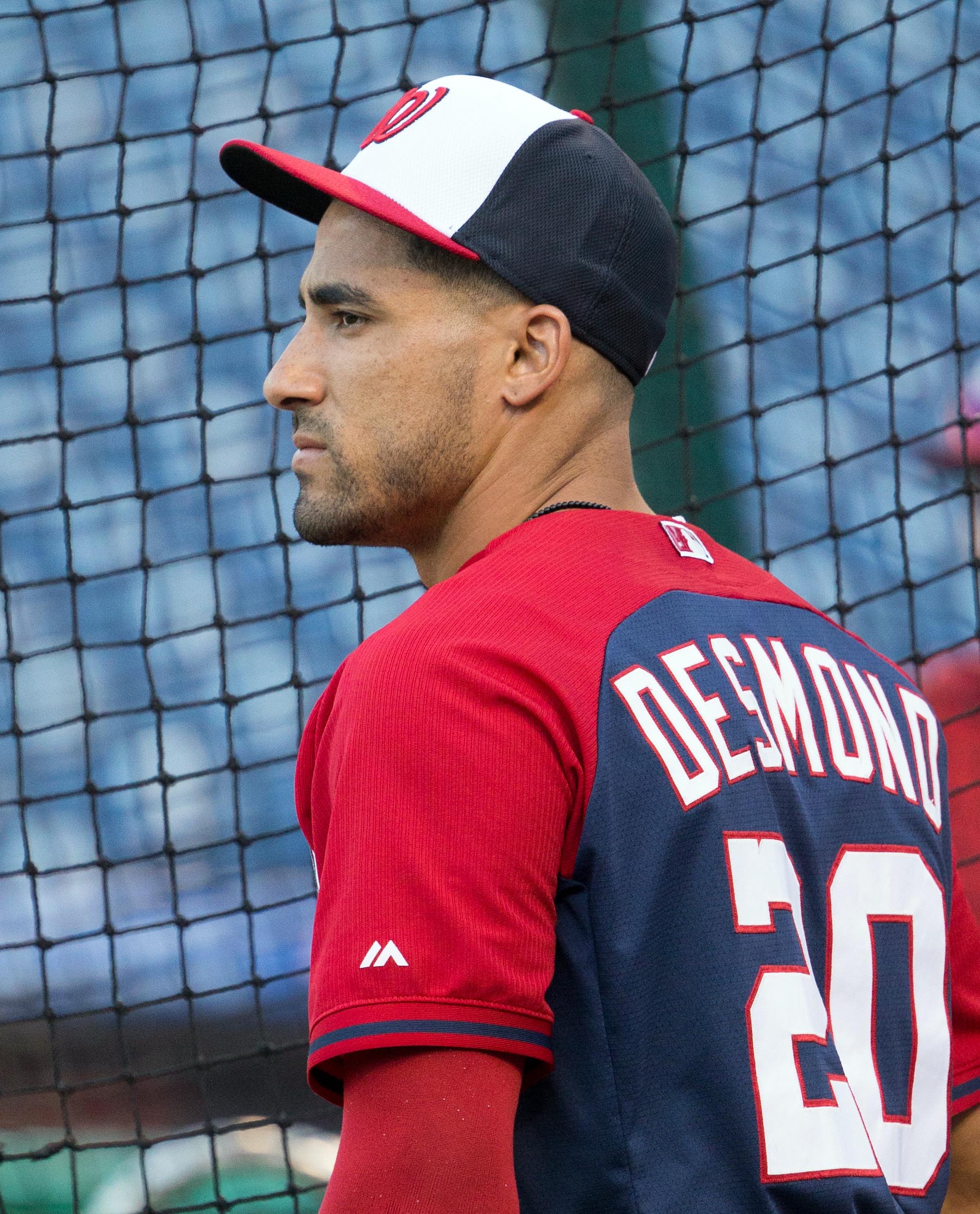
Critics will be quick to point out that Desmond infamously turned down a seven-year, $107MM extension with the Nationals in the 2013-14 offseason. While Desmond undoubtedly has some financial regrets about doing so, the money he apparently left on the table isn’t quite as much as many would assume at first glance. For starters, that contract included his final two arbitration years with the Nats, during which time he earned $17.5MM anyway. Secondly, the contract was also said to include deferred money (as has been the case with virtually every significant Nationals contract offer in recent history due to their ongoing television rights fees battle), further deflating the value of the deal. While Desmond unquestionably comes out behind for the time being, he’ll hope for a big year in Texas and a significantly better result in free agency next offseason.
Throughout the offseason, there’s been talk that Desmond could draw interest from clubs at a position other than shortstop, though there were a number of obstacles that seemed to be standing between Desmond and an agreement with the Rangers. For starters, Texas has repeatedly been said to be averse to adding further payroll, as they’re already looking at what projects to be a club-record payroll north of $145MM. Beyond that, the Rangers will have to surrender the No. 19 overall pick in the 2016 draft in order to sign Desmond. However, if the Rangers make Desmond a qualifying offer next offseason and he turns it down to sign elsewhere, Texas can recoup a first-round pick.
The Rangers picked up the No. 30 overall selection in the draft when Yovani Gallardo signed with Baltimore, though, so they will still have a relatively high draft pick even after coughing up their top selection for Desmond. In turn, the Nationals will now gain the No. 29 overall selection as compensation for the loss of Desmond, who turned down a $15.8MM qualifying offer at the onset of free agency.
That decision, of course, will be scrutinized as well, though it’s easy enough to see why Desmond would bet on himself in free agency. He finished the season one home run shy of delivering his fourth consecutive 20-homer campaign, displaying rare power for a shortstop. And while Desmond’s overall batting line was dragged down by a dismal first half, he did rebound with a .262/.331/.446 second half, during which he homered a dozen times and stole eight bases. Desmond’s defense also came under fire in 2015, but an abnormally large number of his errors (nine) came within the first two weeks of the season, and his glovework settled down from that point forward. While he’s not an elite defender at short, consensus on Desmond has been that he could handle the position, and his bat has typically overshadowed any defensive questions.
It’s easy to say that Desmond “should” have accepted the qualifying offer with the benefit of hindsight, but looking at the matter from a more objective standpoint, it’s often difficult to tell which free agents will thrive in spite of a qualifying offer and which will be hamstrung by the associated draft pick compensation. For instance, at the time qualifying offers were extended, there was little questioning whether Desmond should accept or reject. Even coming off a down season, many expected that Desmond would still secure a solid multi-year pact; conversely, there was an enormous amount of discussion as to whether or not right-hander Ian Kennedy should accept. Kennedy, like Desmond, had a dreadful run early in the season before righting the ship, but most felt it was a mistake for him to test the open market. In the end, though, he landed a five-year, $70MM contract with an opt-out clause — a staggering contract and a firm reminder that predicting the manner in which a qualifying offer will impact a player is no easy feat.
Desmond, then, will end up as yet another data point in CBA negotiations when the MLBPA and the league address the qualifying offer system in the upcoming wave of collective bargaining negotiations. This offseason, the likes of Desmond, Dexter Fowler and Howie Kendrick were all undoubtedly impacted by the draft picks attached to their names in free agency. In previous winters, players like Nelson Cruz, Ervin Santana and Kyle Lohse have each seen their stock dragged down by the qualifying offer as well. There’s a common refrain calling for players to simply accept the qualifying offer, but players spend a minimum of six years (usually more) working toward free agency for the right to no longer be beholden to one-year contracts, and the intent of the qualifying offer was never to drive down the stock of players, but rather to provide teams with compensation for losing their best Major League assets. In that light, the adverse impact on players has indeed been a negative (albeit likely unintended) byproduct.
Earlier this month, we heard that the White Sox, Rays, and Rockies all reached out to Desmond’s camp in recent weeks. In January, the Padres were reportedly giving heavy consideration to signing Desmond before inking Alexei Ramirez. Now, as is often the case with free agents that linger on the market, Desmond will end up with a team that didn’t even appear to be a fit, on paper. However, with Josh Hamilton opening the season on the disabled list, the Rangers saw an opportunity to add a bat with some upside at a relatively low price and will take the chance on Desmond’s glove converting to the outfield at an acceptable level as they look to defend their AL West title.
FOX’s Ken Rosenthal first reported the agreement and the terms (links to Rosenthal on Twitter). MLB.com’s T.R. Sullivan reported (also via Twitter) that Desmond had passed his physical.
Photo courtesy of USA Today Sports Images.
Rangers Sign Drew Stubbs To Minor League Deal
FEB. 28: Stubbs’ contract comes with a $1.5MM base salary in the Majors, reports Jon Heyman (via Twitter).
FEB. 27: The Rangers have officially announced the signing.
FEB. 26: Outfielder Drew Stubbs will sign a minor league deal with the Rangers, reports ESPN’s Jerry Crasnick (on Twitter). The contract contains an invitation to Major League Spring Training.
The 31-year-old Stubbs finished out the 2015 season with the Rangers after having been released by the Rockies, though he went just 2-for-21 in 26 regular season plate appearances (plus another 1-for-4 in the postseason). Crasnick reported over the weekend that Texas was interested in a reunion with Stubbs, which makes sense considering the present uncertainty surrounding Josh Hamilton’s knee. Hamilton is currently slated to open the season on the disabled list.
While the 2015 season, as a whole, represented a poor year for Stubbs, he batted .289/.339/.482 as recently as 2014. The hitters’ haven that is Coors Field undoubtedly contributed to some of that robust production, but Stubbs has proven himself to have a nice blend of power and speed over the years. From 2010-14, Stubbs averaged 144 games, 15 homers and 27 stolen bases per season to go along with a .245/.314/.393 batting line.