
White Sox Outright Juan Minaya
Right-hander Juan Minaya has cleared waivers and been assigned outright to Triple-A Charlotte by the White Sox, thus opening a spot on the team’s 40-man roster. The Athletic’s James Fegan tweets that Minaya’s velocity has dipped “noticeably” in recent outings, and the righty has struggled through a series of poor relief appearances this spring (11 runs in 4 2/3 innings). Beyond Minaya, the Sox also reassigned non-roster invitee Randall Delgado to minor league camp, ending the former D-backs right-hander’s bid to make the Opening Day roster.
Minaya, 28, has been a consistent presence in the White Sox’ bullpen over the past two seasons, pitching to a combined 3.89 earned run average while averaging 10.9 strikeouts and 4.9 walks per nine innings pitched. He briefly served as the team’s closer in 2017, tallying nine saves in that role, and has generally been a solid reliever for the Sox — albeit an erratic one in terms of control. Minaya averaged 95 mph on his heater last season and has posted an 11.5 percent swinging-strike rate across the past two years, though it seems some of that velocity has disappeared in camp.
Minaya’s subtraction from the 40-man roster doesn’t necessarily indicate that the White Sox are on the verge of any sort of signing. Veteran righty Ervin Santana, in camp with the White Sox on a minor league contract, is widely expected to claim a spot in the rotation and now has a clear path to be added to the roster. If that indeed plays out, he’ll reportedly earn a $4.3MM salary in 2019.
As for Delgado, the 29-year-old was a useful bullpen piece himself for the Diamondbacks from 2015-17 when he notched a 3.79 ERA with 8.6 K/9 and 3.6 BB/9 over the life of 209 2/3 innings. (He also mixed in six starts along the way.) A significant oblique strain wiped out more than half of his 2018 season, however, and he managed just 11 1/3 innings with more walks (six) than strikeouts (five) before being designated for assignment.
Blue Jays Reassign Vladimir Guerrero Jr. To Minors Camp
The Blue Jays have reassigned third baseman Vladimir Guerrero Jr. to minor-league camp, the club announced and Ben Nicholson-Smith of Sportsnet was among those to cover (via Twitter). That news brings an official end to the MLB camp experience of baseball’s best hitting prospect.
Guerrero, 19, had already likely wrapped up his spring work owing to the intervention of a recent oblique injury. That nixed any remaining chance that he’d open the season on the active MLB roster — an opportunity that likely wasn’t available anyway, given the front office’s established position on his readiness.
Toronto president Mark Shapiro recently discussed things further, as Nicholson-Smith reported. The club would like to see a “light bulb going off” for the exceptionally talented youngster, who’s expected to be a franchise centerpiece for years to come.
Though he didn’t express any concern with Guerrero’s work ethic, conditioning, or dedication, Shapiro did discuss a need for him (and other young players) to learn how to “live your life with intent.” It’s understandable that the Jays would like Guerrero to seize his full potential with a committed “intent to get better,” though a cynic might be inclined to turn the tables on the front office’s own intentions here. There’s ample reason to believe that Guerrero would be a high-quality major leaguer right now, even if he’s not a fully developed all-around player. And it’s at least fair to question whether his skills and habits will be honed faster in Buffalo rather than in Toronto.
There was one other aspect of Shapiro’s commentary that seems worthy of further attention. The veteran executive said:
“The reality is there’s 50 decisions throughout the day that you can control. If you start to control 38 or 40 of those 50 decisions every day, you’re going to make decisions for Ross (Atkins). Ross isn’t going to have to make them. What you’re ultimately hoping to do is hand the development over to the player.”
We’re all accustomed to hearing pretext for service-time-driven decisions. Some of it has some grounding in reality. Shapiro’s views on players owning their own careers surely have some merit and grounding in good intentions. Vlad Jr. can surely improve his glovework and baserunning as well. But it seems awfully disingenuous to suggest that off-field dedication by a player can “make decisions” for a front office even as teams decline even to acknowledge the often-dispositive influence of long-term player control and financial considerations in promotional decisions.
Nationals Sign Tony Sipp
March 14: The Nats have formally announced the deal, and Sipp has reported to camp. Because they already had an open 40-man spot after releasing Solis, no corresponding move was necessary to accommodate the addition of Sipp.
March 13: The Nationals have a deal in place with free agent reliever Tony Sipp, according to Jon Heyman of MLB Network (Twitter links). It’s a one-year, $1.25MM contract that includes a $250K buyout on a $2.5MM mutual option, per reports from Jesse Dougherty of the Washington Post (Twitter links) and Ken Rosenthal of The Athletic (Twitter link).
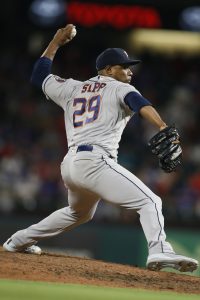
Sipp, a 35-year-old southpaw, bounced back in the results department last season after two rough campaigns in Houston. He finished 2018 with 38 2/3 innings of 1.86 ERA pitching over 54 appearances — quite an improvement over the 5.33 ERA he had maintained over his prior 81 frames. As Sipp’s low innings tallies suggest, he has been used primarily as a left-on-left specialist. That also means the earned runs outcomes probably aren’t the best means of measuring his usefulness on the hill.
Looking beneath the hood, Sipp has generally maintained solid K/BB numbers throughout his career. In five years in Houston, he carried 9.9 K/9 against 3.2 BB/9 and rarely strayed too far from those means. The difference between his good and bad years, more than anything else, has been his ability to limit the long ball. Sipp hit his stride in Houston when he improved upon early-career problems in that regard, then slipped when he allowed more than two dingers per nine innings in those ugly 2016-17 seasons. Last year, only a single opposing hitter left the yard against him.
Though that surely isn’t sustainable — a 2.6% HR/FB rate is sure to rise — it shows that Sipp was able to adjust. He still has the same underlying stuff and ability that led the ‘Stros to give him a three-year deal in the 2015-16 offseason. Last year, he maintained a 13.7% swinging-strike rate and maintained a fastball in the 92 mph range, both of which are at or above his career levels. The Statcast numbers were quite promising: hitters entering the box against Sipp maintained a meager 22.1% hard-contact rate and mustered only a .258 wOBA that actually lagged expectations (.252 xwOBA) based upon contact quality.
Sipp is likely to be deployed primarily as a southpaw specialist in D.C. He held opposing left-handed hitters to an anemic .188/.263/.294 batting line last year after finally dealing with the gopher ball infestation. Over his career, though, Sipp has actually maintained quite neutral platoon splits. Through about a thousand plate appearances each against left-handed and right-handed hitters, the former group carries a .308 wOBA and the latter a .311 mark.
It’s a bit difficult to pinpoint just what allowed Sipp to regain his effectiveness. A re-aligned release point is certainly notable; perhaps it enabled deeper changes (sequencing? tunneling?) to boost the effectiveness of his repertoire. Poor competition in a stratified American League and lower-leverage usage were surely also factors, though it’s fair to note that Sipp ended up with a career-best 1.24 win-probability added and was ultimately called upon to pitch in three ALCS contests.
The Nats probably aren’t expecting premium results from Sipp, given the late-stage signing and meager guarantee. But it’s an easy risk to take on a player who can reasonably be expected to represent an upgrade over the just-released Sammy Solis. The club avoided all but a sixth of the $850K arb deal it had in place with Solis, which accounts for about half of the new obligation. Sipp will serve as a LOOGY and middle relief option for the Washington club, boosting a bullpen depth chart that has its fair share of questions.
Photo courtesy of USA Today Sports Images.
White Sox Option Eloy Jimenez To Triple-A
In what has been a widely anticipated move, the White Sox announced Wednesday that they’ve optioned top outfield prospect Eloy Jimenez to Triple-A Charlotte. The move was one of nine spring cuts by the ChiSox, who also optioned out top pitching prospect Dylan Cease, catcher Seby Zavala and outfielder Micker Adolfo.
Jimenez, 22, is not only considered to be among the game’s premier prospects but is also largely believed to be ready for MLB action. The Dominican-born slugger obliterated Double-A and Triple-A pitching in 2018, posting ridiculous slash lines of .317/.368/.556 and .355/.399/.597 at those respective levels.
Jimenez’s demotion will stand out as one of the more blatant examples of service time manipulation this spring, as the decision to send him to Triple-A is surely motivated more by the desire to gain an extra season of club control over the player rather than to further his development. This year’s regular season is 186 days long, and a player would gain a full season of MLB service by spending 172 of those days at the MLB level (be it on the active roster or the injured list). In other words, by keeping Jimenez in the minors for just 15 days, the Sox will be able to control him for seven seasons as opposed to the six seasons for which they’d control him by bringing him to the Majors to open the year.
It’s a maddening and counter-intuitive side effect of a system that has prompted pundits, players, agents and fans to call for change. For a team in the White Sox’ situation — unlikely to contend this season but optimistic that their ongoing rebuild is nearing the finish line — it makes perfect sense from a business standpoint to trade two weeks of Jimenez in a noncompetitive season for a full extra year of control over a potential premium player. For Jimenez, however, the current structure of service time and free agency delays his path to his most significant potential payday, while the fans are asked to accept that their team won’t bring the 25 best players in camp north to open the season. It’s a system in which there’s arguably no true winner, as the even White Sox’ front office will surely face a negative wave of backlash from fans and onlookers.
For the time being, Jimenez will be asked to continue honing his skills in the minors. Perhaps the Sox will opt not to call him up on the very first day on which he’d fall a year shy of big league service, using the delay as a means of further claiming that the move was a developmental decision rather than one driven by service time. It’s likely that they’ll point to Jimenez’s .154/.154/.346 slash in Spring Training as justification of the move, though few would find it plausible that 26 spring plate appearances are more indicative of MLB readiness than the 456 PAs during which Jimenez laid waste to minor league pitching in 2018. Furthermore, the move would surely have happened regardless of his performance; the White Sox, after all, declined to give Jimenez a September call-up in 2018 despite his aforementioned mastery of minor league pitching and despite the fact that he was already on the 40-man roster.
Regardless of the specific timing, it seems quite likely that Jimenez will be in the Majors very early in the 2019 campaign. Cease and the others who were sent out aren’t as far along in their development and will be on a more uncertain timeline to the big leagues.
To be fair to the White Sox, they’re far from the only club to take this route. The Braves held back Ronald Acuna‘s promotion to the Majors last season under similarly dubious circumstances, while others who’ve been subject to this form of service time manipulation include Kris Bryant and Maikel Franco (among many others). It was a foregone conclusion that the Blue Jays would send Vladimir Guerrero Jr. down to the minors in the exact same fashion, though Guerrero’s recent oblique injury actually gave the Toronto organization a legitimate reason to do so.
Mariners Outright Kris Negron
The Mariners have outrighted utilityman Kristopher Negron after he cleared waivers, per Ryan Divish of the Seattle Times (via Twitter).
That leaves the team with a 40-man roster opening. Veteran outfield Ichiro Suzuki will ultimately need a roster spot to play in the club’s season-opening series in Japan.
As Divish notes, today’s decision clears the way for Dylan Moore to make the team as a bench piece. He had been battling with Negron for the honors.
Negron, acquired in late August, has taken only 334 career plate appearances in the majors. The 33-year-old has torn up Triple-A pitching over the past two seasons, however.
Padres Sign Sammy Solis To Minor League Deal
March 12: The Padres have announced the signing.
March 11: Left-hander Sammy Solis‘ foray into the free-agent market apparently proved to be extraordinarily brief; after being released by the Nationals on Saturday, Solis has agreed to a minor league contract with the Padres, according to Robert Murray and Dennis Lin of The Athletic (Twitter links). Solis is represented by CAA Baseball.
Following Solis’ release, manager Dave Martinez told MLB.com’s Richard Justice that the Nats opted to part ways with Solis in order to give him a chance to latch on with another club while Spring Training as still underway. It’d been determined that he wouldn’t make the team in Washington, and cutting ties with Solis not only gave him a chance to join another Major League camp in pursuit of a roster spot but also saved the Nationals a bit more than $700K of his non-guaranteed $850K salary. In that sense, the move helped out all parties, as Solis will still have more than two weeks to attempt to secure a roster spot in San Diego.
As Lin points out, the interest in Solis was heightened by the recent injury to fellow lefty reliever Jose Castillo, who sustained a flexor strain that, as of March 1, was expected to sideline him for six to eight weeks. San Diego still has multiple lefties on the roster even with Castillo out — both Aaron Loup and Robbie Erlin are expected to claim roster spots — but Solis will provide a depth piece and could yet even work his way into a somewhat unsettled Opening Day bullpen role. Kirby Yates, Adam Warren, Craig Stammen, Loup and Erlin are all set for bullpen spots, but there are at least two jobs up for grabs — perhaps three, if San Diego carries eight relievers.
Solis, 30, has had a pair of rough seasons with the Nationals — most recently working to a dismal 6.41 ERA in 39 1/3 frames last year. However, he also averaged 10.1 K/9 last season and turned in strong marks in terms of swinging-strike rate (12.9 percent) and opponents’ chase rate (31.7 percent). Solis has averaged 94 mph on his fastball in his career and has generally excelled at the Triple-A level. He also still has only three years, 61 days of MLB service time, meaning that if he does find success in the Padres’ pen, the team can control him through at least the 2021 season (and potentially 2022, depending on the timing of a promotion to the Majors).
Mariners Release Dustin Ackley
The Mariners have released infielder/outfielder Dustin Ackley from his minor league contract, per a club announcement. Ackley, who returned to the Mariners on a minor league deal back in January, had been in camp and appeared in 11 games with Seattle this spring, though he’d only tallied a total of 18 plate appearances. In that time, Ackley collected a trio of singles and drew six walks against three strikeouts.
Formerly the No. 2 overall draft pick (Mariners, 2009) and one of the game’s top all-around prospects, the now-31-year-old Ackley hasn’t appeared in the big leagues since a brief, 28-game stint with the Yankees in 2016. It’s been quite a bit longer than that since he enjoyed productivity at the MLB level, however.
Ackley quickly ascended to the Majors, debuting barely two years after being drafted out of UNC, and he made an immediate impression in Seattle when he hit .273/.348/.417 with six homers, 16 doubles, seven triples and six steals through his first 90 games (376 plate appearances) back in 2011. Ackley was widely considered an advanced bat and a slam-dunk big leaguer, but his offense unexpectedly cratered and never recovered following that solid rookie campaign. In 1971 MLB plate appearances since his debut season, Ackley has managed just a .235/.296/.358 slash. If he’s to ultimately work his way back to the big leagues, he’ll assuredly require a stop in Triple-A, where he hit .286/.378/.398 in 284 PAs for the Angels’ affiliate in 2018.
Notable Pre-Arb Salaries: Bregman, Flaherty, Hicks, Ohtani
The Rays decided over the weekend to renew the contract of reigning American League Cy Young winner Blake Snell for just $573,700, highlighting the less-than-satisfying manner in which pre-arbitration players’ salaries are determined. As we noted in that post, other similarly accomplished players have been paid quite a bit more by their respective teams. The collectively bargained system leaves full discretion with clubs to set salaries for those players that are not yet eligible for arbitration, subject only to a floor (currently $555K). A few players have landed in the $1MM range, though that is the exception rather than the rule. Approaches vary widely from team to team. Whatever one thinks about the fairness of that minimum salary level, it’s rather a bizarre system.
Here are some other notable recent pre-arb salary outcomes:
- The Astros renewed star third bagger Alex Bregman for $640,500, per MLB.com’s Brian McTaggart. That’s a bargain rate for one of the game’s best young position players, who says he’s “disappointed” in how things turned out. Bregman explained: “I feel like good business would be wanting to make a player who performed at a high level on your team happy and want to feel like he wanted to be kept and feel like they wanted him to play here forever. I’m just disappointed it doesn’t seem like the same amount of want.” GM Jeff Luhnow defended the decision in part by pointing to the fact that it’s “one of the top ten” pre-arb salaries ever awarded. “I know it’s not satisfying because he’s a great player and no player is ever satisfied the year before they reach arbitration with the amount the club gives them,” said Luhnow. “That’s just the nature of our industry right now.”
- Over in Cardinals camp, there are a few other players who are surely less than thrilled with how things turned out. Righties Jack Flaherty and Jordan Hicks were each renewed, as Derrick Goold of the St. Louis Post-Dispatch reports. The former was renewed at $562,100 — $10K less than the team offered him, reflecting a $10K reduction for his decision not to sign on the dotted line. Flaherty decline to criticize the team, saying that “their process is great and it makes sense,” but says “the system as a whole is not great.”
- Meanwhile, the Angels managed to reach agreement with AL Rookie of the Year recipient Shohei Ohtani, Bill Shaikin of the Los Angeles Times tweets. Ohtani has over than a year less service time than Bregman but will out-earn him at $650K. The ROY hardware certainly didn’t hurt and Ohtani is unquestionably a unique case — and not just because of his two-way contributions. The Halos originally landed Ohtani — Japan’s biggest star and the most fascinating international player ever to cross the Pacific — for a bonus of just over $2.3MM since he chose to come over while still subject to collectively bargained international signing caps. Ohtani’s will be a pre-arb earner one more time in 2020 before qualifying for arbitration.
Dodgers Place Andrew Toles On Restricted List
The Dodgers have placed outfielder Andrew Toles on the restricted list, Bill Plunkett of the Orange County Register tweets. Toles has yet to report to spring camp owing to an undisclosed personal matter.
Details are lacking, though it seems that today’s move was not driven by any change in Toles’s situation. With no resolution in sight, though, the Dodgers will now have another 40-man roster spot to work with for the time being.
Still just 26 years old, Toles burst onto the MLB scene in 2016 but missed much of the ensuing season with an ACL tear. He ultimately received only a limited opportunity last year, struggling in just 32 plate appearances, but hit well (.306/.345/.461) in his 275 trips to the plate at Triple-A.
The expectation had been that the left-handed-hitting Toles would challenge for a part-time role in Spring Training. Just how things might have shaken out can’t be known given that he never made it into camp. Toles will remain under control of the Dodgers organization, which will ultimately need to decide whether to add him back to the 40-man roster if and when he is ready to resume playing.
Royals Sign Martin Maldonado
March 11: The Royals have announced the signing. To make room on the 40-man roster, Perez has been placed on the 60-day injured list.
March 9: The Royals are in agreement with free agent catcher Martin Maldonado on a one-year, $2.5MM contract, per the Athletic’s Ken Rosenthal (via Twitter). Maldonado can earn up to $1.4MM in incentives. The deal is pending a physical.
This union was destined ever since the Royals lost starter Salvador Perez for the season to Tommy John surgery. The Royals were left with only Cam Gallagher and Meibrys Viloria atop their depth chart, which easily would have been the most inexperienced duo in the league. The Maldonado signing likely gives Viloria more time to season in the minors, as he had not appeared above High-A before getting 29 plate appearances with the Royals last season.
While Maldonado has a good chance of becoming a trade chip before the end of July – he’s a good one, one of the most accomplished defensive backstops in the game, and he should help buoy a young Royals staff.
As MLBTR’s own Steve Adams wrote just two days ago: “That Maldonado remains unsigned has seemed an oddity in recent weeks; while he’s unequivocally a below-average hitter, the 32-year-old is also among the game’s premier defenders at his position. As I noted about three weeks ago when Maldonado was linked to the Mariners, the 2016 Gold Glover ranks third among all active catchers in Defensive Runs Saved dating back to the 2012 season, trailing only Buster Posey and Yadier Molina — each of whom has caught at least 2000 more innings than Maldonado in that span. He’s also a perennially strong pitch framer with a career 38 percent caught-stealing rate, including a ridiculous 49 percent mark in 2018 (17-for-35).”
Considering the prevalence of time shares at the catching position these days, it was indeed surprising that it took Maldonado so long to find a home. With the Brewers, Angels and Astros, he has a career batting line of .220/.289/.350, but that shouldn’t have been much of a deterrent in an ecosystem that lacks elite offensive production from the catching spot. Playing devil’s advocate here, Maldonado’s 0.9 fWAR in 2018 places him tied for 25th among catchers last season, on par with names like Matt Wieters and Nick Hundley, both of whom had to settle for minor league deals this winter. Maldonado was rumored to have received a two-year, $12MM offer from the Astros early in the winter, but according to his former agent Scott Boras, they never received a formal offer from Houston, per MLB Network’s Jon Heyman (via Twitter).
Interestingly, the deal comes just a few days after Maldonado switched representation, hiring Dan Lozano of the MVP Sports Group. Maldonado had spent just a few months (since August) with the Boras Corporation. Still, it appears this contract was put in place before the switch, as Boras will collect commission on the deal. Rosenthal (via Twitter) quotes Boras as saying, “The Kansas City deal was in place and finalized without us knowing Maldonado had switched agents.”