
Orioles Claim Jake Cave, Designate Jake Reed
The Orioles have claimed outfielder Jake Cave off waivers from the Twins, according to the MLB.com transactions tracker. Baltimore is designating reliever Jake Reed for assignment in a corresponding move. Roch Kubatko of MASNSports.com confirms the news (Twitter link).
Cave has played parts of five big league seasons, all of them with Minnesota. He was initially drafted by the Yankees but dealt to the Twins before making his major league debut in 2018. The former sixth-round pick played well in part-time action during his first two seasons, hitting 21 home runs over 163 games. He’s had a tougher go over the last three seasons, largely due to increasing issues making contact. Dating back to the start of the 2020 campaign, Cave owns a .206/.262/.351 line in 478 trips to the plate.
The Twins ran Cave through outright waivers last offseason, but he made it back to the majors in early August. He posted a .213/.260/.384 showing with five homers in 54 games, swinging through 17% of pitches he saw. It wasn’t a great big league showing, but the 29-year-old had been very impressive during a longer run with Triple-A St. Paul. Cave popped 14 homers in 373 plate appearances with the Saints, posting an overall .273/.370/.509 line. His 24.9% strikeout rate was still a bit higher than average, but he showed solid power and walked at a strong 11.5% rate.
Cave adds some left-handed hitting outfield depth to Baltimore’s ranks, at least for the moment. He has a fair bit of experience at all three spots on the grass, although public metrics haven’t been fond of his work in center field. He’s a career .243/.314/.430 hitter against right-handed pitching, and he’s been essentially unplayable (.210/.240/.352) in 230 plate appearances against southpaws.
With between three and four years of major league service time, Cave is eligible for arbitration through 2024. He’s projected by MLBTR contributor Matt Swartz for a $1.2MM salary if tendered a contract. It’s possible Baltimore still elects to non-tender him next month (perhaps with hopes of re-signing him to a cheaper or minor league deal), but they’ll add him to the 40-man roster for the time being. Cave still has one minor league option year remaining, so the O’s could keep him at Triple-A Norfolk next year if he holds his spot on the 40-man.
Reed is a recent waiver claim himself, having been added from the Dodgers five weeks ago. The low-slot righty made eight appearances with the O’s, allowing six runs (four earned) in 5 2/3 innings. He suited up with three different teams overall in 2022, also pitching for the Mets and Dodgers. Between the trio of clubs, the 30-year-old posted a 7.02 ERA with a modest 16.9% strikeout rate in 16 2/3 frames.
Despite his lack of major league success, Reed has been a fairly frequent target for teams once he’s hit the waiver wire. That’s in large part thanks to his solid Triple-A track record, as he owns a 3.84 ERA through parts of six seasons at that level. Reed has fanned an above-average 25.6% of batters faced there while walking 9.5% of opponents.
Reed will hit the waiver wire again in the coming days. Like Cave, he still has an option year remaining and could serve as a depth player if another team were to put in a claim. If he passes through the wire unclaimed, he’d have the right to refuse an outright assignment and elect free agency based on his minor league service time.
Braves Extend Spencer Strider
The Braves have extended yet another key member of their impressive young core, this time announcing a six-year, $75MM contract for right-hander Spencer Strider. The contract, which covers the 2023-28 seasons, also contains a $22MM club option for the 2029 season. The six-year guarantee buys out Strider’s final two pre-arbitration seasons, all three arbitration years and what would have been his first free-agent season. The 2029 club option gives the Braves control over what would’ve been Strider’s second free-agent campaign. Strider is represented by Frontline.
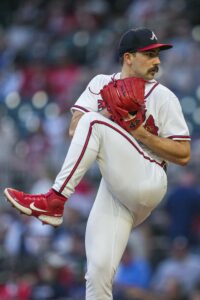
Strider, 24 later this month, will earn $1MM both in 2023 and 2024. He’ll be paid a $4MM salary in 2025 before jumping to $20MM in 2026 and $22MM in 2027 and 2028. The 2029 option comes with a $5MM buyout, which is factored into the guaranteed portion of the contract. If the Braves pick up that net $17MM option for the ’29 campaign, Strider will earn a total of $92MM over seven years.
Strider becomes the fourth young Braves star to be extended this season alone, joining first baseman Matt Olson (eight years, $168MM), center fielder Michael Harris II (eight years, $72MM) and star third baseman Austin Riley (ten years, $212MM). Atlanta, of course, had previously already signed outfielder Ronald Acuna Jr. and second baseman Ozzie Albies to club-friendly extensions. All six of those players are now under club control through at least the 2027 season, giving the Braves a level of continuity and cost certainty that is unparalleled throughout the league.
A fourth-round gem in the extremely truncated 2020 draft (five rounds), Strider skyrocketed through the Braves’ system despite a lack of minor league games in 2020, ultimately making his Major League debut late in the 2021 season. The Clemson product cracked the Braves’ Opening Day roster in 2022, initially working multi-inning stints out of the bullpen before ascending to the starting staff, where he not only found success but emerged as a bona fide front-of-the-rotation arm.
Overall, Strider broke out with 131 2/3 innings of 2.67 ERA ball and a 38.3% strikeout rate that paced all big leaguers who pitched at least 100 innings. Command was an issue at times in the minors and early in the season, but Strider markedly scaled back on the number of free passes he yielded as the season wore on, finishing out the year with an 8.5% walk rate that was scarcely north of the league average. For someone who walked 13.5% of his opponents over the first two months of the season, the improvement was as remarkable as it was rapid; from June 10 onward, Strider walked just 6.8% of his opponents.
Strider’s dominance has positioned him as one of the two favorites for National League Rookie of the Year honors, as he and teammate Harris are widely viewed as the presumptive first- and second-place finishers in an extremely strong year for rookies (both in the NL and in MLB as a whole).
The $75MM guarantee for Strider shatters any prior precedent for pitchers with such limited experience. Prior to this deal, the five-year, $35MM contract Madison Bumgarner signed with the Giants more than a decade ago stood as the record extension for a pitcher with between one and two years of service time. (Strider is currently at 1.003 years.) This new contract not only finally topples that dated mark (in decisive fashion), it also surpasses the established extension records for pitchers with two to three years of service time (Blake Snell‘s five-year, $50MM deal) and even with three to four years of service (Sandy Alcantara‘s five-year, $56MM deal).
Because extensions, more so than free-agent contracts, draw heavily from recent comparables, the Strider deal in many ways paves the way for new precedent to be established in multiple service classes. That’s not to say every pitcher with between one and four years of service time will now require $75MM+ to sign an extension, of course; Strider’s case as a Rookie of the Year frontrunner and budding ace is far from the norm.
Nonetheless, as we’ve seen with young position players in recent years, the market for these types of extensions can still advance rapidly. Back when Acuna signed his eight-year, $100MM extension, that was the largest deal ever for a position player with under a year of big league service. That mark was quickly smashed by Wander Franco (11 years, $182MM) and further surpassed this summer by Julio Rodriguez (12 years, $210MM).
With Strider’s salaries now set through the 2028 season, the Braves, incredibly, already have $76MM on the books six years down the line. That’s more than any other team in baseball. The Padres have about $57MM on the ’28 books between Manny Machado and Fernando Tatis Jr., while the Rangers have about $51MM on the books between Corey Seager and Marcus Semien. (Machado can opt out of his deal with the Friars after next year, so the Padres’ 2028 commitments may not end up being quite so large.) Obviously, $76MM in 2028 will carry less weight than $76MM in 2022, but it’s still a hefty commitment to have so far down the line.
There’s some degree of risk for the Braves in laying out such lengthy commitments, even if each looks quite team friendly in a vacuum. Injuries and regression could always push any of these extensions from “bargain” to “burden” — particularly in the later stages of the deals, when the salaries are come with more heft. Still, given the general excellence of this group, it’s impossible not to be bullish on the team’s future.
Looking more immediately down the line, the Braves already have $153MM on next year’s payroll and nearly $110MM on the 2024 payroll. That’s before considering a slate of arbitration-eligible players headlined by lefty Max Fried, who’s projected by MLBTR contributor Matt Swartz to earn more than $12MM in 2023. Atlanta would have a franchise-record payroll in 2023 even if the only moves made by the front office were to simply tender arbitration contracts to their eligible players.
Of course, that’s certainly not all the Braves will do this winter. First and foremost on the agenda will be negotiations with shortstop Dansby Swanson, who’ll be a free agent once the postseason concludes. The Braves and Swanson have publicly expressed mutual interest in a new contract, but getting something done would likely send the Braves soaring over the $200MM mark in terms of their bottom-line payroll while also pushing them into the general vicinity of the first luxury tax threshold for the first time ever. The Braves also surely are still hopeful of extending Fried, who’s controlled through the 2024 season. If they succeed in signing both Swanson and Fried, there’s virtually no path to avoiding the luxury tax.
On the one hand, while contracts like this Strider extension are cause to celebrate in the long-term, they do also create some shorter-term considerations. Strider would’ve only counted around $750K toward the luxury tax in 2023, had he not signed this extension. He’ll instead now carry a sizable $12.5MM luxury hit — the average annual value of his new contract. It’s still a win for both player and team, but the glut of long-term deals does inflate the Braves’ luxury ledger more quickly than a year-by-year approach would.
On the other hand, that’s a trivial concern when juxtaposed with the benefit of having so many high-end players signed for the next six-plus seasons. And with a World Series win in 2021 and another postseason run forthcoming, the NL East-champion Braves will no doubt see a boost to their revenues, lessening the sting of any luxury penalties that may arise in the next couple years. Atlanta already arguably boasted the best cost-controlled core of any team in baseball over the next half decade, and adding Strider to the preexisting quintet of Harris, Olson, Riley, Albies and Acuna only furthers their case. Waves of injuries can derail any team at any time, but health-permitting, the Braves are going to be good for a long, long time.
Dustin Garneau Announces Retirement
Former major league catcher Dustin Garneau took to Twitter this afternoon to announce his retirement. “Hanging them up. Thank you to everyone who had an impact on my career,” Garneau wrote. “To my wife for always being by my side through the ups and downs. To my agent (Marc Kligman) for always being there and making me a part of your family as well. And to my friends and family who were by my side.”
A 19th-round pick of the Rockies in the 2009 draft, Garneau reached the majors for the first time six years later. The Cal State Fullerton product broke into the big leagues just after his 28th birthday in August 2015. It marked the first of eight straight years in which he’d get to the highest level. Garneau was a prototypical depth catcher, never appearing in more than 41 MLB games in a season but donning six different uniforms along the way.
After two seasons in Colorado, Garneau bounced to the A’s on waivers. He’d find himself in the transactions logs fairly frequently thereafter, moving to the White Sox, Angels, back to the A’s and Astros through 2020. He returned to the Rockies on a minor league deal in 2021 but was dealt to the Tigers, with whom he spent the past couple seasons. That included eight games early this season, but he spent most of the year in Triple-A before reaching minor league free agency last week.
Altogether, Garneau appeared in 168 major league games. He hit .205/.285/.373 over 506 plate appearances, connecting on 15 home runs and 28 doubles. Six of those longballs came in a 20-game stint with Detroit in 2021. Over parts of eight Triple-A campaigns, the righty-swinging backstop was a .248/.329/.480 hitter. He played parts of 14 professional seasons. Best wishes to Garneau in all the best in his post-playing endeavors.
Orioles Outright Anthony Castro
The Orioles announced this afternoon that reliever Anthony Castro has gone unclaimed on waivers and been sent outright to Triple-A Norfolk. The right-hander has previously cleared outright waivers in his career, giving him the right to refuse the assignment and elect minor league free agency.
It’s likely the 27-year-old will indeed set out onto the open market in search of a new opportunity. Castro never suited up at the big league level with the Orioles, with Baltimore nabbing him off waivers from the Guardians in early September. He spent the final month of the season on optional assignment to Norfolk, making eight appearances with the Tides without getting an MLB look. Baltimore designated him for assignment last week to free a 40-man spot for catcher Anthony Bemboom, who otherwise would’ve qualified for minor league free agency.
Castro did make 13 MLB outings with Cleveland this year, but the results weren’t what the club envisioned when they acquired him in an Opening Day swap with the Blue Jays. Castro allowed 15 runs (11 earned) in 13 1/3 innings, surrendering five home runs while walking ten batters. He averaged 94.8 MPH on his four-seam and 84.4 MPH on a slider that served as his primary pitch, but the home runs and control issues plagued him at the big league level. He only surrendered two longballs in 38 innings of Triple-A work this year, but he walked an untenable 15.4% of batters faced there.
The control issues were worrisome enough Castro went unclaimed on waivers, but he’s likely to find some minor league offers this winter (assuming he indeed elects free agency). He’s punched out more than a quarter of opponents in 39 career big league innings, and he owns a 3.19 ERA through 48 Triple-A frames. The Venezuela native figures to get a Spring Training opportunity heading into 2023.
Mets Add Taijuan Walker To Postseason Roster, Joely Rodriguez Removed Due To Shoulder Problem
Heading into tonight’s pivotal Game 2 of their Wild Card Series with the Padres, the Mets have made an injury-related change to their roster. Newsday’s Tim Healey (Twitter link) reports that left-hander Joely Rodriguez has been removed from the 26-man roster due to a shoulder problem, and righty Taijuan Walker has been added as the replacement.
The specific nature of Rodriguez’s injury isn’t known, and he didn’t pitch in yesterday’s Game 1. Due to the roster removal, Rodriguez is now ineligible to pitch until the NLCS, should New York advance that deep into the postseason. In the bigger picture, Rodriguez is also a free agent after the season, so a serious shoulder issue could hamper his chances of landing a notable contract this winter.
It’s a tough blow for both Rodriguez and the Mets, as David Peterson is now the lone left-handed pitcher remaining on the Mets’ playoff roster. New York is on the brink of elimination after losing Game 1, and with the margin of error so slim, Rodriguez’s absence could loom large given the number of several (Juan Soto, Josh Bell, Jake Cronenworth, Jurickson Profar, Trent Grisham) prominent left-handed hitters and switch-hitters in San Diego’s lineup.
The Mets have been thin on left-handed relief pitching all season, with Rodriguez serving as essentially the only reliable southpaw option. Control was an issue for Rodriguez, as his 12% walk rate helped balloon his ERA to 4.47 over 50 1/3 innings. A 3.54 SIERA paints a more positive view of Rodriguez’s performance, as other metrics as a 53.8% grounder rate, a solid 26.4% strikeout rate and excellent hard-hit ball numbers helped make him a valuable member of New York’s bullpen. Rodriguez also had virtually identical numbers against both left-handed and right-handed batters.
Walker and Carlos Carrasco were stalwart rotation members during the regular season, and the Mets opted to leave them off the roster in the three-game series rather than force either pitcher into a somewhat unfamiliar role. With elimination now looming, it’ll basically be all hands on deck for the pitching staff tonight and (the Mets hope) in a potential Game 3, as manager Buck Showalter will undoubtedly be open to all options in getting some critical outs.
Mets Designate Michael Perez For Assignment
The Mets have designated catcher Michael Pérez for assignment, according to their transactions log at MLB.com. The move opens a 40-man roster spot for righty Tylor Megill, who’d landed on the COVID-19 list earlier this week. Megill is on New York’s Wild Card roster.
New York acquired Pérez from the Pirates in mid-July. The lefty-hitting backstop had been designated for assignment by Pittsburgh, and New York brought him aboard for cash considerations. He spent most of his tenure as upper minors depth, appearing in just six major league games with the Mets. Over 17 contests at Triple-A Syracuse, the 30-year-old backstop hit .183/.231/.317.
Pérez has never been a great hitter. He’s appeared in each of the past five MLB seasons, suiting up with the Rays, Pirates and Mets. Over 591 plate appearances, he owns a .174/.244/.301 line with 15 homers and a 27.9% strikeout rate. That includes a rough .149/.214/.298 mark across 132 trips to the dish with Pittsburgh and New York this season.
The Mets will place Pérez on waivers in the next few days. He’s likely to go unclaimed and elect minor league free agency, as is his right as a player with three-plus years of major league service. He’s likely to be limited to minor league offers with invitations to big league Spring Training this offseason.
34 Players Become Free Agents
The Wild Card round of the 2022 postseason begins today, but for the majority of teams and players, the offseason is now underway. With that will come plenty of roster formalities, including veteran players who’ve been outrighted off their respective teams’ rosters reaching minor league free agency. This week, there have been 34 such instances throughout the league, per the transactions log at MiLB.com.
None of these are a surprise, to be clear. Any player who is not on his team’s 40-man roster at season’s end but has three-plus years of Major League service time, multiple career outright assignments and/or seven-plus seasons in the minors has the right to elect free agency. Everyone in today’s group of players falls under that umbrella. The majority of the group will likely find minor league deals over the winter, although a few of the players in question could potentially find a big league deal as a bench piece or middle-inning reliever.
There will be several more waves of players of this ilk, and we’ll make note of them in bunches over the coming weeks as we await the launch of Major League free agency, when all unsigned players with at least six years of Major League service time will reach the open market. For now, here’s the first of what will likely be several waves of newly minted minor league free agents:
Catchers
- Taylor Davis (Pirates)
- Dustin Garneau (Tigers)
- Andrew Knapp (Giants)
- Pedro Severino (Brewers)
Infielders
- Willians Astudillo (Marlins)
- Johan Camargo (Phillies)
- Michael Chavis (Pirates)
- Matt Davidson (Athletics)
- Dixon Machado (Giants)
- Richie Martin (Orioles)
- Josh VanMeter (Pirates)
- Tyler Wade (Yankees)
Outfielders
- Greg Allen (Pirates)
- Lewis Brinson (Giants)
- Jaylin Davis (Red Sox)
- Jonathan Davis (Brewers)
- Jackson Frazier (Cubs)
- Brett Phillips (Orioles)
Pitchers
- Tyler Beede (Pirates)
- Austin Brice (Pirates)
- Miguel Del Pozo (Tigers)
- Jerad Eickhoff (Pirates)
- Luke Farrell (Reds)
- Paul Fry (Diamondbacks)
- Eric Hanhold (Pirates)
- Travis Lakins Sr. (Orioles)
- Mike Mayers (Angels)
- Daniel Mengden (Royals)
- Juan Minaya (Nationals)
- Sean Newcomb (Cubs)
- Dillon Peters (Pirates)
- Dereck Rodriguez (Twins)
- Cesar Valdez (Angels)
- Aneurys Zabala (Marlins)
Orioles Select Anthony Bemboom, Designate Anthony Castro
The Baltimore Orioles have begun their offseason quickly, selecting catcher Anthony Bemboom from Triple-A Norfolk and designating right-hander Anthony Castro for assignment.
Bemboom joined the Orioles on a minor league contract in the offseason, making the Opening Day roster for the 2022 season before being designated for assignment with the arrival of Adley Rutschman. He passed through waivers unclaimed and was outrighted to Triple-A Norfolk where he spent the rest of the season.
Bemboom had a poor showing in his limited time in the Majors this season, slashing .115/.207/.212 in 52 at-bats for a .418 OPS and throwing out three of eight runners attempting to steal. This production was nothing unusual for the 32-year-old, with Bemboom posting a combined .160/.231/.265 slash line in 181 at-bats over parts of four seasons. In Norfolk, Bemboom produced a marginally better .228/.292/.350 line in 123 at-bats, but he is a career .247/.340/.392/.732 hitter in Triple-A.
This transaction prevents Bemboom from becoming a minor league free agent, and, with just over one year of Major League service time, the Orioles can retain him as a cheap backup to their star catcher if they keep him on the 40-man roster all winter. Current backup Robinson Chirinos is a pending free agent, and recent waiver claim Cam Gallagher is a non-tender candidate.
Castro joined the Orioles off waivers from the Guardians on September 3rd and was sent straight to Triple-A, not appearing at the Major League level with the Orioles. Nevertheless, he has pitched in each of the last three MLB seasons, all with different teams — the Tigers in 2020, the Blue Jays in 2021, and the Guardians in 2022.
In 2022 with the Guardians, Castro pitched to a 7.43 ERA in 13 1/3 innings with a poor 18.5% strikeout rate and a high 15.4% walk rate. Castro has had more success in Triple-A Norfolk, authoring a 2.16 ERA in 8 1/3 innings, striking out eight but walking eight. Castro will hit the waiver wire in the next couple days. If he goes unclaimed, he’ll be eligible for minor league free agency this winter and will likely sign another minor league deal with a Spring Training opportunity.
Yankees Outright Chi Chi Gonzalez
Oct. 6: Gonzalez cleared outright waivers and was assigned to the roster in Triple-A Scranton/Wilkes-Barre, per a team announcement. He can reject the assignment to become a free agent right now or can otherwise wait and become a free agent at season’s end (as is the right of any outrighted player with three-plus years of service).
Oct. 3: The Yankees announced Monday that they’ve reinstated right-hander Miguel Castro from the 60-day injured list and designated fellow righty Chi Chi Gonzalez for assignment in order to open space on the roster.
The Yanks were the third team of the season for the 30-year-old Gonzalez, who allowed one run through 4 2/3 innings in a spot start against the Orioles just yesterday. He’s also spent time with the Twins and Brewers in 2022, combining for 23 innings of 5.87 ERA ball with a 15-to-7 K/BB ratio.
Selected by the Rangers with the No. 23 overall pick back in 2013, Gonzalez ranked as one of Texas’ top minor league arms for a few years but never cemented himself as a regular contributor in either the rotation or the bullpen there. His 3.90 ERA through 67 innings as a rookie in 2015 looked promising on the surface, but Gonzalez walked more hitters (32) than he struck out (30) that season. He’s tossed 217 1/3 frames for five teams since that time, pitching to a collective 6.20 ERA along the way.
Struggles in the Majors notwithstanding, Gonzalez has a decent Triple-A track record and has been solid or better there in three of four seasons pitching at that level. That includes the current campaign, where he’s totaled 80 1/3 innings with a 4.03 ERA, a 20.8% strikeout rate and a 7.9% walk rate. The Yankees will place him on outright waivers or release waivers in the next couple days, and assuming he clears, Gonzalez will be able to become a free agent either upon clearing waivers or at season’s end.
Castro, 27, has been on the injured list twice this season due to a shoulder strain. In 27 innings when healthy, he’s posted a 4.00 ERA with a 24.8% strikeout rate, 10.7% walk rate and 46.6% ground-ball rate. Despite the shoulder troubles, Castro’s sinker remains just as lively as it was with the crosstown Mets in 2021, averaging a blistering 97.9 mph this season.
If he’s healthy, Castro will give the Yanks an experienced option to consider for the postseason as he looks to showcase himself in advance of his first trip to free agency this winter. Command has long been an issue for the hard-throwing righty, but he has a 3.93 ERA over his past 348 big league innings, has considerably upped his strikeout rate since 2020 (26.9%) and typically keeps nearly half the batted balls against him on the ground (career 48.9%).
Padres Place Mike Clevinger On IL Due To Illness
The Padres announced that they have placed right-hander Mike Clevinger on the injured list due to illness. Fellow righty Nabil Crismatt was recalled in a corresponding move.
Clevinger, 31, was set to start the final game of the season but was scratched due to this illness. Jeff Sanders of the San Diego Union-Tribune reports that the team is still awaiting the results of a COVID test and also relays that Clevinger has been dealing with some knee soreness lately. He missed time earlier this year due to a knee sprain.
The timing of the ailment is significant, as the Padres have clinched a playoff spot and will begin a best-of-three Wild Card series against the Mets on Friday. Clevinger likely wouldn’t have earned a start in that series, with Yu Darvish, Blake Snell and Joe Musgrove the probables for those three contests. However, if the Friars can survive into the NLDS and beyond, they will likely need a fourth starter at some point. If Clevinger is not 100%, it’s possible that Sean Manaea might get the gig instead.
Clevinger missed all of 2021 while recovering from Tommy John surgery and has returned to throw 114 1/3 innings here in 2022. He has a 4.33 ERA, 18.8% strikeout rate, 7.2% walk rate and 35.2% ground ball rate. He’ll be a free agent at season’s end.