
Draft Pick Currency
The Tigers used "draft pick currency" in acquiring Miguel Cabrera from the Marlins in 2007 using '05 first-round pick Cameron Maybin and '06 first rounder Andrew Miller, agent Scott Boras noted in January. Boras feels that the Tigers were ahead of the curve in that regard. Let's take a look at other first-round picks who were dealt within approximately three years of being drafted in recent years.
- November 2007: Twins trade 2005 first-rounder Matt Garza with Eduardo Morlan and Jason Bartlett to Rays for Delmon Young, Brendan Harris and Jason Pridie. GM: Bill Smith.
- January 2008: Braves trade 2005 first-rounder Joey Devine with Jamie Richmond to the Athletics for Mark Kotsay. GM: Frank Wren.
- July 2008: Red Sox trade 2005 first-rounder Craig Hansen and Brandon Moss to Pirates, Dodgers sent 2006 first-rounder Bryan Morris and Andy LaRoche to Pirates, Red Sox sent Manny Ramirez to Dodgers, Pirates sent Jason Bay to Red Sox. GMs: Theo Epstein, Ned Colletti.
- July 2008: Phillies trade 2006 first-rounder Adrian Cardenas, Josh Outman, and Matthew Spencer to Athletics for Joe Blanton. GM: Pat Gillick.
- July 2008: Brewers trade 2007 first-rounder Matt LaPorta, Michael Brantley, Rob Bryson, and Zach Jackson to Indians for C.C. Sabathia. GM: Doug Melvin.
- June 2009: Cardinals trade 2006 first-rounder Chris Perez and Jess Todd to Indians for Mark DeRosa. GM: John Mozeliak.
- July 2009: Giants trade 2007 first-rounder Tim Alderson to Pirates for Freddy Sanchez. GM: Brian Sabean.
- July 2009: Red Sox trade 2007 first-rounder Nick Hagadone, 2008 first-rounder Bryan Price, and Justin Masterson to Indians for Victor Martinez. GM: Theo Epstein.
- July 2009: Cardinals trade 2008 first-rounder Brett Wallace, Shane Peterson, and Clayton Mortensen to Athletics for Matt Holliday. The A's traded Wallace several months later, and then the Blue Jays traded him in July 2010.
- July 2009: White Sox trade 2007 first rounder Aaron Poreda, Clayton Richard, Adam Russell, and Dexter Carter for Jake Peavy. GM: Kenny Williams.
- December 2009: Mariners trade 2006 first-rounder Brandon Morrow to Blue Jays for Johermyn Chavez and Brandon League. GM: Jack Zduriencik.
- December 2009: Diamondbacks trade 2006 first-rounder Max Scherzer and 2008 first-rounder Daniel Schlereth to Tigers, Tigers sent Curtis Granderson to Yankees, Tigers sent Edwin Jackson to Diamondbacks, Yankees sent Phil Coke and Austin Jackson to Tigers, Yankees sent 2006 first-rounder Ian Kennedy to Diamondbacks. GMs: Josh Byrnes, Brian Cashman.
- December 2009: Phillies trade 2006 first-rounder Kyle Drabek, 2007 first-rounder Travis d'Arnaud, and Michael Taylor to Blue Jays for Roy Halladay and cash. GM: Ruben Amaro, Jr.
- December 2009: Mariners trade 2007 first-rounder Phillippe Aumont, J.C. Ramirez, and Tyson Gillies to Phillies for Cliff Lee. GM: Jack Zduriencik.
- July 2010: Rangers trade 2007 first-rounder Michael Main and Chris Ray to Giants for Bengie Molina. GM: Jon Daniels.
- July 2010: Rangers trade 2008 first-rounder Justin Smoak, 2007 first-rounder Blake Beavan, Matthew Lawson, and Josh Lueke to Mariners for Cliff Lee, Mark Lowe, and cash. GM: Jon Daniels.
- December 2011: Reds trade 2008 first-rounder Yonder Alonso, 2010 first rounder Yasmani Grandal, Edinson Volquez, and 2009 first-rounder Brad Boxberger to Padres for Mat Latos. GM: Walt Jocketty.
- December 2010: Brewers trade 2008 first-rounder Brett Lawrie to Blue Jays for Shaun Marcum. GM: Doug Melvin.
- December 2010: Red Sox trade 2008 first-rounder Casey Kelly, 2009 first rounder Reymond Fuentes, Anthony Rizzo, and Eric Patterson to Padres for Adrian Gonzalez. GM: Theo Epstein.
- July 2011: Tigers trade 2010 first-rounder Chance Ruffin, Francisco Martinez, Charlie Furbush, and Casper Wells to Mariners for Doug Fister and David Pauley. GM: Dave Dombrowski.
- July 2011: Indians trade 2010 first-rounder Drew Pomeranz, Alex White, Joseph Gardner, and Matt McBride to Rockies for Ubaldo Jimenez. GM: Chris Antonetti.
- July 2011: Giants trade 2009 first rounder Zack Wheeler to Mets for Carlos Beltran. GM: Brian Sabean.
Bottom line: if the Cubs reach a point of contending under Epstein, recent first-round picks should keep their bags packed. Melvin, Sabean, and the Phillies' brass have been aggressive in trading first-round picks. Zduriencik moved a couple of first-rounders when the Mariners were closer to contention, although they were not his draft picks.
As for literal draft pick currency, 13 teams are eligible for the first competitive balance draft pick lottery this year. The picks given for this lottery can be traded, but only once by a team, only during the regular season, and not for cash.
Seeking Agency Information For 315 Players
With over 1,500 players, MLBTR's agency database has become a useful tool for fans and journalists. The database has been growing for about a year now, but some gaps in the data remain. Specifically, we're seeking agency information for 315 players currently on 40-man rosters. If you work for an agency that represents any of these players, or otherwise know a player's representation with certainty, we'd greatly appreciate an email to mlbtrdatabase@gmail.com. Click below to see the list of players for which we seek agency data.
The Six-Figure Contract Club
So far this offseason, we have seen whole lot of big money contracts handed out. In early December, Albert Pujols signed with the Angels for an eye-popping $240MM over ten years. Some speculated that Prince Fielder might not get a deal on the same scale as suitors appeared to drop out but the slugger hooked up with the Tigers on a nine-year, $214MM deal. This winter also brought significant paydays for Jose Reyes, C.J. Wilson, Mark Buehrle, Jonathan Papelbon, and others.
However, there were also plenty of bargains to be had this offseason and so far we have seen nine players ink guaranteed deals worth less than $1MM in base pay. Using MLBTR's Transaction Tracker, here's a look at some of the most payroll-friendly Major League signings of the 2011-12 offseason..
- Chris Snyder: $850K with the Astros
- Matt Treanor: $850K with the Dodgers
- Joel Zumaya: $800K with the Twins
- Adam Kennedy: $800K with the Dodgers
- Brian Schneider: $800K with the Phillies
- Clay Hensley: $750K with the Giants
- J.C. Romero: $750K with the Cardinals
- Jack Cust: $600K with the Astros
- Andrew Brackman: $480K with the Reds
This marks Treanor's second consecutive induction into the Six-Figure Contract Club as he re-upped with the Rangers on an $850K guaranteed deal last year. Each deal listed is for one year but the contracts of Treanor, Snyder, and Cust all include options for the 2013 season. With Spring Training just around the corner and several big vets still remaining on the open market, we're sure to see some high-profile inductees added to this list.
MLBTR Seeking Part-Time Ad Sales Person
MLBTR is seeking a part-time ad sales person willing to work on commission only. Experience in online ad sales is preferred. If you are interested, please send an email to mlbtradrep@gmail.com with your qualifications.
Updated Look At The 2013 Free Agent Starters
As the 2011-12 offseason concludes, next winter's market becomes easier to anticipate, since team needs are clearer and the 2012-13 free agent list is taking shape. The Nationals agreed to terms with Edwin Jackson on a one-year deal yesterday and Roy Oswalt is expected to sign a one-year deal of his own before long, so both right-handers will likely reappear on the free agent market a year from now.
Four All-Star caliber starters are projected to join them: left-hander Cole Hamels and right-handers Zack Greinke, Matt Cain and Anibal Sanchez. Jackson, Hamels, Greinke, Cain and Sanchez each contributed at least 3.8 wins above replacement in 2011 and they're all 27 or 28 years old. If they continue pitching at an All-Star level in 2012, they'll be candidates for substantial long-term deals in free agency.
Ryan Dempster, Jeremy Guthrie, Hiroki Kuroda, Colby Lewis, Shaun Marcum, Jonathan Sanchez, Brandon McCarthy and others add depth to the projected free agent market. Some of those pitchers could position themselves for multiyear deals with strong seasons, while others will end up signing one-year contracts.
Keep in mind that this isn't a final look at the starting pitching market. Last year four starters signed extensions between the beginning of February and the end of April, as MLBTR's Exension Tracker shows. Some of the starters listed above will likely sign multiyear deals and weaken the projected 2013 free agent class in the process.
Free $400 Fantasy Basketball Contest (Sponsored Post)
Looking to show off your fantasy basketball genius this week? Try DraftStreet, where you can put together a new fantasy team each week and compete against other users for real money.
Right now DraftStreet has an NBA freeroll for MLB Trade Rumors readers, meaning you can take a shot at a chunk of the $400 prize pool for free, with no strings attached. Here's how it works.
The NBA freeroll begins Friday at 7:00pm eastern time, so you have until then to create your team. You're given a $100K salary cap, and each player is assigned a price by DraftStreet. Chris Duhon appears to be good value at his $5,000 salary, for example. Your roster will cover these positions: 2 forwards, 2 guards, 2 centers, and 2 utility players. You get points based on how your team performs through Friday night's games. The teams with the most points get the prize money. Below is a screenshot of a sample roster:
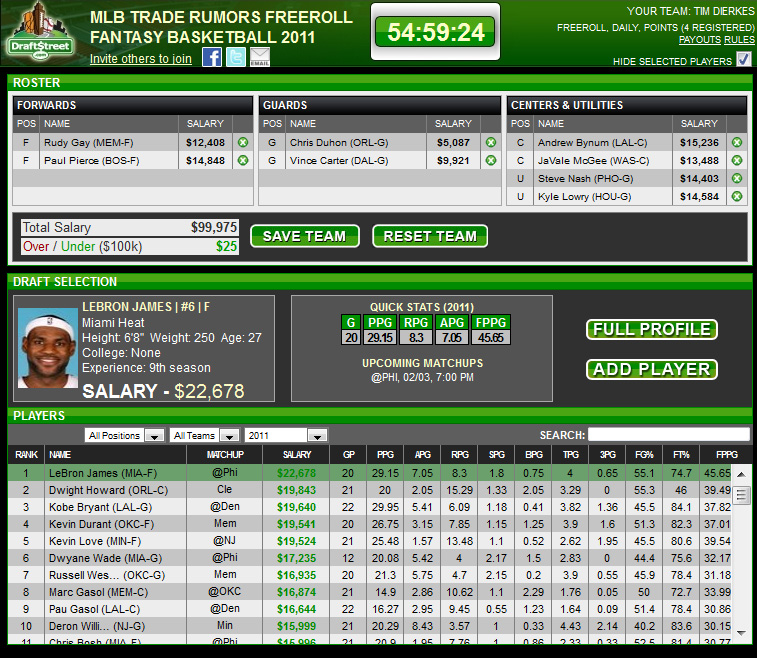
If you're interested, sign up and create a roster prior to Friday's games (7:00pm eastern time). It's quick, easy, fun, and the MLBTR league gives you a free chance to win some of the $400 prize pool. If you enjoy the competition you can try other leagues for free and earn credits, or deposit real money.
February Trades
The offseason is far from over, with extensions on the horizon, dozens of unresolved arbitration cases, and players like Edwin Jackson, Roy Oswalt and Yoenis Cespedes remaining on the free agent market. But if recent history is any indication, there’s not much reason to expect franchise-altering trades in the next six weeks.
Last year, the biggest name dealt between the beginning of February and the middle of March was Aaron Laffey, as our Transaction Tracker shows. The year before saw an early February deal involving Willy Taveras, Aaron Miles and Adam Rosales, but not much else. In 2009, the February 1st to March 15th window featured a Michael Wuertz trade during a similarly quiet period.
Back in 2008, however, months of rumors and speculation ended when Erik Bedard and Johan Santana were involved in early February blockbusters. There’s some history of major trades involving top starting pitchers, but the Matt Garza rumors have quieted down in recent weeks, and a significant deal doesn’t seem likely this month.
Why the calm six-week stretch from the beginning of February to the middle of March? Teams want to see what they have in their own camps before calling around for outside help. Plus, general managers are less likely to inquire about trades before injury concerns emerge during Spring Training. The quiet period should end toward the end of March, when out of options players who haven’t earned roster spots become available and a mini-flurry of deals takes place.
25 Arbitration Eligible Players Remain Unsigned
The arbitration hearing period has begun, and 25 players remain unsigned. At a hearing, the team and the player's agency each take an hour to defend their salary submission, and an independent three-person panel picks one of the salaries. In recent years, we've seen about 3-8 players have hearings annually.
Barring multiyear extensions or trades, expect hearings for Casey Janssen of the Blue Jays, Emilio Bonifacio and Anibal Sanchez of the Marlins, and John Lannan of the Nationals, and Jeff Niemann of the Rays, as their teams employ a file and trial strategy. We've also heard a hearing is likely for Boston's David Ortiz, which Jon Paul Morosi of FOX Sports says is tentatively scheduled for the middle of the month. Many of the unsigned arbitration eligible players, such as Elvis Andrus, Asdrubal Cabrera, Nelson Cruz, Matt Garza, Alex Gordon, Adam Jones, Clayton Kershaw, Shaun Marcum, Mike Napoli, and Sanchez, are candidates for multiyear deals.
For all the arbitration details, check out MLBTR's arbitration tracker.
Free Agencies Separated At Birth: Jackson & Schmidt
It is fairly astonishing that we are entering the month when teams report for Spring Training, and Edwin Jackson remains as homeless as Thomas Jane in Arrested Development.
This is particularly true when we compare Jackson's free agency to the one enjoyed ten offseasons ago by Jason Schmidt. The year was 2001. The Diamondbacks had just beaten the Yankees in the World Series. George Harrison died. Anthrax was in the air.
But none of that stopped Jason Schmidt. The righty, about to enter his age-29 season, had put up an ERA+ of 107 while pitching for two teams. For his career, his ERA+ stood at 99, with career walk rate of 3.8 per nine innings and a strikeout rate of 6.9 per nine innings. He was rewarded with a five-year, $41MM contract from San Francisco.
Fast forward ten years, and look at Edwin Jackson. The righty, about to enter his age-29 season, has just put up an ERA+ of 106 while pitching for two teams. For his career, his ERA+ stands at 97, with a walk rate of 3.7 per nine innings and a strikeout rate of 6.7 per nine innings. And he can't find a job.
If Schmidt is any indication, today's teams are missing an opportunity for a bargain. Over his next five seasons, Schmidt pitched just over 1,000 innings at an ERA+ of 127. He made three All Star teams, finished in the top four of Cy Young voting twice, won an ERA title in 2003, and reduced his walks to 3.2 per nine while elevating his strikeouts to 9.0 per nine. He was well worth that $41MM investment.
Chances are good that Jackson won't approach Schmidt's contract length, and his annual salary could dip below Schmidt's as well, even adjusting for the decade that has passed. Why? Teams fear getting stuck with the other Schmidt deal — the three-year, $47MM contract he signed with the Los Angeles Dodgers prior to the 2007 season. For that money, Los Angeles received 43 1/3 innings of 6.02 ERA pitching.
The Worst Extensions From Two Offseasons Ago
Nearly a billion dollars across 112 contract years was committed to 33 players with less than six years of Major League service time during the 2009-10 offseason extension period, spanning October 2009 through April 2010. Joe Mauer, Ryan Howard, Justin Verlander, Felix Hernandez, and Justin Upton each signed deals worth at least $50MM. Two years removed from this extension period, which contracts now appear the most regrettable?
- Howard's five-year, $125MM extension begins with the 2012 season, the beginning of which he'll miss due to a torn Achilles tendon. Ruben Amaro's deal was panned at the time and only looks worse now.
- Mauer's eight-year, $184MM extension began with a whimper, as he was limited to only 82 games and showed no power at the plate in 2011. Bill Smith technically gets credit for this one, but any $100MM+ deal goes beyond the GM level.
- Amaro signed Joe Blanton to a three-year, $24MM deal prior to the 2010 season. Due to an elbow injury, Blanton didn't provide his usual innings in 2011. He's penciled into the 2012 rotation to finish off the contract. The main player the Athletics received for Blanton in '08 was Adrian Cardenas, who was recently designated for assignment.
- Rockies GM Dan O'Dowd signed Huston Street to a three-year, $22.5MM deal two years ago. Street was decent for 105 2/3 innings for the 2010-11 Rockies, but they unloaded him to San Diego last month in a salary dump. It seems the Rockies decided Rafael Betancourt could handle the ninth inning at setup man-type money.
- Mariners GM Jack Zduriencik locked up center fielder Franklin Gutierrez to a four-year, $20.5MM deal. At the time, locking down the arbitration years of a defensive-minded player did not seem necessary, since the arbitration process rewards power numbers for position players. The Mariners still may benefit from getting one or two of Gutierrez's free agent years, if he bounces back.
- Adam Lind's extension was the first authored by GM Alex Anthopoulos, and the initial returns are ugly. It's a team-friendly deal with steady arbitration salaries and three club options, but the bottom line is the team guaranteed $18MM to a player who may not have a future as a regular.
- Mark Reynolds' three-year, $14.5MM extension was a Josh Byrnes deal. Home runs pay in arbitration and defense may be largely ignored, but a .210 batting average affects earnings negatively. Since the contract only covered arbitration years, it was probably best to just let the process play out.
- In addition to Mauer, then-Twins GM Bill Smith locked up starter Nick Blackburn for four years and $14MM, plus a club option. Like many of the players on this list, Blackburn may have seemed at the time like a nice guy to have around, but going year-to-year made more sense.
- As a non-tender candidate with the Royals, Mark Teahen's three-year, $14MM extension from White Sox GM Kenny Williams was surprising from day one. The Blue Jays took him off their hands to facilitate the Edwin Jackson deal that led to their Colby Rasmus acquisition, and will pay Teahen $5.5MM to not play for them in 2012.
- Athletics GM Billy Beane guaranteed $12.5MM to Brett Anderson, at the time a record for a pitcher with less than two years of service. Because of Anderson's elbow issues and eventual Tommy John surgery, it turns out guaranteeing him at least $8.5MM for his first two arbitration years was a mistake. The club option on Anderson's first free agent year (2015) might still be a plus, but they'd have to overpay at $8MM for his third arbitration year in 2014 to have the chance to realize that.
- Rangers GM Jon Daniels rewarded Scott Feldman with a two-year, $11.5MM deal, covering the pitcher's last two arbitration years. I suppose the main benefit was a $9.25MM option on the righty's first free agent year, but that's not looking valuable now.
- There are a few more multiyear extensions from the 2009-10 offseason worth less than $10MM that proved unnecessary. The overall point is that teams often don't win by guaranteeing multiyear earnings of arbitration eligible players. To evaluate extensions this winter, one must estimate the amount of the arbitration savings compared to going year-to-year, and also determine the value of potential free agent seasons. For non-stars or players with one good year under their belts, year-to-year is usually the way to go.
- Perhaps the Mauer and Howard contracts demonstrate that letting a star reach or finish his contract year has its benefits, even if it increases the risk of losing the player to free agency. On the other hand, Justin Verlander and Felix Hernandez both currently have three-year commitments worth $60MM or less with their original teams, as opposed to seven or eight-year free agent deals signed this winter in excess of $160MM.