
Submit Your MLBTR Mailbag Questions
With August nearing an end, it’s last call for teams to add players from outside their organizations who’ll be eligible to play in the postseason. It’s also time we put in a call for another mailbag. Submit your questions via email to mlbtrmailbag@gmail.com.
Wondering about final roster tweaks? Questions about arbitration decisions that are right around the corner? Have thoughts on how the free agent market might be shaping up? Send ’em our way!
2017 Vesting Options Update
It has been a while since we checked in on the 2017 vesting options that will be decided by the 2016 stat sheets. With all quiet elsewhere, it seemed like an opportune time for an update:
- Coco Crisp ($13MM option vests at 550 plate appearances or 130 games played in 2016): It has been an up and down year for the veteran, who currently owns an adequate but ultimately just-below-average .235/.301/.406 batting line on the year. He has reached 420 plate appearances in 98 games, so it would take something approaching everyday playing time for the option to vest. Crisp recently accused the A’s of tamping down his playing time to avoid just that possibility. From an outside perspective, it does seem that there are legitimate reasons unrelated to the vesting clause to justify less-than-regular action for Crisp — he hasn’t played all that well and the team reasonably hopes to see younger players in action — though the A’s undoubtedly have that consideration in mind as well. Regardless of the precise reason, it’s all but inconceivable to think that Oakland will allow that stack of cash to become guaranteed.
- Matt Holliday ($17MM option vests with Top 10 finish in MVP voting): This one was always a longshot to vest, and it became increasingly apparent over the year that Holliday was posting a solid — but hardly MVP worthy — campaign. Still, his recent injury put the final nail in the coffin for all but theoretical chances at landing inside the top ten. Accordingly, the Cards will face a difficult decision on the veteran outfielder, who is still an above-average hitter but has shown signs of decline.
- Chris Iannetta ($6MM option vests with 100 games started in 2016): Iannetta’s option was trending strongly towards vesting when we last looked, but things have changed with the re-emergence of Mike Zunino in Seattle. Iannetta would need to start 22 games to pick up the $6MM guarantee, but he has only appeared in seven contests thus far in the month of August. Iannetta has also seen his production drop; he currently owns a .218/.310/.343 batting line. Whether or not Seattle has any interest in picking up that tab remains to be seen, but it probably won’t make it to the club’s books by operation of the vesting provision.
- Yusmeiro Petit ($3MM option vests with 80 innings pitched in 2016): The likeliest path to this option vesting was for a need to arise to utilize Petit as a temporary rotation piece. While he has made one spot start and some other lengthy appearances, though, Petit has only compiled 55 frames to date — making it quite unlikely that the clause will vest. (Realistically, it would probably take multiple rotation injuries.) That being said, he has done everything the Nats hoped he would, carrying a 3.27 ERA with 6.7 K/9 and 2.1 BB/9, and still seems rather likely to have the option exercised regardless.
- CC Sabathia ($25MM option vests if he does not end season on DL with shoulder injury or miss 45+ games in 2016 due to shoulder injury): Sabathia’s season has taken a turn for the worst since the last time we checked in about two months ago. His results are looking more like those of disappointing recent years than the bounceback first half. But Sabathia has still shown no signs of shoulder problems, so with less than 45 days left to go on the season, it doesn’t seem there’s any way for the Yanks to get out from under this big tab.
- Kurt Suzuki ($6MM option vests with 485 plate appearances in 2016): The 32-year-old has 303 plate appearances of league-average offensive production, which bodes reasonably well for his free agent case but doesn’t set him up for another year in Minnesota by way of the vesting clause. It is all but official: Suzuki is headed to the open market.
As noted in the original update, both Nick Swisher and Michael Bourn had vesting options for the 2017 season as well, but those options were negated when each was released from the four-year contracts they initially signed with the Indians.
Submit Your MLBTR Mailbag Questions
The August trade market is as tricky to navigate for observers as it is for teams, so we thought now would be an opportune time to re-start the MLBTR mailbag. You can submit your questions about team needs, possible trade targets, and even the offseason to come by shooting an email to mlbtrmailbag@gmail.com.
While we can’t get to all the inquiries that we receive, rest assured we read them all and do our best to answer those of greatest interest. We’ll run our responses tomorrow, and you can keep a look out on Mondays for future iterations of the mailbag.
Pirates News & Rumors: Happ, Huntington, McCutchen
Here’s the latest from the Steel City…
- While J.A. Happ is enjoying a strong season with the Blue Jays, Pirates GM Neal Huntington (via Stephen J. Nesbitt of the Pittsburgh Post-Gazette) didn’t express too much regret over not re-signing the southpaw after his turnaround performance in Pittsburgh. “We wanted to re-sign J.A. We weren’t able to meet the financial asks, or chose not to. Toronto was aggressive and came and got him,” Huntington said. While noting that “hindsight always gives you the opportunity to wish you had done something differently,” Huntington also mentioned that Happ is still not even a full season through the first year of the three-year deal, so it could be too early to judge the signing.
- Huntington also told reporters (including MLB.com’s Adam Berry) that the Pirates are actively scouring the waiver wire for possible additions, though he cited the inherent difficulties of landing players through the unpredictable August waivers process. Some of the salary saved in the Francisco Liriano trade could help the Bucs make claims on pricier players, Huntington said, whether it’s to actually obtain the players themselves or simply block them from going to rival teams.
- If the Pirates were willing to sell low on Liriano just to get his contract off the books, Travis Sawchik of the Pittsburgh Tribune-Review wonder if the club would consider the same with Andrew McCutchen this winter. The former NL MVP is owed $14MM in 2017, and the Bucs have a $14.5MM club option ($1MM buyout) on his services for 2018. McCutchen’s contract has long considered one of the game’s most team-friendly deals given how the outfielder emerged as a superstar after signing the extension, so while it seems wild to now consider it a financial burden, McCutchen is suffering through the worst season of his career, hitting just .241/.314/.404 with 15 homers through 443 PA. Despite these struggles, you would figure that the modest contractual commitment, McCutchen’s relative youth (he’s 29) and excellent track record would still figure to make him a sought-after trade chip if Pittsburgh indeed made him available. Highly-touted prospect Austin Meadows is also waiting in the wings for the Pirates as a possible outfield replacement.
Updated MLB Depth Charts At Roster Resource
Whether you need to refer to the current state of a team’s roster or farm system in the midst of an interesting trade rumor or want to have a look at an updated lineup projection immediately after a roster move is announced, Roster Resource has got you covered.
Now under the Trade Rumors umbrella, Roster Resource has a number of great improvements planned for the near future that will make your browsing experience even better. At this time, we offer up-to-the-minute rosters and depth charts with a ton of additional information to help give you a solid understanding of each organization.
Below, I’ve linked to depth charts for each of the 30 teams — with all of the recent trades and other transactions reflected — along with links to some other useful features to check out as the deadline draws near.
- MLB Team Info Tracker (40-man roster counts, “how acquired” breakdown, projected payroll)
- MLB Team Info Pages (Team Payroll, Service Time, etc.)
- MLB Transaction Tracker (official roster moves and future expected moves)
- MLB Injury Report (DL’d players, retroactive date, rehab assignments, injury updates)
- Arizona Diamondbacks
- Atlanta Braves
- Baltimore Orioles
- Boston Red Sox
- Chicago Cubs
- Chicago White Sox
- Cincinnati Reds
- Cleveland Indians
- Colorado Rockies
- Detroit Tigers
- Houston Astros
- Kansas City Royals
- Los Angeles Angels
- Los Angeles Dodgers
- Miami Marlins
- Milwaukee Brewers
- Minnesota Twins
- New York Mets
- New York Yankees
- Oakland Athletics
- Philadelphia Phillies
- Pittsburgh Pirates
- San Diego Padres
- San Francisco Giants
- Seattle Mariners
- St. Louis Cardinals
- Tampa Bay Rays
- Texas Rangers
- Toronto Blue Jays
- Washington Nationals
Trade Market For Relievers
Pitching is the priority for most contenders. Starting pitchers, however, are costly and there aren’t many good ones available right now unless a team has and is willing to trade away an elite prospect or possibly even two.
The alternative is to trade for a reliable reliever or two, which could help a team who isn’t getting enough quality innings out of their starting pitchers. As the Royals have proven, you don’t need six or seven innings from your starting pitchers to succeed as long as your bullpen can pick up the slack. Three dominant relievers to cover the 7th, 8th and 9th innings helped in their case, but they also had several others who made a strong contribution to the team’s success.
This is the time for a contender to assess how much help their bullpen needs and ensure that they’re stocked up for the stretch run. Here are some relievers who are likely available on the trade market.
Premium Relief Arms
Andrew Miller (Yankees), Wade Davis (Royals), Mark Melancon (Pirates), David Robertson (White Sox), Alex Colome (Rays), Arodys Vizcaino (Braves), Jeremy Jeffress & Will Smith (Brewers)
- Miller and Davis represent the top of the class, but much like the many controllable starters we’ve heard so much about, it’s not clear that either is available for anything less than a true haul. The Yankees already dealt away Aroldis Chapman, and have seemingly put an immense price tag on Miller, who is now unquestionably one of the very best relievers in baseball. The same can be said of Davis, though he hasn’t been quite as excellent this year as last and has one less season of control on his contract, which runs out after 2017.
- There were rumblings before the year that the Bucs could look to swap out Melancon and his $9.65MM salary. The cash probably isn’t a major concern at this point, but the Pirates are in a somewhat difficult position for contention and have reportedly considered a deal for a pending free agent. Melancon is still trucking along with a 1.51 ERA and 8.2 K/9 against 1.9 BB/9, all within range of the new standard he set for himself beginning in 2013. Since Pittsburgh is still a plausible post-season threat, it seems that the team would be looking for a somewhat unique scenario — the ask is for a solid set-up arm to plug onto the MLB roster as well as a prospect haul to make up the difference in value and bolster the organization’s future.
- Robertson is having a fine season and is surely a late-inning upgrade for some contenders. But he’s still due close to $30MM through the 2018 season and he’s just not the same pitcher he was when he signed his current deal with the White Sox. If the Sox were willing to take on some of Robertson’s remaining salary, however, they could well generate a solid return — especially if the names just listed prove too expensive to change hands.
- If the Rays are willing to trade away one of their controllable starting pitchers, as the rumors indicate, then they’d certainly trade All-Star closer Colome. Even with four years left of club control remaining after 2016, Colome won’t have as much value to the Rays until they’re ready to contend again. Still, the price will be high for the 27-year-old and the Rays won’t be motivated to move him unless they’re blown away with an offer.
- Jeffress and Vizcaino are in the same boat as Colome with their respective teams. Young, controllable and talented closers with teams that aren’t competitive now and might not be for at least a couple more years. The price is high, but these guys are definitely available. The question with Jeffress is whether another team will value his groundball-driven approach as highly as do the Brewers. As for Vizcaino, some recent stumbles and a DL stint have significantly reduced the likelihood he’s dealt.
- That leaves Smith, who missed a big chunk of time earlier this year and has been more solid than great since returning. The 27-year-old southpaw owns a 3.60 ERA with 9.0 K/9 and 3.6 BB/9 over twenty innings, representing a drop-off from the 3.79 K/BB ratio he ran up a season ago. With three remaining seasons of arbitration eligibility, Milwaukee may choose to see if he can build up value over the next several months before exploring a deal in earnest.
Click to read below for the rental relievers and other pen arms with future control:
2017 Qualifying Offer Estimated At $16.7MM
Current estimates on the 2017 qualifying offer have it priced at $16.7MM, according to ESPN.com’s Buster Olney (Twitter link). That would represent a year-over-year rise of $900K.
That’s a rather standard increase for the qualifying offer, which is determined by averaging the league’s 125 contracts with the highest mean salaries. It sat at $15.8MM for the current year, after rising from $15.3MM in 2015, $14.1MM in 2014, and $13.3MM in the inaugural year of 2013.
Teams can offer their departing free agents a one-year deal, at the established price tag, within five days of the conclusion of the World Series. Over the next seven days, players who receive the offer are allowed to talk with other teams and decide whether to take the single-season pact. If they reject it, then draft implications attach: their former team stands to gain a compensation pick in the following year’s draft, while a new signing team must give up their highest non-protected draft choice.
The real question with the qualifying offer, though isn’t so much its specific price tag as it is the underlying rules. With a new collective bargaining agreement being negotiated at present, many have suggested that it’s one of the most important issues that is — or, at least, could be — on the table for change. Even if something gets done, though, it presumably wouldn’t go into effect for the coming offseason.
It’s not yet clear whether there’s any realistic possibility of modifications to a system that has had a notable dampening effect on the market experiences of numerous mid-level free agents in recent years. Players entering the market after declining the one-year qualifying offer come with the added cost of draft compensation. That has arguably forced certain good but not great players — those who have the toughest decisions to decline the QO — to shoulder an out-of-proportion piece of the dampening effect that the system imposes on player salaries.
Notably, this last offseason was the first in which any player accepted a qualifying offer — thus taking a one-year deal (admittedly, at a nice price) rather than rolling the dice on a stalled market situation. Matt Wieters of the Orioles, Brett Anderson of the Dodgers, and Colby Rasmus of the Astros all took the deal. The fact that some players have now elected to take the big one-year payday and re-enter the market could conceivably make teams think twice about slapping the offer on marginal candidates.
For those who aren’t familiar with the qualifying offer system, you can check out this old-but-good overview and read up on why “avoiding the qualifying offer” is so important for a free agent’s value.
Playoff Contender Needs (National League)
Yesterday, I analyzed the most pressing needs for the 11 American League playoff contenders just in time for the Red Sox to fill their starting rotation void with the acquisition of Drew Pomeranz. If we’re lucky, one of these eight National League contenders will follow suit and give us another early Trade Deadline present this weekend.
NL EAST
Washington Nationals
54-36, 1st Place, +6
CENTER FIELDER/LEADOFF MAN
Ben Revere has a .268 on-base percentage and still has the privilege of being the starting center fielder and leadoff man for a 1st place team that is 18 games over .500. What does that tell us? For starters, Nationals manager Dusty Baker apparently doesn’t care if his leadoff man gets on base or not. It also means that the Nationals’ lineup and most of the 25-man roster is filled with talent, which is why Baker probably doesn’t lose much sleep over his leadoff man’s inability to be good at the most important aspect of his job.
In all seriousness, the Nats are well aware that they are in need of an upgrade, which is why Trea Turner, who is blocked by Danny Espinosa at the shortstop position, was playing center field in Triple-A before he was recently called up to replace an injured Ryan Zimmerman on the roster. While he could be given a shot as the Nats’ regular center fielder at some point, general manager Mike Rizzo is likely to first explore the trade market, where Charlie Blackmon, Peter Bourjos, Coco Crisp, Jon Jay (likely to return from the disabled list sometime in August) and Melvin Upton Jr. are all likely available. And all are having much better seasons than Revere or his platoon partner, Michael Taylor.
Miami Marlins
47-41, Wild Card (2nd-T), +1
STARTING PITCHING
Mention the Marlins to a baseball fan and the first thing that comes to their mind is the amazing power of Giancarlo Stanton. It really is quite breathtaking, after all. But the most interesting part of this up-and-coming young team is that they have five regulars not named Stanton hitting over .300. Even 42-year-old Ichiro Suzuki, who has played on a semi-regular basis, is hitting .335 and having his best season since he was in his mid-30’s. The bullpen, which now includes Fernando Rodney setting up for All-Star closer A.J. Ramos, is also talented and a lot of fun to watch.
Unfortunately, unless Jose Fernandez can pitch more than once every five days, the Marlins’ rotation isn’t good enough to make a legitimate run for a Wild Card spot. The fact that they’ve pushed Fernandez back a few times to limit his workload makes the rotation that much more of a priority. Wei-Yin Chen, who signed a potential $80MM free agent deal in the offseason, can’t seem to string together more than one good start. If not for Adam Conley, there’s no way the Marlins would be in the mix for a playoff spot.
Rich Hill and Jake Odorizzi are on their radar, as was the recently-traded Drew Pomeranz, but it’s likely that they’ll cast a wide net in hopes that they can acquire some help despite a farm system that is currently light on talent.
New York Mets
47-41, Wild Card (2nd-T), +1
STARTING PITCHING
David Wright could miss the season with a herniated disc in his neck. Lucas Duda is out for an extended period with a stress fracture in his back. Michael Conforto was sent to the minors because he stopped hitting. So can you believe that the Mets’ top priority might be starting pitching?
While they are reportedly prioritizing their bullpen at the moment, they will need to address their very fragile rotation at some point. Matt Harvey‘s season-ending surgery for Thoracic Outlet Syndrome, Zack Wheeler‘s delayed return from Tommy John surgery—he’s not expected back before late August—and bone spurs in the elbows of young stars Noah Syndergaard and Steven Matz should have the Mets looking to land at least one reinforcement and possibly two.
***Click below to read breakdowns of all the other NL contenders***
Check Out BaseballIC.com
This is a sponsored post from Corey Dawkins of Baseball Injury Consultants.
“Clayton Kershaw had a 4.3% chance of getting injured last night when he pitched, but only a 0.7% chance of being hurt if he took the mound today instead.”
This fictitious example highlights one goal of my company, Baseball Injury Consultants, in the medical management of professional baseball players. We are trying to take the seasonal risk assessment to a daily, and then a pitch by pitch, basis among other things. We have seen pre-season risk assessments for years, but how useful is that information other than at the start of the season? Once the season begins, it doesn’t factor in any new information that comes in during that year. What if the Red Sox had a hard number to assess the risk of keeping Blake Swihart in left field on the day the wind was coming in from right field, pushing the ball closer to the cement wall on which he sprained his ankle?
We have moonshot goals because, despite great strides in the treatment of baseball injuries, the number of professional baseball injuries is only getting worse. It is not for a lack of trying or lack of talent. It just has not been put together yet. However, it is not impossible. Something has to be done because reducing injuries will, of course, make a difference in their athletic careers, but also improve the quality of life 20 years later.
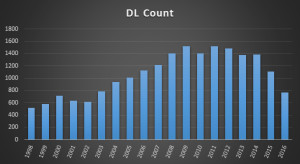
We start by collecting daily injury and performance data on all professional baseball players, giving the capability to provide customized reports and for any sector, industry, company, team, individual researcher or fan. This can include baseball operations, daily fantasy baseball players, season-long fantasy baseball players, medical researchers, biomedical device manufacturers, or insurance entities to name a few.
We track as much information as we can find, from injury details to weather information to performance data, knowing that any piece of information might be the one that solves the puzzle.
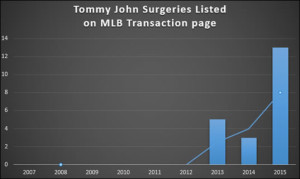
Since someone checks the information before importing into the databases every morning, we fill the information void left over from automated scripts scraping news or transaction sites that don’t categorize injuries according to accepted medical terminology and/or don’t update the original listing. For example, here’s a graph of MLB Tommy John surgeries by year.
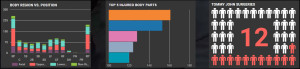
So once we get validated information into the database and onto our website, you can find the information in ways you will not find anywhere else. If you are a casual fan or want a snapshot of MLB, you can check out our “Quick Look” page for summary information and the records I have updated within the last seven days. In the three bar/column graphs, you can hover over individual sections to find greater detail about that particular item.
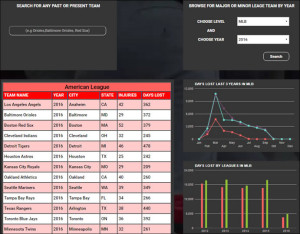
You can search and find summary team data on the “Teams” page.
You can also find search for players by name, browse by last name or find players by position on the “Players” main page.
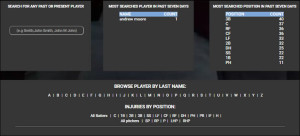
Then once we find the player we want, we can go to the individual page for details at a level you will not find anywhere else. Similar to the “Quick Look” page, you can hover over the columns to find the exact categories and measured levels.
On the “Custom Search” page, you can find information in countless combinations.
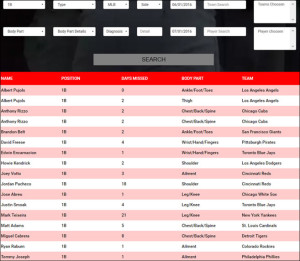
We’re not stopping with just putting the information on the website. We have plans to create and put a model on the website that estimates how productive a player will be for daily fantasy leagues, based on an injury two or three days ago, such as a bruised hand. The website will also have an educational section for evidence-based injury analysis.
However, our biggest moonshot goal is to create individualized risk assessment models, drilling down information to the pitch by pitch level. This would give on-field managers and baseball operations something they never had before. What if they knew that a bruised bottom hand for a hitter affects his power by a certain percentage? What if the risk of throwing a slider on pitch number 103 more than quadrupled the risk not just immediately, but three weeks down the line as well?
These are the goals we are shooting for and hope to raise enough capital to do so soon. We look forward to you creating an account on Baseball Injury Consultants and checking out what we have to offer as well as improving the site.
The 5 Most Important Roster Decisions Of The Week
1. Mets SP Matt Harvey Placed On 15-Day DL
If there was any consolation for the Mets with young rotation stars Steven Matz and Noah Syndergaard having to pitch with bone spurs in their elbows and Zack Wheeler‘s 2016 status being up in the air after his latest setback, it was that Matt Harvey had gotten past his early season struggles.
With six strong starts in a row (2.27 ERA, 35.2 IP, 27 H, 8 BB, 28 K), the 27-year-old was heading into his 4th of July start against Miami on a roll. But not only did Harvey’s hot streak end then, his season would also unknowingly come to an end.
The Marlins lit Harvey up for five earned runs and 11 hits in 3.2 innings. Two days later, he was placed on the 15-Day disabled list with shoulder discomfort. Today, it was announced that he’ll undergo season-ending Thoracic Outlet Syndrome surgery.
At least in the short term, it will be Logan Verrett (5.32 ERA, 23.2 IP, 14 BB, 16 K in five starts) taking Harvey’s rotation spot. Sean Gilmartin (4.48 ERA, 2.4 BB/9, 8.6 K/9 in 13 Triple-A starts) could also on a very short list for a start or two after the All-Star break. Unlike previous seasons, there isn’t a top prospect ready to step in. Jacob deGrom and Bartolo Colon will be relied upon heavily down the stretch, as will Wheeler, if and when he returns.
2. Cardinals 2B Matt Carpenter Placed On 15-Day DL
Even with Matt Carpenter having an MVP-caliber season, the Cardinals were having a hard time staying anywhere near striking distance of the division-leading Cubs. With their best hitter now sidelined—Carpenter was placed on the 15-Day disabled list with a strained oblique on Thursday—they’re in danger of losing ground in a very competitive Wild Card race.
The semi-good news is that Kolten Wong, who has stepped back into the starting second base job, has been better since being recalled from Triple-A with a .277/.358/.340 slash line. Randal Grichuk, who appears slated for regular action in center field with Wong back to the infield, is 5-for-8 with a homer since his return. He was demoted in mid-June after a terrible start.
They Cardinals will need those two young hitters, as well as the rest of the lineup to step up. With Brandon Moss also on the disabled list with a sprained ankle, Matt Adams‘ left-handed bat has become that much more important. And he’s currently in a 3-for-39 slump, which is the exact opposite of “stepping up.”
3. Royals Closer Wade Davis Placed On 15-Day DL
The Royals won the 2015 World Series with a mediocre starting rotation—Edinson Volquez (3.55 ERA, 3.2 BB/9, 7.0 K/9) was probably their ace—and a superstar-less lineup—Kendrys Morales led the team with an .847 OPS. What they did have, though, was an elite bullpen with a closer, Wade Davis, who was pretty much un-hittable (4.4 H/9).
Fast-forward to 2016. The starting rotation isn’t any better. The lineup was just decent before losing Mike Moustakas for the season. And now the strength of their team, the bullpen, will be without Davis, who was placed on the 15-Day disabled list on Tuesday with a strained forearm. There’s an optimistic tone coming out of Kansas City, but forearm troubles are always of at least some substantial concern.
While bullpen depth isn’t an issue in Kansas City, closer candidates Kelvin Herrera and Joakim Soria –the Royals haven’t named either as the clear 9th inning option—each gave up runs in non-save situations since Davis went down. That can’t be a good sign for a team that currently has no clear team strength. They have plenty of post-season experience, but getting there will be a challenge.
4. Mets INF Jose Reyes Has Contract Purchased From Minors
When Jose Reyes last played for the Mets, he was a superstar shortstop headed for a huge payday in free agency. Four-and-a-half seasons later, the 33-year-old has been traded twice (Miami-to-Toronto; Toronto-to-Colorado) and was recently released by the Rockies after serving a 51-game suspension for domestic violence. Now, he’s hoping to rebuild his career and image.
After signing with the Mets on a Minor League contract on June 25th, Reyes joined the big league club in his familiar leadoff role. This time around, though, he’s the starting third baseman with David Wright out indefinitely due to a herniated disc in his neck.
Bringing back Reyes, who has a pair of doubles and a homer in his first three games, is a relatively risk-free move (public relations aside). Since the chances of their starting rotation carrying them in 2016 have decreased greatly over the past few weeks, the Mets really need a spark out of their lineup. A rejuvenated Reyes at the top could do the trick.
5. A’s SP Rich Hill Activated from 15-Day DL
In last week’s “Top 20 Trade Candidates”, Jeff Todd ranked Rich Hill No. 11 and wrote that he wouldn’t make it into top-five status again until he proved that he was back to pre-injury form. Well, he’s made it back and it didn’t take him long: Hill checks in at 3rd on the updated list. If he didn’t re-establish his value after his first start back on July 2nd when he logged a quality start against the Pirates (6 IP, 2 ER, 4 H, 2 BB, 6 K), he certainly did so with his dominating performance against the Astros on Thursday (7 IP, ER, 3 H, 2 BB, 10 K.)
Anything can happen in the coming weeks as Hill can still make 2-3 starts before being dealt. But, barring another injury, his value isn’t likely to decrease at all. The 36-year-old lefty has been one of the best and most consistent starting pitchers in baseball since the Red Sox gave him a shot last September. In 17 starts, he has a 2.06 ERA, 2.8 BB/9, 10.8 K/9 and has not allowed more than three earned runs in any start. That kind of production is going to cost a contending team some real prospect value.