
AL West Notes: Guerrero, Wells, Mariners
Some notes on the AL West with an update on a potential Hall of Famer and another take on the Vernon Wells trade…
- Rangers president Nolan Ryan told the Dallas Morning News that he hasn't ruled out bringing Vladimir Guerrero back. Ryan likes the idea of adding another powerful bat, but suggests Vlad may seek more playing time elsewhere.
- Richard Durrett of ESPNDallas.com examines this prediction of Ryan's: Texas will win 90-95 regular season games in 2011.
- Dave Cameron of FanGraphs wonders if the Vernon Wells trade is, at least from the Angels' perspective, the most inexplicable deal in recent history.
- The Mariners, who select second in this June's draft, will consider amateur players including Anthony Rendon, Gerrit Cole, Matt Purke and George Springer, according to MLB.com's Greg Johns.
Jack Of All Trades: Baseball’s Tallest
As Chris Young found out this week, baseball doesn't pay its players by the yard. Though he checks in at 6'10", Young signed a deal for just $1.1MM guaranteed. Meanwhile, noted tiny person Dustin Pedroia will make $5.5MM in 2011, despite checking in at a generous listing of 5'9". (The rule isn't proportionally inverse, however- 3'7" Eddie Gaedel made just $100 for his one plate appearance).
The Young signing got me wondering: how often is the team getting the tallest player in a trade also getting the best player in that transaction? Let's take a look at trades involving some of baseball's best bets to reach that can on the top shelf.
Currently, the tallest player in baseball history is 6'11" Jon Rauch, who has been dealt three times. In July of 2004, Rauch went from the White Sox, along with reliever Gary Majewski, to the Expos for Carl Everett. Over five seasons in Montreal and Washington, Rauch pitched to a strong ERA+ of 132, becoming one of baseball's better relievers. Everett managed a meager OPS+ of 90 over the rest of 2004, and just 94 in 2005. Is it a coincidence that Everett stands just 6'0?
Chicago dealt Rauch after the 2008 season to Arizona for Emilio Bonifacio, who is a full foot shorter than Rauch. While Bonafacio continued his career-long trend of not hitting, Rauch was awful in the desert, pitching to a 6.56 ERA. Arizona finally sent him to Minnesota in August 2009 for the reasonably-tall 6'2" Kevin Mulvey. Rauch once again thrived. It is hard to say any team that traded for Rauch lost the deal. In this case, the tallest turned out to be best.
As for the aforementioned Young, he's also been traded three times. The Pirates shipped him to the Expos for 5'11" Matt Herges in December 2002. While Herges had a middling season with Montreal, Young continued to pitch well in the minors, leading to a second deal in April 2004. This time Young went to the Rangers with 6'2" minor leaguer Josh McKinley for 6'3" Justin Echols and catcher Einar Diaz, who is not only 5'10", but positionally spends much of his time crouching. And while Young wasn't the best player in the six-person deal that brought him, Adrian Gonzalez and Termel Sledge to San Diego for Billy Killian, Akinori Otsuka and Adam Eaton, he was a strong second to Gonzalez, pitching to a 110 ERA+ over five seasons with the Padres. Again, no one lost out by trading for the really tall guy.
And so it was with the other 6'10" major leaguer, Randy Johnson. At no time did Seattle think, "Oh, to have held on to 6'2" Mark Langston!" The Mariners did get decent value when they traded Johnson, about to hit free agency, for John Halama, Freddy Garcia and Carlos Guillen. But it wasn't equal value, and neither were the heights- Halama at 6'5". Garcia at 6'4" and Guillen just 6'1". (Can't blame them, really- they didn't have the kind of leverage to land a Jon Rauch.)
Believe it or not, the Yankees got the better of their Randy Johnson trade when they acquired him- Brad Halsey, Javier Vazquez and Dioner Navarro did little for the D'backs, not one of them over 6'2"- and got the short end when dealing him back to Arizona two years later for Alberto Gonzalez, Steven Jackson, Ross Ohlendorf and Luis Vizcaino. (Jackson was 6'5" and Ohlendorf 6'4", but both failed to measure up.)
As for the present day, the tallest-player-as-good-luck-charm is present in the person of Kameron Mickolio. A stately 6'9", Mickolio has been involved in two trades. The first saw Mickolio, along with Tony Butler (minors), Adam Jones, George Sherrill and Chris Tillman travel, hopefully with extra leg room, from Seattle to Baltimore in February 2008 in exchange for Erik Bedard. Obviously, Jones has been more valuable to date, but the Mickolio side is well ahead for many reasons on that one. And we'll get to test the theory once again in 2011: Baltimore traded Mickolio last month, along with David Hernandez, to Arizona for Mark Reynolds.
Will the tyranny of the tall hold once more? Or is there something inherent in the Arizona atmosphere that felled Jon Rauch and will do the same to Kameron Mickolio? I can hardly wait for spring training to find out. Tune in next time for analysis of the transactions involving Jumbo Brown and Fat Freddie Fitzsimmons. Working title? Baseball By The Pound.
Make Or Break Year: Scott Kazmir
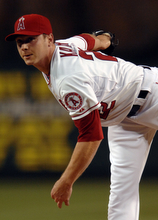 It's hard to believe that it's been almost seven years since the infamous Victor Zambrano-for-Scott Kazmir swap. The Mets received just 202 2/3 serviceable innings out of Zambrano (4.42 ERA) while Kazmir was busy establishing himself as one of the game's best young hurlers in Tampa. Before his 24th birthday, the hard-throwing southpaw had 97 big league starts to his credit, and he owned a 3.64 ERA with 9.7 K/9 in the AL East. At 23, he took home the AL strikeout crown with 239 whiffs.
The Rays rewarded Kazmir with a four-year contract extension after that season, but things have gone downhill since. He missed the first month of the 2008 season with an elbow issue, and then battled a quad strain in 2009. With his ERA sitting at 5.92 at the end of August '09, the Rays traded Kazmir and the two years left on his contract to the Angels for three young players.
Although he pitched well after the trade (1.73 ERA in six starts), things really fell apart in 2010. Kazmir hit the disabled list twice for shoulder soreness/fatigue last season, and when he was on the mound he was rarely effective. His velocity had declined considerably and the strikeouts were proving harder to come by. All told, Kazmir pitched to a 5.94 ERA with nearly as many walks (79) as strikeouts (93) in 150 innings last season, and only eight times in 28 starts did he complete six innings of work.
Kazmir's stock is at an all-time low, which is not where you want it to be with free agency coming up after the season. The Halos are unlikely to exercise his $13.5MM option for 2012, and unless he regains his pre-2009 form, Kazmir is in danger of falling into the Jeremy Bonderman category of reclamation free agent starters.
It's not all bad news though. Kazmir will turn just 27 years old tomorrow, and his 39.1% ground ball rate in 2010 was his best in three years. AL East and World Series experience works in his favor, and an offseason of rest could also do wonders for his achy wing. Next winter's crop of free agent pitchers is weak, so Kazmir could parlay a strong 2011 season in a nice contract. A lot has to change for that to happen, though.
Photo courtesy of Icon SMI.
Looking At The Blue Jays’ Future Salary Obligations
A case can be made that Friday's Vernon Wells trade was the most significant move of the offseason. The Angels took on his entire contract, freeing up a ton of present and future payroll for the Blue Jays. Wells is scheduled to make $23MM in 2011 and then another $21MM each season from 2012-2014, and it's fairly obvious how shedding that much of an obligation will allow GM Alex Anthopoulos to improve his team.
Now that Wells is off the books, let's use Cot's Baseball Contracts to see what the Jays are on the hook for over the next few seasons. This is guaranteed money only, so arbitration and pre-arbitration contracts are not included. Same with option years, only the buyouts are counted since that's the only portion of the contract that is guaranteed.
- 2011: $44.09MM, but only going up once contracts with arbitration-eligibles Jose Bautista, Mike Napoli, and Jason Frasor are finalized.
- 2012: $17.4MM. Both Adam Lind and Ricky Romero will earn $5MM+ while Adeiny Hechavarria and Rajai Davis will each pull down $2MM+. Six-figure buyouts to Jon Rauch, Octavio Dotel, and Edwin Encarnacion made up the rest.
- 2013: $16.15MM: Almost all Lind, Romero, and Hechevarria. Davis' buyout comes into play as well.
- 2014: $9.75MM. Romero and Lind's $2MM buyout.
- 2015: $7.75MM: All Romero.
- 2016: $600K. Romero's buyout.
Aaron Hill's contract contains club options for 2012 ($8MM), 2013 ($8MM), and 2014 ($10MM) with no buyouts, though the 2014 option goes away if the team does not exercise all three before this upcoming season. Either way, it seems like a safe bet that at least the 2012 option will be picked up, increasing that season's total obligation to a still modest $25.4MM.
Toronto holds seven of the first 80 picks in next June's draft, including the Angels' second rounder for Scott Downs, and Anthopoulos has emphasized that method of talent acquisition since taking over. A portion of the Wells savings could be spent there. The club is also set up well for a run at either Albert Pujols or Prince Fielder next offseason, should they choose to go that route.
It was just 18 months ago that the Blue Jays owed over $160MM to Wells and Alex Rios, yet today they owe the pair nothing. Those savings can go a long way towards building the next playoff team in Toronto.
Braves Not Pursuing Jorge Cantu
6:39pm: Dave O'Brien of The Atlanta Journal-Constitution confirmed that the Braves discussed Cantu, but they have decided not to pursue him. His source says they only wanted him for a bench role and to mainly backup rookie Freddie Freeman at first base (Twitter links).
12:31pm: The Padres and Braves appear to be the front-runners to land Jorge Cantu, writes Stephen Goff of the Houston Astros Examiner. In addition to San Diego and Atlanta, Cleveland remains a potential destination for the infielder.
Cantu, who turns 29 next weekend, expressed some disappointment that he wasn't able to work out a deal with his hometown Astros, but is optimistic about securing a contract with another team:
"We've been talking to Atlanta, Houston, San Diego and Cleveland," Cantu said. "We were really trying with Houston, but talks have just ceased with them, which is unfortunate…. Still, San Diego is talking a lot. I like San Diego. They have a winning ballclub and had a great pitching staff last year. I wouldn't mind going over there."
The Rockies, Mariners, and Diamondbacks have also been linked to Cantu at various times this offseason, though it's unclear if they still have any interest.
MLBTR Originals: 1/16/11 – 1/23/11
As the sports world turns its attention to football for the evening, let's recap the original content we posted over the last week…
- Ben Nicholson-Smith gave us five facts about the Elias rankings while Tim Dierkes examined the contracts that the Beverly Hills Sports Council was able to find for their relief pitcher clients this winter.
- Ben also looked at Jeremy Guthrie's arbitration case, the Rays' 2011 draft, and listed the remaining free agent starters by innings pitched. He was on conference calls regarding Gil Meche's retirement and Armando Galarraga being designated for assignment, plus he gathered some thoughts about Joey Votto's new contract extension.
- I went back and listed all of the recent contract extensions signed on January 21st.
- This week's poll questions asked which free agent signing was the most surprising, and if you believe the Cardinals will work out an extension with Albert Pujols.
- The best of the blogosphere can be found in Baseball Blogs Weigh In.
- Here is this week's chat transcript.
- Remember to check out our team and transactions-only feeds, and don't forget our Arbitration Tracker.
Week In Review: 1/16/11 – 1/22/11
Another Sunday closer to Spring Training and Opening Day 2011. Let's recap the last week:
- In an astonishing move, Toronto was able to unload Vernon Wells and his entire contract in a trade with the Angels. Toronto will receive Mike Napoli and Juan Rivera in return for the 32-year-old Wells, who many had deemed one of the most untradeable players in the game. Here's some reactions and details on the trade.
- The Yankees may have missed Cliff Lee, but they managed to land a top free agent when they signed Rafael Soriano for three years and $35MM. Soriano's deal has two opt-out clauses, giving him tremendous leverage. New York also signed Andruw Jones for one year and $2MM.
- The reigning NL MVP agreed to a three-year extension with the Reds. Joey Votto will earn $38MM for his arbitration years, in a move that's drawn some criticism as it doesn't seem to save the Reds much money.
- The Reds also extended Johnny Cueto on a four-year, $27MM deal and are talking about a long-term deal for Edinson Volquez.
- Billy Butler signed an extension of his own with the Royals — for four years and $30MM.
- It's not often you see an injured player leave millions on the table, but Gil Meche walked away from $12MM when he retired a year before his contract ended. A classy move in my opinion. Best of luck in life after baseball, Gil.
- The Twins finally came to terms with Carl Pavano after weeks of being close. The veteran right-hander will earn $16.5MM over the next two seasons in Minneapolis.
- Busy week out in our nation's capital — the Nats acquired Tom Gorzelanny from the Cubs, signed Jerry Hairston Jr. for $2MM on a one-year deal, and inked Todd Coffey as well.
- The Athletics made some big moves to fortify their bullpen, hammering out a two-year deal worth $8.1MM for Grant Balfour and a two-year, $10MM deal with Brian Fuentes.
- Another significant bullpen signing saw Jon Rauch sign with the Blue Jays for one year and $3.5MM, with a $3.75MM club option ($250K buyout).
- The Rays signed both Manny Ramirez and Johnny Damon to one-year deals, with Damon earning $5.25MM and Manny signing for a $2MM base.
- The Mets signed Chris Young to a one-year deal that guarantees the righty just $1.1MM, a nice bargain. Some more low-cost signings included Chad Qualls in San Diego ($2.55MM guaranteed), Marcus Thames with the Dodgers ($1MM), Nick Punto in St. Louis ($700K), and Aaron Heilman in Arizona ($2MM).
- Several two-year deals were ironed out to avoid arbitration: Jason Hammel with the Rockies, Stephen Drew in Arizona, Rajai Davis with the Jays, Sean Marshall with the Cubs, and Matt Lindstrom with the Rockies as well.
- Some more notable arbitration figures included Jonathan Papelbon signing for $12MM, Prince Fielder for $15.5MM, and Heath Bell for $7.5MM. For more arbitration news, be sure to keep up to date with our arb tracker.
- Some of the many minor league signings this week included Jeff Suppan with the Giants, Jody Gerut and Nate Robertson with the Mariners, and Joe Crede with the Rockies. Be sure to check out our Transactions section for all of the week's minor moves.
Jeremy Guthrie’s Arbitration Case
Jeremy Guthrie's representatives at CAA will have to convince a panel of arbitrators that their client is worth more than $5.75MM if the sides go to a hearing. The Orioles offered the arbitration eligible 31-year-old $5MM, while he asked for $6.5MM. The discussion figures to revolve around three similar pitchers in the same service time class – Chad Billingsley, Matt Garza and John Danks – and will likely come down to durability vs. dominance.
Guthrie can point to his own durability and argue that he's worth more than $5.75MM. He has logged 812 1/3 innings in his career, more than fellow-CAA clients Garza and Danks. Garza will earn $5.95MM next year, Danks will earn $6MM and Billingsley will earn $6.275MM.
 Guthrie has made at least 26 starts and logged no fewer than 175 innings in each of the last four campaigns. The other three starters cannot match the Baltimore right-hander's durability, as CAA will likely point out. Only Garza has had to compete regularly in the AL East, where Guthrie regularly faces some of the game's most potent offenses.
The Orioles, however, can argue that Guthrie's durability is compromised by inconsistent results. He led the American League in losses a year ago and posted an ERA over 5.00. None of the three other pitchers have posted an ERA that high since their rookie seasons and all of them have more wins and fewer losses than Guthrie in their careers.
Baltimore can also argue that despite Guthrie's durability, he has been hittable. The 2002 first rounder has been tagged for more hits and homers than the others, both in total and on a per-inning basis. Guthrie, the Orioles could argue, is less dominant than the other pitchers and therefore not deserving of a salary above the $5.75MM midpoint.
They could support that argument by pointing to his 4.15 career ERA (none of the others have career marks above 4.00, a seemingly arbitrary cutoff that could sway a panel of arbitrators). Despite Guthrie's high innings total, Billingsley, Garza and Danks have all struck out more hitters in their careers.
But Guthrie's representatives can point out that he has walked fewer batters than the others, both in 2010 and on a career basis. Guthrie's 2.6 B/9 mark is far better than the others, who have all walked at least 3.1 batters per nine in their respective careers.
So can the Orioles convince a panel of arbitrators that Guthrie's worth less than $5.75MM next year despite his history of durability? That's the $1.5MM question and we'll know the answer to it within a few weeks at the latest.
Poll: Most Surprising Free Agent Signing
Most of the game's top free agents are off the board, and Spring Training is rapidly approaching. The 2010-11 offseason has provided some genuine shocks in terms of free agent signings. Let's take a look at some of the biggest ones:
- Cliff Lee, Phillies, five years and $120MM: For weeks leading up to the signing, we heard that it was a two-horse race between the Yankees and Rangers. Talks of a mystery team surfacing were taken with a grain of salt until the Phillies emerged to add Lee to one of the best rotations most of us will ever see.
- Jayson Werth, Nationals, seven years and $126MM: If you'd been told a few months ago that Werth would sign the then-third biggest deal for a free agent outfielder in history — with the Nationals of all teams — would you have believed it?
- Carl Crawford, Red Sox, seven years and $142MM: Not to be outdone, Crawford one-upped Werth's deal by securing an additional $16MM. The Angels were thought to be the clear favorite, but Theo Epstein and crew had other ideas.
- Adrian Beltre, Rangers, five years and $80MM: With their infield seemingly set, aside from possibly first base, the Rangers didn't seem a fit for the Boras client. But Beltre turned down offers from two of his newest (and former) rivals in the AL West — Oakland and Los Angeles — to play in Texas.
- Rafael Soriano, Yankees, three years and $35MM: Shortly after Brian Cashman publicly declared he wouldn't surrender the Yankees' first round pick, the Yankees signed Soriano, a Type A free agent, to a three-year deal that, incredibly, includes two opt-out clauses.
- Lance Berkman, Cardinals, one year and $8MM: Certainly not as high profile as the other candidates, but with Albert Pujols entrenched at first base, this seemed an impossibility. Berkman though, will serve as St. Louis' primary right fielder after being primarily a 1B/DH since 2005.
All of these moves came as a surprise to some extent, but let's open the issue up to everyone for discussion:
Which Free Agent Signing Was The Biggest Surprise?
-
Cliff Lee to the Phillies 49% (9,111)
-
Jayson Werth to the Nationals 27% (5,015)
-
Carl Crawford to the Red Sox 9% (1,737)
-
Lance Berkman to the Cardinals 7% (1,279)
-
Rafael Soriano to the Yankees 5% (1,003)
-
Adrian Beltre to the Rangers 2% (324)
-
A different free agent signing 2% (306)
Total votes: 18,775
Quick Hits: Cashman, Mets, Blanton, Indians, DeRosa
One year ago, the Orioles officially signed Miguel Tejada, bringing him back for his second stint with the club. Unfortunately for the O's, the veteran infielder couldn't match the numbers he'd previously put up in Baltimore, posting a .670 OPS before a July trade sent him to the Padres. While we wait to see what January 23rd will bring this year, here are a few links to browse:
- Yankees GM Brian Cashman would prefer to run a small market team, opines Bill Madden of the New York Daily News, who is beginning to think Cashman may walk away from the Yankees when his contract expires following the 2011 season.
- ESPN's Adam Rubin provides a breakdown of the Mets' 2011 payroll following Jeff Wilpon's statement that the team payroll will be in the $145MM-plus range.
- Bob Brookover of the Philadelphia Inquirer makes a case for Joe Blanton's value, then says the Phillies need to sell that argument to just one other team. Brookover opines that shedding some money by dealing Blanton could give the Phils a little wiggle room to address other potential areas of need.
- Within a multi-sport mailbag, Terry Pluto of the Cleveland Plain Dealer addresses the Indians' third base picture, which could include Jason Donald, Lonnie Chisenhall, and Jared Goedert.
- Henry Schulman of the San Francisco Chronicle takes a look at what the Giants can expect from Mark DeRosa this season. DeRosa is entering the second and final year of the $12MM deal he signed last winter.
- In their newest blog entries, the Baltimore Sun's Peter Schmuck and MASN's Roch Kubatko each discuss the most recent Orioles rumblings, with a focus on Vladimir Guerrero.