
This is the latest entry in MLBTR’s Offseason In Review series. The full index of Offseason In Review posts can be found here.
The Dodgers spread their cash rather than making a single splash, opting for roster and lineup flexibility over premium assets (at a premium cost).
Major League Signings
- SP Scott Kazmir: Three years, $48MM (opt-out after first year)
- SP/RP Yaisel Sierra: Six years, $30MM
- SP Kenta Maeda: Eight years, $25MM + $20MM posting fee
- 2B Howie Kendrick: Two years, $20MM
- SP Brett Anderson: One year, $15.8MM (accepted qualifying offer)
- OF Yusniel Diaz: $15.5MM bonus (minor league deal)
- 2B Chase Utley: One year, $7MM
- INF Omar Estevez: $6MM bonus (minor league deal)
- RP Joe Blanton: One year, $4MM
- SP Brandon Beachy: One year, $1.5MM
- RP Louis Coleman: One year, $750K
- Total spend: $193.55MM
Notable Minor League Signings
- Corey Brown, Daniel Corcino, Charlie Culberson, Alex Hassan, Elian Herrera, Brandon Hicks, Chin Hui-Tsao, Jordan Schafer, Donavan Tate, Matt West, Jamey Wright (since retired)
Trades And Claims
- Acquired SP Frankie Montas, INF Micah Johnson, OF Trayce Thompson from White Sox in exchange for INF/OF Jose Peraza, INF Brandon Dixon, OF Scott Schebler (all of whom went to Reds in three-team deal that sent Todd Frazier to White Sox)
- Acquired C Jack Murphy from Blue Jays in exchange for 2B Darwin Barney
- Acquired INF Erick Mejia from Mariners in exchange for SP/RP Joe Wieland
- Acquired RP Tyler Olson from Mariners in exchange for PTBNL/cash
- Acquired INF Rob Segedin and PTBNL/cash from Yankees in exchange for INF Ronald Torreyes, RP Tyler Olson
- Claimed RP Brooks Brown off waivers from Rockies
- Claimed OF Danny Fields off waivers from Brewers (later claimed by White Sox)
- Claimed RP Danny Reynolds off waivers from Angels (later claimed by Astros)
- Claimed RP Lisalverto Bonilla off waivers from Rangers (later non-tendered, re-signed)
Options Exercised
- RP J.P. Howell: $6.25MM player option
Extensions
- None
Notable Losses
- Bronson Arroyo, Zack Greinke (exercised opt-out), Chris Heisey, Jim Johnson, Juan Nicasio, Joel Peralta, Jimmy Rollins, Justin Ruggiano
Needs Addressed
Even while failing to make any single commitment of $50MM, the Dodgers ran up a $193.55MM tab in open-market expenditures (including some bonuses to Cuban amateurs). That bought the club 36 years of control spread over 11 players.
Ironically enough, the division-rival D-Backs got six years of former Dodgers’ sub-ace Zack Greinke for a guarantee that the union values at $193.85MM (after accounting for deferrals). Los Angeles pursued a reunion with Greinke after he made the easy decision to opt out of the final three years of his contract. Indeed, the club seemed all but certain to add him before Arizona swooped in with a dramatic offer that the Dodgers probably could have — but didn’t — meet or exceed. While many have criticized the organization’s decision not to chase the bidding, and there’s certainly some risk in forgoing the chance to retain Greinke, it’s not hard to see why the Dodgers felt uncomfortable making that level of investment in a pitcher who’ll turn 33 in October and whose otherworldly 2015 results (a league-leading 1.66 ERA and 0.844 WHIP) were backed by merely excellent peripherals.
The departure of the excellent-but-aging righty set the tone for the rest of the winter, as it left the organization with yet more rotation needs and plenty of financial flexibility. Brett Anderson had already surprised, somewhat, by taking the club’s qualifying offer. But he was one of several staff members who come with long-term injury questions, and he ultimately joined Hyun-jin Ryu and Brandon McCarthy in the rehab line. Anderson is questionable to return this year after back surgery, Ryu has recovered slower than hoped from his shoulder issues, while McCarthy won’t be expected back from TJ surgery before the middle of the year.

The Dodgers went on to pursue a veteran, mid-rotation arm in free agency. It seemed that Hisashi Iwakuma would fill that role after agreeing to terms, but his three-year deal was blown up after his physical. Los Angeles landed Scott Kazmir in his stead, promising three years and $48MM — just $3MM more than would’ve gone to Iwakuma — in a deal that also includes an opt-out after the first season. One-third of the cash is owed in the event that Kazmir departs. Interestingly, MLBTR contributor Matt Swartz values the opt-out at only $5MM, suggesting that’s the approximate amount that the team saved by giving him the opportunity to re-enter the market.
Of course, Kazmir, too, is a pitcher who has a rather checkered medical history, so the Dodgers weren’t done there. They gave a $20MM posting fee to land Japanese stalwart Kenta Maeda, ultimately agreeing to a unique deal after his physical, too, showed some signs of worry. He’ll only be promised $25MM over an eight-year term, but incentives tied to starts and innings could boost its value to over $90MM. Soon to turn 28, Maeda isn’t seen as possessing the same top-of-the-rotation stuff of prior cross-Pacific aces Yu Darvish and Masahiro Tanaka, but he could prove a nice value as a mid-rotation piece.
The Dodgers added yet another long-term, high-upside rotation piece in Frankie Montas, as the club parted with Jose Peraza on its end of the three-team swap that sent Todd Frazier from the Reds to the White Sox. That deal also landed Los Angeles a pair of future options in infielder Micah Johnson and Trayce Thompson, both of whom could impact the roster as soon as this year. Peraza remains an interesting talent, but the same could be said of all three players coming to the Dodgers, who received solid reviews for their side of that move. In addition to making that rare exchange of youngsters, the Dodgers continued to plunk down big money on the international amateur market, dedicating $51.5MM to a trio of Cuban ballplayers.
While president of baseball operations Andrew Friedman and GM Farhan Zaidi focused primarily on the rotation, they also saw work to do in the infield mix. Corey Seager is one of the game’s most exciting players, and figures to hold down shortstop for years to come, while Justin Turner has turned into a highly-productive third baseman and Enrique Hernandez provided a super-utility option. But with Peraza on his way out, the Dodgers brought back August addition Chase Utley on a one-year deal. And with Howie Kendrick languishing on the market after declining his qualifying offer, he was also re-signed. Those two veterans provide a substantial upgrade to the overall infield mix, and free Hernandez to spend more time in the outfield.
The pen lost several oft-used members from the 2015 squad, and looked like it could use some supplementation, even after J.P. Howell exercised his player option at a fairly appealing rate for the club. The Dodgers initially aimed quite high, lining up a deal for Aroldis Chapman that was ultimately scrapped after his domestic violence allegations arose. Instead, the club went after Joe Blanton, who improbably turned himself from an innings-eating rotation piece to a relief ace last year. Brandon Beachy could also provide depth in the pen or the rotation, and Louis Coleman provides another depth piece.
Managing all the moving pieces will be new skipper Dave Roberts, who somewhat surprisingly emerged to run the dugout after the Dodgers mutually agreed to part ways with Don Mattingly.
Read more analysis after the break …
Questions Remaining
The rotation is still anchored by Clayton Kershaw, who is pretty clearly the best pitcher in baseball. And there’s plenty of upside down the line if the Dodgers get some good health breaks; Ryu, McCarthy could provide a significant boost if they can get back to form. But there’s uncertainty even in those arms that are currently in working order. Last summer’s addition of Alex Wood looks all the more important in retrospect, as he’ll hold down a slot — though he, too, is a pitcher who has often been cited as having questionable mechanics. (Even apart from that, he comes with a 72% above average Tommy John risk in 2016, according to the statistical research of MLBTR contributor Bradley Woodrum.)
After the names already mentioned, there are plenty of names but few with MLB track records. Ross Stripling was the surprise victor of a fifth-starter race that the Dodgers never hoped to host. Carlos Frias and Zach Lee were said to be the other finalists. There are other depth options in the form of Mike Bolsinger (when he’s back from an oblique strain) and the re-signed Beachy (if he can stay healthy and return to effectiveness). And the club also has a variety of quality prospects rising up in the system — including young ace-in-the-making Julio Urias, the highly-regarded Jose De Leon, Jharel Cotton, Chris Anderson, and Montas (when he’s back from his own injury). Needless to say, this is going to be a fascinating unit to watch as the season progresses, especially with the club staggering its innings-limited youngsters with a possible eye on maximizing their potential major league value without harming their development.
The bullpen was a source of some consternation last year, especially in the postseason, but was probably better than its run prevention numbers suggested. As with the rotation, you couldn’t ask for a better primary piece; in this case, it’s Kenley Jansen, who is in the conversation as the best reliever in baseball. He’s entering his walk year with a potentially huge contract at stake, and is as sure a thing as you can have in his role. Blanton and Coleman are the two new names, with the latter beating out struggling southpaw Luis Avilan for the final Opening Day slot. If Avilan doesn’t make it, then Howell will be the sole lefty in the pen, and he’s been a reliable source of outs against opposing lefties. Otherwise, Chris Hatcher, Pedro Baez, and Yimi Garcia look to be the primary right-handed setup options. That group doesn’t come with much name recognition, but all three power arms turned in rather strong campaigns in 2015; each averaged better than ten strikeouts per nine with 3.0 or fewer free passes per regulation game. Big-money Cuban free agent Yaisel Sierra could conceivably enter the picture at some point, as could several of the rotation options listed above, and southpaws Adam Liberatore and Ian Thomas remain available at Triple-A.
Unfortunately for the Dodgers, the health issues don’t end with the pitching. The outfield depth was dealt a blow with the news that Andre Ethier will be sidelined for most or all of the first half with a fractured tibia. While he probably isn’t worth his contract and has often been mentioned as a trade candidate, Ethier was set to receive semi-regular time after a strong performance at the plate in 2015. (It’s worth noting that he’s almost certain to reach ten-and-five rights while still on the DL.)
There’s both upside and downside to be found across the rest of the unit. Yasiel Puig has played at a superstar level in the past, but came back down to earth last year while questions arose as to his conditioning and commitment. Joc Pederson looked like an emerging star in the first half of 2015 before struggling down the stretch; to reach his ceiling, he’ll need to make strides against left-handed pitching, reduce his strikeout tallies, and improve his batted-ball results. (Pederson ended the year with a below-average 15.8% line-drive rate and above-average 20.4% soft contact rate, though he also made plenty of hard contact and had a strong 19.7% HR/FB rate.)
Los Angeles will also need contributions from a variety of role players in the outfield. Hernandez could spell Pederson in center against lefties, but it’ll be a tall order for him to replace his productivity from a year ago. Left-handed-hitting veteran Carl Crawford will combine with righties Scott Van Slyke and Trayce Thompson to account for much of the remaining time. All have their function, and could combine to be plenty useful, but might need to produce without receiving consistent at bats. The club will eventually face a decision on Alex Guerrero, who’ll open on the DL but could end up being traded or released.
The injury questions in the infield appear to be more of the short-term variety, but they’ll play a role there, too. Seager, the all-world prospect who exploded on the major league scene late in 2015, has dealt with a balky knee this spring and still has to prove he’s capable of high-end production over a full season in his age-22 campaign. Though Turner how now displayed a consistently excellent bat for the past two years, he’s coming off of microfracture surgery to his left knee and may need to be spelled at times. Kendrick not only missed time late last year but now may need a DL stint with lingering calf problems. And the aging Utley was out for a long stretch in 2015 while battling an ankle injury. Hernandez, Johnson, minor league free agent Charlie Culberson, and perhaps even the enigmatic Erisbel Arruebarrena all represent part-time/fill-in possibilities.
At first base, Adrian Gonzalez produced at an .830 OPS clip last year, but was less effective against southpaws and fell off in the second half. He could yield some time to Van Slyke to stay fresh. The Dodgers go three deep behind the plate, with Austin Barnes joining Yasmani Grandal and A.J. Ellis. Grandal earned an All-Star nod but cooled considerably in August and September, and he’s taking some time off early as a result of forearm issues. Ellis may take a step back at the plate after a strong 2015, but is as good a backup as you could hope for. As for Barnes, who’s also capable of playing elsewhere in the infield, he still needs to prove he can hit at the major league level.
Deal of Note
The Dodgers, more than any other team, have exemplified the rise of creative player transactions in the game of baseball. Exercising the organization’s financial muscle isn’t just a matter of inking big-ticket free agents; far from it, in fact.
There are numerous examples that one could tick through, both before and since Andrew Friedman took over the front office. Indeed, the entire 2015-16 offseason spending strategy is worthy of a study in how nearly $200MM can be spread in so many different directions.
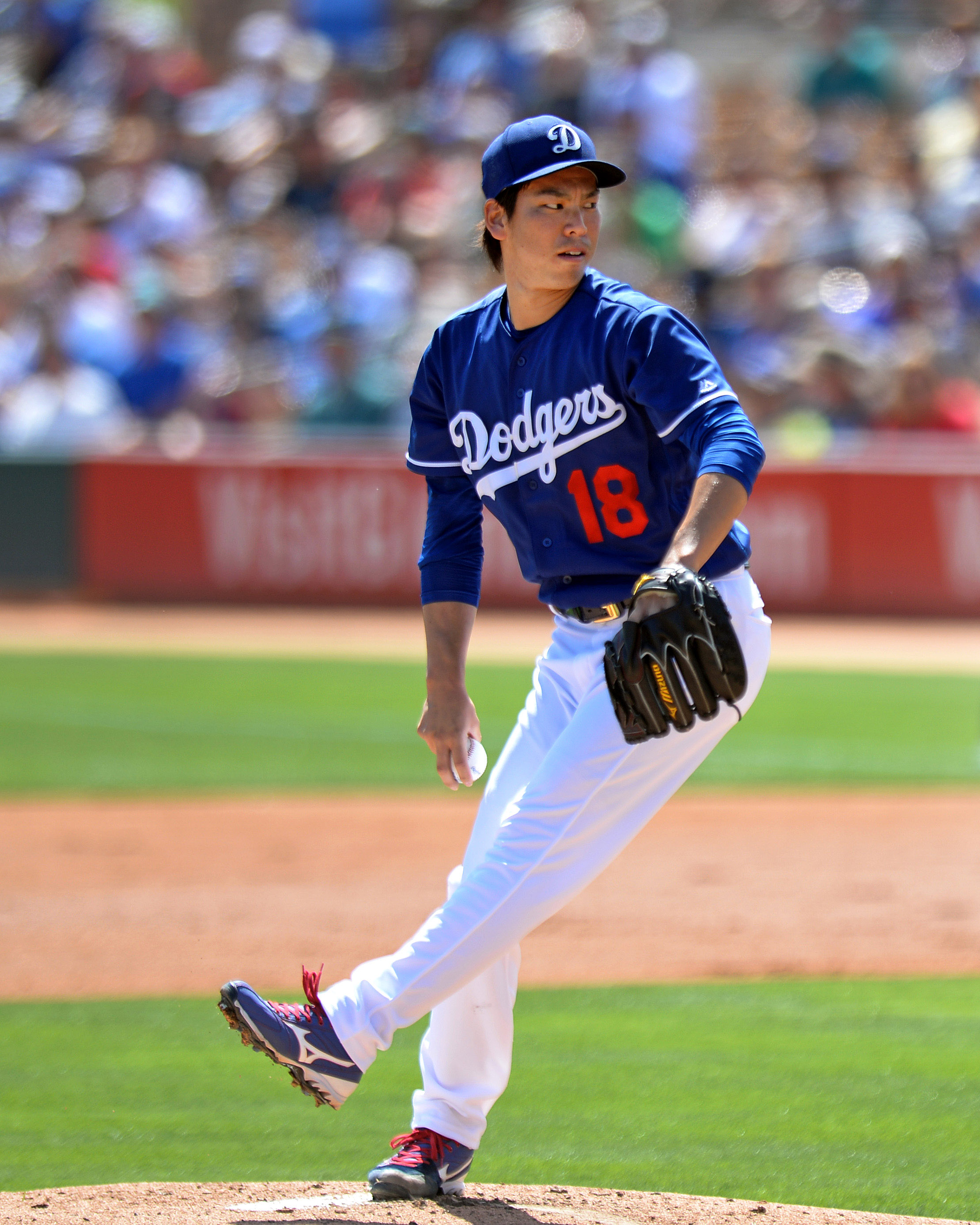
But the signing of Maeda, in particular, represents a whole new style of contract in baseball. With the changes to the posting rules that govern the transfer of players from Japan to the majors, Maeda was effectively a free agent who came with a $20MM tax that functions like the draft pick compensation attached to those who decline qualifying offers. Of course, rather than giving up the right to spend lots of money on a draft pick, a team signing a quality transferee is required to part with a big lump sum payment that can be difficult for many teams to cough up.
While many clubs would have been dissuaded from such an up-front payment for a player deemed to carry injury risk, the Dodgers have shown no such qualms. And rather than simply reducing the guarantee and/or years heading to Maeda to account for whatever it was that his medicals showed, Los Angeles instead presented a contract scenario that is more typical in other sports.
Maeda will be owed only $3MM annually over an eight-year term; if you spread the transfer fee over that span, for purposes of analysis, there’s a $5.5MM guaranteed outlay from the Dodgers for each year of pitching that they acquired. That’s the kind of annual value that many teams commit to back-of-the-rotation starters or good relievers on today’s market, and by the end of the deal it could look like a pittance. Of course, Maeda can also tack on just over $8MM per season based on the number of starts he makes and innings he throws. That kind of financial uncertainty might wreak havoc on some payrolls, but is the kind of fluctuation that the Dodgers are apparently willing and able to absorb — if, of course, Maeda can prove his worth.
What’s so unusual is to see that level of salary committed over such a lengthy timeframe, and for it come with such expansive performance bonuses. Deals with equivalently incentive-heavy arrangements are typically reserved for one-year veterans coming off of sub-par or injury-riddled campaigns. This makes for an intriguing bargain on both sides. Whether or not we see other uncertain but potentially high-level performers agree to this sort of pact remains to be seen, but the deal will be a fascinating one to track as it unfolds.
Overview
The L.A. front office continues to eschew typical big-budget spending patterns, loading up on depth while prioritizing flexibility and young talent over major investments in proven commodities. Pitching injury risk was unquestionably accounted for, but the team’s roster construction theories will be put to the test early and often in 2016. Whether or not this somewhat experimental approach will work promises to be one of the game’s most-watched storylines.
How would you grade the Dodgers’ offseason? (Link for mobile app users.)
How would you grade the Dodgers' offseason?
-
B 51% (836)
-
A 24% (392)
-
C 18% (295)
-
D 4% (71)
-
F 2% (36)
Total votes: 1,630
Photos courtesy of USA Today Sports Images.
I think the dodgers front office did very well this off season and thus gave them a B (B++). The only reason it is not an A is because I think they needed one more established late-inning bullpen arm (they finished 19th in bullpen ERA last year and no, I am not a huge fan of Blanton) and signing Kendrick AND Utley was unnecessary and a waste of money. .
Even though I seem to be in a minority, not re-signing Greinke to a megacontract was the right move in my opinion. That would have handcuffed them for a long time and would keep all of their prospects down in the minors. The re-worked Maeda deal is very low-risk as the dodgers can easily eat the money if he is not performing. Even though they are missing a ton of good starting pitchers, the rotation is still solid, proving that the depth is there. Finally, they robbed the Reds in the weird Todd Frazier deal.
Agree with the Greinke analysis. Was amazing to see the Dodgers paid less for 11 free agents over 36 years than what Arizona paid for 6 years of Greinke. I think that contract ends up hamstringing them the last 2 or 3 years.
I don’t have too big a problemw ith signing both They are only paying 17 million combined for the two, which doesnt seem too extreme and it never hurt to have veterans in the clubhouse. Especially given the potential injury risk of Turner and possibly gonzalez, that flexibility could be needed
I agree too that not signing Greinke was a good move. But I think the contract for the D’backs may turn sour sooner rather than later.
Glad someone else did the maths there : ). The amount of money that the Dodgers spend on the international market is quite exorbitant, and it hasn’t worked out that great so far on the MLB side (Puig is a good investment, but Arruebarruena, Guerrero and Oliveira did not pan out).
Even though the money doesn’t hurt, I would have liked to see a guy who is accustomed to bouncing around the infield instead of Utley./Kendrick, who have never played third base (before last year).. Maybe Zobrist (though not at the contract he eventually received). or Aviles,
Oliveira could end up being huge for LA. Oliveira got LA Wood and Peraza. Peraza was then the main piece that got LA Montas, Thompson, and Johnson. So Oliveira=Wood, Montas, Thompson, and Johnson.
The Dodgers are probably pulling down somewhere on the order of $400M in annual revenue, so this is one team that would not have been handcuffed by Grienke’s contract. Their walking away from it is better understood as money they simply decided not to spend.
Anyway, I gave them a C grade, because we didn’t have the option of an incomplete. Nobody knows whether this depth experiment will work, and even more importantly, we have to wonder if this FO will make the trades they need to make when they need to make them. Their objectives for the team are murky, at best, and they seem to prefer to keep it that way.
We do know that the “depth expierement” works. This is exactly what the Cardinals have done the last 5 years.
It hasn’t been all blind luck the Cardinals have suffered through injuries the last couple of years and still been successful.
Having great depth raises the floor of your team. While that may not be the most exciting thing as a fan, it is tremendously successful. You essentially change the “replacement level” of your team.
Exactly. Quality depth has always been valued, but its even more valued in the post-PED era of MLB. Guys are going to get injured more often, recover slower and decline faster than they did during the steroids and HGH era.
So teams need to have as talented and deep of a 40 man roster as possible to sustain success over a 162 game season and into the playoffs.
Not saying that depth is unimportant, but it’s recognized pretty generally (even if not by many here) that the Dodgers have taken this proposition to the next level. The “more instead of better” route they are taking is an unproven route to a championship.
I don’t know where that’s recognized. Can you cite that? As far as “more,” a 25-man roster and 40-man non-waiver team is pretty set in stone, so the options are finite for every team.
Now compare this team to the D-Backs, who lost Pollock and have been confirmed as doomed by a few people, including (pretty convincingly) Jeff Sullivan at Fangraphs–and the D-Backs were the ones who signed Greinke, following your all-in strategy. They’ve had their depth challenged exactly once, and the bell is already tolling for them. The Dodgers have lost several players til midseason, and predictions still have them very much in contention.
A lot of people in baseball are scratching their heads over the Dodgers approach. This was in a story I read just a few days ago. I will try to find it again and post the link.
Sure the roster is the real constraint, especially for a team with massive resources such as the Dodgers. When I say more instead of better, I refer to Kazmir, Maeda, Beachy, etc. instead of Grienke. It was being prepared to platoon Utley and Hernandez at 2B instead of re-signing Kendrick — which they did only when he got cheaper.
The point being, the Dodgers are one team that can afford to sign the best and depth besides and they are clearly going more for the latter.
Please don’t let it be Platschke or Nightengale you’re reading. In any case, taking depth to a different level means *more depth,* and unless it’s a grave or a pothole, it’s always positive. Always. The D-Backs’ example is effective in understanding this.
And you seem to be overlooking the very point of depth (cf D-Backs and, while we’re at it, throw in the Cards’ recent teams): when a guy goes down, you’ve got something *better* than replacement level. The D-Backs absolutely hamstrung themselves with their recent contracts–and they *followed your view of building teams.*
Excuse me, was this supposed to be a response to anything I said?
latimes.com/sports/mlb/la-sp-dodgers-angels-hernan…
“Even the front office’s staunchest defenders really have no idea how Friedman and his lieutenants are making their decisions.”
“Not saying that depth is unimportant, but it’s recognized pretty generally (even if not by many here) that the Dodgers have taken this proposition to the next level.”
“. . . taking depth to a different level means *more depth,* and unless it’s a grave or a pothole, it’s always positive.”
??
By this, Dylan Hernandez is saying that outside people don’t know the analytical model the Dodgers use to evaluate talent.
Good.
Did you read the entire article? I am guessing not.
Well, it wasn’t a very long article. Hardly a slog, and pretty short on analysis. One thing you failed to mention was the quote preceding the one you pulled: “But whatever metrics the Dodgers are examining remain safely guarded.”
Yeah, people don’t know the metrics the FO uses. Yawn, Dylan O Hernandez. This guy hasn’t been writing much worth thinking about for a while, now.
Naturally.
I agree with the no greinke deal but I dropped a C on them mainly because pretty much all of their signings have been high risk/reward guys and if they were going to do that a 1-2 year deal on iwakuma should have gone through – also I think that there were a number of other options that they should have jumped on in the pitching realm because they have a really high probability of imploding and if they do – next year is a pitching wasteland so they will have to have a rookie rotation rather than bringing guys along at their own pace. Also I think they should have traded puig and ethier for squad friendlier guys
Definitely would have liked to see them add more bullpen depth, but overall I like what they did this offseason. I wonder if/when they eventually move Sierra and Montas to the bullpen, to either provide more power arms or potentially start grooming one of them to take over as a closer if Jansen leaves next offseason.
I’m a Giant’s fan, but I gave them a B. That was mostly for what they didn’t do, not only not re-signing Greinke, but also not throwing money at other high-priced FAs. It’s not that they didn’t spend money, but they seem to have done it more wisely than in the past. With the huge payroll incurred by Coletti, what they did this year seems to be right given the circumstances. AZ should have followed the same strategy and gotten more players, and depth for the money they spent.
The best and most important move was getting rid of Mattingly and hiring Roberts
Interesting. I like the choice in Roberts (I guess we’ll have to see how he actually manages for a while to confirm this), but I liked Mattingly, too. I wasn’t a huge fan of his strategies, but it seemed like he was very effective with players. Still, I agree, and think/hope Roberts will be a step forward.
Mattingly completely killed Puig and Pederson’s confidence. It was time for him to go before he was going to ruin Seager’s.
Hadn’t heard that, though I knew he and Puig didn’t get along well at all. Wondering if Turner Ward is gonna make a difference in comparison to Mark McGwire. I guess we’ll be able to tell more after the season progresses.
In 2014 AZ had an injury riddled team so i’ll throw that one out the door. 2015 AZ had one of best offenses in MLB. They didn’t excell at any 1 category but they hit for average, drew walks, hit for power, and were aggressive on the basepaths <—that's on the manager. McGwire put an emphasis on HR's….nothing else. They were 1st in the NL in HR's despite playing half their games at Dodger Stadium. It was the true McGwire approach…..wait for your pitch and crush it, or not, or draw a walk. 1st in the NL in HR, tied for 1st OBP, 10th in BA. They need a hitting coach with a more balanced approach and I think that's what Ward provides.
Agreed. Last year was frustrating how they couldn’t seem to put together rallies. They either homered and scored big or could barely score when they didn’t homer. I was very happy with opening day this year when they scored 15 runs without one home run. I hope it’s more than a one-game thing.
What I disliked:
(1) signing Chase Utley, prefer Hernandez or Alex Guerrero,
(2) overpay on Sierra.
What I liked:
(1) not throwing $200 million on Greinke (I see two years as a top 10 pitcher, followed by four years as a # 2 to # 3 starter),
(2) signing Maeda,
(3) Not signing the Shark,
(4) cheap signing of Kendrick,
(5) saving money to resign Justin Turner in 2017,
(6) Not trading Urias or DeLeon or Holmes,
(7) Saving money for a mid-season acquisition(s) for bullpen,
(8) Dumping the Chapman deal, great talent but not character.
Grade: B+
I liked their pickup of Blanton, too. Good list. Only thing I might disagree with is Sierra. He might prove to be one of those good risks, and could slot into the bullpen sooner rather than later this season. If he can provide, what, 2 or 3 WAR over the next couple of years, the $15 million might be worth it (at least by some analysts’ standards).
I disagree with the herd here on Greinke. If it was worth it to pay him for five years, then the extra year is meaningless. He will start to regress but if he holds up like Maddux – a close comp – did he will outlast a six year contract. And he wouldn’t have “blocked” the prospects. There would have been three other starting slots up for grabs. That said, the Dodgers will come out all right in the end, assuming they can get Urias, De Leon etc contributing within the next two years. Anymore than that Kershaw will start to regress and they will miss their window of opportunity. Offensively, they must be very confident that Puig and Pedersen will rake this year. If not, the Ds are in trouble this year and really in trouble next year as both Turner and Gonzalez are aging. Should be interesting.
These days the herd discounts anything that doesn’t come from some number-cruncher, but all other things being equal, I will go with what people who know the players best are saying. In this case it was Rick Honeycutt comparing Grienke to Maddux, in terms of his ability to remain effective into his late 30s and possibly beyond. This was of course before the Dodgers decided that they really didn’t need Grienke. Ironic, since unlike Arizona, the Dodgers could have easily afforded to burn the out years of his contract if necessary.
The Dodgers made an offer to Greinke. The D-Backs made a stupid offer to Greinke. Greinke took the stupid one. Greinke took the money. And the Dodgers, with a $236 million opening day payroll, are gonna be just fine.
A puzzling argument.
“Excellent but aging.” I keep reading baseball analysis that refers to “aging” players.
We are all aging. I just aged while writing this post. You just aged while reading this post. We begin aging the moment we are born.
It’s inexplicable they didn’t lock down Grienke — someone messed up, or he couldn’t deal with the broken culture there.
It’s a telling flaw of your system. When there’s no new Grienke in your farm, and you expect to win, and all you add with all your money is a sum less than its parts, well then.
No one messed up – Arizona came over the top with a stack more money and Greinke took it. Fair enough, that’s business.
I’m confused as to what you mean by “when there’s no new Greinke in your farm”. No farm has a Greinke in it, because Greinke is an established quality MLB starter – the farm is for prospects.
But if you want to talk prospects, the Dodgers have some of the best, in quality and depth, going around. If anyone has a farm capable of bringing up a quality arm or three, it’s the Dodgers.
Yeah, the D-Backs committed over 1/3 of their entire 2016 payroll obligation to one guy. If I were the Dodgers, it would almost be an incentive to let a division rival torpedo itself that way. The roughly $60 million difference in rumored contract sizes between the two teams’ offers would be pretty helpful in softening the blow, too.