
Nationals Initiated Extension Talks With Wilson Ramos
8:46am: The team’s offer was for “a bit more” than the three-year, $30MM figure that Heyman suggests, per Jorge Castillo of the Washington Post (via Twitter).
7:57am: The Nationals initiated extension talks with catcher Wilson Ramos, according to Jon Heyman of Fan Rag. Initial chatter, however, has not led to more extensive discussions.
While Ramos has stated that he would invite a chance to re-up with the team, but evidently the preliminary offer was not enough to get things going. Washington opened the bidding at around three years and $30MM, per Heyman.
That does indeed sound like rather a low amount, though it would be right in line with what the Pirates promised Francisco Cervelli earlier this year to keep him from reaching the open market. Of course, that pact took place before much of the season had occurred, meaning that Cervelli was avoiding the risk of an injury or a performance downturn harming his stock — which, it turns out, is just what happened.
Ramos, by comparison, has already absorbed most of the risk, boosting his own earning power substantially with a huge season. As I recently examined, the 29-year-old has a strong case for a five-year deal at a rather lofty average annual value. Many teams are hunting for a backstop, and Ramos now stands out rather clearly as the top available free agent at that position. Though his offensive production has dipped somewhat of late, the overall output (.303/.352/.491, 21 home runs) remains immense for his position.
It’s not clear whether talks will be revisited at some point before Ramos qualifies for free agency, but Heyman calls that a “long shot.” That’s not terribly surprising, as both sides are surely focused on the task at hand with the postseason beckoning. We have seen late-breaking, pre-free-agency extensions — the Giants’ pact with Hunter Pence stands out — so that possibility can’t be ruled out entirely. On the other hand, the Nats have previously moved on from core players like Jordan Zimmermann and Ian Desmond when new contract discussions were not fruitful.
Latest On Bryce Harper
THURSDAY: In the latest twist on this story, Janes reports that Rizzo held a sit-down with Harper, manager Dusty Baker, and trainer Paul Lessard in order to determine whether there was something he was not aware of. Per the report, Harper denied that he was dealing with any injury and Lessard said he had not treated Harper in the shoulder/neck area since he sat out a handful of games earlier this year. Further, says Janes, Harper stated that he had not told Verducci anything to the contrary.
Janes wisely sought out agent Scott Boras for comment on the matter, given his high-profile involvement in the health-related situations of several other major clients. But Boras declined to comment in this case, citing HIPAA laws. That federal health information protection statute obviously does not forbid disclosure or discussion of medical information where consent is obtained from the individual in question.
The report suggests that the Nationals genuinely do not know where the reports are coming from and still have no reason to believe that Harper is dealing with a shoulder injury. As Janes notes, Rizzo’s statements on the matter seem to indicate that he is relying upon what the club’s star is telling him. “Rizzo has effectively tied his own credibility to Harper’s,” she writes, “a strong statement of trust in the 23-year-old’s honesty.”
TUESDAY: Tom Verducci of Sports Illustrated reported for a second time today that reigning National League MVP Bryce Harper is playing through a shoulder injury that is severely hampering his ability to perform at the plate, and, as Chelsea Janes of the Washington Post writes, the Nationals have once again vehemently denied that Harper is playing through a notable injury. Verducci reported similar news last month, prompting GM Mike Rizzo to call the report inaccurate. Harper, Janes notes, wouldn’t confirm or deny the report when approached today and simply refused to comment on it entirely.
Verducci cites “a source close to Harper” in writing that at the peak of the issue, Harper was scarcely able to throw the ball 40 feet and points out that Harper was playing abnormally shallow in right field this past weekend. According to Verducci, Harper has been playing through the issue since early July, and the SI scribe quotes manager Dusty Baker stating “the shoulder thing” has been bothering Harper. Baker, however, adamantly insisted to Janes that he was misrepresented in the column and was referencing the previous neck injury that cost Harper five games in August when he spoke to Verducci this past weekend.
“That’s totally inaccurate,” said the Nationals’ skipper. “I don’t know where they got that from. … Bryce said it didn’t come from him. Nobody really knows where it comes from because it’s not on the injury report. The trainer said no. We treated that shoulder already in the past. If I did make a mistake it was because it’s in his neck, which is connected to his shoulder.” Baker conceded that at the time Harper was held out of the lineup for those five games, his throwing was hindered. But Baker also insisted that Harper is healthy and able to throw right now, pointing to the fact that Braves third base coach Bo Porter held several runners at third this weekend rather than testing Harper’s typically strong arm.
Nationals GM Mike Rizzo, meanwhile, once again stated to Janes that Harper is healthy and added that he checked with Harper himself in light of the report and was told that there’s no issue. Said Rizzo: “I just talked to the player again because of the new stuff that came out, and he says it’s the 4-5 days he had with the neck. That’s it.”
Whether there’s an injury at play or Harper’s productivity is simply lacking due to mechanics or another reason, the drop-off in 2016 has been notable. Harper slugged his way to MVP honors last season when he hit .330/.460/.649 with 42 homers, and he carried an OPS north of 1.000 as deep into the 2016 season as May 22. That’s an admittedly arbitrary endpoint, but Harper is hitting a pedestrian .235/.343/.398 in 96 games since that time. While his patience at the plate is eminently visible — he’s walked in at least 13 percent of his plate appearances each month the 2016 season — he’s showing a fraction of his previous power. Since the All-Star break, just 8.5 percent of Harper’s fly balls have left the yard. That’s a significant drop-off from the 18.6 percent mark he posted in the first half, and it’s a precipitous drop from the staggering 27.3 percent HR/FB rate he posted in 2015.
Verducci’s column breaks down the various ways in which a shoulder and/or neck injury could be impacting Harper’s swing at the plate, whereas Janes’ column has further quotes on the matter and further analysis of comments from Baker and Rizzo. Those looking for a greater level of detail on the reported injury and the team’s denial of said ailment are encouraged to check out both pieces in their entirety.
Extension Candidate: J.D. Martinez
The Tigers discussed a long-term contract with J.D. Martinez last offseason before settling on a shorter multi-year pact. Martinez’s two-year, $18.5MM deal allowed the two sides to avoid arbitration, settling the outfielder’s salaries for both his second and third years of arbitration eligibility. With Martinez now just over a year removed from free agency in the 2017-18 offseason, Tigers GM Al Avila will surely re-engage Martinez’s agents at RMG Baseball about an extension that will keep the slugger in the Motor City for years to come.
Martinez missed just under seven weeks due to a fracture in his right elbow, a somewhat fluky injury that interrupted an otherwise outstanding season. He entered Wednesday’s action hitting .317/.384/.556 (all of which would be career highs) with 21 homers over 469 plate appearances, plus his 151 wRC+ ranks among the top ten hitters in the sport in that metric of total batting productivity. He is also on pace for a career-best walk rate, as well as his lowest strikeout rate in four years. Since joining the Tigers as an unheralded minor league signing during Spring Training 2014, Martinez has done nothing but rake, delivering a .907 OPS over 1606 PA in a Detroit uniform.
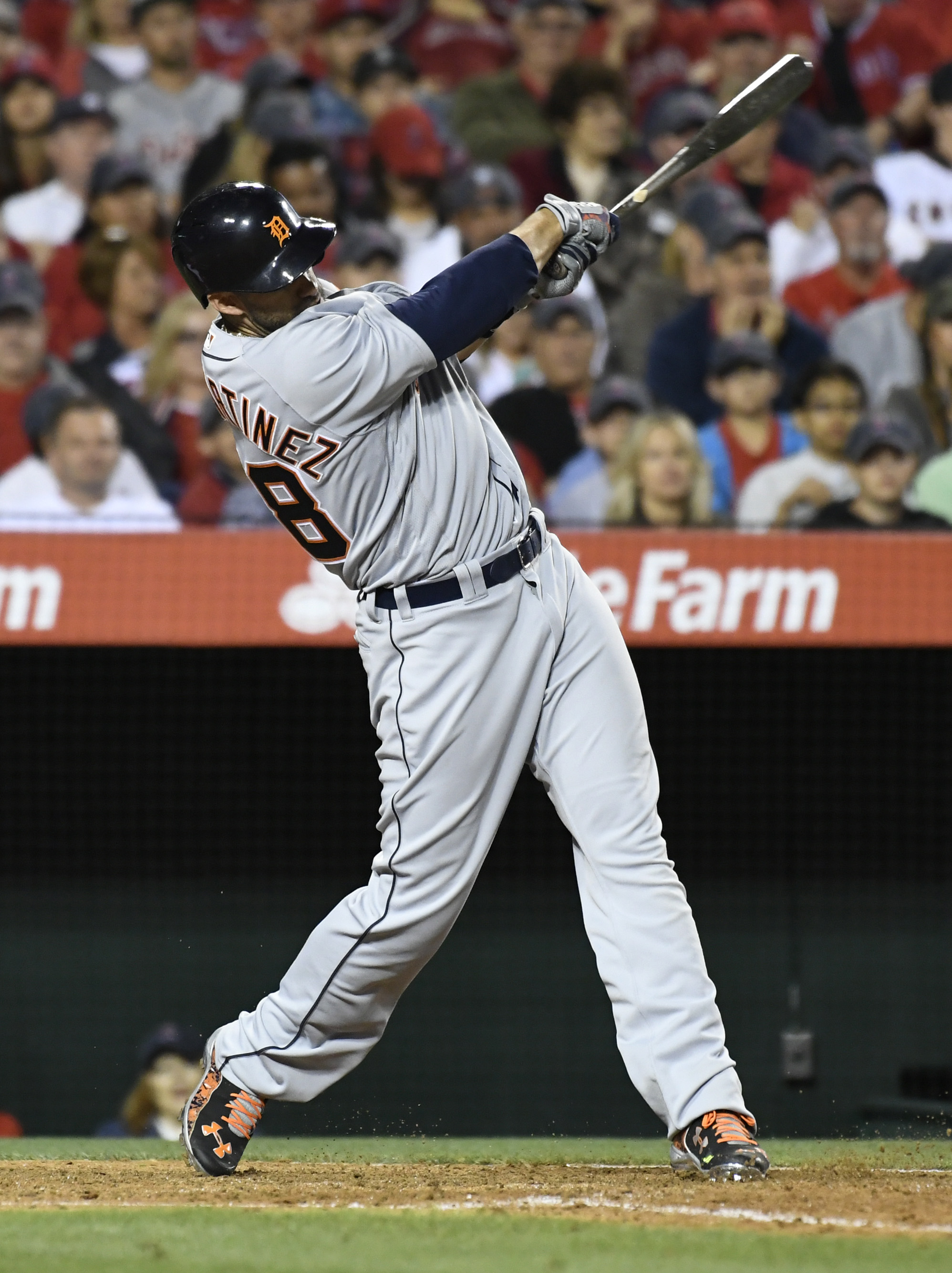 Martinez expressed an interest in being “a Tiger for life” last winter, though his asking price has surely gone up in the wake of his third straight huge season. He has extra leverage in the form of financial security (over $21.5MM in career earnings by the end of next season) and the fact that he’d be in line for a monster contract in the 2017-18 free agent market. If he duplicates his 2014-16 numbers, JDM will have the most earning potential of any hitter in that year’s free agent class. Carlos Gonzalez has a longer track record but he is two years older than Martinez and hasn’t been as impressive of late; the Royals trio of Lorenzo Cain, Eric Hosmer and Mike Moustakas can’t be considered locks for huge money based on their problems in 2016; Justin Upton has also struggled this season and may not choose to opt out of his own contract with the Tigers next winter.
Upton’s situation looms as a major factor in the talks between Martinez and the Tigers. Upton has only recently started to hit after a dreadful first half, so he’d need a big rebound year in 2017 to consider opting out. If he chooses to remain in his contract, the Tigers will owe Upton $88.5MM through the 2021 season. That is a sizeable chunk of payroll that, based on this year’s numbers, Detroit would surely prefer to allocate towards keeping Martinez in the fold.
Edinson Volquez Hopes To Return To Royals, Will Mull Mutual Option
Royals righty Edinson Volquez says that he hopes to stay with the Royals past the present season, Rustin Dodd of the Kansas City Star reports (Twitter links). The veteran hurler suggested that he is tempted to exercise his end of a $10MM mutual option, though he said he’ll need to assess the market and discuss the matter with his agent after the season.
It would be fairly surprising if Volquez does elect to trigger the mutual option, which would force K.C. to decide whether to pay him a hefty $3MM buyout or take on the full $10MM obligation. We’ve heard suggestions, after all, that the club is weighing whether to issue Volquez a $16.7MM qualifying offer — which would certainly presume that he has already passed on the option.
Both of those possibilities tee up the question of how to value the 33-year-old, who is fresh off of a solid outing yesterday but has otherwise been dreadful for quite some time now. Volquez’s earned run average last sat under 4.00 when the calendar flipped from May to June, and it has steadily risen ever since as he has coughed up 78 earned runs and allowed a .294/.360/.472 batting line over his last 114 1/3 innings. As things stand, Volquez owns a 5.25 ERA over 181 2/3 total frames on the season, with 6.6 K/9 and 3.4 BB/9 to go with a 52.1% groundball rate.
That’s not exactly a sterling platform for free agency, but there are some silver linings. First and foremost, Volquez has been a rock, making over 30 starts in each of the last five seasons. And his average fastball velocity is holding firm at over 93 mph. ERA estimators have never really been in love with him, even when he was posting strong results in each of the last two seasons, but they largely view his current season as a continuation — with variances in strand rate, BABIP, and home run susceptibility largely explaining the different bottom-line marks.
It also bears note that the coming market lacks for rotation talent, not just at the top but also in the depth department. Clubs in search of solid innings will be lining up for arms like Volquez, who seems rather likely to find guaranteed money that exceeds the value of his mutual option. That being said, the qualifying offer could prove tempting, if issued, particularly since declining it would mean entering the market with draft compensation. It remains to be seen whether the Royals will be willing to risk that large a chunk of the organization’s payroll.
Trevor May Diagnosed With Stress Fracture In Back
Twins righty Trevor May has been diagnosed with a stress fracture in his back, Mike Berardino of the St. Paul Pioneer-Press reports. His specific condition was diagnosed as a “pars defect” by specialist Dr. Robert Watkins.
It seems that the injury has been present for some time, with Watkins telling May that it had already undergone “cycles of healing” that never completed. “I just kept pitching on it and probably shouldn’t have,” said May. “It was an injury that was a little more serious than I thought it was.”
The 26-year-old said that he anticipates that an offseason of rest will cure the ailment, which is apparently similar to what Lucas Duda has struggled to return from this year. In May’s case, the hope is that he can rest for the remainder of the calendar year before undergoing a strength program and beginning to throw early in 2017.
May has shown plenty of promise despite an unsightly 5.27 ERA in 42 2/3 innings. Working exclusively from the bullpen, he has racked up 12.7 K/9 (with a 13.2% swinging strike rate) against 3.6 BB/9 while sitting at nearly 94 mph with his average fastball.
Home runs have been a problem — May has allowed homers on 15.2% of his flyballs and at a clip of nearly one-and-a-half per nine innings — but the overall numbers seemingly bode well. Of course, there’s an argument to be made that he ought to be given a chance to stick in the rotation before a relief role is set in stone. Regardless the Twins seem to have a useful arm on hand so long as May can progress as hoped from the back issue.
San Diego Padres: Top 5 Bright Spots Of 2016
Rebuilding season or not, falling short of the playoffs and finishing with a losing record probably means that more things went wrong than went right for a team. This series, however, will focus on those silver linings that each team can take away from an otherwise disappointing season.
[Related: “Top Bright Spots” archive]
Here are the biggest bright spots for the San Diego Padres.
1. Ryan Schimpf, 2B
In seven years with the Blue Jays, Schimpf was never even added to the team’s 40-man roster. It’s safe to assume that they didn’t think he was capable of having anywhere near the success he’s had with the Padres (.890 OPS, 19 homers, 15 doubles, five triples in 79 games). To be fair, neither did the 29 teams who passed on Schimpf whenever he was available in the Rule 5 draft. His unimpressive stints in Triple-A (.648 OPS in 2014; .607 OPS in 2015), despite success at every other level, probably helped to keep him off the radar.
For the 28-year-old, who signed a Minor League deal with the Padres this past offseason, it took a 1.160 OPS with 15 homers in 51 games for Triple-A El Paso to finally earn a big league call-up in mid-June. Schimpf got off to 3-for-29 start, but he’s been one of the most productive hitters in baseball since July 1, posting a .946 OPS and 37 extra-base hits in that time.
Schimp’s arrival has seemingly created a logjam at second base with Cory Spangenberg coming back from injury and Carlos Asuaje coming off of a terrific Triple-A season. In reality, though, there’s no way that a guy who just hit 19 homers in a two-and-a-half month span while playing solid defense won’t be penciled into the projected lineup for 2017.
Cueto Diagnosed With Groin Strain; Crawford Dislocates Finger
7:52pm: Cueto has been diagnosed with a grade 1 strain but will likely only need to have his next start pushed back, per manager Bruce Bochy, via Baggarly (Twitter link). Meanwhile, Crawford is wearing a splint and won’t play tonight, but says he expects to play through the injury once the pain subsides somewhat, MLB.com’s Chris Haft tweets.
8:58am: While the Giants topped the Dodgers last night in a 2-0 victory, the win was somewhat bittersweet, as both Johnny Cueto and Brandon Crawford departed early with injuries. Crawford dislocated his left pinkie finger while sliding into third base, whereas Cueto suffered a groin strain that will lead to an MRI today, as Andrew Baggarly of the San Jose Mercury News writes.
Cueto was in good spirits following the injury and displayed a sense of humor about the injury, likening the injury to “a crab going there and biting me,” per Baggarly. Cueto’s curious and upbeat demeanor notwithstanding, though, the Giants can ill afford to lose their rotation’s No. 2 even for a lone start. San Francisco is currently in a three-way tie with New York and St. Louis for the two National League Wild Card spots, so each of the remaining 11 games on the Giants’ schedule is of the utmost importance to their postseason hopes. Giants GM Bobby Evans called Cueto day-to-day last night when asked by ESPN’s Jim Bowden (Twitter link), but the extent of the damage remains to be seen.
Cueto, 30, signed a six-year, $130MM contract with an opt-out following the second season of the deal this winter, as the Giants showed faith that his downturn in effectiveness during his Royals tenure was an aberration and not the beginning of any notable decline. Cueto has emphatically rewarded that faith in his first Giants season, pitching to a pristine 2.79 ERA with 7.9 K/9 against 1.9 BB/9 in 212 1/3 innings behind ace Madison Bumgarner in the rotation. While the Giants have been ice cold in the season’s second half, that pairing alone would give the team as formidable a punch as any opponent could muster in a short playoff series.
Crawford, meanwhile, had his finger popped back into place in the tunnel following the injury and was wearing a splint on his hand after the game. However, the Giants are at least somewhat fortunate that the injury was sustained on Crawford’s glove hand as opposed to this throwing hand. X-rays after the game ruled out a fracture, Baggarly writes, but the 29-year-old shortstop is listed as day-to-day as well, with the chief concern likely to be how the finger injury impacts his ability to swing a bat. Crawford is one of baseball’s premier defenders at shortstop and is in the midst of his third consecutive above-average season at the plate, having batted .268/.334/.424 with a dozen homers, 28 doubles and nine triples under his belt.
Preston Tucker Requires Shoulder Surgery
Astros outfielder Preston Tucker requires surgery on his right shoulder, MLB.com’s Brian MacTaggart reports. The procedure, which was scheduled for today, will address the acromium on his shoulder blade.
The 26-year-old Tucker will not be able to pick up a bat for a few months, with manager A.J. Hinch saying that “it will be a long process for him in the winter,” but is expected to be ready to go for Spring Training in 2017. Tucker will be battling for a roster spot after a campaign spent fighting through shoulder troubles and scuffling at the plate.
Tucker showed well in his debut season of 2015, posting a .243/.297/.437 batting line and banging 13 home runs in 323 plate appearances. Though he did hit well during his time in the minors this year, the results weren’t pretty at the major league level. In his 144 trips to the plate, Tucker hit just .164/.222/.328 with four dingers, leading to a demotion.
The positive side of the surgery is that it holds out the promise of resolving an injury that kept Tucker from trying to reemerge down the stretch. “We do feel like we finally got to the bottom of what his pain was coming from,” Hinch said.
It remains unsettled where the left-handed hitter will factor in the ‘Stros outfield mix next year. The club will bid adieu to pending free agent Colby Rasmus, taking away the organization’s most-used southpaw-swinging outfielder. Youngsters Tony Kemp and Derek Fisher could also claim roles, but the door remains open for Tucker. Of course, Houston could well look to bolster the outfield this winter.
MLBTR Chat Transcript
Click here to view the transcript from today’s MLBTR Chat With Jason Martinez: September 21, 2016
Season Likely Over For Lorenzo Cain
SEPTEMBER 21: Cain likely will not return this year, manager Ned Yost said during an appearance on MLB Network Radio on Sirius XM (Twitter link). Yost explained that Cain’s “wrist has been slow to heal,” with the team feeling there is “no sense trying to push it.”
SEPTEMBER 11,10:59am: Cain now seems to agree with the Royals that shutting him down for a week and then re-evaluating is the best course of action, tweets Rustin Dodd of the Kansas City Star.
8:24am: The Royals are reluctant to shut down Cain for the year, according to ESPN.com. A team spokesman said after Saturday’s game that Cain received a stem cell shot on his wrist that didn’t work, and the club will now wait a week to see if the injury heals before deciding his fate.
SATURDAY: Royals outfielder Lorenzo Cain has been dealing with a sprained left hand, an injury that has made it difficult for him to swing a bat, since August. As a result, Cain is likely to shut himself down for the season, he told FOX Sports on Saturday (via Jeffrey Flanagan of MLB.com). Cain had been out of the Royals’ lineup since Aug. 30 until returning Friday, when he reached base four times, but he’s sitting Saturday. The 30-year-old offered a discouraging assessment of his health after Friday’s game.
“Every swing, it doesn’t feel good. I don’t know what to say,” stated Cain, who also revealed that he was playing through with a tear.
Injuries have been highly problematic this year for Cain, who missed nearly all of July with a hamstring strain. When on the field, Cain has once again been a key cog for Kansas City, though he – like his team – hasn’t been as effective as he was in either the Royals’ American League pennant-winning 2014 season or their World Series-winning 2015 campaign. In those two seasons, Cain combined to slash .304/.351/.447 with 21 home runs and 56 stolen bases across 1,106 plate appearances. His output at the plate, on the base paths and in the field led to a stellar 11.2 fWAR total – tied with Cubs first baseman Anthony Rizzo for fifth in the majors. Thanks largely to further defensive excellence, Cain’s at a still-solid 2.5 fWAR this year, but his .287/.339/.408 line through 434 PAs represents a step backward.
The Royals entered Saturday four games behind the AL’s second wild-card spot, and losing Cain should only further damage their slim playoff chances. They could face an offseason decision on whether to shop Cain, who’s due $11MM in 2017 – the final year of his contract – or take another run at a championship with a healthy roster full of core contributors on expiring contracts. In addition to Cain, first baseman Eric Hosmer, third baseman Mike Moustakas, left-hander Danny Duffy and closer Wade Davis are scheduled to hit free agency after next season.