
March 28: Lowrie is guaranteed $850K on the deal, tweets MLB Network’s Jon Heyman. He’ll also earn a $100K bonus for spending 60 days on the active roster and would receive a $150K assignment bonus if traded. Heyman adds that Stephen Vogt’s one-year deal with the A’s has those same terms.
March 26: The Athletics officially announced the signing.
March 25: The A’s are re-signing Jed Lowrie to a one-year contract, reports Eno Sarris of the Athletic (Twitter link). It’ll be the veteran infielder’s second straight season in green and gold and his seventh year in Oakland over three separate stints. The A’s have a vacancy on their 40-man roster, so no additional move will be necessary. Lowrie is a client of Excel Sports Management.
Oakland is plenty familiar with Lowrie, who has generally been productive while donning an A’s uniform. He posted a wRC+ of at least 120 (offense 20 percentage points above league average) in both 2017 and 2018, picking up an All-Star nod in the latter season. That positioned him to land a two-year, $20MM deal with the Mets that rather infamously went off the rails due to injuries.
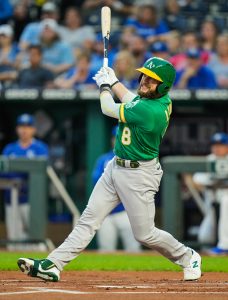
Lowrie only took eight trips to the plate as a Met, dragged down for his entire time in Queens by knee issues. He returned to the Oakland organization via minor league deal last winter, and he broke camp with the big league club. His making the roster wasn’t unexpected, but it was surprising the A’s declared him their primary second baseman, a position at which he started on Opening Day.
Former manager Bob Melvin penciled him in at the keystone 69 times over the course of the year, while he saw action in 58 games as the designated hitter. Lowrie’s defensive metrics weren’t great, as one might expect for a 37-year-old middle infielder coming off serious knee trouble. Yet the switch-hitting veteran showed he still had some life in his bat, posting a .245/.318/.398 line with 14 homers in 512 plate appearances. That’s exactly league average offensive production, according to wRC+, and Lowrie’s underlying numbers were solid.
As he’s been throughout his career, Lowrie was patient enough to take pitches outside the strike zone. He made contact on 77.9% of his swings, the lowest mark of his career but still a hair better than average. And Lowrie posted better batted ball marks than his .398 slugging percentage might suggest. He made hard contact (defined as a ball hit 95 MPH or harder) on 45.9% of his balls in play, about ten points higher than the league mark. His 90.3 MPH average exit velocity was a couple ticks above average, as was his 9.3% barrel rate (essentially a measure of how often a batter hits the ball hard at an optimal launch angle for extra-base impact).
The A’s front office and manager Mark Kotsay obviously value Lowrie’s presence in the clubhouse. Between that familiarity and his still capable offensive traits, he earns another guaranteed roster spot in Oakland. It surely won’t be a costly add for the A’s, who have spent most of the winter orchestrating a sell-off to slash payroll. Lowrie isn’t going to make them into a contender, but the recent re-signings of he and Stephen Vogt add a couple highly-regarded veteran role players to an increasingly youthful clubhouse. Tony Kemp seems likely to be the primary second baseman, but Lowrie can work his way onto the field between the keystone, first base and DH.
Image courtesy of USA Today Sports.
Back to 2013 baby
This can’t work? Can it?
Well he was a league average first after being healthy for the first time in years last year. So it might.
Maybe he’ll produce 1.21 gigawatts worth of WAR.
This guy was the bomb, now he’s just the fizzle, is this a poke and hope for the A’s?
I guess he came CHEEP!
lol can’t even spell cheap…
Sure you can, just look at the suit you’re wearing!
Oh s! We are a step closer to the A’s resigning Josh Reddick and Marco Scutero. We are trending that way. Go A’s!
I didn’t think he was as old as I just saw he was ..
He was a complete disaster last season, like Vogt, he is no longer a MLB-level player. These are just awful, unintelligent signings by Oakland, this is bad.
Him playing in only 8 games during his Mets contract was a disaster
Think of it as hiring player/coaches for the young guys. I don’t mind it.
Although it takes away from stalled, older players in AAA. I’d rather see what Sheldon neuse has to offer or austin Allen who have had decent success in AAA. I guess they value veteran influence of Vogt, lowrie.
Those guys are playing 90% of the time. Vogt and Lowrie will barely play defense unless a youngster gets hurt, or they are feeling nostalgic.
Yay amazing player and club house leader!!!
No. Not at all.
I would rather it be KD not Jed Lowrie. Beane needs to update his phone book all he is doing is calling the old numbers.
Sorry, the Slim Reaper is busy in Brooklyn, though it would be kind of frightening to see what he could do with a bat in his hands…
Khris davis not Kevin.
The A’s are going all out.
Correction: The A’s are going all outs….
See, the A’s traded Chapman to upgrade not cut cost.
WHAT?! Why?!
Who doesn’t love some veteran players
Well we know what we will get out of him , and my guess the A’s want the extra year on Nick Allen . Lowrie does add pop with know how . Plus it gives a job to a guy who has earned it before . Allen will get his reps in Vegas , and force the move .
Alan is out of options. If he doesn’t make the team he becomes a free agent. Most likely, the A’s intend to trade him.
No. Nick Allen hasn’t even made his MLB debut yet. Austin Allen is out of options.
Plus he Lowrie will add an extra year for Nick Allen , and Nick Allen will keep Andrus’s contact from kicking in . Problem solved.
The Mets got great value from Lowrie! The 8 at bats costtheMets $20,000,000, so Lowrie received $2,500,000 per at bat.
Lowrie has only played well as an Astro and an A’s player.
The player that stole 20mil from the Mets.
Bobby Bonilla?
Bobby Bonilla actually turned out to be the smartest man in Baseball
No. Both parties signed a contract. Fully warranty. Lowrie just got hurt and well Jed got paid handsomely…
I’ve never understood MLB contracts. In the real world most people don’t get paid at their jobs while injured. I was a union member for railroad over 10 years at one point same thing. MLB players have it easy. Especially if they are good enough to hold down a active roster spot for any length of time.
I imagine Lowrie will get the bulk of his AB’s as a DH
Thought that Eric Thames was Signed to be the DH? No way they want his Glove out at First Base.
Right now it’s either Thames, Vogt, Billy McKinney, or Dalton Kelly. No matter who is at 1B it’s going to be a huge downgrade defensively from Olson
Always wanted to see Thames get 500 abs and what the end numbers would look like …He might have found the team to grant him that
I really like this signing. One of the few teams that have done less than Hal Steinbrenner. Thanks for making Hal feel special, A’s! (As Hal reads this he shouts into his phone, “See, I told you we aren’t cheap, Cash!” Cashman retorts, “Gardner’s practically the same age, sooooo, this means I can re-sign him again, right?”
The A’s are nothing more than a glorified farm system. They shouldn’t even be allowed to sign free agents.
Funny. I was thinking something similar for your ability to comment. Maybe you should be mandated to take a recent baseball history course, and PASS it, before making one more stupid comment.
Again?
Alright, cool, I needed a shortstop on my “All Older Than Me Team,” it is looking bleak. I am almost 38, so maybe I can no longer be surprised.
Joey Votto at 1b, Kurt Suzuki at C, Albert Pujols at 3b, Robinson Cano at 2b, Lowrie at SS. OF of Brett Gardner, Nelson Cruz?, Miguel Cabrera? Yadier Molina DH.
I am sure I can throw together a pitching staff. I am pretty sure that 2022 will be the last year I can do this.
Old Jed Lowrie has been my favorite baseball player for the past 10 to 15 years. He might be old but he can still play the game better than half of the players on other major league teams. I really like this signing.
At least Lowrie plays on the west coast. In Boston, Lowrie was in and out of the lineup constantly missing significant time only to miss almost the entire two years with the Mets (0-8 with one walk). That was a $20,000,000 walk.
In a weird way, he feels like “Mr. A” at this point. About as much as one can be on that club
Exactly.
Vogt, Lowrie,…up next Adam Roslaes
Nope, Nick Swisher baby!
I still remember Nicky Swish in those MLB Network ultimate fan commercials way back when…
Rosie’s been a coach in the A’s minor leagues for a couple years now.
If not Rosales then perhaps Nick Punto or Jemile Weeks
Jack Cust
Anyone know what Brandon Moss is up to these days? Cliff Pennington?
Get Daric Barton too. All our old defense first guys who couldn’t hit a lick. I’m telling you missing out on Kurt Suzuki was a mistake.
Good money for a guy who doesn’t play
Yes Lowrie was hurt during his tenure with the Mets. But if you look at his stats he has been solid throughout his career. Simply put the guy can play when healthy and he is better choice than most teams at 2B,DH,utility player.
He actually played in 139 games last year and over 150 games each of the 2 years prior to signing with the hapless Mets. Nothing that happens with the Mets should count against a player – it is a suck hole of injury and failure.
This is looking like a 100 loss team for 2022 more each day.
The A’s haven’t lost 100 games since 1979 and before that it was 1964. For an organization to have only one 100 loss season in 50 years is pretty remarkable considering the ownership and turmoil.
Mets fans everywhere are throwing up right now.
$850K? He’s trending toward league minimum.
Maybe the Angels can beat out the As this year.
Lowrie fleeced the Mets hard
@stefan – not sure….
Cant help feeling the Mets fleeced themselves. Lowrie insisted his knee needed surgery, the Mets insisted it didn’t. Result being an unhealthy Lowrie for two years who then funded his own surgery (like any normal person) and after those two years out in his mid 30s returned to hit league average.
And still wants more time in the middle at little more than league minimum.
@A’s fan — Correct.
The Mets, at least prior to the current regime, would pull this trick. They did it with Beltran too. The signing of Lowrie at $10M per was a mistake. How the Mets handled his injury was an even greater mistake.