
Rockies Sign Charlie Blackmon To One-Year Extension
The Rockies announced they’ve signed Charlie Blackmon to a one-year contract extension. He’ll return for a 14th season with the club in 2024. The ACES client receives a $13MM guarantee that offers an additional $2MM in incentives. Blackmon would receive $500K apiece for tallying 425, 450, 475 and 500 trips to the plate.
Blackmon has spent his entire career in Colorado. A second-round pick in 2009, he debuted two years later. By 2014, he’d established himself as a very good everyday center fielder. That season, Blackmon secured his first of four career All-Star nods. His best campaign came in 2017, when he finished fifth in NL MVP balloting and won the NL batting title. Colorado signed him to a $108MM extension the following April — including player options running through 2023.
The two-time Silver Slugger winner remained a well above-average hitter through 2019. He still hit above .300 during the shortened 2020 season, albeit with diminished power. Blackmon slumped to a .267/.332/.415 line between 2021-22, raising the possibility that this would be his final year in Denver. He exercised a $15MM option for this season and was set to hit the free agent market for the first time in the coming weeks.
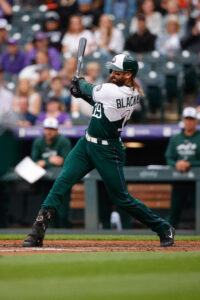
Blackmon rebounded from his down couple seasons. Still working largely out of the leadoff spot, the 37-year-old has turned in a .283/.370/.451 slash through an even 400 plate appearances entering play Friday. He’s still not hitting for much power, but only Nolan Jones has more consistently gotten on base among Rox’s batters. Blackmon is drawing walks at a personal-best 9.8% clip while striking out just 13.5% of the time. He’s still performing well against pitchers of either handedness.
As one would expect for a player in his late-30s, Blackmon hasn’t provided much on the other side of the ball. The Rox moved him off center field after the 2018 season. Since logging 134 starts in right field two seasons ago, the veteran has seen increasing action at designated hitter. Skipper Bud Black has penciled him into the outfield on just 26 occasions while turning to him at DH 60 times.
Blackmon will presumably continue working as Colorado’s primary DH for another season. Jones has had a strong rookie year to take over left field. Kris Bryant was the primary right fielder early on, although he’s been a first baseman or DH since returning from a finger fracture. Bryant could move back to the outfield next season, which would allow the Rox to keep Blackmon out of the field on most days. If the Rockies keep their $182MM signee at first base, they could look to add a corner outfielder in free agency or trade over the winter.
It’s the second late-season extension for Colorado. The club agreed on a two-year, $20MM pact with starter Germán Márquez three weeks ago. Márquez underwent Tommy John surgery in May, so that move is primarily about 2025. This deal ensures veteran continuity for a young roster while keeping around a fan favorite who’s still a productive hitter — albeit in more of a rotational role than an everyday capacity. Reliever Brent Suter and depth starters Chris Flexen and Chase Anderson are the club’s remaining free agents.
Colorado had just over $98MM in guaranteed commitments for the ’24 campaign before re-signing Blackmon. The extension brings their commitments to around $111MM before considering arbitration-eligible players. They opened this year with a player payroll around $172MM, as calculated by Cot’s Baseball Contracts, so there should still be a decent amount of breathing room headed into the offseason.
At the same time, it’s a surprisingly strong sum for the Rox to commit. They’ll likely need to add at least three starting pitchers this offseason. Bullpen and/or center field help could be targets as well. Blackmon’s status in franchise history surely played a part in the deal, though it’s still above market expectations for a non-elite veteran hitter limited to a part-time DH/corner outfield role.
It’s a bit above the $10MM and $12MM respectively secured by J.D. Martinez and Michael Brantley last winter. Martinez indicated he took less than was available to join the Dodgers, while Brantley was coming off a season-ending shoulder procedure. Yet both players have been more productive hitters over the last few seasons than Blackmon has been. The Rockies are willing to go beyond what the veteran likely would’ve received as a free agent in order to ensure he’ll be back at Coors Field for another season.
MLBTR’s Steve Adams first reported the contract details.
Image courtesy of USA Today Sports.
Reds Sign Nick Krall To Extension, Promote Him To President Of Baseball Operations
The Reds have locked in their front office leadership. The club announced they’ve promoted Nick Krall from general manager to president of baseball operations. He also receives a contract extension of undisclosed length, tweets C. Trent Rosecrans of the Athletic. Meanwhile, Brad Meador has been promoted from assistant GM to general manager, solidifying him as the #2 person in the front office hierarchy.
“Nick has a great baseball mind and has shown exceptional leadership in advancing every aspect of our baseball operations,” CEO Bob Castellini said in a statement. “Nick and his staff have earned our confidence, and these moves help ensure the positive momentum will continue across the organization.”
Krall has led baseball operations for three seasons. The 45-year-old took the reigns when former president Dick Williams stepped away at the end of the 2020 campaign. Krall already held the GM title at that point, though as is the case with many front offices around the game, that came with the #2 role in the front office. Williams’ resignation pushed Krall to the top while he retained the GM title.
While he’s only been leading baseball operations for a few seasons, Krall has spent two decades with the organization. He began working as a scout in the early 2000’s and secured a front office position within a few years. The Reds promoted him to GM under Williams in May 2018.
Krall took control of the front office at an inflection point for the franchise. Cincinnati had targeted 2020 to emerge from their last rebuild. They went a little above .500 in the shortened season and were swept in the first round. They hovered around league average for the entire ’21 campaign, missing out on the playoffs after holding a Wild Card spot into September. At that point, the organization slashed payroll, kicking off another rebuild.
Cincinnati’s 2022 campaign was disastrous. The Reds lost 100 games for the second time in franchise history. After another quiet offseason, they entered this year with middling expectations. Cincinnati has surprisingly been one of the sport’s most improved teams. Barring a sweep this weekend at the hands of the Cardinals, they’ll finish with a winning record. They’re still in playoff contention in the season’s final few days, although they’d likely need to sweep St. Louis and get some help from both the Marlins and Cubs to qualify.
Much of that turnaround is attributable to a youth movement involving players acquired during their 2021-22 sell-off. Spencer Steer and Christian Encarnacion-Strand came over from the Twins in the Tyler Mahle deal at last summer’s deadline, arguably Krall’s best move to date. Noelvi Marte, the headliner of the Luis Castillo trade, is holding his own at the major league level as a 21-year-old. Brandon Williamson has turned in back-of-the-rotation results since being acquired in the Jesse Winker/Eugenio Suárez deal.
Matt McLain and Andrew Abbott — two of Cincinnati’s first four selections in the 2021 draft — are among the best rookie performers in the National League. Hunter Greene and Nick Lodolo were selected while Williams was still leading the front office, though Krall was surely involved in those decisions as the #2 executive.
While there’s little question about the organization’s ability to stockpile young talent, it remains to be seen how effectively Krall and his staff can push the team to the next level. Cincinnati didn’t land the starting pitching they were seeking at this summer’s trade deadline. The likeliest outcome is that they’ll miss the playoffs for a third straight season. There’s plenty to like about the organization’s direction, making it unsurprising the Reds are committed to both Krall and fifth-year manager David Bell — who signed an extension running through 2026 in late July. They’ll no longer be a surprising upstart, however. Even if they fall shy of the postseason this year, next year’s club will have the highest expectations of Krall’s tenure atop baseball operations.
Meador, 48, has been atop the scouting and player development departments. He has been a member of the organization’s scouting group since 2009. Meador has surely played a key role in the selections of players like McLain, Abbott, Greene and Lodolo, as well as the signing of TJ Friedl as an undrafted free agent in 2016.
Promotions like this are fairly common in advance of the offseason. Teams typically grant employees permission to speak with other teams about job opportunities only if the other club is offering a higher position. By promoting Meador to GM, the Reds foreclose the possibility of losing him to another team that could’ve considered him as a candidate for the #2 job in their front office — presumably rewarding the longtime executive with a pay bump in the process.
Kiley McDaniel of ESPN first reported the promotions.
Zaidi: Giants Hopeful Of New Managerial Hire By Start Of Free Agency
The Giants made a significant change this afternoon, firing skipper Gabe Kapler as his fourth season at the helm was coming to a close. Bench coach Kai Correa will serve as the interim manager for the final series against the Dodgers.
President of baseball operations Farhan Zaidi spoke with reporters after Kapler’s dismissal. He indicated the front office’s preference is to have a new hire in place by the beginning of the free agent period (link via Susan Slusser of the San Francisco Chronicle). That starts five days after the conclusion of the World Series.
“It’s a pretty universal trait that you want a manager who players want to play for, whether it’s young players and getting them motivated to get the most out of them or free agents who have heard your manager has a good reputation,” Zaidi told the S.F. beat. “I think that’s going to matter a lot.”
Zaidi did not indicate that Kapler’s presence as manager was harmful to the team’s free agent pursuits, to be clear. Yet he noted the club had decided to look for “new and different leadership in our clubhouse, a different dynamic there.” After making the call to move on from Kapler, it’s understandable they’d prefer to have a new manager in place as they try to sell the organization to upcoming free agent targets.
Over his five-year tenure leading baseball operations, Zaidi and his staff have come up short on multiple pursuits of top-of-the-market talents. They pursued Bryce Harper over the 2018-19 offseason but reportedly balked at the long-term offer he was seeking (and eventually found from Philadelphia). San Francisco made a run at Aaron Judge last winter but came up short when the defending MVP returned to the Yankees on a record-setting deal. They agreed to terms on a $350MM pact with Carlos Correa, only for that to fall through on the physical.
The Giants have been active in the middle tiers of free agency but haven’t signed a guarantee larger than the $44MM Carlos Rodon deal under Zaidi. With roughly $110MM in guaranteed money on the books for next season, San Francisco could try again to land a top-of-the-market player. They’ll surely be among the teams courting Shohei Ohtani, while Cody Bellinger could be a fallback target if Ohtani heads elsewhere. San Francisco had interest in Bellinger — with whom Zaidi is familiar from their time with the Dodgers — before he signed with the Cubs on a $17.5MM bounceback deal last offseason. After an excellent rebound campaign, Bellinger seems in line to top $200MM on his next free agent trip.
D-Backs Release Zach Davies
The Diamondbacks have released veteran righty Zach Davies, per the transaction log at MLB.com. That was expected after the Snakes designated him for assignment on Wednesday.
Davies spent two years in Arizona. He turned in a 4.09 ERA through 27 starts last season after signing a $1.5MM free agent deal coming out of the lockout. While that came with middling strikeout and walk numbers, he provided stable enough innings out of the fifth spot in the rotation on a generally young pitching staff.
That secured him a raise when he re-signed with the Snakes in January. Davies landed a $5MM guarantee taking the form of a $4.7MM salary and a $300K buyout on a mutual option for 2024. He tacked on another $950K in incentives and added $200K to the option buyout by topping 16 starts, meaning he’ll collect $6.15MM overall. Arizona will remain on the hook for the buyout once he officially clears release waivers.
Davies will likely be limited to minor league offers this winter. The 30-year-old is coming off a career-worst season, allowing exactly seven earned runs per nine through 82 1/3 frames. His 19.1% strikeout rate is actually his best mark since 2020, though it’s still a few points below league average. The nine-year MLB veteran walked just over 10% of batters faced while allowing hard contact on an elevated 42.4% of batted balls.
Rangers Place Jon Gray On Injured List
The Rangers placed starter Jon Gray on the 15-day injured list, retroactive to September 28, with forearm tightness. Jake Latz is up from Triple-A to take the open spot on the active roster.
Gray left his start in Anaheim on Monday with the injury. It’ll take him out of consideration for the first two rounds of the playoffs. Texas is one win away from securing a playoff berth. They’re up two games on the Astros for the AL West lead with three to play. Even after last night’s walk-off loss in Seattle, they remain the favorite to take the division — which would lock in a bye past the Wild Card series.
Texas would have to make it to the ALCS for Gray to be a potential factor. The 15 days rules him out until October 13, which would be the fifth game of a Division Series. The Rangers could technically reinstate Gray if they’re playing in a decisive Game 5, though that’d require an injury to another player and presumably be too risky for the club even if it were feasible.
It’s not clear if Gray would’ve been in the playoff rotation even were he healthy. Jordan Montgomery would very likely get the first game. Nathan Eovaldi and Dane Dunning could fill the rest of a three-man rotation. Gray has been a consistent presence throughout the season, yet his production has tailed off. He has a 5.32 ERA since the All-Star Break and is allowing over six earned runs per nine this month.
Gray joins Max Scherzer as injured Rangers’ starters hoping for a potential return deep into a postseason run. Scherzer has been sidelined by a terse major strain for the past few weeks.
Offseason Chat Transcript: St. Louis Cardinals
MLBTR is holding live chats specific to each of the 30 teams as the offseason nears. In conjunction with the offseason outlook for the Cardinals, Anthony Franco held a Cardinals-centric chat. Click here to view the transcript.
Offseason Outlook: St. Louis Cardinals
The Cardinals entered the year expected to compete for another NL Central title. Instead, they’re on track for their first 90-loss season in more than three decades. They’re going to make another push for contention this winter, with no secret about a forthcoming pursuit of rotation help.
Guaranteed Contracts
- Nolan Arenado, 3B: $109MM through 2027 (Rockies paying $5MM annually through 2025; deal includes deferred salary through 2041)
- Willson Contreras, C: $77.5MM through 2027 (including buyout of ’28 club option)
- Miles Mikolas, RHP: $32MM through 2025
- Paul Goldschmidt, 1B: $26MM through 2024
- Steven Matz, LHP: $24MM through 2025
- Giovanny Gallegos, RHP: $6MM through 2024 (including buyout of ’25 club option)
Option Decisions
- None
2024 financial commitments: $108MM
Total future commitments (not including deferrals): $264.5MM
Arbitration-Eligible Players
- Tyler O’Neill
- Tommy Edman
- Dakota Hudson
- Ryan Helsley
- Jacob Barnes
- JoJo Romero
- Andrew Knizner
- Dylan Carlson
- Jake Woodford
Non-tender candidates: Hudson, Barnes, Knizner, Woodford
Free Agents
- Adam Wainwright (retiring), Drew VerHagen
It didn’t take long to become clear the Cardinals weren’t going to meet preseason expectations. St. Louis started slowly, rebounded somewhat in May, then fell firmly out of the playoff picture with an 8-15 showing in June. They were positioned as deadline sellers by the All-Star Break.
That’s largely on account of a well below-average run prevention group. The club’s typically excellent defense regressed. Willson Contreras was briefly moved to designated hitter then returned to catcher in a bizarre saga early into the first season of his five-year free agent deal. Most concerning, the starting rotation simply wasn’t good enough to keep the Cardinals in games.
Adam Wainwright had the worst season of his career at age 41. The Cardinals understandably let him continue taking the ball in deference to his place in franchise history. He fortunately managed to hit the 200 win mark with a gem over the Brewers last week to close out his career. Wainwright’s contributions to the last two decades of Cardinal baseball are hard to overstate. He clearly didn’t have much left in the tank this season, though, meaning the Cards shouldn’t have much difficulty finding better production out of one their rotation spots.
They’ll need far more than to replace the outgoing Wainwright. St. Louis dealt impending free agents Jordan Montgomery and Jack Flaherty at the deadline. President of baseball operations John Mozeliak said shortly thereafter that the club was hoping to fill all three vacated spots from outside the organization. They’d give looks to various younger hurlers to see if any would elevate their standing during the final six weeks. The expectation is nevertheless they’d need to add a trio of starters.
There’s an argument the Cardinals could use four new starting pitchers. Miles Mikolas is the one lock for a job. He’s miscast as a staff ace but has proven a very durable source of innings, starting 32+ games in four of the last five full seasons. He’s tallied 194 1/3 frames of 4.82 ERA ball this year. He’s had a rough second half, but he’ll get a chance to bounce back.
The rest of the group is uncertain. Steven Matz has underwhelmed in two seasons since signing a four-year free agent deal. The Cardinals kicked Matz to the bullpen for a spell midseason. He eventually returned to the rotation, turned in his best seven-start run as a Cardinal, then suffered a season-ending lat strain in mid-August. It would’ve been a lot easier to pencil him into next year’s rotation if he’d stayed healthy over the final six weeks.
St. Louis has otherwise cycled through pitchers who haven’t had much success at the MLB level. Matthew Liberatore, Zack Thompson and Drew Rom (acquired from the Orioles in the Flaherty trade) were all well-regarded prospects, to varying extents. Only Thompson has carried that over at the MLB level and that has mostly come in relief.
The Cards have given Thompson nine starts during the final couple months, during which he’s posted a 4.37 ERA with slightly better than average strikeout and walk rates. The former first-round pick has put the best case forward for a season-opening job out of that trio, yet he’ll be 26 in October and has all of 10 career major league starts. He’s probably not a lock either. Jake Woodford and Dakota Hudson have logged some innings without much success. Either could be non-tendered, with Hudson having a particularly tenuous hold on a roster spot heading into his third season of arbitration eligibility.
It’s clearly an insufficient group for a team hoping to return to contention. The Cards have never been huge free agent spenders, preferring to attack the trade market and re-sign the stars they acquire. They’ve yet to go past an $80MM guarantee for a free agent starter (Mike Leake), though they’ve notably been in the free agent bidding for some higher-profile names in the past (most notably, David Price. There’s a chance they set a new franchise record for free agent pitching investment this winter.
The Cardinals have roughly $108MM in guaranteed contracts for next season. The arbitration class will probably tack on a bit over $20MM. That’s still well shy of the $177MM range in which they opened the ’23 campaign. There’s room for a strike towards the upper end of the free agent market.
This winter’s class skews toward pitching. Beyond Shohei Ohtani (who won’t pitch next season), the rotation group is headlined by Blake Snell and NPB star Yoshinobu Yamamoto. That duo might wind up beyond the Cards’ spending range, but the next group of arms includes Montgomery, Aaron Nola, Sonny Gray and Eduardo Rodriguez (assuming he opts out of his deal with the Tigers). Montgomery and Nola are very likely to surpass nine figures, while Gray has a chance to do so. Any of that group would immediately be the best pitcher on the St. Louis staff. Rodriguez could beat the Leake guarantee as well.
Mozeliak and his front office will probably add a couple arms in free agency. Handing out the two biggest free agent guarantees for starters in franchise history in the same offseason might not be tenable. Looking further down the class, players like Seth Lugo, old friend Michael Wacha — if his options with the Padres are declined — and Kenta Maeda could offer stability. The Cards may prefer that to a rebound flier on Frankie Montas or Luis Severino, though they’d certainly have the opportunity to dangle a job to a riskier upside play if that’s a route they’d prefer.
Not all of the work has to be accomplished in free agency. The Cards were a team to watch at last summer’s deadline, with rumors of potential deals involving their young hitters to land a controllable starting pitcher. That didn’t materialize. The Cardinals were active, but their trades generally followed the same pattern: moving an impending free agent (Flaherty, Montgomery, Chris Stratton, Jordan Hicks, Paul DeJong) for upper minors talent, preferably pitching.
Speculation about dealing a big league position player could return. Former top prospect Dylan Carlson is the obvious candidate. He’d looked like the franchise center fielder after securing the position midway through the 2022 season. The switch-hitting Carlson hasn’t had the breakout offensive showing that many expected, however, settling in as a roughly league average bat over the past few years. Lars Nootbaar broke out late in ’22 to take hold of center field.
Rather than return Carlson to an everyday role in the corner outfield, they pushed him into more of a fourth outfield capacity. Top prospect Jordan Walker arrived at the major league level to man right field. Walker is already an above-average MLB hitter, though he’s one of the game’s worst defensive outfielders. Tyler O’Neill is a far better defender in left field. He has been up-and-down offensively while battling various injuries, but the Cards have maintained faith that he could recapture his 30-homer potential. They showed little interest in trading him and reportedly plan to give him the left field job to start his final year of club control.
That leaves St. Louis with a few decisions to make. They probably don’t want to consign the 21-year-old Walker to a full-time DH role. There’s no room for Walker on the corner infield, at least for one more season. Depending on how they handle second base, the Cards could need to keep the DH spot available for an infielder. They could retain Carlson as a fourth outfielder, likely passing on a chance to flip him for pitching talent in the process. Richie Palacios, acquired in a minor June trade with the Guardians, has played well enough in September to have a shot at sticking as a fourth outfielder.
Carlson is no longer going to return an impact controllable starter, but there’d still be interest — particularly in a thin market for center fielders. The Yankees expressed interest in Carlson at the deadline and could put Clarke Schmidt on the table, as a speculative possibility. Perhaps the Marlins are prepared to listen on 2021 All-Star Trevor Rogers after an injury-wrecked ’23 season. If the Cardinals hold Carlson, they could flip Alec Burleson on the heels of a down year. That’d mean selling low on a former top prospect with five years of remaining club control, though.
The middle infield is the other area where they could leverage their young talent in trade. Brendan Donovan and Nolan Gorman are very different players — Donovan is an excellent contact hitter, Gorman has potential 30+ homer power — but they’re each above-average MLB bats. Neither is a great defender at second base, but Gorman has improved at the position and Donovan can bounce around the diamond. Donovan missed most of the second half after undergoing flexor tendon surgery; he’s expected to be ready for Spring Training.
Each of Gorman and Donovan would have more trade value than Carlson. The Cardinals could keep both, rotating them between second base and designated hitter. Yet it’s possible they flip one for a controllable starting pitcher. Speculation about the Cardinals and Mariners lining up on a trade has abounded for months. Seattle certainly isn’t moving George Kirby, and they’d probably balk at dealing Logan Gilbert. They could offer Bryce Miller or Bryan Woo, though it’s debatable if that’s enough from the Cardinals’ perspective. The Marlins (Braxton Garrett) and Tigers (Reese Olson, Casey Mize, Sawyer Gipson-Long) could each float interesting young pitchers as part of a larger trade package.
Tommy Edman would generate a fair bit of interest himself. He’s a decent hitter who can seemingly play plus defense at every non-catching position. The Cardinals seem disinclined to move him given his defensive value, though they’ll surely receive some calls. It’s a dreadful free agent class for middle infield help, leaving teams like Detroit, Miami and the Giants without clear solutions at shortstop. Edman would be an upgrade for any of that trio.
That’d be an easier sell for St. Louis if top shortstop prospect Masyn Winn had hit the ground running. The 21-year-old has mustered only a .168/.233/.243 line in his first 33 big league contests. It doesn’t change his long-term outlook, since most players his age are at Double-A or below. Yet it suggests Winn is probably ticketed for Triple-A to start next season, which would leave Edman as the presumptive starting shortstop.
Nolan Arenado and Paul Goldschmidt will be back at the corner infield. Goldschmidt is going into the final season of the five-year extension he signed upon landing in St. Louis. If the Cardinals struggle early in the year, he’d be a major deadline trade chip. It’d be very surprising if they seriously entertain moving him during the offseason, however. Perhaps another team wants to take a flier on 26-year-old Luken Baker, who is blocked by Goldschmidt but raked at a .334/.439/.720 clip in Triple-A this season.
23-year-old catcher Iván Herrera also had a great Triple-A showing, hitting .297/.451/.500 with 10 longballs in 375 trips to the plate. It’s his second consecutive above-average performance at the top minor league level. He’ll be out of options next year and surely won’t be placed on waivers. Either the Cardinals keep Herrera in the majors or they trade him, but the signing of Contreras muddies Herrera’s path to a regular role.
The Cards could flip or non-tender Andrew Knizner if they wanted to carry Herrera as Contreras’ backup. Herrera would have quite a bit more appeal than Knizner on the trade market, with teams like Miami (again), Tampa Bay and Boston among possible matches.
Deadline trade speculation extended to the bullpen. There was little incentive to hold impending free agents Hicks and Stratton. Giovanny Gallegos and Ryan Helsley were loosely floated in rumors. Helsley was on the injured list at the time, while Gallegos had just signed an extension last October. It’s not surprising no deal came together. While opposing clubs could call again on either, the Cardinals would probably prefer to retain two of their better late-game arms. Alongside southpaw JoJo Romero, that duo should assume high-leverage roles.
With Stratton and Hicks gone and long reliever Drew VerHagen hitting free agency, it’s likely St. Louis will add one or two relievers to the mix. That could include their first notable free agent bullpen pickup since they signed Andrew Miller in advance of the 2019 season, even if the rotation is the higher priority.
It looks like a winter with a fair bit of roster turnover. That doesn’t appear to extend to the top non-playing personnel. Oliver Marmol will be back for a third season as manager. Mozeliak — the sport’s second-longest tenured front office head — doesn’t seem to be in any jeopardy after a decade and a half of mostly successful ball. Mozeliak implied last offseason that he could hand the reigns to longtime lieutenant Michael Girsch once his contract expires after the 2025 season.
That’s a longer-term consideration. For now, the focus for Mozeliak, Girsch and Marmol is on quickly righting the ship after a disastrous season. The Cardinals aren’t accustomed to looking up at the rest of the division. They’ll try to ensure this offseason that it doesn’t happen again.
In conjunction with this post, Anthony Franco held a Cardinals-centric chat on 9-29-23. Click here to view the transcript.
Offseason Chat Transcript: Detroit Tigers
MLBTR is holding live chats specific to each of the 30 teams as the offseason nears. In conjunction with the offseason outlook for the Tigers, Anthony Franco held a Tigers-centric chat. Click here to view the transcript.
Offseason Outlook: Detroit Tigers
The Tigers showed signs of progress in the first season under their new front office regime. There’s still another corner to turn to make this a legitimate contender. They could try to close the gap this winter.
Guaranteed Contracts
- Javier Báez, SS: $98MM through 2027 (can opt out after this season)
- Eduardo Rodriguez, LHP: $49MM through 2026 (can opt out after this season)
Option Decisions
- Miguel Cabrera, DH: $30MM club option ($8MM buyout)
- Carson Kelly, C: $3.5MM club option (no buyout); would remain eligible for arbitration if team declines
2024 commitments (assuming Rodriguez opts out): $33MM
Total future commitments (assuming Rodriguez opts out): $106MM
Arbitration-Eligible Players
Non-tender candidates: Kelly, Meadows, Turnbull
Free Agents
- Rodriguez (assuming opt-out), Cabrera, Matthew Boyd, José Cisnero
Towards the end of last season, the Tigers fired general manager Al Avila and hired Giants general manager Scott Harris away to serve as the new president of baseball operations in Detroit. Harris played things cautiously, taking the 2023 campaign as an evaluative year. Now heading into his second winter at the helm, he’ll face more urgency.
Harris recently made a notable off-field move, tabbing new GM Jeff Greenberg as #2 in the front office hierarchy. Greenberg had spent over a decade in the Cubs’ front office, where he overlapped with Harris, before a year in the NHL with the Blackhawks. He’s back in baseball to work under his old colleague and alongside fourth-year manager A.J. Hinch.
The Tigers weren’t facing any significant free agent departures last winter. That’s not the case this time around, as starter Eduardo Rodriguez could head back to the open market. The veteran southpaw has rebounded from a 2022 plagued by middling production and an extended stay away from the club for personal reasons. Rodriguez has turned in a 3.40 ERA across 25 starts, striking out a solid 23.2% of opposing hitters. While his production has tailed off since a late-May pulley rupture in the index finger of his throwing hand, there’s still a good chance he hits the market.
Rodriguez has three years and $49MM remaining on his five-year free agent contract. His camp can make a strong case that he’s a superior pitcher to Jameson Taillon and Taijuan Walker, each of whom secured four-year pacts ranging from $68MM to $72MM last winter. Rodriguez is clearly comfortable in Detroit and invoked his partial n0-trade clause to kill a deadline agreement that would’ve sent him to the Dodgers. He has been noncommittal when asked whether that decision would have any relation to his opt-out call.
From a strict financial perspective, it’d seem likely Rodriguez opts out. The Tigers would surely be happy to have him back in the fold if he plays out his current contract, though they’ll have to plan for the chance he heads elsewhere. There’s no suspense in two of the club’s other option decisions. Javier Báez is going to opt in for the final four years and $98MM on his contract. The team will pay an $8MM buyout to the retiring Miguel Cabrera.
Their final option call is on Carson Kelly. Detroit signed the veteran catcher after he was released by the Diamondbacks midseason. That deal gave the Tigers a $3.5MM option for what would be Kelly’s final year of arbitration. That’s less than Kelly would’ve made had he been tendered an arbitration contract.
Kelly hasn’t performed any better in Detroit than he did in Arizona. He’s hitting .182/.265/.295 in 16 games after running a .226/.283/.298 slash in the desert. Kelly’s production has cratered since he suffered a wrist injury midway through the 2021 season. Even at a $3.5MM price point, the Tigers could look elsewhere. Kelly would technically remain arb-eligible if the Tigers decline his option, though he’d surely be non-tendered at that point. It’d be illogical for the organization to tender him a contract at a higher value than the option price.
Even if they retain Kelly, he won’t be the starter. That falls to Jake Rogers, who has connected on 20 home runs in 353 trips to the plate. The 28-year-old pairs that power with highly-regarded defense. He’s a plus blocker, an above-average pitch framer and receives excellent reviews for his work with a pitching staff. If not Kelly, the Tigers would probably look to bring in another catcher but aren’t likely to seek out a new starter behind the dish.
On the other hand, they could look for upgrades at most spots on the infield. First base is the exception. Former #1 overall pick Spencer Torkelson has begun to look like an impact slugger after struggling through his first season and a half in the majors. He’s the only player locked into a spot on the dirt.
Detroit has given looks to multi-positional options Andy Ibáñez and Zach McKinstry. Ibáñez is hitting well in the second half; McKinstry had a solid start to the year but has tailed off significantly. They’re each viable MLB utility players. Neither has demonstrated they’re capable of holding down an everyday role for a full season. Ibáñez turns 31 next April, while McKinstry will be 29. It’s hard to count on either as regulars.
Things haven’t gone much better for the rest of Detroit’s infield. Nick Maton struggled on both sides of the ball after being acquired from Philadelphia in the Gregory Soto trade. Neither Zack Short nor Tyler Nevin has hit well. Late-season call Andre Lipcius is 25 and has never been viewed as a top prospect. Ryan Kreidler has spent the bulk of the year in Triple-A.
At least at third base, the Tigers can hope for better production in the near future. Colt Keith has mashed at a .306/.380/.552 clip between the top two minor levels at age 21. He’s now one of the sport’s top prospects and will surely get a look at some point in 2024, though the Tigers haven’t tipped their hand if he’s in consideration for the Opening Day third base job. Harris resisted calls throughout the season to promote Keith or Justyn-Henry Malloy, instead opting for a slow trajectory for the organization’s top prospects.
Malloy is ostensibly an option at the hot corner himself, though scouting reports suggest he might be better suited for left field. Acquired in the Joe Jiménez trade last offseason, the 23-year-old Malloy owns a .277/.417/.474 line over a full season at Triple-A Toledo. As with Keith, he should be up early in the season, though the defensive home is still up in the air.
Detroit isn’t going to make a run at Matt Chapman or Jeimer Candelario, who has emerged as one of the better hitters in the upcoming free agent class after the Tigers non-tendered him a year ago. Players like McKinstry and Ibáñez could cover third base in the short term if Detroit wanted to give Keith a little more time in Triple-A. Yet they’d be well-served to add a regular up the middle.
The organization obviously hoped Báez would anchor the group when they signed him to a $140MM free agent deal two years ago. Instead, he has hit .230/.273/.360 in a little more than 1100 trips to the plate. Báez is still the starting shortstop for now, but Hinch began to curtail his playing time toward the end of the season. The contract alone isn’t a compelling justification for giving him everyday run.
Unfortunately for the Tigers, it’s an awful offseason to be on the hunt for middle infield help. Amed Rosario might be the best player in the free agent shortstop class. It’s barely better at second base, where Whit Merrifield and Adam Frazier lead the group. There’s not much clearer supply on the trade market, where teams like the Giants and Marlins could also be in the mix.
Perhaps the Brewers would move Willy Adames, but he’s not a great fit for a fringe contender like Detroit with only one season of arbitration control remaining. The Cardinals seem reluctant to part with Tommy Edman. Baltimore could move Jorge Mateo, but he’s coming off a dreadful offensive season in his own right. There are a few more options at the keystone, where Brandon Drury or Cavan Biggio could be available — potentially bridging the gap to former #12 overall pick Jace Jung, who performed well at Double-A in his first full pro season.
Given the dearth of middle infield solutions, the Tigers could try to float Báez as a change-of-scenery candidate themselves. Yet he’d be an equally questionable solution for a team like San Francisco or Miami as he is in Detroit. They’d likely have to pay down over three-quarters of the remaining money just to facilitate a deal for a meager return. At that point, it’s probably better to hold onto him and hope for some sort of rebound.
Harris and his staff can feel a lot more comfortable with the outfield. They moved Riley Greene from center to right field late in the season. Assuming he progresses as expected after undergoing Tommy John surgery on his non-throwing elbow, he’ll be back at one of those spots. Parker Meadows, who took over for Greene in center, hasn’t hit much in his first look at MLB pitching. He’s a good enough defender that Detroit could stick with him in hopes the offense improves. Matt Vierling and Akil Baddoo could see some time in the corners — Vierling might also pick up reps at second or third base — with Malloy potentially playing his way into the left field mix.
Kerry Carpenter has rated as a roughly average corner outfield defender. Regarded by many prospect evaluators as a DH-only type, he has impressed with a .288/.346/.492 clip and 20 homers in his first full season at the big league level. With Cabrera retiring, the Tigers could give Carpenter a few more DH at-bats, though his ability to play an adequate left field gives Hinch options.
With that group of young outfielders, it’s hard to envision the Tigers retaining Austin Meadows. Anxiety issues have kept Meadows on the injured list for the bulk of the past two seasons. His mental health is obviously the foremost concern, but there’s probably no longer a place for him on the MLB roster. Detroit could also entertain trade possibilities on Baddoo or Vierling, perhaps as a means of adding a depth starter or middle reliever.
Rodriguez’s potential departure leaves a question mark in the rotation, though there’s still a promising group of fairly young arms. Tarik Skubal is the headliner. He has returned from flexor surgery and picked up where he’d begun last season, working to a 2.95 ERA with a near-32% strikeout rate through 14 starts.
Former #1 overall pick Casey Mize should be back after last year’s Tommy John procedure. Matt Manning somehow was hit by a comebacker that broke his foot on two separate occasions this year. Around that brutal luck, he looked like a decent rotation piece (albeit with an ERA that outstripped his peripherals). Reese Olson has flashed mid-rotation potential in 98 innings as a rookie.
They’ll likely need at least one veteran arm to solidify the staff. Along with Rodriguez, the Tigers traded away Michael Lorenzen at the deadline and lost Matthew Boyd (an impending free agent) to Tommy John surgery. Neither Alex Faedo nor Joey Wentz has done enough to secure a rotation spot.
Detroit has ample short-term financial room. If Rodriguez opts out, they’d have just $33MM in guaranteed commitments entering the winter. The arbitration class is relatively modest. Detroit has opened recent seasons with a player payroll in the $120-130MM range and has spent upwards of $200MM in the past (although that was under the late Mike Ilitch, while his son Christopher Ilitich is now the primary owner).
There’s ostensibly a chance for the organization to make a run at the top of the pitching market. Harris was hired from a Giants front office that generally eschewed long-term investments in starting pitching, preferring reclamation and/or mid-tier acquisitions. Whether he’ll carry that philosophy to Detroit remains to be seen.
If the Tigers wanted to aim high, they’d have a number of possibilities. A deal in the $200MM range for Blake Snell might be rich, but the likes of Aaron Nola and Jordan Montgomery are consistent sources of above-average bulk innings. NPB star Yoshinobu Yamamoto just turned 25 in August, so his expected prime aligns well with a Detroit team emerging from a rebuild. If they prefer to emulate the Giants’ model, the likes of Seth Lugo, Jack Flaherty and Michael Wacha (if his club option is declined by San Diego) could be targets.
Detroit could also subtract a notable name from the rotation picture. Spencer Turnbull once looked like an innings-eating mid-rotation starter who’d be a key contributor. According to various reports, the relationship between player and team looks to have soured over the past six months. Turnbull reported a neck injury after the Tigers attempted to option him to the minors in May, leading Detroit to put him on the major league IL.
The Tigers sent him to the minors once he was healthy, meaning he’ll finish the year just shy of five years of service. Turnbull reported a toenail avulsion that kept him off the mound for a few weeks immediately thereafter, though he has pitched since having the injured nail removed two weeks ago.
Whether the team/player relationship has soured or not, Turnbull looks to have been squeezed out of the rotation. He’s a potential non-tender candidate as a result, although it wouldn’t be a surprise if Detroit finds a minor trade return from a club interested in giving Turnbull a fresh start.
The bullpen seems in good shape even after last winter’s Jiménez and Soto trades. They’ll likely let José Cisnero walk in free agency after a dismal second half. A quartet of Jason Foley, Alex Lange, Will Vest and Tyler Holton still gives Hinch a strong collection of options. Perhaps they’ll bring in a second left-hander behind Holton, but it’s a quality relief group.
Detroit erroneously thought the rebuild was over two years ago. They made the ill-fated trade of Isaac Paredes and a Competitive Balance draft pick for Meadows and pushed in for Báez. The internal core wasn’t ready to take the next step at that point. It might be now, with Torkelson, Greene and Carpenter emerging and Skubal reestablishing himself as a top-end starter. There are still holes; the middle infield will be particularly difficult to solve.
Still, there’s a solid MLB nucleus, a few more upper minors contributors looming, and a mostly clear payroll ledger now that the Cabrera contract is drawing to a close. The Tigers play in the sport’s least competitive division. After a year to familiarize himself with the organization, does Harris consider this the right time to make a real effort at ending a nine-year playoff drought?
In conjunction with this post, Anthony Franco held a Tigers-centric chat on 9-27-23. Click here to view the transcript.
Offseason Chat Transcript: Washington Nationals
MLBTR is holding live chats specific to each of the 30 teams as the offseason nears. In conjunction with the offseason outlook for the Nationals, Anthony Franco held a Nationals-centric chat. Click here to view the transcript.