
Hisashi Iwakuma To Return To Japan
Veteran right-hander Hisashi Iwakuma tells Ryan Divish of the Seattle Times that he will conclude his tenure with the Mariners and return to his native Japan. That does not mean, however, that he’s calling his playing career quits.
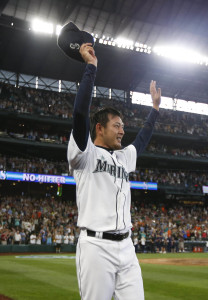
Iwakuma had been trying to return from shoulder surgery, but only made it to a pair of rehab appearances. While he was not able to get all the way back to the big league mound, the 37-year-old says he still hopes to pitch in the Nippon Professional Baseball League in the future.
As Iwakuma put it: “Looking at the big picture, it’s been long process of rehab, and finally in this long tunnel, I’m starting to see light. … I wanted to explore how much more I could do back in Japan and see if there any teams are interested in me.”
Though he did not come to the majors until his age-31 season, following a strong decade-long NPB run, Iwakuma certainly made his mark at the game’s highest level. He ended up throwing 883 2/3 innings of 3.42 ERA ball, all of them coming with the Seattle organization.
It’s easy to forget just how effective ‘Kuma was over the years. He never posted gaudy strikeout rates, but rarely gave up free passes and (in his first three seasons, at least) drew groundballs on about half the balls put in play against him.
His best overall season, unquestionably, came in 2013. Iwakuma came up one out shy of accumulating 220 frames and ended the year with a 2.66 ERA and 7.6 K/9 against 1.7 BB/9. He earned his lone All-Star nod in the midst of that campaign, which ended with a third-place finish in the American League Cy Young voting.
Of course, injuries limited Iwakuma more recently. Problems identified on his physical scuttled a three-year, $45MM contract with the Dodgers after the 2015 season. He ended up returning to the M’s on a deal that included a $12MM guarantee and rolling vesting/club options. While the first campaign under that agreement worked out well enough, as Iwakuma threw 199 innings with a 4.12 ERA, he only made six starts with the team in the 2017 season. After the option was declined, Iwakuma ended up returning on a minor-league deal — the same contract that is now coming to a conclusion.
As he prepares to return to Japan, it’s interesting to look back on the circumstances surrounding his original decision to cross the Pacific. Iwakuma was actually posted in the fall of 2010, with the Athletics winning the bidding under the system in place at that time. When Oakland failed to work out a deal with Iwakuma, he pitched a final season in Japan before drawing interest again as a free agent.
Unfortunately, though he was effective in that intervening campaign, Iwakuma also was limited that year by shoulder issues. He ended up signing an incentive-laden, one-year deal with the M’s for only a $1.5MM guarantee. The Seattle club wisely doubled down on that initial investment in the ensuing offseason with a two-year, $14MM extension that included a cheap, $7MM option for the 2015 season.
Though he spent a relatively brief portion of his career in the majors, Iwakuma rates as one of the better Japanese starters ever to ply his trade at the game’s highest level. Where does he rate among them? That’s up for debate, certainly, but those interested in weighing the question can check out this list I compiled of ten prominent Japanese hurlers who’ve compile a notable number of MLB starts.
Photo courtesy of USA Today Sports Images.
Lotte Giants Place Felix Doubront On Waivers
The Korea Baseball Organization’s Lotte Giants announced today that they have placed lefty Felix Doubront on waivers, as Dan Kurtz of MyKBO.net notes on Twitter (Naver article in Korean). That will presumably bring an end to his tenure with the club.
The move comes on the heels of a particularly rough series of outings for the veteran southpaw. (Statistics via MyKBOStats.com.) He hasn’t made it out of the fourth inning in any of his past three starts, allowing 14 earned runs in just 9 1/3 innings. That poor stretch has pushed Doubront’s season ERA up to 4.92 through 137 1/3 innings, over which he has compiled 109 strikeouts against 62 walks.
We last saw Doubront stateside last season, when he spent time at Triple-A with the Athletics. But the 30-year-old Venezuelan hasn’t appeared in the big leagues since 2015. All told, he owns a 4.89 ERA with 7.7 K/9 and 3.8 BB/9 in 513 2/3 MLB frames, the vast majority of them coming in a starting role.
MLBTR Poll: Predicting Clayton Kershaw’s Next Contract
The 2018-19 free agent class doesn’t look quite as exciting now as it has promised to at points in the past. Still, it’s a notable assemblage of talent. And at the top of the list of pitchers sits future Hall-of-Famer Clayton Kershaw.
Of course, that statement comes with some caveats. In particular, Kershaw will need to opt out of the remaining two years and $65MM on his deal. While that once seemed a foregone conclusion, Kershaw has not been quite his vintage self this season — or, in truth, in the campaign prior. With the backdrop of ongoing back problems, there are undeniably some cracks in the armor.
If Kershaw’s recent form has betrayed his mortality, though, it has still also illuminated his ongoing excellence and value. After all, in his 312 1/3 innings since the start of the 2017 season, he has compiled a 2.36 ERA with 9.7 K/9 against 1.5 BB/9. Even with the reduction in his velocity and swinging-strike rate on display this year, Kershaw has been among the most effective starters in baseball. And the years of unquestioned dominance that came before still represent an important background factor.
All things considered, there’s not much reason to think that Kershaw can’t beat 2/$65MM in free agency. Whether he reaches the open market could still be in question, to be sure. It’s not hard to imagine a new agreement of some kind with the Los Angeles organization coming together before Kershaw is forced to decide on the opt-out clause (or, if he does exercise it, before qualifying offer decisions are finalized). Then again, he and the team know much more about his medical situation than do the rest of us, so perhaps there’s still some possibility he’ll simply opt into the remainder of the deal.
Regardless of how it comes to pass, Kershaw will presumably end up with a more-or-less market-driven rate of pay, even if a deal comes with the Dodgers before he’s formally a free agent. After all, Kershaw’s reps at Excel Sports Management no doubt have a good idea what they think he’s worth, as does the L.A. front office.
For those of us on the outside looking in, it’s a bit more difficult to gauge. The Dodgers and others will surely be stingy, in particular, with the length of the commitment for a pitcher entering his age-31 season. But the focus here will be on the total cash posted rather than on how many seasons it’ll be spread over. Knowing what we know now, and presuming Kershaw finishes the season at his current trajectory and without any significant new injury issues, which level of total guarantee do you think he’ll sign at?
Guess Clayton Kershaw's Next Contract
-
$90MM to $125MM 27% (2,185)
-
$125MM to $175MM 26% (2,129)
-
$65MM (opt-in) 20% (1,603)
-
$175MM+ 16% (1,298)
-
$65MM to $90MM 11% (847)
Total votes: 8,062
Orioles Promote DJ Stewart
The Orioles have announced that outfield prospect D.J. Stewart is heading onto the active roster. His contract was selected today.
A few corresponding moves were announced as well. Righty Cody Carroll and catcher Andrew Susac were both activated, while outfielder Mark Trumbo and righty Pedro Araujo were bumped to the 60-day DL.
Stewart, a former first-round pick, will make it to the bigs in advance of an offseason Rule 5 decision. Clearly, the O’s expect to carry him on the 40-man roster throughout the offseason.
Now 24 years of age, the FSU product has moved steadily through the Baltimore system. He wasn’t able to follow up on a strong 2017 season at the Double-A level, however, as he struggled a bit in his 490 plate appearances this year at the club’s top affiliate. He hit a dozen home runs, swiped 11 bags, and slashed .235/.329/.387 on the year.
White Sox Activate Nate Jones
The White Sox have activated reliever Nate Jones, per a club announcement. That’ll leave the club’s 40-man roster fully occupied.
Jones hit the DL in mid-June with a pronator muscle strain that ended up sapping much of his season. It’s the latest in a string of maladies in the elbow/forearm region of his right arm. Last year, Jones required season-ending nerve repositioning surgery. Previously, he missed virtually all of the 2014 season and part of the 2015 campaign while recovering from Tommy John surgery.
It’s not a particularly promising run of arm health, but it’s hard to ignore the results that Jones has produced in-between DL stints. In particular, he worked 70 2/3 innings of 2.29 ERA ball, with 10.2 K/9 and 1.9 BB/9, in an excellent 2016 season. Though he has thrown only 36 1/3 MLB frames since, Jones has allowed only ten earned runs in that span. He’s still getting swings and misses while pumping upper-nineties heat, though it’s fair also to note that he has also walked five batters per nine.
In the aggregate, as MLBTR’s Connor Byrne recently explored, there’s good reason to imagine the White Sox expect to pick up Jones’s option. It’ll cost $4.65MM, though there’d otherwise be a $1.25MM buyout to pay. For a reliever of his upside, it’s likely a reasonable risk, especially since the deal includes future option seasons as well.
Importantly, while there has been some belief that Jones might be available to the White Sox at a lower price, MLBTR has learned that will not be the case. His contract contemplated two scenarios at its back end. If Jones needed Tommy John surgery before the end of the 2018 season, then there would be a MLB minimum club option in 2019 followed by $3.75MM and $4.25MM club options. If, on the other hand, TJS did not take place, Jones would be controllable via successive club options of $4.65MM and $5.15MM, with a $6MM mutual option for the 2021 campaign.
Now, any uncertainty about the contract values has been resolved: the latter scenario will govern from this point forward. That means that the cost is somewhat higher and, perhaps more importantly, that there are only two more seasons available for control via club option (with the third being a rarely exercised mutual option).
That certainly makes for a tougher decision and raises the stakes somewhat for Jones’s late-season return. Barring a truly worrisome performance, though, it seems fair to guess that the White Sox are rather likely to roll the dice that Jones will be able to stay on the mound in 2019.
Red Sox Activate Chris Sale
The Red Sox have activated ace lefty Chris Sale, as Evan Drellich of NBC Sports Boston was among those to report on Twitter. He is expected to pitch tonight, but only in a limited capacity, as Jason Mastrodonato of the Boston Herald recently explained.
Sale hit the DL in mid-August after experiencing ongoing shoulder inflammation. With a healthy lead in the division, the focus has long been on ensuring the star southpaw’s postseason availability.
The expectation is that Sale will build back arm strength while pitching at the MLB level. With the end of the minor-league season, it’s the only way to get him game action. Skipper Alex Cora and his staff will be keeping a close eye to ensure Sale doesn’t push too hard, too fast.
It’ll certainly be fascinating to see whether Sale can pick up where he left off and enter the playoffs as a dominant force. He has pitched 146 innings of 1.97 ERA ball this year, with a ridiculous 13.5 K/9 against 2.0 BB/9, so his own standard is a lofty one.
Tigers Select Matt Hall, Designate Johnny Barbato
The Tigers announced today that they have selected the contract of lefty Matt Hall. To create 40-man space, the organization designated right-hander Johnny Barbato.
Hall, 24, was a sixth-round pick in the 2015 draft, meaning he’d have been eligible for the Rule 5 draft this winter had he not gone onto the MLB roster. Instead, he’ll get a taste of the big leagues before perhaps competing for a job in camp.
Certainly, Hall has had an excellent season thus far in the upper minors. He opened the year in a relief capacity despite generally succeeding in the rotation in the lower minors. But Hall has thrown well enough overall that he worked as a starter upon rising to Triple-A. All told, he has recorded 114 1/3 innings of 2.13 ERA ball on the year, with 10.6 K/9 against 3.5 BB/9.
Barbato was also a sixth-round pick and has typically been quite effective in the upper minors. He spent most of the year turning in good numbers at Triple-A, with a 1.45 ERA in 37 1/3 innings. Unfortunately, that has not yet translated to the major-league level thus far.
Though Barbato’s MLB opportunities have been limited over the past three seasons, that’s due largely to the outcomes. In his seven MLB relief appearances this year with Detriot, he coughed up nine earned runs on 11 hits (including three home runs) while allowing five walks and managing only a pair of strikeouts.
Drew Smyly Will Not Return In 2018
The Cubs decided yesterday that lefty Drew Smyly will not make it back onto the MLB roster this season, as Jesse Rogers of ESPN.com was among those to report (Twitter links). Instead, he’ll focus on preparing himself for a full and healthy 2019 campaign.
Smyly, who is now 29 years of age, signed a two-year deal with the Chicago organization last winter after undergoing Tommy John surgery in June of 2017. It includes a $10MM guarantee with $6MM in available incentives for the 2019 campaign.
There had been some hope all along that Smyly could represent a notable late-season addition. Particularly with the problems surrounding many of the team’s other key offseason pitching additions, it’d be nice to have the southpaw available. High-priced righty Yu Darvish is done for the year, while fellow rotation addition Tyler Chatwood has not worked out. In the pen, closer Brandon Morrow is still trying to get back from injury and LOOGY Brian Duensing has endured a miserable campaign.
Surely, with the division race still very much in the air, the Cubs would have given Smyly a look if he was truly prepared. He was able to make a single rehab appearance, but evidently did not respond well enough to make it worthwhile to continue pressing for a 2018 return.
Of course, the contract was signed with full knowledge that there were good odds the first season would be a wash. The Cubs hoped, mostly, that they’d recoup their investment in the 2019 campaign. It’ll be interesting to see to what extent the front office relies upon Smyly in structuring the approaching offseason. At the very least, he’ll be seen as an important part of the depth picture, in the rotation and perhaps also the bullpen, but it’ll be hard to allocate too much faith until he gets on the mound in camp. With no small amount of uncertainty in the rotation mix, the organization figures to face some tough roster questions — beginning with a decision on the team’s option over resurgent veteran Cole Hamels.
KBO Establishes Salary Ceiling On Foreign Players
The Korea Baseball Organization has announced notable new restrictions on spending relating to foreign players, as Yonhap News reports (h/t to Dan Kurtz of MyKBO.net). In particular, the rules establish stringent limitations on what KBO clubs can offer players who are not already on their rosters.
Increasingly in recent years, the KBO has represented an intriguing possibility for players who have struggled to establish themselves in the majors. In addition to earning some added money and getting to play a leading role in a country’s highest-level league, the opportunity has functioned as a platform for a return to the majors in many instances.
For KBO clubs, the process of luring players from other parts of the world offers an important means of boosting their rosters. Transfer fees allow MLB organizations to get a piece of the action as well, in instances where the player at issue is under contractual control on this side of the Pacific.
Now, KBO clubs will be limited to a $1MM total outlay, and a one-season commitment, in adding non-Korean players to a roster. That amount includes all financial commitments to the player and any transfer fee paid. The new rules stipulate that multi-year contracts cannot be promised to players outside an organization.
Importantly, once a foreign player has joined a KBO organization, a multi-year arrangement will be possible. That’s available in an extension scenario or for a player who is re-signing with the particular team that signed them originally. Players looking to join another KBO team via free agency, though, will still face the new restrictions.
Importantly, the KBO already imposes a roster limitation on its member teams. Each club may carry only three foreign players. With ten organizations, that means there are at most thirty spots to go around. (Click here for a list of current players and their statistical performances.) Now, there’ll be some important new restrictions on how spending for those openings occurs. While it’s generally typical for foreign players to sign one-year deals, at least upon going to the KBO in the first instance, the initial salary ceiling and intra-KBO spending restrictions will surely change the landscape.
It seems the justifications here are much like those we’re accustomed to hearing for North American sports. The idea, as the article puts it, is to “curb teams’ spending on imports and to ensure fair competition.” It’ll also mean that the KBO isn’t as readily able to attract and retain its top targets, though teams that find players they like will be in a position to double down on their initial commitments through larger or lengthier ensuing contracts.
Extension Candidate: Anthony Rendon
The Nationals will watch their best-known, homegrown position player hit the open market this season. But the team still has another season of control over another top draft choice who made good on his promise, potentially creating an opening for long-term talks.
Sure, Bryce Harper is the bigger star and the more visible talent. But since Anthony Rendon turned into a regular in 2014, he has out-WAR’ed Harper. That’s particularly true over the past three seasons, as Rendon has churned out quality campaigns while Harper’s 2015 MVP effort has faded into memory.
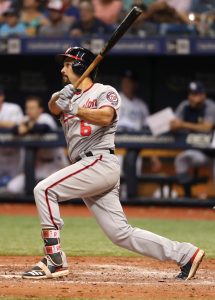
The shadow hanging over Rendon seems to suit his personality. But it has seriously obscured his productivity. Since the start of ’14, he’s among the ten biggest position-player WAR producers in the game, yet he somehow hasn’t yet been named to an All-Star team. True, Rendon has twice finished among the top-ten in the MVP vote, but his profile remains much lower than the quality of his play would support — not even close to that of his long-time teammate.
It’s somewhat surprising that the careers of Harper and Rendon have never been seen as being intertwined in any meaningful way, despite the fact that they were chosen with lofty picks in successive drafts and reached the majors on a similar timetable. There are many reasons for that fact, but it’s all the more interesting to ponder given that there could be a very tangible way in which their outlook is connected. Specifically, if the Nats decide to let Harper walk, or are unable to coax him back, they’ll have vastly more future payroll capacity to work with in pursuing a new deal with Rendon.
To be sure, the Nats have more immediate needs than a new deal with Rendon, who’ll command a healthy raise on his $12.3MM salary through arbitration. But that’s all the more true in the case of Harper, who can be replaced from within by rising young talents Juan Soto and Victor Robles. In the case of Rendon, there’s no obvious heir at third base once he reaches free agency next fall. True, Carter Kieboom and Luis Garcia loom as promising young players in the infield, but neither is quite as advanced or as promising as are the outfielders.
Plus, there’s likely more value to be achieved with a Rendon deal than one involving Harper, if for no other reason than that the latter will be on the open market at a rarely-seen point of his career. Convincing Rendon to stay would cost, to be sure, and he’s also a client of Scott Boras (as are many other current and former Nats, including the recently extended Stephen Strasburg). But it is at least possible that the low-key player would be more inclined to take a slight discount to stave off some risk and maintain stability. He won’t be selling as much of his youth; though he only just turned 28, Rendon won’t reach the market at an unusually young age. And he’d also be weighing terms with another year to go before free agency, creating a lever for at least something of a discount.
Risk, to be sure, would weigh in the equation for both sides if talks take place. Beyond the usual, injuries have been a particular concern for Rendon. A variety of lower-leg ailments, involving his ankles especially, have limited him over the years — both before and during his professional career. While he turned in mostly full 2016 and 2017 seasons, Rendon ended up missing a reasonably lengthy stretch this year after suffering a hairline toe fracture on a hit-by-pitch.
That consideration might weigh down the price, but surely wouldn’t get in the way of a deal entirely. As noted above, after all, Rendon has been supremely valuable despite his medical rap sheet.
It’s also true that Rendon isn’t hitting quite as much as he did in his outstanding 2017 season, when he walked more than he struck out and produced a career-high .232 isolated power mark. But that’s not to say that he isn’t doing quite a lot with the bat. Through 511 plate appearances in 2018, Rendon carries a .298/.358/.508 slash with 19 long balls.
This, interestingly, is the most aggressive version of Rendon we’ve seen. His strikeout-to-walk numbers (14.3% vs. 8.6%) have returned to something like his career norms after the uber-patient 2017 showing. He’s swinging (48.1%) and chasing out of the zone (29.9%) more than ever, though his contact rate remains in range of his career mean.
That’s not necessarily a problem, particularly since we know he has the pitch recognition in his pocket if needed. Rendon is also making more hard contact than ever before (38.1%) this season, so much so that Statcast thinks he has been quite unlucky (.403 xwOBA vs. .366 wOBA).
It’s worth bearing in mind, of course, that Rendon is also a high-quality all-around player. He’s not stealing as often this year as in the past but grades as a well-above-average overall baserunner. With the glove, it’s worth noting a sudden downturn in DRS (from +7 to -6). But he’s still a solidly above-average performer in the view of UZR and has long drawn sterling grades from those metrics and scouts.
So, what kind of a price tag might the Nats be looking at?
In truth, we haven’t seen the veteran third base market tested through extensions for quite some time. David Wright (eight years, $138MM) and Ryan Zimmerman (eight years, $126MM) signed those contracts before Rendon was even in the big leagues. Now, they feel a bit longer and a bit lighter on annual salary than we’re likely to see in the present market. The more recent action has been on players with much greater team control remaining, largely rendering them useless for our purposes.
Neither has the free-agent market seen many premium third baggers of late. Mike Moustakas fell flat on the open market with worries over his OBP and glovework. Pablo Sandoval got five years and $95MM, representing one of the closest comps for Rendon, though the Nats’ star is surely in a higher tier altogether. Before that, Adrian Beltre‘s five-year, $80MM deal stands out as a laughable bargain for the club … and also a deal that’s far too stale to have any real relevance.
Perhaps, in approaching a Rendon price tag, we ought to consider two far more recent contracts, even if they truly aren’t on all fours with Rendon’s situation. Charlie Blackmon inked a deal in advance of his walk season that put a $21MM valuation on his free-agent seasons. While he was in an older age bracket, thus obviating the value of looking at his years, Blackmon was arguably a similarly situated player in terms of quality. Of course, there’s also an argument to be made that Rendon isn’t that far shy of the ability level of Jose Altuve, who was two years from the open market when he signed a deal with an AAV of over $30MM for his age-30 through age-34 seasons. Then again, he won’t be coming off of a superlative season capped by a World Series win and MVP award.
For Rendon, who’d stand to reach free agency in advance of his age-30 season without a new deal, it’s certainly arguable that a valuation between those two makes sense. Contract length is another variable that can’t be considered in isolation; likewise, options and opt-outs are a factor. Generally, the trend is toward slightly shorter deals that leave players with chances to cut things off a few years into the deal. In this case, perhaps, Rendon would be looking at adding five or six new seasons on top of his existing 2019 arbitration contract. With an AAV range in the neighborhood of $22MM to $26MM, that puts a rough guess in the range of a $130MM new-money commitment.
It’s certainly possible that’d be a bit too rich for the Nats’ liking, especially given the injury history (the details of which they know better than other teams) and the organization’s other needs. Then again, it may not be enough for Rendon to give up the chance of testing the open market. As always, these matters come down to negotiations between parties with real-world interests that can’t simply be reduced to baseball valuations. From the perspective of the baseball market, however, the above number — with a healthy error bar on either side — seems to be a generally fair target.
Photo courtesy of USA Today Sports Images.