
Market Notes: Orioles, Lynn, Dickey, Braves
The Orioles have recently begun talks with free agent righty Lance Lynn, according to Ken Rosenthal of The Athletic (subscription link), though the report also suggests that there’s no particular momentum toward an agreement. It’s still anyone’s guess how the Baltimore rotation will be filled out. Despite entering the winter with three open starting jobs, the O’s only 40-man rotation addition to this point is Michael Kelly, a minor-league free agent who has yet to appear in the majors. With Lynn’s own market still largely undeveloped, it’s not surprising to hear of this link, though the question remains whether the Orioles will really open the pocketbook for a starter.
- Of course, other organizations are arguably in a similar position with regard to Lynn. Even taking a pessimistic view of his future, he profiles as a quality back-end starter that would upgrade just about every rotation in baseball. Ben Frederickson of the St. Louis Post-Dispatch argued recently that the Cardinals ought to be ready to grab Lynn — at least, if he can be had for a cheaper-than-expected contract. A similar sentiment has been batted around by Mets writers. (See, e.g., this post from John Harper of the New York Daily News and this Twitter exchange between MLB.com’s Anthony DiComo and Jared Diamond of the Wall Street Journal.) No doubt an argument for the pursuit of Lynn could also be constructed for quite a few other teams, which is the sort of reasoning that supports at least some reason to believe that he and other mid-level free agents can still find significant contracts.
- Veteran knuckler R.A. Dickey has not completely ruled out a return to the hill in 2018, Rosenthal also notes. All indications to date have been that Dickey would likely retire. But it seems there’s still at least an outside possibility he’ll pitch at 43 years of age. The Braves declined a club option over Dickey despite the fact that he turned in a productive 2017 season, throwing 190 innings of 4.26 ERA ball.
- David O’Brien of the Atlanta Journal-Constitution breaks down the current Braves thinking at third base. Many have wondered why Atlanta did not beat the offer made by the division-rival Mets for third baseman Todd Frazier, but O’Brien notes that the team would likely have had to dangle quite a bit more money to lure Frazier from his home town to play for an organization with a less experienced roster. Of even greater interest, O’Brien says the Braves front office likely doesn’t have much free cash to work with, making a pursuit of Mike Moustakas unlikely as well. The team’s contract swap with the Dodgers moved payroll forward to the 2018 balance sheet, so the odds are at this point that the club will simply allow its array of young infielders to sink or swim in the majors.
David Phelps Hires Jet Sports Management
Mariners righty David Phelps has hired Jet Sports Management to represent him, according to Jerry Crasnick of ESPN.com (via Twitter).
Phelps was one of several MLB players that was left searching for a new agency after parting ways with Jason Wood and Career Sports Entertainment. Wood was fired by CSE and suspended by the MLBPA following allegations of misconduct against his own clients.
The 31-year-old Phelps has already avoided arbitration, agreeing to a $5.55MM deal with the M’s. But he’ll soon be in need of further negotiating assistance, as he’s slated to reach the open market at season’s end.
Phelps’s future earnings outlook is rather unclear at present. Notably, Phelps made only ten appearances in Seattle following a mid-season swap. His 2017 season ended with elbow surgery, perhaps removing any possibility that Phelps might return to the rotation, though the hope is that Phelps will be ready for a full 2018 campaign.
So long as Phelps can return to health, there’s good reason to think he’ll be one of the most sought-after set-up men on the market next winter. Since the start of the 2016 season, after all, he has thrown 142 1/3 innings of 2.72 ERA ball with 11.1 K/9 and 4.0 BB/9. It certainly doesn’t hurt that Phelps has a background as a starter, making him a potential multi-inning weapon.
As always, you can keep tabs on the latest agency movement with MLBTR’s Agency Database.
Pirates To Sign Daniel Nava
The Pirates have reached agreement with free agent outfielder/first baseman Daniel Nava, according to Ken Rosenthal of The Athletic (via Twitter). It’s a minors pact that includes a MLB camp invite.
Nava, who’ll turn 35 in a few weeks, had a nice bounceback campaign last year with the cross-state Phillies. He was limited to eighty games of action owing to injuries, which also perhaps prevented him from being dealt to a contender in the middle of the season, but turned in an undeniably productive overall effort.
Over 214 total plate appearances, Nava slashed a robust .301/.393/.421. Though he managed only four home runs, he exhibited a command of the strike zone (just 38 strikeouts with 26 walks) of the type that led to his prior MLB success.
Of course, teams were no doubt also wary given that Nava had struggled over the prior several campaigns. While he grades as a solid defender in the corner outfield, he isn’t exactly a prime asset with the glove. And Nava is pretty clearly a strict platoon asset: the switch-hitter has long been far more successful against right-handed than left-handed pitching.
For the Bucs, those limitations are just fine. As middling as his production has been against southpaws, Nava dominated (.341/.423/.474) when hitting with the platoon advantage last year. He ought to have a fair shot at earning a MLB roster spot in camp. Odds are — as the Pirates’ updated depth chart suggests — he’ll end up in a time share in the corner outfield.
Tony Clark Accuses MLB Teams Of “Race To The Bottom”
MLBPA chief Tony Clark has issued a statement, first provided by ESPN.com’s Jerry Crasnick, leveling significant accusations at MLB organizations. With a huge number of free agents still un-signed, Clark says that teams have failed to engage the market in earnest.
Here is the full statement:
“Pitchers and catchers will report to camps in Florida and Arizona next week. A record number of talented free agents remain unemployed in an industry where revenues and franchise values are at record highs.
Spring Training has always been associated with hope for a new season. This year a significant number of teams are engaged in a race to the bottom. This conduct is a fundamental breach of the trust between a team and its fans and threatens the very integrity of our game.”
Notably, Clark does not accuse teams of acting in concert to artificially suppress earnings — quite a different, more serious potential charge for which we’ve seen no evidence. Rather, his view seems to coincide with the broad points already presented by some prominent media members and agents (as well as at least one sitting GM): i.e., that more teams than usual are strategically disinterested in trying to win in the coming season.
Unsurprisingly, Major League Baseball has a different view of the matter that reflect prior comments from commission Rob Manfred. In a statement released to Crasnick, the league rejects Clark’s characterization as an “unfair” attack on MLB teams. Arguing that many top free agents are “sitting unsigned even though they have substantial offers,” the league statement suggests that agents have failed to “value their clients” reasonably “in a constantly changing free agent market based on factors such as positional demand, advanced analytics, and the impact of the new Basic Agreement.”
Clark’s statement seems to represent a notable ramp up in the rhetoric surrounding the notably slow free agent process this winter. At the moment, though, it seems that this is mostly a war of words for public relations positioning. Camps will soon open without several prominent players, barring some quick developments in the market, which will dramatically raise the visibility of this long-simmering dispute.
The union/agent stance seems to be a familiar one, arguing that tanking tactics are reducing competition for top free agents. From the league/team side, as the above statement suggests, the rejoinder is that clubs are within their rights to operate as they see fit within the rules regime agreed upon by collective bargaining. It isn’t too difficult to see how each side hopes to draw upon the natural but competing inclinations of fans both to chide “cheap” owners and to turn a skeptical eye toward “selfish” players.
In truth, this debate isn’t a new one. Tanking has been discussed for years. Manfred’s prior argument was, in essence, that the market adequately allows for such a strategy; it’s just not that successful an approach if too many teams employ it, since inevitably plenty of clubs will “lose” the “race to the bottom” and fail to recoup top draft picks, etc. Dave Cameron has argued, though, that this year may be somewhat unique in that, for many teams, the incentives to pursue draft status and cost savings may be sufficient to outweigh an expensive, low-odds effort to chase down the half-dozen “super teams” currently pacing the game.
As Evan Drellich rightly observes on Twitter, the concept of tanking does not really adequately cover the deeper mechanisms at play. There’s more at play here, somewhere in the intermingling of pervasive and deepening analytics; aging curves in a (mostly) post-PED era; and drastically cabined amateur spending and other collectively bargained rules. The most recent collective bargaining agreement largely continued the preexisting rules regime, with a few tweaks, largely reflecting an assumption that market mechanisms would allow player compensation to keep pace with earnings growth. Even as they swim in revenue, though, MLB organizations increasingly seem to be pursuing strategies that eschew major long-term free agent entanglements — potentially challenging the assumptions undergirding the players’ commitment to the existing CBA framework.
Orioles Avoid Arbitration With Jonathan Schoop
The Orioles have struck a deal to avoid an arbitration hearing with second baseman Jonathan Schoop, according to Ken Rosenthal of The Athletic (via Twitter). Schoop will take home $8.5MM, per the report.
Recent indications were that there was some friction developing between the O’s and the star infielder. It would seem, though, that any budding problems — which might’ve been exacerbated by a hearing — have been forestalled with today’s agreement.
Schoop had filed at $9MM, with the team countering at $7.5MM. The 2018 MLB arbitration projections of MLBTR and Matt Swartz had pegged Schoop for a $9.1MM salary, so he’ll come in just under that mark.
With this deal now out of the way, Baltimore has just one remaining case. Righty Kevin Gausman is scheduled for a trial on February 14, per Roch Kubatko of MASNsports.com (via Twitter).
So far as Schoop is concerned, attention will no doubt turn to the possibility of broader contract discussions. The 26-year-old has locked in some significant earnings already, with one more arb-eligible campaign to go after 2019, so he has a fair bit of leverage. But the O’s could still take a run at an extension on the heels of a 2017 season in which Schoop checked in with 4.1 fWAR/5.1 rWAR.
MLBTR Poll: Predicting A Contract For Mike Moustakas
The market has just not lined up well to this point for former Royals third baseman Mike Moustakas. While we guessed he’d be able to command a five-year commitment and ranked him the sixth-best free agent available in our 2017-18 Top 50 Free Agents list, that level of contract is increasingly difficult to imagine.
In that ranking, MLBTR’s Tim Dierkes listed the Angels, Braves, and Cardinals as conceivable landing spots. In a full breakdown, MLBTR’s Mark Polishuk noted that a variety of other organizations could conceivably get involved on the still-youthful Moustakas. The Giants and Mets were clear possibilities on paper, with some scenarios imaginable in which teams like the Phillies, Red Sox, Indians, Orioles, or Twins might enter the picture. And, of course, the incumbent Royals were expected to remain in the frame to some extent.
As things have shaken out, several of the plausible pursuers have elected to go in different directions. The Angels (Zack Cozart), Giants (Evan Longoria), and Mets (Todd Frazier) now seem clearly out on Moustakas after adding third basemen. Any outside chance that the Phillies would get involved may have disappeared when the team signed Carlos Santana to play first base. There’s no indication that the Red Sox are looking in this direction, the Indians don’t seem to have funds available, and the Orioles and Twins remain only speculative possibilities at this stage. The Royals don’t seem to expect a reunion. While the Cardinals are still a conceivable fit, indications are the organization doesn’t like the match. Though the Braves likewise still theoretically work, David O’Brien of the Atlanta Journal-Constitution suggested on Twitter today that he doesn’t expect the organization to offer up significant money. Developments have left the Yankees seeking a third baseman, but they are walking a luxury tax tightrope.
Quite apart from the broader market slow-down, then, there are arrows pointing toward trouble for agent Scott Boras in finding a major deal for Moustakas. That’s not to say it isn’t possible — it’s worth bearing in mind there was plenty of hand-wringing over Lorenzo Cain before he recently secured a significant contract, and Moustakas is hardly alone among still-unsigned premium free agents — but the picture does seem decidedly different than it did entering the winter.
All said, it seems an opportune moment to see what the MLBTR readership anticipates. Can Boras still pull off a big contract? Will “Moose” have to settle for significantly less? Is there a middle ground? Give your opinion here on the sort of contract Moustakas is likeliest to sign (link for app users):
What kind of contract will Mike Moustakas end up signing?
-
Lesser multi-year deal (3 to 4 years, ~$10MM to $12MM AAV) 38% (5,987)
-
Opt-out Pillow Contract (multi-year guarantee with opp. to re-enter market next winter) 29% (4,633)
-
One-year Pillow Contract 29% (4,613)
-
Major multi-year deal (5 to 6 years, ~$15MM+ AAV) 4% (607)
Total votes: 15,840
Padres To Sign Tom Wilhelmsen
The Padres have inked righty Tom Wilhelmsen to a minors deal, according to Ken Rosenthal of The Athletic (via Twitter). He’ll receive an invitation to participate in MLB camp. USA Today’s Bob Nightengale tweets that Wilhelmsen will earn a $900K base salary if he makes the roster.
Once an anchor of the Mariners bullpen, Wilhelmsen hit a rough patch upon moving to the Rangers in 2016. While he rebounded somewhat in the second half of that campaign when he returned to Seattle, the veteran settled for a minor-league deal with the Diamondbacks this time last year.
Wilhelmsen, now 34, earned a job in Spring Training and opened the 2017 season as a part of the D-Backs’ relief corps. Things didn’t go quite as hoped, though, as he struggled to a 4.44 ERA with 5.8 K/9 and 4.1 BB/9 over 26 1/3 innings. While he maintained a mid-nineties heater and induced grounders on about half of the balls put in play against him, Wilhelmsen carried a 6.2% swinging-strike rate that fell well shy of his 10.6% career average.
Ultimately, the Diamondbacks cut ties with Wilhelmsen in the middle of the year. He caught on with the Brewers but was unable to earn his way back to the majors. Now, Wilhelmsen will try to crack the Friars’ pen in camp. It looks like that will represent an uphill battle, as he’ll need to beat out a veteran pitcher such as Jordan Lyles and also hold off some of the organization’s younger options.
Quick Hits: Aardsma, Coke, Market Analysis
Former MLB righty David Aardsma has announced on his podcast that he’s officially calling it quits as a ballplayer and joining the Blue Jays front office as coordinator of player development. The 36-year-old, a former first-round draft pick, last pitched in the majors in 2015 and spent some time at Triple-A in the following season with the Toronto organization. Over nine years with eight MLB organizations, Aardsma ran a 4.27 ERA over 337 frames. He’ll surely be remembered best for a two-year run with the Mariners in which he closed out 69 games and maintained a 2.90 ERA. MLBTR — which once hosted Aardsma on its own podcast — wishes him the very best in his new pursuit.
Here are a few more stray notes from around the game:
- Lefty Phil Coke is hoping to reinvent himself as a knuckle-baller, according to Chris Cotillo of SB Nation (via Twitter). The 35-year-old, a nine-year MLB veteran, spent some time last year with Japan’s Orix Buffaloes but has had a tough time gaining traction in recent seasons. Coke had long utilized a varied arsenal and shown good velocity from the left side, so he ought to have some interesting potential accompanying tools to go with his new knuckler.
- Of course, looking at the state of the market is just not possible without examining the general lack of action. Ken Rosenthal of The Athletic again offers some worthwhile perspective in a subscription piece, chiding both the player and team sides for “bickering” over pace-of-play discussions when what’s needed is a joint commitment to evolving the game — and, no doubt, an effort to deal with the dangerous rise in labor tension. ESPN.com’s Jerry Crasnick, meanwhile, asks whether certain unsigned free agents could actually decide to open their own spring camp. Different players and agents have different takes on the concept; what’s most notable, perhaps, is the fact that it’s even a topic of conversation at all.
- Even if there’s a resolution to the current impasse, it seems there’ll likely be a broader, ongoing conversation about where the game of baseball is headed when it comes to player-team relations. Baseball America’s J.J. Cooper argues that the current rules regime creates skewed incentives that do not reward teams that try to contend but come up a bit short. He discusses a few possible ideas, promoting in particular a “tank tax” that docks organizations in the draft if they put together consecutive sub-70-win campaigns. Cooper suggests this kind of mechanism could function similarly to the soccer approach of relegation. Ultimately, the MLBPA may need to begin considering more drastic measures, Nathaniel Grow writes at Fangraphs. He raises the possibility that the union could strategically disband to open the door to an antitrust lawsuit. While that threat might be utilized first as a means to gain leverage in future CBA talks, Grow explains that it could be a realistic option at some point.
- Those interested in getting the full range of opinions on top prospects from around the game will want to check out the latest top-100 lists. The Baseball Prospectus staff and Fangraphs’ Eric Longenhagen and Kiley McDaniel have graded out the game’s best pre-MLB players from their perspectives.
Brewers Sign Lorenzo Cain
January 29th, 6:10pm: Bob Nightengale of USA Today Sports has the details on some incentives in Cain’s contract (Twitter links). The outfielder will reportedly earn $300K every time he makes the All-Star team. He’ll also earn $500K if he’s ever named league MVP, $250K if he finishes second through fifth in the MVP voting, and $125K if he finishes 6th through 10th. Cain can also make an extra $50K by winning the World Series MVP award, and he’ll pocket $25K any time he wins a Gold Glove, Silver Slugger, or LCS MVP. Jon Heyman of FanRag Sports confirms the incentives, and notes that the Brewers will also reserve a suite for Cain at Miller Park during 20 games each season, while pointing out that the estimated value of Cain’s contract with deferments in mind is actually $78,917,630.
January 26th, 2:48pm: Tom Haudricourt of the Milwaukee Journal-Sentinel reports that Cain will earn $13MM in 2018, $14MM in 2019, $15MM in 2020, $16MM in 2021 and $17MM in 2022 (Twitter links). He’ll also receive an additional, deferred payment of $1MM in each of the five years following the contract’s conclusion. The no-trade provision offers complete protection in year one of the deal and limited protection each season thereafter, dropping down to five teams in the final year of the contract. More specifically, MLB.com’s Adam McCalvy adds that Cain can block deals to 15 teams in 2019, seven teams in 2020 and five in 2021-22.
12:00pm: In a stunning turn, the Brewers even further bolstered their outfield, announcing on Friday that they’ve signed Lorenzo Cain to a five-year pact that will reportedly guarantee him $80MM. The All Bases Covered client will reportedly pick up no-trade rights as well, with full protection early in the contract and more limited no-trade provisions in its later years.
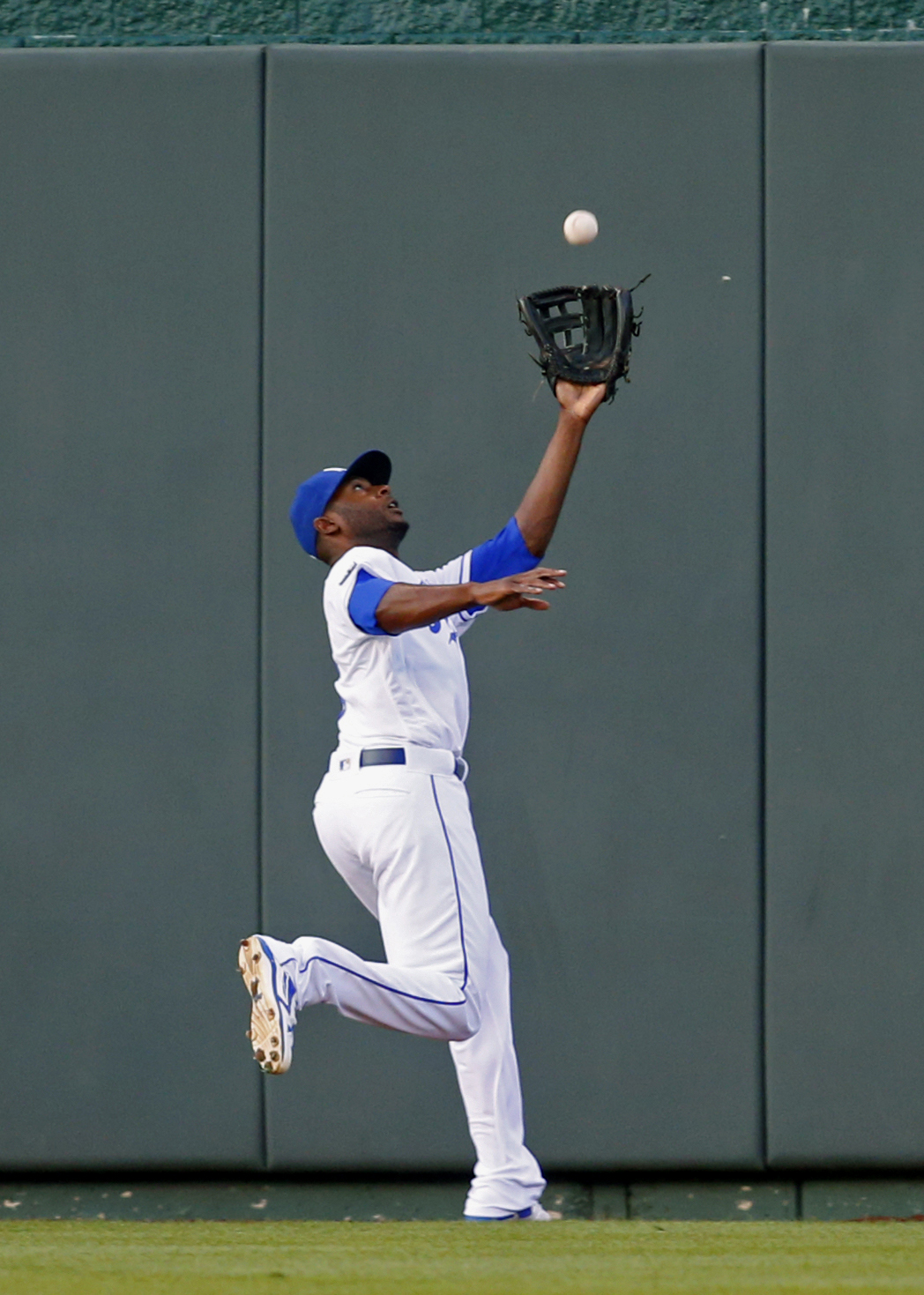
Cain will join Christian Yelich in a stunningly re-made Milwaukee outfield — opening up new avenues for trades of existing players that could shake the market. The signing also breaks open a moribund free agent signing period, with a premium player scoring a big contract for the first time in weeks.
Entering the day, the Brewers featured Ryan Braun and Domingo Santana in the corners, with a trio of young options — Keon Broxton, Lewis Brinson, and Brett Phillips — up the middle. Now, Brinson is out, Cain and Yelich are in, and the remaining players (excepting, perhaps, Braun) appear to be possible trade chips.
[RELATED: Updated Brewers Depth Chart]
Milwaukee had a clear need to improve its rotation when the winter started, particularly given uncertainty surrounding righty Jimmy Nelson. The organization has decided first to improve the outfield, though that could all be part of a plan to move other assets for starting pitching. Santana and Phillips could both be hotly pursued assets, with a variety of teams — the Athletics, Braves, and Rays all make some degree of sense on paper — potentially representing suitors with some pitching on offer.
As much as the signing could mean for the trade market, it’s a welcome sign for players anxiously watching a slow-motion free agent period. In MLBTR’s top 50 free agent ranking, we predicted that Cain would secure $70MM over four years, so this represents a strong contract for the excellent but soon-to-be 32-year-old outfielder. The contract is the first this winter that guarantees more than three seasons and more than $60MM. Cain becomes only the second of MLBTR’s ten top-rated free agents who has signed to this point.
It’s equally intriguing to consider the teams that missed out on Cain. Crasnick again has the details, tweeting that the Dodgers, Cubs, Giants, and Indians were involved in the market. While San Francisco was long known to have interest, tempered by its luxury tax considerations, the other clubs are all rather eye-opening pursuers in various regards. Los Angeles has been tough to decipher all winter long as it watches its own payroll. The Cubs have a fairly well-stocked outfield mix but seem to have irons in a variety of fires. And the Indians have signaled they don’t have much more to spend, but were evidently still willing to consider a major win-now move (presumably with other salary-shedding efforts to accompany it).
It seems hard to recall after his years in Kansas City, but Cain was once a Brewer. Indeed, he joined the Milwaukee organization as a 17th-round pick way back in 2004. As Tom Haudricourt of the Milwaukee Journal-Sentinel notes on Twitter, both Cain and Jeremy Jeffress have returned to the Brewers after being dealt to the Royals in the 2010 Zack Greinke swap.
In the interim, Cain has emerged as a star. He reached his career pinnacle in 2015, turning in elite efforts at the plate, on the bases, and in the field to rack up 6.5 fWAR. After a step back in the ensuing season, which was marred in part by injury, Cain emerged again in 2017.
While initial reports connecting Cain to Milwaukee this offseason came as somewhat of a surprise, it appears he’s been on their radar since the onset of free agency. “They said from the minute free agency opened that I was on the top of their list,” Cain said in a chat with MLB.com’s Jeffrey Flanagan.. “We just had to work through all the details, and eventually we both got to the numbers we liked.”
Even if Cain’s superstar-level ’15 output isn’t likely to be repeated, the Brewers will hope he can keep up his most recent efforts. Last year, Cain dropped his strikeout rate to a career-low 15.5%, walked at a career-best 8.4%, compiled 15 home runs and 26 steals, and ended with an even .300 batting average. While metrics now grade him more as a good than a great fielder in center, Cain remains a high-quality all-around performer.
Since Cain rejected a qualifying offer from the Royals, draft compensation will result from the signing. As an organization that received revenue sharing and did not go past the competitive balance tax line in 2017, Milwaukee will have to sacrifice its third-highest draft pick. Notably, MLBTR has confirmed that Competitive Balance draft picks are exempt from this type of forfeiture, however, meaning the Brewers will only have to surrender their third-round selection. For the Royals, bidding adieu to Cain — since he signed for more than $50MM — will mean recouping a pick after the end of the first round of the 2018 draft.
Ken Rosenthal of The Athletic first reported the agreement (via Twitter). ESPN.com’s Jerry Crasnick reported the terms of the deal (Twitter links).
Photo courtesy of USA Today Sports Images.
Mets Re-Sign Jose Reyes
9:11pm: Bob Nightengale of USA Today Sports has the scoop on the incentives in Reyes’ contract. The veteran will earn an additional $250K after reaching 500 plate appearances during the 2018 season, and an additional $250K for hitting the 550 PA mark.
Jan. 26, 4:07pm: The Mets have announced the signing.
Jan. 25: The Mets have agreed to re-sign infielder Jose Reyes, according to Ken Rosenthal of The Athletic (via Twitter). It’s a one-year, $2MM deal that also includes up to $500K in achievable incentives, Jon Heyman of Fan Rag tweets.
While this move may not bring quite the impact Mets fans have been hoping for from an infield signing, it seems the plan is not to utilize Reyes as a regular. Instead, per Rosenthal, the club still hopes to find an everyday choice to line up at second base.
Presumably, then, Reyes will join Wilmer Flores as a roving infield asset. Both players could see time at second and third, while the former may also see action against lefties at first base.
Reyes, a 34-year-old switch-hitter who starred for the Mets earlier in his career, obviously has a strong relationship with the New York organization. After all, the team agreed to bring him back in 2016 after Reyes served a lengthy suspension for an awful domestic abuse incident. He’ll now open his third-straight season (and twelfth overall) with the Mets.
Last year, Reyes ended up seeing quite a lot of action as the Mets dealt with injuries and ultimately traded away several veterans. In 561 plate appearances, he slashed .246/.315/.413 (good for a 94 wRC+) with 15 home runs and 24 steals. It is worth noting, too, that he performed much better in the second half after a rough opening to the season. (Of course, that may mostly be explained by the shifting winds of fortune; Reyes carried a .222 BABIP through 323 plate appearances and .323 thereafter.)
Interestingly, defensive metrics split widely on Reyes’s effort last year, as he split time between short, third, and second. DRS viewed him as markedly subpar infielder, while UZR graded him as a more or less average performer. Accepting the marks of the Defensive Runs Saved system, Reyes was a roughly replacement-level player. Working from Ultimate Zone Rating, on the other hand, and mixing in highly-rated baserunning, led Fangraphs to credit Reyes with 2.0 fWAR in 2017.