
Bryan Sammons Signs With NPB’s Chiba Lotte Marines
Former Tigers left-hander Bryan Sammons has signed a one-year deal with Nippon Professional Baseball’s Chiba Lotte Marines, per announcements from the team and from Sammons’ agency, GSI.
Sammons made his big league debut as a 29-year-old rookie this past season, pitching 27 1/3 innings of 3.62 ERA ball for the Tigers during their Cinderella push to the playoffs. The 6’4″ southpaw averaged 91.5 mph on his heater, fanned 17.3% of his opponents and logged a 8.7% walk rate. Sammons spent the bulk of his 2024 season in Triple-A Toledo, where he pitched 102 innings with a 4.15 ERA, 23.1% strikeout rate and 10% walk rate. Detroit outrighted Sammons off the 40-man roster after the season, and he became a minor league free agent.
The move to Japan is the latest step in the type of baseball odyssey for which all fans love to cheer. The Athletic’s Cody Stavenhagen penned a fantastic look at Sammons’ journey from under-recruited high schooler to an eighth-round pick of the Twins who wound up being released both by Minnesota and by Houston. (Readers are highly encouraged to check out Stavenhagen’s piece in full.) Sammons, who graduated from Western Carolina with an engineering degree, contemplated giving up baseball entirely to pursue a more traditional career before taking one last shot and pitching in the Atlantic League. Just over a year later, he was on the mound at Comerica Park.
While Sammons is joining the same team for which Roki Sasaki has starred in his NPB career, he’s effectively taking the place of veteran lefty Dallas Keuchel, who started eight games for the Marines in the second half of the 2024 NPB season. The Marines announced in early December that Keuchel had been released and was a free agent. Sammons’ role will be determined, but manager Masahito Yoshii said his hope is that Sammons can pitch out of the rotation in 2025 (link via Yahoo Japan).
Nationals Sign Konnor Pilkington To Minor League Deal
The Nationals have signed lefty Konnor Pilkington and right-hander Clay Helvey to minor league deals, per a team announcement. Both will be in major league camp as non-roster invitees this spring.
Pilkington, 27, has pitched in parts of two seasons with the Guardians (2022-23) and carries a career 3.75 ERA in 60 innings. Fielding-independent metrics are more bearish thanks to worse-than-average rate stats, including a 19.5% strikeout rate, 12.4% walk rate and 39.9% ground-ball rate in that time. He sits just over 92 mph, on average, with his heater and complements the pitch with a low-80s slider and mid-80s changeup.
Though he’s worked both as a starter and reliever in his professional career, Pilkington has seen the bulk of his work come out of the rotation. He’s had a very rough go of it in Triple-A, thanks in part to a pair of seasons with the D-backs’ system and their extraordinarily hitter-friendly environment in Reno, though environment alone can’t explain away the southpaw’s 6.80 ERA in 209 frames at that level. He’ll get a chance to compete for a spot on the Nats’ staff, be it in the bullpen or rotation, and will otherwise head to Rochester to serve as depth.
Helvey, 28 in February, was a 22nd-round pick by the Giants in 2018. He’s spent his entire career in San Francisco’s system, most recently pitching 71 1/3 innings of relief with Triple-A Sacramento in 2024. He posted a 5.17 ERA in that span but also punched out a gaudy 30.5% of his opponents — albeit against an unsightly 11.1% walk rate. Missing bats has never been an issue for Helvey, who’s punched out 28% of his opponents in his pro career. Command has been a persistent struggle, however, evidenced by his lifetime 12.9% walk rate.
Agent Joel Wolfe On Roki Sasaki’s Free Agency
Agent Joel Wolfe of Wasserman held court with the media at this week’s Winter Meetings in Dallas to discuss a variety of topics, headlined by an overview of the plan for newly posted right-hander Roki Sasaki. MLBTR was on hand as Wolfe discussed Sasaki, the 23-year-old ace of Japan’s Chiba Lotte Marines, who is now eligible to negotiate with all major league teams.

Because of his age, Sasaki is subject to Major League Baseball’s international amateur guidelines; more specifically, that means he can only sign a minor league deal and receive a bonus that fits within his team’s league-allotted, hard-capped bonus pool. Had Sasaki waited two years to come to the majors, he’d have been 25 and thus qualified as an amateur, possibly setting him up for a contract rivaling that of countryman and current Dodgers righty Yoshinobu Yamamoto (12 years, $325MM).
Asked why Sasaki chose to seek a posting now rather than come to the majors as a true free agent in two years — potentially leaving hundreds of millions of dollars on the table — Wolfe indicated he’d been asked that question “by everyone you can imagine” and attempted to answer to the best of his ability.
“It’s a difficult question to answer. Some of it is Japanese culture. Some of it is just Roki Sasaki. There are no absolutes in baseball and, through Roki’s eyes, there are no absolutes in life. … He does not take anything for granted. It is not an absolute lock, as some people in baseball have assumed, that two years from now he’s going to get a Yamamoto contract. Sometimes, baseball just doesn’t work out. You know, you look at the epidemic of injuries that pitchers suffer. You could have Tommy John surgery. He’s had two shoulder injuries. He’s had an oblique injury. Things may not go the way you want.
“The other thing is, it’s always been his dream to come to the major leagues, since he was in school. He’s grown up idolizing players like Yu Darvish, Masahiro Tanaka, Daisuke Matsuzaka. This is something he’s always wanted to do, and when he went to [the World Baseball Classic] and was around some of these major league players, it really rubbed off on him. He became sure that ‘this is what I want to do as soon as possible.'”
With regard to what sort of factors Sasaki will prioritize in his free agency, Wolfe was more vague. He indicated that he and his client have yet to even discuss such factors at length, as Sasaki’s primary focus for so long has been on whether he’ll be posted at all. Wolfe noted that some teams have already submitted presentations for Sasaki but that in-person meetings have yet to begin. Wolfe himself said he’s seen “three or four” of the presentations that have been submitted but added that he expects more to file in. Asked how many teams scouted Sasaki this past season in Japan, Wolfe replied that at least half the league had done so.
Wolfe naturally declined to specify which teams had submitted initial presentations or scouted his client in person. The immediate focus for Sasaki will simply be learning about the teams, organizations and cities among which he’ll choose. He’s slated to arrive in the United States this week, and after reviewing the introductory presentations from interested teams, Sasaki and Wolfe will host teams for a first-round of in-person visits at a central location, beginning next week. Additional waves of team visits — perhaps some in the cities of the finalists — will take place down the road, but Sasaki also plans to return to Japan for a week or two during the upcoming holidays.
Asked specifically whether Sasaki might consider a small market, Wolfe said he it could possibly be of interest but emphasized that he had not confirmed as much with his client:
“Yeah, absolutely. I mean, I think there’s an argument to be made that a small- or mid-market team might be more beneficial for him, as a soft landing, coming from Japan and what he’s been through and not having an enjoyable experience with the media — it might be. I’m not saying it will be, but I don’t know how he’s going to do it. It might be beneficial for him to be in a smaller market, but I really don’t know how he looks at it yet because I haven’t had a chance and discuss it with him [at great length].”
Wolfe spoke at multiple points, once doing so unprompted, about the media coverage of Sasaki in Japan, labeling it “in my personal opinion, a bit unfair” and candidly acknowledging that at times it could have a negative impact on the young right-hander:
“There has been a lot of negativity in the media directed at him because he has expressed interest in going to play for MLB at such a young age. That’s considered in Japan to be very disrespectful and sort of swimming upstream. There’s been a lot of things. A lot of people jumped on board, creating false rumors about him and his family, and it was detrimental to his mental state.”
Wolfe also emphasized that wherever Sasaki lands, it won’t be a pure short-term financial decision:
“Given that the gap in bonus pool amounts is so negligible, my advice to him is: don’t make decisions based on that. The long-term arc of your career is where you’re going to earn your money, so it’s probably not advisable to make a short-term decision in that regard. Take all the factors into consideration.”
Sasaki was officially posted for major league teams on Dec. 9, kicking off a 45-day negotiating period for big league clubs. He’ll have to have a contract finalized by Jan. 23. Wolfe noted that the signing is expected to occur after Jan. 15, so it can fall under the purview of the 2025 international free agent period, which begins that day. While Sasaki’s decision won’t be a purely financial one, Wolfe specified that MLB wanted to ensure as much of a “level playing field” as possible and ensure that both Sasaki and his former team would get the most beneficial deal possible, which is the posting was formalized on Dec. 9, giving him the chance to extend his free agency into next year’s period — when all 30 MLB teams will have more international resources available.
It’ll be a tough pill for the Marines to swallow, regardless. Under the NPB/MLB posting system, NPB players’ former teams receive a release fee equal to 20% of the contract’s first $25MM, 17.5% of the next $25MM and 15% of any money thereafter. In Yamamoto’s case, for instance, his former club received a mammoth $54.375MM release fee from the Dodgers for agreeing to let Yamamoto go. Since Sasaki will be signing for a hard-capped bonus that’ll likely come in south of $10MM, the Marines will probably receive a release fee under $2MM.
Sasaki has pitched in parts of four NPB seasons and tallied 414 2/3 innings of 2.02 ERA ball with a 32.4% strikeout rate and 5.6% walk rate. Any team that signs him will have control of him for at least six seasons. He cannot sign an immediate extension following his minor league deal, pursuant to attachment 46 of the 2022-26 collective bargaining agreement, which indicates that any contracts deemed to be a circumvention of the CBA will not be permitted by the commissioner’s office. Wolfe noted that MLB teams cannot technically even promise Sasaki a spot on the big league roster when signing him, let alone broker an extension ahead of time at a to-be-determined date.
It’s possible, in theory, that Sasaki could sign an extension later in his young MLB career — likely more than a year or two down the road — but Wolfe pushed back on the notion that they’d even be amenable to that. “If he’s really, really good, the leverage would be on our side, so there wouldn’t be much incentive for us to sign a long-term extension.”
Rangers Seeking Left-Handed Bat, Multiple Relievers
The Rangers had an active week at the 2024 Winter Meetings, retaining righty Nathan Eovaldi on a three-year deal, signing reliever Jacob Webb and acquiring slugger Jake Burger from the Marlins. Next up on their to-do list, per Evan Grant of the Dallas Morning News, is to add a left-handed bat and multiple arms to the relief corps. Grant specifically lists Joc Pederson as an option for Texas to consider, though it’s not clear whether the two sides have had any negotiations of note to this point.
The 32-year-old Pederson (33 in April) turned in perhaps the best season of his career with the Diamondbacks in 2024. The lefty-swinging slugger hit .275/.393/.515 with 23 homers, 17 doubles, a triple and seven steals (in 11 tries) through 449 plate appearances.
Pederson fanned in 23.4% of his plate appearances — his highest mark since 2021 — but also walked at a stout 12.2% clip. As just about every club has done, the D-backs platooned him heavily. Pederson has a lengthy track record of struggling versus fellow southpaws and did so again in a tiny sample of 42 plate appearances last year. In 407 trips to the plate against right-handers, however, he mashed at a .281/.392/.531 clip — about 54% better than league average, by measure of wRC+.
Because Pederson already received a qualifying offer once in his career — he accepted a QO from the Giants following the 2022 season — he was ineligible to receive one from Arizona this winter. He won’t cost the Rangers or any other team a draft pick or future international bonus pool space. Pederson, however, can rightly seek a raise on last year’s $12.5MM salary and perhaps do so while pursuing the multi-year deal that has eluded him in what’s now been four separate trips through free agency.
Whether the Rangers have the funds to make that happens isn’t clear, but their recent spending certainly indicates there could be a path to both paying Pederson and securing the multiple relievers they’re hoping to acquire (also per Grant). RosterResource projects the Rangers at a roughly $203MM payroll with just under $220MM worth of luxury obligations. Dipping under the CBT threshold is a reported goal of the Rangers this offseason.
Be that as it may, Joel Sherman of the New York Post reported earlier in the week that Texas offered Max Fried a seven-year deal worth roughly $190MM. That $27.1MM AAV would be even higher than the $25MM AAV on Eovaldi’s $75MM deal. Between the larger-than-expected deal for Eovaldi and a spirited pursuit of Fried, it seems the Rangers were comfortable pursuing at least one big-ticket item. Pederson will surely command an eight-figure AAV of his own, but Texas could deal from its rotation depth (e.g. Tyler Mahle, Jon Gray, Dane Dunning) to drop payroll a bit.
There’s been some speculation about a possible trade of Nathaniel Lowe in the wake of the Burger acquisition — both at MLBTR and via other outlets — but moving Lowe would only subtract a left-handed bat from a team on the lookout for just such hitters. Perhaps they could trade Lowe, use some of his projected $10.7MM salary to help round out the relief corps, and look for a more affordable lefty bat in free agency or via the trade market. Looking to the trade market for affordable relief help would also make sense.
Other left-handed bats of note on the market include Max Kepler, Jesse Winker, Alex Verdugo, David Peralta, Gavin Sheets and switch-hitters Josh Bell and Carlos Santana, to name a few. The Rangers would surely like veterans Kirby Yates and David Robertson back, but both will command notable commitments — Yates possibly on a multi-year deal. Texas has also been linked to longtime Braves lefty A.J. Minter and will likely cast a wide net in searching for bullpen help, as their relatively quiet signing of Webb indicates.
Rays Sign Danny Jansen
The Rays have upgraded behind the plate. Tampa Bay announced they have signed free agent catcher Danny Jansen on a one-year deal with a mutual option for 2026. The contract reportedly guarantees the ISE Baseball client $8.5MM — taking the form of an $8MM salary and a $500K buyout on the $12MM option. Jansen reportedly declined multi-year proposals in order to return to the open market next winter.
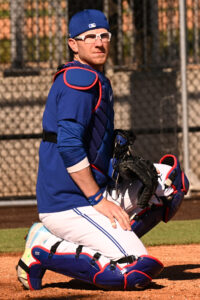
Jansen, 29, is a longtime division foe, having spent his entire career to date with the Blue Jays and, briefly this summer, the Red Sox. He’s a rebound candidate looking to bounce back after a down year at the plate in which he slashed just .206/.308/.348 in 328 plate appearances. It was a rough year and a particularly rough finish for Jansen, but heading into the season he looked primed for a notable deal in free agency. From 2021-23, he slashed a combined .237/.317/.487 (121 wRC+) — including a huge .260/.339/.516 showing in 2022.
Any discussion of Jansen’s downturn at the plate should take note of the fact that he opened the season on the injured list due to a fracture in his wrist he suffered during spring training. Jansen raced out of the gate with a .295/.375/.533 slash through his first 120 plate appearances before falling into a prolonged slump from which he never really recovered. Jansen hit just .150/.270/.237 over his final 204 trips to the plate.
(Anecdotally, Jansen also became the first player in MLB history to play for both teams in the same game, starting for the Jays in a rain-suspended game against the Red Sox that was subsequently finished in the second half — after he’d been traded to Boston.)
Jansen still walked at a stout 12.7% clip in that time and fanned in a slightly lower-than-average 21% of his plate appearances. However, his quality of contact went into the tank (85 mph average exit velocity, 24.2% hard-hit rate). Jansen’s .172 average on balls in play during that span of just over 200 plate appearances was surely indicative of some poor fortune, but the lack of quality contact underscores that it wasn’t mere bad luck on its own.
The Rays will hope a healthier Jansen can help them solve a need behind the plate that has persisted for several seasons. Tampa Bay’s catchers last year were predictably among the least-productive in the league — as one would expect when opening the year with journeyman Alex Jackson and a defensive specialist like Ben Rortvedt as the big league catching tandem. By measure of wRC+, the Rays’ catchers were 33% worse than average at the plate. Only the Marlins and White Sox received less-productive output from the position. Tampa Bay catchers combined for a disastrous .194/.272/.291 slash on the season, though Rortvedt’s knack for drawing walks and strong glovework at least made things slightly more palatable.
Even if Jansen simply matches last year’s lackluster output, it’d be an offensive upgrade for the Rays. If he can recapture a portion of his 2021-23 form, it could be a massive improvement to the lineup. Defensively, he’s probably a step down, though there’s reason to hope for improvement in 2025. Jansen has typically rated as a solid but not elite defender. Statcast gave him plus grades for blocking pitches in the dirt and slightly below-average framing marks last year. Jansen has a career 20% caught-stealing rate but sits just over 13% in the past two seasons. However, he’s fractured the middle finger and the wrist in his throwing hand over those two seasons, either of which could have a subsequent impact on his throwing; Jansen’s average 1.99 second pop time is still right in line with where it sat in 2022 (1.98 seconds).
Jansen’s signing should push the Rays’ payroll into the $86MM range. That number could still change dramatically, however, as the Rays have received trade interest in veterans like Jeffrey Springs ($10.5MM in 2024), Yandy Diaz ($10MM), Pete Fairbanks ($3.666MM) and Zack Littell (projected $4.8MM) — among others. It’s not clear just how willing ownership is to spend in the wake of the hurricane damage that ruined Tropicana Field’s roof and forced the Rays to relocate to Tampa’s Steinbrenner Field (home of the Yankees’ Class-A affiliate). The Jansen deal, however, at least signals a willingness to spend modestly, even if the eventual plan is to balance things out by trading other veterans for young, controllable (and cheaper) talent.
Marc Topkin of the Tampa Bay Times first reported the Rays and Jansen were nearing a deal. Ken Rosenthal and Sahadev Sharma of the Athletic reported that it would be a one-year contract. Robert Murray of FanSided reported the $8.5MM guarantee, as well as Jansen’s decision to decline multi-year offers. Topkin was first with the mutual option and salary breakdown.
White Sox Sign Dan Altavilla To Minor League Deal
The White Sox announced Thursday that they’ve signed right-handed reliever Dan Altavilla to a minor league contract. The MAS+ Agency client will be in spring training as a non-roster invitee.
Altavilla, 32, has pitched in parts of seven big league seasons but frequently dealt with injuries that have limited his amount of time on the mound. Since making his MLB debut with the 2016 Mariners, Altavilla’s laundry list of injuries includes shoulder inflammation, a pair of UCL sprains (the latter resulting in Tommy John surgery), a forearm strain and a notable oblique strain that sent him to the 60-day injured list just this past season.
In his first three seasons from 2016-18, all coming with Seattle, Altavilla pitched a combined 79 2/3 innings with a 3.28 ERA, 25.3% strikeout rate and 10.7% walk rate. He’s managed just 40 big league innings since, working to a combined 6.53 earned run average along the way. It’s not as though Altavilla has been consistently healthy in the minors during that stretch, either; he’s totaled 84 1/3 minor league frames in that time, bringing him to a total 120 1/3 frames in a span of six years.
There’s little doubt that Altavilla is talented when his arm is right. Even with his recent injury-plagued seasons weighing down his career numbers, he carries a 4.36 ERA and 26% strikeout rate in the big leagues. He pitched just 3 2/3 MLB innings with Kansas City this past season but averaged a sizzling 96.8 mph on his heater. In 41 Triple-A innings for K.C., he logged a 3.51 ERA, albeit with a 22.2% strikeout rate and 12.9% walk rate — both pedestrian marks.
The rebuilding White Sox will have plenty of room for non-roster players to compete for bullpen jobs this coming spring. Right now, the only relievers with even a year of experience in the Chicago bullpen are Justin Anderson, Jared Shuster, Steven Wilson and Ron Marinaccio. If Altavilla cracks the roster, he could log some meaningful innings and will be controllable through the 2026 campaign, as he currently has only 4.153 years of MLB service.
Angels Have Checked In On Arenado, Bohm, E. Suarez
The Angels are known to be open to an everyday addition at third base, and Jeff Fletcher of the Orange County Register reports they’ve at least gauged the respective asking prices for Nolan Arenado, Alec Bohm and Eugenio Suarez in talks with the Cardinals, Phillies and Diamondbacks, respectively.
The Halos are reportedly one of the at least six teams to which Arenado would approve a trade, though that’s a somewhat surprising development in and of itself. Both reporting out of St. Louis and, more recently, direct quotes from agent Joel Wolfe have suggested that the eight-time All-Star would prefer to land with a team that has a clear path to contention over the remaining three years of his contract. Said Wolfe earlier this week to a host of reporters at the Winter Meetings: “He wants a team that has the throttle down … that he believes he can jump right in and they’re going to win right now.”
While the Angels are clearly looking to better the club — they’ve added Yusei Kikuchi, Jorge Soler, Travis d’Arnaud, Kevin Newman and Kyle Hendricks this winter — it’s less clear that those moves position them as a contender for the foreseeable future. The Angels’ 63-99 record was the fourth-worst in MLB last season, landing them last place in the American League West. Arenado is an Anaheim-area native, however, having been born in Newport Beach and attended high school in Lake Forest. That proximity to home could understandably hold some sway, especially when coupled with a series of win-now moves from the Angels over the past six weeks or so.
Arenado, 34 in April, is owed $74MM over the next three seasons, but the Rockies are on the hook for $10MM of that under the terms of the deal that sent him from Denver to St. Louis several years ago. His offensive contributions have fallen off over the past two seasons — .269/.320/.426, compared to .293/.358/.553 in third-place MVP season in 2022 — but the six-time Platinum Glove winner remains a premium defender with excellent contact skills. That sets something of a high floor, while the money left on his contract means the asking price for Arenado (prospect-wise) won’t be exorbitant unless the Cardinals pay down a notable portion of the deal.
With Bohm, the asking price has appeared higher, at least in the Phillies’ early asks. They reportedly asked the Mariners about right-handers Logan Gilbert and George Kirby in early talks regarding the longtime Philadelphia third baseman — an outlandish ask even coming off a solid season for Bohm. (That said, it stands to reason the Phillies would aim high early in any trade talks.)
Bohm, 28, hit .280/.332/.448 this past season, but the overwhelming majority of his production came in an outrageous April wherein he slashed .366/.438/.598. From May 1 onward, Bohm hit just .258/.303/.410 — slightly below league-average production. He’s long had negative defensive grades at third base but made strides in 2024 according to both Defensive Runs Saved (0) and Outs Above Average (4). Whether that’s sustainable will be a question interested clubs weigh carefully. Bohm is projected by MLBTR contributor Matt Swartz to earn $8.1MM in 2025 and is controllable through the 2026 season.
It’s not entirely clear that Suarez is available — Arenado and Bohm very much are — but the D-backs are a medium-payroll club with inhouse options to step up in the event that a deal comes together. Top prospect Jordan Lawlar is all but MLB-ready, and young Blaze Alexander could take some reps at the hot corner alongside shortstop Geraldo Perdomo if the Snakes opt to give Lawlar a bit more seasoning in Triple-A.
At one point this season, Suarez even briefly looked to be losing the grip on his starting third base job to Alexander. Suarez caught fire shortly thereafter, however, and not only regained his form but was one of the game’s best hitters in the season’s final three months: .312/.357/.617, 24 home runs in his final 325 plate appearances from July 1 onward. That prompted the D-backs to exercise a $15MM club option. Suarez is a free agent following the season, though, and it’s feasible that the Diamondbacks could move him for some minor league talent, go with Alexander/Lawlar at third base in 2025, and reallocate Suarez’s salary to needs at first base, in the bullpen and on the bench. That’s speculative, but the fact that the Angels have at least checked in suggests the Diamondbacks didn’t expressly turn them away.
It seems clear that GM Perry Minasian is seeking upgrades at the hot corner, even with Anthony Rendon signed for another two seasons. Any of the three players listed here would fit the bill, given what the Halos received at third base last year (combined .217/.290/.311 batting line). That’s also true of Alex Bregman and Gleyber Torres — another reported target of the Angels — but Fletcher adds that Bregman and perhaps even Torres might be out of the Angels’ price range at this point. That Torres might be too spendy doesn’t bode well for an Arenado acquisition (again, barring financial help from the Cards), but Bohm and Suarez seem feasible.
Pirates Have Reportedly Been Willing To Listen On Mitch Keller
The Pirates already moved one big league pitcher this week, sending righty Luis Ortiz to the Guardians in a trade to acquire new first baseman Spencer Horwitz, but Pittsburgh’s pitching depth could be sufficient enough to set the stage for another deal. Noah Hiles and Andrew Destin of the Pittsburgh Post-Gazette report that the Bucs have also been willing to talk about right-hander Mitch Keller, whom they signed to an extension just this past spring. Righty Jared Jones was even someone on whom the Pirates were at least willing to listen, per the report, though it’s not clear whether the trade of Ortiz has reduced their willingness to talk about other controllable, pre-arbitration arms.
Trading either right-hander would be somewhat surprising, albeit to differing degrees. Any player who signs a notable contract in Pittsburgh is going to eventually come up in trade rumblings as the salaries escalate. Still, moving Keller fewer than 12 months after signing him to an extension that promised him just over $71MM in new money from 2025-28, would be unexpected. He’s owed $15MM in 2025, $16.5MM in 2026, $18MM in 2027 and $20MM in 2028 — a total of $69.5MM over the next four seasons.
Keller, 29 in March, has posted similar bottom-line results in each of the past two seasons: a 4.21 ERA in 32 starts during the 2023 campaign and a 4.25 ERA in 31 starts in 2024. He posted strong, nearly identical walk rates between the two seasons (6.7% in ’23, 6.5% in ’24) and had the exact same 1.16 HR/9 mark in each year.
However, Keller lost four percentage points off his strikeout rate from 2023 (25.5%) to 2024 (21.5%), while his average four-seamer dropped by 0.8 mph and his sinker lost about a half mile per hour. He allowed more balls in the air, more hard contact and more overall contact in 2024 — particularly within the strike zone. Fielding-independent metrics were more bullish on his 2023 work (3.80 FIP, 3.83 SIERA) than on his 2024 efforts (4.08 from both FIP and SIERA).
Regardless, Keller is a quality arm with enough velocity, prospect pedigree, track record and (perhaps most importantly) affordability to draw considerable interest on the market. Even if the Bucs weren’t necessarily interested in trading him at the outset of the offseason, the soaring prices of free-agent pitching have suddenly made Keller look like even more of a bargain. Consider that 37-year-old Alex Cobb secured a $15MM guarantee coming off a season in which he made three starts or that Frankie Montas, 32 in March, commanded a $17MM annual value (with an opt-out) after a 4.84 ERA with a similar strikeout rate and worse command in fewer innings — and Keller’s contract looks quite appealing.
The Pirates don’t necessarily need to shop Keller, but there’s no getting around the reality that a $15MM salary for him this season — and the escalating numbers in subsequent seasons — is a sizable number for Pittsburgh in a way that isn’t true in other markets. Hiles and Destin suggest that any trade from the big league rotation would be made with an eye toward both adding a major league bat to a lackluster lineup. In Keller’s case, it’d also free up money to pursue help at other areas of need. Corner outfield, second base and the bullpen are among the areas that come to mind.
A trade of the 23-year-old Jones would register as something of a stunner. The former second-round pick entered the 2024 season lauded as one of the game’s best prospects and quickly established himself as a viable big league arm while demonstrating star upside. Jones averaged a blazing 97.3 mph on his four-seamer, fanned 26.2% of his opponents against a tidy 7.7% walk rate and pitched 121 2/3 innings of 4.14 ERA ball. His huge 14.1% swinging-strike rate showed clear potential for even more strikeouts.
Jones missed about seven weeks with a lat strain and showed signs of rust in his return late in the year. Prior to landing on the injured list, he’d pitched 91 innings of 3.56 ERA ball with strikeout and walk rates right in line with his season-long rates. He was more prone to homers and walks in his relatively brief September return than he’d been prior to the injury, suggesting his command was lacking — not a huge surprise for a young pitcher simultaneously returning from an injury and establishing a new career-high number of innings (when combining his big league total with his 11 rehab frames).
Moving Jones would require a seismic return. He’s a 23-year-old with five seasons of club control, elite velocity, plus bat-missing abilities, strong command and some big league success already under his belt. One would imagine the Pirates would only even entertain the notion if presented with a hitter of similar upside and club control. Even then, given the rarity of starters with this upside, the Bucs might seek additional prospects on top of any young hitter(s) they’d target. If Jones were truly available, he would likely be the most coveted arm on the entire starting pitching market — and rightly so.
General manager Ben Cherington told Hiles and Destin Wednesday (after the Ortiz trade) that he could “in theory” move another arm from his rotation but cautioned against dipping to far into his cache of arms. The Pirates have Paul Skenes, Keller, Jones, Bailey Falter and Johan Oviedo as current starters with some big league success under their belts, plus an enviable line of well-regarded prospects behind them. Mike Burrows and Braxton Ashcraft are both on the 40-man roster, while prospects Thomas Harrington and Bubba Chandler are close to the majors. Chandler, in particular, is regarded as one of the best pitching prospects in the game (as Jones and Skenes were an offseason ago). He ranked 15th, 19th and 21st on the most recent top-100 prospect rankings from MLB.com, FanGraphs and Baseball America, respectively.
Readers (Pirates fans, in particular) will want to check out the entire piece from Destin and Hiles, as the portion on starting pitching is just one of several Winter Meetings topics the report explores. The Post-Gazette duo also touches on Jack Suwinski‘s offseason efforts to put an ugly 2024 season behind him, injured righty Hunter Stratton‘s rehab, and some potential news on the coaching front.
Mets Sign Juan Soto
Juan Soto is officially a New York Met. The team announced the signing on Wednesday evening after the star outfielder passed his physical. He’ll be introduced in a press conference tomorrow at Citi Field. Soto shattered contract records as the Winter Meetings began on Sunday evening, agreeing to a stunning 15-year, $765MM deal. Soto would be able to opt out of the deal after the 2029 season, though the Mets can prevent that by triggering an escalator that raises his salaries by $4MM annually from 2030-39. If they do so, he’d make at least $805MM over the next decade and a half.
Soto receives a whopping $75MM signing bonus. That’ll be followed by successive $46.875MM salaries for the first two seasons. He’ll make $42.5MM in 2027 before the salaries jump back to $46.875MM for 2028-29. The deal calls for $46MM annually for the final ten years. After the 2029 season, the Mets will need to decide whether to push Soto’s salaries to $50MM per season. If they decline, he could opt out of the remaining decade and $460MM. Soto also gets a full no-trade clause and escalators based on his MVP finishes.

Brokered by the Boras Corporation, the 26-year-old Soto’s deal is the largest contract in the history of professional sports, blowing away not only the $461MM net present value of the deal Shohei Ohtani landed with the Dodgers last winter but even the $700MM sticker price Ohtani signed for before accounting for that deal’s record-breaking deferrals. Soto’s $51MM average annual value eclipses the record for MLB players, which was previously held by Ohtani, by a significant margin as well.
Soto is the game’s first true $500MM player, $600MM player, $700MM player, and $50MM-per-year player, all in one epic contract. The deal calls to mind Boras’ ten-year, $252MM contract with the Rangers for Alex Rodriguez 24 years ago, announced at the Winter Meetings at the same Anatole Hotel in Dallas this one figures to be.
The Mets weren’t the only team willing to go to record-setting lengths to land Soto, as Heyman reports the Yankees’ final bid for the slugger clocked in at $760MM over 16 years. MassLive’s Sean McAdam, meanwhile, reports that the Red Sox offered Soto $700MM over 15 years. Each of those deals would have shattered all expectations entering the offseason; MLBTR predicted a 13 year, $600MM contract for Soto as part of our annual Top 50 MLB Free Agents list.
The Soto bidding was long believed to be the first true litmus test on how Mets owner Steve Cohen, the wealthiest in the sport, would proceed in a bidding war for a must-have player. The sale from the Wilpon family to Cohen was finalized just over four years ago, and while we’ve seen the Mets spend aggressively along the way, they’ve yet to truly flex their full financial might in this manner. The Mets did not pursue Aaron Judge when he was a free agent two offseasons ago, nor did they seriously pursue Ohtani last winter. They were involved in Yoshinobu Yamamoto‘s market, reportedly even offering the same $325MM guarantee he received in Los Angeles, but the West Coast Dodgers were typically perceived to have a geographic advantage there.
With regard to Soto, the stage was set for a Yankees-Mets bidding war — with presumptive interest from other teams — the minute Soto was traded from San Diego to the Bronx last December. In the end, the outcome that Mets fans have pined for since Cohen bought the club and that Yankees have feared since Soto hit the market proved true: Cohen refused to be denied, putting forth an offer that even the most aggressive prognosticators wouldn’t have envisioned entering the offseason.
Cohen’s purchase of the Mets created enough unease among other owners that during the last wave of collective bargaining negotiations, a fourth tier of penalization was added to the luxury tax setup. Teams exceeding the tax threshold by more than $60MM would be taxed at an 80% rate in year one, a 90% rate if exceeding that mark for a second straight season and a whopping 110% rate for a third straight offense. Colloquially referred to as the “Cohen Tax,” that penalty was ultimately more of a speed bump than a true roadblock for the Mets. They’ll be a third-time payor in 2025 — and presumably for years to come thereafter, thanks largely to this contract.
It’s not quite as basic as saying Soto’s contract itself will be taxed at 110% (that’d be a $56.1MM annual hit), but he’ll naturally thrust the Mets into the Cohen Tax threshold on a near annual basis, assuming the Mets surround him with other high-end players. They’re already paying Francisco Lindor and Brandon Nimmo annual salaries of $34.1MM and $20.5MM, respectively, through at least 2030. RosterResouce projects that the Mets’ luxury obligations now sit just north of $251MM.
That’s “only” $10MM over the $241MM threshold, but with Soto now in the fold there’s no reason to expect they’ll let up. The club still seems likely to make a corner infield addition, whether that be a reunion with Pete Alonso or perhaps the addition of a third baseman who could allow Vientos to move off of the hot corner going forward. Additionally, the Mets are known to be in the market for at least one more starting pitcher after previously adding Clay Holmes and Frankie Montas to their rotation alongside incumbent starters Kodai Senga and David Peterson. It also wouldn’t be a surprise to see the club target relief help to supplement a bullpen that saw a number of key pieces including Phil Maton, Drew Smith, and Brooks Raley depart for free agency.
The Mets will have plenty of resources with which to make those additions. Even after Soto’s record-breaking deal, they’re still roughly $95MM away from last year’s $336MM payroll, and the aforementioned $251MM luxury ledger is more than $100MM shy of last year’s $358MM figure. Historic as the Soto agreement is, it’s more of a launching point than a capstone with regard to what will be a precedent-shattering offseason under Cohen and president of baseball operations David Stearns.
Soto’s free agency has been one of the most anticipated in MLB history. The phenom has seemingly been destined for a record-breaking deal ever since he declined a $440MM extension offer from the Nationals during the 2022 season. Given the $54MM Soto went on to earn in his last two arbitration years, the Nationals’ offer ultimately equated to $386MM for 13 free agent years, a figure that Soto nearly doubled tonight. Soto’s prescient decision on the Nationals’ offer prompted a trade to the Padres. Already a career 152 wRC+ hitter entering the 2021 season, he’s been even better since then with a .279/.423/.520 slash line that’s been good for a 161 wRC+.
The massive deal secured the Mets one of the most talented hitters in the sport. Soto had a platform season for the ages in 2024 after being traded from the Padres to the Yankees, slashing .288/.419/.569 (180 wRC+) in 157 games while belting 41 homers and walking (18.1%) more than he struck out (16.7%). In an era of increased strikeout rates, it’s not just Soto’s elite power but his otherworldly plate discipline that causes him to stick out from the crowd. He’s recorded more unintentional walks than strikeouts in each of the past five seasons and has led the majors in unintentional walks three times throughout his career.
Soto’s 769 career unintentional walks land him the No. 11 spot on the active leaderboard after just seven seasons in the majors. That sensational batting eye figures to allow Soto to age much better than players who get to their value through elite speed and defense, which surely helped make the Mets (and other interested clubs) more willing to shatter records in order to land Soto’s services. Soto is so good at drawing walks that he has gained notoriety for his manner of taking a pitch, which sometimes prompts the Soto Shuffle.
It’s important to note that Soto made his MLB debut back in 2018 at just 19 years of age, allowing him to reach free agency at the rare age of 26. The best MLB superstars are occasionally paid through the age of 40, which in Soto’s case means the longest contract in MLB history at 15 years. Soto’s youth, plus his Hall of Fame track, make this deal possible.
Soto has accumulated 36.4 Baseball-Reference WAR through the age of 25, which ranks 17th all-time. Mike Trout is the only other active player on that list. Of the 15 others, 12 are in the Hall of Fame, another is a lock to get there in Albert Pujols, and Alex Rodriguez would be in if not for steroid usage. The only reason Soto isn’t ranked higher is his below-average outfield defense, though that was roundly ignored by his free agent suitors given the $700MM+ offers.
One thing Soto has that his Hall of Fame peers did not (aside from free agency rights, of course) is Statcast. Modern-day GMs highly value Statcast metrics demonstrating how hard a player hits the ball, and Soto’s numbers regularly reside in the 99th percentile. It’s key evidence that Soto’s elite offense is sustainable for many years, even if his glovework is less desirable.
It also bears mentioning that the narrative of Soto being a poor defender has become somewhat overstated by his detractors. There’s no getting around the fact that he is a below-average defender on the whole, but he’s not yet reached the point where he’s an unmitigated liability in the outfield — nor do we know when or if he’ll get there. Defensive metrics can vary heavily on a year-to-year basis, but Soto has only had one truly dismal season in the eyes of Statcast and Defensive Runs Saved. And looking at his seven big league seasons on the whole, Soto has been dinged for -15 DRS and -24 Outs Above Average.
On a yearly basis, he’s been somewhere in the range of -2 DRS and -3 OAA. He’s not likely to make any sizable gains, but he ought to be able to play a passable right field for the next several years. He may be lacking in range and doesn’t top the charts in terms of raw arm strength by any means, but Soto’s arm is quite accurate. Over the past two seasons, only Lane Thomas and Ian Happ have more outfield assists. Statcast ranked his throwing value in the 90th percentile of MLB outfielders. Soto might eventually require a move away from the outfield, but he could potentially have a stop at first base before eventually moving to a DH role. Ultimately, if teams thought his defense was as problematic as his most strident critics typically portray it to be, Soto probably wouldn’t have commanded a contract of this sheer magnitude.
Soto is set to enter the prime of his already illustrious career in a Mets uniform. He’ll patrol right field and pair with Lindor to create a frightening one-two punch that should offer the Mets a reasonable facsimile of the unbelievable partnership of Soto and Judge, which helped to carry the Yankees from an 82-80 showing in 2023 to a 94-win campaign and an AL pennant this past season. The Mets, for their part, were far closer to being a top team even before adding Soto; their 2024 season saw the club win 89 games and fight their way into the NLCS, where they fell to the eventual World Champion Dodgers in six games. In addition to Lindor, Soto will be protected in the lineup by the presence of fellow corner outfielder Brandon Nimmo and an intriguing group of youngsters like Mark Vientos and Francisco Alvarez. A reunion with Alonso remains possible, and the Mets will surely explore every avenue of the trade and free agent markets as they look to further augment the lineup.
Now that the load-bearing free agent of the offseason has finally been dislodged, a flurry of activity around the league is expected throughout the Winter Meetings in Dallas this week as free agents and trade candidates alike who had been slowed by Soto’s presence may begin to move. Fellow free agent corner outfielders Teoscar Hernandez and Anthony Santander figure to see their markets pick up in a big way now that the Yankees, Red Sox, Dodgers, and Blue Jays are set to explore their various contingency plans for failing to land Soto.
Other high-priced free agents such as Max Fried, Corbin Burnes, and Alex Bregman could similarly see increased movement with the winter’s top dog no longer in the picture. They’ve all been linked to the Jays, Yankees and Red Sox — to varying extents. Certain high-priced pieces available on the trade market like Cody Bellinger and Nolan Arenado could start seeing additional action in the coming days. Bellinger specifically saw his potential market inextricably linked to the Soto bidding.
The Yankees, in particular, figure to be aggressive after coming up short. They’ve long been expected to be aggressive in their search for impact talent to replace Soto’s production in the event they came up short in a Subway Series bidding war. Hernandez, Bellinger, Burnes and Fried are all among the names who have come up in connection to the Bronx in recent weeks who seem more plausible as targets now that Soto has departed for Queens.
It could be years before we see another free-agent bidding of this nature — possibly decades, if the gap between Alex Rodriguez and Soto is representative of anything. But while the Soto talks have dominated the early stages of the 2024-25 offseason, his eventual decision isn’t a sign of things winding down but rather a catalyst to truly unleash the full scope of offseason drama. The first and most significant domino has fallen, but the offseason is just getting started.
Jon Heyman of the New York Post first reported the Mets were signing Soto to a 15-year, $765MM deal. ESPN’s Jeff Passan reported that the deal did not contain deferred money and could push beyond $800MM with escalators. The Athletic’s Ken Rosenthal was first to report the $75MM signing bonus. Joel Sherman of the New York Post was first to report the opt-out, while ESPN’s Jorge Castillo reported the opt-out override. Tim Healey of Newsday was first with the no-trade protection. Heyman reported the salary breakdown.
Brewers Sign Grant Wolfram To Major League Deal
The Brewers have agreed to a major league contract with free-agent lefty Grant Wolfram, per Todd Rosiak of the Milwaukee Journal Sentinel (X link). He’s already passed his physical. It’s a nice birthday present former 18th-rounder, who’ll turn 28 on Thursday. Wolfram is a client of All Bases Covered Sports Management.
A towering 6’8″ southpaw, Wolfram is being added to a 40-man roster for the first time in his career. He’s pitched exclusively in the Rangers organization to this point, logging parts of three seasons in Double-A and another two in Triple-A.
Wolfram was hit hard in his Triple-A debut in 2023 but excelled with the Rangers’ top affiliate in Round Rock this past season. In 56 2/3 innings, Wolfram posted a 3.34 ERA with a sharp 25.6% strikeout rate. His 10.9% walk rate is notably higher than league-average, but Wolfram has typically missed bats at strong levels and, over the past couple seasons, has seen an uptick in grounders. He kept the ball on the ground at a 44.6% rate in 2024.
An 18th-rounder who signed for an $85K bonus out of Division-II Davenport University in Michigan, Wolfram has spent parts of seven seasons in pro ball but has yet to reach the majors. Now that he’s on Milwaukee’s 40-man roster, he’ll have a good chance to do just that in the coming season. While it’s not common for career minor leaguers with no big league experience to sign major league contracts, it’s certainly not unheard of. There tend to be a handful of contracts along these lines every offseason, with Kyle Finnegan standing as one of the more prominent recent examples.
The Brewers aren’t exactly lacking in left-handed bullpen options, but Wolfram gives them some further depth. At the moment, Milwaukee has Jared Koenig, Bryan Hudson, Tyler Jay, DL Hall and Aaron Ashby all on the 40-man roster. Hall and Ashby could be ticketed for rotation work, however, and Jay is more of a depth arm who’s not a lock to survive the entire offseason on the 40-man roster himself. Since Wolfram is being added to a big league roster for the first time, he’ll have a full slate of minor league options, giving Milwaukee plenty of flexibility with him for the next few years.