
Braves Exploring Trade Market For Outfield Help
The Braves are actively surveying the trade market in an effort to bolster their outfield group, reports Ken Rosenthal of The Athletic. Atlanta recently brought veteran Eddie Rosario back on a minor league deal after he was released by the Nationals, but president of baseball operations Alex Anthopoulos is also canvassing the market for more certain upgrades. Talks to this point have been “preliminary” in nature, Rosenthal adds.
There’s little surprise that Atlanta is seeking to augment its outfield mix. Ronald Acuna Jr. was lost for the season two months ago when he suffered an ACL tear, and Michael Harris II is still on the mend from a Grade 2 hamstring strain suffered in mid-June. That pair of injuries has left the Braves relying on Jarred Kelenic in center field, where he’s being flanked by a combination of Adam Duvall, Ramon Laureano and Luke Williams. (Laureano, like Rosario, signed a minor league deal with Atlanta after being released earlier in the season.)
As one would imagine after a pair of major injuries to starters, the production from the Atlanta outfield hasn’t been anywhere close to expectation this season. Braves outfielders have combined to hit .239/.296/.372 on the season. That batting average lands them in the middle of the pack of MLB clubs, but they’re 24th in OBP from their outfield corps and 21st in slugging. Going back to the time Acuna was lost for the season, Atlanta outfielders are hitting just .227/.276/.374.
It’s still “early” enough in trade season that a number of borderline Wild Card contenders haven’t committed to a deadline strategy yet. There are a handful of outfielders who’ll clearly be available in trade among the few clear-cut sellers, however. The White Sox (Tommy Pham, Luis Robert Jr., Gavin Sheets), A’s (Brent Rooker, Miguel Andujar), Marlins (Jazz Chisholm Jr.) and Angels (Kevin Pillar, Taylor Ward) all have outfielders who are expected to be available between now and the July 30 trade deadline. Depending on how things play out around the league, that list could expand to include names like Lane Thomas, Jesse Winker, Randal Grichuk, Harrison Bader, Kevin Kiermaier and Mark Canha, among others.
Presumably, Atlanta’s focus will be on shorter-term solutions. Acuna is signed through 2026 with club options for the 2027-28 seasons. Harris is signed all the way through 2030, with club options for the 2031-32 seasons. Kelenic is under club control via arbitration through 2028. It’s certainly possible the Braves still acquire someone signed/controlled beyond the current season, but any such acquisition would likely need some familiarity playing elsewhere on the diamond, as the 2025 outfield is generally already in place.
Salary is likely another factor worth taking into consideration. Per RosterResource, Atlanta’s luxury-tax ledger is just shy of $273MM, placing them a little more than $4MM away from the third tier of penalization. Crossing into the third tier is the point at which a team’s top pick in the following year’s draft is pushed back 10 places — an outcome most clubs prefer to avoid. A trade partner could always pay down some salary to help alleviate those concerns for the Braves, but that would also only increase the cost in terms of prospects.
Braves To Designate J.P. Martinez For Assignment
The Braves are designating outfielder J.P. Martinez for assignment, reports Francys Romero. The team has not yet announced the DFA or a corresponding transaction.
Acquired in an offseason swap that sent minor league righty Tyler Owens to the Rangers, the 28-year-old Martinez is a former high-profile signee out of Cuba who has seen limited big league action with Texas and Atlanta. Martinez made his MLB debut last year with the Rangers, hitting .225/.250/.325 in a tiny sample of 44 plate appearances. This year, he’s seen even less MLB time, going 2-for-10 with the Braves.
Though he hasn’t seen much MLB time and hasn’t hit well in his tiny cups of coffee, Martinez has a nice overall track record in Triple-A — despite middling numbers there in 2024. He’s hitting .244/.335/.360 thus far with the Braves’ Gwinnett affiliate but was outstanding with the Rangers’ top affiliate a year ago. In all, he’s played parts of three Triple-A seasons and slashed .258/.369/.450 in 777 plate appearances. He’s shown both power and speed in the upper minors, belting 23 Triple-A homers while going 72-for-82 in stolen base attempts. He’s played all three outfield spots in his professional career but has spent the majority of his time in center field.
Martinez has struggled with contact issues throughout his minor league tenure, often running strikeout rates in the upper-20s and low-30s. He looked to have reined that in last year with a manageable 22.9% strikeout rate in Triple-A, but that number has spiked back to 27.6% in 2024.
The Braves will have a five days to trade Martinez or place him on outright waivers. Going through waivers would then be a 48-hour process.
Submit Your Questions For This Week’s Episode Of The MLB Trade Rumors Podcast
On the MLB Trade Rumors podcast, we regularly answer questions from our readers and listeners. With the next episode set for Wednesday, we’re looking for MLBTR’s audience to submit their questions and we’ll pick a few to answer.
We’re just over three weeks away from the July 30 trade deadline. If you have a question about the ongoing 2024 season, a future transaction, a look ahead to the offseason, or anything else baseball related, we’d love to hear from you! You can email your questions to mlbtrpod@gmail.com.
Also, if you want to hear your voice on the podcast, send us your question in audio form and we might play it. iPhone users can find instructions on how to do so here.
In the meantime, don’t forget to subscribe to the podcast on Spotify and Apple Podcasts.
Which Other Postseason Hopefuls Might Have Arms To Spare?
The Rays made a somewhat unconventional trade Wednesday, shipping right-hander Aaron Civale to the Brewers in exchange for infield prospect Gregory Barrios. Tampa Bay had the luxury of moving a current member of its rotation despite the fact that the team is still in the Wild Card race and still harbors postseason aspirations. That's due primarily to the organizational depth in the rotation, which was thin earlier in the season but is deepening as the year wears on and as injured arms like Shane Baz, Jeffrey Springs and (eventually) Drew Rasmussen reenter the fold. Baz will step into the Rays' rotation in Civale's place this Friday.
Most teams don't have that type of cushion. Starting pitching is always at a premium, and starters -- particularly those with multiple years of club control remaining -- tend to be the most coveted asset at nearly every MLB trade deadline.
And yet, the Rays aren't the only club that's poised to operate in this capacity over the next 27 days. There are a handful of teams who could walk the line of dealing from the big league roster -- specifically the rotation -- despite hoping to find themselves playing a prominent role in October baseball. Let's take a look at some possibilities.

Unlock Subscriber-Exclusive Articles Like This One With a Trade Rumors Front Office Subscription
- Access weekly subscriber-only articles by Tim Dierkes, Steve Adams, and Anthony Franco.
- Join exclusive weekly live chats with Anthony.
- Remove ads and support our writers.
- Access GM-caliber tools like our MLB Contract Tracker
Rays Trade Aaron Civale To Brewers
The Brewers are kicking off their summer trade season with a deal to bring in some much-needed rotation help, announcing the acquisition of right-hander Aaron Civale from the Rays in exchange for infield prospect Gregory Barrios. Milwaukee designated righty Taylor Clarke for assignment in a corresponding move.
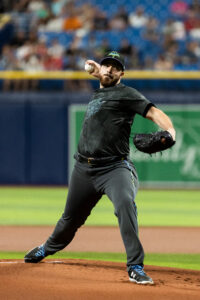
It’s one of the first notable trades of the 2024 season — one that addresses a key need for the Brewers (rotation depth) while netting some longer-term value for a Rays club that has multiple arms nearing a return from injury. Right-hander Shane Baz‘s rehab from 2022 Tommy John surgery is effectively wrapped up, while southpaw Jeffrey Springs is nearing a return from his own Tommy John procedure, performed last April. Righty Drew Rasmussen, who underwent an internal brace procedure last July, is further behind that pair but is now one year removed from his surgery.
With those arms nearing a return that’ll slot them in alongside Zach Eflin, Zack Littell, Taj Bradley and Ryan Pepiot, the Rays have reportedly been open to dealing some veteran rotation help — with Civale and Littell the primary names among the reported possibilities. It bears emphasizing that there is no indication Tampa Bay is prepared to embark on a full-scale rebuild or notable summer sell-off. The organization surely feels that moving Civale (and potentially still listening on Littell and Eflin) is a matter of trading from a position of strength. The Rays exist in a perpetual state of both “buyer” and “seller,” regularly flipping veterans with dwindling levels of club control (such as Civale) in exchange for younger and more controllable talent.
While the Rays are currently flush with viable rotation candidates, the same cannot be said for a Brewers squad that has been hammered by injuries in 2024. Wade Miley underwent Tommy John surgery early in the season, and well-regarded pitching prospect Robert Gasser followed suit last month after impressing through his first five big league starts (2.57 ERA). DL Hall, acquired from the Orioles in the offseason Corbin Burnes trade, has been out since April with a knee sprain. Righty Joe Ross is on the 60-day injured list with a back strain.
The Brewers, who recently acquired Dallas Keuchel in a cash swap with the Mariners (and have received one rough start and a second sharper outing from the former Cy Young winner), have already used 15 different starting pitchers this season. Civale will make 16. At the moment, Milwaukee has Freddy Peralta, Bryse Wilson, Colin Rea and Tobias Myers in the rotation alongside Keuchel. Rea and Myers have exceeded any expectations, combining for 25 starts (14 for Rea, 11 for Myers) while both sporting earned run averages well south of 4.00. They’ve been rotation saviors for first-year skipper Pat Murphy, but some reinforcements were known to be a target for Milwaukee general manager Matt Arnold and his staff with the trade deadline now just 27 days away.
While it feels like most pitchers thrive and unlock a new gear upon being traded to the Rays organization, that hasn’t been the case for Civale. Acquired late last July in a trade sending first base prospect Kyle Manzardo to Cleveland, Civale came to the Rays with two and a half years of club control remaining and a strong track record with the Guardians. The 2016 third-rounder had battled his share of injury troubles but typically been good to great when healthy. In parts of five seasons, he gave Cleveland 430 innings of 3.77 ERA ball, all coming out of the rotation. He averaged 5 2/3 innings per outing, punched out a slightly below-average 21.1% of his opponents and limited walks at an excellent 6.1% clip.
With Tampa Bay, Civale has struggled to keep his ERA down. He’s worked to a 5.17 ERA in 132 1/3 frames dating back to last year’s deadline. That unsightly mark comes despite the fact that Civale has notably improved his strikeout rate (24.7%) even as the league-average strikeout rate has declined. He’s generally maintained his strong command, too (6.5% walk rate).
However, Civale has become increasingly homer-prone, yielding an average of 1.56 round-trippers per nine innings pitched — a sizable uptick from the 1.19 HR/9 he averaged in Cleveland. He’s also been plagued by a spike in his average on balls in play (despite Tampa Bay’s strong defense). It’s all added up to tank Civale’s strand rate and lead to more runners crossing the plate, even as metrics like xFIP and SIERA feel he’s been a comparable pitcher to his Cleveland days from a skill standpoint.
Acquiring Civale is something of a roll of the dice by the Brewers. Adding any homer-prone pitcher and plugging him into the Brewers’ homer-happy American Family Field is not without risk. That said, Milwaukee also has a reputation for maximizing pitcher performance, just as the Rays and Guardians do. The Brewers likely have their own tweaks and slight changes to game-planning that they feel can help get Civale back into his Cleveland form. Failing that, he at least ought to provide some steady back-of-the-rotation innings.
For a budget-conscious team like the Brewers, Civale surely holds some extra appeal. He’s earning a reasonable $4.9MM in 2024, with about $2.34MM of that sum yet to be paid out. The Brewers will assume the remainder of that tab. They’ll also control Civale through the 2025 season via arbitration, making him a likely multi-year member of the rotation. He’ll be due one final raise, though with his slow start to the season, his earning power via that process will be relatively suppressed even if he engineers a turnaround with the Brew Crew.
Barrios will give the Rays yet another talented infield defender to plug into the system. The Venezuelan-born 20-year-old is already in High-A and has handled the level quite well despite facing older competition. In 60 games (252 plate appearances), Barrios is slashing .317/.361/.423 (121 wRC+) with a homer, 17 doubles, two triples, 16 steals (in 22 attempts), a 5.2% walk rate and a tiny 9.5% strikeout rate.
Entering the season, Baseball America pegged Barrios 26th in Milwaukee’s system. He sat No. 21 on MLB.com’s list of the top 30 Brewers prospects at the time of the swap, and Keith Law of The Athletic listed him just outside the Brewers’ top-20 farmhands heading into the season. Barrios’ strong defensive skills and potential to be a plus glove at shortstop have made him a prospect of some note in Milwaukee’ system even as he’s struggled offensively in his first three pro seasons.
That well-regarded glove now looks all the more intriguing with Barrios hitting well against more advanced pitching in High-A. He’ll likely slot into the middle of the Rays’ top 30 or so prospects moving forward. Barrios won’t do anything to improve the Rays’ chances in 2024 (unless he’s included in a subsequent trade for help in other areas), but by late 2025 or early 2026, he could push for a big league debut if he’s able to continue this offensive breakout. He won’t be eligible for the Rule 5 Draft until the 2025-26 offseason, so the Rays needn’t worry about adding him to the 40-man roster anytime soon.
While it’s the first notable trade of the season for both teams, it’s not likely to be the last. The Brewers could still use some rotation help and have an enviable stash of young outfielders that will continue to pique the interest of other clubs. The Rays opened one rotation spot, likely for Baz, but still have another prominent arm (Springs) on the mend with another on the horizon (Rasmussen). They’re currently three games back in the AL Wild Card race, so a full sell-off should not be expected (barring a protracted losing streak), but their stock of arms will draw interest and provide them the opportunity to either restock their farm (as they did in this deal) or add some big league help at another area of need as the deadline draws nearer.
Jon Heyman of the New York Post first reported that Civale had been traded to Milwaukee. The Athletic’s Ken Rosenthal reported that the Brewers were sending a minor league infielder to Tampa Bay. The Post’s Joel Sherman first reported that Barrios was the return in the 1-for-1 swap.
GM: Reds Have Yet To Commit To Deadline Strategy
The Reds entered the 2024 season as hopeful contenders but find themselves five games under .500 and 10.5 games back of the Brewers for the division lead in the National League Central. It’s certainly not how they drew things up, but the tightly bunched NL Wild Card picture still leaves Cincinnati with some legitimate playoff aspirations. The Reds are only four games back of the third NL Wild Card spot at the moment. They’re one of many teams on the Wild Card bubble whose deadline activity will likely hinge on how the team plays in the coming weeks. In fact, general manager Brad Meador effectively confirmed as much to Gordon Wittenmyer of the Cincinnati Enquirer.
“We have to wait and see how we finish off this road trip and the homestand coming up, and then we’ll see,” Meador tells Wittenmyer. “We’re talking about it. We’d love to be able to add, but realistically, we’ll probably just have to see how it goes.”
The Reds control their own fate, in many respects, and they’ll head into the upcoming All-Star break with a series of eminently winnable games. They took the first of a three-game set at Yankee Stadium last night and have a tough task finishing off that series, but they’ll close out the first half against three teams with sub-.500 records — including the two worst clubs in the NL. On Friday, Cincinnati commences a 10-game homestand where they’ll host the Tigers, Rockies and Marlins for three, four and three games, respectively. The Reds will open the second half with a nine-game road trip through Washington, Atlanta and St. Petersburg before starting a home series against the Cubs on July 29 (one day before the July 30 trade deadline).
It’s a pivotal stretch of games for the Reds, to say the least. A winning streak could catapult them north of .500 and prominently into the Wild Card hunt (while narrowing the division gap), while an underwhelming stretch against some of the less-competitive clubs on the upcoming schedule could serve as a death knell for their 2024 postseason aspirations. Playing roughly .500 ball between now and July 30 would leave the front office with some tougher decisions to make. For now, Meador acknowledged “vague” conversations exploring both sides of the market while cautioning nothing is close.
Among the most notable trade candidates on the roster, if the Reds go that route, will be Jonathan India and Frankie Montas. India is hitting .275/.381/.405 with five homers and eight steals on the season. He’s fanned in a career-low 19.7% of his plate appearances and has restored his walk rate to a hefty 12.8% after seeing it dip to a combined 8.6% in 2022-23.
India is playing out the first season of a two-year, $8.8MM contract that bought out two of his three arbitration seasons. He’s locked into a $5MM salary for the 2025 season and would be arbitration-eligible in the 2025-26 offseason before hitting the open market post-2026. He’s not a good defensive second baseman, but he’s been a line-drive machine at the plate this year (24.9%) while showing his best K-BB profile since winning NL Rookie of the Year in 2021.
While India conceded to Wittenmyer that last year’s slate of trade rumblings got to him mentally, this time around he feels more prepared for it. The 27-year-old emphasized a desire to remain in Cincinnati long-term, noting he “loves” the city and organization while simultaneously acknowledging that a potential trade is beyond his control and not something on which he plans to dwell.
Montas would be the roster’s most straightforward trade candidate. The 31-year-old hasn’t bounced back to his Oakland form but has been healthy with the Reds after missing nearly all of the 2023 season due to shoulder surgery. He’s on a one-year, $16MM contract and has pitched to a 4.23 ERA in 72 1/3 innings across 15 starts.
Montas’ 95.1 mph average heater (via Statcast) is down from its 96.8 mph peak, and his 18.6% strikeout rate isn’t close to his career-best 26.6% mark, set back in 2021. Still, he’s pitched like a capable enough fourth starter and has seen his velocity build as the season has progressed. Montas sat 94 mph with his fastball through late April but is at 95.5 mph dating back to May 1.
Over Montas’ past six starts, he’s pitched 31 1/3 innings of 3.73 ERA ball with a much-improved 23.3% strikeout rate. His 10.9% walk rate in that stretch is too high, but the velocity and missed bats are beginning to resurface. If he can continue some of those positive gains in velocity and strikeouts, Montas could be of interest to teams looking to add to the middle tier of their rotation.
The Reds have other candidates to be moved, though their willingness to give out some surprising opt-out clauses over the winter could work against them in that regard. Veterans Emilio Pagan and Nick Martinez signed two-year contracts worth $16MM and $26MM, respectively, but the second season of each of those deals is a player option. As MLBTR’s Anthony Franco detailed for MLBTR Front Office subscribers earlier this week, such clauses often present severe impediments to trading a player.
Other names to watch in the event of a Reds sale would include relievers Buck Farmer, Lucas Sims and Brent Suter. All three are free agents at season’s end. Each has had varying levels of success this season while playing on an affordable salary. The return for any one of those three likely wouldn’t be enormous but could shed a small money off the payroll while adding a lottery-ticket prospect to the lower tiers of the farm system.
All of that is putting the cart before the horse, however. The Reds’ roster will have a nice window of winnable games to convince the front office that adding pieces is the proper route in the weeks ahead. Cincinnati has received negligible production from the outfield, designated hitter and first base this season — although Noelvi Marte‘s recent return likely means they’ll install a productive hitter (Jeimer Candelario) in at first base more regularly now. Adding some kind of bat to help boost the offense would be prudent — assuming the Reds can keep themselves afloat or even improve upon their standing in the next couple weeks.
Rockies Will Listen To Offers On Cal Quantrill, Austin Gomber
The Rockies have a reputation for hanging onto — and at times extending — veterans who would be likely trade candidates with other organizations. In recent years, they’ve declined to trade Trevor Story, Jon Gray, Daniel Bard, C.J. Cron, Brent Suter and others despite sitting near the bottom of the standings in the National League. (Bard and Cron were signed to ill-fated extensions.) Various reports have already indicated that the Rockies have zero inclination to listen to trade scenarios involving third baseman Ryan McMahon, but Will Sammon, Katie Woo and Patrick Mooney of The Athletic report that Colorado decision-makers “plan to consider” offers for some players who are controlled beyond the current season.
Right-hander Cal Quantrill and lefty Austin Gomber are the two most obvious trade candidates on the staff, and the team will indeed consider offers on each, per the report. Both are in their second season of arbitration eligibility, with Quantrill earning a $6.55MM salary and Gomber being paid just shy of half that at $3.15MM. Both are controlled through the 2025 season and are slated to become free agents in the 2025-26 offseason.
Of the two, the 29-year-old Quantrill likely has more value despite being the pricier arm. He’s posted a team-high 95 1/3 innings in 2024 and recorded a 3.78 ERA on the back of an 18% strikeout rate, 8.5% walk rate, 46.9% grounder rate and 1.13 HR/9. It’s been a nice rebound effort for Quantrill in a tough setting for any pitcher. The former No. 8 overall draft pick was torched for a 5.24 ERA last season in an injury-shortened year with the Guardians but is now in the midst of his third season of solid results in a big league rotation. Quantrill also pitched to a combined 3.16 ERA in 336 innings with Cleveland in 2021-22, showing the same blend of sub-par strikeout rates with an aversion to hard contact.
Quantrill isn’t without his flaws. His 18% strikeout rate is worse than the league-average, but right in line with his career 17.8% mark. He’s never missed bats at a high level, and his command is more good than great. Similarly, while he uses a sinker as his primary offering, his ground-ball rates are typically a bit above average but far from elite. Quantrill has in the past featured a changeup — he’s largely moved away from the pitch this season — but it hasn’t kept lefties in check as much as hoped when the pitch received plus grades back to his prospect days. Lefties have a career .241/.318/.404 slash against him, while righties are at a comparable .266/.313/.400. He’s been hittable by all opponents but also not overexposed in platoon settings.
Gomber, 30, has pitched 87 2/3 innings this season and turned in a 4.72 ERA. That number has climbed by nearly two runs since the calendar turned to June. At the end of May, Gomber was sporting a tidy 2.76 earned run average, but he’s been blasted for 28 earned runs with an 18-to-7 K/BB ratio over his past 29 frames, dating back to June 2.
Rough patches of this sort are all too familiar for the Rockies and Gomber, who came to Denver as part of the regrettable Nolan Arenado trade with St. Louis. The former fourth-round pick is second (to Kyle Freeland) on the Rockies in innings pitched dating back to his acquisition, having piled up 466 2/3 frames over 99 appearances (83 starts). He’s posted a tepid 5.13 ERA in that time and actually generated slightly better results at Coors Field (4.96 ERA) than on the road (5.31 ERA). Look back through Gomber’s month-to-month splits in any given season, and there’s typically a month or two like his April/May run in 2024, but they’re largely offset by pronounced struggles that mirror his current slump.
Gomber punched out a solid 23.2% of his opponents in his first season with the Rox, but he’s at 16.1% this year and has seen the average velocity on his fastball drop from 91.6 mph in ’21 to 90.3 mph this season, per Statcast. He’s also scaled back the usage of his slider in favor of more curveballs and changeups. Back in 2021, Statcast credited his slider with a hearty 35% whiff rate, but the pitch is down to 17.7% this season and has been hit increasingly hard over the past couple seasons, so it’s not a huge surprise to see him moving away from it.
While neither Quantrill nor Gomber would fetch the type of haul that would seismically improve the Colorado farm system, both should generate interest. That’s true not only due to their relatively affordable salaries and extra year of club control, but also due to the simple lack of alternatives on the market for teams seeking rotation help. Quantrill is a borderline playoff starter at best, and Gomber is likely seen as more of a fifth starter who can help eat innings before sliding into a bullpen role in the playoffs. For some clubs, that type of stability is all they’re seeking.
It’s far from a given that the Rockies will ultimately move either pitcher. Quantrill has spoken positively about the experience of pitching in Colorado and at Coors Field specifically. He’s exceeded expectations since being acquired from Cleveland and, historically speaking, is the type of veteran the Rockies have looked to sign for multiple years rather than trade. Their ostensible willingness to listen to offers on him would be something of a change of pace but arguably a welcome one for a club that has at multiple times passed on trade opportunities that would’ve bolstered their minor league system only to eventually lose said players for no return at all when they become free agents. Whether either pitcher drums up enough interest to warrant an offer that convinces the Rockies to move remains an open question, though.
Colorado does have other arms that are controlled/signed beyond the current season, though most are performing poorly. Dakota Hudson has an ERA just shy of 6.00 with nearly as many walks as strikeouts. He’s arbitration-eligible this winter. Kyle Freeland is signed through 2026 and will earn $16MM in each of the next two seasons. In a healthy season, he might’ve drawn interest, but he only returned from the 60-day IL a couple weeks back after a lengthy stint due to an elbow strain. He’s looked sharp since returning (two runs in 12 2/3 innings) but was clobbered for a 13.21 ERA in four starts prior to his IL trip.
The Athletic also cites righty Ryan Feltner as a name who could draw interest despite an ugly 5.60 ERA of his own. There’s some sense to that as a potential buy-low candidate. Feltner averages 95 mph on his heater and has turned in a career-low 6.2% walk rate in this year’s 91 2/3 innings. His 19.3% strikeout rate is below average by a couple percentage points, but his 10.5% swinging-strike rate isn’t far from par and he has solid spin rates on his breaking pitches.
Feltner, 27, will be arb-eligible as a Super Two player this offseason. He’s controllable for four more seasons and has a pair of minor league options remaining. A contending club might not want to plug him directly into their rotation — particularly if said team is in a tightly contested division/Wild Card race. Other clubs looking to 2025 and beyond — or perhaps those with comfortable division leads but still needing some rotation depth — could view him as a longer-term project with good raw stuff who could benefit from a change of scenery.
Nationals Request Release Waivers On Eddie Rosario
The Nationals announced Wednesday that they’ve requested unconditional release waivers on outfielder Eddie Rosario, who was designated for assignment earlier in the week when top prospect James Wood was called up to the majors. Once Rosario and the remainder of his $2MM base salary officially clear, he’ll become a free agent who can sign with any team. A new club would only owe Rosario the prorated league minimum for any time spent on the MLB roster or injured list.
Rosario, 32, is a former 30-homer slugger whose bat has declined substantially over the past four seasons. He had a brief and memorable surge with the 2021 Braves after being acquired from Cleveland in a salary-dump trade — .271/.330/.573 down the stretch, plus NLCS MVP honors after going 14-for-25 with three homers — his overall offensive output dating back to 2021 has been sub-par. In 1433 trips to the plate between Cleveland, Atlanta and Washington, he’s batted just .235/.283/.403 (85 wRC+) with increasing strikeout troubles.
The 2024 season has been particularly tough. Rosario posted a strong .253/.319/.530 performance in the month of May, but that’s been bookended by two of the worst months of his career from an offensive standpoint. Overall, he’s hitting just .183/.226/.329 with the Nats, making it a foregone conclusion that he’ll pass through release waivers and become a free agent.
Rosario was a productive everyday outfielder with the Twins from 2017-20, hitting .281/.317/.493 and belting 96 home runs in 2002 plate appearances, but it’s been quite some time since he’s produced near that level over a sample of any meaningful note. Another club will likely take a flier on the veteran’s left-handed bat with another minor league contract, but he’ll probably have to play his way back to the big leagues with a strong showing in Triple-A.
Mets Designate Matt Festa For Assignment
The Mets announced Wednesday that they’ve designated right-hander Matt Festa for assignment. His spot on the active roster will go to right-hander Christian Scott, who has been recalled from Triple-A Syracuse to start today’s game.
Festa, 31, signed a minor league deal with the Mets on May 20 and posted outstanding Triple-A numbers prior to being selected to the MLB roster recently: 15 1/3 innings, 1.76 ERA, 32.2% strikeout rate, 5.1% walk rate. He only got into one game at the big league level with the Mets, however, and the results were nightmarish. In one inning, he was roughed up for five runs (four earned) on four hits and a walk. That lone frame was enough to inflate his career ERA from 4.32 (in 93 2/3 innings) to 4.66.
A former seventh-round pick, Festa has now pitched in parts of five big league seasons, the other four coming as a member of the Mariners. The 6’1″, 195-pound right-hander has seen his career slowed by injuries, most notably including 2020 Tommy John surgery. That wiped out his entire 2020 campaign and the bulk of his 2021 season as well.
Festa saw big league time in the two years prior to that surgery (2018-19) and the two years following the completion of his rehab (2022-23). In addition to the aforementioned 4.66 ERA in the majors, he’s turned in a sharp 25.1% strikeout rate to go along with plus swinging-strike rates. His 10.9% walk rate is also a couple percentage points worse than the league average, however, and his 92.6 mph average fastball velocity is rather pedestrian.
Beyond his strong showing with the Mets’ Triple-A club, Festa pitched decently with the Padres’ top affiliate in El Paso after signing a minor league deal in the offseason. He logged 16 innings and yielded eight runs, though a .360 average on balls in play didn’t do him any favors in that small sample. He fanned 21.6% of his opponents during that brief stay in the Padres organization and turned in a 9.5% walk rate.
In parts of five Triple-A seasons, Festa has a 2.10 ERA, a 27.7% strikeout rate and a 9% walk rate. He’ll be traded or placed on outright waivers within the next five days now that he’s been designated for assignment (and waivers themselves would take another 48 hours). Any team that acquires or claims Festa would need to put him right on the major league roster, as he’s out of minor league options. He’s been outrighted once in the past (2020), so Festa would have the right to reject a Triple-A assignment if he goes unclaimed on waivers.
Checking In On 2024’s Reliever-To-Rotation Experiments: July Edition
About a quarter of the way through the 2024 season, I took a look at how the most prominent examples of teams’ attempts to turn an established reliever into a starter had progressed. At the time, the majority of these experiments were going well, by and large. At that mid-May juncture, most of the relievers making the switch had yet to reach their innings workloads from the season prior. Now that we’re at the season’s halfway point, that’s no longer the case. Many of the pitchers striving to make this jump are now approaching or have already eclipsed their 2023 innings totals — if not their career-high workloads — so it seems a good time to check back on how they’re faring.
As a reminder, the focus here is pitchers who pitched exclusively or near-exclusively out of the bullpen last season. Someone like the Rays’ Zack Littell or Red Sox’ Kutter Crawford, who moved into the rotation last summer and continued that move this year, isn’t the focus.
Garrett Crochet, LHP, White Sox
Stats at quarter mark: 9 games started, 46 2/3 innings, 4.63 ERA (2.47 SIERA), 34.2 K%, 4.8 BB%, 43.8 GB%
Stats since: 9 GS, 54 2/3 innings, 1.65 ERA (2.27 SIERA), 36.3 K%, 5.2 BB%, 45.5 GB%
At the 25% mark of the season, Crochet sat on a pedestrian ERA but elite K-BB profile. His production had been skewed by a series of three straight rough outings: five runs versus the Reds, seven in Philadelphia and another five in Minnesota.
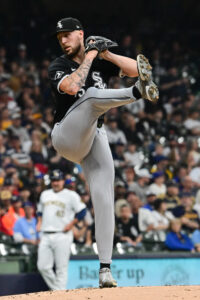
Those three starts still stand as the worst three of his season. Crochet hasn’t yielded more than three runs in a single outing since that time. He’s not only maintained his elite K-BB profile but improved upon it, slightly upping his strikeout rate while sustaining his exceptional command. No starter in baseball is striking out hitters at a higher rate than Crochet, and only 12 are limiting their walks more effectively.
At last check, Crochet had ace-like rate stats but pedestrian run-prevention numbers overall. That’s no longer the case. The only question as to whether Crochet is a bona fide No. 1 starter is one of durability. All of the pieces are there, but Crochet has never pitched a full season in the rotation. In fact, this year’s combined 101 1/3 innings not only stand as a career-high, they eclipse his combined total of professional innings pitched — majors and minors combined — since being selected in the first round of the 2020 draft.
With two and a half years of team control left, a bottom-of-the-barrel $800K salary and the worst team in baseball behind him, Crochet stands as a clear-cut trade candidate. The Sox reportedly broached the possibility of an extension with him but are now expecting to trade him after contract talks failed to progress. A new team will have to worry about how Crochet will hold up down the stretch, but there’s little doubting that he’s a front-of-the-rotation talent.
Jordan Hicks, RHP, Giants
Stats at quarter mark: 9 GS, 48 innings, 2.44 ERA (3.99 SIERA), 19.9 K%, 8.2 BB%, 56.2 GB%
Stats since: 8 GS, 37 2/3 innings, 4.54 ERA (4.29 SIERA), 22.2 K%, 10.2 BB%, 45.8 GB%
Early on, Hicks was thriving in terms of run-prevention in spite of a pedestrian strikeout rate. He’s picked up the strikeout rate a bit since that time but has seen his command, ground-ball rate and velocity all drop. After averaging 5 1/3 innings through his first nine starts, Hicks is averaging about 4 2/3 innings per outing and has seen his average sinker velocity drop by nearly two miles per hour. Since mid-May, his sinker is averaging 93.5 mph — down from the 95.5 mph at last check and even further from the 100.2 mph Hicks averaged in his time as a reliever.
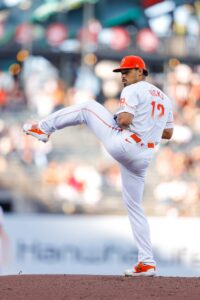
Hicks has struggled to turn the lineup over multiple times. Opponents own an awful .196/.268/.348 slash when facing him the first time in a game. Unlike many pitchers, who experience a stark drop when facing opponents a third time, Hicks’ troubles begin the second trip through the order. Opponents in those settings carry a .267/.373/.382 slash. He’s only faced a hitter for the third time on a given day 57 times this season, but opponents have batted .283/.333/.434 in that small sample.
Back in May, I noted that opponents had posted an embarrassing .079/.167/.105 slash in the 42 plate appearances Hicks had finished off with a splitter. They’ve fared better against the pitch since that time, though it’d be hard to have performed much worse. And, with opponents still slashing only .160/.244/.272 against the pitch (which Statcast credits with a .270 expected wOBA), that newly implemented offering still has the look of a plus pitch.
Hicks has remained reasonably effective but hasn’t been the roaring success he was through the first quarter of the season. San Francisco signed the 27-year-old flamethrower to a four-year, $44MM deal and did so with an eye toward Hicks starting, so it’s clear this is a multi-year undertaking. Nothing Hicks has done to date suggests he decidedly can’t handle being a starter, but he’s faded from his early-season production, which is perhaps to be expected for a pitcher whose 85 2/3 innings are already a career-high mark.
The manner in which Hicks has begun to fade only further underscores the remarkable nature of Crochet’s performance to date as he navigates uncharted workload territory. That said, Hicks has an overall 3.36 ERA with a nearly average strikeout rate, a manageable walk rate and a plus ground-ball rate. There have been some roadblocks of late, but this year could serve as a launching pad to a better performance in 2025-27, when he’s more accustomed to his current workload.
Reynaldo Lopez, RHP, Braves
Stats at quarter mark: 7 GS, 40 1/3 innings, 1.34 ERA (4.00 SIERA), 25.2 K%, 10.1 BB%, 40.2 GB%
Stats since: 7 GS, 39 innings, 2.08 ERA (3.58 SIERA), 26.1 K%, 7.0 BB%, 32.7 GB%
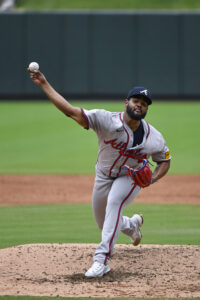
The Braves have been judicious with Lopez’s start-by-start workload thus far. He hasn’t topped 94 pitches in a single appearance and has only recorded four outs after the sixth inning all season. So far, that level of caution has paid off. Since last check, Lopez hasn’t lost any life of his heater and has actually tacked on 0.4 mph on average, per Statcast.
Atlanta doesn’t often give Lopez the opportunity to turn the lineup over a third time, and the opportunities he’s had haven’t gone well. Lopez has yielded a mid-.500s OPS to opponents the first or second time through the order but has been tagged for a .245/.359/.396 batting line the third time through. It’s not egregious, but it’s far less dominant than his first couple trips through a lineup.
Lopez is still running a plus strikeout rate, and he’s improved his command and his velocity as the season has worn on. As the only member of this list who’s previously worked multiple full seasons as a starter, he might have been the best-equipped to handle this transition, and so far it doesn’t appear he’s slowing down much at all.
Lopez entered the season with a career 71.1% strand rate, and he’s currently stranding 86.3% of his baserunners. His .279 average on balls in play is lower than league average but right in line with his career .281 mark. He’s allowed only 0.45 homers per nine frames, thanks in large part to a paltry 4.7% homer-to-flyball ratio that sits well shy of his career 11.3% mark. There’s some correlation there; it’s easier to strand runners if you’re almost never allowing a ball to clear the outfield fence, after all. In all likelihood, both that HR/FB and strand rate will trend toward his career marks as the season (and, more broadly, his three-year contract) wears on, but the outside-the-box bet on Lopez as a starter looks like one that will pay off for Atlanta.
Jose Soriano, RHP, Angels
Stats at quarter mark: 7 GS, 38 2/3 innings, 3.72 ERA (4.03 SIERA), 20.3 K%, 9.5 BB%, 61.5 GB%
Stats since: 5 GS, 33 2/3 innings, 3.21 ERA (3.97 SIERA), 16.9 K%, 6.2 BB%, 58.6 GB%
Soriano was continuing his sharp start to the season when he was scratched from a mid-June start due to abdominal pain. The Halos discovered an infection in the young righty’s abdomen that required a trip to the injured list and was expected to sideline him a few weeks. That’s thrown a bit of a wrench into his rotation breakout, though there’s no indication it’s a serious issue and the Halos can take solace in the fact that there’s no arm issue at play. And, after pitching just 65 1/3 innings last season, Soriano is already at 72 1/3 frames this year, so perhaps it can serve as a well-timed breather for his right arm.
The 25-year-old Soriano’s first run as a starter in the big leagues this season looked promising through mid-May and continues to do so. Impressively, he hasn’t lost any life on his four-seamer or sinker despite the shift from short relief to starting work. Statcast measured his average four-seamer at 98.9 mph in both 2023 and 2024, while his sinker clocked in at an average of 97.7 mph in 2023 and is actually marginally better in 2024 at 97.8 mph.
That sinker has helped Soriano run up an elite ground-ball rate; his 60.1% grounder rate ranks third among the 145 big league pitchers with at least 50 innings pitched this year, trailing only Framber Valdez (61.4%) and Cristopher Sanchez (60.3%). That uptick in grounder rate over last year’s 51% mark correlates with a huge spike in Soriano’s sinker usage (13.3% in ’23, 40% in ’24). The extra sinker usage has come at the expense of some four-seamers (25.8% in ’23, 17.8% in ’24) and particularly Soriano’s knuckle curve (41.2% in ’23, 27.5% in ’24).
The tweak in repertoire could come down to a pursuit of efficiency as Soriano looks to work deeper into games. The right-hander fanned 30.3% of opponents last season and registered a hearty 14.8% swinging-strike rate but also required 16.6 pitches per inning pitched, on average. In 2024, his strikeout rate is down to 20.3% with a 10.2% swinging-strike rate. But he’s significantly upped his grounder rate and is now averaging just 15.1 pitches per frame. Soriano averaged 6 2/3 innings per start in the five appearances between our last check and this one, so it seems clear he’s placing an emphasis on being able to work deeper into games in his new role. Opponents are hitting .313/.421/.521 in 58 plate appearances when facing him a third time, so the results aren’t there so far, however.
Bryse Wilson, RHP, Brewers
Stats at quarter mark: 11 G (5 GS), 34 innings, 2.65 ERA (4.60 SIERA), 20.4 K%, 10.9 BB%, 39.1 GB%
Stats since: 9 G (4 GS), 44 innings, 5.52 ERA (4.27 SIERA), 17.6 K%, 6.7 BB%, 41.3 GB%
Wilson hasn’t technically “started” each of his past nine appearances, but he’s averaged five innings per outing while working as a starter and bulk reliever (on the heels of an opener). Effectively, the Brewers are using him as a starter — they’re just shielding him from the top-third of some lineups on occasion, when the matchup dictates.
This wasn’t a planned move to a longer role. The former Braves top prospect and Pirates hurler entered the season slated for a second straight season as Milwaukee’s long man, but injuries to Wade Miley, Joe Ross, Robert Gasser and DL Hall combined to not only push Wilson into this rotation-ish role but to keep him there. After pitching 76 2/3 innings of pure long relief in 2023, Wilson is already at 78 frames and counting.
As one would typically expect, Wilson’s fastball has taken a slight dip as he’s stretched out for longer stints. He averaged 94 mph through the season’s first quarter, but several of those earlier appearances were still in short relief. He’s averaging 93.2 mph since mid-May and has seen his strikeout rate drop but also seen his walk rate improve. As he’s been tasked with facing more lefties, Wilson has upped his changeup and cutter usage a bit, doing so at the expense of his four-seamer and curveball.
Wilson has been far too homer-prone this season (1.62 HR/9) and is giving up too much hard contact (45.8%, per Statcast). More so than any pitcher on this list, he’s run into troubles the third time through the order; in 45 such plate appearances, they’ve posted a Herculean .400/.467/.650 slash. Those plate appearances account for just 13.6% of Wilson’s batters faced this season but have resulted in 21.5% of his home runs allowed. Wilson seems best suited for a long relief role or a five-inning start/bulk role, but he’s pitched more than five innings six times this season and is giving Milwaukee some desperately needed innings when their rotation is in tatters.
A.J. Puk, LHP, Marlins
Stats at quarter mark: 4 GS, 13 2/3 innings, 9.22 ERA (7.13 SIERA), 15.6 K%, 22.1 BB%, 31.9 GB%
Stats since: 0 GS, 21 1/3 innings, 2.95 ERA (3.36 SIERA), 21.4 K%, 4.8 BB%, 44.3 GB%
The Marlins quickly pulled the plug on the Puk rotation experiment, and it’s worked out for all parties. The former No. 6 overall pick (A’s, 2016) turned heads as a starter in spring training but was shelled in what currently stand as the only four starts of his big league career (though Puk was a starter both for the University of Florida and in the minor leagues).
It’s unlikely that Puk would’ve continued to struggle quite so substantially had Miami continued using him as a starter, but the left-hander certainly looks more comfortable in the short relief role in which he thrived from 2022-23 (123 innings, 3.51 ERA, 19 saves, 22 holds, 29.4 K%, 6.9 BB%). He’s performing far better in his old role, and he required a three-week stint on the injured list for shoulder fatigue following his early start in the rotation.
There’s no reason to fault the Marlins for trying to stretch out a clearly talented reliever who has a track record in the rotation, but Puk is back in the bullpen and figures to draw attention over the next month from teams seeking left-handed bullpen help. He’s controllable through the 2026 season.
Tyler Alexander, LHP, Rays
Stats at quarter mark: 7 G (5 GS), 39 2/3 innings, 5.45 ERA (4.44 SIERA), 19.1 K%, 6.9 BB%, 30.4 GB%
Stats since: 3 G (1 GS), 17 innings, 7.94 ERA (3.68 SIERA), 20.3 K%, 1.4 BB%, 27.8 GB%
Alexander entered the season in the same type of role Wilson currently holds with the Brewers: occasional starter and frequent bulk reliever behind an opener. He made a handful of solid appearances early on, though the value of those was offset by some particularly rough outings versus the Yankees (six runs in seven innings) and the Royals (eight runs in five innings).
Following our last check-in, Alexander made three appearances before being optioned to Triple-A Durham, where he’s worked quite effectively out of the Bulls’ rotation: five starts, 29 2/3 innings, 3.64 ERA, 24.2% strikeout rate, 2.4% walk rate. That should position him as a depth option in the event of a big league injury and/or trade. Tampa Bay reportedly has considered fielding offers on current members of its big league rotation — Zack Littell and Aaron Civale, most notably. Part of that is due to the looming returns of Shane Baz and Jeffrey Springs, but Alexander gives them another rotation candidate who’s performed well recently in Durham.
The Rays haven’t abandoned the Alexander starting experiment, but for the time being he’s not in their big league rotation plans. Speculatively, that could make Alexander himself a trade option for teams seeking back-of-the-rotation depth, though if the Rays do ultimately move Littell, Civale or a more expensive arm like Zach Eflin, they may not want to deplete the rotation depth much further.