
MLB Will Hold Draft Remotely
1:45m: ESPN’s Kiley McDaniel adds that undrafted amateurs will be eligible to sign beginning on June 14 — three days after the draft’s conclusion (Twitter thread). There will be a “dead period” for contact between teams and those players in the interim days. Teams aren’t permitted to offer undrafted free agents anything other than what they can offer draftees (e.g. scholarship money for high school players).
12:30pm: The shortened 2020 MLB Amateur Draft will be held remotely, ESPN’s Jeff Passan reports (Twitter thread). It’s not a particularly surprising development but is nevertheless yet another departure from the norm. Per Passan, teams won’t be permitted to have draft rooms. Each club’s head of baseball operations will be on camera during the draft, without audio, as was the case with last month’s virtually conducted NFL Draft. The MLB Draft will be conducted on June 10-11, with Day One including just the first round and Day Two featuring the rest.
This year’s draft has been shortened to just five rounds — a reality brought about by owners strongly pushing back against paying the wide slate of bonuses associated with a traditional 40-round draft amid widespread revenue losses. Undrafted players will be able to sign with any club, although those bonuses will be capped at just $20K.
As such, the next several drafts figure to have a substantial influx of talent, with so many would-be mid-round prospects forgoing their first steps into pro ball. The truncated structure will also come with significant ramifications in the NCAA, as countless prep prospects who would’ve gone pro will now instead opt for college ball. Many juniors will return for a senior season when they otherwise would not have, as well.
The No. 1 overall pick, held by the Tigers, will come with a slot value of $8,415,300, tweets The Athletic’s Ken Rosenthal — the same slot value as the No. 1 pick in 2019. As for the actual payout of bonuses, they’ll be heavily deferred. Rosenthal notes that only $100K will be paid to players up front. They’ll receive 50 percent of their remaining bonus in July 2021 and the other 50 percent in July 2022.
It’s been known for some time that this year’s slot values won’t increase, as they do on an annual basis in every other year — another ownership-driven issue that did not sit well with agents. The MLBPA agreed to numerous concessions on the draft when negotiating the March agreement that granted players service time and at least a small portion of their salary in the event of a canceled season or prorated salaries in a partial season. Draft prospects, of course, aren’t represented by the union, and the Players Association sought to protect its members first and foremost. Owners have since contended that said agreement didn’t account for spectator-less games and sought further salary reduction among MLB players.
Realmuto On Spring Extension Talks With Phillies
Neither the Phillies nor J.T. Realmuto had been quiet about the fact that the two sides were exploring an extension prior to the league’s shutdown in mid-March. However, the roster freeze that was implemented back in March also prohibits teams from negotiating long-term contracts with their players, so talks between the two sides were halted. In a new interview with The Athletic’s Matt Gelb (subscription required), Realmuto indicates that the Phils had yet to present a formal offer, but he also speaks optimistically that a deal indeed could have come together.
“There was definitely a feeling that things were about to start moving pretty quickly,” Realmuto tells Gelb in a wide-ranging interview that discusses his mindset during the pandemic shutdown, the upcoming free-agent landscape and the league’s attempt to reboot the 2020 season. (Phillies fans, in particular, will want to read it in its entirety.)
The Phillies sent three players — catcher Jorge Alfaro, top pitching prospect Sixto Sanchez, young lefty Will Stewart — and international bonus allotments to the Marlins last winter in order to acquire Reamluto’s final two pre-arbitration seasons. However, it has long seemed that the goal all along was to entice Realmuto to sign a long-term deal in Philly, adding him to a core group including Aaron Nola, Bryce Harper, Rhys Hoskins and Scott Kingery. General manager Matt Klentak has gushed about Realmuto’s importance to the club and had no qualms about labeling him the game’s best backstop — an opinion with which many onlookers would agree. It’s understandable that there’d be strong interest in locking the 29-year-old up for the long term.
Whenever the transaction freeze is lifted, the two sides will be able to resume negotiations. The Phils surely still have interest in retaining Realmuto long-term, but mutual interest between the two parties may be the only constant that carries over from previous talks. With a surefire loss of revenue on the horizon, there’s no guarantee that owner John Middleton will be willing to put forth the same number he might have under normal circumstances — or whether he’ll be willing to put forth an offer at all.
There’s also no telling how the looming uncertainty will impact Realmuto’s asking price and desire for stability. The catcher says to Gelb that the “top tier” of free agents “always seem to find a way” to get paid. However, the forthcoming offseason has the potential to be even chillier for free agents than the tepid 2017-18 and 2018-19 offseasons that led to allegations of collusion and set the stage for what should be an extraordinarily contentious wave of collective bargaining. (The current clash over player compensation in a shortened season only figures to exacerbate that tension.)
Given that owners are already seeking additional concessions from players who’d previously agreed to prorated salaries, it’s hard to envision many teams handing out lucrative multi-year extensions when the freeze is lifted — at least extensions that are deemed reasonable on the player side. Deferred money and backloaded structures might curb some concerns from the team perspective, but the wide-ranging economic uncertainty will complicate extension negotiations in an unprecedented manner.
Universal DH Could Give Blocked Cardinals Sluggers An Opportunity
More than a month ago, I took a look at several Cardinals hitters who had limited avenues to big league playing time by virtue of the team’s veteran roster. The sudden likelihood of a universal DH gives those players another notable chunk of at-bats to display their MLB readiness. The Cardinals’ depth perhaps makes it unlikely that they’ll go with one or even two players as their primary DH like the D-backs will, but they’ll be able to cycle through a blend of veteran and rookie options in a matchup-based approach.
Matt Carpenter graded out well at the hot corner both in Defensive Runs Saved (+5) and Outs Above Average (+6) last year. But as he approaches his 35th birthday, he could see some more time at the DH slot or at first base on days when Paul Goldschmidt needs a breather. Either scenario makes it easier to slot Tommy Edman in at the hot corner. The 25-year-old Edman was the Cardinals’ 2019 out-of-nowhere breakout du jour — they have one every year, it seems — and manager Mike Shildt will want him in the lineup as much as possible after he hit .304/.350/.500 in 349 plate appearances.
Given Edman’s ability to play virtually anywhere on the field, though, he’d have been worked into the mix regularly with or without a DH. That’s less true of young outfielders like Tyler O’Neill and Lane Thomas, who were vying for at-bats in left field in the wake of Marcell Ozuna‘s departure. O’Neill has long been awaiting a legitimate opportunity in the Majors. Soon to turn 25, he’s shown some swing-and-miss throughout his career but has clear light-tower power. Thomas is more defense-oriented than O’Neill but has had his share of success at the plate in the upper minors, too.
The Cardinals’ trade of Jose Martinez this winter may seem ill-timed now, as he’d have been well-suited for DH duties, but part of the reason for the trade may have been that the club believes in the also-right-handed bat of 28-year-old Rangel Ravelo — an out-of-options first baseman/outfielder who was squarely behind Goldschmidt on the depth chart. Despite a .293/.369/.452 slash in 1652 Triple-A plate appearances, Ravelo only has 49 big league plate appearances. That number wouldn’t have gone up much as a pure bench bat, so the implementation of a DH slot in the NL would be music to his ears. Waiver claim Austin Dean, another right-handed bat with a big Triple-A track record, carries a similar skill set. The left-handed-hitting Justin Williams is yet another option.
Of course, the player who excites Cards fans the most is top prospect Dylan Carlson, a 21-year-old 2016 first-rounder who ranks among the game’s very best prospects. Carlson was hoping to break camp with the Cards and might’ve been a long shot, but the uncertain minor league season could make him likelier to land on the Major League roster and get his at-bats in left or center. The addition gives the Cards the opportunity to get a look at Carlson without those at-bats coming at the direct expense of O’Neill, Thomas, Ravelo and Edman. Carlson surely would’ve gotten a lengthy audition sooner than later, but a DH allows the organization to evaluate him and other young options in simultaneous fashion that would’ve otherwise been difficult in the past.
With Edman and Brad Miller filling versatile super-utility roles, plus several intriguing younger and/or inexperienced bats who have been waiting for a chance (Carlson, O’Neill, Ravelo, Thomas, etc.), the Cards should be able to find a productive mix.
Universal DH Could Open Door For 2019 Minor League Home Run King
The Diamondbacks weren’t a bad offensive club in 2019, but they were a middle-of-the-pack unit in the National League in terms of total runs (sixth overall with 813), home runs (ninth, 220) and wRC+ (seventh, 94). Like most contending clubs with a good bit of depth, those numbers should tick up if the league implements a universal DH in 2020, as seems increasingly likely.
For the Diamondbacks, the most established beneficiary on the roster is lefty swinging Jake Lamb. Shoulder injuries have torched the 29-year-old’s past two seasons, and the former everyday third baseman has since lost that spot to Eduardo Escobar as a result. With a DH added to the mix, Lamb could rotate between designated hitter and both infield corners, providing occasional breathers for Escobar and 2019 breakout performer Christian Walker — at least against right-handed pitching. Lamb has struggled mightily in his career against southpaws, though, so he’d likely need to be platooned.
Enter Kevin Cron.
The righty swinging younger brother of slugger C.J. Cron has never been considered among the D-backs’ top prospects, in part because of a lack of defensive value and the type of plodding speed you’d expect from a 6’5″, 250-pound first baseman. But Cron has consistently hammered minor league pitching, and never more so than in 2019, when he belted a minor-league-leading 39 home runs in just 84 games. (Yes — the Triple-A ball was also juiced.)
Cron logged a ridiculous .331/.449/.777 slash with a career-high 16.2 percent walk rate and a 20.4 percent strikeout rate with Triple-A Reno. He only received 78 plate appearances in the Majors, due in no small part to the breakout of Walker, who is also a stellar defender at first base. That said, Cron tacked on another six round-trippers in the big leagues, bringing his season total to 45 in just 460 plate appearances.
Lamb might get the first look at DH — he’s playing on a $5.525MM contract after all — but Cron should be in line for at least a platoon gig early in the season. Further injuries to Lamb or some struggles at the plate could open the door for a wider look. It’s not a given that Cron’s minor league dominance would carry over to the big leagues — he’s not even ranked in their top 30 prospects at Baseball America and sits just 26th at MLB.com — but when you homer in nearly 10 percent of your 400-plus plate appearances, it’s probably time for a legitimate chance.
Beyond Cron and Lamb, the D-backs have prospect Seth Beer working his way toward the Majors. He came over from Houston in the Zack Greinke swap and is a bat-first corner option himself, although he’s yet to appear in Triple-A. Versatile Swiss army knives like Josh Rojas and Andy Young can be plugged in all over the diamond, giving the Snakes increased opportunities to spell Ketel Marte, David Peralta, Kole Calhoun, etc. with a day at designated hitter as well.
The D-backs have the depth to take a mix-and-match approach to the DH spot, plus one veteran option looking for a bounceback … but the most interesting thread to follow will be whether 2019’s minor league home run king can capitalize on an opportunity he didn’t expect to have when Spring Training originally commenced.
Latest On MLB’s Proposal For Return To Play
Since the league shutdown in mid-March, the looming question hanging over Major League Baseball has been one of how a positive test or tests among players and coaches would be handled. Even earlier this week, as the league presented the the Players Association with a proposal to return to play, that aspect remained a critical unknown. This morning, Jared Diamond and Louise Radnofsky of the Wall Street Journal shed some light on those matters, reporting that MLB’s proposal would see players tested multiple times per week.
Major League Baseball, per the WSJ report, is confident in its ability to gain access to tens of thousands of test kits without depleting the supply available to essential frontline workers. The specifics of that arrangement aren’t clear, and detractors will surely argue that multiple tests per week for athletes, coaches, training staff and umpires could be better allocated. Granted, testing capacity is on the rise and could look markedly different by the time play resumes. Diamond and Radnofsky also write that the league will focus on acquiring primarily 24-hour tests as opposed to more immediate, rapid-result tests.
That, of course, comes with its own potential for pitfalls; an asymptomatic player, coach or umpire who tests positive would still have been in contact with others for a full day before learning of the diagnosis under that scenario. Paired with going a day or multiple days between tests, it’s not hard to envision infections spreading quickly.
Notably, Diamond and Radnofsky underline that a positive test would not result in a stoppage of play under the current proposal. Any person or persons who test positive would be immediately quarantined, while those who’d been in contact will be more closely monitored. Specifics on the protocol for contact tracing and increased or more aggressive testing in the wake of a positive test remain unknown.
With all that in mind, it’s not particularly surprising to see SNY’s Andy Martino cite an unnamed agent who states that there’s “no question” some players will opt not to play in 2020. He adds that no specific proposals on how exemptions for at-risk players would be handled — a debate that carries its own set of intricacies regarding service time and salary.
Some players with heightened risk due to underlying medical conditions have recently voiced a willingness to play, but others have been more outspoken about their concern. There are also many players with underlying conditions that aren’t public knowledge, to say nothing of family members and loved ones who could be at greater risk. Concerns figure to be prominent among coaching staffs as well, where numerous personnel are in their 60s and 70s — some with more troubling medical concerns.
Of course, there’s no situation where play resumes and the risk is wholly eliminated. The goal is to dramatically reduce the risk, and regular testing coupled with temperature checks and other regulations will work toward that end. In the Korea Baseball Organization, there’s been a ban on spitting, high fives and handshakes. Similar restrictions will likely be put in place in MLB, and although strictly enforcing them will be difficult, the players know it’s in their best interest to work to curtail those habits. USA Today’s Bob Nightengale writes that players and personnel will be discouraged from using rideshare services such as Uber and Lyft, and they’ll also be advised against signing autographs and taking pictures with fans at their hotels.
MLB is also wary of the potential for another notable wave of virus cases in the fall and winter, Nightengale adds, which is why the league ultimately scrapped a plan that would’ve seen postseason play push into December. The aim now is for an 82-game season with an expanded, 14-team postseason format that can be concluded in early November.
The health component is the most important piece of negotiations between the league and the players union — although it’s certainly not the only one. The two sides still need to reach some kind of agreement on salary, and players appear loath to accept a revenue sharing system that would represent even greater reductions than the prorated salaries to which they already agreed back in March.
Universal DH Would Highlight Dodgers’ Ridiculous Depth
The designated hitter is likely coming to the National League in 2020. And while many lifelong NL fans will have strong feelings against the change, Dodgers fans may be most amenable to the switch, knowing how strongly their club is positioned to take advantage of the rule change.
Among the 18 non-pitchers who took at least 50 plate appearances with the Dodgers last season, a whopping 13 of them were better than the league average in terms of wRC+. That doesn’t even include projected second baseman Gavin Lux, who is widely regarded as the game’s No. 2 overall prospect due largely to his upside at the plate (.392/.478/.719 in 232 Triple-A plate appearances last year). It seems safe to expect him to join that group of above-average bats.
It’s true that the Dodgers lost three of those above-average hitters — David Freese retired, Alex Verdugo and Kyle Garlick were traded — but L.A. also added one of the best hitters on the planet in Mookie Betts. He’ll pair with Cody Bellinger and some type of platoon between Joc Pederson, A.J. Pollock and Chris Taylor in the outfield.
That’s only part of the Dodgers’ outfield depth, of course, and the infield is similarly stacked with talent and much better-than-average bench pieces. The arrival of Lux at second base likely pushes Max Muncy to first base, leaving Corey Seager and Justin Turner to continue suiting up on the left side of the diamond. Will Smith has the makings of a very good hitter behind the plate, as well.
That’s an extremely deep starting lineup as is, but the Dodgers could field nearly an entire second starting infield with their bench options. Taylor, already mentioned, hasn’t quite replicated his huge debut season in L.A., but his .257/.332/.451 slash over the past two seasons is strong. First baseman/left fielder Matt Beaty was a roughly league-average hitter in 268 PAs last year, and fellow corner option Edwin Rios would be in the mix to start at third base for some clubs after posting a 112 wRC+ in Triple-A last year and hitting .277/.393/.617 in 56 big league plate appearances. Enrique Hernandez had a down season but is only a year removed from hitting .256/.336/.470.
Beaty and Rios give manager Dave Roberts a pair of lefty-swinging bats to work into the mix at first base (either player), third base (Rios) and in left field (Beaty). Hernandez and Taylor can both play shortstop, second base or any outfield slot. No matter who needs a breather at DH on a given day or what hand the opposing starter throws with, Roberts has versatile option with quality offensive track records. The Dodgers also got a nice showing from outfielder DJ Peters in Triple-A last year and reacquired first baseman/outfielder Luke Raley from the Twins this winter on the heels of a 122 wRC+ in Triple-A. Don’t worry — platoon options abound there as well; Peters hits right-handed to Raley’s left-handed bat.
As it already stood, the Dodgers could’ve rolled out a lineup featuring Betts, Bellinger, Pederson/Pollock, Turner, Seager, Lux, Muncy and Smith on any given day. Now, it seems they’ll be able to rotate any of those regulars through the DH position while replacing him in the field with a versatile piece in a favorable platoon matchup. And on days when that projected lineup is out there, virtually any bench bat at Roberts’ disposal should be equipped to deliver well above-average offense — particularly given the ability to tweak based on matchups.
The Dodgers led the NL with a 111 wRC+ last year, and with a deep stable of balanced bats who have versatile gloves, they should excel in 2020 without even needing to think about another addition for the new DH spot.
How The Athletics Acquired A Cornerstone From A Division Rival
Apparently the Astros didn’t know everything that was coming in 2017. Their Nov. 20 trade with the Athletics netted them right-hander Brandon Bailey … in exchange for budding outfield star Ramon Laureano.
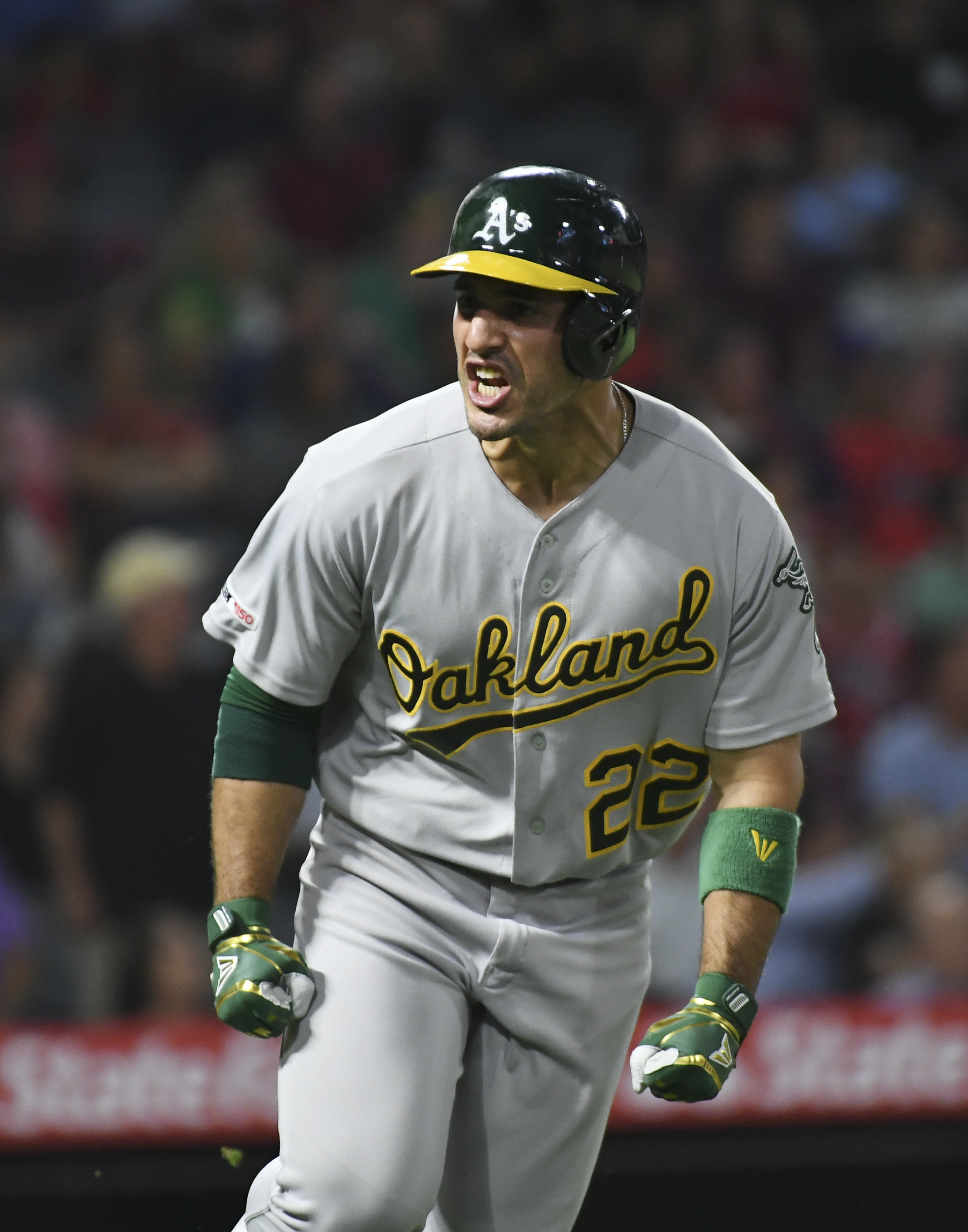
At the time of the swap, it barely drew notice. It certainly didn’t seem like any sort of egregious misstep. Laureano had turned in a woeful .227/.298/.369 slash in Double-A that year. He connected on 11 home runs and swiped 24 bags, showing a bit of pop and some speed, but his walk rate was cut in half from its 2016 mark. Scouting reports praised his glovework, but the Astros apparently didn’t think his defense was as good as it’s proven to be. Former GM Jeff Luhnow admitted to Chandler Rome of the Houston Chronicle last April that the Astros didn’t “quite [have] the defense rated as well as it’s played in the big leagues,” plainly calling the trade “one I’d love to have back.”
Laureano’s glove in 2019 didn’t play out quite as well as it did in 2018 — at least not in the estimation of most metrics. In just 385 innings in 2018, he logged +6 Defensive Runs Saved, a 3.7 Ultimate Zone Rating and +2 Outs Above Average. Those numbers dipped to +3, +0.7 and -5, respectively, in 1041 innings between center field and right field this past season. Even as his overall numbers might’ve taken a step back, Laureano showed off a cannon from both center and right. In 1426 innings at the MLB level, he’s racked up 17 assists — earning every bit of his “Laser Ramon” nickname.
As for his work at the plate, Laureano’s 2019 output matched his standout showing from his 2018 debut. Over the life of 481 plate appearances, he turned in a .288/.340/.521 batting line with 24 long balls and 13 stolen bases (in 15 attempts). That was good for a 126 wRC+ that lined up nicely with the 130 mark he posted as a rookie in 2018.
Overall, Laureano has appeared in 171 MLB games and taken 687 plate appearances — just over a full regular season’s worth of work. Between his outrageous arm, solid all-around defense, well-regarded baserunning ability and his strong work at the plate, he’s been worth 6.0 fWAR and 5.9 bWAR. That trade, considering the club control (through 2024) and low cost of acquisition, stands out as one of the best moves in recent memory for A’s executive vice president of baseball operations Billy Beane, GM David Forst and the rest of the Oakland staff.
Speaking of that cost of acquisition, it’s worth taking a look at what the Astros did get. The now-25-year-old Bailey is still a prospect of some note — albeit one that the ‘Stros almost lost for nothing. Houston opted to leave Bailey unprotected in December’s Rule 5 Draft, and the Orioles (headed up by former Astros assistant GM Mike Elias) snagged him with the second overall pick. Baltimore since returned him, but that selection speaks to Bailey’s ability in and of itself.
Last year, the right-hander logged a 3.30 ERA in a pitcher-friendly Double-A setting, averaging an even 10 strikeouts against 3.98 walks per nine innings pitched. He’s not an elite prospect, but Eric Longenhagen ranked him 30th among Houston farmhands at FanGraphs this winter, labeling him as a potential reliever with a “robust” arsenal. Clearly though, even if Bailey meets or exceeds that ceiling, he has a long way to go before making the Laureano swap look like anything less than a heist.
So, why did Houston move Laureano in the first place? The trade took place just prior to the deadline to set 40-man rosters in advance of the 2017 Rule 5 Draft, and the Astros weren’t set on adding Laureano after his aforementioned down year in Double-A. It’s a mistake that every club has made in some shape or form, and I’ll be the first to say that it’s not really fair to look back and make harsh judgments with the benefit of hindsight. That said, Astros decisionmakers have to cringe when they look back at the players they chose to preserve over Laureano.
The Astros themselves actually kept a 40-man roster spot open, which they used to select outfielder-turned-left-hander Anthony Gose from the Rangers in the Rule 5 Draft. Gose never pitched for Houston and wound up back with the Rangers. Preston Tucker was already on the 40-man roster but had posted a 102 wRC+ in Triple-A in 2017 without appearing in a big league game. He was designated for assignment less than a month after trading Laureano (clearing a roster spot for Hector Rondon). Houston also dedicated a 40-man roster spot to backup catcher Juan Centeno, whom they claimed off waivers a few days after trading Laureano.
As for players actually selected to the 40-man roster in protection from the Rule 5 Draft, Houston added lefty Cionel Perez and righty Dean Deetz. The former is still with the team but has yet to establish himself as a regular member of the pitching staff. The latter was hit with an 80-game PED suspension later that offseason and outrighted off the 40-man roster earlier this winter. He’s pitched 3 1/3 innings in the Majors.
Both Perez and Deetz were more highly regarded prospect at the time, and no one was labeling the Laureano deal any sort of heist or steal for the A’s. The purpose here isn’t to look back and say, “How could the Astros have possibly done this?!” but rather to give a tip of the cap to a savvy acquisition from the A’s that has not only greatly boosted their own long-term outlook but done so at the expense of a division powerhouse.
Oakland, after all, has Laureano penciled in as its center fielder for the next half decade and figures to reap enormous surplus value from his remaining pre-arb years and early arbitration seasons. For a low-payroll club, that’s all the more valuable. The Astros, meanwhile, are set to lose their entire outfield to free agency this winter. Vaunted prospect Kyle Tucker gives them one likely replacement, but it must be particularly difficult to see another would-be outfield cornerstone thriving with their closest competitor for AL West supremacy.
6 Potential DH Contributors For NL Clubs
The National League appears likely to implement the designated hitter in 2020 — much to the chagrin of many fans — suddenly giving 15 clubs the potential to bulk up their lineup with another non-pitcher bat. Several teams already have logical in-house options to fill that spot. However, there are a handful of yet-unsigned position players who’ll welcome the seemingly forthcoming influx of DH spots as they look to get another chance at the big league level. Let’s run through some still-available names…
- Yasiel Puig (29 years old): Puig was still a perfectly fine defensive right fielder last season, grading out as average via Defensive Runs Saved, Ultimate Zone Rating and Outs Above Average. A team may not look at him as a full-time DH because of that, but a club with an already-set outfield could now switch a more defensively challenged option to DH and slot Puig into right field. Or, Puig could simply rotate through DH and the outfield corners on a new NL club. The Giants have been oft-connected to Puig and have a piecemeal mix of options in the outfield. At the very least, an added DH spot wouldn’t hurt his chances of landing in San Francisco (or anywhere else in the NL).
- Jose Bautista (39): Joey Bats generated some chatter this winter when word got out that he was contemplating a return as a two-way player. The former home run champ set the record straight last month, indicating that while he did throw some bullpen sessions with friend/former teammate Marcus Stroman this winter and would welcome the opportunity, he’s more focused on a return as a hitter. Bautista’s glovework declined quite a bit in his late 30s, but he walked at a 14 percent clip and posted a .168 ISO in his final two seasons in 2017-18. He’s kept himself in shape — could he have one more run left in him?
- Mark Trumbo (34): Knee problems torpedoed Trumbo’s 2019 season and much of his 2018 campaign as well, though he did return late last year to appear in a dozen games with the Orioles. While 2019 was a lost season, the slugger hit .261/.313/.452 in 358 plate appearances in 2018 (105 wRC+, 108 OPS+). Trumbo has never been much of an OBP threat, but he has massive power from the right side — evidenced by an MLB-best 47 homers in 2016. He was open about his uncertain baseball future back in November, but 15 new DH slots could give him an unexpected opportunity.
- Melky Cabrera (35): The Melk Man is still hoping to play another couple seasons, but deteriorating glovework has become increasingly difficult to overlook. That said, the switch-hitter hasn’t batted lower than .273 in the past decade, and his contact skills generally make him a source of a respectable OBP even though he doesn’t walk that much. Cabrera’s .280/.313/.399 slash with the Pirates last year was below-average on the whole (88 OPS+, 85 wRC+), but he was an average or better hitter in the three preceding seasons. Melky carried an .807 OPS into the All-Star break last year, but he hit just .231/.257/.306 down the stretch as his role shrunk. To his credit, he struck out at just a 10.3 percent clip last year.
- Hanley Ramirez (36): HanRam’s comeback attempt with the Indians last year was a bust. He homered in his second game of the season but went deep just once more, posting an ugly .184/.298/.327 slash in 57 plate appearances before being cut loose. Ramirez underwent shoulder surgery last summer, revealing that he’d been plagued by shoulder pain for several years and making clear that he hoped to play in 2020. He played in the Dominican Winter League this offseason, hitting .273/.298/.418 in 57 plate appearances. Ramirez has a lot to prove, but maybe an NL club would take a flier in a rebooted Spring/Summer Training and hope to catch lightning in a bottle.
- Lucas Duda (34): Nothing went right for Duda last year, although the Royals still gave him 119 plate appearances. In that time, he posted a disastrous .171/.252/.324 slash, and he wasn’t much better in Triple-A, hitting .202/.281/.303 in 114 PAs between the affiliates for Kansas City and Atlanta. Duda showed solid power while bouncing around the league in the two seasons prior, hitting .228/.318/.482 with 44 home runs in 253 games spread across five teams — including a 30-homer effort in 2017. Last year didn’t inspire any confidence, but he’s only 34 and could perhaps operate as a platoon option or lefty bench bat.
There are still some other unsigned players. Scooter Gennett never latched on with a team this winter. Tim Beckham remains unsigned, though he still has to serve the final 32 games of an 80-game PED ban. Russell Martin is a free agent. It’s doubtful that any of those players would markedly impact a team’s DH picture or see his market improved by the new presence of a DH (although any could draw increased interest as a bench option by virtue of expanded rosters). It’s also possible that some veterans on minor league deals could opt out or be cut loose once training camp resumes, thus entering the mix for potential DH work in the NL. Carlos Gonzalez, for instance, was reportedly unlikely to make the Mariners’ roster.
Most clubs will probably prefer to handle the DH spot internally rather than hand out more money at a time when revenue is already being slashed by the pandemic stoppage. But for the non-Puig veterans here who are simply looking for one more chance to revive their careers, a sizable commitment wouldn’t be expected anyhow. Whether it’s one final run for Joey Bats (with a bullpen appearance or two?), a Hanley Homecoming in Miami, a Trumbo resurgence or any number of other scenarios, there could be some fun storylines to follow.
MLBTR Chat Transcript
Click here to read a transcript of this week’s chat with MLBTR’s Steve Adams.
NL East Notes: Mets, Realmuto, Cano, Marlins, Brinson, Sierra
Let’s check in on a pair of teams from the National League East…
- The Mets pushed hard to land J.T. Realmuto before he was ultimately traded from Miami to Philadelphia, and Mike Puma of the New York Post writes in his latest mailbag column that the team’s pursuit of Realmuto might not yet be over. Realmuto is represented by CAA, the former agency of GM Brodie Van Wagenen, and current catcher Wilson Ramos has a club option for the 2021 season that isn’t a lock to be picked up ($10MM or a $1.5MM buyout). The Mets have acquired several of Van Wagenen’s former players since he became GM — Jed Lowrie, Michael Wacha and Robinson Cano — although CAA has a rather large base of clients and Van Wagenen has certainly added plenty of players from other firms (Ramos, J.D. Davis, etc.). Still, there’s no obvious in-house alternative if the team opts to move on from Ramos — or to pick up his option and look to trade him. Realmuto would indeed be an upgrade, particularly on the defensive side of things, which is notable given the questions that arose regarding Ramos’ glove in New York last year.
- The COVID-19 shutdown hasn’t been fun for anyone, but Cano has at least found a silver lining during the delayed season. Cano said Tuesday that the downtime has “been beneficial for me for sure” physically, as Tim Healey of Newsday relays. “My legs feel strong right now,” continued Cano, who’s champing at the bit to return to the diamond. “Just can’t wait to go back on the field, and then play.” If there is a season, the longtime star, 37, will aim to rebound after a rough debut campaign with the Mets. Cano hit just .257/.307/.428 with 13 homers during an injury-limited, 423-plate appearance season.
- Expanded rosters should be quite favorable for several Marlins outfielders who might not have been a lock to make the team, writes Barry Jackson of the Miami Herald. Lewis Brinson has drawn his share of flak having yet to produce after arriving as the centerpiece in the widely panned Christian Yelich trade, and he’d be “very, very” likely to break camp with an expanded roster. Magneuris Sierra is out of minor league options and was a risk to be exposed to waivers given his lack of big league production, but greater roster flexibility and his elite speed make him a likely bench piece at the very least. Sierra, like Brinson, came over in a high-profile swap — the Marcell Ozuna deal — although the Fish have already fared quite a bit better in that deal. Sandy Alcantara was that trade’s headliner, while righty Zac Gallen was also in that deal and has since netted the team top shortstop prospect Jazz Chisholm.