
Advertise With MLB Trade Rumors
The Trade Rumors network consists of MLB Trade Rumors, Hoops Rumors, Pro Football Rumors, and Pro Hockey Rumors. In aggregate, our four sites received 389 million pageviews in 2023. For details on advertising opportunities, please check out our media kit here.
White Sox, Dylan Cease Avoid Arbitration
The White Sox avoided arbitration with righty Dylan Cease by agreeing to an $8MM deal, according to Robert Murray of FanSided.
Cease, a client of the Boras Corporation, fell short of our projection in agreeing to a $2.3MM raise over last year’s salary. As a player with four years of Major League service time, Cease will be eligible for arbitration once more for 2025 before reaching free agency.
Cease, who recently turned 28, had an off-year results-wise in 2023 with his ERA climbing to 4.58. Still, his 97 starts over the last three seasons leads all of MLB, and he finished second in the 2022 AL Cy Young voting coming off a 2.20 ERA. Cease averages about 96 miles per hour on his fastball and misses plenty of bats, though he also issues a lot of free passes.
Cease remains one of the top remaining trade candidates of the 2023-24 offseason. New White Sox GM Chris Getz has been fielding inquiries, and there’s likely at least a half-dozen suitors. You can read up on the latest Cease rumors here.
At present, though, Cease leads a projected White Sox rotation that also includes new additions Erick Fedde, Mike Soroka, and Chris Flexen, as well as holdover Michael Kopech.
2023-24 MLB Free Agents
The following players are currently free agents. Each player’s 2024 age is in parentheses. The cutoff for this list is typically 50 plate appearances or 20 innings pitched in the Majors in 2023.
For a free agent list that can be filtered to signed or unsigned players, position, age, handedness, and much more, check out our MLB Contract Tracker. The Contract Tracker is only available to Trade Rumors Front Office subscribers.
Updated 3-27-24
Catchers
Manny Piña (37)
First Basemen
Brandon Belt (36)
Wil Myers (33)
Darin Ruf (37)
Donovan Solano (36)
Second Basemen
Hanser Alberto (31)
Jonathan Schoop (32)
Jean Segura (34)
Donovan Solano (36)
Shortstops
Adalberto Mondesi (28)
Third Basemen
Evan Longoria (38)
Jean Segura (34)
Left Fielders
Corey Dickerson (35)
Austin Meadows (29)
Tommy Pham (36)
AJ Pollock (36)
Raimel Tapia (30)
Center Fielders
None
Right Fielders
Wil Myers (33)
Designated Hitters
Kyle Lewis (28)
Austin Meadows (29)
Starting Pitchers
Matthew Boyd (33)
Mike Clevinger (33)
Johnny Cueto (38)
Zack Greinke (40)
Rich Hill (44)
Noah Syndergaard (31)
Julio Urias (27)
Vince Velasquez (32)
Right-Handed Relievers
Anthony Bass (36)
Brad Boxberger (36)
Codi Heuer (27)
Mark Melancon (39)
Zach Neal (35)
Alex Reyes (29)
Nick Wittgren (33)
Left-Handed Relievers
Jarlin Garcia (31)
Brad Hand (34)
Aaron Loup (36)
Marc Narducci: My Hall Of Fame Ballot
Marc Narducci spent 37 years covering all sports for The Philadelphia Inquirer before retiring in July 2021. He covered everything from high school sports to the Phillies winning the World Series and the Eagles winning the Super Bowl. A lifelong southern New Jersey resident, he remains a freelance writer and broadcaster. Once again, Marc reached out to see if MLB Trade Rumors would be interested in publishing his Hall of Fame ballot. I am happy to do it and hope it can be an interesting topic of debate for our readers. Here’s Marc…
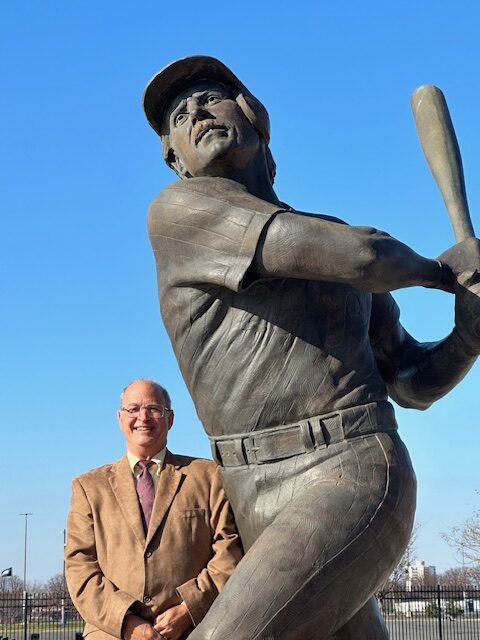
This was an extremely difficult baseball Hall of Fame ballot because it causes debate over those who prioritize longevity over others who place emphasis on shorter-term excellence.
Before going into the ballot, a little bit about the philosophy of this voter.
First off, I won’t criticize anybody’s ballot. There are many different opinions on what a Hall of Fame player should be and that is fine.
As stated last year at MLBtraderumors.com and in also in 2021, I have not voted for those associated with steroids.
As one can see from the comments sections, there are many of you who have disagreed and that’s fine. I’m not here to try to convince anybody to change his or her mind. This is just the way I feel, how the steroid era put such a stain on the game.
I have also not voted for Carlos Beltran, who admittedly was the mastermind of the 2017 Houston Astros sign-stealing scandal. Those actions cost him his job as a manager and for now, this vote.
Again, I can see people who think this is crazy to keep such an accomplished player off the ballot. I’m not here to attempt to convince anybody either way, just to say this is what went into my voting.
I don’t think all the Astros should be punished, but that’s another story for another day.
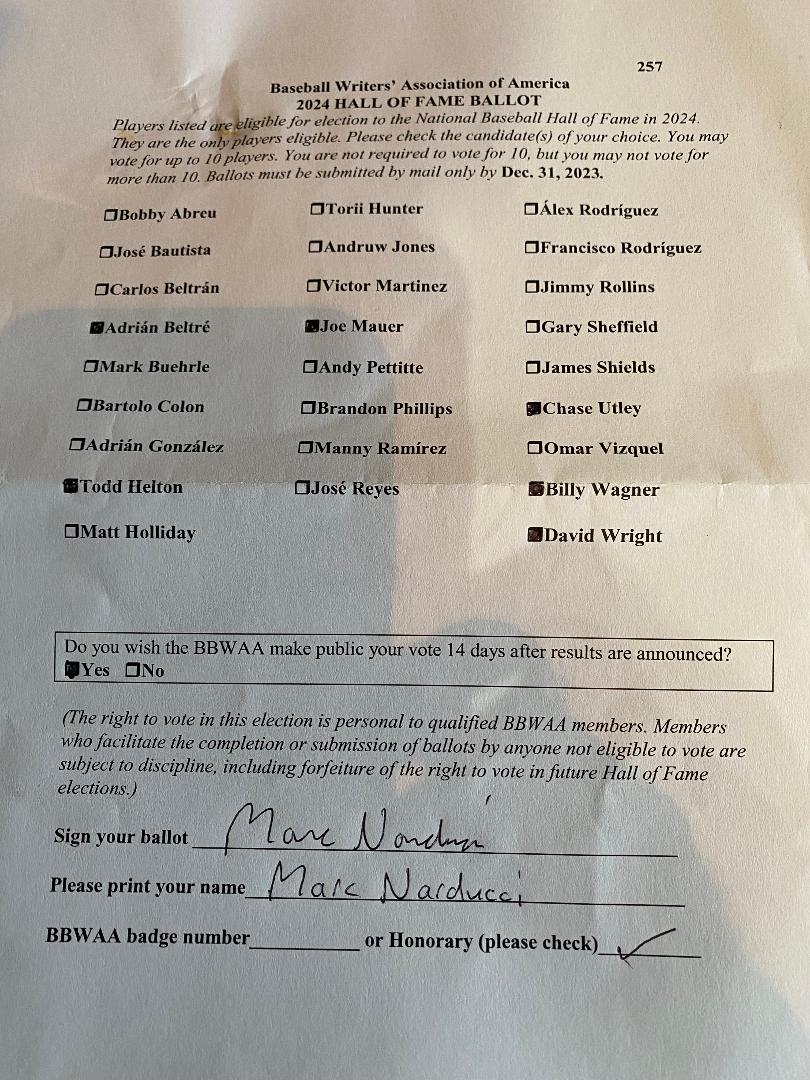
Now, for the ballot.
There are two holdovers who I voted for last year and we will start there.
Helton, now in his sixth year on the ballot, is close to the finish line. He received 72.2% of the votes. Just a refresher, a player needs 75% of the votes. For those who didn’t see last year’s story, we’ll reiterate his case.
The negative perception is that he was a product of playing his entire career at Coors Field. The splits were significant home and away.
Yet his .287/.386/.469 slash line on the road was impressive, but it did pale in comparison to his numbers at Coors – .345/441/.607.
His career line was .316/414/.539.
While the sabermetrics community may scoff at batting average, it takes a lot to hit .300 for a season, let alone a career. Last season just nine players with the required 502 plate appearance hit .300.
In 2000, Helton won a batting title hitting .372.
Here were his splits that season – home: .391/.484/.758. Away: .353/.441/633.
He was a first baseman who wasn’t known for his power, but he still hit 369 home runs and had 1,406 RBI, while playing all 17 seasons for the Rockies.
Helton was a five-time All-Star, a four-time Silver Slugger winner and a three-time Gold Glove recipient.
It’s more than enough to put him on this ballot.
Wagner is in his ninth year on the ballot and keeps moving closer. (How a person fares on other ballots doesn’t impact this vote, but it is good to note how close or far somebody is from being elected).
Wagner last year earned 68.1% of the votes.
The two knocks against Wagner are his low innings total and his postseason struggles.
Both are valid points.
Wagner pitched just 903 innings. His postseason production, even though it only consisted of 11 1/3 innings over 14 appearances, was poor to say the least. He had a 10.03 ERA, although Wagne did convert all three save opportunities.
His positives outweigh the negatives.
In looking for a HOF player, I like to see excellence. Wagner’s 11.9 strikeouts per nine innings (minimum of 750 innings pitched) is the best in MLB history.
Wagner had 422 saves, and an impressive save percentage (86%). His career 2.31 ERA and 187 ERA+ are second best among HOF relievers. Only Mariano Rivera (2.21 ERA, and 205 ERA+) is better in both categories.
The newcomers
There won’t be much convincing to do here. Beltre’s career 93.5 rWAR is surpassed by just two HOF third basemen – Mike Schmidt (106.8) and Eddie Matthews (96.0).
Here were Beltre’s career numbers – .286/339/.480 for his career with 3,166 hits, 477 home runs, 1707 RBI and a 116 OPS+. One thing that is interesting is that he was just a four-time All-Star. He won five Gold Gloves, four Silver Sluggers and was a Top 10 MVP finisher six times.
The only question with Beltre is whether he will be a unanimous choice.
Here is where the debate starts. The knock against Mauer is that while he was an excellent catcher, he only played the position for a decade. Due to concussions from catching, he moved to first base for the final five seasons. He caught 70 or more games eight times. In total he caught 921 games, making 885 starts as a catcher.
In those 10 seasons he hit .323/405/.469 with a 135 OPS+.
When somebody does something historical, the feeling here is that it should add to his HOF candidacy. Mauer is the only catcher to win three batting titles, in 2006, 2008 and 2009. In those three years, he caught 120, 139 and 109 games respectively. He batted .347 in 2006, .328 in 2008 and .365 in 2009.
During those first 10 seasons, he was a six-time All-Star, won an MVP (in 2009) and finished in the Top 10 four times. Mauer also earned five Silver Slugger awards and three Gold Gloves.
Is that enough production in a decade of work?
Due to the demands of the position, we think so.
Plus, how much did the toll of catching and the injuries contribute to the decline after he switched positions?
His final five seasons were well below HOF worthy – .278/.359/.388 with a 105 OPS+. Never a big home run hitter, he hit 38 of his career 143 home runs in the final five seasons.
Still, even with the decline, here are his career statistics – .306/.388/.439 with a 124 OPS+.
Only eight HOF catchers have a higher career rWAR than Mauer (55.2).
He certainly did enough in his years as a catcher to make this ballot.
The longevity issue is what hurts Utley. Utley had a five-year stretch that was definitely HOF standard. From 2005-2009, he hit .301/.388/535 and averaged 29.2 home runs. 110.6 runs, 101.4 RBI, 151 games and 675 plate appearances. His fWAR average for those five years was an astonishing 7.7.
During this span Utley earned four of his six All-Star appearances.
The Phillies made the playoffs the final three of those seasons, winning the World Series in 2008 and losing to the NY Yankees in the 2009 World Series. Utley hit five home runs in the 2009 series, which is tied for the most in MLB history. Reggie Jackson in 1977 and George Springer in 2017 also hit five.
He had other strong seasons, but none to match this five-year average.
His career numbers, especially for a second baseman were strong – .275/.358/.465 and a 117 OPS+. He had 1,103 runs and 1,025 RBI. Will the fact that he had fewer than 2,000 hits (1,885) hurt Utley?
Probably in the eyes of some, but he ended up being a six-time All-Star and earning four Silver Slugger Awards.
Only 10 HOF second basemen have a higher rWAR than Utley (64.5). Only four HOF second basemen have more home runs than Utley (259).
Injuries caught up to Utley, but he was more than a five-year wonder. Even after 2009, he would make two other All-Star teams and from 2010-2014 had an average OPS+ of 116.
Utley played the game hard, was a quiet leader of during the greatest run in Phillies history when they qualified for the playoffs five consecutive seasons 2007-2011.
It is understandable for those who feel he didn’t perform at a top level long enough, but he did enough to get on this ballot.
New York Mets third baseman David Wright was on a HOF trajectory before spinal stenosis ended his career. Wright’s last full-time year was his age-31 season in 2014.
His counting stats, which included 1,777 career hits and 242 home runs, will be used against him, but Wright had an impressive nine-year peak, where he earned seven All-Star berths. The seven all-star games matched last year’s HOF inductee Scott Rolen.
From 2005-2013, Wright hit .302/.384./.505 with a 138 OPS+. Wright averaged 23 home runs, 90 runs and 93 RBI. During this time, he won two Gold Gloves, two Silver Slugger awards, and finished in the Top 10 in MVP voting four times. After this period, he would play just one more full season, 2014 when the decline began.
His final career numbers were .296/376/.491 and a 133 OPS+. Only seven HOF third baseman have a higher OPS+ than Wright.
Should Wright be penalized for suffering what turned out to be a career-ending injury, that ended his full-time status after his age 31 season?
It can be argued that durability is part of being a HOF player and that is a good case, but Wright was the face of the franchise, a perennial All-Star and a strong two-way performer.
We can see both sides of this argument, just as we can for Utley and to a degree Mauer, but these players did enough to make it onto this ballot, even if their excellence was shorter than some would like.
Angels Sign Francisco Mejia To Minor League Deal
The Angels signed catcher Francisco Mejia to a minor league deal, according to reporter Miriam Luz. The deal includes a spring training invite.
Mejia, 28, put up a .227/.258/.400 batting line in 160 plate appearances for the Rays this year. He split time behind the dish for Tampa Bay with Christian Bethancourt, logging 381 innings. Mejia hit the IL in late July with an MCL sprain, an injury that cost him about a month. Upon his activation in August, the Rays instead chose to designate Mejia for assignment, sticking with Rene Pinto as their backup catcher. Mejia then accepted his outright assignment, so as not to abandon the remainder of his $2.155MM salary. He then elected free agency in October.
Signed out of the Dominican Republic in 2012, Mejia broke out as a bat-first switch-hitting Indians prospect in 2016. Prior to the 2018 season, Baseball America considered him the 20th best prospect in the game, while MLB.com had him at #11.
In July of 2018, the Indians traded Mejia to the Padres for relievers Brad Hand and Adam Cimber. Mejia made the Padres in 2019 as the backup to Austin Hedges, though by the end of 2020 he was optioned to Triple-A. In December of 2020, Mejia was again traded, this time heading to the Rays with Luis Patiño, Blake Hunt, and Cole Wilcox for Blake Snell. Mejia and Patiño, the principals in that trade, have fallen far in these three years. Patiño was claimed on waivers earlier today, returning to the Padres. Snell, meanwhile, reached free agency, won his second Cy Young award, and was reported yesterday as an Angels priority by Susan Slusser of the San Francisco Chronicle.
Mejia paired up with Mike Zunino to form the Rays’ catching tandem in 2021. He posted a .260/.322/.416 batting line in 277 plate appearances, providing the best offense of his career to date. In 2022, with Zunino on the injured list, Mejia led the Rays and set a career-high with 638 1/3 innings caught, despite injuries of his own.
Though Mejia is still relatively young, he generally hasn’t impressed defensively and his highly-touted bat never materialized. Logan O’Hoppe holds the starting catching job for the Angels, and Mejia will have to supplant Matt Thaiss for the Halos’ backup role. The Angels shipped catcher Max Stassi to the Braves earlier this month along with David Fletcher, who then flipped Stassi to the White Sox. It’s been a quiet offseason otherwise for Angels GM Perry Minasian, who has seen Shohei Ohtani depart and has thus far added three relievers in Luis Garcia, Adam Cimber, and Adam Kolarek.
MLB Trade Rumors Reader Survey
If you have a few minutes, please take the survey at this link. We will be using this data in the aggregate in efforts to sell advertising.
Check Out Our MLB Contract Tracker!
As the MLBTR team has been doing contract research this winter, we’ve been loving our MLB Contract Tracker tool. Below is a video showing off some of its capabilities.
[fvplayer id=”2″]
The MLB Contract Tracker is only available to Trade Rumors Front Office subscribers. Many MLBTR readers have signed up recently, so this post will serve as a brief explainer/tutorial on some of the Contract Tracker’s features.
What is the MLB Contract Tracker?
The MLB Contract Tracker is a database containing Major League free agent contracts, minor league free agent contracts, and multiyear extensions dating back to October 1, 2006. The Contract Tracker is updated daily with new contracts, and we’re also planning to add data prior to 10-1-06. Player names are linked to the MLBTR post, so it’s easy to follow up and read about the deal.
That’s a ton of data. How can I slice it up?
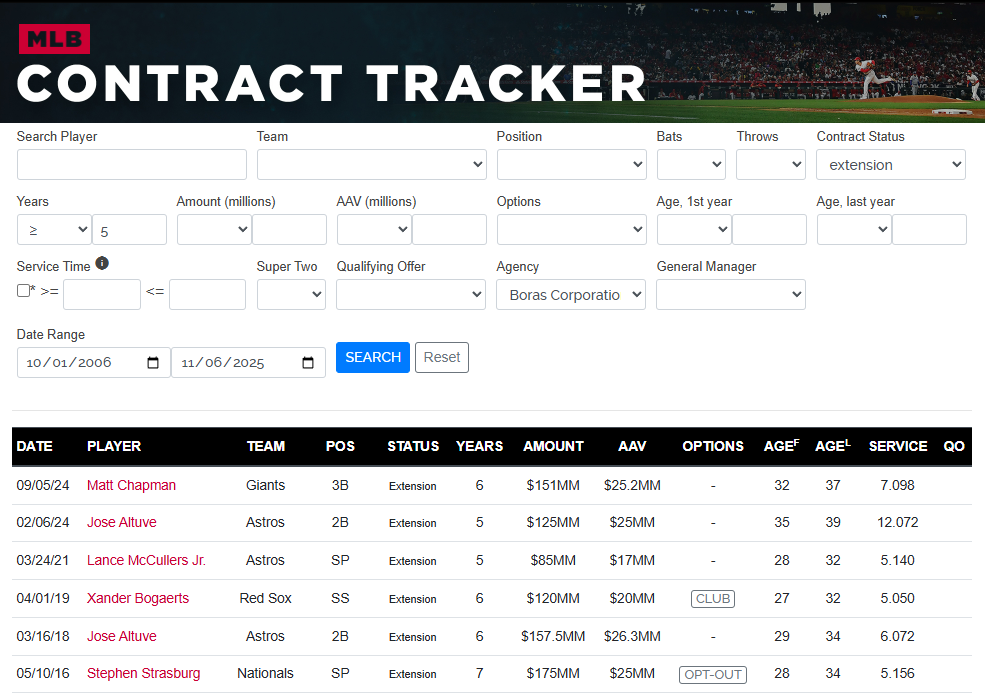
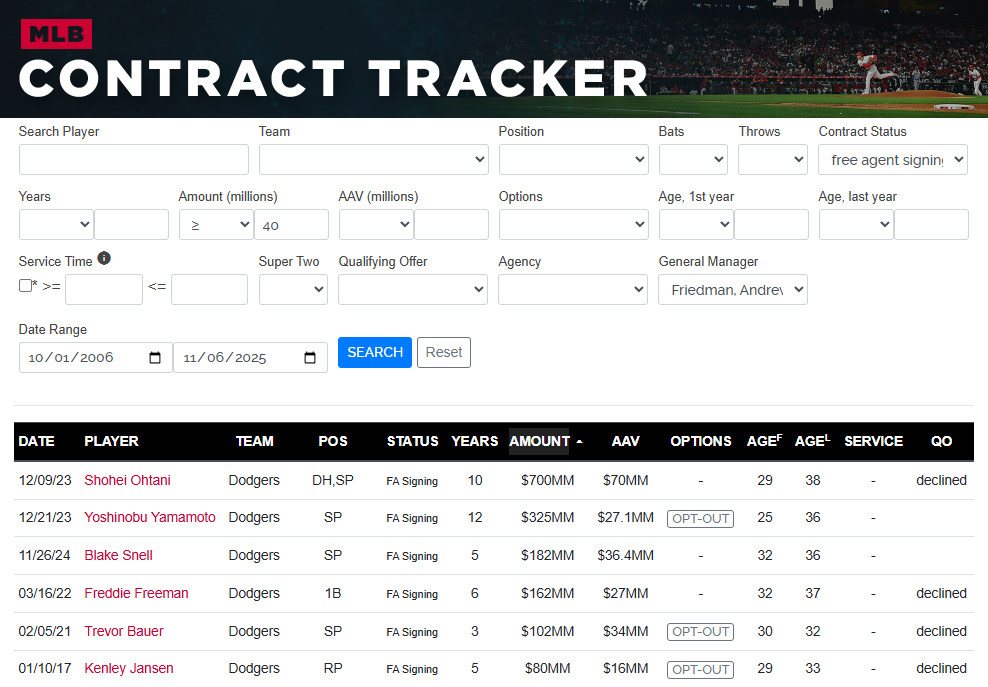
You can filter by player name, team, position, batting handedness, throwing handedness, contract type (MLB deal, minor league deal, extension), number of years, amount of total money, average annual value, type of option, age in the first year of the deal, age in the last year of the deal, service time for those who signed extensions, Super Two status, qualifying offer status, agency at the time of signing, GM at the time of the signing, and any date range from 10-1-06 to present.
What makes this tool unique?
Many aspects of the MLB Contract Tracker are unique. I have found the “age in first year” and “age in last year” filters to be valuable in learning, for example, how often a pitcher who will be 34 in Year 1 of a free agent contract has signed for at least four years. Or how many players have been signed through the age of 40 on a deal of four or more years.
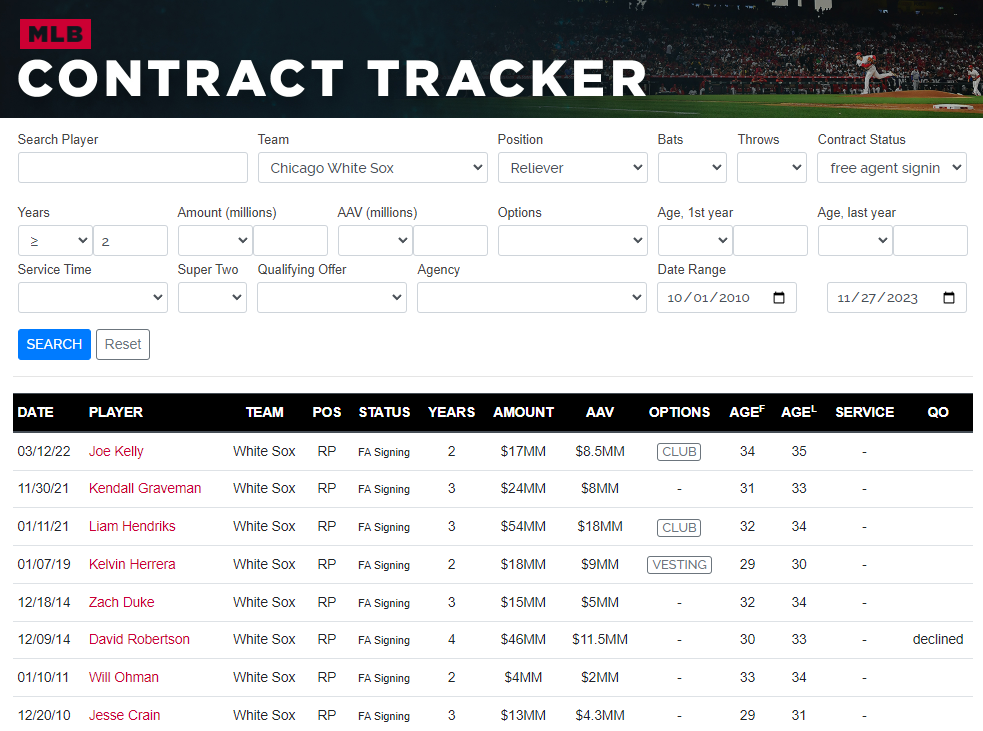
Other tools lack most of the above-listed data and accompanying filters. Our tool allows for endless combinations of filtering. You may want to know how many multiyear deals for relievers a certain team has done in the last ten years, which agencies have represented players who accepted qualifying offers, or the largest extensions for outfielders with less than four years of service. The only limit is your imagination!
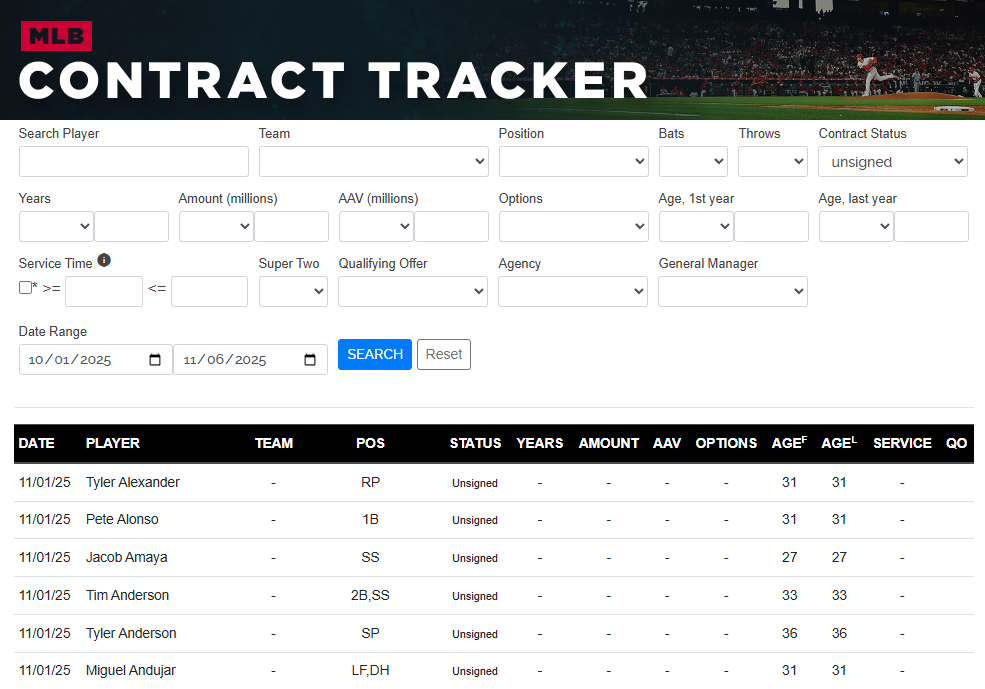
How about some screen shots demonstrating how to use the MLB Contract Tracker?
I thought you’d never ask! These might not show up if you’re in our app, so you’ll want to go to the actual website.
Why Shohei Ohtani’s Contract Structure Is Not A Luxury Tax Dodge
Earlier today, we learned that Shohei Ohtani‘s $700MM contract with the Dodgers has a stunning deferral structure: he’ll earn a mere $2MM in each of the ten seasons he’s agreed to play baseball for the club, and then $68MM per year from 2034-43.
Based on what I’ve seen on social media tonight, a lot of baseball fans think the purpose of these deferrals is for the Dodgers to “dodge” the competitive balance tax (yes, t-shirts are already being drawn up). Here’s why that’s wrong.
The collective bargaining agreement has a section for calculating the CBT hit for a contract that includes deferred money. According to reports, that calculation works out to a $46MM average annual value and accompanying CBT hit for the Dodgers and Ohtani. As you can see here, $46MM tops Max Scherzer‘s previous AAV record of $43,333,333.33. It’s $6MM beyond Aaron Judge‘s $40MM AAV, which was the highest for a player on a deal of more than three years.
Not only is $46MM a record AAV, but it’s entirely in line with expectations. MLBTR predicted a $44MM AAV for Ohtani. Most other prognosticators were in that range. In fact, the median Ohtani AAV prediction of the other six outlets we’re tracking was $45,984,849. It would be almost impossible for Ohtani’s luxury tax AAV to have met expectations any harder.
The problem is the initially reported $70MM AAV. That was the first number people saw, and it gets ingrained for fans after being seen in thousands of headlines. The agent certainly didn’t mind. Though news of significant deferred money quickly followed and ESPN’s Jeff Passan narrowed it down to $40-50MM yesterday, more precise numbers weren’t known until today.
There was enough time for the shocking $700MM and $70MM figures to take hold. So it’s logical for some fans to say the Dodgers are paying Ohtani $70MM a year but “getting away with” just a $46MM CBT hit. However, I’d argue that the $70MM figure was never “real,” in that it dwarfs expectations and there’s no current indication that any team offered anything close to that AAV without huge deferrals. The $46MM AAV is what matters. Ohtani moved the AAV record forward as expected, but only by about six percent rather than an insane 62%.
MLB does have the power to stop teams from circumventing the CBT, but this doesn’t qualify. In fact, it is explicitly allowed. As Passan explained tonight, the CBA specifically says, “There shall be no limitations on either the amount of deferred compensation or the percentage of total compensation attributable to deferred compensation for which a Uniform Player’s Contract may provide.” This is just my opinion, but perhaps if the deferrals led to a luxury tax AAV below $35MM or so on Ohtani, MLB might have considered it a tax dodge, but not for a record $46MM.
Ah, but what about Jon Heyman’s report a year ago about how the Padres “were contemplating” a 14-year offer for Aaron Judge that would’ve taken him through age 44? About that, Heyman noted, “sources say they would not have been allowed, as MLB would have seen the additional years as only an attempt to lower their official payroll to lessen the tax.”
MLB would’ve been right – there would be no other reason to pay Judge through age 44. Teams are loathe to pay players that far into their careers, and of course the vast majority of players do not have MLB careers at age 44. Our MLB contract tracker goes back to 10-1-10, and the only contracts of three or move years that even went through age 41 were for Albert Pujols and Yu Darvish. So there’s simply no precedent for paying Judge three years longer than that. Furthermore, even based on Heyman’s reporting, none of this actually happened: Heyman did not report that the Padres made a 14-year offer or that MLB actually tried to stop something. Just that they would (I’d say “might”) have stopped it. As I was contemplating how long Ohtani’s contract might go, I think you could at least make a case to go through age 42.
All that said, Ohtani’s contract structure does present a big advantage to the Dodgers. I mean, they’re actually paying him $2MM a year. Many arbitration eligible utility players or relievers make more. Paying Ohtani so little seems ludicrous in that sense, even if it is within the rules. A team’s CBT payroll uses the average annual value of each contract, and that determines their luxury taxes. But teams also operate off real payrolls, where a player on a two-year, $20MM deal might actually be paid $5MM in the first year and $15MM in the second despite his $10MM CBT hit.
The Dodgers have a certain budget or target with that real payroll, and instead of paying Ohtani $46MM on that payroll, they’re actually paying him less than Austin Barnes. That means, in theory, the Dodgers can more easily afford to add more quality players, such as Yoshinobu Yamamoto.
So, is this a problem? Does deferring 97.1% of a huge contract mean baseball is broken, and does it represent a major point of contention when the CBA expires after the 2026 season? Lindsey Adler of the Wall Street Journal wrote tonight, “According to league and union sources, MLB has proposed limiting deferrals in prior CBA negotiations, but the MLBPA has declined those limits because deferrals allow a player flexibility that allows a contract to be worth, let’s say, $700 million instead of $460 million.”
When this came up previously in CBA talks, it was probably more of a “nice to have” for MLB, but not something for which they’d actually make a concession to the MLBPA. The MLBPA won’t want to give this up, for the handful of players who actually want their payment deferred 20 years into the future. As you know, money is worth more now than it is in the future, so players have not exactly been clamoring to wait until retirement age to receive 97.1% of their contract. I’m sure deferred money will come up in the next CBA talks, and may even be eliminated, but one player doing it does not translate to a hot button issue or something where billions of dollars hang in the balance. They’ll find more consequential things to fight about.
Ohtani can do this because he is not a normal MLB player, and he rakes in significant endorsement money every year. And as The Athletic’s Fabian Ardaya and Evan Drellich explain, Ohtani’s choice on deferrals gives the Dodgers payroll flexibility to add other players and may give him a tax benefit if he isn’t living in California when the $68MM salaries start rolling in.
As Jack Harris of the L.A. Times notes, Ohtani “took this approach…with all the teams he negotiated with.” Given that Ohtani’s contract roughly equates to a 10-year, $460MM deal, I’d argue that he’s chasing rings a lot more than he’s chasing every last dollar. Any team could have done this deal, but Ohtani wanted to play for the Dodgers.
The combination of Friday’s shaky reporting suggesting Ohtani was heading to the Blue Jays, plus an unprecedented contract structure, seems to be leading some fans to villainize him. I think that’s a shame, because he has been squeaky-clean off the field and remains a generational and thrilling player.
Download Our Free Trade Rumors App
At the prompting of MLBTR readers, we have fixed bugs related to leaving comments and muting people in the Trade Rumors iOS app. Sorry for the delay on those fixes. If you have noticed other bugs in our iOS or Android apps, please mention them in the comments of this post if you’re so inclined.
The codebase for both apps is getting a bit long in the tooth, so we are planning a full revamp hopefully by late 2024. If there’s something you’d like to see in the new Trade Rumors app next year, let me know in the comments!
That said, both apps still get the job done, and they allow you to set up feeds and notifications for MLB, NBA, NFL, and/or NHL, as well as any combination of teams and players for those leagues. Click here to download our iOS app and here for Android.
Please note: many of you may already be reading this post in the app, in which case there’s no need to download anything. And others may not be aware that the app is based on our four longstanding websites: MLB Trade Rumors, Hoops Rumors, Pro Football Rumors, and Pro Hockey Rumors.
Support Our Winter Meetings Coverage With An Ad-Free Subscription
The 2024 MLB Winter Meetings are upon us! Team executives and agents are ready to make some deals in Nashville. The top storyline this year is two-way superstar Shohei Ohtani, only the biggest free agent in MLB history. On top of that we’ve got a pair of 25-year-old stars on the market: ace righty Yoshinobu Yamamoto has been posted by Japan’s Orix Buffaloes, and Padres left fielder Juan Soto could be traded.
There are many other free agents and trade candidates, of course, and MLBTR will have round-the-clock coverage of the firehose of hot stove news coming out of Nashville. That includes our overnight news coverage, as you may have seen. We’ve been doing this for 18 years and we’re excited as ever for this offseason!
If you’re one of the millions of people hitting F5 constantly on this website this week, please consider purchasing an ad-free subscription for $29.89 per year. We call this service Trade Rumors Front Office, and we pack a ton of value into it. You get to enjoy the website and app with no ads, you gain access to our industry-approved MLB Contract Tracker, and we’re sending out exclusive articles and chats from Steve Adams and Anthony Franco every week. Your subscription also supports our independent company in a time of declining ad rates. Check out Trade Rumors Front Office today!