
Read The Transcript Of Our Chat Hosted By Former MLB Pitcher Collin Balester
Righty Collin Balester was part of the last-ever Montreal Expos draft in 2004, as the club took him in the fourth round out of Huntington Beach High School. Though he came from a surfing family, according to Baseball America, Balester moved quickly through the lower minors. By 2007, he was considered the Nationals’ best prospect and a future number one or two starter.
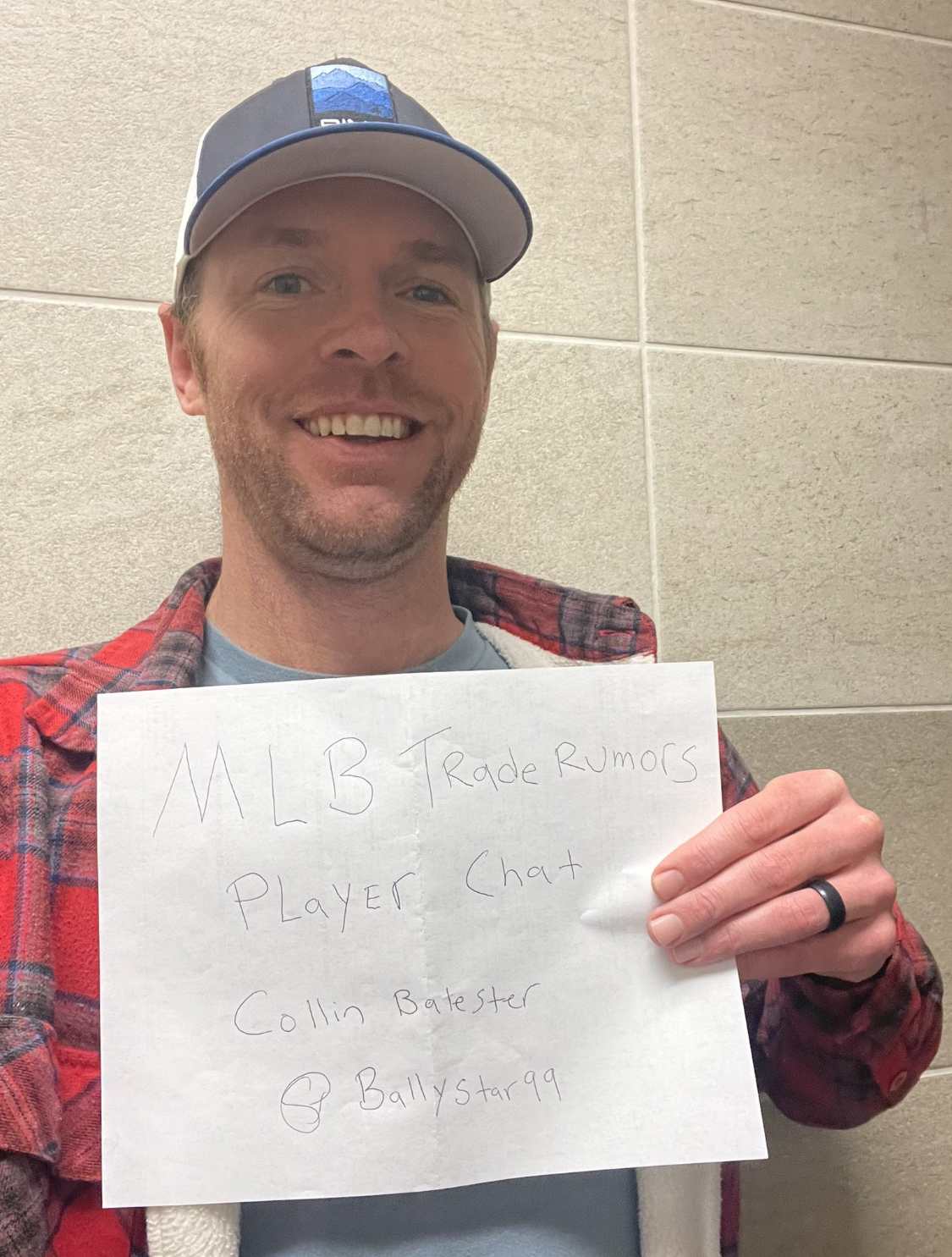
During the summer of ’08, Balester was deemed ready to join the rotation of the tanking Nationals club. He made a career-high 15 starts as a 22-year-old rookie, putting up three quality starts in the process.
Balester eventually moved into a relief role for the Nats, but was traded to the Tigers in December 2011. His career also included stops in the Rangers, Pirates, Reds, and Giants organizations, as well as a stint with KBO’s Samsung Lions. Along the way, Balester underwent Tommy John surgery in June 2013, battling to get back to the Majors with the Reds in after a gap of more than three years.
Ultimately, Collin topped 200 total innings in the Majors in parts of six different seasons. Along the way he managed to strike out Ken Griffey Jr., Buster Posey, Freddie Freeman, and Chipper Jones, among many others. Now 36, Collin owns a juice shop with his wife called Local Roots, and also does logistics for an expedited shipping truck company. Give him a follow @Ballystar99 on Twitter.
Collin took questions from MLBTR readers today, covering a wide range of topics including being traded, pitching in Korea, being on the 2012 Tigers, and his juice and smoothie recommendations. Click here to read the transcript!
If you’re a current or former MLB player, we’d love to host you for a future chat! It only takes one hour, and you get to choose which questions to publish and answer. Contact us here!
Read The Transcript Of Our Chat Hosted By Former MLB Pitcher Cory Wade
Righty Cory Wade was drafted by the Dodgers in the 10th round in 2004 out of Kentucky Wesleyan College “after setting the career record for strikeouts at Indianapolis’ Broad Ripple High,” according to Baseball America. He broke into the Majors in late April of 2008 as a 24-year-old, tossing a scoreless inning against the Diamondbacks at Dodger Stadium.
As Wade’s stellar rookie season continued, he gained the trust of manager Joe Torre. He finished the regular season with a 2.27 ERA in 71 1/3 innings, ranking third among all relievers. Wade was a key part of the Dodgers’ NLDS sweep of the Cubs in ’08, pitching well out of L.A.’s bullpen in all three games.
Unfortunately, Wade’s Dodgers career was derailed by shoulder surgery. He battled to get back to the Majors, opting out of a minor league deal with the Rays in the summer of 2011 and signing with the Yankees. Wade jumped straight into the Yankees’ big league bullpen on June 15th, posting a 2.04 ERA on the season that was bested by only a handful of AL relievers, including pen-mates Mariano Rivera and David Robertson. Under manager Joe Girardi, Wade once again found himself getting crucial postseason innings, putting up two scoreless against the Tigers in the second game of the ALDS.
Wade moved around after his time with the Yankees, pitching in Triple-A for the Rays, Cubs, Mets, and Royals organizations. After retiring from pitching, Wade spent nine years as a pro scout for the Padres. He recently left that job to help start a sports scouting app called ScoutUs Pro.
Despite an average fastball velocity shy of 90 miles per hour, Wade showed impeccable control and wound up as one of the league’s better relievers in his work with both the ’08 Dodgers and ’11 Yankees. His strikeout victims included Chipper Jones, Bobby Abreu, and Todd Helton.
Cory answered questions from MLBTR readers for over an hour today, touching on topics such as modern baseball analytics, scouting, bouncing back from injuries, and much more. Check out the transcript here!
If you’re a current or former MLB player and you’d like to host an hour-long chat with our readers, contact us here! It’s easy and fun!
Read The Transcript Of Our Chat Hosted By Former MLB Catcher Michael McKenry
Michael McKenry is next up in our MLB Player Chat series! Michael was drafted by the Rockies as a catcher in the seventh round back in 2006 out of Middle Tennessee State University, after starring at Farragut High School in Knoxville.
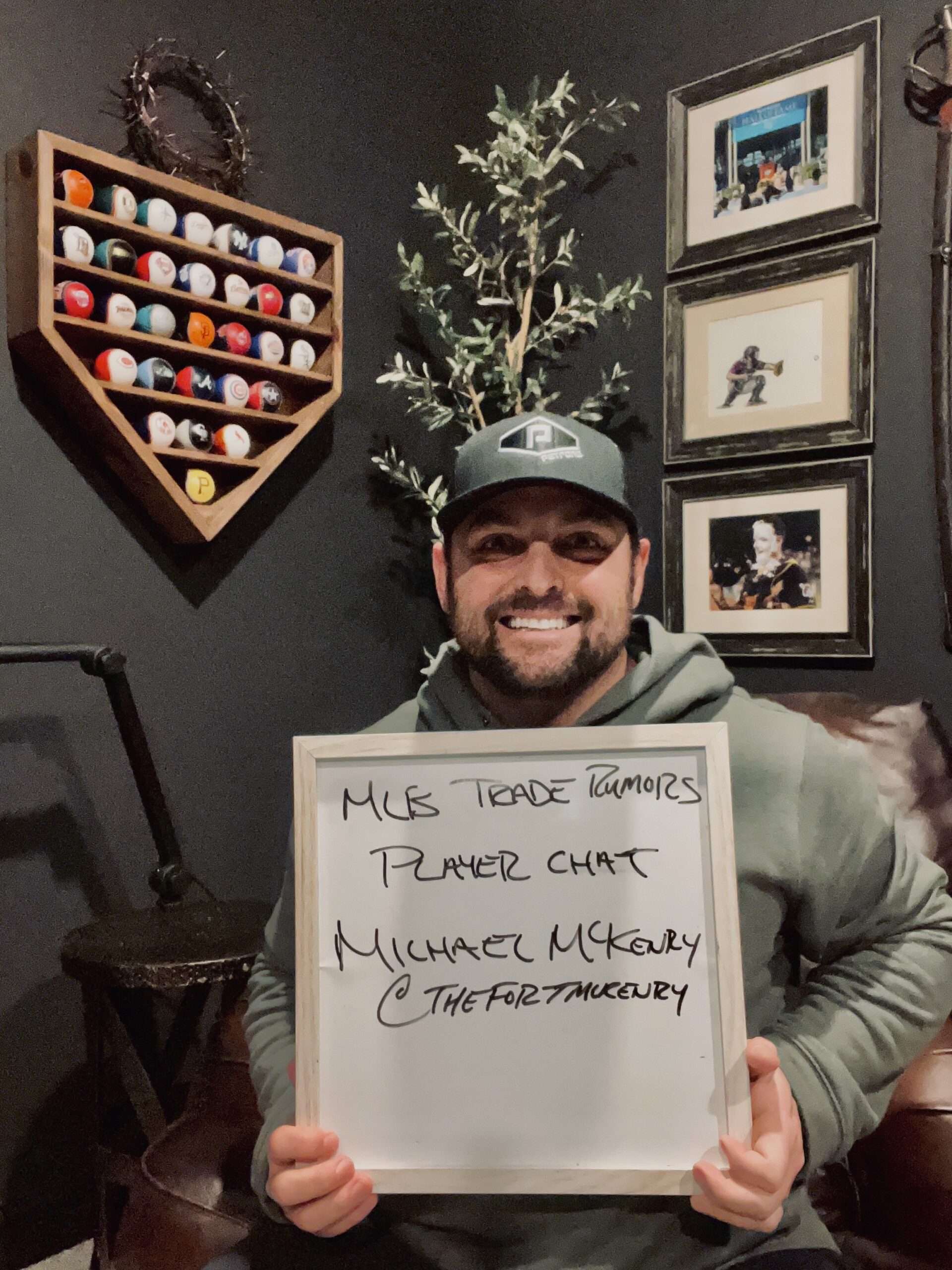
Four years later, McKenry made his MLB debut with the Rockies. Not long after, the Rockies traded him to the Red Sox for Daniel Turpen. The Red Sox flipped McKenry to the Pirates a few months later.
As a rookie in 2011, McKenry led the Pirates in innings caught, pairing with Ryan Doumit. He split duties the following year with Rod Barajas, and then worked behind Russell Martin on the 2013 Pirates.
McKenry had a two-home run game in 2013, victimizing the Reds’ Mat Latos and Jonathan Broxton in an April win at PNC Park. A few months later McKenry had a four-hit game at Marlins Park. That Bucs team won 94 games, ended the franchise’s 20-year losing streak, and emerged victorious in the Wild Card game against Johnny Cueto and the Reds.
The 2013 season was cut short for McKenry by a knee injury, and the Pirates non-tendered him in December. He inked a minor league deal to return to the Rockies and serve as Wilin Rosario’s backup in 2014. In 192 plate appearances that year, McKenry batted a robust .315/.398/.512 – one of the finest batting lines featured by a catcher.
McKenry finished his MLB career with the Cardinals, snagging a couple last MLB plate appearances in 2016. He also spent time in the Red Sox, Braves, Rangers, Brewers, and Rays organizations. McKenry’s MLB career wrapped up with more than 2,000 innings behind the dish. He paired up with Pirates standout pitchers such as Gerrit Cole, Francisco Liriano, Charlie Morton, and A.J. Burnett.
McKenry hit 29 home runs in his 953 career plate appearances, including shots off Johan Santana and Jonathan Papelbon. He also had the pleasure of hitting a walkoff home run in the bottom of the 11th off the Mariners’ Mayckol Guaipe for the Rockies in 2015. That same year, McKenry nabbed his lone career stolen base off Derek Norris. The man nicknamed “The Fort” managed a fine wRC+ of 109 at the plate back in 2012, plus an excellent 140 mark in 2014.
Today at age 37, Michael serves as a pregame, postgame, and color analyst for the Pirates, as well as a speaker, mentor, and consultant. You can follow him on Twitter @theFortMcKenry.
Michael was kind enough to volunteer some time to take questions about his career, the Pirates’ future, his work in the broadcast booth and quite a bit more in a chat with MLBTR readers today. You can read the transcript of his chat here.
If you’re a current or former MLB player, we’d love to have you for a chat with our readers! It’s a great way to interact with fans for an hour (or longer, as Michael did today!), and you get to choose which questions you publish. Click here to contact us.
Read The Transcript Of Our Chat With Former MLB Pitcher Jacob Turner
Considered the “consensus top high school righthander available” by Baseball America back in 2009, Jacob Turner was drafted ninth overall by the Tigers out of Westminster Christian Academy in Missouri. He stood at 6’5″, 210 lbs and touched 98 with his fastball. Adviser Scott Boras was able to get the 18-year-old Turner a $5.5MM Major League contract, most of which came in the form of a signing bonus.
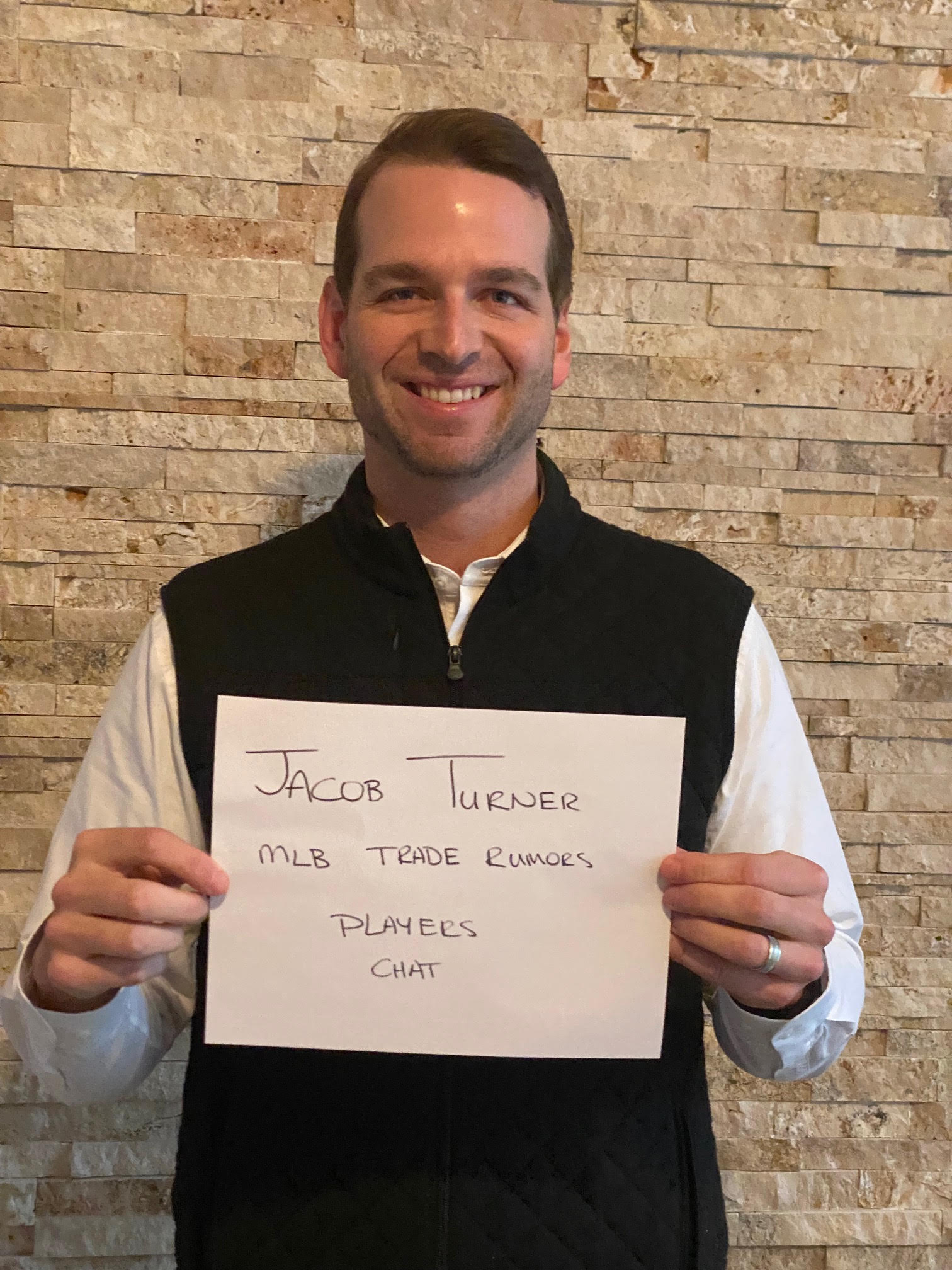
After two years in the minors, MLB.com ranked Turner the 15th prospect in the game, ahead of future stars such as Nolan Arenado, Zack Wheeler, and Francisco Lindor. Turner made his MLB debut at the age of 20, pitching well against the Angels for Jim Leyland’s Tigers. At that point in late 2011, Turner profiled as a future number two or three starter in the Majors.
The following year, Turner picked up his first big league win on July 22nd against the White Sox. The 2012 Tigers would go on to win the pennant, but they’d do so without Turner. The day after that first career W, they sent him packing to the Marlins for more immediate help in the form of Anibal Sanchez and Omar Infante.
By late May 2013, Turner had secured a spot in a Marlins rotation that also featured Jose Fernandez, Tom Koehler, Ricky Nolasco, Nathan Eovaldi, and Henderson Alvarez. Turner’s age-22 season would turn out to be his best, as he put together 20 starts with a 3.74 ERA that year.
Things took a turn in 2014, as Turner lost both his rotation and 40-man roster spots with the Marlins, joining the Cubs on a waiver claim. An elbow injury spoiled Turner’s 2015 season, which ended in a crosstown waiver claim by the White Sox. Turner went on to a stint with the Nationals, followed by returns to the Marlins and Tigers. For the 2019 season, Turner moved to KBO’s Kia Tigers.
Turner’s time in MLB was over before his 30th birthday, certainly not the career some expected of him back when he was starring in high school and the low minors. But he still competed for parts of seven seasons in the bigs, pitching 369 innings and making 56 starts. The 22-year-old kid was pretty darn good in the Majors in 2013, going at least seven innings five different times that year. One career highlight: a one-run, complete game victory over the Padres that year. Across those seven seasons, Turner punched out many of the game’s stars, including Bryce Harper, Buster Posey, Carlos Beltran, Jose Bautista, Nolan Arenado, David Wright, and Freddie Freeman.
Still only 31 years old, Turner now runs a company that “helps educate athletes around money and helps them be good stewards of the money earned in their careers,” as he puts it. He’s on Twitter @TheSuddenWealth, where he posted a thread last summer about his experiences that ended up going viral. Jacob notes that people can DM him on Twitter to get in touch, and you can view his website here.
Jacob took questions from MLBTR readers earlier today. Click here to read the transcript!
If you’re a current or former MLB player, we’d love to have you for a chat with our readers! It’s a great way to interact with fans for an hour, and you get to choose which questions you publish. Click here to contact us.
Read The Transcript Of Our Chat With Knuckleballer Mickey Jannis
MLB player chats are back! Last year, MLBTR readers chatted with 13 different former and current MLB players, and it was a blast. This year, we’ve got more than 25 on tap. If you’re a former or current MLB player, we’d love to host you for a chat! It’s a great time, and you get to choose which questions you publish and answer. Click here to contact us.
Today’s chat guest, pitcher Mickey Jannis, is a study in perseverance. Mickey was drafted by the Rays in the 44th round out of California State University, Bakersfield – a draft round that doesn’t even exist anymore. By 2012 he found himself in independent ball, at which point he converted to a knuckleball pitcher. After grinding it out for four years with teams like the Lake Erie Crushers, Bridgeport Bluefish, and Southern Maryland Blue Crabs, Jannis managed to land a minor league deal with the Mets.

Jannis honed his craft for three years in the Mets organization, reaching Triple-A. He then inked a deal with the Orioles, only to see the minor league season cancelled in 2020. Jannis stuck with the O’s, and was rewarded with his lone big league opportunity to date in 2021. On June 23rd, 2021 at Camden Yards, Jannis entered the losing side of a 6-0 game against the heart of the Astros’ order. His first opponent was the dangerous Yordan Alvarez, and Jannis caught him looking. Though Jannis was not able to make it through the rest of the outing unscathed, he’d made it to the big leagues as a 33-year-old rookie knuckleballer after 12 years of minor league baseball.
19 months later, Jannis remains the last knuckleballer to pitch in the Major Leagues. The knuckleball is a lonely road and often a last resort for a pitcher, but this spinless wonder has given us multiple Hall of Famers and All-Stars. The most recent major success with the pitch was R.A. Dickey, who won the NL Cy Young award in 2012 and pitched successfully through 2017, his age-42 season.
MLB teams haven’t cracked the code on the knuckleball, and most seemingly have not figured out a way to teach the pitch. Who knows, maybe the pendulum will swing and the lowest possible spin rate will become the new market inefficiency. For Mickey Jannis’ sake, we’d love to see it. As Mickey puts it, he’s “currently working out for teams, trying to keep the knuckleball alive!” You can follow him on Twitter and Instagram @mickeyjannis.
Today, Mickey answered questions from MLBTR readers for over an hour. Click here to read the transcript.
Are You A Current Or Former MLB Player?
Last offseason during the lockout, 13 current and former MLB players conducted live chats with MLBTR readers. If you’ve played in MLB, there’s a chance you’ve been teammates with one of them: Christian Colón, Dan Straily, Chad Cordero, Caleb Joseph, Jody Gerut, Paul Sewald, Chipper Jones, Alex Hinshaw, Shea Hillenbrand, Will Ohman, Tyler Danish, Christian Bergman, and Jonny Gomes. You can check out transcripts from all of those chats here.
When I started this site, Rich Hill was a rookie, and now he’s the oldest player in baseball! So we’ve been around for a while. In MLB Trade Rumors’ 17-year-existence, I’ve heard many anecdotes about players reading this website in the clubhouse. I still think that’s awesome! If you’re reading this and you’ve played Major League Baseball, we’d love to have you do a one-hour online chat with our readers.
What’s in it for you? First, it’s a really cool way to have positive interactions with fans in a controlled setting. Hundreds of questions will be submitted, but you get to scroll through and pick which ones to publish and answer. Last offseason, the response to this project was overwhelmingly positive, and many players enjoyed it so much they chatted well beyond their allotted hour. These chats are done on a computer, kind of like a chat room, so there’s no setting up cameras. Second, MLBTR reaches a wide audience, and we’re happy to link to your favorite charity or whatever project you’re currently working on.
To get in touch with us, you can reach out through MLBTR’s contact form. Or, if you’re on Twitter, you can reply to one of our tweets and we can direct message there.
2023 MLB Arbitration Tracker
Today is the deadline for players and teams to exchange figures in arbitration — an annual deadline that leads to a slew of one-year deals and, typically, a handful of multi-year deals. In all likelihood, more than 100 players will agree to their salary for the 2023 season within the next few hours. MLBTR is planning to make improvements on our old Arbitration Tracker tool, but that’s a goal for next year. For 2023, we’ll put all of the agreements in this post.
Each player’s service time is in parentheses, and you can of course check back to see each player’s projected salary from MLBTR contributor Matt Swartz. We’ll keep this updated throughout the day — refresh for updates — and break off some of the larger, more prominent agreements in separate entries.
Angels (9)
- Hunter Renfroe (5.165): No agreement reached, will exchange figures
- Shohei Ohtani (5.000): $30MM agreement in October
- Gio Urshela (5.127): No agreement reached, will exchange figures
- Griffin Canning (3.075): $850K agreement
- Luis Rengifo (3.043): No agreement reached, will exchange figures
- Jaime Barria (3.035): $1.05MM agreement
- Jared Walsh (3.010): $2.65MM agreement
- Taylor Ward (2.164): $2.75MM agreement
- Patrick Sandoval (2.149): $2.75MM agreement
Astros (8)
- Phil Maton (5.047): $2.55MM agreement
- Ryne Stanek (5.038): $3.6MM agreement
- Framber Valdez (3.163): $6.8MM agreement
- Kyle Tucker (3.079) No agreement reached, will exchange figures
- Jose Urquidy (3.049): $3.025MM agreement
- Cristian Javier (3.000): No agreement reached, will exchange figures
- Blake Taylor (3.000): $830K agreement
- Mauricio Dubon (2.162): $1.4MM agreement
Athletics (3)
- Tony Kemp (5.098): $3.725MM agreement
- Ramon Laureano (3.165): $3.55MM agreement
- Paul Blackburn (3.018): $1.9MM agreement
Blue Jays (12)
- Adam Cimber (4.156): $3.15MM agreement
- Trevor Richards (4.084): $1.5MM agreement
- Danny Jansen (4.050): $3.5MM agreement
- Vladimir Guerrero Jr. (3.157) $14.5MM agreement
- Tim Mayza (3.156): $2.1MM agreement
- Cavan Biggio (3.129): $2.8MM agreement
- Erik Swanson (3.096) $1.25MM agreement
- Trent Thornton (3.073): $1MM agreement
- Bo Bichette (3.063) No agreement reached, will exchange figures
- Jordan Romano (3.051): $4.5375MM agreement
- Santiago Espinal (2.149): $2.1MM agreement
- Daulton Varsho (2.128): $3.05MM agreement
Braves (8)
- Joe Jimenez (5.061): $2.765MM agreement
- A.J. Minter (4.154): $4.2875MM agreement
- Max Fried (4.148) No agreement reached, will exchange figures
- Mike Soroka (4.122): $2.8MM agreement in November
- Tyler Matzek (4.019): two-year, $3.1MM deal in November
- Lucas Luetge (4.015): $1.55MM agreement
- Dennis Santana (3.095): $1MM agreement
- Sean Murphy (3.029): six-year, $73MM extension earlier this month
Brewers (14)
- Victor Caratini (5.051): $2.8MM agreement yesterday
- Brandon Woodruff (4.161): $10.8MM agreement
- Matt Bush (4.132): $1.85MM agreement in November
- Willy Adames (4.105): $8.7MM agreement
- Corbin Burnes (4.049) No agreement reached, will exchange figures
- Eric Lauer (4.033): $5.075MM agreement
- Adrian Houser (4.010): $3.6MM agreement in November
- Rowdy Tellez (4.004): $4.95MM agreement
- Luis Urias (3.120): $4.7MM agreement
- Hoby Milner (3.068): $1.025MM agreement yesterday
- Devin Williams (3.056): $3.35MM agreement
- Mike Brosseau (3.031): $1.4MM agreement in December
- Keston Hiura (3.009): $2.2MM agreement
- Abraham Toro (2.149): $1.25MM agreement
Cardinals (10)
- Jordan Montgomery (5.153): $10MM agreement
- Chris Stratton (5.100): $2.8MM agreement in November
- Jack Flaherty (5.006): $5.4MM agreement
- Jordan Hicks (5.000): $1.8375MM agreement
- Dakota Hudson (4.062): $2.65MM agreement
- Tyler O’Neill (4.059): $4.95MM agreement
- Tommy Edman (3.114): $4.2MM agreement
- Ryan Helsley (3.105): No agreement reached, will exchange figures
- Andrew Knizner (3.021): $1.1MM agreement
- Genesis Cabrera (3.011): No agreement reached, will exchange figures
Cubs (6)
- Ian Happ (5.036): $10.85MM agreement
- Rowan Wick (3.114): $1.55MM agreement in November
- Nico Hoerner (3.014): $2.525MM agreement
- Codi Heuer (3.000): $785K agreement
- Nick Madrigal (2.164): $1.225MM agreement
- Adrian Sampson (2.117): $1.9MM agreement in November
Diamondbacks (6)
- Carson Kelly (4.161): $4.275MM agreement
- Christian Walker (4.124): $6.5MM agreement
- Zac Gallen (3.100): $5.6MM agreement
- Cole Sulser (3.028): $825K agreement in November
- Josh Rojas (2.152) No agreement reached, will exchange figures
- Kyle Lewis (2.146): $1.61MM agreement
Dodgers (10)
- Julio Urias (5.117): $14.25MM agreement
- Walker Buehler (4.168): $8.025MM agreement
- Caleb Ferguson (4.088): $1.1MM agreement
- Yency Almonte (3.143) $1.5MM agreement
- Will Smith (3.090): $5.25MM agreement
- Dustin May (3.059): $1.675MM agreement
- Trayce Thompson (3.010): $1.45MM agreement
- Brusdar Graterol (2.167): $1.225MM agreement
- Tony Gonsolin (2.152) No agreement reached, will exchange figures
- Evan Phillips (2.136): $1.3MM agreement
Giants (10)
- Scott Alexander (5.080): $1.15MM agreement in November
- John Brebbia (5.078): $2.3MM agreement
- Jakob Junis (5.002): $2.8MM agreement
- Austin Slater (4.147): $3.2MM agreement
- J.D. Davis (4.137) $4.21MM agreement
- Mike Yastrzemski (3.128): $6.1MM agreement in November
- Logan Webb (3.044): $4.6MM agreement
- LaMonte Wade Jr. (3.035): $1.375MM agreement
- Tyler Rogers (3.034): $1.675MM agreement
- Thairo Estrada (2.169): $2.25MM agreement
Guardians (7)
- Amed Rosario (5.062): $7.8MM agreement
- Shane Bieber (4.097): $10.01MM agreement
- Cal Quantrill (3.132): $5.55MM agreement
- Josh Naylor (3.127): $3.35MM agreement
- Zach Plesac (3.086): $2.95MM agreement
- Aaron Civale (3.058): $2.6MM agreement
- James Karinchak (2.169) $1.5MM agreement
Marlins (9)
- Joey Wendle (5.088): $6MM agreement
- Garrett Cooper (5.053): $4.2MM agreement
- Dylan Floro (5.053): $3.9MM agreement in November
- Jacob Stallings (4.149): $3.35MM agreement
- Pablo Lopez (4.093): $5.45MM agreement
- Tanner Scott (4.059): $2.825MM agreement
- Jon Berti (3.168): Did not reach agreement, will exchange figures
- JT Chargois (3.101): Reportedly reached one-year agreement
- Jesus Luzardo (2.165): Did not reach agreement, will exchange figures
Mariners (6)
- Teoscar Hernandez (5.097): Did not reach agreement, will exchange figures
- Tom Murphy (5.092): $1.625MM agreement
- Diego Castillo (4.118): Did not reach agreement, will exchange figures
- Paul Sewald (4.072): $4.1MM agreement
- Dylan Moore (4.000): Did not reach agreement, will exchange figures
- Ty France (3.089): $4.1MM agreement
Mets (8)
- Tomas Nido (4.089): Reportedly reached one-year agreement
- Jeff McNeil (4.069): Did not reach agreement, will exchange figures
- Joey Lucchesi (4.067) $1.15MM agreement in December
- Elieser Hernandez (4.051): Reportedly reached one-year agreement
- Drew Smith (4.034): $1.3MM agreement
- Pete Alonso (4.000): $14.5MM agreement
- Luis Guillorme (3.167): Reportedly reached one-year agreement
- Jeff Brigham (3.010): Reportedly reached one-year agreement
Nationals (8)
- Carl Edwards Jr. (5.169): $2.25MM agreement
- Victor Robles (4.033) No agreement reached, will exchange figures
- Tanner Rainey (3.127): $1.5MM agreement in December
- Hunter Harvey (3.047): Agreed to one-year deal, per team.
- Victor Arano (3.022): $925K agreement
- Lane Thomas (3.014): $2.2MM agreement
- Ildemaro Vargas (3.007): One-year, $975K deal in November
- Kyle Finnegan (3.000): $2.325MM agreement
Orioles (6)
- Anthony Santander (4.162): $7.4MM agreement
- Austin Voth (3.127): Did not reach an agreement, will exchange figures
- Cedric Mullins (3.078) : $4.1MM agreement
- Austin Hays (3.057): $3.2MM agreement
- Dillon Tate (3.048): $1.5MM agreement
- Jorge Mateo (3.000): $2MM agreement
Padres (8)
- Josh Hader (5.115): $14.1MM agreement
- Juan Soto (4.134): $23MM agreement
- Tim Hill (4.112): $1.85MM agreement
- Jose Castillo (3.125): $730K agreement in November
- Austin Nola (3.106): $2.35MM agreement
- Trent Grisham (3.060): $3.175MM agreement
- Adrian Morejon (3.013): $800K agreement
- Jake Cronenworth (3.000): $4.225MM agreement
Phillies (8)
- Jose Alvarado (5.082) No agreement reached, will exchange figures
- Rhys Hoskins (5.053): $12MM agreement
- Seranthony Dominguez (4.131): Did not reach agreement, will exchange figures
- Jake Cave (3.137): $950K agreement in November (then with the Orioles)
- Ranger Suarez (3.112): $2.95MM agreement
- Gregory Soto (3.102): $3.925MM agreement
- Sam Coonrod (3.078): $775K agreement in November
- Edmundo Sosa (2.140): $950K agreement
Pirates (6)
- Ji-Man Choi (5.076) No agreement reached, will exchange figures
- Robert Stephenson (5.049): $1.75MM agreement
- Miguel Andujar (4.002): $1.525MM agreement in November
- Duane Underwood Jr. (3.044): $1.025MM agreement
- Mitch Keller (3.026): $2.4375MM agreement
- JT Brubaker (3.000): $2.275MM agreement
Rangers (5)
- Mitch Garver (5.045) $3.9MM agreement
- Brett Martin (3.151): $1.275MM agreement
- Taylor Hearn (3.125): $1.4625MM agreement
- Jonathan Hernandez (3.041): $995K agreement
- Nathaniel Lowe (2.145): $4.05MM agreement
Rays (14)
- Yonny Chirinos (4.125): $1.275MM agreement
- Yandy Diaz (4.122) No agreement reached, will exchange figures
- Shawn Armstrong (4.113): $1.2MM agreement
- Jalen Beeks (4.070): $1.375MM agreement
- Andrew Kittredge (4.070): $2.075MM agreement
- Francisco Mejia (4.062): $2.155MM agreement
- Jeffrey Springs (4.055) No agreement reached, will exchange figures
- Harold Ramirez (3.124) No agreement reached, will exchange figures
- Colin Poche (3.109) No agreement reached, will exchange figures
- Pete Fairbanks (3.057) No agreement reached, will exchange figures
- Christian Bethancourt (3.038): $1.35MM agreement
- Ryan Thompson (3.000) No agreement reached, will exchange figures
- Jason Adam (2.132) No agreement reached, will exchange figures
- Randy Arozarena (2.129): $4.15MM agreement
Red Sox (8)
- Ryan Brasier (5.109): $2MM agreement
- Rafael Devers (5.070): $17.5MM agreement earlier this month (followed by 10-year, $313MM extension)
- Nick Pivetta (4.166): $5.35MM agreement
- Alex Verdugo (4.078): $6.3MM agreement
- Rob Refsnyder (4.048): $1.2MM agreement in November
- Christian Arroyo (4.036): $2MM agreement
- Josh Taylor (3.121): $1.025MM agreement earlier this week
- Reese McGuire (3.027): $1.225MM agreement
Reds (7)
- Buck Farmer (5.140): $1.75MM agreement in November
- Luis Cessa (5.131): $2.65MM agreement
- Kevin Newman (4.046): $2.662MM agreement
- Lucas Sims (4.014): $1.2675MM agreement
- Nick Senzel (3.150): $1.95MM agreement
- Justin Dunn (3.016): $900K agreement
- Tejay Antone (3.000): $770K agreement
Rockies (5)
- Brent Suter (5.161): $3MM agreement in November
- Dinelson Lamet (5.070): $5MM agreement in November
- Tyler Kinley (4.014): three-year, $6.25MM deal in November
- Austin Gomber (3.111): $1.65MM agreement earlier this week
- Brendan Rodgers (3.075): $2.7MM agreement
Royals (9)
- Amir Garrett (5.099): $2.65MM agreement
- Adalberto Mondesi (5.088): $3.045MM agreement in December
- Brad Keller (5.000): $5.775MM agreement
- Scott Barlow (4.030): $5.3MM agreement
- Nicky Lopez (3.139): $3.7MM agreement
- Taylor Clarke (3.120): $1.15MM agreement
- Josh Staumont (3.072): $1.025MM agreement
- Brady Singer (2.156) No agreement reached, will exchange figures
- Kris Bubic (2.135): $2.2MM agreement
Tigers (4)
- Jose Cisnero (5.020): $2.2875MM agreement
- Austin Meadows (4.074): $4.3MM agreement in November
- Tyler Alexander (3.058): $1.875MM agreement in November
- Rony Garcia (2.138): Agreed to one-year deal, per team.
Twins (8)
- Emilio Pagan (5.091): $3.5MM agreement
- Tyler Mahle (5.018): $7.5MM agreement
- Caleb Thielbar (4.131): $2.4MM agreement
- Kyle Farmer (4.129): $5.585MM agreement
- Jorge Lopez (4.102): $3.525MM agreement
- Chris Paddack (4.000): $2.4MM agreement
- Luis Arraez (3.121) No agreement reached, will exchange figures
- Jorge Alcala (3.014): $790K agreement
- Kyle Garlick (2.163): $750K agreement in November (Garlick is currently in DFA limbo)
White Sox (5)
- Lucas Giolito (5.080): $10.4MM agreement
- Reynaldo Lopez (5.004): Agreed to one-year deal
- Dylan Cease (3.089): $5.7MM agreement
- Jose Ruiz (3.048): $925K agreement
- Michael Kopech (3.041): $2.05MM agreement
Yankees (12)
- Wandy Peralta (5.168) $3.35MM agreement
- Frankie Montas (5.015): $7.5MM agreement
- Isiah Kiner-Falefa (5.000): $6MM agreement in November
- Lou Trivino (4.163): $4.1MM agreement in November
- Gleyber Torres (4.162) No agreement reached, will exchange figures
- Clay Holmes (4.031): $3.3MM agreement
- Jonathan Loaisiga (4.022) $2.26MM agreement
- Domingo German (4.017) $2.6MM agreement
- Kyle Higashioka (4.005): $1.4625MM agreement
- Nestor Cortes (3.094): $3.2MM agreement
- Jose Trevino (3.063): $2.36MM agreement
- Michael King (3.004) $1.3MM agreement
2022-23 MLB Free Agents
The following players are currently eligible for free agency. Players’ ages for the 2023 season are listed in parentheses. Generally, the cutoff for this list is at least 50 plate appearances or 20 innings pitched in 2022.
Updated 3-28-23
Catchers
Robinson Chirinos (38)
Kevin Plawecki (32)
Austin Romine (34)
Gary Sanchez (30)
First Basemen
Franchy Cordero (28)
Miguel Sano (30)
Second Basemen
Robinson Cano (40)
Charlie Culberson (34)
Cesar Hernandez (33)
Andrelton Simmons (33)
Jonathan Villar (32)
Shortstops
Alcides Escobar (36)
Didi Gregorius (33)
Andrelton Simmons (33)
Dee Strange-Gordon (35)
Jonathan Villar (32)
Third Basemen
Charlie Culberson (34)
Phil Gosselin (34)
Jonathan Villar (32)
Left Fielders
Albert Almora (29)
Franchy Cordero (28)
Center Fielders
Albert Almora (29)
Odubel Herrera (31)
Rafael Ortega (32)
Right Fielders
Albert Almora (29)
Luis Barrera (27)
Kole Calhoun (35)
Travis Demeritte (28)
Nomar Mazara (28)
Designated Hitters
Gary Sanchez (30)
Justin Upton (35)
Starting Pitchers
Chris Archer (34)
Dallas Keuchel (35)
Mike Minor (35)
Michael Pineda (34)
Anibal Sanchez (39)
Right-Handed Relievers
Archie Bradley (30)
Jhoulys Chacin (35)
Kyle Crick (30)
Ken Giles (31)
Will Harris (38)
Corey Knebel (30)
Reyes Moronta (30)
Garrett Richards (35)
Hansel Robles (32)
Joe Smith (39)
Left-Handed Relievers
Zack Britton (35)
Ross Detwiler (37)
Marc Narducci: My Hall Of Fame Ballot
Marc Narducci spent 37 years covering all sports for The Philadelphia Inquirer before recently retiring in July. He covered everything from high school sports to the Phillies winning the World Series and the Eagles winning the Super Bowl. A lifelong Southern NJ resident, he remains a freelance writer and broadcaster. Once again, Marc reached out to see if MLB Trade Rumors would be interested in publishing his Hall of Fame ballot. I am happy to do it and hope it can be an interesting topic of debate for our readers. Here’s Marc…
Let’s get it out of the way first.
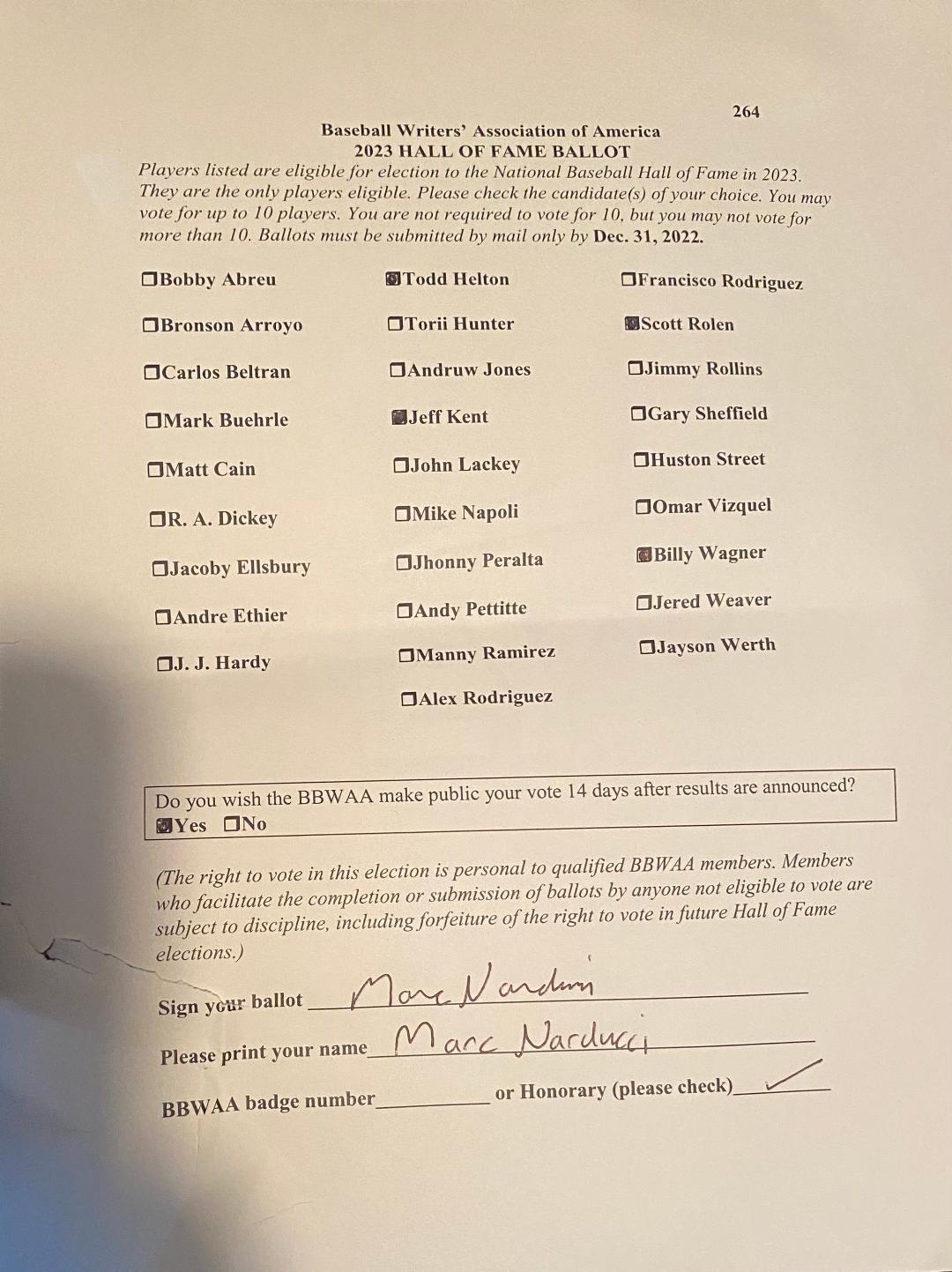
Last season while writing for MLB Trade Rumors about my Hall of Fame ballot, the case was presented that there was no room for the steroid players.
As anybody can see from the comments, my ears were burning as the overwhelming majority of the readers disagreed.
That’s fine. A little discourse is good, and while Barry Bonds, Sammy Sosa and Roger Clemens are off the ballot, and while there are still players on the ballot linked to steroids, the biggest controversy this year centers around Carlos Beltran, albeit, not steroid related.
It was Beltran who MLB said was the mastermind of the Houston Astros cheating scandal in 2017 when they won the World Series. MLB said Houston used an intricate electronic method to steal signs and the only player named as the ringleader was Beltran.
It cost him the job of the New York Mets manager and at least for now, is costing him this vote.
Beltran has a strong resume, a nine-time all-star, three-time Gold Glove winner who, put up a career 279/.350/486 line with 435 home runs and 1,587 RBI.
In 65 postseason games, he hit .307/.412/609 line with 16 home runs and 42 RBI over 256 plate appearance.
Beltran himself said that the Astros World Series title was “stained” by the scandal.
The fact that he was the mastermind, well, that was cheating the game. He was not a slam dunk candidate before this occurred, but he did have a lot in his favor. For now, he will remain off this ballot.
Should all the Astros be punished?
That will be answered later, but for being the mastermind, Beltran pays the price on this ballot.
And for those who don’t think it was a big deal, both the Yankees and Dodgers, who lost to Houston in seven-game series in the ALCS and World Series respectively, didn’t hold back on their criticism of the Astros.
Now back to the ballot, with the players listed in alphabetical order.
One can talk all they want about the advantage for Colorado Rockies hitters in Coors Field and there is some obvious truth, but it’s also difficult to play on the road after hitting in that altitude.
If a player had a .287/.386/469 line for a career, that would open some eyes. The fact that it was Helton’s road total shows what a good hitter he was. At Coors it was .345/.441/.607.
That gave him a career mark of .316/.414/.539.
He was a first baseman who wasn’t known for his power, but he still hit 369 home runs and had 1,406 RBI, while playing all 17 seasons for the Rockies.
He was a five-time All-Star, a four-time Silver Slugger winner and a three-time Gold Glove recipient.
For those who give all the credit to the hitting atmosphere in Coors Field, he has a 133 career OPS+ and a 132 WRC+.
He also won the batting title in 2000, hitting, .372.
Again, while some suggest batting average is an outdated measure to evaluate players, it should be remembered how difficult it is to hit .300. In 2022, only 11 total players from both leagues hit .300 or better. Helton did it for his career.
This is his fifth season on the ballot and his percentage of votes has increased each year. Last year he received 52% of the vote. It may be too big a jump to make the needed 75% threshold this year, but Helton, a former quarterback with Peyton Manning at Tennessee, appears to one day be headed to Cooperstown.
This is Kent’s 10th and final year on the ballot and it doesn’t appear as if he will come close to getting elected by the writers.
Last season he received his highest vote total, 32.7 percent, so unless he has a miracle surge this year, Kent won’t make it.
Still, being the best power hitting second baseman in history is a main reason he made this ballot.
We know Kent was a below average fielder, but nobody hit more home runs as a second baseman in MLB history.
Kent hit 377 home runs, including 351 as a second baseman. The closest second baseman was Rogers Hornsby, who hit 301.
We acknowledge that Hornsby had 325 fewer at-bats than Kent, but the 50- home run difference (as second basemen) is still jaw dropping, especially for a position that isn’t known for power.
While RBI are downgraded by many in the sabermetrics community, most of the top players in the league each season are among the RBI leaders. Kent is third among second basemen in the Hall of Fame with 1,518 RBI.
Only three HOF second basemen have hit more than Kent’s 560 doubles.
Among HOF second basemen, he is second only to Hornsby with a .500 slugging percentage. (Hornsby had an insane .577 slugging percentage).
Kent’s career B-WAR is just 55.4, thanks largely to a -0.1 DWAR.
His .855 OPS is fifth among HOF second basemen.
He not only hit for power, but for average. His had a career line of .290/.356/.500.
Kent was the 2000 MVP, a five-time All-Star, and four-time Silver Slugger recipient.
He was a solid, if not spectacular postseason performer, but qualified for the playoffs seven times with four different teams.
In 49 career postseason games, Kent hit .276/.340/.500 with nine home runs and 23 RBI in 189 plate appearances.
Just a great hitting career, one that was HOF worthy.
Scott Rolen continues to make good progress in his attempt to earn a HOF berth. This is his sixth season on the ballot and last year he received 63.2% of the vote.
He is a player who was as great defensively as he was offensively, maybe even better. There have only been 17 third basemen selected to the HOF, the least among all positions, with the exception of relief pitchers.
Rolen is somebody whose offensive stats weren’t overwhelming, but they were more than good enough to complement his outstanding defense.
First off, he accumulated 70.1 B-WAR, 10th best all-time among third basemen. Of the other nine, eight are in the Hall of Fame and Adrian Beltre is expected to earn induction when he becomes eligible next year.
Just eight Hall of Famer third basemen have a higher career OPS than Rolen’s .855. Ten HOF third baseman have a better OPS+ than Rolen’s 122.
Rolen had a .281/361/.490 line with 316 home runs and 1,287 RBI.
He was a seven-time All-Star, the 1997 National League Rookie of the Year and an eight-time Gold Glove winner and earned one Silver Slugger award in 2002.
Rolen played in the postseason five different times and won a World Series in 2006 with the St. Louis Cardinals. He hit .421/.476/.737 in the Cardinals’ World Series win in five games over the Detroit Tigers.
The 6-4, 245-pound Rolen had great defensive range, even more impressive for somebody his size. He also had a great arm.
He has improved his percentage of votes each year and Rolen is considered to have a good chance to be voted in by the writers, whether it is this year or possibly next.
Like Kent, Wagner’s time is dwindling. This is his eighth year on the ballot, although he had his best showing last year, earning 51.0% of the vote.
The biggest argument against Wagner is his lack of innings. There are eight relief pitchers in the HOF and all have pitched more than the 903 innings that Wagner threw.
Yet Wagner’s 11.9 strikeouts per nine innings is best in MLB history (minimum of 750 innings pitched).
He actually had more strikeouts (1,196) than the greatest reliever of all time, Mariano Rivera. Rivera struck out 1,173 in 1,282 2/3 innings.
According to MLB.com, Wagner had 422 saves in 476 opportunities (88.6 percent). Only two Hall of Fame relievers have a higher save percentage, Rivera (89.1%) and Trevor Hoffman (88.8%).
Wagner also has a higher strikeout ratio (33.2%) than any reliever in the HOF. The closest is Hoffman (25.8%).
Wagner finished with a 2.37 ERA and a 187 adjusted ERA and Rivera is the only HOF relief pitcher who bettered those totals.
Wagner was a seven-time all-star and besides the lack of innings, his other blemish is his postseason performance.
He qualified for the postseason seven times and had a 10.03 ERA in 14 appearances totaling 11 2/3 innings. His postseason WHIP was 1.971.
Yikes.
Still that is a small sample size even if it is in the most pressurized setting.
Even with the lack of innings and a shaky postseason, Wagner’s dominance in the regular season, puts him on this ballot.
Sign Up For The Free MLBTR Newsletter
The MLB Trade Rumors Newsletter has been going strong for over a year! The newsletter is written by Cliff Corcoran, who has an extensive resume contributing to Sports Illustrated, The Athletic, Baseball Prospectus, and other outlets. Cliff will take you through the hot stove highlights of the previous day, boiling down MLBTR’s posts into the essential stories. It’s a great morning read during these busy hot stove times.
This free newsletter arrives via email Monday through Friday in the morning. Be sure to check your inbox and click the link in the confirmation email. If you’re not seeing the box to input your email, you can simply click this link to sign up.