
Free Agent Profile: Jeff Samardzija
After an offseason trade to the White Sox, Jeff Samardzija struggled through his worst season in four years as a starting pitcher. He’ll still likely aim for a sizable multiyear contract in free agency.
Strengths/Pros
Samardzija is, first and foremost, a workhorse. He tossed 647 1/3 regular season innings from 2013-15, sixth-most in baseball. David Price is the only free agent with more during that span, and he only had eight additional innings. Samardzija has never been on the disabled list and has never missed a start due to injury. The 6’5″, 225 lb. righty seems built to last.

Samardzija has lower mileage on his arm than most of his fellow free agents, mainly because he spent a portion of his big league career as a reliever. As a 31-year-old with no DL time, Samardzija has still only thrown 1502 pro innings. Yovani Gallardo, who is a year younger than Samardzija, has 1901 innings. Johnny Cueto and Scott Kazmir have mileage similar to Gallardo. Ian Kennedy has 1590 2/3 innings, a total held down by 2009 shoulder surgery. Jordan Zimmermann and Wei-Yin Chen have lower mileage than Samardzija, but both had Tommy John surgery. Mike Leake, who recently turned 28, has 1115 career innings.
Samardzija has shown the ability to pitch at the front end of a rotation. He was his team’s Opening Day starter in each of the past three seasons, and earned an All-Star nod in 2014. That season, Samardzija posted a 2.99 ERA in 219 2/3 innings. His 4.7 K/BB ratio ranked 14th among qualified starters. He also brings the heat. From 2012-15, Samardzija averaged 94.6 miles per hour on his fastball, second only to Stephen Strasburg among those with 600 innings.
Samardzija turned the corner with his control in 2014, walking only 1.8 batters per nine innings. His 1.9 mark from 2014-15 ranks 15th among qualified starters, and many of those ranked above him are soft-tossers. From 2012-14, Samardzija showed an elite combination of skills and durability, ranking eighth in MLB with a 3.35 SIERA for those with 600 or more innings. During those three years, Samardzija was firmly operating in Jordan Zimmermann/Jon Lester territory. That valuation was borne out when Samardzija (along with Jason Hammel) netted the Cubs Addison Russell and Billy McKinney in a trade with the Athletics.
Weaknesses/Cons
There’s no tiptoeing around the fact that 2015 was a very rough season for Samardzija. He allowed the most hits and earned runs of any MLB starter, and he tied for the most home runs allowed in the AL. In his four seasons as a starter, his 6.9 K/9 was easily a career worst, as were his 4.96 ERA, 1.22 HR/9, and 39% groundball rate. In his 32 starts, he allowed five or more earned runs in 11 of them. Samardzija had a stretch in August where he gave up 22 earned runs in three starts. Zack Greinke didn’t give up his 22nd earned run until his 21st start of the season. A childhood fan of the White Sox, Samardzija’s season on the south side of Chicago did not go as planned.
In four seasons as a starter, Samardzija has posted a 4.03 ERA over 822 innings, and his only campaign below 3.81 was 2014. In each of the 2012, ’13, and ’15 seasons, Samardzija’s SIERA was significantly below his ERA. What has caused the big righty to post higher-than-expected ERAs in three out of his four seasons as a starter? Batting average on balls in play, home run per flyball rate, and issues pitching out of the stretch have all manifested in those three seasons, but none consistently. His All-Star season, 2014, was the only one where all three of those factors were normal. I asked SIERA creator Matt Swartz about this, and he concluded, “You have to figure he’s more likely to underperform his SIERA than the average pitcher, but nothing jumps out as a persistent problem.”
With the White Sox, Samardzija reduced the usage of his two-seam fastball in favor of the cutter, perhaps unsurprisingly. That pitch change mix supports the narrative that Samardzija can be fixed. On the other hand, why couldn’t Samardzija right the ship during the 2015 season?
Samardzija received and turned down a qualifying offer from the White Sox, so signing him requires draft pick forfeiture. Teams with unprotected picks in the teens such as the Red Sox, Diamondbacks, and Orioles could shy away.
Personal
Jeff Samardzija was born and raised in Merrillville, a town in Northwest Indiana. Inspired by his older brother Sam, Jeff played football, baseball, and basketball at Valparaiso High School. Tragically, Jeff lost his mother Debora during that time to a rare lung disease. With his father and brother in mind, Jeff looked at colleges close to home and landed a football scholarship to Notre Dame. Jeff was a star wide receiver for the Irish, but quietly pitched for the college’s baseball team as well. A baseball teammate noted Jeff resembled the shark from Finding Nemo, giving him a nickname that stuck. Since most teams thought he was destined for the NFL, Samardzija fell to the fifth round in the MLB draft in 2006. Cubs GM Jim Hendry was a good friend of Samardzija’s baseball coach Paul Mainieri, who urged Hendry to draft the greatest athlete he’d ever coached. Jeff agreed to a $250K deal with the Cubs, provided he could return to Notre Dame for his senior season.
After making seven appearances for Cubs minor league affiliates in Boise and Peoria, Samardzija had to decide whether to commit to the Cubs or enter the 2007 NFL draft as a potential first-round pick. Samardzija surprised the Cubs by working out a five-year, $10MM deal to commit to baseball. Samardzija ascended through the Cubs’ minor league system more because of his contract than due to success. As an up-and-down reliever, Samardzija briefly kicked around a return to football in April 2010. However, he had a decent year out of the Cubs’ pen in 2011, and then Theo Epstein’s regime took over the team’s front office. Samardzija removed his distractions that offseason and told Epstein he wanted to be a starting pitcher. He was awarded the Cubs’ fifth starter job out of camp in 2012, and his MLB career took off.
Market
We see Samardzija in a tier with Wei-Yin Chen and Mike Leake, a notch below David Price, Zack Greinke, Jordan Zimmermann, and Johnny Cueto. Comparing Samardzija’s contract with Chen’s will offer an interesting data point on whether teams are really moving past ERA. ERA makes Chen look better than Samardzija, yet Samardzija has a better reputation with the team executives to whom we’ve spoken, as well as superior skill-based stats. For some teams, Samardzija offers a chance at a #2 type starter coming off a down year, resulting in a potential bargain. Samardzija is an innings guy at worst, with the same high floor as Leake. Leake, however, doesn’t offer the same ceiling.
Though the draft pick loss will be an issue for some, a potential list of suitors for Samardzija includes the Orioles, Red Sox, Yankees, Blue Jays, Tigers, Royals, Twins, Astros, Angels, Rangers, Marlins, Nationals, Cubs, Cardinals, Diamondbacks, Padres, Dodgers, and Giants. He could be a top choice for a team like the Tigers, who intend to add multiple starters and therefore may sit out the $100MM+ market. Former Cubs GM Jim Hendry currently works for the Yankees (at least for now), so there’s an obvious connection with Shark.
Expected Contract
In June 2014, Jon Paul Morosi of FOX Sports reported Samardzija rejected a five-year extension offer from the Cubs worth slightly more than $85MM. A few months prior, Homer Bailey had signed an extension with the Reds for six years and $105MM, and that comparable may have compelled Samardzija to turn down the Cubs. The Cubs’ argument may have been that Bailey was younger than Samardzija, and that’s why he received a sixth year. That same question still exists: is there a team willing to sign Samardzija through 2020, his age 35 season? Given the list of teams above, as well as the pitcher’s durability, I think there will be enough suitors for Samardzija and his agents at Wasserman Media Group to get a fifth year on the open market. A slightly lower average annual value could bolster that case – Samardzija may cost $16-17MM per year, as opposed to $20MM+ salaries for guys like Rick Porcello and, presumably, Zimmermann. I’m predicting a five-year, $80MM deal for Samardzija.
Check Out Our MLB Free Agent Tracker
With the offseason underway, make sure to bookmark our 2015-16 MLB free agent tracker. This feature provides everything you need to follow along with the excitement of MLB free agency. Our tracker allows you to filter by signing team, signing status, position, contract, qualifying offer status, and handedness. We’ve also added tracking for the different contract option types.
The tracker has endless uses. For example, here’s a list filtered to show all unsigned starting pitchers who did not receive a qualifying offer. Here’s a look at everyone who has signed or retired so far. And here are all the unsigned right-handed-hitting right fielders.
Check out the constantly-updated 2015-16 MLB Free Agent Tracker today!
2015-16 Offseason Outlook Series
The MLBTR staff has been hard at work on our annual Offseason Outlook series. This post will be updated to include links to all the completed articles, and will be available under MLBTR Features on the right-hand sidebar on the desktop version of the site.
AL East
AL Central
AL West
NL East
NL Central
NL West
Last Chance To Enter The MLBTR Free Agent Prediction Contest
The Yankees have nowhere to put Jason Heyward. The Giants will steal Zack Greinke away from the Dodgers. The Cardinals would never sign a player like Chris Davis. The Rangers are going to add a big bat. Do you have strong opinions like these on MLB’s top free agents? Then enter into the MLBTR Free Agent Prediction contest and prove your genius!
The closes tonight at 11:59pm central time. The only requirement is a Facebook account. The winners will receive cash prizes and, more importantly, bragging rights over MLBTR’s writing team and other contest participants. Your picks can be saved and edited up until the deadline. Try it today!
Sign Up For The MLBTR Newsletter
It’s time to give the free MLBTR email Newsletter a try! We’ll deliver an exclusive article to your inbox every week – no strings attached! I’ll be weighing in on deals, rumors, and all the hot stove-related topics MLBTR has been known for since I launched the site a decade ago. These articles will be exclusive to MLBTR Newsletter subscribers and will not appear on the website. I may also provide occasional updates on what’s next for MLBTR. It’s completely free.
I’ll be honored if you give us your email address and join the thousands of MLBTR readers already enjoying the Newsletter. We will never sell your email address or market anything to the mailing list, and you can unsubscribe easily. Those of you viewing this post in our app can use this link.
Top 50 Free Agents Chat Transcript
Our top 50 free agents list with team and contract predictions came out on Friday. Today, I chatted with MLBTR readers about all things related to players on that list. Click here to read the transcript.
2015-16 Top 50 MLB Free Agents With Predictions
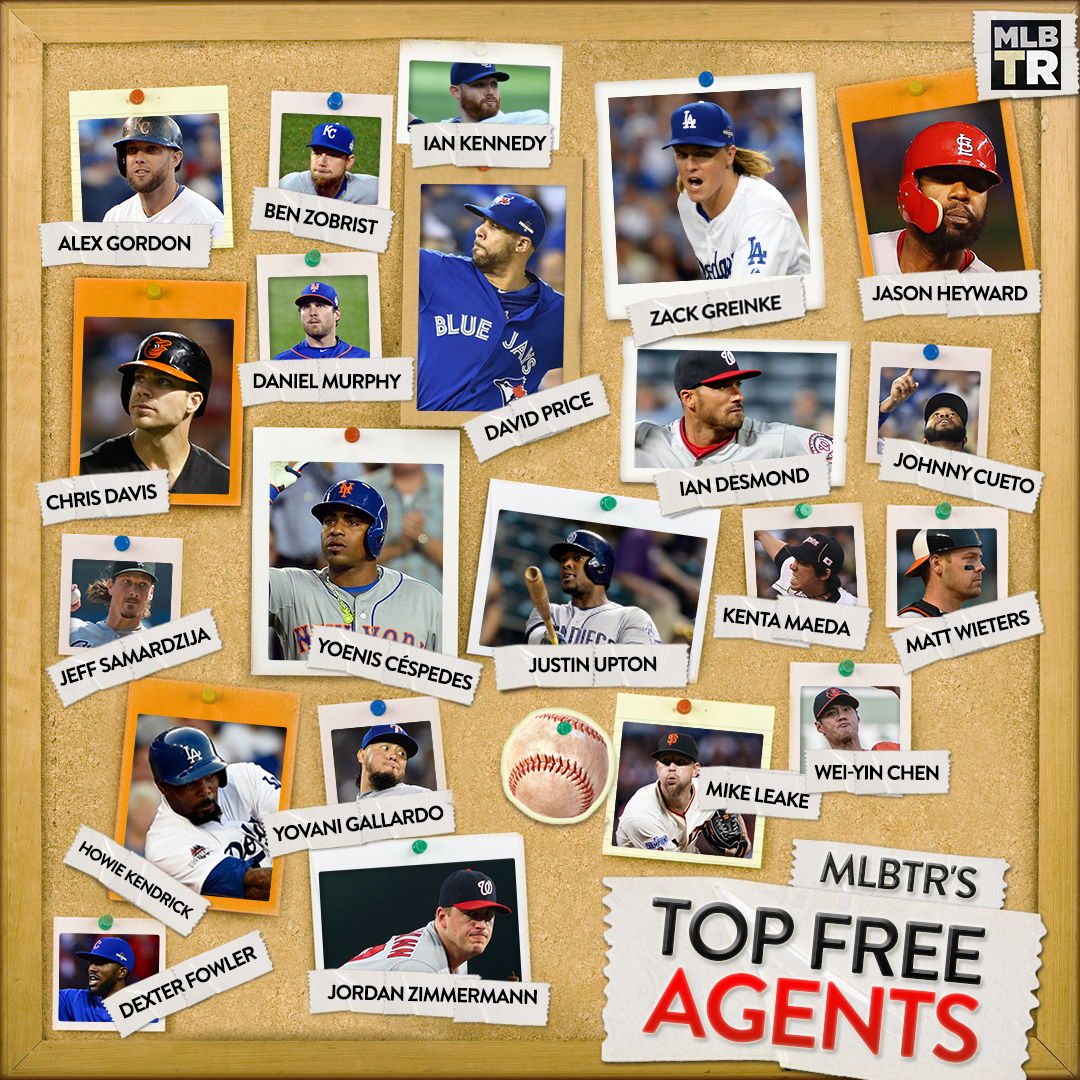
Just in time for the tenth anniversary of MLB Trade Rumors, our Top 50 Free Agents list has arrived! The entire list of available free agents can be found here, and you can filter by position, signing team, and qualifying offer status with our free agent tracker here.
New to MLBTR? You can follow us on Twitter, download our free app for iOS and Android, listen to our podcast, and sign up for our free weekly newsletter.
This is the fifth year for our free agent prediction contest, which allows you to test your prognostication abilities against those of the MLBTR writing team as well as other readers. Last year 3,469 people entered, with Carson Pennington taking home the batting title with 15 correct picks out of 49, a .306 average. Mark Polishuk topped MLBTR writers with 14 correct. The contest is back for 2016 and is open now! You can enter your picks anytime between now and November 13th at 11:59pm central time, and you’re free to make changes up until that point. A Facebook account is required to participate in the contest. Once all top 50 players have signed, the winners will receive cash prizes.
This year, I asked MLBTR writers Steve Adams, Jeff Todd, Mark Polishuk, Charlie Wilmoth, Zach Links, and Brad Johnson to send me their picks so I could compare to my own. Discussions with the MLBTR writing team, especially Steve and Jeff, helped inform the predictions found below. Each player’s team was picked in a vacuum, so we’re not predicting the Nationals will sign both Justin Upton and Gerardo Parra. Additionally, we’ve added our contract predictions to the mix. We vetted these as much as possible, but with 50 predictions and a volatile free agent marketplace, we know we’ll be off on some. Still, the contract predictions give a more clear criteria, as players are ranked by earning power. Without further ado, we’re proud to present MLBTR’s Top 50 Free Agents!
MLB Trade Rumors Turns 10
Back in June 2005, I worked at a search engine marketing company in Chicago. It was about the coolest job a kid fresh out of college could hope to have. I remember being impressed that it was normal to be on the Internet all day at work, and that people communicated with each other using AOL Instant Messenger. I had been at the company for about a year and it was a fun and interesting job. I became friends with a consultant named Jeff, and naturally we chatted about baseball. I had a lot of ideas, and he suggested I start a blog. I barely knew what that was, but he had one.
So I fired up a free blog using Blogger. The next day, I registered my own domain, rotoauthority.com, and soon moved to a more serious platform, TypePad. RotoAuthority would be where I would write a bunch of fantasy baseball posts. I was all over the forums promoting my blog, and I remember my future wife waiting patiently as I chalked the name of it all over the quad at the University of Illinois at Urbana-Champaign when we visited our alma mater. I also had the novel idea of mailing out packages of Big League Chew to baseball reporters I liked, to get RotoAuthority on their radar. I sent out a bunch of them, to Peter Gammons, Jerry Crasnick, Rob Neyer, and the like. Years later, Rob told me he chewed the gum immediately.
I mentioned to Jeff that I was thinking about naming my new company The Roto Authority, and he told me I should think bigger, I may want to start a second site at some point. The 2005 MLB season was over, and I found myself writing a bunch of stuff on RotoAuthority that had only a loose connection to fantasy baseball, including my first-ever Top 50 Free Agents list.
I still thought RotoAuthority was my meal ticket to becoming self-employed, as I used it as a vehicle to sell self-created projection spreadsheets for $9.99. I was also making a few bucks writing the Waiver Wired column for RotoWorld. Nonetheless, I was drawn to all the rumors and deals of the 2005-06 MLB offseason, and wanted to write about Bobby Abreu, Billy Wagner, and Juan Pierre without the constraints of fantasy baseball. So, so many posts about Juan Pierre. So, ten years ago on this date, I registered a new site, mlbtraderumors.com, and wrote this post about the Yankees potentially pursuing Torii Hunter. The site’s design looked like this. Raise your hand if you remember it!
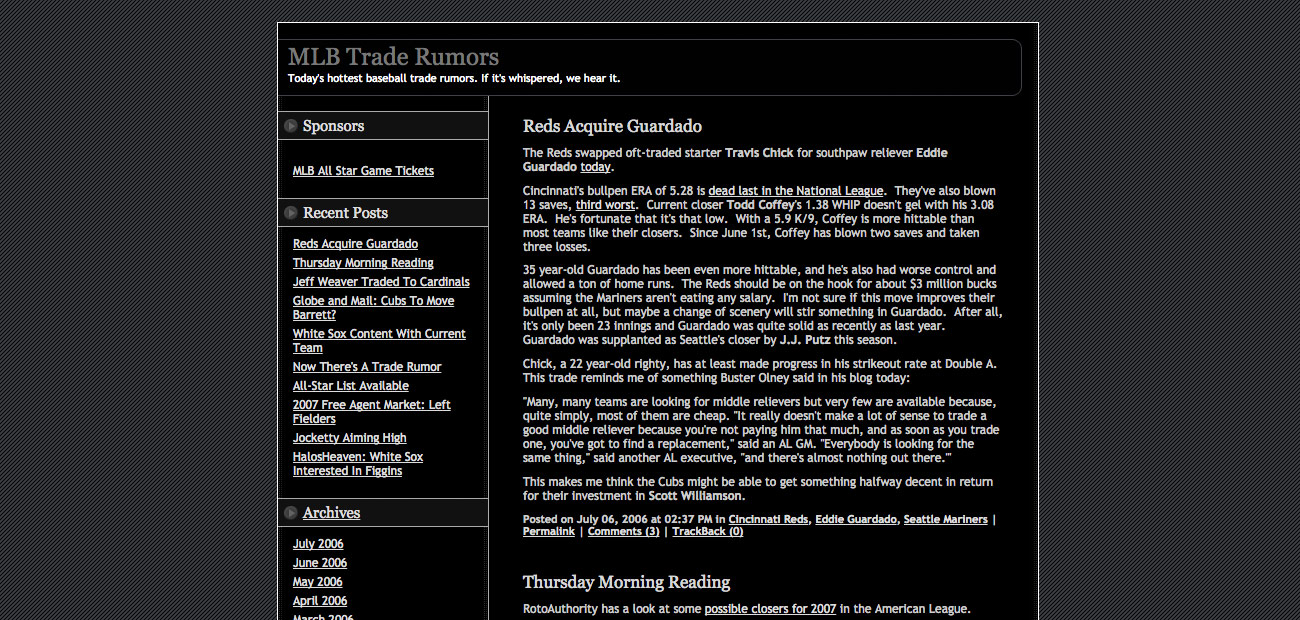
MLB Trade Rumors quickly passed up RotoAuthority in traffic, and started to take up more of my time. During busy times like the July trade deadline or the Winter Meetings, our posts went viral in an old school way, with links on forums and perhaps carrier pigeons. It certainly wasn’t succeeding because of my journalistic integrity. In the early years of MLBTR I was completely naive about the hard work and years of trust-building that goes into getting most baseball scoops. So, if someone emailed about having the same barber as Octavio Dotel and therefore knowing where he might sign, I believed it and printed it.
A major turning point came during the 2007 Winter Meetings. Someone pretended to be a Mets beat reporter (one I knew of but had not interacted with) and sent me a whopper of a trade rumor. He was happy to let me write an exclusive post on MLBTR about the potential three-team deal sending Johan Santana and Bobby Crosby to the Mets, Jose Reyes and Kevin Mulvey to the A’s, and Dan Haren to the Twins. I was not present at those Winter Meetings, but this bogus rumor spread like wildfire after I posted it, and of course was shot down.
Shot down is an understatement, actually. Here are the choice quotes from A’s GM Billy Beane:
“There’s a better chance of me breeding unicorns than there is of that deal happening.” – ESPN
“It’s ridiculous. All-time most ridiculous. Of all the trade rumors the whole time I’ve been coming here, because of the genesis and how quickly it went around, that was the finest, or the worst, whatever you like.” – San Francisco Chronicle
“I’m on the bike, and (Zaidi) is on the treadmill, and he figures out a way to get on the Internet, and he says, ‘Hey look at this.’ Of all the trade rumors in all my career, that one’s the furthest from the truth.” – Contra Costa Times
I was mortified at what I’d done and that it was on Beane’s radar to that degree. I finally realized that I had to take sourcing much more seriously, and also stop worrying about trying to break stories.
Soon after, I quit my job to focus on MLBTR full-time. A parade of great writers and friends joined me on our team and helped make the site better each year. The core of what we do hasn’t really changed since 2008. We collect, organize, and analyze everything related to MLB transactions in a timely manner, filtering out anything lacking in credibility. The format and means of sharing the information have changed, but the idea remains the same.
Thank you for indulging my trip down memory lane. I am forever grateful for the opportunity to run MLBTR for a living, and I don’t intend to stop anytime soon. I would like to express my gratitude to our many contributors over the years, and to the journalists on the beat. And of course, thanks to our readers, whether you were here for the black background days or you just discovered the site this week. Here’s to the next ten years!
Offseason Outlook: Chicago Cubs
The Cubs’ primary offseason goal is to add an impact starting pitcher. They will also address center field, consider trades for surplus position players, and explore an extension for Jake Arrieta.
Guaranteed Contracts
- Jon Lester, SP: $125MM through 2020; mutual option for 2021
- Starlin Castro, 2B/SS: $38MM through 2019; club option for 2020
- Anthony Rizzo, 1B: $32MM through 2019; club options for 2020 and 2021
- Miguel Montero, C: $28MM through 2017
- Jorge Soler, RF: $18MM through 2020; may opt into arbitration after 2017
- Jason Hammel, SP: $11MM through 2016; club option for 2017 that may become void based on ’16 performance
- David Ross, C: $2.25MM through 2016
Arbitration Eligible Players (service time in parentheses; projections by MLB Trade Rumors)
- Clayton Richard (5.154) – $1.1MM
- Chris Coghlan (5.148) – $3.9MM
- Jonathan Herrera (5.101) – $1.1MM
- Travis Wood (5.004) – $6.4MM
- Pedro Strop (4.156) – $4.7MM
- Jake Arrieta (4.145) – $10.6MM
- Taylor Teagarden (4.093) –
- Hector Rondon (3.000) – $3.6MM
- Justin Grimm (2.170) – $1.0MM
- Non-tender candidates: Herrera, Teagarden
Contract Options
- None
Free Agents
- Dexter Fowler, Trevor Cahill, Dan Haren, Tommy Hunter, Jason Motte, Fernando Rodney, Chris Denorfia, Austin Jackson
 Expectations have been raised for the 2016 Cubs, after the club reached the NLCS for the first time in 12 years. The team’s position player core has the potential to be in place for at least five more years. Jorge Soler is under team control through 2020, while Anthony Rizzo, Kris Bryant, Addison Russell, Kyle Schwarber, and Javier Baez are under control through 2021. At 26 years old, Rizzo is the elder statesman of the group. Bryant, Russell, Schwarber, and Baez are years from arbitration, and Soler ($3MM) and Rizzo ($5MM) are also very cheap. Theo Epstein and company have assembled something special and have lined the players up for sustained success.
Bryant’s rookie season defense suggests he’ll remain mostly at third base next year, although manager Joe Maddon dabbled with him at each outfield position and may continue to do so. Rizzo is locked in at first base. The veteran tandem of Montero and Ross will return at catcher.
The Cubs have a middle infield surplus. Russell will remain the starting shortstop, so the question is what to do with Baez and Castro. Both players were acquired under the Jim Hendry front office, though Epstein’s group brokered the extension with Castro in the summer of 2012. Castro’s 2015 season was near replacement level, and he lost the starting shortstop job to Russell in August. Partially because of an injury to Soler that forced Chris Coghlan back to the outfield, Castro became the starting second baseman in September and had a blistering month. He continued in that role throughout the playoffs.
Castro won’t turn 26 until March, and he’s an enigma. He tallied 529 hits from age 20-22, joining Alex Rodriguez as the only middle infielders to accomplish that feat in baseball history. Since then he’s had replacement level seasons in 2013 and ’15, sandwiching a solid 2014. The Cubs prefer Russell and Baez over Castro as defensive shortstops, so it’s unclear whether another team would install Castro at short. He did show pretty well at second base late in the year.
If Castro became a free agent right now and demanded a four-year deal with a club option, I think he could get $38MM or a bit more. So perhaps the Cubs could move him without eating salary, though they wouldn’t get a player back with much surplus value. The Mets, Padres, White Sox, and Yankees could be potential trade partners for the Cubs, who would presumably look to add starting pitching. Most of those teams have pitching depth, and the Cubs could look to add to their bullpen as well.
Baez, who turns 23 in December and comes with six years of control, is also a trade candidate. He was able to cut his strikeout rate a bit in Triple-A this year, while dealing with the tragic passing of his sister as well as a broken finger. Baez’s star potential gives him much more trade value than Castro, and it would be risky for the Cubs to move him. The flip side of that is that making him available opens the door to controllable upper-tier arms like Carlos Carrasco and Tyson Ross, pitchers the Cubs pursued in July. All in all, Castro is more likely to be dealt than Baez this winter, yet there is a reasonable chance the club enters the season with both and delays the trade decision. Baez could serve as the team’s backup infielder to start the season.
Schwarber’s bat is well ahead of his glove. He joined the Cubs in mid-June and clubbed 21 home runs in 304 plate appearances, including his postseason onslaught. The plan remains the same for 2016: bring him along as a catcher when possible, while keeping his bat in the lineup as the left fielder. Trading Schwarber at this point in his career would be an extremely bold move that I don’t anticipate the Cubs making. Trading Chris Coghlan is a safer alternative. He and Schwarber both bat left-handed, so they can’t form a left field platoon. Coghlan remains affordable in his final year of team control, and he hit .264/.355/.476 against right-handed pitching this year. I’m reminded of Seth Smith, who was traded to the Padres for Luke Gregerson two years ago. The Angels, Astros, Giants, Orioles, Padres, Royals, and White Sox could be potential trade partners for Coghlan.
Though he’s cut from the same cloth as Baez, the Cubs could consider trading Soler for controllable pitching. Soler posted a replacement level rookie season, with poor defense and a 30% strikeout rate. His 112 total games played marked a pro career high. Still, Soler flashed All-Star potential in the playoffs. Like Baez, the safe move here is to retain Soler and see what he becomes.
With Schwarber and Soler penciled in at the outfield corners, center field is the Cubs’ clearest position of need. Coming off the healthiest season of his career, Dexter Fowler is due a qualifying offer and perhaps a four-year contract in the $60MM range. While the Cubs have the capacity to sign him, they may acknowledge that a four-year deal wouldn’t provide good value. If Denard Span does not receive a qualifying offer and the Cubs aren’t scared off by his September hip surgery, he could be a cheaper replacement on a shorter term. The Cubs have 2012 first-rounder Albert Almora working his way up the minor leagues, so a shorter-term investment makes sense. Bringing Austin Jackson back is an option, or the Cubs could look into a trade for the Yankees’ Brett Gardner. Epstein has named outfield defense as an area of improvement, which could mean exploring trades for players like Leonys Martin or Juan Lagares.
Despite some decisions to be made on the position player side, the Cubs’ offseason focus will be on their rotation. The group is currently fronted by Jake Arrieta and Jon Lester. After the season, Epstein spoke of his desire to add “impact pitching,” as well as big league depth. He seems open to the “necessary evil” of free agency, and this year’s class is stacked with David Price, Zack Greinke, Johnny Cueto, and Jordan Zimmermann. Jeff Samardzija could also be considered a potential impact arm. Then there’s John Lackey, who Epstein signed as Red Sox GM six years ago. Greinke, Zimmermann, Samardzija, and Lackey would likely require the Cubs to forfeit their first-round draft pick. The Cubs could make trade attempts for Carrasco, Ross, Jose Quintana, Sonny Gray, Matt Harvey, or Stephen Strasburg, though some of them will be off-limits and they come with varying amounts of team control. In the end, expect the Cubs to come away with someone they’re comfortable starting in the first three games of a playoff series.
Hammel and Hendricks can capably fill out the back of the Cubs’ rotation. Hendricks, 26 in December, won’t reach arbitration until after the 2017 season, and the Cubs could include him as part of a trade for a better pitcher like Ross. Epstein’s mention of depth is important, as the club avoided major injuries in 2015. They need to safeguard against possible injuries in 2016, especially with ace Jake Arrieta reaching 248 2/3 frames. That means starting the year with at least six capable options. Travis Wood could be stretched out if needed, but the Cubs should probably add two starters.
The Cubs assembled an interesting collection of relievers by the time the playoffs started, with a surprisingly heavy reliance on failed starters Wood, Trevor Cahill, and Clayton Richard along with Hector Rondon, Pedro Strop, and Justin Grimm. Wood’s past as a starter will drive his arbitration price up to more than you’d like to pay, but he posted a 2.95 ERA and 11.0 K/9 in regular season relief and should be retained. It’s unclear whether Cahill, 28 in March, will embrace a relief role as a free agent. He was very good in that role for 22 1/3 innings after joining the Cubs, and the team should find a way to bring him back.
Perhaps in the new year, the Cubs will explore an extension for Arrieta. A big factor is who they are able to acquire – if it’s David Price on a seven-year deal, the Cubs would seem unlikely to make Arrieta their third long-term $25MM+ pitcher. If it’s two years of Tyson Ross, maybe there’s room for a huge deal for Arrieta. We project Arrieta to make a big leap to a $10.6MM salary in arbitration for 2016, and then he’d be due another raise for 2017. Signing him now could allow the Cubs to temper those two arbitration salaries, but it would be a question of how many years the pitcher would need on top. Arrieta’s projected free agency begins with his age 32 season, and Scott Boras is his agent. Zack Greinke’s new deal will also begin with his age 32 season. Whatever Greinke gets for his free agent years, Boras will expect the same. That could be $150MM over five years, $160MM over six, or something else, but we should know by January. The Cubs have to ask the hard question of whether giving Arrieta ace money through age 36 or 37 is prudent, when they already control his age 30 and 31 seasons.
If the Cubs are already looking at $185MM or so over seven years to lock Arrieta up in January 2016, how much higher would the price be in January 2017? Can the Cubs wait this year out to see how Arrieta’s arm holds up after all the added innings, or will the window to extend him be mostly closed by that point? If a long-term deal can’t be reached, the Cubs could at least gain cost certainty by signing Arrieta to a two-year deal.
In 2015, Joe Maddon’s Cubs got close enough to taste their first World Series in 70 years before running into the Mets buzzsaw in the NLCS. The Cubs were playing with house money with a lot of fans this year, as many perceived this club to be a year early. Now, the team will hike ticket prices and add to the payroll to assemble a playoff-caliber rotation to complement their exciting young position players.
Free Agent Profile: Matt Wieters
Once the game’s most-hyped prospect, switch-hitting catcher Matt Wieters has put in six years of Major League service with the Orioles. After five-plus years as a very good, durable backstop, Wieters missed a year due to Tommy John surgery and played in 75 games this season.
 Strengths/Pros
Wieters is an above average hitter for a catcher. In 2015, the average catcher hit .238/.302/.376 with a Weighted Runs Created Plus of 85. Wieters hit .267/.319/.422 with a wRC+ of 100. He displayed a league average bat, even though catchers generally hit significantly worse. He has shown good pop, leading all catchers with 67 home runs from 2011-13. Wieters made the All-Star team twice in that span, and again in 2014 after a 26-game hot start to that season.
Defensively, Wieters has been among the game’s best at preventing stolen bases. The stat Stolen Base Runs Saved credits catchers for throwing out runners and preventing them from attempting to steal in the first place, and Wieters led all of baseball from 2011-13. The simpler version of this is caught stealing percentage, and Wieters was among the top four qualified catchers in each of 2011-13 seasons. Wieters has also been one of baseball’s best at blocking pitches. He won Gold Glove awards in 2011 and ’12.
As with Justin Upton, it feels like Wieters may not have reached his ceiling. The Orioles drafted Wieters fifth overall in 2007, and his 2009 big league debut was highly anticipated. In 2008, Baseball America wrote that Wieters had “the makings of a legitimate star,” a switch-hitter with plus bat speed, good plate discipline and pitch recognition, and excellent defense including plus-plus arm strength. He doesn’t turn 30 until May, and is easily the best free agent catcher.
Weaknesses/Cons
From 2011-13, Wieters caught 3,539 2/3 innings, the most in baseball. The ability to catch more than 140 games per season would be considered a huge positive, but as Wieters heads into free agency, we have to question how many innings behind the plate he can handle for the next several years. Wieters’ 2014 season ended on May 10th with elbow soreness, and he had Tommy John surgery in June of that year. Though he was at one point on track to be ready for Opening Day, Wieters experienced elbow tendinitis in March and started the year on the DL. His season debut came on June 5th.
From the day of Wieters’ season debut, he started at catcher for 55 of the team’s 109 games. He battled a hamstring strain in August and a wrist injury in September. Still, there was no point this season where Wieters was used like a regular catcher by the Orioles. As Mark Brown of Camden Chat pointed out, he only caught on consecutive days four times this year. He’s not a good enough hitter for significant time at DH or first base to be appealing as part of a long-term contract, as it was with Brian McCann. In a given year, anywhere from 11-18 catchers get at least 900 innings behind the dish, and a team giving a multiyear pact to Wieters will need confidence he can do that.
Exploring the question of Wieters’ ability to stay behind the plate long-term, one must consider his massive size. He is literally the only regular catcher in baseball history who is 6’5″ and 230 pounds. Dropping the weight requirement to 220 gives a list of five total catchers (including Wieters himself). One of those is Joe Mauer, who was done catching by age 31 due to a lengthy history of concussions as well as back and leg injuries.
Looking at Wieters’ pitch framing data at StatCorner, he’s below average at getting pitches outside of the zone called strikes for his pitchers. The stat is called oStr%, and Wieters was the worst in baseball this year among those with a sample of 4,000 or more pitches. He was below average at this key framing skill from 2012-14 as well. Also, it’s unclear whether Wieters’ once-vaunted arm is as effective at preventing stolen bases. He threw out 30.8% of attempted thieves this year, which would have ranked eighth among qualifiers.
I believe Wieters will receive and turn down a qualifying offer from the Orioles, meaning signing him would require a team to forfeit its first eligible draft pick. This could present an issue for a team like the Mariners, who probably wouldn’t want to give Wieters a decent-sized contract and also forfeit the 11th overall draft pick.
Personal
Wieters was born in Charleston, South Carolina and resides in Sarasota, Florida with his wife and son in the offseason. According to Dan Connolly of the Baltimore Sun, Matt met his wife while attending Georgia Tech, and they also have a house in Atlanta. Will Graves of the Associated Press called him a “stoic cornerstone” for the Orioles in 2013, and more recently Connolly wrote, “Wieters’ leadership, steady influence and professionalism has been immeasurable.” Matt’s father, Richard, was a minor league pitcher for the Braves and White Sox, and as you’d expect, that sparked an interest in the game for Matt. He remained humble despite huge hype coming out of college and in his minor league career.
Market
Interest in Wieters will vary based on his contract demands and whether he receives a qualifying offer. I feel making a qualifying offer is a relatively easy “yes” for the Orioles, because he’d be worth $15.8MM on a one-year deal if he accepts. But why would a 29-year-old catcher, the best free agent at his position, decline his first chance at an open-market multiyear deal without fully exploring the market first? If all the multiyear offers are unacceptable, Wieters would probably be able to find a one-year deal worth close to $15.8MM in February or March. In March 2014, Wieters’ agent, Scott Boras, told ESPN’s Jerry Crasnick in reference to Stephen Drew and Kendrys Morales, “Everybody talks about these players turning down these [one-year] qualifying offers like they’re village idiots. The reason is, they don’t want to be in the same position again next year. If I’m a good player, I’m going to take the prospect of free agency.”
If Wieters becomes a one-year deal guy late in the offseason, opportunistic teams will swoop in, and the door could re-open to the Orioles. Before then, Boras needs to find a team that loves Wieters’ pedigree, and feels he can be a bargain on a multiyear deal if an offseason of normal rest brings back the durability he once had. Clubs that could enter the market for a starting catcher include the Rangers, Nationals, Braves, White Sox, Mariners, Twins, Rockies, Angels, and Astros. Of those nine teams, the Braves, White Sox, and Rockies have protected first round picks. The White Sox have not historically been involved with a lot of Scott Boras’ free agents, but we can’t rule them out. The Braves are a legitimate match. Wieters grew up rooting for the Braves, his father pitched in their minor league system, and he starred at Georgia Tech. Plus, former Oriole mainstay Nick Markakis joined the Braves last winter, and the team appears to have soured on young catcher Christian Bethancourt. The Rockies have Nick Hundley in place for 2016, but could see Wieters as a long-term solution behind the plate.
The Nationals are an under-the-radar fit. They were not happy with Wilson Ramos this year, according to MLB.com’s Bill Ladson, and the team’s management has a well-known strong relationship with Boras. Meanwhile, Jon Heyman of CBS Sports says the Rangers could take a look at Wieters, but only if he does not receive a qualifying offer. Surely Boras would appreciate the Orioles choosing not to make a qualifying offer, which would be extremely risk-averse. The O’s didn’t make a qualifying offer to Markakis last winter, which Mark Brown of Camden Chat theorized may have been a gesture of loyalty from owner Peter Angelos.
Wieters has little competition on the free agent market, but he will be affected by the availability of Brewers catcher Jonathan Lucroy. Any of the above teams could make a deal for Lucroy and drop out of the Wieters market.
Expected Contract
I can picture Boras coming out of the gates seeking Russell Martin/Brian McCann money for Wieters, meaning five years and $82-85MM. I don’t think he’ll get there, but I’m predicting a four-year, $64MM deal, even with a qualifying offer.