
Transaction Retrospection: The Rocky Colavito/Harvey Kuenn Blockbuster
Pop quiz, who were the AL and NL batting champions last season?
If you didn’t immediately have the names of Tim Anderson (.335) and Christian Yelich (.329) at the tip of your tongue, don’t worry. Given how modern statistics have lessened the importance of batting average in recent years, the batting title doesn’t carry nearly as much prestige in 2019 as it did for much of baseball’s history. One could even make the case that the home run crown lost some its luster last year since so many players were suddenly clearing the fences — a record 6776 homers were hit during the 2019 season, with Pete Alonso (53) and Jorge Soler (48) leading the way in their respective leagues.
All this being said, you can imagine the furor that would have been generated this offseason if a Yelich-for-Alonso deal had been arranged between the Brewers and Mets, or if the White Sox and Royals decided to swap Soler and Anderson in a one-for-one deal. Ultimately, any straight-up trade of star players is going to generate headlines, though the idea of a “home run champ for batting champ” trade makes for just as intriguing a concept today as it did 60 years ago yesterday, when the Indians dealt Rocky Colavito to the Tigers for Harvey Kuenn.
Both players were All-Stars in 1959, with Colavito finishing fourth in AL MVP voting and Kuenn in eighth place. Colavito’s 42 home runs tied Harmon Killebrew for the American League lead, as “The Rock” managed to top his 41-homer performance from a season earlier. Over four full seasons with the Tribe, Colavito has already hit 129 home runs and slashed .271/.364/.533 over 2166 plate appearances, making him an instant superstar to the Cleveland faithful.
However, Colavito hit “only” .257 in 1959, which led Indians GM Frank Lane to balk at Colavito’s demand for a raise for the 1960 season. For younger fans used to today’s guaranteed contracts and arbitration structure, players in 1960 had to negotiate their salaries on a year-to-year basis, and since teams had total control over player movement due to the reserve clause, even some of the game’s biggest stars had little leverage in salary negotiations. In fact, there was also some dispute between Kuenn and the Tigers in the batting champ’s own contract talks heading into the 1960 season.
Though Colavito and the Indians ultimately worked out a deal for 1960, Lane (known as “Trader Frank” for completing over 400 swaps during his two decades as a GM for five different teams) jumped at the opportunity to move the slugger for a player Lane felt was a better all-around talent. While Kuenn’s reputation has been somewhat diminished by his decline after this trade, it should be noted that he was a very good ballplayer in his prime. From 1953-59, Kuenn hit .314/.360/.426 with 53 home runs, while leading the league in hits four times, doubles three times, and once in batting average thanks to his career-best .353 mark in 1959.
As steady as Kuenn was, however, 1959 was by far his best offensive year, and it was still only somewhat better (141 OPS+, 145 wRC+) than Colavito’s production (133 OPS+, 130 wRC+) that same season. Kuenn was also almost three years older than Colavito, and of course didn’t have Colavito’s folk hero status in Cleveland. Indians fans were instantly enraged by the trade, while Lane was confident that he had made a shrewd move. In an infamous quote that has gone down in Tribe lore, Lane told reporters that dealing Colavito for Kuenn was like trading hamburger for steak.
In 1960, it seemed like the Indians may have at least broken even on the deal. Kuenn hit .308/.379/.416 over 537 PA, good for a 118 OPS+ and wRC+ through modern analytical eyes. Colavito, meanwhile, far outpaced Kuenn in the power department by hitting 35 homers and collecting 87 RBI over 616 PA, but also batted .249/.317/.474 (107 wRC+, 108 OPS+) in his first season in Detroit.
It didn’t take long for Trader Frank to lose interest in Kuenn, however, as Kuenn was traded to the Giants in the 1960-61 offseason for left-hander Johnny Antonelli and outfielder Willie Kirkland. Antonelli’s MLB career ended after the 1961 season, while Kirkland put up some decent power numbers along with a low average (ironically, making him something of the version of Colavito that Lane feared Colavito would become). Kuenn played six more years in the big leagues and had a couple more productive seasons, though he never again approached his 1959 peak.
As for Colavito, he rebounded from his 1960 down year to become one of the game’s most fearsome bats of the 1960’s, hitting .266/.362/.470 with 210 home runs from 1961-68 despite playing in a notoriously pitcher-friendly era. This included a second stint in Cleveland in 1965-67, as the Indians (with Lane no longer in the organization) reacquired Colavito for a return visit.
Cleveland fans may already be cringing at any recollection of “The Curse Of Rocky Colavito,” which was the title of a 1994 book by longtime Cleveland sportswriter Terry Pluto. After dealing Colavito, the Indians didn’t reach the postseason again until the 1995 season, and the club had only six winning seasons between 1960-1993. The Colavito trade was hardly the only reason for the Indians’ long slide, of course, and it arguably wasn’t even the starting point of the team’s downfall — nor was it even the most damaging trade the Indians made with the Tigers that same week. Just five days prior to the Colavito deal, Cleveland sent Norm Cash to Detroit for infielder Steve Demeter, who went on to appear in just four games for the Tribe and never again played in the majors after the 1960 season. Cash, meanwhile, proceeded to rip up American League pitching for the next 15 years in a Tigers uniform.
Still, the Cash trade never seemed to loom as large in the minds of Tribe supporters, perhaps since Cash never actually played a game in a Cleveland uniform. (The Indians acquired Cash from the White Sox as part of a seven-player deal that saw Minnie Minoso head back to Chicago earlier in the 1959-60 offseason.) Colavito had already become a fan favorite at the time of the deal, and continued to remain a presence in Cleveland for years afterwards, both in his return stint as a player and then as a coach and broadcaster for the Indians.
Trading one star player for another was as relatively unusual in 1960 and it would be today, though in some ways, the story of Colavito-for-Kuenn has a lot of parallels to modern-day front office moves. Money was naturally a factor, as both Colavito and Kuenn were coming off rather contentious contract negotiations, and it seemed as though Lane had misgivings about continuing to pay top dollar for what he felt was a power-only type of ballplayer.
In today’s game, you might see a front office just non-tender an arbitration-eligible slugger rather than work out a trade — just ask Chris Carter or C.J. Cron. Likewise, many a current GM would undoubtedly prefer more of a well-rounded hitter than a power-only type, though of course Lane was far off the mark both in evaluating Colavito as a one-dimensional hitter, and in betting that Kuenn would continue his 1959 form.
Losing Colavito was a tough beat for Indians fans, though since the Tribe have been regular postseason participants since Pluto’s book was published, maybe the “curse” is technically no more. Of course, Cleveland also hasn’t won a World Series since 1948 (the longest streak of any team in baseball), so maybe the baseball gods have more of an issue with the Tribe than just the Colavito deal. Maybe fate simply prefers hamburger to steak.
Mike Clevinger At Full Intensity In Return From Knee Surgery
Indians righty Mike Clevinger seems to be recovering quite nicely from offseason knee surgery. He tells MLB.com’s Mandy Bell that he’s working at “100 percent intensity now.”
Skipper Terry Francona said yesterday that Clevinger was among the rehabbing Cleveland players making progress. But it seems the ace righty is even further along.
The real challenge faced by Clevinger is more or less the one confronting every other ballplayer. He says he’s “monitoring the progression in the weight room” but otherwise running a mostly normal schedule — within the confines of a pandemic shutdown.
Clevinger says he was “doing beach workouts” before that became untenable. He’s now throwing to a catcher in a “facility that’s clean, sanitized, no one’s going in there.” Clevinger says he’d “like to have more of a set plan,” adding that he understands it just isn’t possible at the moment.
[RELATED: Mike Clevinger: The One That Got Away From The Halos]
The Indians are no doubt keeping a keen interest in Clevinger’s activities. He’s a critical part of the team’s plans, now and in the future. His knee surgery wasn’t serious, but the last thing anyone wants is for some other issue to crop up while he’s finishing off his rehab work and building back up on the mound.
Ace-Off: Buehler v. Bieber
Two of the preeminent young starters in baseball have emerged in the cities of Los Angeles and Cleveland over the past couple years. With no disrespect to Dodgers great Clayton Kershaw, who’s one of the best to ever take the mound, right-hander Walker Buehler has assumed the mantle of the club’s most valuable starter when you combine age, contract and performance. Meanwhile, the Indians have a similarly enviable rotation piece to build around in righty Shane Bieber, who joined Buehler among the majors’ most productive pitchers in 2019. So, here’s a question that has no wrong answer: If you had to pick one, which of the two would you choose?
To begin, they’re almost the same age, and they’re under team control for the same number of years. The 25-year-old Buehler won’t be eligible for free agency until after 2024. As a Super Two player, he brings one more pre-arbitration campaign to the table (though it won’t matter if there is no 2020 season). Bieber, who will turn 25 next month, is due to reach free agency at the same time, but he’s in his penultimate pre-arb year.
As for on-field results, Buehler has the edge on Bieber thus far in terms of run prevention. Excluding 9 1/3 rough debut innings as a reliever in 2017, Buehler has parlayed a 96 mph-plus fastball into a sterling 2.98 ERA/3.02 FIP with 10.3 K/9 and 2.08 BB/9 across 319 2/3 innings over the past two seasons.
Bieber also began to make his mark in 2018, and while his 4.55 ERA didn’t wow anyone, his peripherals indicated that he deserved better. Although he doesn’t match Buehler’s velocity (Bieber averages 93 mph on his heater), he nonetheless broke out in earnest last season. Bieber notched a 3.28 ERA/3.32 FIP and put up 10.88 K/9 against 1.68 BB/9 in 214 1/3 frames – the second-highest total in the game (only AL Cy Young winner Justin Verlander amassed a larger amount) and 32 more than Buehler’s 182 1/3. Buehler had a very similar year otherwise, though, posting a 3.26 ERA/3.01 FIP and recording 10.61 K/9 versus 1.83 BB/9. He further put himself on the map with 12 2/3 exemplary innings of one-run ball in a playoff series loss to the eventual World Series champion Nationals.
It’s obvious there’s a ton to like about this tandem. Buehler and Bieber have not only already established themselves as elite pitchers in their mid-20s, but perhaps elite players in general. Going forward, however, which one would you take to head up your rotation? (Poll link for app users)
Walker Buehler or Shane Bieber?
-
Buehler 74% (3,366)
-
Bieber 26% (1,156)
Total votes: 4,522
Indians Provide Updates On 5 Injured Players
Prior to the leaguewide shutdown, the Indians faced questions about a number of key players, including Mike Clevinger (knee surgery), Carlos Carrasco (elbow inflammation), Emmanuel Clase (teres major strain), Oscar Mercado (wrist sprain) and Tyler Naquin (2018 ACL repair surgery). At this point, nearly all of them are up to speed, manager Terry Francona told reporters Thursday (link via Mandy Bell of MLB.com).
Clase, Francona explained, is a bit harder to track than the others because he lives in a fairly remote area of the Dominican Republic. The club is likely to send someone from its Dominican academy down to get a first-hand look in the near future. Clase has been throwing off flat ground — Indians Prospective tweeted some video footage — as he works back from an injury that was initially projected to sideline him for eight to 12 weeks. It’s been exactly seven weeks since that diagnosis, so it seems there’s a good chance that whenever play is able to resume, Clase will either be recovered or close to it.
Updates on the others were more generic but widely positive. Carrasco has been throwing regular bullpen sessions, recording them and sending video footage to Indians officials. Clevinger, Naquin and Mercado are all doing “great” or “fine.” That’s particularly encouraging with regard to Naquin, whose September surgery was projected to keep him out seven to nine months (into mid-April or mid-June). It seems that his recovery is on track for the shorter end of that timeline.
Carrasco, Clevinger and Mercado, in particular, will be vital pieces for Cleveland as they look to rise back to the top of the ranks in the AL Central. With Corey Kluber traded to Texas (in the deal that netted Clase), Carrasco and Clevinger will team with Shane Bieber atop a rotation that will otherwise rely on some intriguing but generally inexperienced young arms in the final two spots (e.g. Aaron Civale, Zach Plesac, Logan Allen, Scott Moss, Jefry Rodriguez).
Mercado, meanwhile, is perhaps the one constant in an Indians outfield mix that looks decidedly unsettled. He should play center on a regular basis, with some combination of Domingo Santana, Jordan Luplow, Franmil Reyes, Greg Allen, Delino DeShields Jr. (also acquired in the Kluber swap), Jake Bauers, Bradley Zimmer and Naquin filling in at the corners. Luplow’s dominance of left-handed pitchers should assure him at least the short side of a platoon, and Reyes might factor in more as a DH than a prominent piece of the outfield rotation. But it’s clear that opportunities for playing time in the corners will be relatively wide open.
Clase, presumably, is being treated as a potential high-end setup piece for Brad Hand. The right-hander made his MLB debut with Texas in 2019 and compiled a 2.31 ERA with a 21-to-6 K/BB ratio and a superlative 60.6 percent ground-ball rate in 23 1/3 innings while averaging 99.3 mph on his heater. Clase skipped Triple-A entirely, but the success he found in last year’s 21 MLB games provides little to no reason to send him back down.
Mike Clevinger: The One That Got Away From The Halos
The post-trade-deadline trades of yore can’t happen anymore under baseball’s current rules. That’s a shame in some respects, because the August revocable waiver trade period delivered some doozies over the years. Here’s a story about one of them …
Back in 2014, the Angels were sprinting towards an AL West title and looking to bolster their bullpen. GM Jerry Dipoto had already swung a series of deals: he acquired closer Huston Street, nabbed lefty setup man Joe Thatcher, made a memorable change of scenery deal to get Jason Grilli for Ernesto Frieri, and even took a flier on Rich Hill (who never contributed in Anaheim).
The Street swap — the biggest of these moves — took place two weeks before the trade deadline. Dipoto was understandably still itching to improve a talented roster and ensure that the team was fully loaded for the postseason when an interesting opportunity arose in early August …
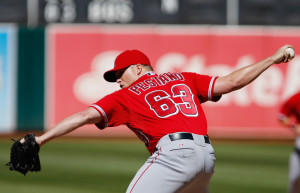
Vinnie Pestano was on the outs with the Indians. He was excellent in 2011 and 2012 but had stumbled in the ensuing two seasons. Still, a glance at his 2014 numbers shows why the Halos perked up when they saw his name scroll across the waiver wire.
Pestano, then 29, had a 13:1 K/BB ratio in nine MLB innings that year — even if he also allowed five earned runs. And in his 30 1/3 Triple-A frames, he owned a 1.78 ERA with 37 strikeouts against a dozen walks. It didn’t hurt that Pestano was earning just $975K and could be controlled through 2017.
The Indians hadn’t put Pestano on revocable waivers with intentions of letting him go for nothing. When the Angels were awarded the claim, they had to work out a deal to bring Pestano over from Cleveland.
It turned out that Dipoto had managed to make the above-noted additions without sacrificing any prospects who ended up turning out to be big losses over the long haul. That wasn’t so with the Pestano move, which cost a little-known prospect by the name of Mike Clevinger.
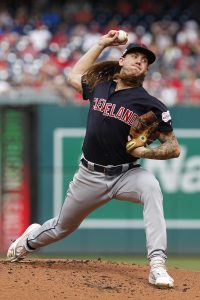
At the time, the 2011 fourth-rounder was on the radar but hardly an elite prospect. He was still in the middle of his first full professional season, having been sidelined for much of 2012-13 owing to Tommy John surgery. And though he had shown quite well at the Class A level to open the 2014 campaign, Clevinger had only managed a 5.37 ERA over his 55 1/3 High-A frames.
Clevinger didn’t exactly hit the ground running with the Cleveland organization, as he struggled through just five more High-A appearances after arriving. He really popped in 2015, when he punished Double-A hitters to the tune of a 2.73 ERA in 158 innings. Still, as the 2016 season approached, the idea of a Jacob deGrom career path was mostly floated because the two hurlers both feature flowing locks.
While he wasn’t then and never would be a top-100 sort of prospect, that was also true of deGrom. And as it turned out, Clevinger has tracked a lot more closely to the Mets star than anyone could’ve seriously predicted.
Clevinger went through some rookie struggles but produced very good results in 2017 and 2018. Last year, he took an ace turn. Though he missed a significant stretch owing to a teres major muscle strain, Clevinger produced monster numbers when healthy. Over 126 innings, he worked to a 2.71 ERA with 12.1 K/9 against 2.6 BB/9.
While he suffered some more poor fortune with a meniscus tear this spring, that’s likely not to impact the future (particularly since he’s rehabbing while the season is on hold). Suffice to say that Clevinger is one of the game’s more valuable pitching commodities, as he’s just entering his first of three arbitration-eligible seasons. (He’ll earn $4.1MM.)
Ironically enough, the Angels showed trade interest in Clevinger this spring … with the Indians reportedly responding by asking about elite prospect Jo Adell. The Halos would surely rather not have traded him away in the first place. Pestano did make a dozen strong appearances down the stretch in 2014, with two more in the team’s unsuccessful ALDS appearance, but he washed out in 2015 and hasn’t been seen in the majors since. It’s yet another reminder that sometimes those under-the-radar deals end up being quite important over the long haul.
Photos courtesy of USA Today Sports Images.
This Date In Transactions History: From Cleveland To Cincinnati
We’ve reached the 14-year anniversary of a pivotal Reds-Indians trade that was hardly a headline-grabber at the time. It was on April 7, 2006, that the Reds acquired 24-year-old second baseman Brandon Phillips from the Indians for a player to be named later. That player turned into right-hander Jeff Stevens, whom Cincinnati sent to Cleveland in June of that year.
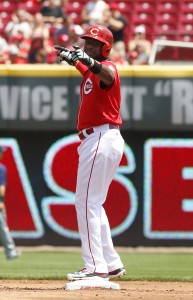
Phillips entered the pro ranks as a high draft selection of the Montreal Expos, who picked him in the second round (No. 57) in 1999. He was later part of a Montreal-Cleveland deal that had a massive impact, as the Expos sent Phillips, Grady Sizemore, Cliff Lee and Lee Stevens to the Indians for Bartolo Colon and Tim Drew. Sizemore and Lee became stars in Cleveland, but Phillips didn’t amount to much there in 462 combined plate appearances from 2002-05.
Phillips spent the majority of his final season as a member of the organization with the Indians’ then-Triple-A team in Buffalo, where he put up a .734 on-base plus slugging percentage. Unimpressed, the Indians and former general manager Mark Shapiro soon gave up on Phillips. That proved to be a mistake, at least when you consider what they received for Phillips. Stevens never even pitched for the franchise, instead throwing a combined 37 1/3 innings with the Cubs from 2009-11 after the Indians traded him as part of a deal for utilityman Mark DeRosa (notably, that transaction also saw Chris Archer head to Chicago). While DeRosa was effective for the Indians in ’09, that was his lone season with the club. The team later sent him to to St. Louis in a trade for reliever Chris Perez.
Perez had his moments in Cleveland, but they don’t match up to Phillips’ impact in Cincinnati. “Dat Dude” was a productive Red from the jump and eventually became a franchise icon – someone who was instrumental in breaking their 14-year playoff drought in 2009. The Reds went on to earn two more playoff berths while Phillips was in their uniform. His long tenure with the franchise concluded in February 2017 with a trade to the Braves, but not before Phillips racked up a laundry list of personal accomplishments. As a member of the Reds, Phillips made three All-Star teams, won four Gold Gloves and batted .279/.325/.429 with 191 home runs, 194 stolen bases and 28.1 wins above replacement over 6,899 plate appearances. He’s currently eighth in Reds history in games played (1,614) and PA and 10th in hits (1,774), runs scored (877) and total bases (2,722), to name just a few key statistics.
Phillips, now 38 years old, hasn’t played in the majors since 2018. But he’ll always be a part of the Reds’ rich history, and his acquisition was no doubt one of the shining moments of former Reds GM Wayne Krivsky’s stint. It’s also another bit of proof that you shouldn’t sleep on any transaction, no matter how minor it may seem at the time.
Photo courtesy of USA Today Sports Images.
How The Delayed Season Impacts The Indians
All 30 big league clubs are waiting to see whether a 2020 season will be played at all, but assuming a season is able to take place in some capacity, the prolonged delay will impact some clubs more than others. We’ve already examined the potential effects for the Yankees, Angels, Phillies, Athletics and Twins. Today, we’ll turn to Minnesota’s likeliest challenger in the AL Central, the Indians.
For every roster, the hiatus most obviously affects injured players. The delay gives currently them more time to recover, and Cleveland has a few who fit that bill. That’s most notable for a pair of right-handed starters.
Veteran Carlos Carrasco had been nagged by inflammation in his throwing elbow during Spring Training. While Carrasco fortunately avoided structural damage, president of baseball operations Chris Antonetti had cast doubt on his chances of being ready for a March 26 Opening Day. Cleveland hadn’t provided a firm timetable for his projected return, but the issue seemed relatively minor. Presumably, the 33-year-old would now have a much better chance at being in the season-opening rotation if baseball resumes.
That’s also true of staff ace Mike Clevinger. The hard-throwing righty underwent knee surgery in mid-February, which was expected to sideline him for six to eight weeks. Nothing has trickled out on the status of his recovery since, but we’re in the middle of that timetable now. Assuming Clevinger’s progressing as had been expected, he seems likely to be ready to ramp back up if the season gets going.
It’s even possible we see hard-throwing righty Emmanuel Clase in the season-opening bullpen. That wasn’t true prior to the shutdown when Clase went down for eight to twelve weeks at the end of February with a strain in his back. Owner of a 100 MPH cutter, Clase was the primary return from the Rangers in the Corey Kluber deal (along with getting Kluber’s $17.5MM salary off the books). If healthy, he’ll likely be an integral part of Terry Francona’s relief unit.
That’s a trio of potential impact arms who could see a greater portion of the season for Cleveland than had been initially anticipated. And simply by introducing more randomness, a shortened season probably increases their odds of upsetting the reigning division champs in Minneapolis. Yet the threat of a cancelled season looms as large for the Indians as any team in MLB.
Enter Francisco Lindor. The face of the franchise is two years from free agency. If it never becomes possible for MLB to return in 2020, Lindor will pick up another year of service time by virtue of having logged a full year in 2019. Extension talks, which have never seemed all that likely to come to fruition, were tabled even before the MLB moratorium. A cancelled season would be one fewer year for Cleveland fans to ‘enjoy‘ the presence of one of the game’s most talented, charismatic players. Regardless of whether a season is played, Lindor’s name would surely be bandied around in trade rumors next offseason unless an extension is reached. Cleveland fans won’t want to hear it, but there’s now seemingly a possibility he’s played his final home game there.
Fortunately, much of the roster is under team control for 2021. If the 2020 season is ultimately cancelled, the Cleveland front office could bring back the entire starting rotation and eight members of the starting lineup, as projected by Roster Resource. (Only second baseman César Hernández, an offseason signee, isn’t controlled beyond this season). Yet Lindor’s status already looms large for the franchise; if the season were wiped away, it’d only become more pressing.
Rebound Candidate: Domingo Santana
To say it was a low-spending winter for the Indians would be an understatement. They largely stayed away from doling out guaranteed contracts, but the one-year, $1.5MM pact they handed outfielder Domingo Santana was among the few. The Indians are hoping Santana can turn the clock back a couple seasons and help them reclaim the American League Central from the reigning division champion Twins. If there is a season in 2020, Santana figures to at least open it as a prominent member of the Indians’ lineup.
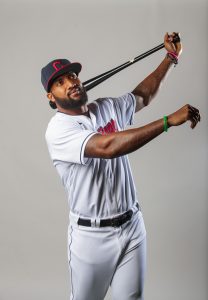
In the event that the Indians get something resembling the 2017 version of Santana, it’ll go down as one of the shrewdest bargain signings of the offseason. As a member of the Brewers that year, Santana batted .278/.371/.505 (127 wRC+) with 30 home runs, 15 stolen bases and 3.3 fWAR in 607 plate appearances. Santana crashed to earth the next year, though, and the Brewers traded him to the Mariners during the ensuing offseason.
At first, the Santana pickup looked like a wise move by the Mariners. Santana was an effective offensive player during the first half of the season, but thanks in part to a nagging right elbow injury, his production tanked from July onward. Santana wound up posting a .253/.329/.441 line (good for a 107 wRC+) with 21 homers and eight steals over 507 PA. That’s not going to cut it for someone who was inept in the field, where he accounted for a horrific minus-16 Defensive Runs Saved and a minus-16.1 Ultimate Zone Rating. Santana’s defensive troubles helped overshadow his passable performance at the plate, rendering him a replacement-level player (0.0 fWAR). As a result, the Mariners non-tendered Santana during the winter in lieu of paying him a projected $4.4MM in arbitration.
Based on the numbers he put up from 2018-19, Santana’s days as an impact contributor could be over. And he didn’t help himself during spring training before it shut down, collecting twice as many strikeouts as hits (10 to five) in an admittedly small sample size consisting of 25 trips to the plate. That said, there may be at least some hope for a revival on the offensive side. As mentioned, Santana’s elbow failed him in 2019 and had a hand in his horrid second-half output, so staying healthy this year would bode well for a rebound. Plus, it’s worth noting that Santana fared rather nicely in multiple Statcast categories as a Mariner. He ranked in the league’s 69th percentile in hard-hit rate and expected weighted on-base average (.347, compared to a .326 real wOBA), and in its 74th percentile in expected slugging percentage (.492). Santana also finished with an excellent .483 xwOBA on contact.
One clear issue for Santana is that he had great difficulty actually putting the bat on the ball last year, finishing 11th worst among 135 qualifiers in contact percentage (69.9) and dead last in strikeout rate (32.3). But an overwhelming amount of strikeouts is what everyone has come to expect from Santana, who has fanned 32 percent of the time since he debuted in the majors in 2014. Even in his career-best 2017, Santana went down on strikes at a 29 percent-plus clip. However, he helped offset that to some degree with a 12.5 percent walk rate – a number that dipped below 10 percent in each of the previous two seasons.
Along with better health and amassing more walks, it seems Santana’s value to the Indians will increase if they keep him away from the field. For the most part, Santana has been a defensive nightmare in the bigs, having recorded minus-37 DRS and a minus-31.2 UZR. He should see a lot of DH time in Cleveland, which ought to aid in maximizing his value, but one problem for the club is that it has a similar corner outfielder in Franmil Reyes. He’s another powerful, high-strikeout, defensively challenged player. At least one of those two will be in the outfield on a regular basis, and that probably doesn’t sound too appealing if you’re a member of Cleveland’s pitching staff.
Considering Santana’s defensive shortcomings, the Indians couldn’t have taken a flier on the 27-year-old expecting him to hold his own in the field. Instead, the hope for the Indians is that Santana will reach his previous heights as a hitter, and it wouldn’t be entirely surprising to see him at least log respectable numbers at the plate if his health holds up. The team’s paying Santana relatively little, so he shouldn’t have much trouble living up to his deal.
Photo courtesy of USA Today Sports Images.
10 Players Switch Agencies
Agent Rafa Nieves’ newly-founded Republik Sports agency will represent several players formerly represented by Nieves at Wasserman. A video published earlier today on Republik’s official Twitter feed reveals the names of 11 players who will continue to be represented by Nieves at this new firm.
We already heard last night that Nationals outfielder Victor Robles (a Nieves client at Wasserman) was joining Republik, and the other ten names cited in the video include a mix of prominent veteran and up-and-coming stars. The list consists of Indians infielder Jose Ramirez, Reds right-hander Luis Castillo, Pirates outfielder Gregory Polanco, Athletics right-hander Frankie Montas, Blue Jays outfielder Teoscar Hernandez, Rockies righty Antonio Senzatela, Padres outfielder Franchy Cordero, Marlins catcher Francisco Cervelli, and White Sox relievers Alex Colome and Kelvin Herrera.
As we’ve seen in several past cases of representatives changing agencies or starting new agencies, it’s quite common for players to continue using the same agent even after that rep becomes part of another company. We saw this in 2017 with Nieves himself, as several of the aforementioned players (namely Ramirez, Robles, Herrera, Colome, Cervelli, Polanco, and Montas) all went with Nieves when the agent moved from the Beverly Hills Sports Council to Wasserman.
The 10 changes have all been updated in our Agency Database. If you see any notable errors or omissions within the database, please let us know via e-mail: mlbtrdatabase@gmail.com.
Extension Candidates: AL Central
It’s now official: MLB rosters are frozen. We won’t see any players coming and going for some times. And it’s unlikely that any new long-term extensions will be announced. But that doesn’t mean such deals won’t be explored. Some may already have advanced nearly to completion before the global pandemic intervened.
While we may have to wait to learn who the targets are and see what deals get done, there’s a silver lining: more time for rampant speculation! Okay, we’re not going to speculate here; rather, we’ll tick through some interesting possibilities on paper. Remember, we’ve seen an increasing prevalence of deals with less-experienced players (even some without any MLB service) and with new player types (early-career relievers and utilitymen).
In the present MLB environment, value is king and the old forms are fading. We’ve already checked in on the NL East, NL Central, NL West, AL East, and AL West. To round things out, here are some possible extension candidates from the AL Central …
Indians
Francisco Lindor is the big story. Unfortunately, that ship seems to have sailed: he informed the team he’d like to halt talks since the sides weren’t making progress. Unless there’s a change of heart and another attempt during the current pause, Lindor is not going to sign onto a long-term deal (at least, before he has reached his final season of arbitration eligibility later in 2020).
There are a few other interesting candidates. Top hurlers Mike Clevinger and Brad Hand would be of interest, but the Cleveland org may not be able to afford these high-end veterans. Perhaps a few others would be more achievable targets for the cost-efficient Indians. Outfielder Oscar Mercado has only 139 days of service under his belt, meaning he’s two full seasons away from likely Super Two arbitration qualification. Young starters Shane Bieber and Adam Plutko are each in the 1+ service class, so they shouldn’t cost all that much and could convey significant upside.
Royals
There are certainly some interesting questions for the K.C. organization to consider. Slugger Jorge Soler had an eye-popping 2019 … but is he going to keep it going and should the team lock into a player who profiles best as a DH? And how about exciting young shortstop Adalberto Mondesi? There’s no real limit to his ceiling but he had some struggles last year and is still working back from a shoulder injury.
The situation is equally uncertain on the pitching side. Righty Brad Keller has had success through two full MLB seasons but isn’t exactly a top-of-the-rotation arm. You could perhaps make a case for relievers Scott Barlow and Tim Hill, though there doesn’t seem to be a pressing reason to push for a deal with either.
Tigers
The Detroit MLB roster turned in a roundly awful 2019 season. But it still has a few potential targets. The versatile Niko Goodrum could be a part of quite a few rosters around the game, though there’s no particular need to lock into him for the long haul. There are more interesting candidates on the pitching side: starter Matthew Boyd and reliever Joe Jimenez. The former has a whole lot of upside and three more seasons of team control remaining; perhaps the club could take a bit of a gamble. As for Jimenez, 2020 is something of a boom or bust year — rack up a lot of saves and he’ll get a big first-time arbitration payday; stumble and he may not do very well at all. Perhaps he and the club could take share the risk over a longer term.
It’s probably a bit too soon to consider the top of the farm system for deals. But this time next winter, the Tigers could have a host of interesting candidates.
Twins
Both of last winter’s extensions turned out well; the team struck again more recently with Miguel Sano. Perhaps the most obvious remaining candidate is quality young righty Jose Berrios, who is entering his first season of arbitration eligibility. Now that he’s in line for bigger money, it’ll cost more to do a deal. The sides have struck out in previous talks. Byron Buxton is also a 3+ service-class player. There’s likely too much uncertainty in his outlook to structure a deal, but it’s not out of the question.
It’s tempting to stake out a case for a deal with breakout catcher Mitch Garver, but he’s already 29 years of age and still a full season away from arbitration eligibility. Outfielder Eddie Rosario is two seasons from the open market, but that also gives him greater leverage for a higher price tag. Would the Twins really want to commit?
How about a few wild cards? Infielder Luis Arraez should at least be a nice utility player for years to come. There might be upside in an early deal for the plate-discipline magician. And reliever Taylor Rogers is another interesting target. He’s still three seasons from free agency but gets more impressive with each successive campaign. The Twins will owe him a big raise on his $4.45MM salary if he keeps racking up saves; perhaps a deal could suit both sides.
White Sox
The South Siders have already extended a wide swath of their roster. You might wonder whether there are any candidates left. But the team is exceptionally aggressive in this arena and can’t be counted out on exploring deals with just about anyone of interest.
The most obvious candidate at this point is righty Lucas Giolito. We recently broke down his case for an extension. You could perhaps argue for fellow starters Reynaldo Lopez and Dylan Cease, or even injury rehabbers Michael Kopech and Carlos Rodon, but there’s likely too much uncertainty in each of those situations for the sides to see eye to eye. The same is true of outfielder Nomar Mazara.
If you’re looking for a sleeper candidate … how about second baseman Nick Madrigal? The Sox haven’t been shy at all with pre-MLB extensions and the former fourth-overall pick is just about ready for a run at the game’s highest level.