
Indians Have Ample Long-Term Payroll Flexibility
2020 salary terms are set to be hammered out in the coming days. But what about what’s owed to players beyond that point? The near-term economic picture remains questionable at best. That’ll make teams all the more cautious with guaranteed future salaries.
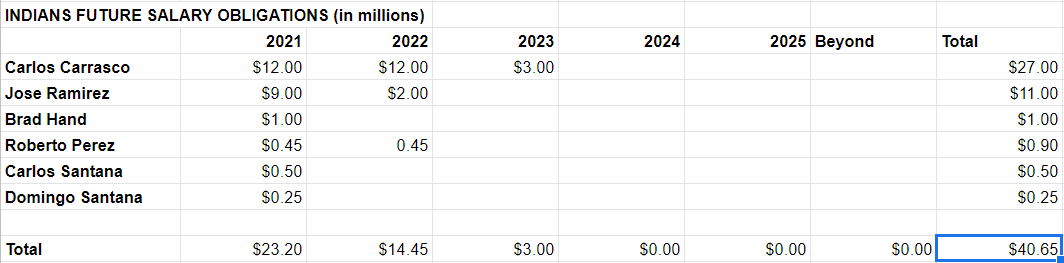
Every organization has some amount of future cash committed to players, all of it done before the coronavirus pandemic swept the globe. There are several different ways to look at salaries; for instance, for purposes of calculating the luxury tax, the average annual value is the touchstone, with up-front bonuses spread over the life of the deal. For this exercise, we’ll focus on actual cash outlays that still have yet to be paid.
We’ll run through every team, with a big assist from the Cot’s Baseball Contracts database. Next up is the Indians:
(click to expand/view detail list)
Indians Total Future Cash Obligation: $40.65MM
*includes buyout of club options
Which 15 Players Should The Indians Protect In An Expansion Draft?
In a few weeks, we’ll be running a two-team mock expansion draft here at MLBTR. Currently, we’re creating 15-player protected lists for each of the existing 30 teams. You can catch up on the rules for player eligibility here.
So far, we’ve done the White Sox, Rays, Yankees, Red Sox, Blue Jays, and Orioles. The Indians are next.
We’ll start by removing Cesar Hernandez, Oliver Perez, and Sandy Leon from consideration since they’ll be free agents after the season. Carlos Santana has a relatively pricey $17.5MM club option, so we’ll remove him as well. Roberto Perez has more affordable club options on 2021 and ’22, so we’ll include him in the poll. I’m only going to lock in these five players:
Francisco Lindor
Mike Clevinger
Shane Bieber
Jose Ramirez
Brad Hand
That means you get most of the control here, as you can choose 10 of the following 26 players:
Greg Allen
Logan Allen
Christian Arroyo
Jake Bauers
Bobby Bradley
Carlos Carrasco
Yu Chang
Adam Cimber
Emmanuel Clase
Aaron Civale
Delino DeShields
James Hoyt
James Karinchak
Jordan Luplow
Phil Maton
Oscar Mercado
Tyler Naquin
Roberto Perez
Zach Plesac
Adam Plutko
Franmil Reyes
Jefry Rodriguez
Domingo Santana
Nick Wittgren
Hunter Wood
Bradley Zimmer
With that, we turn it over to the MLBTR readership! In the poll below, select exactly ten players you think the Indians should protect in our upcoming mock expansion draft. Click here to view the results.
Did The Marlins Gift The Indians A Setup Man?
Like any club, the Indians have had their share of notable players slip through their fingers, though the losses of Kirby Yates and Gio Urshela can likely be forgiven when looking at the low costs of acquisition for the likes of Corey Kluber and Mike Clevinger. Cleveland’s Feb. 4, 2019 acquisition of righty Nick Wittgren from the Marlins isn’t going to have that type of long-term impact on the franchise, but it nevertheless appears to be another high-quality, low-cost pickup for a team that has had its share of success in that regard in recent years.
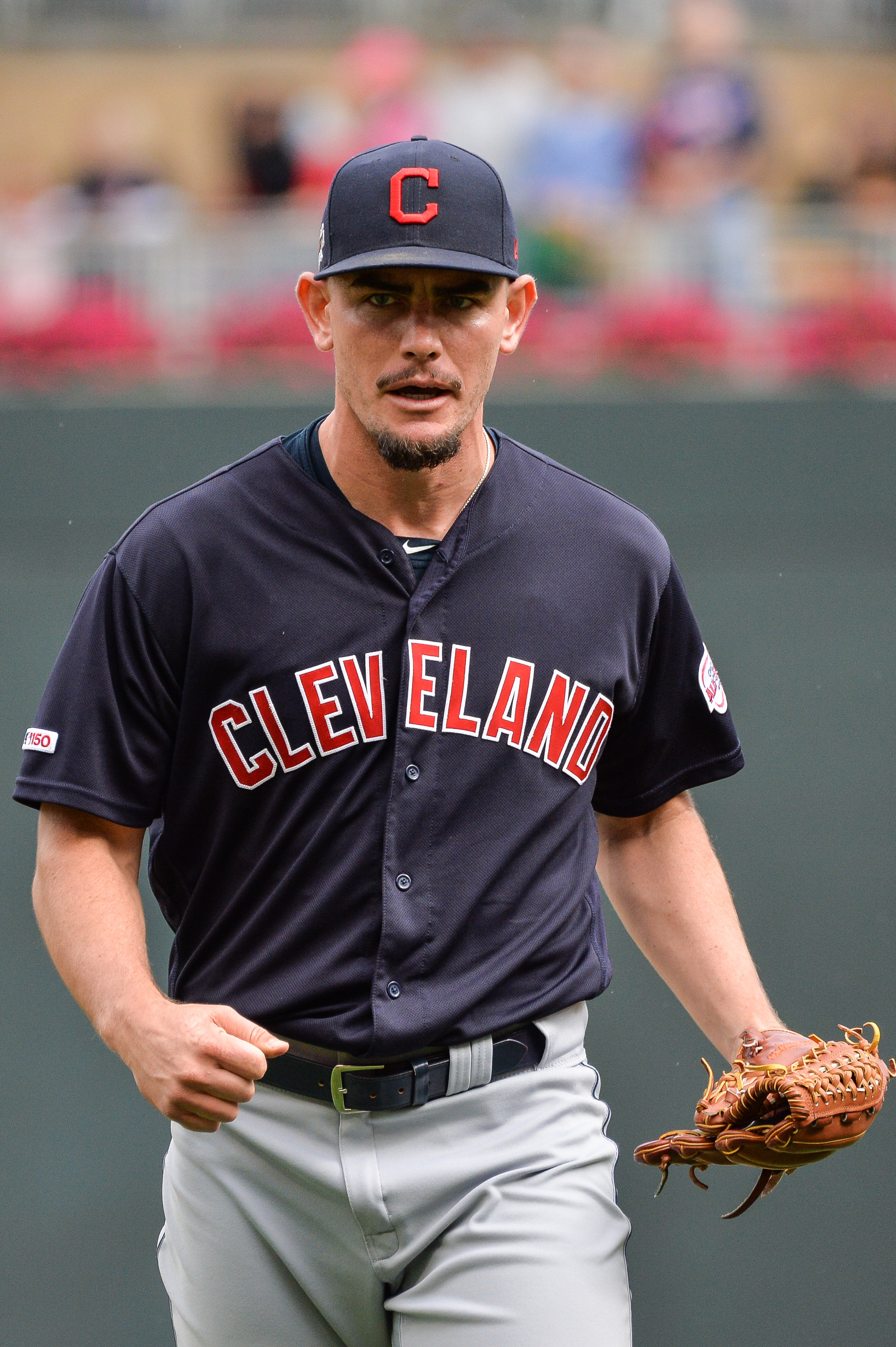
When the Marlins designated Wittgren for assignment in Jan. 2019, it registered as something of a surprise, as noted here at the time. He’d had an up-and-down year in 2018 but finished out the season with a 2.94 ERA, 8.3 K/9, 4.0 BB/9, 0.27 HR/9 and a career-best 46 percent ground-ball rate in 33 2/3 innings with Miami. Wittgren was a 27-year-old with a minor league option remaining, a 3.60 ERA (3.50 FIP) and a 116-to-38 K/BB ratio in 127 2/3 innings of relief for the Marlins. He wasn’t expensive — still pre-arbitration at the time — and could’ve been controlled through 2022.
Whatever the reasons, the Marlins felt Wittgren was the most expendable piece on the 40-man roster when they signed Neil Walker. Five days after being designated for assignment, he was traded to Cleveland in exchange for Jordan Milbrath — a minor league righty who is only about two months younger than Wittgren and, at the time, had only briefly reached Triple-A.
For an Indians club that had moved on from the long-solid trio of Cody Allen, Zach McAllister and Dan Otero and, a year prior, had lost iron man Bryan Shaw in free agency, Wittgren proved to be a godsend. While he didn’t break camp with the team, Wittgren was summoned in early April and made his Cleveland debut by pitching 1 1/3 innings with four strikeouts. At no point in 2019 did the righty carry an ERA higher than 3.34, and by the time the season had drawn to a close, Wittgren was regularly pitching in the eighth inning as one of Brad Hand‘s primary setup men. His 12 holds ranked third on the club behind Oliver Perez and Adam Cimber.
Wittgren doesn’t have the flashy Statcast numbers that some other relievers we’ve profiled recently do. He’s not a hard-thrower (92.3 mph average fastball), and he ranks below average in terms of spin rates and hard-hit rates. His home-run rate looked ripe for regression in 2018 and did indeed spike in 2019 — although the extent of that spike was surely impacted by the juiced ball (as was the case for virtually every pitcher in the league).
But Wittgren has demonstrated above-average control throughout his career and generally been effective against both righties and lefties (last year’s more pronounced platoon splits notwithstanding). Fielding-independent metrics suggest that the sub-3.00 ERA he’s managed over the past two seasons isn’t likely to hold up, but Wittgren has a career 3.71 FIP in 185 1/3 big league innings at this point.
In some ways, Wittgren mirrors the previously mentioned Shaw, who was a similarly unheralded pickup but emerged as a rock-solid late-inning stabilizer in Cleveland for a half decade. He’s not an overpowering righty but generally has solid control and has, to this point in his career, managed to maintain an ERA south of his FIP and (particularly) his xFIP thanks to home run suppression skills. He has a ways to go in terms of matching Shaw’s uncanny durability, but Wittgren still seems like a solid piece in the ‘pen — even if his ERA trends a bit closer to his FIP marks.
As a 28-year-old middle reliever/setup man without huge strikeout totals, we probably won’t see Wittgren named to any All-Star teams in the near future. He’s the type of reliever who even in maintaining success will also maintain relative anonymity. Most seventh- and eighth-inning relievers on smaller market clubs aren’t exactly household names. But considering the cost of acquisition — Milbrath is already out of the Marlins organization after posting a 4.50 ERA an 5.49 FIP in 52 Triple-A frames last year — and the fact that Wittgren can be cheaply controlled through 2022, the trade looks like a nice under-the-radar move that can help Cleveland for the foreseeable future.
When Padres Gave Up An Eventual 2-Time Cy Young Winner
Although right-hander Corey Kluber has been one of the most successful starters in recent memory, it’s not as if his he was a can’t-miss prospect who was expected to turn into the two-time American League Cy Young winner he became. Kluber entered the pros as a fourth-round pick of the Padres in 2007, but he wasn’t lights-out at preventing runs at the lower levels of the minors with them during his time with the franchise. The Padres eventually deemed Kluber expendable when they sent him to the Indians in a July 2010 three-team trade that also involved the Cardinals. The headliners then were outfielder Ryan Ludwick (he went from the Cardinals to the Padres) and righty Jake Westbrook (the Indians shipped him to the Redbirds). Little did anyone know Kluber would turn into the most valuable player in the deal.
If we go back a decade, Ludwick was amid a rather impressive run with the Cardinals, largely because of a 5.3-fWAR campaign in 2008 in which he posted a jaw-dropping 151 wRC+. While he fell back to earth from there, the Padres – who were playoff contenders in 2010 – expected him to at least serve as a solid regular in their uniform. But the Padres, despite winning 90 games that year, didn’t end up making the playoffs, and they never got much value from Ludwick. He slashed a weak .228/.301/.358 (86 wRC+) over 664 plate appearances in a Padres uniform in 160 games before they sold him to the Pirates in July 2011.
Ludwick’s subpar production in San Diego makes it all the more unfortunate that the team said goodbye to Kluber, who later evolved into one of the top starters of the past several years. Kluber came into his own in 2013, his first full season in the majors, and proceeded to post a sterling 2.96 ERA/2.89 FIP with 9.91 K/9 and 1.86 BB/9 across 1,238 2/3 innings through 2018.
As mentioned, Kluber took home a pair of Cy Youngs during his halcyon stretch. He also earned three All-Star nods, ranked 10th among all qualified starters in ERA, and helped the Indians to four playoff berths and three AL Central championships. Not bad for someone who was unheralded when the Indians got him. Westbrook, whom the Indians gave up, was quite good in their uniform at times, and he did enjoy success in St. Louis, but that’s nonetheless a trade that Cleveland would make again in light of how much Kluber blossomed as a member of the club.
However, now 34 years old, Kluber is no longer part of the team with which he broke out. After a disappointing, injury-ruined 2019, the Indians sent Kluber and his waning team control (he has a guaranteed one year, $18.5MM left on the five-year, $38.5MM pact the Indians gave him in 2015) to the Rangers for reliever Emmanuel Clase and outfielder Delino DeShields. It has never come off as an overwhelming return for Cleveland, especially in light of Clase’s recent 80-game suspension for performance-enhancing drugs. Then again, Kluber didn’t look like a special pickup when he joined the Indians, and look how he panned out. Regardless of what happens with Clase and DeShields, you can’t argue with what the Indians got from Kluber when he was in their rotation. For the Padres, though, he’s a star who got away.
Photo courtesy of USA Today Sports Images.
Quick Hits: Snell, Draft, Torkelson, Molina, Jefry
It’s not quite a Cy Young Award, but Rays southpaw Blake Snell captured another unique honor by winning the MLB The Show Players League championship today. (MLB.com’s Mandy Bell, Adam Berry, Do-Hyoung Park and Juan Toribio have the details.) The tournament featured one player from each team competing in a round-robin regular season of games of MLB The Show, with the top performers advancing to the postseason. Snell dominated play in both the regular season and playoffs, including a three-game sweep of Lucas Giolito in the best-of-five World Series.
Snell’s victory clinched an extra donation to the Boys & Girls Clubs of the Suncoast. Each of the 30 players represented a different local Boys & Girls Club, with every Club receiving charitable donations from the league, the players’ union, and Sony Interactive Entertainment. Full details on the tournament are available here.
Some more notes from around the non-virtual baseball world…
- There seems to be an increasing expectation that the Tigers will take Arizona State first baseman Spencer Torkelson with the first overall pick in the amateur draft, according to both Lynn Henning of the Detroit News and Anthony Fenech of the Detroit Free Press. While nothing will be certain until Torkelson’s name is called, the slugger is considered the top prospect available by many pundits, and is perhaps something of a safer pick. Perfect Game national director Brian Sakowski tells Fenech that the lack of spring baseball created less opportunity for any prospect to showcase new skills or have a breakout performance, so while Vanderbilt’s Austin Martin may not necessarily be behind Torkelson on Detroit’s draft board, the lack of clarity about Martin’s future defensive position might inspire the Tigers to just go with Torkelson’s more obvious power potential. Henning is even more straight-forward in his assessment, writing “the Tigers are all but certain to take Torkelson,” as he would immediate become the headline bat in a Detroit farm system that is rich in quality young arms but short on blue chip hitting prospects.
- Yadier Molina raised some eyebrows by recently saying that he was open to play for another team besides the Cardinals when he reaches free agency, though Ben Frederickson of the St. Louis Post-Dispatch still feels Molina will ultimately remain with the Redbirds. “The Cardinals need Molina more than any other team needs him, and no other team would appreciate him like the Cardinals do,” Frederickson writes, and a reunion should eventually happen “as long as sanity and reason remain at the heart of the conversation.” That said, if another team could emerge as a potential suitor for the veteran catcher, Frederickson speculates the Angels could be a possibility, given Molina’s ties to Albert Pujols and Tony La Russa (who was hired in November as a special advisor to the Halos’ baseball operations department).
- Jefry Rodriguez started eight of his 10 games with the Indians last season, though Cleveland.com’s Joe Noga feels the right-hander could be a swingman option for the Tribe if the 2020 season gets underway. It was an open question as to whether or not Rodriguez would have made Cleveland’s Opening Day roster under normal circumstances, but his ability to work in multiple roles and pitch multiple innings could be helpful in a shortened season, given a compressed schedule and the likelihood that regular starters would be on a reduced workload. The 26-year-old Rodriguez came to Cleveland from Washington as part of the Yan Gomes trade in November 2018, and he posted a 4.63 ERA, 6.4 K/9, and 1.57 K/BB rate over 46 2/3 innings last season.
The One Who Got Away From Cleveland
Tomorrow marks the two-year anniversary of a seemingly innocuous decision that ultimately backfired. On May 4, 2018, the Indians designated third baseman Gio Urshela for assignment. Five days later, they traded him to the Blue Jays for cash considerations, ending his decade-long tenure in the organization.
The decision to move on from Urshela made perfect sense at the time. He had never been a top prospect, instead profiling as a glove-first depth infielder. His offensive numbers in the high minors were fine but unspectacular. That wasn’t the case in MLB, though, as he’d hit just .225/.273/.314 (56 wRC+) in parts of three seasons. Most pressing, he’d exhausted all his minor-league options by 2018. Rather than carrying Urshela on an active roster already featuring Francisco Lindor, José Ramírez, Jason Kipnis and Erik González (himself out of options and capable of playing shortstop), the front office elected to move on.
Urshela played in just 19 games in Toronto before they too cut him loose. He cleared waivers, was traded to the Yankees, and didn’t return to the majors in 2018. He became a minor-league free agent after the season. Presumably finding no MLB interest, he returned to the Yankees on a minor-league deal last November.
That under-the-radar series of events proved massively important in 2019. With Miguel Andújar injured, the Yankees turned third base over to Urshela. He responded with an out-of-nowhere breakout, hitting .314/.355/.534 (132 wRC+) in 476 plate appearances. It’s an open question whether he can sustain anything approaching that production moving forward, but his underlying batted ball metrics were fantastic. In February, 68% of MLBTR readers opined the hot corner in the Bronx was Urshela’s to lose, even with Andújar returning. The 28-year-old is under team control through 2024, making him a potential long-term asset for the New York organization.
For the Indians (and to a lesser extent, the Jays), seeing Urshela’s success with an AL rival has to be a bitter pill to swallow. Obviously, they couldn’t have seen his 2019 season coming. No one around the league did, seeing as Urshela was available for little more than an MLB roster spot an offseason ago. Every team has players they wish they hadn’t let get away in retrospect (some significantly more painful than losing Urshela). Perhaps the 28-year-old simply needed a change of scenery and/or a new voice on the player development side to unlock another gear. Regardless of how and why it happened, there’s no doubt Urshela washing out in Cleveland proved to be a huge gain for the Yankees.
Emmanuel Clase Receives PED Suspension
Indians reliever Emmanuel Clase has received an 80-game suspension, per a league announcement. He tested positive for banned PED boldenone.
Clase, acquired in the trade that sent Corey Kluber to the Rangers, had been rehabbing a teres major strain this spring. Precisely when the positive test was recorded isn’t known, though it certainly may have taken place prior to the shutdown of play. Clase would have had an opportunity to appeal the suspension before it was announced.
The Indians were disappointed to see Clase go down in camp. But it seemed he’d have a chance to accomplish much of his rehab work while the season was on pause. That’ll still be the case, but he’ll now be sidelined regardless when the 2020 campaign gets underway. The suspension will begin once the season gets underway, even if Clase is still rehabbing.
It obviously hasn’t been the smoothest start to Clase’s tenure with the Cleveland organization. The club pinned big hopes to the 22-year-old hurler, who was the chief asset brought back in a deal for one of the team’s best-known players.
Clase wasn’t a widely known player entering the 2019 season. But he zipped up the Texas farm system ladder and opened eyes with his MLB debut at just 21 years of age. Featuring a triple-digit heater, Clase turned in a 2.31 ERA with 8.1 K/9, 2.3 BB/9, and a hefty 60.6% groundball rate over 23 1/3 innings.
There is quite a silver lining here for the Indians — and a big dent to Clase’s long-term earnings outlook. He had only accrued 59 days of service in 2019 and will not be able to add enough days in 2020 to reach a full season of MLB service (172 days). Though he could ultimately qualify for arbitration in 2023 as a Super Two player, his anticipated free agent clock will end up moving back a year.
J.D. Martinez, Alex Bregman … Jordan Luplow?
Raise your hand if you know which three major league hitters had the most success against left-handed pitching last season. The first two names – Boston’s J.D. Martinez (242 wRC+) and Houston’s Alex Bregman (205) – don’t come as any kind of surprise. Everybody knows they’re elite offensive players. The same is not true of the third-place finisher, Indians outfielder Jordan Luplow, who put up a jaw-dropping 198 wRC+ and slashed .320/.439/.742 in 155 plate appearances versus southpaws. Nobody could have seen that coming when the Indians made a fairly under-the-radar trade for him before last year.
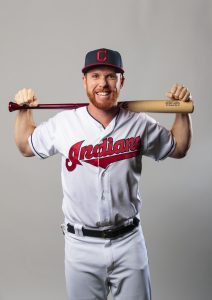
Heading into the 2018-19 offseason, Luplow was a Pirate who, in limited big league opportunities, didn’t produce much. At that point, the former third-round pick was the owner of a dismal .194/.274/.371 line (72 wRC+) in 190 trips to the plate. Unimpressed, Pittsburgh sent him to Cleveland in a deal that has gone the Indians’ way so far.
In exchange for Luplow and infielder Max Moroff, the Indians gave up infielder Erik Gonzalez and a couple minor league right-handers in Dante Mendoza and Tahnaj Thomas. Like Luplow, Gonzalez had been a replacement-level player and a non-threat at the plate in the majors when the trade occurred. Still, then-Pirates general manager Neal Huntington was happy to bring him aboard.
“Erik Gonzalez is an athletic middle infielder who plays solid defense and has the potential to be a productive hitter at the major league level,” said Huntington. “He gives us another quality option to play shortstop or in the middle of our infield this year and into the future.”
Gonzalez fell flat in Year 1 as a Pirate, though, as he batted an ugly .254/.301/.317 (59 wRC+) in 156 PA during an injury-shortened campaign. He’s 28 and controllable through 2022, so it’s too soon to throw dirt on Gonzalez’s career, but it’s not looking good so far. Meanwhile, the 21-year-old Mendoza has struggled in the minors, where he logged a 5.82 ERA/6.06 FIP across 43 1/3 innings in rookie ball last season. If there’s a silver lining to this trade for the Pirates so far, it’s that they got a solid prospect in Thomas, 20. Formerly an infielder, Thomas ranks as FanGraphs’ No. 5 Pirates farmhand. FanGraphs’ Eric Longenhagen wrote of Thomas two months ago, “He may be the most anonymous 100 mph arm in baseball.”
Perhaps Thomas will one day go down as a player who got away for Cleveland. For now, the team’s benefiting from the deal at the MLB level, though it’s already out one-half of its return in Moroff. He was a non-factor in the bigs last year and is now a member of the Mets organization. And, of course, Luplow doesn’t come without question marks at the plate. The righty amassed 106 PA versus same-handed pitchers in 2019, hit just one of his 15 home runs off them and could only muster a .216/.274/.299 line with a wRC+ of 48. Those are in line with the numbers he posted against right-handers in previous seasons.
Despite his shortcomings, the inexpensive Luplow has already given the Indians a substantial amount of bang for their buck. As a 2.2-fWAR performed last year, FanGraphs valued his output at $17.6MM. At the very least, the Indians appear to have found a nice platoon hitter in Luplow — one who has experience at all three outfield positions. The fact that he’s still just 26 and controllable for five more years (including two pre-arbitration seasons) only adds to his appeal from the low-budget Indians’ perspective.
Photo courtesy of USA Today Sports Images.
AL Notes: Cora, Red Sox, Indians, Blue Jays
Ex-Red Sox manager Alex Cora was just suspended for 2020 thanks to the role he played as the Astros’ bench coach during their 2017 sign-stealing scandal. Red Sox chief baseball officer Chaim Bloom and president Sam Kennedy made it sound earlier this week as if they wouldn’t bring Cora back at the end of his ban, but Kennedy may be open to it after all (via Chris Cotillo of MassLive.com). Kennedy told “Ordway, Merloni & Fauria” of WEEI that Cora’s “a great baseball manager.” As for whether the Red Sox would rehire him, Kennedy said: “We’ll talk about that down the road. We just removed Ron Roenicke’s interim tag and he’s going to lead our club going forward. I think a lot of Alex’s future depends on how he approaches this suspension period.” For at least this season, Roenicke – Cora’s former bench coach – will manage the team.
More on a couple other American League franchises…
- The Indians have taken a step to compensate the majority of their employees for the foreseeable future during the COVID-19 pandemic. They’ve committed to paying their full-time staff their entire salaries through at least the end of June, Jeff Passan and Kiley McDaniel of ESPN.com report. Forty of the Indians’ senior staff members took pay cuts so the rest of the full-time staff could receive their typical salaries. The Indians have furloughed part-time workers and interns, on the other hand, but they could make the same amount of money or even more by way of unemployment benefits, according to Passan. While most of the league’s teams have committed to paying their non-player employees through May, the Indians are among the few that we know will extend beyond that point.
- As a result of the season postponement, two fans recently filed a lawsuit against all 30 MLB teams and ticket companies StubHub, Ticketmaster, Live Nation, and Last Minute Transactions because they haven’t been able to get a refund for tickets purchased for 2020. The Blue Jays are not among the teams that have refused to give fans their money back, however, president Mark Shapiro told Gregor Chisholm of the Toronto Star. “We have fielded every single call and whenever there has been a hardship, or a circumstance, that has necessitated a refund, we have refunded those tickets,” said Shapiro, who added, “We have not fought any of those and will continue to do that.” Shapiro’s under the impression that the league’s “very close” to announcing “a broader policy on refunds and exchanges.”
The Effects Of The Largest Contract In Indians History
We updated each major league team’s largest contract of all-time last week. Nothing has changed of late for the Indians, whose biggest guarantee remains the three-year, $60MM pact they gave first baseman/designated hitter Edwin Encarnacion in advance of the 2017 season. That ties the Pirates (six years, $60MM for Jason Kendall) for the least expensive sum on the list, which further indicates that the Indians probably won’t be able to keep superstar shortstop Francisco Lindor from hitting the free-agent market after the 2021 season.
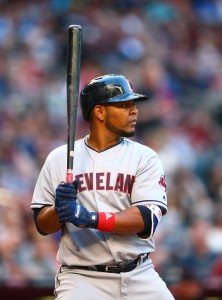
When Encarnacion reached free agency three years ago, few people (or maybe no one at all) thought he would choose Cleveland. At the outset of that offseason, MLBTR ranked Encarnacion as the sport’s second-best free agent and predicted he’d land a four-year, $92MM contract. It seemed like a reasonable call at the time in light of the marvelous production Encarnacion put up as a Blue Jay over the previous seasons. In a 3,133-plate appearance span from 2012-16, Encarnacion collected the majors’ second-most home runs (193) and parlayed a .272/.367/.544 line into the league’s fifth-highest wRC+ (146), not to mention 20.7 fWAR.
Despite the wonderful numbers Encarnacion compiled as a Blue Jay, his market didn’t come together as planned after his tenure with the team concluded. Encarnacion had his sights set on a guarantee approaching $100MM, evidenced by reports that he rejected a Toronto offer in the range of $80MM over four years. That turned out to be a blessing for the Blue Jays, who wouldn’t have contended from 2017-19 even with Encarnacion on their roster. And by issuing Encarnacion a qualifying offer and allowing him to depart, the team received a first-round pick (No. 28) in 2017 as compensation. With that selection, the Jays chose right-hander Nate Pearson, now one of the premier prospects in baseball.
While hitting Encarnacion with a QO did benefit Toronto, it didn’t do his market any favors when he became a free agent. Neither Encarnacion’s age (he was on the verge of turning 34) nor defensive limitations that mostly limited interest in him to American League teams helped his cause, either. The Astros, Yankees, Rangers and Red Sox were said to have pursued him to at least some extent, while even the low-budget Athletics tried to swoop in and grab Encarnacion when it became clear he was going to sign for less than expected.
The fact that Cleveland is closer than Oakland to Encarnacion’s native Dominican Republic reportedly played a role in his decision. And the Indians did give him a pact that could have maxed out at $80MM, depending on whether they’d exercise a $20MM club option for 2020. That option was ultimately declined this past winter, but not by the Indians, with whom Encarnacion lasted just two seasons and whose signing cost the club a first-rounder.
Back when Cleveland inked Encarnacion, it was coming off a seven-game World Series loss to the Cubs. The fact that the Indians went as far as they did that year was a boon to their bottom line and reportedly had some impact on their decision to go after Encarnacion. He came in to replace Mike Napoli, whom the Indians let walk after their pennant-winning campaign, and provided an instant upgrade.
Encarnacion batted .258/.377/.504 (130 wRC+) with 38 HRs in 669 PA and 157 games in his first year as an Indian. That output aided the Indians in their second straight AL Central title-winning season, but another deep playoff run wasn’t in the cards as they fell in the first round to the Yankees. While the club went on to a third consecutive division championship in 2018 (and yet another first-round loss, this time to the Astros), it did so without fellow first baseman/DH Carlos Santana, whom it lost to the Phillies in free agency during the previous offseason.
The addition of Encarnacion the year prior helped protect the Indians from Santana’s departure, but the former only managed pedestrian production by his standards that season. Encarnacion did rack up another 32 dingers, though his .246/.336/.474 showing in 579 PA led to his worst wRC+ (115) since before he morphed into a force several years earlier. That proved to be the end of the line on his Indians tenure.
In December 2018, the Indians traded Encarnacion to the Mariners in a three-team deal that also involved the Rays. The move returned Santana to Cleveland, as Philly ended its union with him after only one season when it sent him to Seattle earlier that month, but there was more to the blockbuster. The Indians also had to send third baseman Yandy Diaz and right-hander Cole Sulser to Tampa Bay, which dealt first baseman/outfielder Jake Bauers to Cleveland. Diaz has been a real loss for the Indians thus far – he got his first extended major league opportunity last year and showed well, though injured limited him to 79 games. Sulser did nice work with the Rays’ Triple-A team last season, but he was also 29 at the time; they’ve since lost him on waivers to the Orioles. And though Bauers was once a well-regarded prospect, the 24-year-old didn’t hit much in either the majors or minors in 2019.
The best player in the Encarnacion/Santana deal a year ago was the latter, who went to his first All-Star Game and recorded a career-high 4.4 fWAR. The 34-year-old switch-hitter has one more guaranteed season left at just under $21MM. The Indians will have a chance to keep Santana around in 2021 for $17.5MM, but they could instead buy him out for just $500K. So, because we may not even see a 2020 season, it’s possible Santana won’t play for the Indians again.
As for Encarnacion, who had a fine 2019 divided between the Mariners and Yankees, he’s now a member of one of the Indians’ division rivals. Encarnacion revisited the open market this past winter, though he didn’t cash in to nearly the same degree, inking a one-year, $12MM guarantee with the White Sox. That pact also includes a $12MM club option for 2021, so if there is no season, Encarnacion could still stick around in Chicago beyond this year. Based on the length and dollar figure, Encarnacion has a better chance to live up to that accord than the one the Indians gave him. For them, signing Encarnacion to a franchise-record contract didn’t go as hoped.
Photo courtesy of USA Today Sports Images.