
Guardians Trade Nolan Jones To White Sox
The Guardians announced they’ve traded non-roster outfielder Nolan Jones and cash considerations to the White Sox. Chicago sends a $250K international bonus pool allotment to Cleveland in return.
Cleveland outrighted Jones off their 40-man roster at the end of Spring Training. He therefore won’t immediately occupy a roster spot for Chicago. The Sox announced that they’ve assigned him to Triple-A Charlotte. Jones has spent the entire season in the International League with Cleveland’s affiliate in Columbus.
The 28-year-old Jones appeared in the Majors each season from 2022-25. He had by far his best season with the Rockies in 2023, hitting .297/.389/.542 with 20 homers in a little over 400 plate appearances. Back problems limited him to half a season a year later. His numbers plummeted, as he hit only .227/.321/.320 with three homers in 79 games.
Colorado moved on after that injury-riddled season. The Rox dealt Jones back to Cleveland, the organization that had drafted him in 2016 and with which he made a brief debut six years later. He spent the entire season on the MLB roster, aside from a season-ending oblique strain in late September, but did not rebound offensively. Jones mustered only a .211/.296/.304 batting line while striking out in 28% of his 403 trips to the plate.
It came as a surprise that the Guardians tendered him an arbitration contract after a second consecutive season of below replacement level production. The sides hammered out a $2MM agreement early in the offseason. Jones had a rough camp and failed to make the team out of Spring Training. He cleared waivers and had an easy call to accept an assignment to Triple-A so as not to forfeit that salary.
Jones is amidst a nice year in the minors. He’s hitting .275/.385/.460 with eight longballs across 226 plate appearances. He’s striking out a little too often (24.3%) but hitting the ball hard and drawing walks at an excellent 14.2% rate. Jones has had that “three true outcomes” approach throughout his career.
The Guardians are paying an undisclosed portion of the roughly $1.15MM he’s owed through the end of the season. The White Sox weren’t going to take on that entire sum for a Triple-A player. Cleveland takes the opportunity to get some amount of salary relief for a player who had clearly been squeezed out of their plans. The Guardians haven’t gotten much from their outfield lately, but Jones was behind the 10 outfield options they have on their 40-man roster.
Chicago isn’t actually sending cash. They’re trading $250K in space from their hard-capped bonus pool for international amateurs, which means the Guardians can spend a little more of their own money to add to their farm system. The White Sox seemingly don’t intend to sign anyone else of note before the close of this period. They also packaged $250K in bonus space alongside Derek Hill in their afternoon trade with the Phillies to add a couple minor leaguers.
Jones gives them some upper minors depth for right field, which has been an issue this season. They’re in better shape now with Braden Montgomery up and Everson Pereira back from the injured list, but they don’t have much depth in the upper minors. Jones would be eligible for arbitration for a few years if the Sox call him up before the end of the season. He’d otherwise become a minor league free agent once the regular season concludes.
Will The Guardians Make An Outfield Move?
The Guardians enter this afternoon’s series finale against the Yankees with a narrow lead in the AL Central. They’re half a game up on the White Sox with a 37-32 record in their bid for a third consecutive division title.
It has been a similar story to the past few iterations of Guards baseball. They have one of the better bullpens in the American League, moving seamlessly to Cade Smith in the ninth inning while getting surprisingly strong work from reclamation pickup Colin Holderman. They could use another lefty, but the back end is generally a strength.
They’re the only team that has used the same five-man rotation all season, mostly successfully. Parker Messick and Gavin Williams have made for an excellent combination at the top. Tanner Bibee, Slade Cecconi and Joey Cantillo have been less consistent but reasonably effective overall.
The other side of the ball remains the big question. The offense isn’t as bad as last season, when they somehow won the division despite scoring the fewest runs in the American League. They’re certainly better positioned in the middle infield with Travis Bazzana at second base and Brayan Rocchio amidst a breakout season at shortstop.
It’s still one of the weaker overall lineups in the league, however. They’re 10th in the AL in scoring, 12th in home runs, and last in batting average and slugging. They’ve worked enough walks to get to middle of the pack in on-base percentage. By measure of wRC+, only the Red Sox and Royals have had less productive offenses among AL teams. They’re 22nd by that measure overall and 21st in MLB in runs scored.
There should be a clear target area for the front office as they approach deadline season: the outfield. Cleveland is clearly content to punt offense from the catcher position. First base hasn’t been great overall, but Kyle Manzardo and Rhys Hoskins have each gotten going since the beginning of May. The outfield, on the other hand, has been rough after a reasonably encouraging start to the season.
Cleveland outfielders were hitting .251/.321/.413 through the end of April. They were 12th in OPS and tied for 11th in homers. Since the calendar turned to May, they’ve combined for a .215/.291/.310 line across 465 plate appearances. Their .601 OPS over the last six weeks is dead last in the Majors. They’ve hit just eight home runs, above only the White Sox, Rays, and Royals. Only Houston outfielders have fared worse by the park-adjusted metrics.
Essentially the entire outfield has gone cold. Chase DeLauter started his career with a bang, homering four times in his first three regular season MLB games. He added another homer amidst a three-hit game on April 3. He’s gone deep just twice since then and has a .252/.315/.333 line since the beginning of May. It’s common for players even as talented as DeLauter to have some ruts during their rookie seasons. He’s not in danger of losing playing time, but his slump exposes the depth concerns elsewhere.
Steven Kwan was supposed to be the stabilizer. He’s an elite defensive left fielder whom the Guardians felt could play a capable center field on a semi-regular basis. Kwan has impressed defensively, but his bat has tanked. He’s hitting .213/.323/.262 with just one home run through 264 trips to the plate. No other qualifier has made less hard contact.
Kwan’s game has always been about plate discipline rather than hard contact. He rarely expands the strike zone and probably has the best pure contact skills of anyone not named Luis Arraez. That’s still intact — even Arraez has a slightly higher swing-and-miss rate this year — but Kwan can’t be a productive hitter without some kind of extra-base impact. He’d topped 10 home runs in both 2024 and ’25 and hit at least 25 doubles in three of his first four seasons. This year, he’s on pace for 19 doubles and two homers. Stephen Vogt dropped him from the leadoff spot in favor of Bazzana in mid-May; Kwan has hit seventh for the past couple weeks.
It’d be less concerning if this were only a bad two-month stretch. Kwan’s numbers trended down during the second half of the ’25 season as well. He’s a .233/.311/.310 hitter in nearly 700 trips to the plate over the last calendar year.
Kwan has come up in trade rumors for the last few seasons. It’d be less straightforward to move him now than it would’ve been last summer, when they were deadline sellers before going on an improbable run to seize the division from Detroit. At the same time, Kwan is the team’s second-highest paid player on a $7.725MM salary.
That’ll probably jump into eight figures for his final arbitration season. He’s on pace to be worth roughly one win above replacement despite the defensive contributions. Would a team that runs one of the lowest payrolls in the sport be willing to tender him a $10MM contract if he hits like this all season? If they feel he’s trending toward a non-tender, they could entertain trade scenarios this summer while looking to acquire a corner outfielder who has more offensive punch.
That’s complicated by their lack of recent production from center and right field. Hot starts from Angel Martínez and Daniel Schneemann were among the reasons for Cleveland’s early success. Schneemann’s fantastic April always felt unsustainable, and he has hit .160/.233/.181 since the beginning of May. Schneemann has gotten some run as a regular center fielder but should be in a utility role.
Martínez has bigger physical tools and can certainly flash significant upside. He’s less than a month removed from winning AL Player of the Week after popping four homers in five games. Martínez also has an extremely aggressive approach and almost never walks, lowering the floor from an on-base perspective.
He’s among the bottom 10 qualified hitters this year with a .275 OBP. In 19 games since the Player of the Week award, he’s hitting .178 with a .200 on-base mark — though he matched last year’s career high by connecting on his 11th home run of the season this afternoon.
Schneemann and Martínez are each capable big leaguers, but they should be role players rather than locked into the everyday lineup on a contender. Cleveland has Kahlil Watson, George Valera, CJ Kayfus and Petey Halpin on the 40-man roster and on optional assignment in Triple-A.
Watson and Valera have hit pretty well against minor league pitching, as has non-roster corner bat Nolan Jones. Neither Valera nor Watson has an MLB track record. Jones hasn’t hit big league pitching since 2023. Gabriel Arias could get some outfield work when he returns from a hamstring strain, but his strikeout issues are well established.
Although the Guardians aren’t typically aggressive deadline buyers, they could move one or two of their toolsy but unestablished minor league outfielders for someone with a higher floor. There aren’t many defined sellers yet, though the Rockies have a couple outfielders (Mickey Moniak and Jake McCarthy) who should be available. Moniak is currently sidelined by ankle tendinitis but expected back before the deadline. Lars Nootbaar, Taylor Ward, Trevor Larnach, Casey Schmitt and Jacob Young are some of the other players who could hit the trade market. Adding someone to raise the offensive floor should be the priority next month.
White Sox Re-Acquire Peyton Pallette From Guardians
TODAY: Pallette cleared waivers and was offered back to the White Sox, with MLB.com’s Tim Stebbins writing that Chicago has accepted the right-hander back into the fold. The Sox have assigned Pallette to Triple-A Charlotte.
MAY 24: Right-hander Peyton Pallette has been designated for assignment, the Guardians announced. Lefty Logan Allen is rejoining the big-league club to take his spot in the bullpen.
Cleveland picked up Pallette from the White Sox in the Rule 5 draft. As part of the standard DFA process, the club has five days to trade him or place him on waivers. If another team makes a move to add Pallette, they’ll take on the Rule 5 requirements. If Pallette passes through waivers, he’ll be offered back to Chicago.
Pallette scuffled to a 5.23 ERA in 20 2/3 innings with the Guardians. He punched out opponents at a decent 22.7% clip, but it came with an untenable 16.5% walk rate. The righty led with a 95 mph four-seamer, accompanied by a pair of breaking balls. He threw the occasional changeup. Pallette’s curveball and slider both performed well, generating decent whiffs and preventing hits. The fastball was an issue. Pallette’s heater ceded a 51.6% hard-hit rate and a .410 wOBA.
The White Sox took Pallette in the second round of the 2022 draft. He posted strong strikeout numbers in each level of the minors, which is what likely drew Cleveland’s interest. Walks were becoming a problem before Pallette moved to his new organization. The righty had a 9.9% walk rate last season at Double-A, and it jumped to 10.9% after he was moved to Triple-A.
Allen has pitched in parts of the last three seasons with the Guardians. He’s worked almost exclusively as a starter in the big leagues, posting a 4.48 ERA in 74 appearances (73 starts). Allen has struggled from a run prevention perspective through eight Triple-A outings this season, but he’s notched a solid 25.4% strikeout rate. He’ll likely step into a long relief role with Cleveland. Allen could also operate as a sixth starter if the club wants to get some extra rest for the rotation. The Guardians are playing their 10th straight game on Sunday during a two-week stretch without an off-day.
Photo courtesy of David Richard, Imagn Images
Guardians Select Stuart Fairchild
The Guardians have selected the contract of outfielder Stuart Fairchild from Triple-A Columbus. He takes the active roster spot of fellow outfielder Steven Kwan, who has been placed on the bereavement/family medical emergency list. To open a 40-man spot, infielder Gabriel Arias has been transferred to the 60-day injured list. Tim Stebbins of MLB.com was among those to relay the moves.
Fairchild has experience in parts of five MLB seasons and has three-plus years of major league service. He’s a glove-first outfielder with a lifetime .223/.305/.384 batting line in 277 big league games (670 plate appearances). The 30-year-old right-handed hitter hasn’t done much of anything against righties in his career (.203/.269/.366), but he carries a .246/.343/.404 line against lefties, which is a bit better than league-average production (106 wRC+).
Cleveland signed Fairchild to a minor league deal over the winter. He started the season in Columbus and has hit quite well there, batting .289/.417/.479 with five homers, eight doubles, a pair of triples, nine steals (in 11 attempts), a 14.8% walk rate and an 18.2% strikeout rate in 176 turns at the plate. That stout production isn’t necessarily a portent for a major league breakout, however. It falls right in line with Fairchild’s career .281/.384/.500 batting line in 706 Triple-A plate appearances.
Fairchild is a plus runner capable of playing all three outfield spots at an average or better clip. Statcast credited him with 86th-percentile sprint speed last year, and he carries strong career marks in Defensive Runs Saved (10) and Outs Above Average (9) in just under 1500 innings of big league outfield work. Fairchild is out of minor league options and thus might wind up being designated for assignment once Kwan returns.
Arias, 26, has been out since early April due to a hamstring strain. He was already approaching 60 days on the injured list, making today’s move little more than a formality, but he doesn’t appear close to returning anyhow. Manager Stephen Vogt conceded earlier this month that Arias’ recovery has been a bit on the slow side. He still hasn’t progressed to a minor league rehab assignment, which he’ll clearly need after spending close to two months on the shelf.
Arias is out of minor league options, which will present Cleveland with a decision when he’s ready to return. Shortstop Brayan Rocchio is having a breakout year at the plate, and former No. 1 pick Travis Bazzana has hit the ground running in his initial call to the majors. Neither is going to be displaced for Arias, a career .215/.273/.358 hitter. It’s possible the Guardians will keep Arias in a reserve role, but utilityman Daniel Schneemann is having a productive season in his own right.
All of that hinges on the health of the Guardians’ roster whenever Arias is able to return, of course. For the time being, his focus is simply on getting back into playing shape, but his fit on the roster doesn’t look as clean as it once did.
Travis Kelce Purchases Minority Stake In Guardians
Longtime Kansas City Chiefs tight end Travis Kelce has purchased a minority stake in his hometown club, the Cleveland Guardians, per a team announcement. It’s not clear how large a stake he purchased. He’s reportedly earned more than $111MM in career salary with the Chiefs, to say nothing of other revenue streams (e.g. endorsements, podcast).
“I have so much love for this city,” Kelce tells ESPN’s Jeff Passan. “I say it all the time: I’m just a kid from the Heights living the dream. I credit every good thing in my life to Cleveland and being raised here with the values and the people and the work ethic. Cleveland Heights is such a diverse and dynamic place. Every friend, neighbor, teacher and teammate — they all made me the man I am today. It just fueled such a deep appreciation for life and community and service. … There was nothing like Cleveland baseball in the ’90s. That’s just a core memory for me. Kenny Lofton, Carlos Baerga, Jim Thome, Sandy Alomar Jr., the list goes on, and I admire how they just continue to pour into this city and this game.”
The Dolan family still holds the majority stake in the team. The late Larry Dolan purchased the club for a reported $323MM back in 2000. Recent estimates have pegged the Guardians’ present-day franchise value at more than five times that sum.
Larry Dolan passed away at 94 years of age in Feb. 2025. His son, Paul, had succeeded him as the team’s official control person back in 2013 and remains the team’s chairman and chief executive officer. However, in 2022, the Dolan family agreed to sell a 25-30% stake in the team to David Blitzer, the managing partner of the NBA’s Philadelphia 76ers and the NHL’s New Jersey Devils. Blitzer also has minority stakes in the NFL’s Washington Commanders and in Major League Soccer’s Real Salt Lake. His 2022 deal with the Dolan family also came with the option to purchase a majority stake of the club in 2028.
Kelce, 37 in October, is an 11-time Pro Bowler with three Super Bowl rings. He ranks third all-time among tight ends in both receptions and receiving yards and is fifth all-time in touchdowns at his position. His stake isn’t likely to be a significant one, though it’s always feasible that he seeks to increase his share at some point down the road. Kelce’s teammate and fellow three-time Super Bowl champion Patrick Mahomes can now formally be on opposite ends of an American League Central rivalry; Mahomes purchased a minority stake in the Royals back in 2020.
Guardians Select Will Dion
The Guardians announced that they have selected to contract of left-hander Will Dion. The 40-man roster had a vacancy due to Rule 5 pick Peyton Pallette being designated for assignment a few days ago. To open an active roster spot for Dion, left-hander Logan Allen was optioned to Triple-A Columbus.
Dion, 26, was a ninth-round pick in the 2021 draft. As he climbed the minor league ladder, he worked primarily as a starter. Despite not having elite velocity, he was able to put up pretty good numbers through Double-A but struggled when he first reached Triple-A.
Here in 2026, he has been working exclusively out of the bullpen with very encouraging results. He has thrown 26 innings over 15 appearances, allowing 4.50 earned runs per nine. That ERA is obviously not going to knock any socks off but things look much better under the hood. Dion has struck out 34.6% of batters faced and only given out walks to 4.8% of opponents. The extra runs seem to have been caused by a .371 batting average on balls in play and 58% strand rate, which are both to the unlucky side. His 1.83 FIP on the year paints a much more flattering picture than his ERA.
As mentioned, Dion doesn’t light up the radar gun. He was averaging around 90 miles per hour with his four-seamer in 2024 and 2025. He has ticked up in a relief role this year but only to 91.2 mph. Statcast also credits him with a sinker, cutter, slider, curveball and changeup. Going into 2025, when he was still a starter, FanGraphs ranked him the #37 prospect in the club’s system. That report noted that Dion’s delivery resembled that of Clayton Kershaw. It also stated that Dion’s fastball can outperform the velo thanks to its riding life and that his secondaries are not outstanding but the change plays up thanks to Dion’s excellent command.
The Guards have had Erik Sabrowski and Tim Herrin as their two lefty relievers for most of the season. Allen was called up on Sunday to add a long relief option. Sabrowski hit the IL yesterday, then Allen was needed to cover four innings out of the bullpen in last night’s contest. With Sabrowski on the shelf and Allen unavailable for a few days, Dion has been added.
For now, Dion gives Cleveland a second lefty reliever alongside Herrin and will be making his major league debut as soon as he gets into a game. Both Herrin and Dion are optionable, should the Guards decide to make a switch later in the year, or if Sabrowski is able to get healthy relatively quickly.
Photo courtesy of Arianna Grainey, Imagn Images
Guardians Place Erik Sabrowski On IL With Elbow Inflammation
The Guardians announced that left-hander Erik Sabrowski has been placed on the 15-day injured list due to left elbow inflammation. Right-hander Codi Heuer was recalled as the corresponding move.
Sabrowski has beek a key arm out of the Cleveland bullpen with an approach that is wild but effective. He now has 63 innings under his belt, thrown over the three most recent seasons, allowing just 1.43 earned runs per nine. His 15.1% walk rate is very high but he has also punched out a massive 39.8% of batters faced.
The ERA is surely at least a bit misleading. He has a .224 batting average on balls in play and 87.8% strand rate, both of which are fortunate figures. His 2.52 FIP and 2.89 SIERA are probably more accurate representations of his contributions but he would be a big asset even if his ERA regresses to that level. Thus far, he has racked up a save and 29 holds for the Guards, including 17 holds already in 2026.
Elbow issues have been an issue before. He missed the first three months of the 2025 season due to elbow inflammation and that same issue now puts him on the shelf again. It’s unclear if the Guards consider his current status to be serious but it’s always somewhat concerning when a pitcher’s throwing elbow is the focus of an injury.
For now, the Guardians lose one of their key setup arms and their primary lefty reliever. They are now left with Tim Herrin and Logan Allen as their southpaw relievers. Allen has primarily been in the rotation in his career and was starting in Triple-A until being recalled yesterday, so he’s likely slated for a long relief role, meaning Herrin could be the only lefty for key spots late in games. Herrin has a 2.12 ERA this year but not in a sustainable way. His 16.3% strikeout rate and 15% walk rate are both awful numbers. His run prevention is mostly due to an 87% strand rate that won’t last.
The Guards are 32-23, giving them a lead of 4.5 games in the American League Central. They are in a good position to go into the deadline as buyers. Most contenders look for extra relief help at the deadline and that may be a more acute need for the Guards if their lefty contingent continues to feel light over the next few months.
Photo courtesy of Steven Bisig, Imagn Images
The Guardians’ Faith In Their Own Players Is Paying Off
The Guardians had a very disappointing offseason. Despite winning the American League Central in two straight years and three of the past four, they did almost nothing to upgrade their roster for 2027. They made no trades of significance and spent less than $12MM in free agency.
Even that very modest outlay was offset by savings elsewhere. Emmanuel Clase was supposed to make $6MM this year but he probably won’t see any of that due to his ongoing gambling investigation. José Ramírez signed an extension that technically increased his 2026 salary from $21MM to $26MM but the new deal defers $10MM annually, so it actually saved the club money in the short term.
After MLBTR published its Offseason In Review entry for the Guards, readers mostly panned the club’s actions. In the poll at the bottom of the post, both the F and D options got 37% of the vote. C was next with 19%. The B option got just a 5% share, followed by A at 2%.
But almost two months into the season, they are thriving. They are currently 30-22, one of the few American League clubs comfortably above .500. They are 3.5 games clear of the White Sox and six up on the Twins. Coming into the season, the Tigers were considered by many to be the division favorite, but they are 9.5 back.
How are the Guards doing it? The pitching staff is quite good, which isn’t really a surprise, since they were strong in that department last year. But they have taken a big step forward offensively. The team has a collective .230/.324/.377 line and 101 wRC+. That may not sound too impressive, being just barely above average, but consider where they were last year. The 2025 Guards hit .226/.296/.373 for a wRC+ of 87. They were successful in spite of that lack of offense thanks to their pitching and defense. Cranking up the offense, even just to be middle of the pack, is a notable improvement.
Since they made almost no effort to add external options, the gains are clearly coming from inside the house. Some of this was to be expected. Chase DeLauter and Travis Bazzana came into the season ranked among the club’s top prospects and both are contributing, but the Guards are also getting improved results from guys who have already been on the team for years, as each of Brayan Rocchio, Angel Martínez and Daniel Schneemann have boosted their numbers this season.
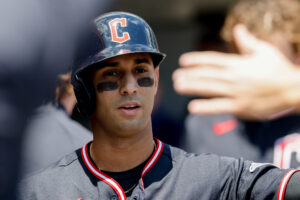
Rocchio came into this season seemingly on the fringe of the roster. By the end of 2025, he had 911 career plate appearances. He had just 13 home runs, a .222/.293/.327 line and 77 wRC+. He had exhausted his final option season. On paper, he and Gabriel Arias had the middle infield jobs but Bazzana was on the way, along with Juan Brito and Angel Genao. There was a non-zero chance of him getting pushed off the roster.
But instead, he’s been taking a step forward. The Guards somewhat surprisingly started the year with Bazzana in the minors and Rocchio at second base. Arias hit the IL in April, leaving Rocchio in charge of the shortstop job. Rocchio has stepped to the plate 188 times and has a .290/.376/.420 line, leading to a 130 wRC+. A lot of that is due to plate discipline. He came into the year with a 7.7% walk rate and 21.3% strikeout rate in his career. Those numbers are at 10.1% and 10.6% this year.
His contact hasn’t made huge strides. In fact, his hard hit rate and exit velocity are actually down relative to last year. What seems to be working for him is some extra patience. His swing rate is down 3.4 percentage points. Perhaps more importantly, his first pitch swing rate is down by 11.5 points. That has led to more walks and fewer strikeouts.
There is a bit of luck at play, as he has a .309 batting average on balls in play. Since he is striking out so rarely, that means lots of balls in play and the luck is really helping him. Perhaps there is some regression coming but Rocchio has already racked up 1.7 wins above replacement in the eyes of FanGraphs, with his solid shortstop defense and nine stolen bases also helping.
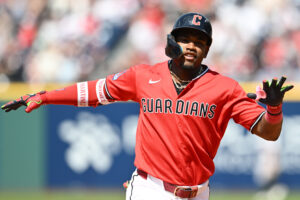
Martínez was sent to the plate 653 times over the 2024 and 2025 seasons. He had a tepid .226/.277/.353 line and 77 wRC+ in those, hitting 14 home runs. His 21.9% strikeout rate was around average but his 5.8% walk rate was quite low. He wasn’t guaranteed playing time in 2026, as Cleveland came into the year with an outfield mix consisting of DeLauter, Schneeman, Steven Kwan, George Valera, CJ Kayfus, David Fry and Petey Halpin.
But some struggles from the guys in that group have opened time for Martínez that he has taken advantage of. Unlike Rocchio, there are no big improvements here in terms of discipline. His 19.4% strikeout rate is a bit better but he’s also walking less, with just a 3.4% rate this year. But he already has nine home runs, almost matching his previous career tally, in just 175 plate appearances. That has helped him hit .256/.298/.488 for a 119 wRC+.
Also unlike Rocchio, there are some tangible shifts in the Statcast data. His 36.2% hard hit rate is only around league average but a big jump from the 29.3% rate he had last year. His 88.6 mph average exit velocity is exactly league par but a mile and a half better than his own mark from last year. His 41st percentile bat speed isn’t too impressive but he was in the 21st percentile last year. Making those kinds of gains can sometimes come with more whiffs but, as mentioned, he is actually striking out less.
He also may have found a defensive home in the outfield, depending on who you ask. Martínez was bounced between second base, third base and the grass in 2024 and 2025. His outfield results were poor, as he was given minus-9 Defensive Runs Saved and minus-5 Outs Above Average. DRS is still not convinced this year, giving him a minus-3 grade. Since that’s in roughly one third as many innings, it’s roughly the same pace as last year. But he has been credited with 3 OAA on the year. He has also stolen eight bases, already matching last year’s total. He’s been credited with 1.2 fWAR on the year.

Schneemann spent 2024 and 2025 in a utility role, playing everywhere except first base and the battery. He hit .210/.290/.358 for a wRC+ of 84 in 643 plate appearances. He has been sent to the plate 150 times this year with a .246/.327/.403 line and 109 wRC+.
It’s possible that Schneemann’s improvements are more fluky than those of Rocchio or Martínez. While Rocchio is showing an improved approach and Martínez is hitting the ball with more authority, Schneemann’s gains look to be based on luck, as he has a .333 BABIP so far. HIs 10.7% walk rate is nice but only a slight gain on the 9.8% pace he had coming into the year. His 28.7% strikeout rate is high and only a marginal improvement over the 29.1% rate he had in previous seasons.
In terms of the Statcast data, his hard hit rate and average exit velocity are actually down relative to last year. If there’s one big bright spot, it’s that Statcast has his launch angle sweet spot percentage in the 97th percentile, whereas he was in the 23rd percentile last year. The regression may already be setting in, as Schneemann is hitting .143 in May after batting .321/.391/.564 through the end of April. Even if it was just one big month, some solid offensive results have combined with his speed and defense to give him a tally of 1.0 fWAR on the season.
These three guys aren’t going to get any MVP votes but their contributions are significant in the larger context. As mentioned, the Guards did almost nothing to add outside help. There are seven players on the team who have received at least 150 plate appearances this year. Ramírez is doing his usual thing. DeLauter is having a strong rookie season. But Kwan and Kyle Manzardo are struggling so far. Rocchio, Martínez and Schneemann have stepped up. Those three have a combined .265/.335/.439 line, 120 wRC+ and 3.9 fWAR on the year so far.
Time will tell if they can keep it going but those strong starts have already pushed the Guards out to a nice division lead. If the gains do prove to be sustainable, then it could lead to some interesting decisions down the line.
Bazzana was called up at the end of April and has taken over the second base job, having hit .288/.409/.384 for a 133 wRC+ in the early going. The Guards also have one of the league’s top infield prospects in Genao. He was promoted to Triple-A earlier this month and has put up a .305/.359/.576 line at that level so far. A promotion is arguably already viable and his knocks on the door should get louder every day. His defense is still a work in progress but evaluators expect him to be a viable big league shortstop as he refines his tools.
The Guardians have historically not been shy about trading from their middle infield. Francisco Lindor was their regular shortstop for most of the 2015 to 2020 period before getting flipped to the Mets. Amed Rosario and Andrés Giménez came back in that trade and were fixtures of the middle infield for the next few years. Giménez even got a nine-figure extension. But both were eventually traded, Rosario to the Dodgers and Giménez to the Blue Jays. With Bazzana, Genao, Rocchio, Arias, Schneemann and Brito all now in the middle infield mix, maybe they can make someone in that group available to address another part of the roster.
In the outfield, it’s probably just nice that things are going relatively well out there, as Cleveland has been struggling for years to get production from the grass. Their outfielders hit a collective .225/.288/.341 last year for a 77 wRC+, putting them ahead of only the Royals. This year, they are up to the middle of the pack with a .232/.316/.384 line, thanks to Martínez and DeLauter.
Perhaps the Guards will have to move on from Kwan at some point. He is under club control through 2027. He’s making $7.725MM this year and would be due an arbitration raise going into next year. But his offense slipped to league average last year and he’s down to .202/.330/.260 in 2026, so perhaps a non-tender or a trade are becoming possibilities. Even without Kwan, they have DeLauter, Martínez, Valera, Schneemann, Fry, Halpin, Kayfus, Brito and Kahlil Watson in the mix and controllable for years to come.
Photos courtesy of Brett Davis, Rick Osentoski, Ken Blaze, David Richard, Imagn Images
Guardians Re-Sign Kolby Allard To Minor League Deal
The Guardians are bringing left-hander Kolby Allard back on a minor league contract, reports Tim Stebbins of MLB.com. Cleveland had granted the southpaw his release yesterday, but it seems Allard didn’t find an MLB opportunity with another club.
Cleveland’s front office and coaching staff clearly appreciates what Allard brings to the table as a depth arm. He’s capable of working multiple innings and held a low-leverage relief spot for the majority of the 2025 season. Allard worked to a 2.63 ERA across 65 innings a year ago despite sitting 90 mph with his fastball and running a well below-average 15.8% strikeout rate.
Allard fills up the strike zone but has fringy stuff. He has given up 16 hits to allow 10 runs across 8 2/3 MLB frames this year. He has pitched three times with Triple-A Columbus, surrendering seven runs with an uncharacteristic seven walks over 5 1/3 innings. The Guardians have signed him to five minor league contracts over the past two seasons.
Gio Urshela Announces Retirement
Infielder Gio Urshela has announced his retirement as a player in a post on his Instagram page. In the post, he thanks the people who contributed to his career, including his family, friends, fans, baseball organizations, coaches, the people of Colombia and more.
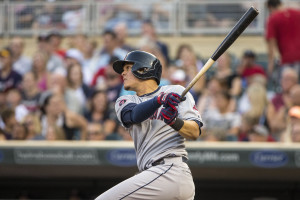 Urshela, now 34, was signed by Cleveland back in 2008. An international amateur out of Colombia, he secured a signing bonus of $300K. He quickly developed a reputation as a plus defender at third base while also dabbling at the other infield positions. His bat was a bit more questionable. He didn’t strike out much in the minors but also didn’t draw many walks and it wasn’t clear how much thump he could produce with his contact approach.
He cracked the majors in 2015. His initial big league opportunities matched his profile. He could pick the ball at third and didn’t strike out a lot but also didn’t produce offensively. He was eventually designated for assignment in 2018 and flipped to the Blue Jays in a cash deal. The Jays put him on waivers later that year and the 29 other clubs all declined a chance to claim him. At that time, he had 499 major league plate appearances and a .225/.274/.315 line.
The Jays traded Urshela to the Yankees for cash late in 2018. He began the following season as non-roster depth for Miguel Andujar, who had just finished a solid rookie campaign, finishing second in American League Rookie of the Year voting behind Shohei Ohtani. Early in the 2019 campaign, Andujar suffered a torn labrum in his right shoulder, an injury that would eventually require season-ending surgery. Though that was unfortunate for Andujar, it turned out to be the opportunity for Urshela to break out.
Urshela took over the third base job in the Bronx that year with a big step forward offensively. He hit 21 home runs and slashed .314/.355/.534 for a 132 wRC+. FanGraphs credited him with 3.1 wins above replacement. He may have hit his personal zenith that year with some help from external forces. His .349 batting average on balls in play was well above average. That was also the juiced-ball year, with home run records set all around the league.
Regardless, Urshela still proved to be a viable major league hitter in subsequent seasons. Over the shortened 2020 season and the 2021 campaign, he hit 20 homers in 159 games and slashed .275/.320/.438 for a 108 wRC+. He was credited with 2.4 fWAR for that span.

Going into 2022, Urshela was part of a big trade. He and catcher Gary Sánchez were flipped to the Twins for third baseman Josh Donaldson, infielder Isiah Kiner-Falefa and catcher Ben Rortvedt. Urshela had a solid campaign in Minnesota, hitting 13 home runs and putting up a .285/.338/.429 line, translating to a 118 wRC+. FanGraphs put another 2.6 WAR on his ledger that year.
Ahead of the 2023 season, Urshela was traded to the Angels for pitching prospect Alejandro Hidalgo. That was unfortunately just before things started to turn sour for Urshela. He hit a respectable .299/.329/.374 for the Halos but went on the injured list in June due to a pelvic fracture. He didn’t require surgery but he missed the second half of that season and was never really able to get back on track after that.
He became a free agent and signed a $1.5MM deal with the Tigers going into 2024. He got into 92 games for Detroit but hit .243/.286/.333 for a wRC+ of 74. He was designated for assignment and released that August. He latched on with Atlanta and finished on a slightly higher note, slashing .265/.287/.424 in 36 games.
That strong finish was enough to get him a $2.15MM deal with the Athletics for 2025. He hit .238/.287/.326 in 59 games for the A’s before getting designated for assignment and released in August. He returned to the Twins on a minor league deal this past offseason. He hit .192/.250/.231 in spring training and was released at the end of camp.
Urshela finishes his career having played in 851 games with 3,028 plate appearances. He only walked in 5.9% of those but also limited his strikeouts to an 18.3% pace. He collected 759 hits, including 147 doubles, nine triples and 73 home runs. He scored 312 times, drove in 352 runs and stole seven bases. His career slash line finishes at .270/.314/.407. That leads to a subpar 97 wRC+ but is dragged down by his slow start and soft finish. From 2019 to 2022, he hit .290/.336/.463 for a 118 wRC+. Both FanGraphs and Baseball Reference credit him with about eight wins above replacement, mostly from that four-year peak. Baseball Reference pegs his career earnings over $25MM.
We at MLB Trade Rumors congratulate Urshela on a fine career and wish him the best for his post-playing days.
Photos courtesy of David Butler II, Jesse Johnson, Nick Wosika, Imagn Images