
Quick Hits: Bettis, Suspensions, Lazarito, Trades, Frazier
Since the Rockies are lacking in frontline pitching, Patrick Saunders of the Denver Post predicts that right-hander Chad Bettis will emerge as the team’s “quasi-ace” in 2016. Youngster Jon Gray is still adapting to the bigs and Jorge De La Rosa‘s age and injury history make him a question mark, and if De La Rosa does pitch well, he may end up leaving in a deadline trade. That leaves the 26-year-old Bettis perhaps in the best position to become Colorado’s top starter. The righty posted a 4.23 ERA, 7.7 K/9, 2.33 K/BB rate and 49.3% grounder rate over 115 innings last season, his first extended taste of Major League action. There’s a lot to like about Bettis’ potential, though time will tell if he can consistently produce in the notoriously hitter-friendly Coors Field. Here’s more from around baseball…
- Major League Baseball will likely announce any discipline for Aroldis Chapman, Yasiel Puig and Jose Reyes before Spring Training camps open and no later than March 1, FOX Sports’ Ken Rosenthal reports (Twitter links). The three players all face possible suspensions for recent domestic violence incidents, as per the Joint Domestic Violence, Sexual Assault and Child Abuse Policy instituted by MLB and the MLBPA last August. The league’s rulings will be closely watched as possible precedent-setters under this new policy. As Rosenthal notes, the policy doesn’t set any minimum or maximum penalties, and it also doesn’t state whether a suspended player would still be eligible to play during Spring Training.
- Sixteen-year-old Cuban outfielder Lazaro Armenteros held a showcase for scouts on January 8th and “early returns…have been mixed at best,” ESPN.com’s Eric Longenhagen tweets. Several sources described Armenteros as “unable to play center field” and “too muscular & stiff,” though he did receive a very good grade of between 6-7 (based on the scouting grading scale of 2-8) on his running. Between 150-200 scouts were expected to attend his showcase, and one veteran scout even cited such names as Willie Mays and Bo Jackson to USA Today’s Bob Nightengale last month in terms of comparable power and speed, though the caveat that Armenteros was still quite “young and raw” in his ability. There has been quite a bit of speculation about the phenom known as “Lazarito,” as this was the first time MLB scouts had been able to see him in any sort of baseball activity since the summer of 2014. It isn’t yet known if Lazarito will be cleared to sign with a Major League team during this international signing period or the next (which begins on July 2).
- “Nobody wants to do a small trade. They only want to talk about big trades,” an executive tells ESPN’s Buster Olney (Twitter link). This observation about the current trade market is followed up by Olney in his latest subscription-only column, as he notes that teams are looking to acquire big-name players now since the next two free agent markets are pretty thin on elite talent. As such, Olney lists several big names that executives feel could be major trade targets this summer.
- The White Sox made the single biggest position upgrade of any team this offseason when they dealt for Todd Frazier, MLB.com’s AJ Cassavell writes. Using the Steamer projection system, third base for the White Sox projects to improve by 3.5 WAR from its sub-replacement total in 2015. While Frazier is a fine player, this may be more an indictment of Chicago’s long-time struggles at the hot corner. as Cassavell notes that White Sox third basemen have a cumulative -0.5 WAR over the last five seasons.
NL West Notes: Guerrero, Rodney, Diamondbacks
The Dodgers face a tricky situation with 3B/OF Alex Guerrero, Steve Dilbeck of the Los Angeles Times writes. Guerrero’s contract has two years and $10MM remaining, and it doesn’t allow the Dodgers to option him to the minors without his permission. That means the Dodgers are effectively stuck with him on their 25-man roster, even though he isn’t an especially good defender at any position and tailed off badly at the plate after a hot start last season. Guerrero also isn’t much of a trade asset due to his contract (which, in addition to the provision about optioning him, also allows him to become a free agent next winter if he’s dealt this season). For a big-market team like the Dodgers, $10MM sure isn’t a huge hindrance, but Guerrero’s presence on the roster currently seems like it could be a minor headache for them. Here’s more from the NL West.
- A number of teams have been in touch with free agent reliever Fernando Rodney‘s representation, Dennis Lin of the San Diego Union-Tribune tweets. The Padres, who previously had been connected to Rodney, do not currently seem to be most likely to sign him. (A previous report had indicated that the Blue Jays, Diamondbacks and Cubs were involved in his market.) Rodney, of course, struggled in Seattle for most of the 2015 season, but seemed to find new life after an August trade to the Cubs. In Chicago, the 38-year-old struck out 15 batters and walked four in 12 innings.
- Diamondbacks superstar Paul Goldschmidt is excited about the team’s moves this offseason, writes MLB.com’s Steve Gilbert. Goldschmidt says that he new the team would spend if it found an opportunity it liked, but that he was still taken aback when he heard the Snakes had landed Zack Greinke. “I was definitely surprised,” he says. “All of a sudden my phone started blowing up with people texting and calling me. It was exciting.”
Jimmy Rollins Drawing Interest As Second Baseman
“Multiple teams” have some interest in signing veteran infielder Jimmy Rollins as a second baseman, Ken Rosenthal of FOX Sports reports on Twitter. For now, though, the 37-year-old is waiting to see if an opportunity arises for him to continue as a shortstop.
In the sixteen seasons he’s logged to date, Rollins has spent exactly one third of an inning in the field at a position other than short. (That notable moment came back in 2002, and according to Baseball-Reference he was indeed standing at the second base position.) Of course, there’s a good reason for that: Rollins has long delivered solid-to-excellent glovework up the middle — though UZR has generally preferred him more than has DRS as he’s aged.
Last year was, by many measures, the worst in Rollins’ dignified career. He put up a career-low 78 OPS+ last year with a .224/.285/.358 slash line, logged less than twenty steals for the first time since an injury-shortened 2010 season, and finished with a negative BsR rating (Fangraphs’ baserunning component of WAR) for the first time ever. Though Rollins is still as sure-handed as ever, declining range left him with poor defensive marks. Indeed, the Dodgers gave the bulk of the playing time down the stretch and in the divisional series to freshly-promoted youngster Corey Seager (due in part to injury).
That all sounds like a less-than-promising combination. And there’s little doubt that Rollins is no longer the outstanding player of yesteryear. But he’s also just one campaign removed from a ~3.5 to 4-WAR season.
The concept of utilizing Rollins at second base actually makes a good bit of sense, from my perspective. As noted above, he remains a sound fielder, and could well rate as an excellent overall defender at second. With approximately league-average offensive lines in three of the last five years, there’s still cause to hope that he’ll approach that level of production at the plate while returning to contributing on the bases.
The free agent supply at second is, of course, rather light outside of Howie Kendrick, and it doesn’t hurt at all that Rollins would also function as a reserve shortstop. While it’s always tough to guess at possible suitors, I’d peg the Angels as the club that makes the most sense for this sort of arrangement, at least on paper, and some other teams may have interest in setting up a time share of some kind.
Rosenthal On Nats, Chen, Maeda, Davis, Orioles
In his latest notes column for FOX Sports, Ken Rosenthal reports that the Diamondbacks strongly considered a swap that would’ve sent center fielder Ender Inciarte to the Nationals in exchange for lefty Gio Gonzalez. While such a scenario is no longer a possibility — Inciarte went to the Braves along with two other highly regarded pieces in exchange for Shelby Miller, and Gonzalez makes little sense for a rebuilding Atlanta club — Rosenthal notes that the Nats could still explore similar possibilities. Moving Gonzalez for a center field option and then signing Wei-Yin Chen, to whom the Nats have previously been linked, could give the team the left-handed-hitting center field option it desires without significantly weakening the rotation. It’s also worth noting that Washington has been linked to the Rockies in the past, who have a left-handed hitting center field option in the form of Charlie Blackmon, though GM Mike Rizzo figures to explore many avenues if that route is indeed on the table.
A few more notes from Rosenthal’s latest column…
- Rizzo has repeatedly stated that he’s not interested in trading Jonathan Papelbon or Drew Storen unless he receives a nice return, but sources tell Rosenthal that the Nationals are indeed trying to move both of the right-handers. The Nats would likely need additional bullpen help were they to move either pitcher, though as Rosenthal points out, right-hander Tyler Clippard is still available in free agency, and a reunion between the two sides could make some sense. The Dodgers “figure to be” one club that will check in with the Nationals regarding Storen, Rosenthal writes.
- The specific irregularities in Kenta Maeda‘s elbow remain unknown, but the Dodgers‘ $25MM guarantee with $10MM worth of annual incentives is a reflection of the team’s acknowledgment that he may require surgery over the deal. According to Rosenthal, the bonuses at the back end of the deal are “largely unattainable,” so even though the contract can max out at $105MM over eight years, it’s unlikely that Maeda will receive such a sum. The elbow issue was known to every team that requested Maeda’s medical information, as it turned up in an MRI taken at the urge of his representatives with the Wasserman Media Group. Per Rosenthal, Maeda is presently asymptomatic and pain-free when he pitches.
- The Orioles have been debating moving on from Chris Davis for about a month, but the team remains engaged with the slugging first baseman due to owner Peter Angelos’ affinity for Davis. If Baltimore does ultimately move on to alternatives, Yoenis Cespedes is a more likely target for the team than Justin Upton, as Cespedes wouldn’t require the O’s to part with a draft pick.
NL West Notes: Span, Giants, Maeda, Parra, Rea
The Giants expect to install Denard Span in center field and at the top of the lineup, pushing Angel Pagan to left, Andrew Baggarly of the Mercury News writes, Having added Span, moreover, San Francisco appears not to be involved in the rest of the outfield market, according to Baggarly (via Twitter). Indeed, it’s not even clear that the team was looking elsewhere recently. Though Jon Morosi of FOX Sports had tweeted yesterday that the club was interested in Justin Upton and Yoenis Cespedes, Bob Nightengale of USA Today said after the Span signing (via Twitter) that the organization “never considered” a long-term arrangement with either player before locking up Span.
Here’s more from the NL West:
- While all involved acknowledged that the MRI results led to Kenta Maeda signing a lighter-than-expected deal with the Dodgers, club president of baseball operations Andrew Friedman says that the righty is “totally asymptomatic,” as Bill Shaikin of the Los Angeles Times reports (Twitter links). The concerning results were not discovered during a team physical after a deal, Shaikin adds, but were apparent from the medicals submitted by Maeda to all MLB teams — which may explain why his market was so quiet.
- The Rockies are “making a push” for free agent outfielder Gerardo Parra, Jon Heyman reports on Twitter, though they aren’t alone. He previously noted Colorado’s interest, which would seem to make the most sense if the club is prepared to ship out one of its current starting outfielders.
- Padres righty Colin Rea moved quickly to reach the majors last year, and MLB.com’s Corey Brock writes that he’s looking forward to competing for a rotation spot this spring. Rea, 25, did end up being shutdown with elbow/forearm soreness, though he says that was precautionary.
Dodgers Designate Ronald Torreyes For Assignment
The Dodgers announced that they have designated infielder Ronald Torreyes for assignment in order to clear a spot on their 40-man roster for their newest pitcher, right-hander Kenta Maeda.
Torreyes, who turned 23 in September, was traded to the Dodgers from the Blue Jays back in June, with cash considerations heading to Toronto in exchange. Torreyes got a brief cup of coffee with L.A. in 2015 — his Major League debut — collecting a pair of hits in six at-bats/eight plate appearances. Torreyes has seen most of his professional defensive work come at second base, though he does have significant experience at shortstop (144 games) and third base (65 games) as well. He’s also seen a bit of time in the corner outfield.
This past season, Torreyes batted .261/.308/.347 between Double-A and Triple-A across three organizations: the Astros, Blue Jays and Dodgers. While he’s never shown much pop, Torreyes has hit for average pretty consistently in the minors while displaying the aforementioned defensive versatility. He’s a lifetime .287/.330/.358 hitter at Triple-A and an overall .298/.353/.409 hitter in the minor leagues.
White Sox Claim Daniel Fields From Dodgers
The White Sox announced today that they have claimed outfielder Daniel Fields off waivers from the Dodgers. Fields was designated for assignment last week after the Dodgers finalized their signing of left-hander Scott Kazmir.
Fields, 25 next month, has spent the majority of the past two seasons at the Triple-A level, where he’s batted a combined .225/.312/.358 with 13 homers and 25 steals in 825 plate appearances. Baseball America has ranked him among the Tigers’ Top 30 prospects in each of the past six offseasons (26th last winter) since he received a $1.625MM bonus to forgo his college commitment to Michigan. Their latest scouting report noted that he has fringy arm strength and is a fringe-average runner, making him better suited to play left field than center field. He does have average raw power, per BA, but he’s also prone to swinging and missing.
Much like catcher Josmil Pinto, Fields is being bounced around the league quite a bit this winter. After spending 2015 with the Tigers, he’s been claimed by the Brewers, Dodgers and now White Sox, making them his fourth organization since season’s end. Considering the fact that the Sox have been linked to outfield upgrades, it makes sense to add Fields as a depth piece. However, the fact that Chicago may yet bring in a veteran outfielder also lends some uncertainty to Fields’ roster spot.
Dodgers Re-Sign Brandon Beachy
The Dodgers have officially struck a deal with free agent righty Brandon Beachy, as first reported by Jeff Passan of Yahoo Sports (Twitter link). The ICON Sports Management client will receive a $1.5MM guarantee, per the report, and can reach $4.25MM through incentives.
Beachy, 29, reached the majors only briefly last year with Los Angeles as he worked back from consecutive Tommy John surgeries. In his 48 2/3 Triple-A frames, which included ten starts, Beachy worked to a 3.51 ERA with 6.8 K/9 against 4.1 BB/9.
Before that, of course, Beachy had looked like a solid young rotation piece with the Braves. Over the 2010 through 2013 campaigns, he worked to a 3.23 ERA with 9.2 K.9 against 2.9 BB/9 across 267 2/3 innings in that span.
While the Dodgers did not receive a significant major league contribution from Beachy last year, the club obviously saw enough to motivate a return. And given that he was able to achieve a major league deal despite a less-than-complete comeback, it appears that some other clubs also saw some room to expect bigger things in 2016.
Jon Heyman (Twitter links) and SB Nation’s Chris Cotillo (Twitter link) provided details of the incentives clause.
West Notes: Reyes, Maeda, Kazmir, Fowler
An MLB source tells Patrick Saunders of the Denver Post that there is still no timeline regarding possible disciplinary action against Rockies shortstop Jose Reyes. (Twitter link.) That appears to be due, at least in part, to the fact that the criminal proceedings have not been wrapped up. While the league’s domestic violence policy does not require criminal action for the commissioner to impose punishment, there is arguably less cause to move swiftly given that the allegations arose during the offseason.
- The Astros made a play for Japanese hurler Kenta Maeda before he reached agreement with the Dodgers, according to Evan Drellich of the Houston Chronicle. Houston remains an interesting potential factor in the free agent market. While the team probably does not need to make a splash, it is not difficult to imagine the team emerging as a dark horse for several players.
- Houston was also said to have had interest in retaining Scott Kazmir before he decided to join the Dodgers, and it appears they were far from alone in that regard. The veteran lefty said that a dozen clubs had at least some communication with his camp this winter, J.P. Hoornstra of the Los Angeles News Group tweets.
- The fact that free agent outfielder Dexter Fowler appeared at a Golden State Warriors game recently should not be interpreted as a sign he’s about to sign with the Giants, Andrew Baggarly of the Mercury News tweets. He hears that “nothing is cooking” between Fowler and the club at this time. Meanwhile, MLB.com’s Chris Haft looks at the fit of some of San Francisco’s possible outfield targets.
The Dollar Value Of Recent Opt-Out Clauses
Following a wave of multi-year club options attached to deals, players and their agents have begun to request and receive player options in recent years as well. David Price, Johnny Cueto, and Jason Heyward have each received them this winter, meaning that quantification of such deals is essential for careful team building. (Editor’s note: this article was written before the Dodgers reached an agreement with Scott Kazmir.) Everyone up to the commissioner has expressed concern that these “opt-out” clauses have been included in deals, and some feel teams simply should not give them. However, this is akin to saying that teams should not pay players above the league minimum salary—of course teams would like to do this, but you need to give players compensation to sign them. An opt-out is a way to lower the cost in dollars to the team, because the player will want more money otherwise.
Each of these three deals would be substantially more expensive without opt-out provisions—each opt-out clause is worth around $20MM, by my calculations. To test this, I looked at how a rough weighting of previous years’ WAR would affect a future projection, and compared this to how that projection would crystalize as it got closer. This led to an estimate that a very rough projection of future value 2-3 years in advance would change by about 1.0 WAR over the following 2-3 years. A more sophisticated system would probably change by about 0.7 WAR as it gets closer—and dollar value would probably change by about $7MM per year after accounting for overall uncertainty in salary levels. (The relationship between dollars and WAR utilized in this post is explained at this link.)
Given that potential level of variation, there are still a wide band of possibilities in terms of what a given player’s expected future value will be at the point of decision on an opt-out. But at base, an opt out is a binary choice: yes or no. Based on what we know now, and based on reasonable projections, we can estimate a given player’s future expected value at that point of decision by weighting different possible outcomes.
In other words, if Player X opts out, we can assume it is because his anticipated value at the point of that decision is higher than that which he would have earned through the remaining portion of the contract. But we don’t know exactly how much higher. So, to arrive at a value for the scenario in which a player does opt out, I’ve weighted all of those possibilities and reduced them to a single dollar value. The same holds true of the situations in which the player does not opt out.
We’ll get into each player’s situation further below, but this table shows the results of the exercise. (App users can click on this link to see the table image.)
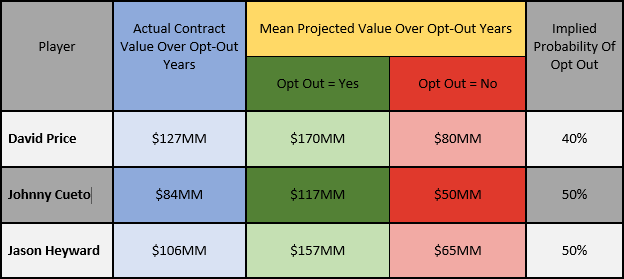
David Price received a contract for seven years at $217MM, but it was really a three-year contract for $90MM with a player option of four years and $127MM. If Price only held teams to a three-year commitment, he would probably get close to $120MM—but this is not what he did. Instead, he will require $127MM for 2019-22, only on the condition that he looks to be worth less than that by then. Although $127MM is not a terrible estimate of his 2019-22 production as of January 2016, this value will probably change drastically by October 2018, one way or the other. If he does not opt out, he probably will have performed worse, and conditional on the assumption that he will not have opted out, I estimate his expected value for his 2019-22 seasons to be $80MM. If he does opt out, he probably will have performed better, and conditional on the assumption that he will have opted out, I estimate his expected value for those seasons to be $170MM. Given that this corresponds to roughly a 40% chance of opting out, his opt-out clause is worth about $17MM, meaning that his seven-year $217MM contract is roughly equivalent to a seven-year $234MM contract with no opt-out clause.
Johnny Cueto’s contract is somewhat trickier, but it essentially amounts to a deal of two years for $46MM, with a player option of four years and $84MM, followed by a club option of one year for $16MM. Cueto would probably be worth $17MM above his salary for 2016-17. But for 2018-21, he is likely to be worth $50MM if he does not opt out and $117MM if he does. With roughly even odds of opting out, this makes his opt-out worth about $17MM. While the club option for 2022 makes the deal somewhat more attractive for the Giants, the odds that he will be worth much more than this are low. Overall, Cueto’s six-year deal for $130MM would probably cost about $147MM with no opt-out clause.
Jason Heyward’s contract is even trickier, but it mostly boils down to a three-year deal for $78MM, followed by a five-year player option for $106MM—except that the first player option (if exercised) is only certain to include one more year for $20MM. That’s because there’s a vesting provision that, if triggered—by Heyward reaching 550 plate appearances in the season following the initial option decision—would give him yet another player option for four years and $86MM. (If he exercises the initial option but then doesn’t reach that PA threshold, then both sides would be stuck with the remaining four years of the contract.) Heyward’s value is further complicated by the fact that signing him required forfeiting a draft pick, which is worth around $9MM.
Although Heyward’s contract contains two opt-outs, it is not all that likely that he opts out after 2019 if he does not after 2018. Players’ values do change substantially, but he is likely to be either much more valuable than his five-year player option after 2018, or much less valuable. It is not that we expect his value to look similar after 2018 and 2019—it is that he will probably already be way above or way below the current expected value near $20MM per year, and is likely to remain way above or way below this line through 2019.
For the first three years of Heyward’s contract, I estimate that he is worth about $22MM more than his contract will pay him. With five years of player option, there is a wide range of potential values afterward. I estimate that he also has about even odds of opting out, but if he does not opt out then he is probably only worth $65MM, while if he does he would be worth $157MM. If he doesn’t opt out after 2018 and does after 2019, he is likely near the middle and the value of the second opt-out is small. The net effect is that his opt-out clauses are worth about $25MM, and he would probably have received $209MM for eight years instead of $184MM had no opt-out been included in the deal.
With values of $17MM for each of the two pitchers and $25MM for Heyward’s pair of opt-outs, these opt-outs help keep costs down for teams. While they contain more downside and less upside than typical free agent contracts, they cost less money as well. As teams move forward in this new market, they should be careful to properly consider the true cost of these player options. If teams are willing to expose themselves to some downside risk, they can lower the cost of acquiring elite players.