
Ryan O’Rourke Announces Retirement
Former MLB southpaw Ryan O’Rourke announced last night on Twitter that he’s hanging up his spikes. MLBTR wishes him the best in his future endeavors.
O’Rourke made two appearances last year with the Mets before he was cut loose. He caught on with the Twins on a mid-season minors deal but never got the call to the MLB roster.
Most of O’Rourke’s experience at the highest level of the game came in his 2015-16 stint with the Twins. Over 47 frames in 54 appearances, he worked to a 4.98 ERA with 9.2 K/9 and 4.8 BB/9.
O’Rourke, a Massachusetts native and former 13th round pick, did find quite a bit of success at the Triple-A level. Through an even one hundred appearances over five campaigns, he posted a cumulative 3.29 ERA.
76ers, Devils Owners Eyeing Mets
Josh Harris and David Blitzer are “in the early stages” of compiling a bid for the Mets, Scott Soshnick of Variety reports. They join a still-amorphous A-Rod/J.Lo bidding group among known pursuers of the club.
There’s little question that Harris and Blitzer have ample experience in purchasing and running major sports franchises. The former is principal owner of the NBA’s Philadelphia 76ers and NHL’s New Jersey Devils. The latter also has ownership stakes in those franchises. Both are shareholders in the Premier League side Crystal Palace F.C. There’s baseball experience, too: Blitzer co-owns the Yankees’ Triple-A affiliate (the Scranton Wilkes-Barre RailRiders), an interest he’d likely have to divest to swing this deal.
The pair of potential Mets owners surely aren’t looking only for a fun place to park their capital. Both acquired their bankroll through their work at famed private equity shops (Apollo Global Management and Blackstone, respectively). And they’ve made out like bandits through their other sports-related investments.
New bidders generally represent good news for the current ownership group, led by Fred and Jeff Wilpon. Then again, it seems notable that this particular slate of candidates is only just emerging. Harris and Blitzer may well smell an opportunity.
It remains hard to imagine that the Wilpons will be able to wrangle the $2B asking price they’ve reportedly placed on the franchise — unless, perhaps, they waver on their desire to hang on to the SNY network. No doubt profit-minded investors will want the television revenue opportunity to be included in the package.
Each NL Team’s Top Recent Draft Class
With the MLB draft scheduled for next week, let’s take a look at each National League team’s most successful draft class in recent memory. Using Baseball Reference’s draft tracker, we can sum the combined career bWAR of each player selected by each team in a given year. It’s a simple shorthand, not a perfect measure, but it’ll give some insight into which teams have really hit on their picks in certain years.
First, a quick note on the methodology. For simplicity, we’re limiting this search to the 2006-2015 classes. A player’s value is only included if he signed with the club, although he needn’t have actually played for his drafting team in the majors. (So, the 2008 Yankees don’t get credit for drafting but failing to sign Gerrit Cole, while the 2007 Red Sox do get credit for drafting and signing Anthony Rizzo, even though he was traded before ever playing an MLB game for Boston). Of course, a player drafted in 2006 has had more time to rack up value than one drafted in 2015, so we’ll note in each team’s capsule if a more recent class is on the verge of taking over from an older class. On to the results…
- Braves: 2007 (76.6 bWAR) – Hitting on Jason Heyward and Freddie Freeman in the first two rounds goes a long way. Heyward has been a disappointment with the Cubs but had some electrifying seasons in his early days in Atlanta (and his year in St. Louis), while Freeman has emerged as a fixture in the Braves’ lineup as one of the best hitters in baseball over the past decade.
- Brewers: 2009 (30.7 bWAR) – This was period of some underwhelming draft returns for Milwaukee. The 2009 class tops the list thanks to Khris Davis, Mike Fiers and Scooter Gennett, all of whom are better known for their play (or whistleblowing, in Fiers’ case) elsewhere.
- Cardinals: 2006 (56.3 bWAR) – By virtue of putting up baseball’s best record in 2005, the Cardinals sat at the back of every round in 2006. No matter, as they managed to find a handful of highly productive big leaguers. First-rounder Adam Ottavino didn’t work out in St. Louis but went on to a strong career as a reliever in Colorado. Tommy Pham (16th round) and Jon Jay (2nd round) have each carved out strong careers, while Allen Craig (8th round) had a brief but productive peak.
- Cubs: 2007 (54.4 bWAR) – Unfortunately for the Cubs, this class is almost all about Josh Donaldson, who did none of his damage in a Chicago uniform. Perhaps Javier Báez (2012 draft) or Kris Bryant (2013 draft) will match or exceed Donaldson’s stellar career in time.
- Diamondbacks: 2009 (73.1 bWAR) – Paul Goldschmidt (8th round) went on to become the top position player in franchise history. First-rounder AJ Pollock had a couple star-level seasons of his own before injuries knocked him off track, while Chase Anderson (9th round) has emerged as a solid back-of-the-rotation starter.
- Dodgers: 2006 (70.6 bWAR) – The Dodgers only signed two big leaguers from the 2006 class. When one of them goes on to become arguably the best pitcher of his generation, you can more than get away with it. Clayton Kershaw’s Hall of Fame plaque will boast at least three Cy Young Awards and an NL MVP.
- Giants: 2008 (65.6 bWAR) – The late-2000’s draft classes set up the crux of the Giants’ three World Series titles the first half of the next decade. None was more impactful than 2008, when SF grabbed Buster Posey and Brandon Crawford in the first and fourth rounds, respectively.
- Marlins: 2010 (56.1 bWAR) – Christian Yelich and J.T. Realmuto have matured into two of the best players in baseball, so the Marlins’ 2010 class (which also boasted late-blooming A’s slugger Mark Canha) has a chance to be really special. Of course, none of those players are still in Miami.
- Mets: 2010 (50.5 bWAR) – Seventh overall pick Matt Harvey was briefly the ace the Mets hoped they were adding in 2010. As it turns out, Jacob deGrom (9th round) had a lot more staying power atop their rotation.
- Nationals: 2009 (44.9 bWAR) – First overall pick Stephen Strasburg has more than made good on that selection, culminating in a World Series MVP effort in 2019. The 2009 class also brought in a handful of role players, including Drew Storen and Michael Taylor.
- Padres: 2007 (38.9 bWAR) – Another team for whom the top player simply got away, the crown jewel of the Padres’ 2007 class was Corey Kluber (4th round). Obviously, even San Diego didn’t him expect him to go on to win a pair of Cy Young Awards.
- Phillies: 2014 (24.2 bWAR) – There were some tough results for the Phillies on draft day in recent seasons, but 2014 looks to be a notable exception. Aaron Nola went seventh overall and has emerged as a high-level starter, while Rhys Hoskins (fifth round) looks like the Phils’ long-term answer at first base.
- Pirates: 2011 (29.7 bWAR) – The Pirates’ 2011 class is almost exclusively about the contributions of first overall pick Gerrit Cole, but he obviously reached his peak after being traded to Houston. Josh Bell (2nd round) looked to have turned the corner at the plate in the first half of 2019.
- Reds: 2007 (43.1 bWAR) – The Reds found three future everyday players in the 2007 class. Todd Frazier (supplemental first-round), Zack Cozart (2nd round) and Devin Mesoraco (1st round) all went on to become productive players in Cincinnati.
- Rockies: 2009 (47.4 bWAR) – The Rockies graduated six players from the 2009 class to the big leagues, although only one proved a smashing success. Finding a player of Nolan Arenado’s caliber in the second round makes for a great draft even if the rest of the players taken underwhelm.
Quick Hits: NPB, Harvey, Astros
Japan’s Nippon Professional Baseball is set to open its regular season June 19. Initially, games will be played without fans in attendance, but that may not be the case the entire summer. Former MLB reliever Frank Herrmann, now a member of NPB’s Chiba Lotte Marines, tells David Laurila of Fangraphs the league has discussed allowing some number of fans into ballparks as soon as July 10, with hopes of incrementally increasing attendance moving forward if safety permits. The NPB plans to run a 120-game condensed season, down from its typical 143-game schedule.
Turning our attention to the United States…
- As we approach the ten-year anniversary of the 2010 MLB entry draft, Ken Davidoff and Dan Martin of the New York Post look back at the Mets’ selection of Matt Harvey. Then-GM Omar Minaya credits former scouting director Rudy Terrasas for staying on the right-hander even as he slumped through a difficult sophomore season at the University of North Carolina. Minaya says the club had scouts in attendance for every one of Harvey’s starts as a junior, allowing them to feel comfortable enough to select him seventh overall when his performance rebounded that season. The story of Harvey’s meteoric rise to stardom and his equally rapid fall from that peak has been told many times. Nevertheless, Mets’ fans in particular will want to check out the full piece for an entertaining look back at the caliber of player Harvey was in his prime.
- Astros GM James Click tells Brian McTaggart of MLB.com that this year’s shortened, five-round draft forces teams more than ever to draft the best prospects on their board, rather than worrying about balancing out their minor-league systems. That’s particularly true for Houston, who lost their first and second round picks this season (and next) as punishment for their sign-stealing violations. “Even if you end up drafting four very similar players, you should be able to find playing time for them at some place and at some point,” Click tells McTaggart. Even in a typical season, MLB teams almost always select the player whom they believe to be the best available talent (subject to signability) in the early rounds of the draft. Drafting for need doesn’t make the same impact in baseball, where prospects are often years away from the majors and face high rates of attrition along the way, as it might in sports like football or basketball.
Quick Hits: A’s, Phillies, Yankees, Mets
Checking in on a few MLB teams…
- Athletics owner John J. Fisher made the widely panned decision last week to stop paying minor leaguers at the end of May. Industry sources told Susan Slusser of the San Francisco Chronicle they’re of the belief that “the front office was tremendously disappointed” in A’s ownership’s call. It’s a choice that Slusser notes could have a negative effect on the A’s after next week’s five-round draft, as various minor leaguers and agents told Slusser the A’s would not be their No. 1 choice. However, as Slusser writes, Oakland still has a chance to land talent if it’s willing to pay enough, and if it presents the best opportunity to the player.
- With no season underway yet, the Phillies are in cost-cutting mode. Owner John Middleton told full-time employees in an email Monday that the team’s projecting losses of “substantially more than $100 million” in 2020, Scott Lauber of the Philadelphia Inquirer reports. As a result, anyone in the team’s business department who’s on a $90K salary or above must take a pay cut. The Phillies will continue to provide health insurance, pension and 401(k) benefits to their full-time staff. However, because there may not be fans in the stands this year, the team’s facing “an enormous financial challenge” according to Middleton, who wrote that “approximately 40% of our total annual revenue is generated by attendance — tickets, food and merchandise concessions, parking and sponsorships.” Of course, the lack of fans is one of the reasons the owners have pushed for a far smaller schedule this year. They and the players have not been on the same wavelength in negotiations, though.
- Teams are expected to have a few extra rosters if there is a season in 2020. Between that and likely a lack of a minor league campaign, Kristie Ackert of the New York Daily News has been profiling Yankees pitching prospects who could get to the majors sooner than expected this year. Right-handers Deivi Garcia (link) and Clarke Schmidt (link) are among them. Garcia (No. 3) ranks a bit below Schmidt (No. 2) on Baseball America’s list of Yankees farmhands, and the scouts Ackert spoke with are optimistic they’ll turn into capable major league contributors.
- The Mets have reopened their spring training complex in Port St. Lucie, Fla., to players for the first time since late March, Anthony DiComo of MLB.com writes. Four to six players, including catcher Wilson Ramos, have resumed training at the facility. It’s an encouraging sign that they’re getting back to work, though DiComo points out that the players must follow “MLB, CDC, and local and state safety protocols.”
Alex Rodriguez, Jennifer Lopez Still Working On Mets Bid
Three weeks ago, it appeared Alex Rodriguez no longer had any hope of purchasing the Mets. However, it now looks as if he and famous fiancee Jennifer Lopez have re-entered the picture. According to Thornton McEnery of the New York Post, Rodriguez, Lopez and some of JPMorgan Chase’s “very senior bankers” are working on putting together a bid to buy the franchise from current owners Fred Wilpon and Jeff Wilpon.
This is clearly a serious attempt from Rodriguez and Lopez, who McEnery hears are putting in “hundreds of millions” of their own dollars to land the Mets. It’s unclear exactly who else would be part of a Rodriguez-Lopez ownership group – Wayne Rothbaum was said to be in the mix earlier, but it doesn’t seem that’s the case anymore – though they have been talking with New England Patriots owners Bob Kraft and Jonathan Kraft. The Krafts don’t want to buy a baseball team, yet they’re “very intrigued” with the plans Rodriguez and Lopez have to breathe new life into Citi Field and its surrounding areas, McEnery details in his piece.
Regardless of whether the Krafts do accompany Rodriguez and Lopez, a source told McEnery that “the money is there,” that “a bid is coming,” and odds are the Mets will go for less than $2 billion if they do change hands. Furthermore, while the Wilpons have been reluctant to give up any part of the SNY television network in a sale, it seems they’re more open to it now. The Wilpons would still want to keep some portion of SNY in giving up the Mets, however, McEnery reports.
The coronavirus shutdown could continue to lead to major financial losses for the Wilpons, who may reportedly lose up to $150MM even during a half-season. That could increase their urgency to sell the team, and it now looks possible that Rodriguez and Lopez will swoop in if the Wilpons do step away.
Latest Minor League Releases
Minor League Baseball has never faced greater uncertainty than it presently does, with contraction widely expected later this year and significant doubt as to whether a 2020 minor league campaign will even be able to take place. Over the past several days, we’ve seen wide swaths of minor league releases due to myriad reasons. It’s common for players to be released late in Spring Training, but those cuts didn’t happen this year. Between that, the likely absence of a minor league season and the typical wave of releases that precede the annual MLB draft, cuts have been abundant.
The Score’s Robert Murray tweets several clubs who’ve made undetermined numbers of releases: the Brewers, Reds, Nationals, Rays, Cardinals and Blue Jays among them. MLB Network’s Jon Heyman tweets that the Diamondbacks have released a whopping 64 players in recent days. In all likelihood, all 30 teams will make significant cuts. The Orioles, White Sox, Rockies and Mariners are already known to have done so.
Most of the players who’ve been cut loose have yet to be named — and the majority of them won’t be especially recognizable to any but diehard fans of a particular organization. We’ll track some former big leaguers and other notable names in this post and update as more information comes to light…
- The Mets cut 39 players loose this week, with first baseman Joey Terdoslavich and right-handers Nick Rumbelow and Rob Whalen among those let go, according to Roster Roundup. Newsday’s Tim Healey had previously reported an unspecified number of players were being cut loose. Each of Terdoslavich, Rumbelow and Whalen has big league experience. Terdoslavich, 31, was at one point a fairly well-regarded farmhand with the Braves, for whom he appeared in 2013-15. Rumbelow pitched with the Mariners in 2018-19 but hasn’t replicated the high-end performance he showed in Triple-A when working back from Tommy John surgery. Whalen, 26, had announced his retirement at one point but opted for a comeback this past winter. He logged 36 innings between the Braves and Mariners from 2016-18.
- The Red Sox announced Friday the release of 22 minor league players. While none of the bunch has appeared in the Majors, there are some notable names in there all the same. Infielder Nick Lovullo, 26, is the son of former Sox bench coach and current D-backs skipper Torey Lovullo. He’d been with the organization since being selected in the 20th round of the 2016 draft. Boston also cut ties with infielder Juremi Profar — the younger brother of Padres second baseman Jurickson Profar. Boston inked the younger Profar brother to a minor league pact back in November after he’d spent seven years in the Rangers organization. The Boston Globe’s Pete Abraham tweeted the whole list for those interested.
Latest News, Notes On Minor League Pay
The manner in which teams are — or, in some cases, aren’t — continuing to pay their minor league players has drawn increased attention as the end of the month draws near. Major League teams agreed back in March to pay minor league players $400 per week through the end of May, but most minor league players now face ongoing financial uncertainty. The Dodgers have already committed to continue that $400 weekly stipend through the end of June, but veteran left-hander David Price is stepping up to add a helping hand, pledging $1,000 to each non-40-man Dodgers minor leaguer, according to a report from Francys Romero (Twitter link). That includes more than 220 minor leaguers, per MassLive.com’s Chris Cotillo. It’s a similar gesture to the one Shin-Shoo Choo made with the Rangers back in April.
Of course, the very fact that veterans such as Choo and Price even feel it necessary to step up to help out minor leaguers speaks to the manner in which minor league players are under-compensated. While some clubs — the Marlins and Padres — are reportedly set to pay out that $400 weekly stipend through the end of the minor league season, the Athletics are cutting off the stipend at month’s end. Others have extended the stipend through June but have not committed further.
Here’s how a few other clubs are handling the matter…
- The Mets, Rays, Brewers, Cardinals, Giants and Indians are all extending the $400 weekly stipend through the month of June, per reports from MLB Network’s Jon Heyman (tweet), the Tampa Bay Times’ Marc Topkin, the Milwaukee Journal-Sentinel’s Todd Rosiak (tweet), the St. Louis Post-Dispatch’s Derrick Goold, Alex Pavlovic of NBC Sports Bay Area (tweet) and Kyle Glaser of Baseball America (tweet). “This money right now, especially for guys who aren’t as well off, this is a huge deal,” Rays minor league catcher Chris Betts tells Topkin. “…I’m beyond excited about it, and I’m honestly just more stoked and proud that the organization I play for took this route more than anything.”
- The Athletics have, unsurprisingly, drawn a wide array of harsh criticism for their wide-ranging furlough and the full cutoff of minor league payment, Susan Slusser of the San Francisco Chronicle writes. Slusser notes that owner John Fisher repeatedly used the word “family” in his letter to fans explaining the cutbacks, but many impacted by the cuts don’t feel the effects of that word. “It’s very hard to preach family and then not act like it when times are difficult,” Class-A pitcher Aiden McIntyre tells Slusser. Triple-A outfielder Jason Krizan added: “…[I]t hurts to see the Marlins continue to pay their players when they made the least in baseball last year,” though he noted he’d rather remain an Athletic and receive benefits than otherwise. Other players, past and present, voiced similar criticisms to Slusser, as did a big league agent and an executive with another club. Sports Illustrated’s Stephanie Apstein writes that termination of the stipend saves the Athletics an approximate $1.3MM.
Which 15 Players Should The Mets Protect In An Expansion Draft?
In a few weeks, we’ll be running a two-team mock expansion draft here at MLBTR – just for the fun of it! Currently, we’re creating 15-player protected lists for each of the existing 30 teams. You can catch up on the rules for player eligibility here.
The American League results are in! Click here to see who’s protected and who’s available for each AL team.
So far, we’ve covered the Marlins, Braves, Cardinals, Pirates, Brewers, Reds, Cubs, Diamondbacks, Rockies, Dodgers, Padres, Giants, Rangers, Mariners, Athletics, Angels, Astros, Twins, Royals, Tigers, Indians, White Sox, Rays, Yankees, Red Sox, Blue Jays and Orioles. The Mets are up next.
First, we’ll begin by removing free agents Jed Lowrie, Rick Porcello, Yoenis Cespedes, Justin Wilson, Michael Wacha, Marcus Stroman, Jake Marisnick, Wilson Ramos, Brad Brach, and Dellin Betances from consideration. The latter three have 2021 options, but we will consider them free agents for this exercise. Robinson Cano and Jacob deGrom will make the protected list by virtue of their no-trade clauses. We’ll protect a total of a dozen players out of the gate:
Robinson Cano
Jacob deGrom
Pete Alonso
Jeff McNeil
Noah Syndergaard
Michael Conforto
Amed Rosario
Brandon Nimmo
J.D. Davis
Steven Matz
Edwin Diaz
Seth Lugo
That leaves three spots for the following 12 players. Be sure to check out the Mets’ contract statuses here.
Tyler Bashlor
Jeurys Familia
Robert Gsellman
Luis Guillorme
Walker Lockett
Tomas Nido
Corey Oswalt
Jacob Rhame
Paul Sewald
Dominic Smith
Drew Smith
Daniel Zamora
With that, we turn it over to the MLBTR readership! In the poll below (direct link here), select exactly three players you think the Mets should protect in our upcoming mock expansion draft. Click here to view the results.
Did The Mets Rob The Astros?
Mets general manager Brodie Van Wagenen has come under fire at times since the team hired the former agent after the 2018 season, but BVW has nonetheless had his high points atop their front office. One of his best decisions in New York came in January 2019, when he acquired a player who’s now among the Mets’ most valuable hitters in a trade with the Astros.
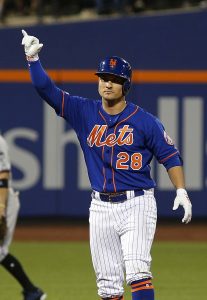
Sixteen months ago, Van Wagenen and then-Astros GM Jeff Luhnow worked out a swap that sent infielder/outfielder J.D. Davis and INF Cody Bohanek to the Mets for the trio of second baseman Luis Santana, outfielder Ross Adolph and catcher Scott Manea. Nobody from that quintet looked like a high-end asset at the time, and Davis was the only member of the group with major league experience.
Davis, a third-round pick of the Astros in 2014, hit a miserable .194/.260/.321 in 181 plate appearances in their uniform from ’17-18. However, Davis did have his way with Triple-A pitchers, against whom he slashed .335/.400/.589 with 22 home runs in 450 trips to the plate.
Davis’ success at the highest level of the minors impressed the Mets, who now look as if they acquired a terrific hitter at a low price. Davis got his first extensive look in the majors last season, his age-26 campaign, and ran with it.
Across 453 PA, Davis batted a strong .307/.369/.527 (136 wRC+) with 22 home runs in his Mets debut. The righty swinger showed no vulnerability against either same-handed or southpaw pitchers in the process, and his Statcast numbers don’t suggest his success was fluky. On the contrary, Davis finished in the league’s 80th percentile or better in barrels, exit velocity, expected slugging percentage, hard-hit rate, expected weighted on-base average and expected batting average. His xwOBA (.383) outdid an already impressive real-life mark of .373 and ranked 21st in the league, placing him among a slew of big names.
As great as Davis’ offense was last season, defensive woes tamped down his value. He lined up at third and in left field, where he combined for minus-20 Defensive Runs Saved and a minus-6.3 Ultimate Zone Rating. Still, thanks to his offensive breakout, the overall package was worth an above-average 2.4 fWAR. That’s especially good for someone who looked like a lottery ticket when the Mets got him, and for someone who made a minimum salary in 2019. Davis won’t be eligible to reach free agency until after 2024, which means he could be an important piece of New York’s offense for several more years (perhaps especially if the NL adds a DH).
Unlike Davis, Bohanek hasn’t shown a ton of potential so far, and the 24-year-old turned in fairly nondescript numbers at the High-A level last season. The Astros don’t seem as if they’ll miss him, but what about their return? Here’s how it has panned out through one season…
- Luis Santana: The Mets’ 19th overall prospect at MLB.com when the trade occurred, Santana’s now the outlet’s 22nd-ranked Astros farmhand. The 20-year-old hit just two homers last season, batting .267/.339/.352 in 186 Low-A attempts and .228/.333/.263 in 66 PA at the Double-A level.
- Ross Adolph: The 23-year-old outfielder combined for a .228/.357/.366 line with seven homers in 460 PA between Single-A and High-A ball last season. Eric Longenhagen and Kiley McDaniel recently wrote for FanGraphs that he could amount to a role player in MLB.
- Scott Manea: The 24-year-old offered a .235/.347/.387 line with 12 HRs and 389 PA at the High-A level last season. He’s not regarded as a notable prospect.
This looks like anything but a can’t-miss package for the Astros, though it’s still way too early to throw dirt on the careers of anyone they picked up. The Mets, meanwhile, can’t be anything but thrilled with what they’ve gotten from Davis.
Photo courtesy of USA Today Sports Images.