
Yankees Acquire Caleb Ferguson From Dodgers
The Dodgers and Yankees swapped left-handed relievers on Monday. New York acquired Caleb Ferguson for Matt Gage and minor league right-hander Christian Zazueta.
Ferguson, 27, joins a new organization for the first time in his career. He was drafted by the Dodgers in 2014 and has been with them ever since. He made his debut in 2018, starting his first three major league outings before being moved to a relief role. Apart from some occasional starts as an opener, he’s stayed in the bullpen ever since.
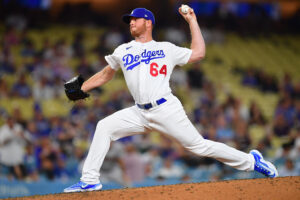
The results have been quite strong, with Ferguson making 96 appearances from 2018 to 2020, tossing 112 1/3 innings while allowing 3.93 earned runs per nine. He struck out 29.1% of batters faced in that time, gave out walks at an 8.7% clip and kept 44% of batted balls on the ground. Unfortunately, he required Tommy John surgery in September of 2020, wiping out the remainder of that campaign and preventing him from pitching at all in 2021.
He has since returned to the mound and has produced fairly similar statistics to before his injury layoff. In 126 appearances over 2022 and 2023, he has 113 2/3 innings pitched with a 2.85 ERA. He struck out 27.5% of opponents in that time, walking 8.8% of them and getting grounders at a 48% clip. Those results have come with Ferguson moving to higher leverage appearances, as he earned seven holds in 2022 and 17 last year.
He is now in his final season of club control, slated for free agency after the upcoming season in which he’ll make a salary of $2.4MM. This is the second left-handed reliever that has gone from the Dodgers to the Yankees this offseason, with Victor González having been dealt to the Bronx in December.
The Yankees have used Wandy Peralta as their primary lefty out of the bullpen in recent years, but he became a free agent this offseason and signed with the Padres last week. They now have Ferguson and González as their top southpaw relievers, alongside righties Clay Holmes, Jonathan Loáisiga and Tommy Kahnle.
Gage, 31 next week, will give the Dodgers another lefty to replace Ferguson, but one with a more limited track record. Gage has made 16 big league appearances over the past two years, suiting up for the Astros and Blue Jays, with a 1.83 ERA in a tiny sample of 19 2/3 innings. He spent most of last year’s with Houston’s Triple-A club, tossing 37 1/3 innings at that level with a 4.58 ERA, 23.4% strikeout rate, 12% walk rate and 41.5% ground ball rate. New York claimed him off waivers from the Astros last week.
For now, it appears the trade will be 40-man neutral. By sending Gage to the Dodgers, the Yanks opened up a 40-man spot for Ferguson. The Dodgers are also reportedly signing Ryan Brasier, so they will still need to open a spot for him but could perhaps do so by designating Gage or some other player for assignment.
For the Yanks, they upgrade their bullpen for the 2024 season while giving up a bit of future value in Zazueta, a 19-year-old who posted a 3.29 ERA in the DSL last year. The Dodgers, meanwhile, were going to be facing a roster squeeze with the Brasier signing and have used one year of Ferguson’s services to give them an extra prospect and some more roster flexibility. It wouldn’t be a surprise to see them pursue a different lefty at this point, as they are now down to Alex Vesia, Ryan Yarbrough and Gage as their southpaw relievers.
Jon Heyman of the New York Post first reported the Yankees were acquiring Ferguson. The Post’s Joel Sherman reported the Dodgers were acquiring two players, one in the upper minors and one nowhere near the majors. Heyman reported Gage’s inclusion.
Giants “In Talks” With Jorge Soler
The Giants are “in talks” with free agent slugger Jorge Soler, per Susan Slusser of the San Francisco Chronicle. It’s unclear how close the sides are in those talks or if anything is imminent.
The 32-year-old Soler opted out of the final year and $13MM of a three-year, $36MM deal with the Marlins at the beginning of the offseason. That seemed like a foregone conclusion after the 2019 American League home run leader (48) posted one of his best seasons in 2023. Serving as a part-time right fielder and regular DH in Miami, Soler .250/.341/.512 (126 wRC+) with 36 home runs. Last year’s 11.4% walk rate and 24.3% strikeout rate were both the second-best marks of his career, and Soler continued to deliver his typical brand of loud contact. His 91.3 mph average exit velocity (81st percentile) and 48% hard-hit rate (84th percentile) both placed him among the best in the game.
A fit in San Francisco seems fairly obvious. Soler would immediately become the top power threat in a generally light-hitting Giants offense. Last season, San Francisco 19th in the big leagues in home runs, 24th in runs scored, 28th in average (.235), 24th in OBP (.312) and 27th in slugging (.383).
While Soler likely won’t see much time in the outfield, he’s a nice right-handed complement to left-handed corner outfielders like Michael Conforto and Mike Yastrzemski. Production against left-handed pitchers, in particular, was a problem for the 2023 Giants (.245/.306/.376). Soler’s mammoth .277/.393/.688 output against lefties last year would represent an enormous boost to San Francisco in such situations. Soler could join Conforto and Yastrzemski in a rotation through the corner outfield spots and designated hitter, spending more time at the latter.
From a payroll vantage point, the Giants can easily accommodate Soler or just about any free agent on the market. Their offseason trades shipping out Anthony DeSclafani, Mitch Haniger and Ross Stripling have helped to drop the payroll to a projected $154MM — well shy of the franchise-record $200MM. They’re similar well-situated with regard to the luxury tax — about $37MM shy of the first threshold, per Roster Resource.
Soler has drawn interest from teams several teams this winter, but many have since filled their designated hitter vacancies with more affordable free agents. The Mariners (Mitch Garver, two years/$24MM), Blue Jays (Justin Turner, one year/$13MM) and Diamondbacks (Joc Pederson, one year, $12.5MM) have all gone in other directions. Pederson, notably, was one of the top power hitters on the same Giants roster that’s now said to be in talks with Soler. His departure only further underscores the need to replenish the lineup with someone capable of hitting in the middle of the order.
The Giants have been active in free agency this winter but were unable to secure top targets Shohei Ohtani and Yoshinobu Yamamoto, both of whom not only signed elsewhere but landed with the archrival Dodgers. San Francisco did lure top KBO outfielder Jung Hoo Lee to Oracle Park on a six-year, $113MM contract, and they’ve also signed flamethrowing Jordan Hicks with an eye toward moving him from the bullpen to the rotation. Backup catcher Tom Murphy also inked a two-year, $8.3MM deal. Generally speaking, however, it’s been a tough offseason in terms of player acquisition for the Giants. Adding Soler would be the biggest boost the team has made to its lineup thus far, though time will tell whether a deal ultimately comes to fruition.
Mariners Acquire Gregory Santos
The Mariners have acquired right-hander Gregory Santos from the White Sox in exchange for right-hander Prelander Berroa, outfielder Zach DeLoach, and their 2024 Competitive Balance Round B draft pick (#69 overall), according to Jeff Passan of ESPN. Both clubs have since announced the deals. To make room for the club’s additions on the 40-man roster, the White Sox announced that they’ve designated right-hander Lane Ramsey for assignment.
Santos, 24, entered the 2023 campaign with just 5 2/3 innings in the majors under his belt for his career but fashioned a strong rookie performance out of the White Sox bullpen last year. The right-hander posted a strong 3.39 ERA in 66 1/3 innings of work across 60 appearances for Chicago last season, and those already solid numbers are backed up by even stronger peripherals. Santos paired a solid 22.8% strikeout rate with a microscopic 5.9% walk rate last season all while generating grounders at an excellent 52.5% clip. Those quality peripheral numbers left Santos with a 2.65 FIP last year, a figure bested by only Felix Bautista, Tanner Scott, Matt Brash, and David Bednar among relief arms with at least 60 innings of work last year.
Given the presence of both Brash and flamethrowing closer Andres Munoz at the back of Seattle’s bullpen, it seems unlikely that Santos will find himself in line for many save opportunities with the Mariners after picking up five saves in eight opportunities with the White Sox last season. That being said, Santos appears likely to step into the void created by right-hander Justin Topa‘s departure from the club’s late-inning mix. Topa, who posted a 2.61 ERA and 3.15 FIP for the Mariners last year, was shipped to Minnesota last week alongside Anthony DeSclafani and two prospects in exchange for infielder Jorge Polanco. While reporting earlier this winter indicated that Santos may not be ready for Spring Training after ending the season on the injured list with elbow inflammation, MLB.com’s Daniel Kramer relays that the Mariners expect Santos to make six to eight appearances this spring in preparation for Opening Day.
In exchange for parting ways with a quality relief arm with five seasons of team control remaining, the White Sox are receiving a pair of rookie-eligible youngsters as well as what should become a third noteworthy piece in the form of the #69 selection in this year’s draft. That will be Chicago’s third pick in next year’s draft as things stand, as they will also draft the #5 and #43 selections this summer.
Berroa, 23, was acquired by the Mariners back in May of 2022 in a deal that sent Donovan Walton to San Francisco. The right-hander was listed as Seattle’s #15 prospect by MLB.com last season on the heels of a 2022 campaign that saw him post a 2.86 ERA in 26 starts split between the High-A and Double-A levels of the minors. The Mariners converted Berroa to the bullpen in 2023 and he found considerable success in the role as he punched out 36.6% of batters faced while compiling a 2.89 ERA in 65 1/3 innings of work in a return to Double-A last year. Impressive as those strikeout numbers are, Berroa’s penchant for issuing free passes stands out as a possible red flag. The righty walked 14.1% of batters faced last season and has walked at least 11.8% of opponents every year since he made the jump to full-season ball back in 2019.
Though the youngster has yet to appear at the Triple-A level to this point in his career, he got his first taste of big league action last year, with 1 2/3 scoreless innings of work across his first two appearances in the majors. There should be plenty of opportunities this season for the righty to step into a significant role in Chicago’s bullpen, where they figure to rely on the likes of John Brebbia, Tim Hill, and Garrett Crochet as late-inning options.
As for DeLoach, the 25-year-old was Seattle’s second-round pick in the 2020 draft. Early in his professional career, DeLoach struggled to create much power with his swing, clubbing just 14 home runs in each of his first two pro campaigns. The right fielder managed to improve his power output this past season, however, as he slashed .286/.387/.481 in 623 trips to the plate at the Triple-A level. While that translates to a wRC+ of just 111 in the inflated offensive environment of the Pacific Coast League, where the Mariners’ Triple-A affiliate plays its games, DeLoach’s 23 homers last season still show the power potential necessary to make him a potential big league contributor as soon as this season.
While star slugger Luis Robert Jr. is locked into the everyday center field job and veteran outfielder Andrew Benintendi figures to get the lion’s share of starts in left for the White Sox this year, the club’s right field situation is far less certain. Oscar Colas was the club’s main contributor at the position last year, though he posted a brutal .216/.257/.314 slash line in 75 games with the big league club last year. As such, there’s plenty of room for either DeLoach or fellow recent addition Dominic Fletcher to seize an everyday role with the club during Spring Training later this month. That trio also figure to battle with non-roster invitees Brett Phillips and Kevin Pillar for the club’s fourth outfield role headed into Opening Day.
Making room on the 40-man roster for the additions of DeLoach and Berroa is Ramsey, a 27-year-old who made his big league debut last season. Originally acquired by the White Sox in the 23rd round of the 2018 draft, Ramsey struggled to a 5.85 ERA in 20 innings of work with the big league club last year as he struck out just 19.6% of batters faced while walking 9.8%. The club will have seven days to either trade Ramsey or attempt to pass him through waivers. If they are successful in doing so, they’ll have the opportunity to outright him to the minor leagues where he’ll remain with the club as non-roster depth headed into the 2024 campaign.
White Sox Acquire Dominic Fletcher
The White Sox have a deal in place with the Arizona Diamondbacks to acquire outfielder Dominic Fletcher, according to Daryl Van Schouwen of the Chicago Sun-Times. Right-hander Cristian Mena is headed to Arizona in exchange for Fletcher’s services. Both teams have since announced the deal.
The younger brother of Braves utility player David Fletcher, the 26-year-old was Arizona’s second-round selection in the 2019 draft. He made a 28-game cameo in the big leagues last year and impressed in his first taste of big league action with a .301/.350/.441 slash line in 102 trips to the plate. Fletcher combined that solid first impression in the majors with strong numbers at the Triple-A level last year, where he slashed .291/.399/.500, good for a wRC+ of 120 even in the inflated offensive environment of the PCL, where the Diamondbacks’ Triple-A affiliate plays its games. Strong as Fletcher’s offensive numbers have been to this point in his career, defense is the outfielder’s true calling card. In ranking Fletcher as Arizona’s #11 prospect last season, MLB.com described him as a center fielder with strong reads off the bat and solid routes in the outfield that he pairs with an arm strong enough to handle right field.
As promising as the start to Fletcher’s big league career was last season, it’s understandable that the Diamondbacks would look to part ways with the 26-year-old. After all, the club currently boasts a crowded outfield mix headlined by young star Corbin Carroll that also features veteran free agent additions Lourdes Gurriel Jr. and Joc Pederson in addition to former top prospect Alek Thomas. With Jake McCarthy penciled into a bench role and the likes of Pavin Smith and Jorge Barrosa already on the 40-man roster as depth options, Fletcher was left as a superfluous asset in Arizona.
By contrast, Fletcher fills a notable need for the White Sox headed into the season. While Andrew Benintendi and Luis Robert Jr. figure to man left and center field for the club on a daily basis, the club appeared likely to rely on the likes of Oscar Colas and Brett Phillips in right field headed into Spring Training later this month. Colas struggled to a .216/.257/.314 slash line in 75 games with Chicago last year while Phillips has slashed an anemic .152/.230/.269 in 296 trips to the plate across the past two seasons. The addition of Fletcher should provide the White Sox with another viable option headed into camp who can battle for a spot on the big league roster alongside Colas, Phillips, Zach DeLoach (who the club acquired from the Mariners earlier today), and Kevin Pillar (who the club signed to a minor league deal yesterday).
In exchange for parting ways with Fletcher, the Diamondbacks acquire a 21-year-old hurler in Mena. After signing for $250K out of the Dominican Republic during the 2019 international signing period, Mena has climbed through the White Sox system to become the club’s #10 prospect last year per MLB.com, which notes Mena’s impressive repertoire includes a fastball that touches 96, a low-80s curveball, as well as a slider and a mid-80s changeup that are still developing.
That pitch mix gives Mena the potential to be a mid-rotation starter at some point, though to reach that potential he’ll need to iron out control issues that cropped up in 2023, when he walked 11% of batters faced in 27 starts split between the Double- and Triple-A levels. Despite those concerns with Mena’s strike-throwing, the righty managed to punch out 26.9% of batters faced last year between the two levels. It’s a feat made all the more impressive when you consider that 2023 was Mena’s age-20 campaign, making him far younger than the average pitcher at even the Double-A level, to say nothing of Triple-A. Even after parting ways with Mena, the White Sox still have a pair of upper-level pitching prospects knocking on the door of the majors in Jake Eder and Nick Nastrini, with the likes of Ky Bush and Noah Schultz further down on the organizational depth chart.
Cardinals Sign Keynan Middleton
The Cardinals announced today that they’ve signed free agent reliever Keynan Middleton, as first reported by Robert Murray of FanSided (X link). The club announced that the deal is a one-year arrangement with a club option for 2025. Murray adds that the ACES client is guaranteed $6MM by the deal, and will earn $11MM if the option is exercised. Middleton will make $5MM next season with a $1MM buyout on the $6MM option, according to The Associated Press.
Middleton, 30, is coming off a solid season split between the White Sox and Yankees. The right-hander had bounced between the Angels, Mariners and Diamondbacks over the preceding three years. He inked a minor league deal with Chicago last January and was selected onto the MLB roster within a couple weeks of Opening Day.
The 6’3″ righty had a strong first half in Chicago. He pitched to a 3.96 ERA while striking out more than 30% of opposing hitters across 36 1/3 innings. With the Sox out of contention and Middleton headed back to free agency, he became one of the more obvious trade targets at the deadline. Chicago flipped him to New York for High-A righty Juan Carela on August 1.
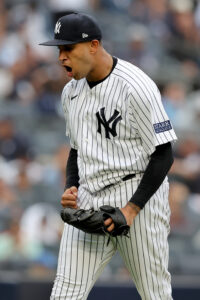
Middleton made headlines a few days later with some parting shots at the White Sox’s clubhouse culture. Lance Lynn, who’d played with Middleton in Chicago before being traded to the Dodgers, went on the record to back him up. They’ll be teammates again in St. Louis after Lynn inked a one-year deal with the Cards at the start of the offseason.
Shoulder inflammation sent Middleton to the injured list in early September. That kept him from making much of an impact in the Bronx, where he was limited to 12 appearances. He struck out 17 and allowed only three runs in 14 1/3 innings as a Yankee, finishing his year on a generally strong note. For the season, he worked to a 3.38 ERA with a 30.2% strikeout percentage. He logged 50 2/3 innings, his heaviest workload since his 2017 rookie campaign.
While Middleton runs his fastball into the 95-96 MPH range, he leaned more heavily on both his changeup and slider last season. He missed bats with all three pitches and generated swinging strikes on an excellent 17% of his offerings overall. As has been the case throughout his career, Middleton issued a few more walks than is ideal — a 10.8% clip. He has more swing-and-miss upside than a standard middle reliever, though.
St. Louis entered the offseason with a goal of adding two pitchers to the bullpen. They dealt outfielder Richie Palacios to the Rays for Andrew Kittredge last month. They’ll dip into free agency for Middleton on what should be a modest one- or two-year commitment. The Cardinals have a projected payroll around $179MM, according to Roster Resource. That’s right in line with their season-opening mark a year ago.
Image courtesy of USA Today Sports.
Twins Sign Carlos Santana
The Twins announced they have signed Carlos Santana to a one-year contract. The veteran first baseman, an Octagon client, is guaranteed $5.25MM on a deal that also includes performance incentives.
At the start of the offseason, president of baseball operations Derek Falvey said the team was open to adding at first base. That preceded three months of a dearth of activity on both the trade and free agent fronts. With an expected payroll reduction as they anticipated a dip in their local broadcasting revenues, the Twins made essentially no acquisitions.
Things kicked into gear this week with the trade sending second baseman Jorge Polanco to the Mariners for a four-player return. Two of the players headed back to the Twin Cities — reliever Justin Topa and starter Anthony DeSclafani — addressed a portion of the pitching depth the team lost with Sonny Gray, Kenta Maeda, Tyler Mahle and Emilio Pagán signing elsewhere.
The trade presaged a free agent acquisition on the position player side, as Falvey acknowledged shortly after it was finalized. Minnesota offloaded Polanco’s $10.5MM salary. They took back Topa’s $1.25MM deal and assumed $4MM of the $12MM owed to DeSclafani for the upcoming season. That netted them $5.25MM in cost savings — the exact amount they’re now committing to Santana.
Moving Polanco indirectly opened the door to a more defensively-limited hitter. Edouard Julien now has a path to everyday reps at second base. Julien will still see some action at designated hitter but won’t log nearly as many at-bats there as he would’ve had Polanco still been on the roster. Santana and Alex Kirilloff should share the majority of the playing time between DH and first base.
Even as he nears his 38th birthday, Santana is better suited to play on the infield than at the DH spot. He remains a solid defender at first base. Statcast and Defensive Runs Saved each typically grade him slightly better than average with the glove. DRS estimated he was 11 runs above par a year ago, while Statcast had him at +2 runs.
The defense accounts for a good portion of Santana’s value. He’s a solid hitter but doesn’t have the kind of offensive firepower typically associated with the position. He’s coming off a .240/.318/.429 showing across 619 plate appearances split between the Pirates and Brewers. He hit 23 home runs, 33 doubles, and picked up his first triple in four years.
That offensive output was essentially league average, as measured by wRC+. He also rated as an average hitter in 2022, when he put together a .202/.316/.376 line in 506 plate appearances between the Royals and Mariners. While his triple slash stats were quite a bit higher in ’23 than they’d been the year before, offense was up around the league. (The league OPS jumped from .707 to .734.) Milwaukee’s American Family Field, where Santana finished last season, is also a far more favorable hitting venue than are either of the parks he called home two years ago.
Park-adjusted metrics didn’t feel Santana took a major step forward at the plate. That sentiment was apparently shared by the market, which valued him fairly similarly as it did a year ago. His 2024 salary is a little below the $6.725MM he’d been guaranteed on his one-year pact with Pittsburgh.
A switch-hitter, Santana has been more effective from the right side. Over the past two seasons, he owns a .266/.370/.430 line in 303 plate appearances against left-handed pitching. That’s quite a bit better than his .208/.298/.397 showing against righties. Santana’s recent productivity versus southpaws is appealing to a club that struggled somewhat in that regard a year ago. Minnesota had a .244/.330/.432 batting line against right-handers while hitting .241/.313/.414 against lefties.
Assuming Byron Buxton can play center field most days, which is the current expectation, most of Minnesota’s in-house DH possibilities hit from the left side. The corner outfield trio of Max Kepler, Matt Wallner and Trevor Larnach are all lefty bats, as is Kirilloff. Santana complements the group from a handedness perspective.
Perhaps more importantly, he has also been incredibly durable. Santana has remarkably gone on the injured list just one time since 2014 (a minimal stay for ankle bursitis in May ’22). He has played in 130+ games in every full schedule since 2011 and appeared in all 60 contests during the shortened season. That kind of reliability pairs well with Kirilloff, a talented hitter who has been bothered by various injuries to this point in his career.
Kirilloff has missed time in all three of his MLB campaigns. Right wrist injuries led to extended absences in his first two seasons, culminating in season-ending surgeries both years. He battled shoulder problems last season and underwent a labrum repair in October. While he’s expected to be ready for Spring Training, the injury history has to be of concern to the front office. Last season’s 88 MLB games represented his personal high.
Minnesota’s payroll projection jumps back to the approximate $123MM figure at which they started this week, as calculated by Roster Resource. They’re reportedly aiming for a season-opening payroll in the $125-140MM range.
Darren Wolfson of SKOR North first reported the Twins and Santana had agreed to a one-year contract. Jon Heyman of the New York Post reported the $5.25MM guarantee and inclusion of performance bonuses.
Image courtesy of USA Today Sports.
Arnold: Brewers “Open To More Conversations” Following Burnes Trade
Last night’s trade of Corbin Burnes took baseball by surprise. With spring training less than two weeks away and the Brewers having just spent $34MM to sign Rhys Hoskins for the next two seasons, the general expectation had been that the team planned to hold onto top stars like Burnes, Willy Adames and Devin Williams, despite the trio inching closer to free agency. (Burnes and Adames are free agents next winter, Williams after the 2025 season.) The Orioles, however, clearly came through with an offer that Milwaukee general manager felt he couldn’t turn down, and in the wake of the trade Arnold acknowledged that he’s “certainly open to more conversations” and “wouldn’t shut any conversations down at this point in the offseason” (link via Adam McCalvy of MLB.com).
That’s a far cry from a declaration that the Brewers are open for business, but both Ken Rosenthal of The Athletic and Mark Feinsand of MLB.com report that Williams, in particular, is also a possibility to move. Rosenthal writes that the Brewers have already “entertained” the possibility of moving the star righty.
Williams, 29, is among the game’s most dominant relievers. Over the past four seasons, he’s logged a 1.75 ERA while striking out a staggering 40.5% of his opponents. Williams’ 11.9% walk rate is well above the league average, but his prodigious strikeout ability, strong 49.5% ground-ball rate and knack for inducing weak contact (85.1 mph average exit velocity, 28.2% hard-hit rate) have all combined to help him mitigate that shaky command.
Excellent as he’s been, Williams isn’t the prototypical power-armed closer we see so often in today’s game. That’s not to suggest he’s a soft-tosser, but he doesn’t brandish the triple-digit heater that’s become increasingly common in modern baseball. Williams averaged 94.2 mph on his fastball in 2023 — an exact match with the league average for relievers — and sits at 94.8 mph dating back to 2020. However, Williams has one of the game’s best pitches, an 80-grade changeup nicknamed the “airbender.” Nearly a quarter of the changeups Williams has thrown in his career (23.1%) have generated a swinging strike. Opponents have batted just .137 and slugged only .199 against the pitch in his career.
Beyond his sheer dominance, Williams is eminently affordable. He agreed to a one-year, $7.25MM deal last month and tacked on a $10.5MM club option for the 2025 campaign, thus avoiding the need for an arbitration hearing this year or next. The value of that club option will likely increase based on some escalators that are baked into the contract. Pitching in 52 games would bump the option value by $200K, while reaching 57 and 62 appearances would add $250K each, plus another $300K for 66 games (which would establish a new career-high, topping 2022’s 65 games). Even if Williams unlocks that full $1MM worth of escalators, an $11.5MM option on a reliever of this caliber would still be a clear bargain.
It should be noted and emphasized that there’s no indication Milwaukee is aggressively shopping Williams or anyone else on the roster. This, however, is the manner in which the Brewers (and Arnold’s former organization, the Rays) have continually operated: maintain an openness on star players as their club control dwindles — particularly those who are likely beyond the organization’s comfort level in terms of asking price on an extension.
Flexibility when it comes to moving short-term players with one to two years of club control is a driving factor in how the Brewers have remained competitive regularly despite perennially ranking in the bottom half of the league in terms of payroll. The trade of Josh Hader at the 2022 deadline netted the Brewers left-hander Robert Gasser (one of their current top pitching prospects) and outfielder Esteury Ruiz, who was subsequently flipped for William Contreras, who won a Silver Slugger as Milwaukee’s starting catcher last season. Hader himself came to Milwaukee alongside Adrian Houser in a trade sending Carlos Gomez to Houston. Right-hander Freddy Peralta, now the Brewers’ top starter, was acquired as a 19-year-old in a trade sending first baseman Adam Lind to Seattle. The list goes on.
Any trade involving Williams will surely require a steep asking price — arguably a comparable or even greater return than Burnes commanded, given his extra year of club control and more affordable contract status. And Williams, like Burnes, figures to be a qualifying offer candidate once he’s able to reach free agency, meaning a new team would know that so long as he remains healthy, there’ll be some draft pick compensation to help recoup the value surrendered in order to acquire him in the first place.
It stands to reason that with Burnes out the door and at least a willingness to listen on Williams, the Brewers have similar thoughts on Adames. The 28-year-old broke out almost immediately after being traded from Tampa Bay to Milwaukee in 2021, when the Brewers sent righties Drew Rasmussen and J.P. Feyereisen to the Rays in exchange for Adames and righty Trevor Richards.
In two and a half seasons as a Brewer, Adames has slashed .242/.319/.454 with 75 homers, 86 doubles and a pair of triples in 1668 plate appearances — all while playing strong defense at a premium position. He’s walked at a 10% clip against a 26% strikeout rate and established himself as a power threat who can hit anywhere in the order, evidenced by 2022’s 31-homer showing. Adames has turned in 17 Defensive Runs Saved and 26 Outs Above Average in the past two seasons alone. He’ll earn a reasonable $12.25MM in 2024 before becoming a free agent ahead of his age-29 season.
As with Burnes, Adames will be a slam-dunk qualifying offer candidate next season. He’s extremely likely to receive and reject a QO, and he’d surely sign a contract worth more than $50MM in total with his next team. That’d give Milwaukee a compensatory pick at the end of the first round of the 2025 draft. Any trade offers would need to eclipse that value — and likely by a strong margin.
That said, the acquisition of Joey Ortiz in the Burnes trade makes it easier for the Brewers to listen to offers. Ortiz himself is a shortstop — and an MLB-ready one at that. He struggled in a tiny sample during last year’s MLB debut (34 plate appearances, .212/.206/.242) but is an accomplished upper-minors hitter who’s considered a good defender at shortstop. The 25-year-old Ortiz spent the bulk of the 2023 season in Triple-A Norfolk, where he slashed .321/.378/.507. That marked his second stint in Norfolk, as he also finished out the 2022 season there and hit well in a sample of 115 plate appearances. Overall, in 504 trips to the plate at Triple-A, Ortiz is a .327/.383/.521 hitter with 13 homers, 37 doubles, six triples and 17 steals.
Of course, as a plus defender at shortstop, Ortiz is more than capable of breaking into the big leagues as an everyday second baseman or third baseman. He and Adames can absolutely coexist on Milwaukee’s roster, and Ortiz could easily slide over to shortstop in 2025 if the team hangs onto Adames for the upcoming season. The Brewers surely don’t feel they need to trade Adames, but as Arnold strongly implied, he also won’t be turning anyone away on principle, either.
That willingness to listen could set the stage for another splashy trade or even two between now and Opening Day, but this isn’t an A’s-esque situation where the Brewers will be selling everything that’s not nailed down. Burnes commanded a pair of immediate big leaguers who both have six years of club control remaining. Any trades of Williams, Adames and/or anyone else on the roster would presumably need to afford similar near-term help.
The Brewers’ recent signing of Hoskins and focus on MLB-ready talent even in trading away their ace highlights the fact that this isn’t a team punting on 2024. Rather, they’re trying to thread the needle of remaining competitive on an annual basis without needing to undergo the exact type of teardown that Burnes’ new team underwent for a half decade prior to emerging as a powerhouse in the AL East. Teams will undoubtedly check back in on Williams, Adames and others in the wake of the Burnes blockbuster, but further trades aren’t necessarily a given.
Mets Sign Jake Diekman
The Mets announced the signing of free agent lefty Jake Diekman to a one-year contract. The veteran reliever, a client of the Beverly Hills Sports Council, is reportedly guaranteed $4MM. There’s a matching club option for the 2025 season, which Diekman would vest if he appears in 58 games this year.
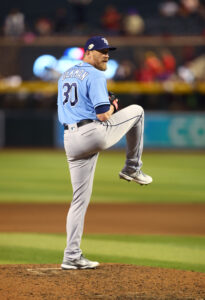
Diekman, 37, is a veteran of 12 major league seasons. The Mets would be the southpaw’s ninth club. He’s never had even average command of the strike zone (career 13.3% walk rate), but he’s a power-armed lefty who misses bats in droves and has managed to overcome his penchant for walks more often than not.
The 2023 season was an uneven one for Diekman, who opened the year with an ugly 11 1/3 innings in the White Sox bullpen before (like so many pitchers before him) making a 180-degree turnaround upon signing with the Rays. Diekman was rocked for 10 runs on 11 hits and 13 walks with the ChiSox but gave the Rays 45 1/3 frames of 2.18 ERA ball with a 28.6% strikeout rate and 13.5% walk rate. He averaged 95.7 mph on his heater during his time with Tampa Bay — right in line with the 95.6 mph he averaged over the seven seasons prior.
While Diekman has had some rough seasons interspersed throughout his mostly solid career, he’s never posted an ERA of 5.00 or higher and has kept his earned run average south of 4.00 in eight of his dozen MLB campaigns. On the whole, he sports a lifetime 3.82 ERA in 570 1/3 MLB innings, including a 3.67 ERA over the past four years.
Tampa Bay changed up his pitch usage a bit, as Diekman threw his changeup at a career-high 15.8% clip as a Ray. He’d previously never thrown the pitch at more than a 7% clip in any full season. In fact, Diekman entered the season with just 149 total changeups thrown in his career … before throwing 137 of them in 2023 alone. The results were strong: opponents batted just .176/.222/.294 in the 36 plate appearances that Diekman finished off with a changeup. His slider and four-seamer remained effective as ever; opponents hit just .161 and .175 while slugging .290 and .228 against that pair of offerings, respectively.
Lack of command has been the primary flaw holding Diekman back from standing as one of the game’s elite lefties. At age 37, that’s unlikely to change. But even with a bloated walk rate, the quality of Diekman’s pitches should continue to produce plenty of whiffs and a deluge of weak contact. Opponents have averaged a below-average 87.8 mph off the bat against him in his MLB career and hit just 33.6% of batted balls at 95 mph or greater. In 2023, opponents mustered a pitiful 84.6 mph average exit velocity and similarly feeble 26.4% hard-hit rate against him.
The Mets signed a quartet of free agent relievers to major league contracts before talks with Diekman gained traction, adding Jorge Lopez, Michael Tonkin, Austin Adams and, most recently, Adam Ottavino on one-year deals. That group figures to join returning veterans Edwin Diaz, Brooks Raley and Drew Smith in a revamped Mets bullpen.
One thing the Mets lack in the bullpen, following that slate of veteran additions, is flexibility. None of Diaz, Raley, Smith, Ottavino, Diekman, Lopez, Tonkin or Adams can be optioned to the minors, nor can Sean Reid-Foley or Phil Bickford. That sets the stage for the Mets to further shake up the relief mix, either by designating someone like Reid-Foley or Bickford for assignment or perhaps finding a trade partner for one or both of those holdovers.
The Mets are already in the highest tier of luxury taxation and are entering their third straight season exceeding the tax threshold. As such, every dollar they spend at this stage of the offseason is taxed at a 110% rate. Effectively, they’ll pay just over double whatever Diekman’s salary is in order to add him to the bullpen for the upcoming season. The Mets had a projected $309MM payroll and $322MM of luxury obligations even without Diekman, per Roster Resource. Both numbers jump even further north by $4MM.
Will Sammon and Ken Rosenthal of the Athletic first reported the Mets and Diekman were nearing an agreement. SNY’s Andy Martino reported the Mets had offered a one-year deal with a vesting option at around $4-5MM annually. Martino confirmed the sides had an agreement. MLB.com’s Anthony DiComo reported the $4MM guarantee, while Joel Sherman of the New York Post reported the $4MM option that vested with 58 appearances.
A’s Sign Alex Wood
The A’s announced the signing of starter Alex Wood to a one-year free agent contract. The left-hander is reportedly guaranteed $8.5MM with an additional $1MM in performance incentives. Wood is an ACES client.
Wood, who celebrated his 33rd birthday earlier this month, will remain in the Bay Area for Athletics’ final season in Oakland after spending the past three seasons as a member of the Giants. A second-round pick by Altanta during the 2012 draft, spent the first several years of his career as a quality mid-rotation arm for the Braves and Dodgers with a 3.29 ERA (117 ERA+) and 3.36 FIP across 803 1/3 innings of work from 2013 to 2018. Things took a turn for the worse for Wood after he was traded to the Reds as part of a multi-player blockbuster that also sent Yasiel Puig and Matt Kemp to Cincinnati. The lefty managed just 16 appearances between the 2019 and 2020 seasons and struggled to a 5.96 ERA and 6.02 FIP across the 48 1/3 innings he was able to muster during that time.

That pair of injury-marred campaigns didn’t stop the Giants from taking a chance on Wood, however, and they were rewarded for that decision almost immediately. The lefty made 26 starts for San Francisco in 2021, pitching to a 3.83 ERA with a 3.48 FIP in 138 2/3 innings of work as the Giants stormed to a 107-win season and their first division title since 2012. The club rewarded Wood with a two-year, $25MM contract that offseason, though his second contract in San Francisco was nowhere near as successful as the first.
Wood struggled to a 5.10 ERA in 26 starts with the Giants in 2022 despite peripheral numbers that indicated a much stronger performance, including a career-best 5.4% walk rate paired with solid strikeout and grounder rates. Those struggles led the club to use Wood as a hybrid starter and bulk reliever in 2023. The veteran southpaw recorded more than 12 outs just three times after the month of June last year but struggled in the swing role with a middling 4.33 ERA to go with a 4.47 FIP. Unlike 2022, Wood’s peripherals backed up the lackluster results in 2023 as his walk rate ballooned to 9.8% while his strikeout rate dipped to just 17.2%.
Despite his struggles over the past two seasons, the addition of Wood could be a significant boost for an A’s club that lost 112 games last year thanks in part to a rotation that finished 2023 with a collective ERA of 5.74, worst among major league clubs that do not call Coors Field home. Even Wood’s diminished production of a 4.77 ERA and 4.07 FIP over the past two seasons would be a notable improvement over that figure, and if he recaptures the mid-rotation form he flashed earlier in his career Wood could be a valuable piece for the A’s to flip at the deadline as they continue their rebuild. In the meantime, Wood figures to join JP Sears and Paul Blackburn in the Oakland rotation with the likes of Luis Medina, Joe Boyle, and Joey Estes among the possibilities to round out the club’s starting five.
The deal for Wood takes another starting-caliber arm off of the market for clubs in search of pitching help. Teams in search of starting options can still look to Blake Snell and Jordan Montgomery in terms of impact options, but the lower levels of free agency have begun to dwindle with arms like Michael Lorenzen and Hyun Jin Ryu representing some of the next-best options remaining after the top-of-the-market southpaws. As for the A’s, the club has previously indicated they expect to increase payroll over their 2023 figure. Pending the terms of Wood’s deal with the club, RosterResource projects the club for a microscopic $41MM payroll as things stand in 2024, $17MM below where they stood last year. That should leave room for the club to target further rotation additions or perhaps help at shortstop in the run-up to Spring Training next month, though they remain unlikely to shop in the higher tiers of free agency.
Robert Murray of FanSided reported the A’s and Wood had reached agreement. Melissa Locked of the Athletic first reported the $8.5MM guarantee and the $1MM in performance bonuses.
Giants Trade Ross Stripling To Athletics
The A’s announced Friday that they’ve acquired right-hander Ross Stripling and cash from the Giants in exchange for minor league outfielder Jonah Cox. In order to clear a spot on the 40-man roster, infielder Jonah Bride was designated for assignment. Oakland also confirmed its previously reported one-year deal with lefty Alex Wood.

It’s a rare swap of players between the two Bay Area clubs — one that will add some direly needed pitching to an Athletics roster that’s largely devoid of proven big league arms. The 34-year-old Stripling is coming off a tough first season after signing a two-year, $25MM deal with San Francisco, though he did pitch quite a bit better as the season wore on. The veteran swingman opened the season with 32 1/3 innings of 7.24 ERA ball between the rotation and bullpen before hitting the injured list with a back strain for the next six weeks.
Perhaps Stripling was never at full strength to begin the year, because upon returning from the injured list he pitched much more like his typical self. Over the course of his final 56 2/3 frames, the right-hander notched a 4.29 earned run average with a pedestrian 18.7% strikeout rate and an elite 2.6% walk rate. That lines up far more nicely with Stripling’s broader track record; from 2016-22, he logged a 3.78 ERA in 672 innings split between the Dodgers and Blue Jays.
Stripling is owed $12.5MM this coming season. He had an opt-out opportunity following year one of his contract but unsurprisingly decided to forgo that right after his uneven showing with the Giants. Andrew Baggarly of The Athletic reports that the Giants are paying down $3.25MM of Stripling’s salary; the A’s will be on the hook for the remaining $9.25MM.
The A’s could opt to use Stripling in the rotation or in the bullpen. He has ample experience in both roles and has had success in each as well. Certainly, Oakland brass had hoped that by now, several of the young arms acquired in the trades of Matt Olson, Matt Chapman, Chris Bassitt, Sean Manaea, Frankie Montas, Sean Murphy, Lou Trivino and others would have yielded some controllable cornerstone pieces in the starting rotation.
That hasn’t happened, however. Left-hander JP Sears, who posted a 4.54 ERA in 32 starts and 172 1/3 innings out of the rotation last year, is the lone pitcher acquired in that fire sale who’s had any semblance of sustained success with the A’s. Others such as Ken Waldichuk, Kyle Muller, Adrian Martinez, Luis Medina, Zach Logue and Adam Oller (among others) have struggled. Medina did pitch fairly well in the second half of the 2023 season and is likely ticketed for a rotation spot in ’24, but that’s a sample of only 50 innings (4.32 ERA, 21.3% strikeout rate, 11.1% walk rate).
As such, it seems likely that Stripling and Wood will be reunited as not only teammates but rotation-mates. Stripling’s experience oscillating between a starting and relief role could mean he ends up in the bullpen at various points while the A’s take a look at younger arms. His familiarity with that role is a benefit to a team in the Athletics’ situation. If either Stripling or Wood can rebound after posting shaky results with the 2023 Giants, it’s quite likely that a non-contending A’s team will flip them both for younger talent prior to this summer’s trade deadline.
Stripling’s acquisition comes at the cost of the 28-year-old Bride’s roster spot. Bride, a versatile infielder/outfielder who’s played just about every position on the diamond, has appeared in each of the past two big league seasons. He’s batted just .192/.296/.232 in 293 trips to the plate, but he carries a stout .322/.450/.533 line in 401 plate appearances in Triple-A, where he’s walked more often than he’s struck out. The A’s will have a week to trade Bride or attempt to pass him through outright waivers. He still has a minor league option remaining. Between that, his plus hit tool and defensive versatility, he’s a candidate to be claimed or flipped to another club in a separate, minor trade.
As for the Giants, they’ll acquire Oakland’s sixth-round selection from just this past summer’s draft. Cox, 22, batted .287/.366/.403 with a 28.3% strikeout rate and 6.2% walk rate in 145 plate appearances split between the Athletics’ Rookie-level Arizona Complex League and Low-A clubs. Baseball America ranked him 29th among A’s farmhands heading into the 2024 season, touting him as a plus-plus runner who can handle center field. Cox is years away from being a potential big league factor, but despite struggling with strikeouts in his debut season, BA praised his strong bat-to-ball skills and credited him with an above-average hit tool.
For San Francisco, the money saved in the trade is every bit as important as the player side of the return. Moving the bulk of Stripling’s contract dropped the Giants’ payroll to a projected $154MM, per Roster Resource, and they’re now just under $200MM in luxury tax obligations. That gives them $37MM worth of AAV to work with before they come against even the first luxury threshold.
There are any number of ways for Giants president of baseball operations Farhan Zaidi to reallocate those funds. The Giants have been linked to Matt Chapman throughout the offseason, and signing him would bolster the infield defense while adding some pop (but also quite a few strikeouts) to the lineup. Cody Bellinger looks like less of a fit than he did prior to the Giants’ signing of Jung Hoo Lee on a six-year deal, but it could conceivably work out if the Giants push Michael Conforto into more of a DH role (or trade Conforto or another outfielder such as Mike Yastrzemski). San Francisco also reportedly made a late offer to Rhys Hoskins before he signed in Milwaukee, so it seems there’s the possibility of adding a bat to the first base/designated hitter mix.
Just as notable is San Francisco’s lack of rotation stability. Ace Logan Webb is one of the game’s best arms, but the trade of Stripling leaves the Giants with zero established arms beyond him. Top prospect Kyle Harrison was solid in last year’s MLB debut, but that amounted to all of 34 2/3 innings. The Giants signed oft-injured reliever Jordan Hicks and plan to plug him into the rotation — a dicey proposition that would be more befitting of a team with only one rotation hole and several workhorse arms ahead of him. Younger righties like Keaton Winn and Tristan Beck could factor into things as well, but it was obvious even before trading Stripling that the Giants needed at least one more starting pitcher.
The Giants have the resources to pursue top-of-the-market arms like Blake Snell and Jordan Montgomery, though doing so would require deviating from the front office’s prior aversion to long-term deals for pitchers. Other yet-unsigned options include Michael Lorenzen, Mike Clevinger and Hyun Jin Ryu. The trade market features names like Dylan Cease, Shane Bieber and any number of Marlins hurlers (Edward Cabrera, Braxton Garrett and Jesus Luzardo among them).
Stripling becomes the second pitcher and third free-agent signing from last offseason that the Giants will pay to pitch elsewhere in 2024. San Francisco paid the Mariners $6MM in the trade sending Anthony DeSclafani and Mitch Haniger to Seattle. (DeSclafani has since been flipped to Minnesota along with a bit of additional cash kicked in from the M’s.) They’ll have to hope for better results in this winter’s crop of signees if they hope to avoid a fifth playoff miss in six seasons under the current front office.