
Large Gap Remains Between Red Sox, Rafael Devers In Extension Talks
The contract statuses of Xander Bogaerts and Rafael Devers have been front of mind for Red Sox’s fans dating back to at least this past Spring Training. The club made unsuccessful runs at extending both players in March. Those efforts were put on hold during the season, but with the offseason approaching, they’re certain to rekindle discussions.
Chief baseball officer Chaim Bloom already called working on a new deal with Bogaerts before he opts out (which he can formally do after the World Series) a “top priority” this month. There’s less immediate urgency with Devers, who’s still one year from the open market, but there’s no question Boston’s front office will be in touch with the third baseman’s camp at Rep 1 Baseball throughout the winter.
Earlier this week, reporter Yancen Pujols tweeted the team was making a renewed effort at an extension. Subsequent reports out of Boston characterized a visit from assistant general manager Eddie Romero to Devers in his native Dominican Republic as more of a typical offseason check-in (links via Alex Speier of the Boston Globe and Chris Cotillo of MassLive). There was no question the Sox would make a run at extending Devers at some point this winter, but it’s not clear how much to make of Romero’s check-in.
Regardless of the specific nature of the meeting between Romero and Devers, Jon Heyman of the New York Post writes tonight the sides have indeed reopened talks recently. Heyman reports that Boston has put forth an offer at or above $200MM but suggests there’s still a notable gap between the sides. According to Heyman, Devers’ camp is seeking a deal of ten-plus years worth at least $300MM.
During Spring Training, the Sox reportedly used the eight-year, $168MM extension signed by Braves first baseman Matt Olson as a viable comparison in talks. The sides were well apart at that time, although Devers’ specific asking price was unclear. Boston has raised its offer on the heels of another very strong season from Devers, but the two-time All-Star has increased leverage after an excellent year that moved him closer to free agency.
In his age-25 campaign, Devers appeared in 141 games and tallied 614 plate appearances. He connected on 27 home runs and put together a .295/.358/.521 line. Those slash stats are in line with his numbers from recent seasons, but Devers’ production was arguably a career best in the context of a leaguewide offensive downturn. By measure of wRC+ (which adjusts annually for the league environment and ballpark), he was 41 percentage points better than an average batter. That’s the best mark of his career, and it ranked among the top 20 hitters in the game (minimum 500 plate appearances).
With another great season under his belt, Devers can feel even more comfortable setting a lofty ask in extension talks. He banked $11.2MM this year and is projected by MLBTR contributor Matt Swartz for a salary in the $16.9MM range next season if he goes through his final year of arbitration. He’s presently slated to be one of the top talents in the 2023-24 free agent class, arguably second behind Shohei Ohtani.
12 months from the open market, Devers’ camp can look to the biggest free agent deals in MLB history to set their asking price. A $16.9MM projected arb salary is obviously below his free agent market value, but he’ll lock in one more strong payday before getting to the open market. The Red Sox can perhaps hope to price in a marginal discount to guard against the possibility of Devers having a disappointing or injury-plagued platform year, but the star third baseman has a significant amount of leverage in talks.
This summer, the Braves signed their All-Star third baseman, Austin Riley, to a 10-year, $212MM extension. Riley owned a .301/.360/.604 line at the time of that deal but serves as a generally similar comparison as a bat-first third baseman. However, Riley’s deal was signed midway through his third full MLB season and bought out his final three years of arbitration eligibility. With only one arbitration season remaining, Devers has far more leverage in extension talks. It’s little surprise his reps are aiming much higher than the Riley range.
At the same time, it’s easy to understand why the Red Sox may not be anxious to dole out a deal topping $300MM. That’s a threshold reached only nine times in MLB history. Mookie Betts, Mike Trout, Francisco Lindor, Fernando Tatis Jr. and Giancarlo Stanton got there on extensions, while Bryce Harper, Corey Seager, Gerrit Cole and Manny Machado reached or topped the marker on free agent deals.
Devers turned 26 earlier in the week and is on track to reach free agency going into his age-27 season. That’s a year older than Machado and Harper were over the 2018-19 offseason but a year younger than Seager was last winter. Broadly speaking, that youth serves Devers well in his effort to land a decade-long commitment. It’s rare to see teams commit to players deep into their 30’s, but a lengthy pact is more palatable for players who hit the market in their mid-20’s.
At the same time, one could argue all three players were safer long-term bets than Devers. Harper had a more robust offensive track record that included a monster 2015 showing to win an MVP. Machado had hit .297/.367/.538 during his platform year and was a Gold Glove-caliber third baseman who could play shortstop if needed. Seager is a full-time shortstop who had a .306/.394/.521 mark during his final year in Los Angeles. All three players also had the benefit of an open market bidding war.
That wasn’t the case for Betts and Lindor, each of whom signed extensions above $300MM with between five and six years of service time. Both players, however, had far more defensive value than Devers. Betts is one of the sport’s top outfielders, and Lindor is arguably the game’s best shortstop.
Devers, by contrast, comes with his share of defensive question marks. He’s played almost exclusively third base in the majors but has always been regarded as a bat-first player. There’s been some trepidation dating back to his time as a prospect about how long he could stick at the hot corner, and that’s largely been borne out in his defensive metrics as a big leaguer. He’s rated as a below-average defender by measure of Defensive Runs Saved in every season of his career. Statcast gave him an outlier excellent defensive grade in 2019 but has otherwise panned his work as well. This past season, he rated as six runs below average by measure of DRS and two runs below par according to Statcast.
While there’s no indication the Sox would want to move Devers off the hot corner immediately, it’s fair to wonder how deep into a long-term deal he can stick there. He certainly has the offensive aptitude to continue playing every day as a first baseman or designated hitter, but a move further down the defensive spectrum would reduce the team’s roster flexibility around him somewhat.
That’s not to say Devers isn’t an excellent player, but $300MM+ investments have generally been reserved for players with more defensive value or an established MVP-caliber offensive season. Stanton’s 13-year, $325MM extension over the 2014-15 offseason may be the best example for Devers’ camp, but Stanton landed that deal after a .288/.395/.555 showing in one of the game’s most pitcher-friendly home environments.
Given the recent comparable players, it’s little surprise Devers and his group would want to handily top $200MM while the Red Sox would balk at an ask north of $300MM. There’s obviously a fair bit of ground in between those extremes. Whether the sides can find a mutually agreeable price at some point over the next six months will be one of the key storylines of the Boston offseason.
Cardinals Re-Sign Adam Wainwright
Oct. 27: Dave Skretta of the Associated Press has the contract details. Wainwright will earn a base of $17.5MM, same as in 2022, but $10MM of that will be deferred. That deferred money will be paid out at a rate of $1MM per year from 2024 to 2033. He can also earn some extra cash via bonuses, getting $500K if he reaches 28 starts and another $500K at 30 starts. There’s another $500K if he finishes in the top 10 in Cy Young voting and then $50K bonuses for making the All-Star team, winning LCS MVP, World Series MVP or a Gold Glove award, and a $25K bonus for a Silver Slugger award. He will also have full no-trade protection.
Oct. 26: Adam Wainwright is continuing his career, as the Cardinals announced this afternoon that he’ll be back for a 19th season with the club. Derrick Goold of the St. Louis Post-Dispatch first reported Wainwright was in agreement on a one-year contract extension. Financial terms of the deal have not yet been disclosed. Wainwright is an Aegis Sports Management client.
Wainwright’s return puts to rest any questions whether he might join a pair of Cardinals icons in hanging up their spikes. Longtime battery mate Yadier Molina and Cardinals legend Albert Pujols each announced before this past season that 2022 would be their final playing years. There had been plenty of speculation the 41-year-old Wainwright would call it quits, too. Instead, he’ll be back on the Busch Stadium mound.
The right-hander pitched to a 3.71 ERA across 191 2/3 innings for the Cardinals this season. It was yet another reliable season for the veteran, who made 32 starts for the second-straight season. His results did dip a little from 2021, when he posted a 3.05 ERA and finished seventh in NL Cy Young voting. However, that year was helped out somewhat by a .256 opponents BABIP, and his FIP came in at exactly 3.66 in both 2021 and 2022. He did experience a dip in velocity on his fastball from 89.3 mph to 88.1 mph, though, and his strikeout percentage fell to 17.8%, down from 21% in 2021.

Of course, Wainwright has never thrived on a power arsenal. He’s succeeded into his 40’s thanks to excellent control and a knack for keeping hitters off balance with his trademark curveball. This year’s 6.7% walk rate wasn’t far off the prior season’s 6% mark. Wainwright also led all qualified starters in called-strike percentage, compensating for a lack of whiffs by freezing opponents by mixing his pitches inside the strike zone.
Wainwright’s re-signing solidifies the team’s rotation heading into the off-season. Miles Mikolas is signed through 2023, while mid-season trade acquisition Jordan Montgomery is arbitration-eligible for the final time, and both figure to be rotation mainstays. The backend of the rotation still has some question marks, though. Injuries contributed to Steven Matz struggling in his first season in St Louis, but he’s under contract for three more seasons and should at least have an opportunity to start the season in the rotation. Jack Flaherty is under control via arbitration for one more year, and while he’s also had injury problems for a while now, he figures to have a shot in the rotation if healthy.
With the uncertainty surrounding Matz and Flaherty and the potential free agent departure of Jose Quintana, St. Louis could look into fortifying by adding another rotation arm at the back end. The bigger priority, however, seems to be on the position player side. President of baseball operations John Mozeliak told reporters this morning the club would look externally for catching help to replace Molina. The team is also hopeful of their chances of retaining star third baseman Nolan Arenado, who’ll have to decide whether to opt out of the final five years and $144MM remaining on his deal.
It’s presently unknown how much Wainwright will make next season, although he’s coming off a one-year, $17.5MM salary. Mozeliak suggested the team planned to raise its payroll from this year’s approximate $155MM Opening Day mark.
On a more personal note, Wainwright’s return means he’s likely to reach the 200-win milestone for his career. Owner of 195 career wins, he’ll have a chance to surpass Jesse Haines’ 210 wins for second on the Cardinals all-time leaderboard.
Image courtesy of USA Today Sports.
David Stearns Steps Down As Brewers’ President Of Baseball Operations
10:08am: At a press conference announcing his decision, Stearns stated that he’s “not going anywhere” and will remain in Milwaukee. That, of course, doesn’t rule out pursuing opportunities in the future, but it’s a rather firm declaration that for the time being, he has no plans to join another organization. Rather, Stearns added that he’s “looking forward to taking a deep breath, spending time with my family and exploring some other interests.”
8:35am: David Stearns is stepping down as the Brewers’ president of baseball operations but will remain with the club in an advisory capacity, the team announced. General manager Matt Arnold will now oversee the baseball operations department.
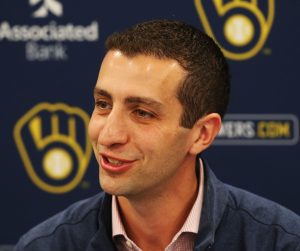
It’s a surprise shakeup atop the Brewers’ baseball operations department, as Stearns has built a reputation as one of the most widely respected baseball execs in the game since taking over the reins in Milwaukee. He’d been under contract through the 2023 season.
“This is not an easy decision for me and is something I have been wrestling with for a long time,” Stearns said in a prepared statement. “[Owner] Mark Attanasio and I have had an open dialogue and we both knew this day could eventually come. It has been a priority for both of us that any transition would take place while the organization is in a healthy position with solid leadership and a talented roster going forward. That is certainly the case today.”
“I’m very grateful to Mark and all of our staff for their support and efforts throughout my tenure with the Brewers,” Stearns continued. Matt [Arnold] and I both arrived in 2015 and he is more than ready for this next opportunity. I am committed to serving as a resource to Matt as he sees fit as the organization moves through this transition.”
Of course, the announcement will prompt immediate speculation about whether Stearns might ultimately be headed elsewhere. The team noted that he’ll serve ownership and the baseball ops department as an advisor, and Stearns himself suggests within those comments that he’ll remain with the organization for the time being to help guide Arnold and others through the transition. Nonetheless, his departure from such a prominent role could pave the way for his eventual departure altogether.
For instance, the Mets have pursued Stearns, a New York native, for their vacant president of baseball operations post in each of the past two offseasons but been denied permission to interview him. Mets owner Steve Cohen eventually landed on Billy Eppler to lead his baseball operations staff, but Eppler was given the “general manager” title, leaving the door open for a president to be appointed atop the hierarchy.
That said, Stearns could well be of appeal to a broad number of teams seeking a veteran baseball operations leader over the course of the next year. The Harvard grad has been running baseball operations for the Brewers since 2015 and, prior to that, was an assistant GM in Houston, a director of baseball operations in Cleveland (a role he shared with current Twins president of baseball ops Derek Falvey).
As for Arnold, he’ll receive autonomy over a baseball operations department for the first time in his career. Hired away from the Rays in 2015 to serve as an assistant GM under Stearns, Arnold was promoted to the title of general manager in 2020. Arnold, like Stearns, had been drawing interest from other teams in their front office search, and the bump to the GM’s chair made it more difficult for other teams to pursue him (as clubs are generally only permitted to interview other teams’ executives if they’re offering a promotion).
Despite holding the GM title for the past two years, the 43-year-old Arnold has been second on the team’s operations hierarchy until today’s announcement. He’s spent more than 20 years working in baseball ops, however, serving as Tampa Bay’s director of player personnel in addition to holding a variety of roles in scouting, player development and player analysis for the Dodgers, Reds and Rangers over his career.
That Arnold is the one now assuming oversight of the department leaves the Brewers with some more continuity than the standard changing of the guard, but the change in leadership is nevertheless a seismic shift for the Brewers. Attanasio called Stearns’ impact on the club “transformational” in his own statement today, adding that he’s “disappointed” in the decision but also “grateful” to Stearns for the past seven years.
It’s easy to see why. Prior to hiring Stearns in 2015, the Brewers had won only two division titles dating back to 1969 and had reached the postseason on just four occasions. Milwaukee won the NL Central in both 2018 and 2021 under Stearns’ leadership and reached the playoffs in four consecutive seasons, from 2018-21.
Along the way, Stearns, Arnold and their staff built out a powerhouse rotation headlined by draftees Brandon Woodruff and Corbin Burnes, as well as trade acquisitions such as Freddy Peralta, Eric Lauer and Adrian Houser. (Woodruff was drafted by the prior regime in 2014 but, as an 11th-round pick, is still a player development triumph for the organization as a whole.)
A look up and down the Brewers’ roster reveals one of the most trade-dependent clubs in the Majors. In addition to Peralta, Lauer and Houser, Stearns oversaw trades that brought Willy Adames, Rowdy Tellez, Hunter Renfroe and Luis Urias into the organization. His most infamous swaps include the lopsided Christian Yelich acquisition from the Marlins and the trade that sent Carlos Gomez and Mike Fiers to Houston in return for Houser, outfielder Brett Phillips and Josh Hader.
Stearns has drawn his share of flak for trading Hader to the Padres at this summer’s deadline despite the fact that his team was in contention for what would be a third NL Central title under his watch. The now-former Brewers president has since acknowledged that the move had a larger impact on the clubhouse than he anticipated. However, threading the needle by acquiring controllable talent in exchange for players with dwindling club control (at or near peak value) is a reality for most small- and mid-market front offices. (Hader will be a free agent next winter and has a projected $13.6MM salary in arbitration.)
In general, though, it’s fair to say that Stearns’ willingness to act boldly on the trade market has benefited the Brewers more often than it’s harmed them. Now, those decisions will ultimately fall to Arnold. It’s impossible to say for certain whether he’ll have the same affinity for aggressively attacking the trade market, but given Arnold’s roots in an ever-active Rays organization, seven years working alongside Stearns and a massive arbitration class, the Brewers are likely in for another active offseason.
Adam Wainwright Planning To Retire After 2023 Season
Cardinals right-hander Adam Wainwright spoke with the media today, including Jeff Jones of the Belleville News-Democrat, on the heels of the announcement that he and the club had agreed to a contract for 2023. In discussing the deal, Wainwright admitted that 2023 will be his final season.
“I could tell you yes, but then there’s a whole lot of hoopla you’ve gotta go through,” Wainwright said in response to a question about whether this would be his final run. “Long story short: yes, this’ll be the last one. Just everybody relax, don’t freak out about it.”
Prior to 2022, fellow Cardinal legends Yadier Molina and Albert Pujols announced that they were entering their final respective seasons. There was plenty of speculation that Wainwright might eventually decide to ride into the sunset with them, but he has instead decided to mount up for another campaign, which will evidently be his last. Wainwright turned 41 years old in August and will therefore be set to retire shortly after his 42nd birthday.
Wainwright is currently sitting on 195 career wins and will certainly crack the 200 plateau as long as he’s able to stay healthy. He is setting his sights higher than that, however. “The number I’m looking at is not 200, the number is 210,” Wainwright said, per Jones. Getting to 210 would allow Wainwright to tie Jesse Haines for second place on the all-time Cardinals list, behind only Bob Gibson’s 251. Wainwright also added that he would like to catch John Smoltz, who logged 213 career victories.
Regardless of how the 2023 campaign ultimately goes, Wainwright will finish with a fine career résumé. Making his debut back in 2005, he’s already appeared in 457 games, starting 390 of those and logging 2,567 1/3 innings. He has a career ERA of 3.38 over that time while notching 2,147 strikeouts. He’s made three All-Star teams, won a couple of Gold Gloves and was a World Series champion in 2006 and 2011 (though he missed the entirety of the latter championship season due to Tommy John surgery). That’s already a tremendous career, though he will have one more season to try to add to his personal accomplishments and grab one last World Series ring before hanging up his spikes.
Marlins Hire Skip Schumaker As Manager
The Marlins have settled on their next manager, announcing Tuesday evening they’ve tabbed Cardinals bench coach Skip Schumaker. He replaces Don Mattingly, who spent seven years in the role before he and the Marlins mutually agreed to part ways. Schumaker’s contract runs through the 2024 season, and the Marlins hold a club option on his services for 2025.
“After an extensive process, it is with great pride and excitement that we announced Skip Schumaker as manager of the Miami Marlins,” chairman and principal owner Bruce Sherman said in the statement announcing the news. Schumaker made a statement of his own. “I’m very excited and grateful that Bruce, (general manager Kim Ng), and the Marlins organization have given me an opportunity to manage a very talented team. Delivering a winning, sustainable culture with the expectation of getting into the postseason is the next step for this organization and South Florida – and I can’t wait to get started.”
As another disappointing season was winding down in Miami, it was reported that Mattingly and the club would go their separate ways. Over the past few weeks, recent reporting indicated that the final four candidates were Schumaker, Rays’ bench coach Matt Quatraro, Astros’ bench coach Joe Espada and Yankees’ third base coach Luis Rojas.
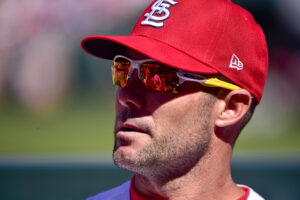
Schumaker, 43 in February, played in the big leagues from 2005 to 2015, spending time with the Cardinals, Dodgers and Reds. He signed a minor league deal with the Padres for 2016 but announced his retirement in March. It didn’t take long for him to get involved in post-playing roles, as he was hired by the Padres to be their first base coach for 2018. Prior to the 2020 season, the Friars gave him the title of “associate manager.”
One year ago, the Cardinals surprisingly parted ways with manager Mike Shildt despite a solid run in the dugout. Once they promoted Oli Marmol to take over, they suddenly had a vacancy at the bench coach position and hired Schumaker to take that over. The Marmol-Schumaker pairing seemed to work well, as the Cards went 93-69 in 2022 and recaptured the Central division. However, the club will now be looking for a new bench coach for a second year in a row.
For the Marlins, they are looking to take a turn after years of frustration. Outside of the pandemic-shortened 2020 season, they haven’t made the playoffs since way back in 2003. There have been many frustrating stops and starts for the fans in that time, with 2022 once seeming like it could have been the year that the Marlins made a serious jump into contention. They had a strong pitching staff and supplemented their position player mix by bringing in outside additions like Jorge Soler, Avisaíl García, Jacob Stallings and Joey Wendle. Unfortunately, all four of those players dealt with injury or underperformance or both. When combined with injuries and disappointing results elsewhere on the roster, Miami fell well out of contention again and ended up with a 69-93 record.
Ng and the rest of the front office will surely be hoping that Schumaker will be instrumental in turning things around. The impacts of coaches can be difficult to quantify, but there’s no doubting Schumaker has made a quick rise through the ranks. It was just a few years ago that he was still playing, and he quickly joined the big leagues as a coach without first requiring a stint in the minors. From there, he got a promotion in San Diego and then has been quickly poached by two different organizations, highlighting the respect he has around the game. If that’s not enough, Marlins players are quickly showcasing their approval, with Jazz Chisholm Jr. and Sandy Alcantara both taking to social media to share their enthusiasm (Twitter links).
Of course, a manager alone can not turn a poor team into a champion. There is still a lot of work for the Marlins to do this winter in upgrading their roster. But for now, they can cross one item off their to-do list, adding a young up-and-coming manager who seems to have tremendous respect throughout the game.
Craig Mish of SportsGrid and the Miami Herald was first to report the Marlins were hiring Schumaker, and to report Schumaker’s contract details.
Image courtesy of USA Today Sports.
Rangers Hire Bruce Bochy As Manager
The Rangers have hired Bruce Bochy as the club’s next manager, announcing that Bochy has signed a three-year contract.
There was increased speculation in recent days linking Bochy to the job, especially when Rangers GM Chris Young (who played under Bochy on the 2006 Padres) visited the veteran manager at his home in Nashville, rather than a formal interview. Interim Rangers manager Tony Beasley was the only other candidate known to receive an interview, further adding to the idea that the team had narrowed its focus towards bringing Bochy back to the dugout after three years away from the game.
 In the team’s official press release, Bochy said he is “incredibly excited to be joining the Texas Rangers. Over the last several days, I’ve had extensive conversations with Chris Young and other individuals in the organization, and I had the chance to meet with [co-owner] Ray Davis. Their vision and commitment to putting together a club that can contend and win year in and year out is impressive, and I became convinced I wanted to be a part of that. If I was going to return to managing, it had to be the right situation. I strongly believe that to be the case with the Rangers, and I can’t wait to get started.”
Bochy brings 25 years of experience as a Major League skipper, managing the Padres from 1995-2006 and then the Giants from 2007-2019. During his long career, the 67-year-old Bochy has overseen rebuilding clubs, contenders, and teams that took dips in performance and then returned to contention — there have been enough ebbs and flows that Bochy actually has a career losing record, at 2003-2029.
However, Bochy’s resume also includes some major successes. The Giants won three World Series titles in 2010, 2012, and 2014 under Bochy’s leadership, as the “Even Year” mini-dynasty brought the organization back to championship glory for the first time since 1954. (Ironically, the 2010 Giants defeated the Rangers in the Series.) Bochy also managed another NL pennant winner in the 1998 Padres, which marked the last time that San Diego reached the World Series.
The hire represents a change in direction for the Rangers, as the club tended to hire first-time managers when Jon Daniels was in charge of baseball operations. (Interim manager Don Wakamatsu ran the team for 10 games in 2018, and was the only one of the last six Texas managers to have any previous MLB experience as a skipper.) Of course, Daniels was himself fired in August, shortly after ex-manager Chris Woodward was also let go.
Daniels’ firing reportedly even caught Young by surprise, as Young suddenly found himself in charge of an organization that is eager to start winning. Texas spent big last winter in signing Corey Seager, Marcus Semien, and Jon Gray, and while the team itself felt 2023 might be a more realistic target date for a return to contention, the 2022 club didn’t show much progress in posting a 68-94 record. This clearly wasn’t good enough for Davis and the Rangers’ ownership group, who didn’t even wait until the end of the season before overhauling the front office.
With Texas sitting at six consecutive losing seasons, there is certainly pressure on Young and Bochy to start delivering some better results in 2023. The Rangers are again expected to be aggressive this winter, whether that manifests itself as more splashy free agent signings, or trades for proven veterans.
The Royals, White Sox, and Marlins are now the only teams looking to fill managerial vacancies. In addition to Bochy’s hiring, the Blue Jays (John Schneider), Angels (Phil Nevin), and Phillies (Rob Thomson) all officially signed their interim skippers from 2022 for the full-time positions.
Photo courtesy of USA Today Sports Images
Blue Jays Hire John Schneider As Manager
The Blue Jays have officially removed the interim label from John Schneider, announcing today that the 42-year-old has been hired as the team’s manager. Schneider was signed to a three-year contract, with a club option for the 2026 season.
A longtime member of the Jays organization, Schneider was promoted to the bench coach job prior to the 2022 season, but he took over as interim manager when Charlie Montoyo was fired on July 13. Toronto held a 46-42 record at the time of Montoyo’s firing, but had played inconsistent baseball to that point, and was in the midst of a major slump that cost Montoyo his job.
This opened the door for Schneider, who stabilized matters by leading the Blue Jays to a 46-28 record over the remainder of the season. Toronto captured the top wild card spot in the American League, though the Jays’ playoff trip was both short-lived and painful — the Mariners swept the Blue Jays in the Wild Card Series, as the Jays were shut out in Game 1 and then suffered a major bullpen breakdown in Game 2.
Despite the postseason disappointment, there was a sense that Schneider had done enough to earn the full-time managerial job. He reportedly has plenty of support from within the clubhouse, and while Jays GM Ross Atkins left a bit of wiggle room during his recent end-of-season meeting with the media, he also stated that “it will be very difficult for us to find better than John Schneider” as the team’s next bench boss.
Schneider has spent his entire pro career with the Blue Jays, starting when he was a 13th-round pick for the club in the 2002 draft. After six seasons in the minors, Schneider retired from playing due to injuries and moved into the coaching ranks, slowly working his way up the organizational ladder. Schneider managed the Blue Jays’ rookie ball affiliate, both A-ball affiliates, and the Double-A affiliate from 2008-18, before receiving a promotion to the big league coaching staff prior to the 2019 season. As it happened, Schneider’s climb coincided with the progress of several of Toronto’s young stars, so he was a familiar face in the dugout once the likes of Vladimir Guerrero Jr., Bo Bichette, Jordan Romano, and others arrived in the big leagues.
The early returns on Schneider as a Major League manager are promising, and the three-year deal represents the front office’s confidence in their new skipper. However, Schneider faces immediate pressure as the leader of a team that has World Series aspirations, yet fell so devastatingly short in 2022. Schneider’s own decision-making drew criticism following the epic Game 2 collapse, though in the view of the front office, the outcome of one game (important as that game was) wasn’t enough to erase Schneider’s work as manager over the previous three months.
Schneider becomes the third interim manager to receive a full promotion for 2023, following the Phillies’ Rob Thomson and the Angels’ Phil Nevin. With Toronto finalizing their managerial situation, that leaves the White Sox, Royals, Marlins, and Rangers as the teams still looking to find a new skipper.
Ted Leonsis’ Group Emerging As Front-Runner In Nationals’ Ownership Sale
Six months ago, the Lerner family announced they were exploring the possibility of a sale of the Nationals. As the offseason nears, some clarity has emerged on that process. David Aldridge, Britt Ghiroli and Ken Rosenthal of the Athletic write that a group led by businessman Ted Leonsis is now the “clear front-runner” to eventually take over the Nationals. The Talk Nats blog first reported in late September the Leonsis group had broken through as the most likely party to buy the Nats.
Leonsis is already a key factor in the D.C. sports scene, as his Monumental Sports & Entertainment owns the NBA’s Wizards, the NHL’s Capitals and the WNBA’s Mystics. (The Lerners are a minority owner in that venture). Landing the Nationals would give Leonsis control over the D.C. franchises in three of the four major men’s sports leagues, The Athletic notes, a distinction currently only held by the Kroenke family that owns the Los Angeles Rams, Colorado Avalanche and Denver Nuggets. Leonsis isn’t mounting a solo ownership bid, however. The Washington Business Journal reported in August that private equity businessman David Rubenstein is also part of the group; it is unclear whether anyone else is involved.
Previous reports have also linked South Korean businessman Michael B. Kim and mortgage mogul Stanley Middleman to the sales process. There were reportedly upwards of five bidders in talks with the Lerner family at one point, but The Athletic reports that Leonsis’ group seized control roughly a month ago.
While it appears that Leonsis and company are now in the driver’s seat to push the deal across the finish line, the closing of the sale isn’t imminent. Aldridge, Ghiroli and Rosenthal hear the sale isn’t likely to be finalized before the December 4-7 Winter Meetings in San Diego. That appears to be the more optimistic end of the timetable, as The Athletic writes it’s possible the sale isn’t finished until after the calendar flips to 2023.
As The Athletic notes, Leonsis also controls his own regional sports network, NBC Sports Washington. Monumental Sports & Entertainment had previously purchased 33% of NBC Sports Washington, and it bought out NBCUniversal’s 67% share this past August. Not coincidentally, NBC Sports Washington holds the local broadcasting rights to Capitals, Wizards and Mystics games.
The Nationals’ local broadcasting contract currently runs through the Mid-Atlantic Sports Network, which it shares with the Orioles. The Orioles own approximately 75% of the network, while the Nationals own the remaining share. The two franchises have been embroiled in rights fees litigation for the better part of a decade. The Washington franchise won a major victory in 2019 when an arbitrator ruled the Orioles owed the Nats $105MM. The Baltimore organization appealed that decision, and the matter has still yet to be decided by the New York State Court of Appeals.
While The Athletic notes it’s unclear how or if the sale of the Nationals would affect the MASN dispute, Talk Nats tweeted in August that Leonsis’ group would be interested in reaching a settlement with the Orioles to buy out of the MASN deal. If that did come to pass, the Nationals would presumably then be broadcast on the NBC Sports Washington platform. That’d obviously be a complicated process that requires negotiations with the Orioles, but it does seem to offer a glimmer of hope for a resolution to the saga.
The Lerner family first bought the Nationals in 2006, paying $450MM. The specific prices under consideration in their sale aren’t clear, but Daniel Kaplan of the Athletic wrote last month they were seeking $2.5 billion.
Jose Ramirez To Undergo Hand Surgery, Expected To Be Ready For Spring Training
Guardians star José Ramírez will undergo surgery on his right hand early next month, agent Rafa Nieves tells Enrique Rojas of ESPN (Twitter link). The procedure is not expected to impact his readiness for next Spring Training. Tenchy Rodriguez was first to report (on Twitter) that Ramírez would have to undergo surgery.
Ramírez first suffered the injury midseason, Rojas adds, but he played through the issue as the Guardians ran down and eventually cruised to an AL Central title. He remained in the lineup on a more or less everyday basis, appearing in 157 regular season games and starting all seven of the club’s postseason contests at third base. Ramírez did miss two games in late June due to a right thumb injury but avoided the injured list all season.
Whether directly related to the thumb issue or not, the four-time All-Star slowed down after an otherworldly first few months. Ramírez carried a .292/.389/.641 line through 244 plate appearances on June 13. By measure of wRC+, he was the fifth-best qualified hitter in the game to that point. Ramírez first suffered the thumb injury at some point during a series against the Rockies that ranged from June 14-16, however (link via Paul Hoynes of Cleveland.com). From that point forward, he posted a .273/.336/.446 line in 441 trips to the plate. Even the seemingly diminished version of Ramírez was an above-average player, but his second half was well below the MVP-caliber form he’s shown at his best.
After Cleveland’s elimination at the hands of the Yankees yesterday, Ramírez has decided to go under the knife. The expectation is that the issue will be corrected in plenty of time so as not to interrupt his preparation for next season. Assuming all goes according to plan, the 30-year-old should head into 2023 as one of the top handful of players in the sport.
Ramírez signed a team-friendly seven-year contract extension with Cleveland in Spring Training, ensuring he remains with the only organization he’s ever known. He’s due $119MM over the next six seasons, a bargain for the kind of production on both sides of the ball he provides at his peak. He’ll remain the integral piece of a young Cleveland lineup that was roughly average overall this season. The Guardians got solid contributions from a number of young players (i.e. Steven Kwan, Óscar González and Andrés Giménez) and will look to build off this year’s surprising division title over the coming seasons.
Fernando Tatis Jr. Undergoes Follow-up Procedure On Wrist
Padres shortstop Fernando Tatis Jr. underwent a second procedure on the fractured left wrist which required surgery back in March, Kevin Acee of the San Diego Union-Tribune reports. There was no setback in Tatis’ recovery from the first surgery, per the report. However, given that Tatis is also on the mend from September shoulder surgery, Padres medical staff and multiple specialists agreed that the second procedure, performed last week, could provide greater long-term stability. Padres president of baseball ops A.J. Preller tells Acee that the recovery timetable of this new surgery aligns with that of September’s shoulder operation. Tatis is expected to be ready for Spring Training.
Of course, Tatis won’t be a part of the Padres’ Opening Day roster, regardless. His nightmarish 2022 year has included not only three surgeries to address two injuries but also an 80-game PED suspension, which was handed down on Aug. 12. He cited a ringworm medication which, unbeknownst to him contained a banned substance, as the reason for his positive test and did not appeal the punishment.
The exact amount of time Tatis will miss early next season is dependent on the Padres’ performance over the next few weeks, as postseason games count toward the suspension. He was suspended for the final 48 games of the Padres’ regular season and was unpaid during that time.
Tatis, 23, originally injured his wrist during an offseason motorcycle accident that the team didn’t learn of until the lockout lifted. (Teams were barred from communicating with their players in any form during the 99-day lockout.) The shoulder issue, meanwhile, dates back to a pair of subluxations suffered during an otherwise stellar 2021 season — the first on a swing early in the season and second while sliding into second base in July. Despite the pair of shoulder injuries, Tatis not only avoided surgery but recorded a .282/.364/.611 batting line with 42 home runs and 25 steals in 130 games (546 plate appearances).
There are still 12 years remaining on the 14-year, $340MM contract extension Tatis signed following his second season in the Majors. He’ll be paid $7MM in 2023 (minus the prorated portion of that salary for any days still remaining on his suspension). He’s then owed salaries of $11MM in 2024, $20MM in 2025-26, $25MM in 2027-28 and $36MM annually from 2029-36. His contract affords him full no-trade protection through 2028 and limited no-trade protection (to 13 teams of his choosing) thereafter. If not traded in 2029-30, he’d gain 10-and-5 rights heading into the 2031 season and then once again be able to veto any trade.