
MLB Makes Counter-Proposal To MLBPA
2:48pm: Jeff Passan of ESPN has more info on roster size: Teams would be able to carry 30 players for the first two weeks, 28 for the next two and 26 for the rest of the season. They’d be able to use a total of 60 players during the season.
2:45pm: The deadline for the union to accept this 72-game offer is Sunday night, per Nightengale, who adds that players who fear contracting the coronavirus can choose not to play. However, only high-risk players would still get paid and accrue service time. If the union approves, which seems unlikely, the league will announce a season timeline and a resumption of a 21-day spring training within 48 hours, Rosenthal reports. This plan would also suspend draft-pick compensation for the 2020-21 offseason and expand the playoffs to as many as eight teams per league. If the playoffs are completed, players would receive 83 percent of prorated salaries.
2:33pm: MLB’s proposal promises players $1.5 billion if there’s a postseason, Bob Nightengale of USA Today tweets. It’s $1.27 billion for the regular season, which would begin July 14 and conclude Sept. 27. Teams would be able to carry 29 players on their roster during the first month. Ken Rosenthal of The Athletic adds that players receive 70 percent of prorated salaries for a 72-game regular season and 80 percent if the playoffs take place.
10:39am: In its latest offer to Major League Baseball, the MLBPA proposed an 89-game regular season with fully prorated salaries and playoff expansion. The league is expected to make a counter-proposal today, though it doesn’t seem like one that will move the needle enough for the union. MLB plans to offer the players a season of 70-plus games with 80 to 85 percent pro rata salaries and a playoff pool bonus, Karl Ravech of ESPN reports.
It’s expected to be a 72-game offer, per MLB Network’s Jon Heyman, who adds the league will “significantly raise” the players’ share if the COVID-19 pandemic forces the cancellation of the postseason. However, “there’s no confidence” that the players will say yes to the league’s newest attempt, according to Heyman.
Prorated salaries continue to serve as the main roadblock between the parties, considering the union has insisted on receiving 100 percent of that pay for the season. With that in mind, the players obviously want as many games as possible to occur. The league, on the other hand, seems more willing to play a shorter schedule because of financial losses that will come as a result of a lack of fans in the stands. MLB could reportedly lose in the billions if the coronavirus prevents spectators at games. Furthermore, owners such as the Cardinals’ Bill DeWitt Jr. and the Cubs’ Tom Ricketts have publicly raised concerns over profits in recent weeks.
To the bewilderment of many, DeWitt claimed earlier this week that the baseball industry “isn’t very profitable.” Last month, Ricketts said that “about 70 percent of the revenue that comes into our organization comes in on day of game.”
Despite the ongoing disagreements between owners and players, commissioner Rob Manfred insisted this week, “We’re going to play baseball in 2020 — 100 percent.”
Under the agreement the owners and players made in March, Manfred has the ability to choose the length of a season (perhaps one as few as 40-plus games). While neither side wants it to come to that, the 11th hour is approaching, and if the owners and players don’t see eye to eye in talks soon, Manfred could take matters into his own hands in the coming days. Such a move likely would not bode well with the current collective bargaining agreement set to expire after 2021, but Manfred may decide to risk it if leads to any kind of a 2020 season.
Tigers Select Spencer Torkelson With No. 1 Pick
The Tigers have made official what so many have expected to be the case over the past several months: Arizona State first baseman Spencer Torkelson has been selected by Detroit with the No. 1 overall pick in the 2020 MLB Draft. Interestingly, the team announced him as a third baseman — where he played in high school but has not appeared in college. The slot value for the top pick checks in at $8.415MM.
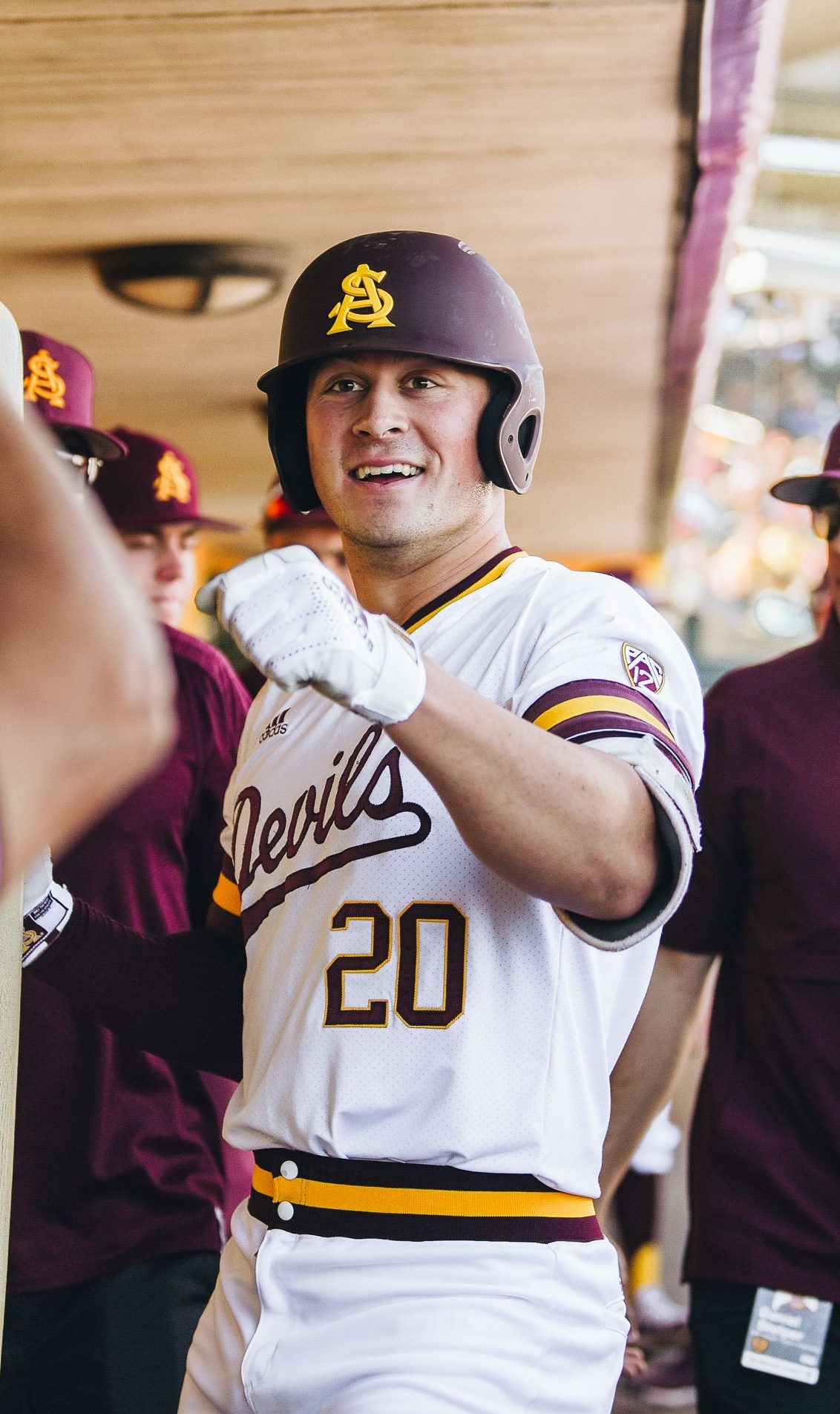
Torkelson, still just 20 years of age, has wowed scouts with his power, plate discipline and feel for hitting throughout his career with the Sun Devils. A career .337/.463/.729 hitter with 54 home runs, 33 doubles and a 110-to-104 BB/K ratio in 628 college plate appearances, Torkelson was off to his best start yet when the NCAA halted play due to the COVID-19 pandemic. Through 17 games and 82 plate appearances in 2020, Torkelson had posted a ridiculous .340/.598/.780 slash with six homers and 31 walks against 15 punchouts.
Pre-draft rankings were in agreement that Torkelson and Vanderbilt third baseman/outfielder Austin Martin were the top two talents in this year’s draft. Most gave Torkelson the slight edge — he topped the rankings at Baseball America, ESPN, FanGraphs and MLB.com — although some peg Martin as the slightly better all-around prospect due to his superior defensive value.
There’s little arguing that the Tigers made any sort of misstep, though. Torkelson is widely regarded as a potentially fast-moving bat with off-the-charts power who could hit in the middle of a big league lineup for years to come. That’d be music to the ears for the Tigers and their fans, as the organization’s lengthy rebuild has resulted in a farm system that is deep in high-end pitching talent but has fewer bats on the fast track to the Majors. Right-handers Casey Mize (the No. 1 pick in 2018) and Matt Manning, coupled with southpaw Tarik Skubal, give the Tigers a trio of arms upon which to dream. That trio is backed by several other potential rotation pieces, including Alex Faedo, Beau Burrows and Franklin Perez.
Torkelson should immediately become the Tigers’ top position prospect — and one of the top position prospects in all of baseball for that matter. FanGraphs’ Eric Longenhagen writes that the 20-year-old Torkelson possesses “sublime hitter’s timing, plus bat speed, and above-average barrel control and ball/strike recognition,” ultimately tabbing him as a future “thumping, heart of the order hitter.” ESPN’s Kiley McDaniel calls him the safest pick in the draft, pointing to his previous success with a wood bat in summer league play and calling Torkelson a potentially “above-average hitter with an above-average walk rate and 30+ homers.”
Torkelson is being advised by the Boras Corporation, but there’s no indication that a deal will be difficult to reach. In fact, Lynn Henning of the Detroit News suggested yesterday that the two sides are expected to come to terms on a deal in the vicinity of Torkelson’s slot value without a long, drawn-out negotiation process. Assuming that indeed pans out, the Tigers will suddenly find themselves with five of the top 60 prospects in baseball according to each of MLB.com, FanGraphs, Baseball America and The Athletic (joining the aforementioned pitchers and 2019 first-round outfielder Riley Greene).
It’s been an excruciating rebuild process for Tigers fans, but the team’s next core is coming into focus, and Torkelson should be squarely in the middle of the team’s resurgence.
Photo courtesy of Arizona State University Media Relations.
Manfred: “We’re Going To Play Baseball In 2020”
Major League Baseball is preparing yet another counter-offer to the Players Association after the MLBPA proposed an 89-game season with prorated salaries yesterday, commissioner Rob Manfred said minutes ago in an appearance on MLB Network (hat tip: Bill Shaikin of the L.A. Times, on Twitter). More encouragingly, Manfred emphatically stated: “We’re going to play baseball in 2020 — 100 percent.” The commissioner’s preference remains for a negotiated agreement between the league and union, but Manfred does have the ability to implement a shorter season (at fully prorated salaries) under the standing March agreement.
The details of the forthcoming proposal will be telling. Manfred acknowledged that it’ll be in the “players’ direction” but also suggested that he hopes the union will back down from its insistence on prorated pay. That has been the crux of the players’ entire argument to this point, and it has not seemed likely at all that they’ll be swayed. If anything, recent brazen comments from Cardinals owner Bill DeWitt Jr., Cubs owner Tom Ricketts and D-backs owner Ken Kendrick about the lack of profitability in baseball and the need for revenue sharing have only caused the players to further dig in. Many big leaguers — Justin Turner, Jameson Taillon, Randal Grichuk among them — met DeWitt’s comment that the baseball industry “isn’t very profitable, to be honest,” with bewilderment and disbelief.
USA Today’s Bob Nightengale reported earlier today, citing three MLB executives, that a counter-proposal was indeed in the works. Yesterday’s union proposal did contain some concessions that should appeal to ownership, but the MLBPA has steadfastly insisted that the prorated salaries which they feel were agreed upon back in March remain in place. That and the 89-game length of the proposal remain too costly in the eyes of ownership.
Nightengale suggests that Manfred will implement a season length of around 50 games if an agreement isn’t in place by next week. Of course, we’ve seen both sides negotiate through the media with a series of strategically leaked bluffs and half-truths, so it’s anyone’s guess whether ownership actually plans to wield that hammer or if this, paired with Manfred’s strong comments, is yet another leverage play. Remember, after all, that the league sent a counter-proposal to the MLBPA on Monday — just days after putting out the message that no counter was coming.
Regardless, it’s true that the clock is ticking for some kind of decision to be made. Ken Rosenthal and Evan Drellich of The Athletic wrote this morning that the time for “best and final” offers from both parties is nigh. Separately, Rosenthal suggests that the league should propose a 72-game season with prorated salaries and several of the new elements put forth by the union yesterday (e.g. two years of expanded 16-team playoffs, increased instances of players being mic’d up during broadcasts, an offseason All-Star Game/Home Run Derby this winter, etc.). To this point, neither side has made a proposal that has even moved the needle for the other.
MLBPA To Propose 89-Game Schedule In Latest Offer To MLB
The Major League Baseball Players Association is preparing to send a counter-proposal to the league which will call for 89 games at prorated salaries and expanded playoffs, ESPN’s Jeff Passan reports (Twitter thread). It’s 25 fewer games than the 114-game proposal the union last sent and 13 games more than MLB’s 76-game proposal on Monday. Of course, the league’s proposal only guaranteed players 50 percent of their prorated salaries — plus another 25 percent should a 16-team postseason be played to completion. As such, it’s hard to envision this deal being accepted — or even considered — by the league.
The new number of games does bring the midpoint between the two proposals to 82 games — the originally proposed number by the league. And ESPN’s Jesse Rogers reports that the union proposal contains expanded 16-team playoffs in both 2020 and 2021, which would surely hold appeal to ownership. The Athletic’s Evan Drellich adds that the players’ share of the playoff pool would be set at $50MM in the event that attendance is either limited or prohibited. Should fans be able to attend — unlikely in 2020 but plausible in 2021 — the players’ share would be dependent on gate revenue, as usual.
The players are also willing to commit to “broadcast enhancements” in the regular season and the playoffs, per Rogers, which would presumably lead to players regularly being mic’ed up to interact with the broadcast team during play. They’d also concede that non-high-risk players opting not to play during the COVID-19 pandemic (e.g. players who have family members at higher risk) would not receive salary or service time. High-risk players could opt not to play and still receive both.
Tonight’s proposal also contains several new elements. Bleacher Report’s Scott Miller tweets that an All-Star Game and Home Run Derby could be held after the World Series concludes — which could create further revenue for teams. The Wall Street Journal’s Jared Diamond, meanwhile, tweets that the union proposal seeks to establish a joint, $5MM fund with the league to support minor league players and drive social justice initiatives.
Still, the biggest issue hasn’t been the potential for expanded postseason play or even the overall number of games, but rather the disagreement on player salary. The union has steadfastly insisted upon prorated salaries, while ownership has continued to push the notion that additional pay cuts are necessary (while making brash claims about team profitability). Ownership has also staunchly refused to consider playing beyond the end of October, and that’s sure to be another roadblock in this latest proposal; Rogers reports that the proposal calls for the regular season to begin on July 10 and run through Oct. 11. As Diamond observes, that would ensure that MLB playoffs don’t go up against the NBA playoffs, which are set to conclude on Oct. 12.
If the sides cannot come to an agreement on salary terms, it seems increasingly likely that commissioner Rob Manfred will implement a roughly 50-game season with prorated salaries. All of the reported components of tonight’s proposal may create optimism that an actual negotiation could finally commence, but MLB Network’s Jon Heyman gives plenty of reason for caution (Twitter link). One ownership source reacted to Heyman: “We’re nowhere.”
Matt Harvey Has Received KBO, NPB Interest
June 9: Harvey has also drawn interest from teams in Japan’s Nippon Professional Baseball, tweets MLB Network’s Jon Heyman.
June 5: Former Mets ace Matt Harvey recently made known that he’s throwing regular bullpen sessions and hoping for another shot in the Majors, but the right-hander has also received interest from at least one club in the Korea Baseball Organization, MLBTR has confirmed. SBS in South Korea reported yesterday that Harvey had received interest and is at least open to the idea.
That said, there are some notable caveats to consider. Harvey does not appear to have received an offer, and the team in question is not focused solely on Harvey, a source tells MLBTR. It’s possible that the club could ultimately extend an offer to another pitcher of interest. KBO teams are capped at the number of foreign players they’re allowed to roster at the same time, so it’s not likely that the interested team would pursue multiple arms.
Furthermore, there are still some real obstacles with regard to actually getting a foreign pitcher up to speed with a KBO club. Daniel Kim of South Korea’s MBC recently tweeted that teams believe it could take four to six weeks to get a new player into game action. Beyond the actual negotiation and paperwork, the incoming player would need to go into a mandatory two-week quarantine upon arriving in South Korea. Pitchers, in particular, would then need some time to build up to game readiness. Just as many signed pitchers throughout MLB feel they’ll need a minimum three-week ramp-up period before returning to play, Harvey or any other pitcher would need a few weeks to build up his pitch counts.
It’s hard not to wonder what it’d be like to see a player who was at one time such a high-profile star make his way over to the KBO. There’d be some risks for Harvey, as a poor showing in the KBO would only further limit his appeal to MLB teams. Still, given the likely absence of a minor league season in 2020, it’s not as though he can hope for the opportunity to go prove himself in a Triple-A setting. Harvey’s most direct path back to the Majors right now is to hope that a team would be willing to carry him on an expanded roster/taxi squad, but his ugly 2019 numbers might make that a difficult path to achieve. A strong showing in the KBO could serve as a half-season audition for Major League clubs in 2021 and/or lead to 2021 offers in the KBO or Japan’s NPB.
Harvey, 31, struggled with the Angels in 2019 when he totaled 59 2/3 innings with a 7.09 ERA, 5.9 K/9 and 4.4 BB/9. He had a solid run in Cincinnati following a trade in 2018, though, pitching to a 4.50 ERA and 4.33 FIP in 24 starts. By all accounts, he fit in well in the Reds’ clubhouse, and Harvey himself spoke to the New York Post’s Dan Martin last month about the manner in which he feels he’s grown since his early years with the Mets. “I’ve grown up and matured on and off the field,” Harvey told Martin. “There are a lot of things I’d do differently, but I don’t like to live with regret.”
DeWitt Claims Baseball Industry “Isn’t Very Profitable”
Cardinals chairman Bill DeWitt Jr. offered some eyebrow-raising comments in an interview with Frank Cusumano of 590 The Fan (audio link). You’ll want to listen to the entire chat for yourself, but we’ll cover some pertinent elements here — in particular, his highly questionable claim that the baseball industry isn’t even a terribly profitable one.
DeWitt says he believes there will be a 2020 season and that the game will be fine in the long haul. Baseball has “always survived and come back stronger,” he says.
But that doesn’t mean it’ll come about through a mutually satisfactory bargaining process. Indeed, DeWitt seemed less than optimistic that the sides will end up agreeing to terms.
“At some point we do have the right to implement a season and pay full salaries and the only way it makes sense is with a shorter season,” he said. “And that’s I think the way it’ll turn out.”
DeWitt insists that the owners want to make the season as long as possible. At the same time, he rejected the idea of pushing play outside the normal bounds of late October/early November. He cited concerns of a second COVID-19 wave and called it “a little bit of a ridiculous proposal” to imagine “Christmas shopping while you’re watching the World Series on television.”
The Cards’ chairman left little doubt as to where the league sees its leverage. “We understand that if we implement a season — a shorter season — that they will get full pay but in total they’ll make less money,” he said. “So it really doesn’t make a lot of sense for them to continue to hold out.”
That’s all interesting enough, but DeWitt’s most notable comments came when he attempted an explanation of the owners’ overarching position that players should share in the downside of a limited 2020 campaign. The host posed the question why players should subsidize losses even when their salaries have declined on average while the game raked in record revenues over the past two seasons.
DeWitt rejected the idea that declining salaries were tied to more profits: “don’t think for a minute that the reduced payroll added money in the pockets of the owners because it didn’t.” Citing the growth of non-player personnel — from 240 to 400 in the past six years, he says — DeWitt claims “It’s a bit of a zero-sum game” because “a lot more is put into training, conditioning, promotional work, front office, analytics.”
One might respond that what the teams are really doing with those alternative investments — given the areas of emphasis DeWitt cited — is looking for more efficient ways to spend their roster-related funds. And to boost the profitability of the existing product.
But DeWitt insists, against all reason, that “The industry isn’t very profitable, to be quite honest.” It’s rather a remarkable quote.
Depending upon how one draws the lines around the multi-faceted business efforts tied to the game, it may be possible to narrowly support such a claim. But surely, when you pull in broader efforts — television, retail, real estate — someone is making money in the industry?
DeWitt even rejects that notion in large part. He referenced the Cardinals’ massive Ballpark Village effort — the second phase of which the team values at $260MM. It’s an opportunity to benefit St. Louis, he says, but for the Cardinals? Per DeWitt, “we don’t view as a great profit opportunity.”
DeWitt went on to suggest that it’s the players’ own historic preference for market-based salaries that is gumming up the efforts to resume play. Other sports are “aligned with the players,” says DeWitt, because “the more the revenue the more the players get based on a formula.” It’s interesting that this viewpoint arose at this particular moment, during a downturn. And it’s not entirely clear why such a sophisticated businessperson suddenly feels he and his fellow owners aren’t able to adequately consider costs and revenues when bidding on talent.
DeWitt notes that there’s “been a little bit of distrust” when it comes to the players believing ownership’s sharing of financial information. Frankly, it’s not hard to see why. Players have indeed shared in the benefits over the years, as DeWitt notes, even as franchise values have soared. Even though many of the league’s main profit-generating efforts have occurred somewhat outside the scope of the arena the players can access directly, they’ve no doubt been able to secure greater paydays as a result. But it’s inconceivable that wealthy investors would continue to tie up billions of dollars into a business that doesn’t throw off profits. Arguing otherwise won’t help rebuild that missing trust.
Latest MLB Proposal Includes Further Expansion Of Playoff Field
4:24pm: A variety of other notable details of the new proposal have now emerged. Initial reactions from the players’ side to the latest draft agreement seem less than favorable. The league has communicated its view that the sides “need to reach an agreement by Wednesday” in order to prepare for a 76-game campaign.
Players would be guaranteed half of their prorated salaries, per Ronald Blum of the Associated Press. If the postseason goes off without a hitch, the players would collectively stand to earn 75% of the prorated portion of their original salary guarantees.
The league has also suggested some major tweaks to the 2020-21 offseason, as Jeff Passan of ESPN.com covers on Twitter. The qualifying offer would go on hiatus. Instead, a team would get draft compensation for losing a player who signed a multi-year deal for over $35MM or a one-year deal for over $17.8MM. Signing such a player wouldn’t require any sacrifice of draft picks.
1:17pm: The new proposal sent this morning by Major League Baseball to the Players Association in many ways boils down to a repackaging of previous, similar offers, but it does come with at least one particularly notable change, per Joel Sherman of the New York Post (Twitter link). The league asked for 2020 postseason fields to expand even beyond the previously discussed 14 teams, adding another team per league and bringing the total to 16 playoff clubs.
The idea behind the league’s latest expansion would see a traditional bracket format play out, with the No. 1 seed playing the No. 8 seed, No. 2 vs. No. 7, etc. until each league has played down to one winner to square off in the World Series. The first round of play, Sherman adds, would be just a three-game set.
That’s a particularly strong deviation from the norm, where the top teams in each league have long been assured at least a five-game series against the weakest playoff entrant. The prospect of a sub-.500 No. 8 seed upsetting a dominant N0. 1 seed would create some excitement, to be sure, but the watered down playoff field and short early-round formats would undoubtedly be a turnoff for a very vocal set of MLB fans as well.
The league’s motivation here is clear. Postseason television contracts represent ownership’s best stream of revenue without fans in attendance at MLB games, and further broadening the playoff field would ensure that more games are played and that fans from more markets tune in to see the early rounds of play. The latest proposal from MLB to the MLBPA calls for owners to share some of those television rights with the players — typically, player postseason shares are derived from gate alone — so it’s only logical that owners are keyed in on making those games as lucrative as possible.
Today’s proposal will surely be rejected by the union, but it’s interesting that the league has now requested even more playoff expansion. On the surface, that’s something the MLBPA could incorporate into a counter-proposal, although it remains eminently possible that we simply see commissioner Rob Manfred implement a heavily truncated season with fully prorated pay. As few as 48 to 54 games have been speculated upon in the past week.
MLB Makes New Economic Proposal To MLBPA
10:55am: Players have been asked to respond to the proposal by Wednesday, tweets ESPN’s Jeff Passan.
10:25am: Major League Baseball’s 30 owners have made a new proposal to the union, ESPN’s Karl Ravech reports (via Twitter). The latest attempt by the league to return to play would see a 76-game season that pays players at 75 percent of their prorated contracts and concludes on Sept. 27. The postseason would still finish before the end of October, and the players would receive some portion of “playoff pool money.” Draft pick compensation for signing players would also be temporarily eliminated.
On the one hand, it’s encouraging to see a new effort from ownership. On the other hand, Mike Axisa of CBS Sports points out (via Twitter) that the offer essentially boils down to the same one the league has previously made twice — just dressed up differently. The league’s 82-game, sliding-scale proposal would’ve paid players, on average, about a third of their full-season salary. That’s also true of a roughly 50-game schedule with fully prorated salaries, and the new offer is also in that same ballpark.
To that end, it’s not surprising to see SNY’s Andy Martino tweet that the general player reaction to this is further anger. The Athletic’s Evan Drellich elaborates, tweeting that the union thinks this offer is actually a step back, as players would be more dependent on postseason bonuses to receive their full pay — despite the fact that the league itself has persistently expressed concern about the potential cancellation of playoff games due to an autumn surge in COVID-19 cases.
Per Drellich, the proposal would pay players only half of their prorated salaries for the proposed 76-game regular season, though that number would rise to 75 percent should a full postseason be able to be played out. Meanwhile, Ravech tweets that some sources contend that this offer translates to about $200MM more in total player salaries being paid out in 2020. That seems contingent on the postseason being played in full, though, so the union likely does not see things that way.
It’s also worth noting that while the league can point to the temporary suspension of the qualifying offer/draft compensation system as a win for players, that’s a potentially hollow gesture. Given the widespread revenue losses, even fewer players than usual would be expected to receive a QO at all. Mookie Betts, George Springer and J.T. Realmuto might receive a QO under any circumstance, but borderline cases would almost surely not be given a QO due to ownership fear over accepting and being saddled with a hefty 2021 salary. The Athletics were in essence publicly shamed into paying their minor league players after cutting their weekly stipends to save a total of $1.2MM; it shouldn’t even be assumed that a player like Marcus Semien would be guaranteed a QO.
It seems quite likely that the MLBPA will reject this offer, though if the outcome is a return to some actual back-and-forth negotiation, that could make the new proposal significant even if it was never likely to be accepted in the first place.
In the absence of a true negotiation, the league appears poised to stand by commissioner Manfred’s ability to set a season length at which ownership is comfortable paying fully prorated salaries. If the league views that as the likely outcome, then it may not feel a great sense of urgency anyhow, as a season in the vicinity of 50 games could be played out between August and September (or sooner, depending on start date) with a postseason being completed well prior to the Oct. 31 cutoff point on which owners have been adamant.
MLB Rejects MLBPA Proposal; No Counter-Offer Planned
5:21pm: Two team executives, Reds president of baseball operations Dick Williams and Brewers president of baseball ops David Stearns, expressed optimism Wednesday that the owners and players will hammer something out. Williams told Jim Day of Fox Sports Ohio that “both sides want to play,” interestingly adding that he believes an agreement’s “very close” (via C. Trent Rosecrans of The Athletic). Stearns said, “I firmly believe we are going to have baseball this season” (per Tom Haudricourt of the Milwaukee Journal Sentinel).
3:43pm: The two sides are seeing eye to eye on expanded playoffs and the universal DH, Jon Heyman of MLB Network tweets. They’re also “close to agreeing on the all-important health protocols,” Heyman writes, but season length could still stand in the way of a deal.
2:45pm: One possible point of leverage for the MLBPA, per Rosenthal and Drellich (subscription required), is that the March agreement offers rather concrete language indicating that MLB cannot simply impose an expanded postseason format without agreement from the union. A May report from USA Today’s Bob Nightengale suggested that expanding the postseason to the oft-floated 14-team setup would increase projected television revenue from $777MM to roughly $1 billion.
Meanwhile, The Athletic’s Jayson Stark tweets that he’s heard some talk of pushing the potential start date back from the July 4 weekend to July 15, as the league and union continue their interminable staredown.
1:00pm: The latest, widely expected step in the exhausting back-and-forth between Major League Baseball and the MLB Players Association became official today, as the league has formally rejected the union’s proposal for a 114-game season with prorated salaries, Ken Rosenthal of The Athletic tweets. Moreover, the league has no plans to even extend a counter-proposal. The commissioner’s office has begun speaking with owners about implementing a shortened season, Rosenthal adds, and hopes to have similar talks with the union (rather than a negotiation regarding season length).
Owners contend that ommissioner Rob Manfred can seek to unilaterally impose a shortened season if the union won’t budge from its prorated salary demands, and it appears that’s where they’re leaning, per the New York Post’s Joel Sherman. Either a 48- to 54-game season with fully prorated salaries or an 82-game season at less than prorated salaries are under consideration.
The union can still push back on that, however; Rosenthal and Drellich wrote over the weekend that the MLBPA could point to a clause in the March agreement which states the league will make its “best efforts to play as many games as possible” as a point of contention against a league-implemented short schedule. Union chief Tony Clark could conceivably point to his side’s 114-game proposal as an effort to honor that language while contending that the league simply has not done so. As for any chances of the MLBPA accepting a 48- or 54-game season, those seem minuscule. The union wasn’t pleased with an 82-game schedule; nearly halving that hardly seems like a palatable alternative. Jason Mackey of the Pittsburgh Post-Gazette tweets that one player described those proposed lengths to him as a “joke” and “absurd.”
All of this aligns with an ominous sentiment tweeted by SNY’s Andy Martino this morning, wherein he reported that there “has not been much dialogue” between the league and the players union. Sherman adds to that, noting that he’s “heard greater pessimism today” from both sides than at any point since these negotiation began.
There’s a bit more optimism on the health and safety guidelines, it seems; Martino writes in a full column that the two sides have made progress and believe an agreement can be reached. Might some productive talks in another area finally help facilitate a breakthrough in terms of player salary? Some speculate that to be the case, but it’s hard to be overly optimistic when neither side appears willing to give an inch.
[Related: HoopsRumors — NBA Expected to Approve 22-Team Return-to-Play Format]
The next chapter in this interminable saga unfolds against the backdrop of the NBA’s impending vote on its own return-to-play scenario. A vote to ratify that plan will come tomorrow and would bring basketball back on July 31. MLB seemed to have the opportunity to come back in early July and be the first major sport to give starved fans across North America some of the entertainment they’ve desperately craved. On the surface, doing so seemed like an opportunity to perhaps broaden the sport’s fanbase by attracting new fans (or luring old ones back into the fold) as the only game in town, so to speak. Instead, there’s increased doubt as to whether a season will be played at all.
At this point, the “good faith” negotiations that were oft-referenced in the March agreement are a distant memory. Both sides have issued proposals they knew to be nonstarters — twice, in the league’s case, although the revenue-sharing plan was a strategic leak rather than a formal proposal. Now, ownership appears intent on driving home the point that play will only resume under its terms.
Chris Archer Undergoes Thoracic Outlet Surgery
The Pirates announced Wednesday that right-hander Chris Archer underwent surgery yesterday to relieve symptoms of thoracic outlet syndrome. The surprising, out-of-the-blue announcement rules Archer out for any games that are played in 2020. He’s expected to be ready for full competition in 2021, per the team’s press release, although his future with the club is far from certain at this point. The Pirates hold an $11MM club option ($250K buyout) over Archer for the 2021 season. The decision to undergo surgery came after “consulting with several leading vascular and orthopedic surgeons in recent weeks,” according to the Pirates.
The track record of pitchers coming back from TOS surgery, which typically involves the removal (or partial removal) of a rib in order to alleviate pressure on nerves in the shoulder/armpit area, is rather poor overall. Matt Harvey, Tyler Thornburg, Tyson Ross, Nate Karns, Matt Harrison, Carter Capps, Andrew Triggs and Kyle Zimmer are among the players to have undergone the surgery in recent years. None of that bunch has found much success upon returning. That said, recently retired righty Chris Young attributed TOS surgery to salvaging his career, and we’ve seen other success stories in Chris Carpenter, Jaime Garcia and Clayton Richard. It’s not an insurmountable hill to climb, but a TOS procedure is one of the more ominous arm operations a pitcher can undergo.
The revelation of a TOS diagnosis goes a long way toward explaining some of Archer’s recent struggles. From 2013-17, the righty pitched to a 3.60 ERA (3.45 FIP) with 9.7 K/9 against 2.9 BB/9 in a hitter-friendly American League East division. His numbers dipped a bit in 2018 but were generally serviceable. In 2019, however, Archer was lit up for a 5.19 ERA (5.02 FIP) with career-worst marks in BB/9 (4.1) and HR/9 (1.9). In retrospect, Archer’s 2019 season did end about a month early due to shoulder discomfort, and he was slowed by neck pain this spring prior to the league shutdown. However, while those symptoms are present in most TOS cases, most instances of neck/shoulder discomfort for pitchers don’t result in a TOS diagnosis.
Rather, much of the reason for Archer’s struggles in Pittsburgh were previously believed to have been due to the organization’s push to use a two-seamer/sinker that simply wasn’t an effective pitch for the right-hander. Archer had scrapped the two-seamer years prior, but the since-dismissed Pirates regime had a pitching philosophy that focused on incorporating sinkers into a pitcher’s repertoire. Archer finally jettisoned the pitch this past June and saw his strikeout and walk percentages immediately trend in positive directions, even though he continued to be unusually homer-prone (an issue that plagued many pitchers in last year’s juiced-ball season). The significant K-BB% gain was one of several reasons I profiled Archer as a rebound candidate back in March, but it’s now clear that there were more concerning causes for his struggles.
The generally poor track record of pitchers returning from TOS surgery presents the perennially low-spending Pirates with a particularly difficult decision this offseason. With teams losing enormous revenue amid the pandemic shutdown, it’s widely expected that free agents and arbitration-eligible players will feel the effects of those losses. Many in the game expect a depressed free-agent market and a spike in the number of non-tendered players. Archer’s club option is a net $10.75MM decision for the Pirates — a figure that represents nearly 18 percent of their would-be $60.7MM payroll in 2020. On the surface, it’s immensely hard to see owner Bob Nutting green-lighting such a commitment.
At the same time, the Pirates gave up Tyler Glasnow, Austin Meadows and prospect Shane Baz to acquire Archer in a trade that now looks to be among the most regrettable swaps in franchise history. It’d be understandable if the club sought one final bite at the apple, so to speak, in hopes of a rebound that could help salvage some value from that deal, be it in the form of a quality performance from Archer or a summer 2021 trade that recouped some prospect capital.
Ownership and the new front-office regime, headed by GM Ben Cherington, will have several months to decide, but it’s certainly plausible that Archer has pitched his final game as a Pirate.