
Red Sox Extend Xander Bogaerts
Just a week after locking up free-agent-to-be Chris Sale with a five-year extension, the Red Sox secured long-term control over another member of their core Monday when they announced a six-year extension with shortstop Xander Bogaerts. The deal reportedly guarantees Bogaerts $120MM from 2020-25 (in even, $20MM increments) and contains a vesting option for the 2026 season. The vesting option is reportedly worth another $20MM and would kick in if Bogaerts made 535 plate appearances in 2025. Bogaerts, a client of the Boras Corporation, is also said to have received an opt-out provision after the 2022 season.
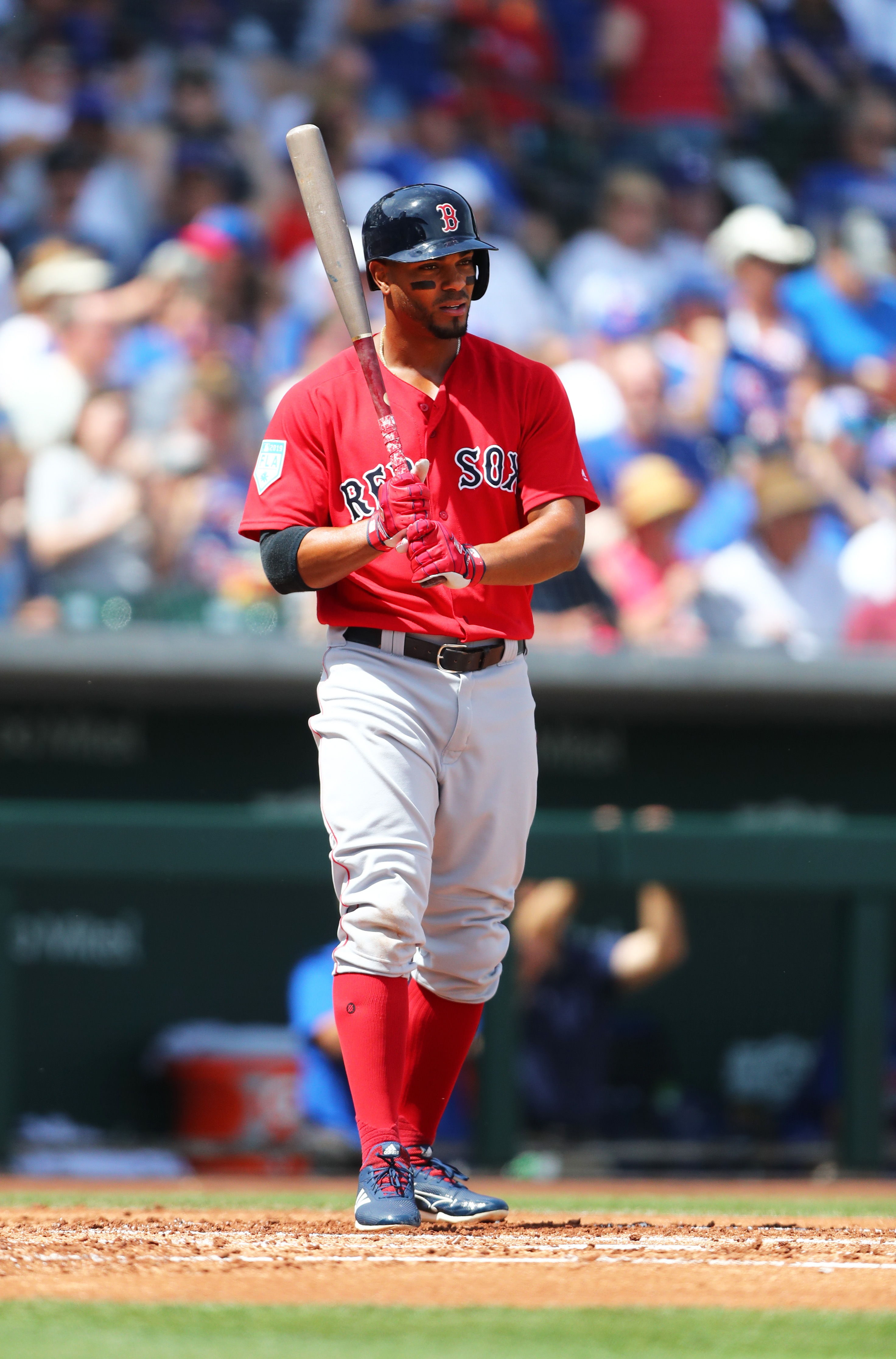
Bogaerts and the club had been in talks during the winter, and though neither side wanted negotiations to extend into the season itself, it seems things were close enough to the finish line that a deal was able to be struck just beyond Opening Day.
Bogaerts, who turned 26 last October, originally signed with Boston as a 16-year-old amateur out of his native Aruba, and quickly developed into one of baseball’s best prospects. He made a quick impact in his 2013 rookie season, helping solidify a problematic third base position for the Red Sox as the team went on to win the World Series. He didn’t fully begin to blossom until the 2015 season, and Bogaerts has gone on to generate 17.6 fWAR over the last four seasons, hitting .295/.354/.446 with 61 homers over 2588 plate appearances. This includes a career-best 23 homers, .883 OPS, and 133 wRC+ in 2018, as Bogaerts rebounded from an injury-marred 2017 campaign to help lead the Red Sox to another World Series title.
Defensively, Bogaerts has been something of a mixed bag at shortstop. The Defensive Runs Saved metric has never looked kindly on his glovework (-48 DRS) while his UZR/150 mark of -0.3 posits him as just slightly below average. There has been some speculation that Bogaerts could eventually move from shortstop, and while that change doesn’t look to be happening anytime soon, that decision could eventually hinge on Rafael Devers‘ development as a third baseman, plus whether prospect Michael Chavis plays at second base, third base, or elsewhere around the diamond.
The pact between Boston and Bogaerts is just the latest in a precedent-setting number of extensions over the last few weeks, as multiple superstars (both near and far from free agency) have chosen to lock in guaranteed paydays with their current teams. Of this group, players who were going to be free agents after the 2019 season included Bogaerts, Sale, Nolan Arenado, Justin Verlander, Paul Goldschmidt, and Aaron Hicks.
It’s clear that the lack of free agent activity in the last two offseasons has influenced many of these decisions, and in Bogaerts’ case, he’ll forego entering the open market for his age-27 season. Keeping a young player who may just be entering his prime on a $20MM average annual value looks like a very solid deal for the Red Sox. Bogaerts also has the ability to opt out of the contract as he enters his age-30 season, if he feels he can top the three years and $60MM still owed to him.
For luxury tax purposes, Bogaerts’ new deal will add an even $20MM to Boston’s Competitive Balance Tax bill beginning in 2020. This is no small factor in the contract, given the rather onerous tax situation the Red Sox find themselves in, though some relief from at least the top level of the CBT structure could come as several contracts come off the books for the club next winter.
It also helps the Red Sox afford what would be their biggest extension yet — a pact with Mookie Betts before the reigning AL MVP hits free agency following the 2020 season. Betts has been firm in his desire to go year-to-year in arbitration rather than sign a long-term deal before getting his chance on the open market, so the topic of an extension could be moot, though Boston will surely continue to explore the possibility of keeping the star outfielder at Fenway Park even if a $300MM+ commitment is required. The Bogaerts and Sale extensions are evidence, if Betts needs any, that the Sox are serious about keeping this winning core of players together.
WEEI’s Evan Drellich broke the news that the two sides were close to a deal (Twitter link). ESPN.com’s Jeff Passan reported the terms of the contract (Twitter links). The New York Post’s Joel Sherman reported the inclusion of the vesting option (Twitter links). MLB Network’s Jon Heyman added some details on the option and also first reported that Bogaerts had passed his physical Monday morning (Twitter links). The Boston Globe’s Alex Speier reported the final details on the vesting option, while Chris Cotillo of MassLive.com tweeted the annual breakdown.
Corey Knebel To Undergo Tommy John Surgery
Brewers reliever Corey Knebel has elected to undergo Tommy John surgery, he tells reporters including Tom Haudricourt of the Milwaukee Journal-Sentinel (Twitter link). The rehab process will take him out of action for all of the 2019 season and quite likely some of 2020 as well.
Knebel had been weighing the replacement of his right ulnar collateral ligament after speaking with multiple physicians. Evidently, it was less than a clear-cut decision, but he ultimately decided to bite the bullet rather than taking an uncertain rehab course that may only have delayed the inevitable.
The 27-year-old hurler had already agreed to a $5.125MM arbitration salary in his second season of eligibility. As a former Super Two qualifier, he’s eligible twice more. Whether the Brewers elect to tender him a contract next fall may depend upon how his rehab is progressing. Knebel would stand to earn a repeat of this season’s salary, which may be a bit of an expensive gamble. The presence of another season of arb eligibility certainly boosts the merits of a tender.
No matter how the future plays out, the reality at present is that the Brewers are down a key arm in the pen. Though he wasn’t as dominant last year as he had been in 2017, Kluber still ran up 55 1/3 innings of 3.58 ERA ball while recording an eye-popping 14.3 K/9 against 3.6 BB/9. Thankfully, the unit is still headlined by Josh Hader and Jeremy Jeffress (once he’s off the IL), but there’s little question it’s weakened from its ’18 levels.
Athletics Acquire Kendrys Morales
TODAY: The deal ships $1MM in international bonus availability to Toronto, per Shi Davidi of Sportsnet.ca (via Twitter).
YESTERDAY, 7:40pm: Slusser reports that the Jays are covering more than $10MM of the $12MM remaining on Morales’ contract.
7:06pm: The two teams have announced the trade. Toronto is sending Morales and cash to Oakland in exchange for minor league infielder Jesus Lopez and international bonus money. To clear a spot on the 40-man roster, Oakland transferred right-hander Jharel Cotton to the 60-day injured list as he recovers from Tommy John surgery.
7:02pm: In a surprising move, the Blue Jays have traded designated hitter Kendrys Morales to the Athletics, reports Jeff Passan of ESPN (via Twitter). The 35-year-old Morales is earning $12MM in the final season of a three-year, $33MM contract with the Jays, so presumably Toronto is providing substantial financial relief in the deal.
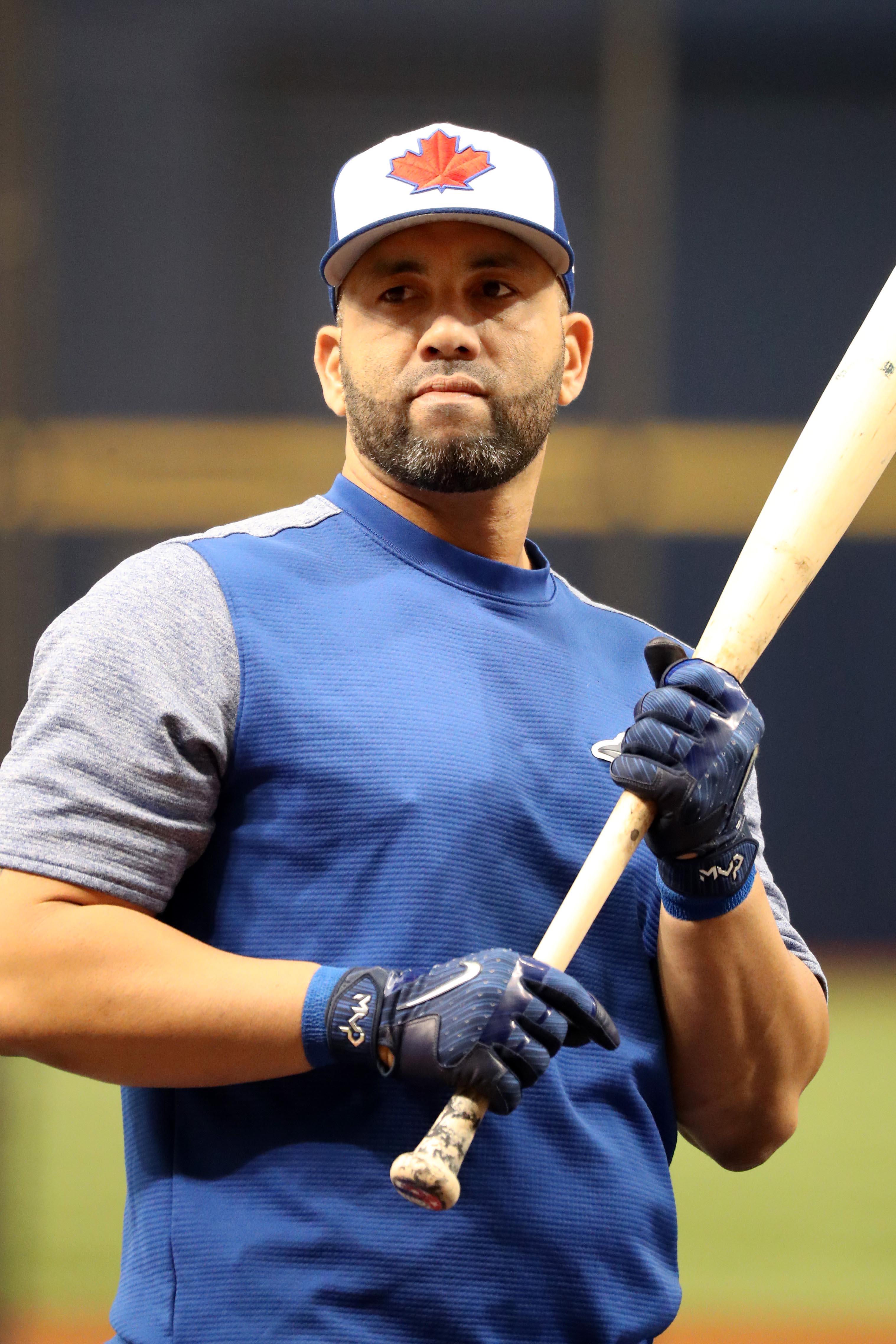
Oakland recently lost first baseman Matt Olson when the slugger underwent a hamate excision procedure on his right hand. Olson suffered the injury in the second game of the Athletics’ two-game set against the Mariners in Tokyo. With Khris Davis locked in as the primary designated hitter in Oakland, it seems likely that Morales will play first base while Olson is sidelined. Susan Slusser of the San Francisco Chronicle tweets that Olson will be out anywhere from six to eight weeks.
Morales won’t match Olson’s offensive output or especially his glovework, but the veteran switch-hitter is coming off a solid 2018 rebound campaign in which he batted .249/.331/.439 (112 OPS+) with 21 homers. His recent work at first base has been extremely limited, as he’s logged just 30 games at the position over the past two seasons. The A’s also have Mark Canha and Jurickson Profar (who played 24 games at first base last year in Texas) as alternative options at first base should the need arise.
The addition of Morales will also help to balance out a righty-heavy Athletics roster. Prior to the trade for Morales, switch-hitters Profar and Robbie Grossman were the only two players on the active roster capable of hitting left-handed. A career .264/.328/.468 hitter against right-handed pitchers, Morales isn’t exactly a standout but will present a sound platoon partner for the right-handed-hitting Canha.
For the Blue Jays, the move creates some much-needed roster flexibility. Teoscar Hernandez can now receive semi-regular at-bats in the DH slot, with Billy McKinney, Kevin Pillar and Randal Grichuk lining up around the outfield. The Jays can also rotate some other regulars through the DH slot, and the trade of Morales could even create a path to the Majors 24-year-old first baseman Rowdy Tellez on the heels of a .280/.308/.600 showing in Spring Training.
The return for the Jays, as one would expect when dealing a soon-to-be 36-year-old DH in the final season of an undesirable contract, is minimal. The 21-year-old Lopez spent the 2018 season with Class-A Beloit, where he hit .239/.293/.402 with 10 homers, 15 doubles and a couple of triples in 326 plate appearances. He spent time at third base (587 innings), shortstop (65 innings) and second base (53 innings). Lopez wasn’t ranked among the Athletics’ top prospects. The amount of international money picked up by Toronto in tonight’s deal isn’t clear, though international funds must be traded in blocks of at least $250K.
Mets Extend Jacob deGrom
TODAY: The deal includes $52.5MM in deferred money, all without interest, Jon Heyman of MLB Network reports (Twitter links). $12MM in 2020, $13.5MM in 2021, $15MM in 2022, and $12MM in 2023 will all be pushed to the future. There’ll also be a $15MM deferral on the 2024 option, if it’s picked up.
The deferred money will be pushed back 15 years, per Ron Blum of the AP, which sets up a series of payouts beginning in 2035. Amusingly, and surely not coincidentally, deGrom’s payments will seamlessly take over the slot long occupied by annual payouts to former player Bobby Bonilla, Mike Mayer of Metsmerized notes on Twitter.
Those extensive deferrals clearly reduce the true value of the contract, though the precise amount depends upon what discount rate is utilized. Bob Nightengale of USA Today tweets that the $137.5MM owed to deGrom in the future has been assigned a present-day valuation of $108.9MM, though it’s unclear what basis was used to reach that number.
YESTERDAY, 4:52pm: The Mets have formally announced deGrom’s extension.
“This is a tremendous day for Jacob, his family, our fans and the entire Mets organization,” Mets COO Jeff Wilpon said in the press release announcing the contract. “Last year, Jacob had one of the most remarkable seasons in baseball history and we are excited to be able to reward him. Mets fans can celebrate knowing their ace will remain in Flushing.”
7:36am: The Mets have agreed to terms on an extension with star right-hander Jacob deGrom, according to Andy Martino of SNY.tv (Twitter links). deGrom, the reigning National League Cy Young Award winner, is undergoing a physical today. The contract includes four years and $120.5MM in new money, as Ken Rosenthal of The Athletic first reported (Twitter links), with some of it deferred.

Earlier this year, deGrom agreed to a $17MM arbitration contract for the 2019 season. That effectively remains in place, though it is now restructured as a $10MM signing bonus and $7MM salary, Joel Sherman of the New York Post reports on Twitter. What would have been deGrom’s final arbitration season, 2020, will be locked in at $23MM. He’ll then earn $33.5MM in each of the next two seasons and $30.5MM in 2023 — if he does not first opt out. The option-year value is $32.5MM, ESPN.com’s Jeff Passan tweets.
If indeed a deal is finalized, it’d bring an end to a long-running and rather fascinating saga regarding deGrom’s future. It was just last summer that deGrom’s then-agent, Brodie Van Wagenen, was advocating that the team either work out an extension or trade the ace right-hander. In a cinematic twist, Van Wagenen became the Mets’ general manager last fall, recusing himself from direct extension talks with deGrom while the pitcher chose to remain with the same agency (CAA Baseball). (That recusal concept was evidently of rather limited scope, or has since been modified or waived, as Sherman tweets that Van Wagenen was personally on hand for the final negotiations.)
The sides held preliminary talks at the Winter Meetings, but then a lengthy silent period ensued. After agreeing to a 2019 arbitration salary, which included a record-setting $9.6MM raise, the deGrom camp put an Opening Day deadline on talks, so the clock was ticking. It seemed hopeful as camp opened that a deal would materialize, but the more recent vibe was much less promising. But Andy Martino of SNY.tv tweeted yesterday that talks were still ongoing, with Michael Mayer of MetsMerizedOnline adding on Twitter that there was some forward progress toward a deal.
As it turns out, the sides lined up on a contract that understandably includes some concessions in both directions. deGrom will turn 31 this June and was not set to reach the open market until the conclusion of the 2020 campaign. Compare that to Chris Sale, whose recent extension came just before his 30th birthday and entering his final season of contractual control. (Of course, the lefty was also coming off of an injury-limited second half to the 2018 season.) Sale’s contract provided five seasons and $145MM in new earnings; he’ll pitch the entire final season of that deal at 35 years of age. deGrom receives a slightly higher AAV, even though the first new contract year covers an arb-eligible season, and will celebrate his 35th birthday in the middle of his final guaranteed season (if he hasn’t already opted out).
Both of those outstanding hurlers might have found greater riches in free agency. Sale would’ve been the top arm available this coming winter, while deGrom surely would’ve been among the most desirable free agents of the 2020-21 offseason. Zack Greinke had already turned 32 when he secured a six-year, $206.5MM deal with the Diamondbacks. But that deal seemed an outlier when it was signed and the market has since shifted. Clayton Kershaw hadn’t yet turned 31 and had produced nothing but excellent results when he re-upped with the Dodgers last fall, but settled for a three-year pact after experiencing back issues and peripheral declines.
There’s also ample risk in pitching a full MLB season, so extensions have generally lagged free agency in value to a greater extent than is the case for position players. A few still-youthful hurlers nearing free agency have secured bigger money — Kershaw didn’t quite reach $200MM in his first long-term contract if you deduct his anticipated arbitration salary from that season; Stephen Strasburg secured $175MM over seven new seasons part-way through his final year of team control. But otherwise, the largest pitching extensions have gone to Sale ($145MM), Cole Hamels ($144.5MM), and Justin Verlander ($140MM).
[RELATED: MLBTR Extension Tracker]
For their money, the Mets will secure the services of one of the game’s very best hurlers for most or all of his remaining productive campaigns. Never overly hyped as a prospect, deGrom’s early development was slowed by Tommy John surgery. But he emerged in 2014, earning a call-up to the majors and succeeding beyond any reasonable expectations. While he was never much of a strikeout pitcher in the minors, deGrom steadily maintained about a K per inning in his early seasons. He began ramping that up further in 2017, which was also his first 200-plus-inning campaign, but didn’t really take the next step until last year.
Entering the 2018 campaign, deGrom carried a 2.98 ERA with 9.7 K/9 and 2.3 BB/9 through 680 2/3 career innings. There had been a few health wobbles along the way but he was, by and large, a durable and thoroughly excellent pitcher. It seemed there wasn’t much more ceiling to reach, but he unquestionably found it.
Ramping up his velocity (96.7 mph average fastball) and increasingly shelving his sinker in favor of his two offspeed offerings (change and slider; combined usage of 40%) helped deGrom boost his swinging-strike rate to a career-high 15.1%. He drove his strikeout rate up to a personal-best 11.2 K/9 while maintaining a typically sparkling 1.9 BB/9 walk rate, cut back on the home run issues that had cropped up a bit in 2017, and induced nearly as much soft contact (25.2%) as he allowed hard contact (26.6%).
The results followed those impressive underlying numbers. deGrom finished the 2018 campaign with 217 innings of 1.70 ERA ball. Unsurprisingly, given the off-the-charts earned run outcomes, ERA estimators felt there was a bit of good fortune mixed in — but not enough to detract from deGrom’s excellence. He was credited with 1.99 FIP, 2.60 xFIP, and 2.78 SIERA.
Nothing is assured in this world, least of all when it comes to future pitching performance. But deGrom seems about as good a bet as any veteran hurler to keep producing into his mid-thirties. His ability to maintain top physical form will perhaps dictate the extent to which he can approach his newly established personal heights, but his multi-pitch arsenal and impeccable command seem to provide about as much of a floor as any starter.
The upside in the contract is plainly limited by deGrom’s age, but that doesn’t mean the Mets can’t hope to achieve good value. The organization will still retain a fair bit of payroll flexibility after the 2020 season, the final year of obligations to Yoenis Cespedes and a few other pricey veterans. deGrom knocks Cespedes off of the organization’s financial Mt. Rushmore, joining David Wright, Johan Santana, Carlos Beltran to make up the four largest contracts in Mets history.
Photo courtesy of USA Today Sports Images.
Padres To Promote Fernando Tatis Jr.
An already fascinating season for the Friars just got more interesting. The San Diego organization has made the bold choice to promote top prospect Fernando Tatis Jr. to the MLB roster to open the season, according to Kevin Acee of the San Diego Union-Tribune (via Twitter).
Tatis, widely considered one of the game’s best two or three best overall prospects, only reached his 20th birthday earlier this year. But he has done nothing but produce offensively in the minors and showed himself to be ready on both sides of the ball this spring. At the plate, he slashed .265/.345/.490 in 55 plate appearances.
Perhaps it shouldn’t be seen as particularly bold to make a decision of that kind, but the reality of today’s game is that teams are loath to part with future seasons of team control. By holding a player down for a few weeks before a promotion, it’s possible to get nearly a full season of production without burning a full year of service time — thus delaying that player’s eventual free agency.
As ever, it’s a tough tradeoff. Just a few weeks of action from one player — particularly, an inexperienced youngster — likely won’t mean the difference between sinking or swimming. But the Padres are to be commended for making the decision based upon a straight talent evaluation. If the club is to make a real run at the postseason this year, every boost will matter; even beyond Tatis’s on-field contributions, the go-for-it mentality may help to further motivate an already stoked roster.
Friars GM A.J. Preller ultimately found it irresistible to put a new left side of the infield into action after seeing it all spring. Promising Manny Machado $300MM was quite a bit more radical than promoting Tatis, after all, and the organization has waited for quite some time to see this much talent in that area of the field. The hope will be that those two players handle the vast majority of the reps at those positions for the next six seasons — if not longer.
Eventually, the Pads would surely like to see Luis Urias join this group to round out the infield (along with first baseman Eric Hosmer). It had been expected that Urias would man short to begin the year and shift over to second base in the long run. But with veteran Ian Kinsler locked in at second for the time being, Urias will end up opening the season at Triple-A, according to Dennis Lin of The Athletic (via Twitter).
That’s not to say that Tatis will be the lone youngster in the Padres’ dugout. To the contrary, exciting right-hander Chris Paddack is also slated to head north with the big-league roster, as Lin first tweeted. Youngsters including Francisco Mejia, Franchy Cordero, and Franmil Reyes (#FranDiego?) are expected to do so as well, along with a variety of other hurlers.
Photo courtesy of USA Today Sports Images.
Steven Souza Jr. To Undergo Season-Ending Knee Surgery
The Diamondbacks announced Tuesday that right fielder Steven Souza Jr. will undergo major surgery to repair his his left knee. The operation will address not only a torn ACL but also a torn LCL, a partially torn PCL and a posterolateral capsule tear. Souza suffered the injury while crossing home plate in last night’s Cactus League game. He was helped off the field after crumpling to the ground and underwent an MRI to evaluate the damage this morning.
The gruesome injury will bring about a second frustrating year for Souza, whom the D-backs had hoped could give them a controllable power bat in right field at the time of his acquisition from the Rays. A series of pectoral strains limited Souza to just 72 games in 2018, though, and he now won’t suit up until 2020 at the earliest. A specific timetable on injury of this magnitude won’t be known until surgeons have repaired the extensive damage.
Souza, 29, looked to be healthy after last seasons injury troubles this spring as he turned in a 10-for-47 effort with a pair of homers, a double and seven walks. He’d been lined up to serve as Arizona’s everyday right fielder but will now cede those duties to some combination of Adam Jones and Jarrod Dyson. Jones, who signed a one-year deal worth $3MM with the Diamondbacks earlier this month, had been set to play all three outfield positions but may now slot in as the primary right fielder with Dyson backing up Ketel Marte. The loss of Souza significantly increases the odds that utilityman Ildemaro Vargas will break camp with the Diamondbacks.
Arizona and Souza agreed to a $4.125MM salary to avoid arbitration earlier this offseason, and he’ll remain under team control through the end of the 2020 season. It’s fairly common for players who miss the entire season due to injury to receive the same salary in arbitration rather than any kind of raise, so if the team is confident in Souza’s ability to return to health in 2020, he could be in line for a similar (if not slightly reduced) rate of pay.
The loss of Souza is compounded by the fact that Arizona had placed fellow outfielder Socrates Brito on waivers prior to last night’s game, meaning one of the team’s primary depth pieces to replace him could now be lost to another organization. If Brito ultimately clears waivers, the Diamondbacks could immediately select him back to the 40-man roster, as placing Souza on the 60-day injured list would open a spot on the 40-man roster. If Brito is claimed by another club, it wouldn’t be a surprise to see the Diamondbacks look into outfield alternatives. The team does have some non-roster options to which it could turn in the form of Yasmany Tomas, Abraham Almonte and Matt Szczur, but none of that trio was able to secure a roster spot in Spring Training.
Cubs Extend Kyle Hendricks
12:57pm: It’s a four-year, $55.5MM extension for Hendricks, per The Athletic’s Ken Rosethal (Twitter links). Hendricks will be paid $12MM in 2020 and $14MM annually from 2021-23. He has a $16MM vesting option for the 2024 season that comes with a $1.5MM buyout but would become guaranteed if he finishes top three in the 2020 Cy Young voting.
12:47pm: The Cubs announced Tuesday that they’ve signed right-hander Kyle Hendricks to a four-year contract extension spanning the 2020-23 seasons. The deal also contains an option for the 2024 season. Hendricks, who is already set to earn $7.405MM in 2019 after avoiding arbitration, was originally under control through the 2020 season. He’s represented by Wasserman.
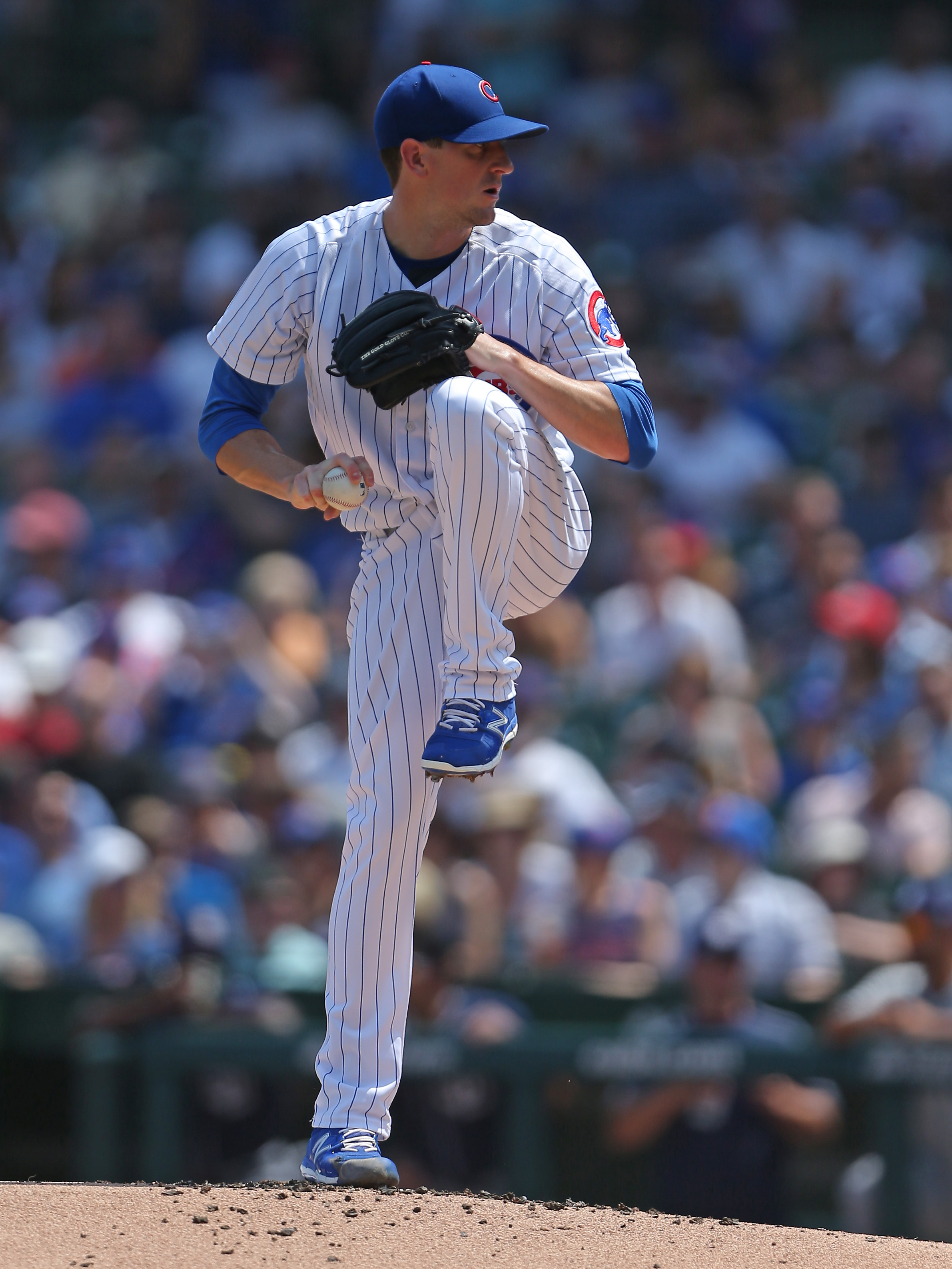
Hendricks, 29, has blossomed from unheralded prospect to steadying force in the Chicago rotation. While he’s unlikely to ever match the dominance that carried him to a third-place finish in the 2016 Cy Young voting, when he pitched 190 innings of 2.13 ERA ball, he’s nevertheless a rock-solid mid-rotation piece, thriving on pristine control and weak contact rather than overpowering opponents. Hendricks averages just 87 mph on his fastball, but he ranked in the top eight percent of the league in terms of average opponents’ exit velocity in 2018 (85.2 mph), and the spin rate on his curveball is among the best in the game (89th percentile).
In all, since debuting in 2014, Hendricks has amassed 789 innings of 3.07 ERA ball with 7.6 K/9, 2.1 BB/9, 0.86 HR/9 and an above-average 48.9 percent ground-ball rate. His plus changeup and hook, paired with pinpoint control, allow him to generate a well-above-average swing-rate on pitches outside the strike zone (32 percent), which helps to explain how he’s managed to continually limit hard contact despite laying claim to one of the slowest fastballs in the Majors.
Hendricks would’ve reached free agency heading into his age-31 season, and the price on his four-year extension is somewhat reflective both of his age and his proximity (or lack thereof) to an open-market setting. Both Nathan Eovaldi and Miles Mikolas, for instance, received $68MM on their own recent four-year contracts. However, Eovaldi received that sum as a 29-year-old on the free-agent market, while Mikolas received that deal with his own foray into free agency just a few months away.
For the Cubs, getting Hendricks locked up long-term was likely of particular importance given the long-term outlook of their starting staff. Lefties Jon Lester and Cole Hamels remain quality options but are both near the expiration of their contracts and are both aging. Lester has just two guaranteed years of his contract remaining, while Hamels can become a free-agent at season’s end. Jose Quintana, similarly, has just one year of control remaining beyond the current season.
The Cubs do have some longer-term options, but the organization can’t know exactly what to expect from Yu Darvish, who pitched just 40 innings in the first season of a six-year, $126MM contract last year. Chicago picked up Kendall Graveman this winter as he recovers from Tommy John surgery, but while he’s controlled through the 2021 campaign, he won’t be a plausible option until next year. Mike Montgomery is arbitration-eligible through the 2021 season as well, but he’s never worked a full season as a starter. With Hendricks now in place for an additional three years beyond the point at which he’d have originally become a free agent, the Cubs have some much-needed certainty in place.
From a luxury tax standpoint, the extension does have some ramifications. Hendricks had counted as a $7.405MM hit against the team’s luxury-tax bill, but that number now rises to $12.581MM. And because the Cubs were already into the second bracket of luxury tax penalties, every single dollar of that increase will come with a 32 percent tax hit. As such, even though Hendricks’ salary is unchanged for the coming season, the Cubs will now pay an additional $1.656MM in surcharges. Beyond flying in the face of the audacious comments made by owner Tom Ricketts last month, in which he claimed that the Cubs “[didn’t] have any more” money to spend, the Hendricks extension will give the Cubs more than $232MM of salary that counts against the luxury tax. It’ll also push the Cubs’ 2020 payroll to a guaranteed $114MM before the 2019 season even kicks off.
From a broader perspective, Hendricks’ contract is the latest in an avalanche of long-term deals signed by players this spring against a backdrop of general unrest regarding the state of free agency. Dating back to Sonny Gray‘s late-January extension with the Reds, there have been a remarkable 22 multi-year deals signed by players who were still under club control (as shown in MLBTR’s Extension Tracker). That number would typically constitute two, if not three year’s worth of spring extensions. The series of long-term deals has not only weakened next winter’s free-agent class but now, with extensions from Hendricks and Jacob deGrom, has begun to cut into the 2020-21 class of free agents as well.
Marlins Release Dan Straily
8:44am: Marlins president of baseball operations Michael Hill announced to reporters that Straily has been released by the organization (Twitter link via Joe Frisaro of MLB.com). Mish tweets that Straily is going on release waivers today, meaning he’ll become a free agent if he clears on Wednesday at 1pm ET. Assuming that happens, he’ll receive the aforementioned 45 days’ termination pay and can can sign with any club for any amount of money (on top of that termination pay from Miami).
7:52am: In a fairly surprising move, the Marlins have designated right-hander Dan Straily for assignment, according to Craig Mish of SiriusXM (all Twitter links). The Marlins will now have a week to trade him or release him. Left-hander Caleb Smith has made the Marlins’ Opening Day rotation in what was expected to be Straily’s spot, Mish adds.
Straily, 30, was acquired from the Reds in a January 2017 trade that cost the Marlins right-hander Luis Castillo (along with the since-reacquired righty Austin Brice and minor league outfielder Zeek White). Straily made 33 starts for Miami in his first year with the club and tallied another 23 starts for the Fish in a 2018 season that was slowed a bit by a forearm strain early in the year. In all, he gave the Marlins 304 innings of 4.20 ERA ball with averages of 8.0 strikeouts, 3.3 walks and 1.5 homers allowed per nine innings pitched.
On the heels of that output, Miami and Straily agreed to a $5MM salary earlier this winter, avoiding arbitration in the process. Today’s DFA will save the Marlins about $3.8MM of that $5MM sum, as even if Straily is released, the organization would only owe him 45 days’ termination pay (roughly $1.2MM). Ultimately, those cost savings were surely at the heart of the move. There’s little doubt that Straily is a better option for the Miami pitching staff than fellow veteran Wei-Yin Chen, but Miami will retain Chen and his fully guaranteed $20MM salary and instead part ways with a veteran arm whose salary was only partially guaranteed.
Miami has reportedly been exploring trades for Straily all offseason, including prior to tendering him at that $5MM rate, but without any success. As such, it may be difficult for them to find a partner in the coming days, though perhaps a club with injury issues in its rotation will have some interest — if not via trade then via straight waiver claim. Straily did rank in the 70th percentile of MLB pitchers in terms of fastball spin and in the 80th percentile in terms of curveball spin, so he could hold particular appeal to clubs that emphasize spin rate. If he goes unclaimed, Straily will become a free agent who is eligible to sign with any club for any amount of money while still pocketing the $1.2MM owed to him by Miami.
As for the Marlins, they’ll now trot out a younger rotation consisting of Jose Urena, Trevor Richards, Pablo Lopez, Sandy Alcantara and Smith, with Chen lined up as the long man in the bullpen. Elieser Hernandez, Jeff Brigham and Jordan Yamamoto are all on the 40-man roster as depth options.
Developmentally speaking, one can hardly fault the rebuilding Marlins for wanting to give as many of their growing stable of arms an opportunity as possible, though the fact that doing so now means paying a reasonably useful Major League arm to pitch somewhere else is hardly ideal. The truly questionable element of the whole equation will be the decision to tender Straily in the first place a youth movement was always the preferred route for the rotation. Presumably, though, when that decision was due in early December, Miami still had confidence in its ability to find a trade partner.
Red Sox, Chris Sale Agree To Extension
TODAY, 1:43pm: Bob Nightengale of USA Today adds (via Twitter) that Sale’s vesting option for 2025 will be exercised if Sale earns a top-10 finish in AL Cy Young voting in 2024 and does not finish the year on the IL.
SATURDAY, 8:12am: The Red Sox have officially announced Sale’s new contract.
FRIDAY, 9:01pm: Sale has passed his physical, Rosenthal tweets, so all that remains is for the contract to be announced. Sale will earn $30MM in each of the first three seasons of the deal, after which time he has the right to opt out of the remaining two seasons. Those campaigns are valued at $27.5MM, meaning Sale will be deciding on two years and $55MM versus a trip onto the open market.
There’s further upside in the deal as well, ESPN.com’s Jeff Passan reports (Twitter links). It includes a vesting option at a floating value (minimum $20MM) based upon games started. There are also Cy Young-based escalators in years 2021-24 and in the option year. Sale receives full no-trade protection beginning in the middle of the 2020 season.
There are competing reports on the accounting of the deal. Rosenthal and others say the deal will wrap in Sale’s preexisting 2019 salary, creating a readjustment of his luxury tax hit for the present season (and pushing the team into the highest level of penalties). That’s not the case, though, per Speier (Twitter link). He reports that the Boston organization will elect to keep the ’19 season separate, which will avoid immediate tax entanglements but increase the luxury tax hit over the new years of the deal, potentially leading to future luxury obligations.
2:30pm: The Red Sox and ace Chris Sale are closing in on a contract extension, as first reported by Alex Speier of the Boston Globe. Sale, a client of Jet Sports Management, will receive $145MM over five seasons (2020-24) if he passes a physical, Ken Rosenthal of The Athletic reports (Twitter links).
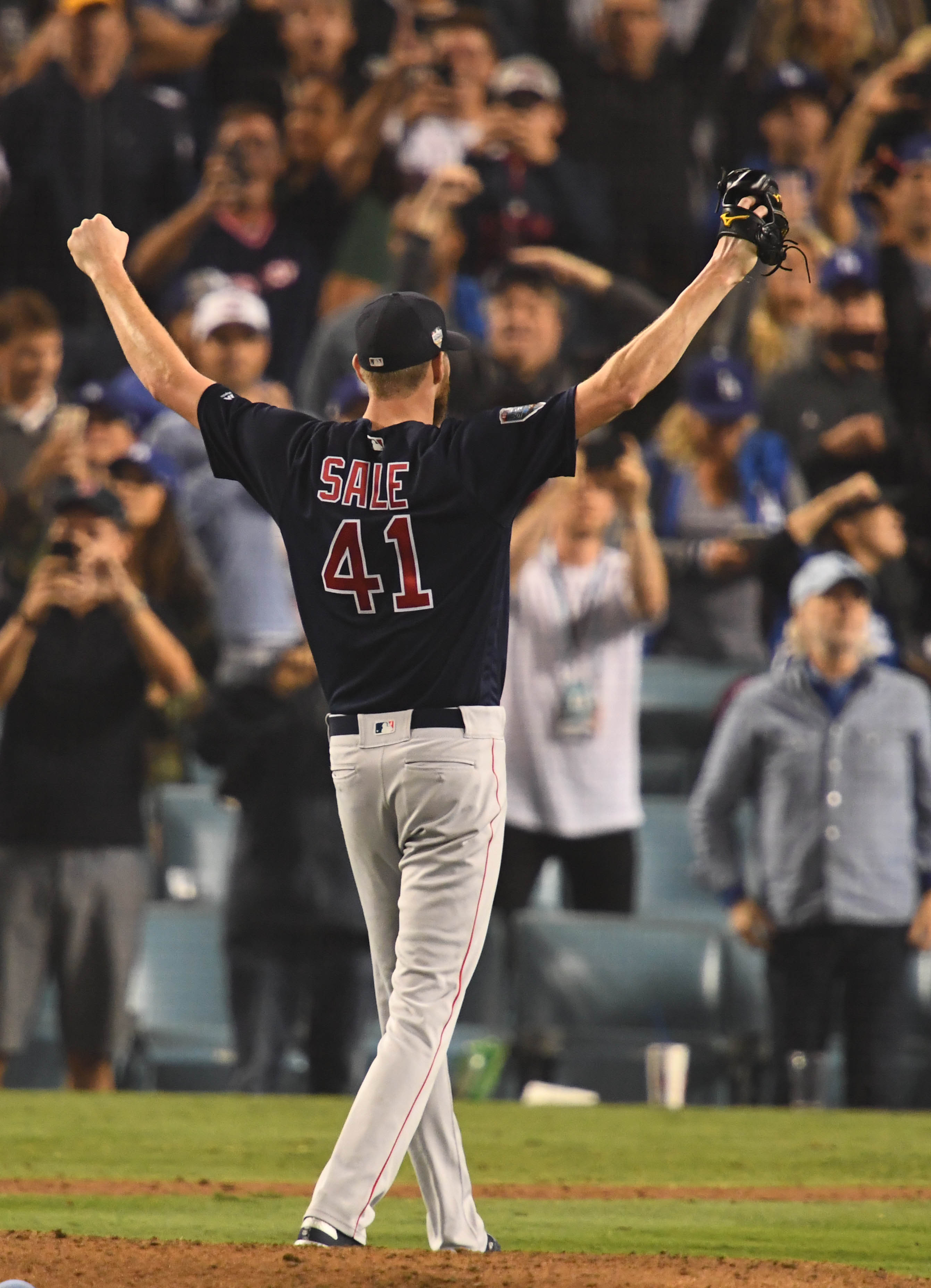
Earlier this spring, both Sale and the Red Sox expressed mutual interest in working out a long-term arrangement that’d keep the left-hander, who is slated to become a free agent at season’s end, in Boston for the long term. MLBTR’s Jeff Todd recently broke down several possible scenarios when exploring what a Sale extension would cost the Sox.
Sale, 30 next week, has been among the game’s elite starters since moving to the rotation with the White Sox back in 2012. He’s made seven consecutive All-Star teams and registered six consecutive Top-5 finishes in American League Cy Young voting, though he’s somewhat incredibly never taken home a Cy Young trophy himself.
Since being traded to Boston in the 2016 blockbuster that sent Yoan Moncada, Michael Kopech, Luis Alexander Basabe and Victor Diaz to Chicago, Sale has pitched to a brilliant 2.56 ERA while averaging 13.2 strikeouts and just 1.9 walks per nine innings pitched. That level of K/BB excellence is nothing new for Sale, who holds the all-time Major League records for both K/9 (10.88) and K/BB ratio (5.31) among pitchers with at least 1000 innings pitched.
Any extension for Sale would begin in his age-31 season — he’ll pitch the 2019 season at age 30 — and figures to come with as much as a 100 percent increase over this year’s $15MM salary. The length of the contract was surely a sticking point in negotiations between Sale and the Sox, given last season’s shoulder troubles that limited him to 158 regular-season innings. Beyond that, his age likely gives Boston some degree of pause, as teams have become increasingly reluctant to guarantee players — particularly pitchers — significant salaries into their late 30s.
The luxury tax also undoubtedly plays a factor in negotiations, as the Red Sox’ payroll currently carries about $240.8MM in annual values that count against the tax ledger (as MLBTR recently examined when highlighting the unlikelihood of a Craig Kimbrel reunion). Should the Sox cross the $246MM threshold, they’d move into the top bracket of luxury penalization, which would include a 75 percent tax on any dollars spent beyond that point and would also cause their top pick in the 2020 draft to be pushed back by 10 spots, though for the Sox, keeping Sale from testing the open market looks to have been deemed worth of incurring that level of penalization.
It’s still possible that the Sox manage to lessen the luxury hit, though; Boston is reportedly shopping catcher Sandy Leon and his $2.475MM salary, and trimming that off the books would lighten the sting in terms of luxury payments on a new contract for Sale. A theoretical $30MM annual value for Sale would effectively take his luxury hit from $15MM (his current one-year salary, as options are treated in the CBA) to $27.5MM (the five-year, $150MM term plus this year’s $15MM salary divided over a six-year span). That $12.5MM increase currently stands to put the Red Sox about $6.5MM over the top luxury line, so shedding Leon’s contract could ultimately leave Boston’s luxury commitments at about $250-251MM. That’s still a huge penalty, but they’d only be paying the 75 percent tax on about $4-5MM of expenditures in that scenario.
Sale is far from the lone key Red Sox player who is (or was) slated to hit the open market following the 2019 season, but given the luxury implications another extension would present, he may be the only one to sign a long-term deal. Shortstop Xander Bogaerts and right-hander Rick Porcello are also free agents following the 2019 campaign, while designated hitter J.D. Martinez has the ability to opt out of the remaining three years and $62.5MM on his contract. Looking further down the line, reigning AL MVP Mookie Betts will become a free agent following the 2020 season, though Betts flatly stated this week that he doesn’t expect to sign an extension before free agency.
In the now likely event that a Sale extension is finalized, it would mark the 17th contract extension signed by a player this spring alone, including the sixth by a would-be free agent and the fifth worth greater than $100MM in total guarantees (as shown in MLBTR’s Extension Tracker). Players throughout the league have become frustrated with the slow pace of free agency and the lack of spending outside of the very top tiers of the free-agent market. Rather than test what has become a largely stagnant market, many players are simply opting into long-term arrangements with their current club, thus forgoing the stress and oft-disappointing outcomes free agency has presented over the past two years.
Cardinals Extend Paul Goldschmidt
1:38pm: Bob Nightengale of USA Today adds details (via Twitter) on the incentives package included in Goldschmidt’s new contract. The slugger can earn $250k for being named an All-Star, $250k for winning a Gold Glove award, and $1.5M for winning the NL MVP. As Saxon reported earlier, Goldschmidt’s yearly earnings will tally $26MM, which comprises a $22MM yearly base salary in addition to a $20MM signing bonus that will be spread evenly across the five years of the contract.
10:17am: Goldschmidt will earn $26MM per season from 2020-24, The Athletic’s Mark Saxon reports (Twitter link).
TODAY, 8:04am: The deal is done, and the Cardinals will officially make the announcement at a press conference this morning, MLB.com’s Jenifer Langosch reports (Twitter link).
THURSDAY: The Cardinals are closing in on an extension with first baseman Paul Goldschmidt, per Ken Rosenthal of The Athletic (via Twitter). If he passes a physical, Goldschmidt will remain a Cardinal for five additional seasons at a price of $130MM, per Derrick Goold of the St. Louis Post-Dispatch (via Twitter), thus setting a new contractual record for the storied St. Louis franchise.
Goldschmidt is already slated to earn $14.5MM in 2019, the final season of the extension he signed earlier in his career. With five new seasons tacked on, he’ll now be under contract through the 2024 season. The new deal will afford Goldschmidt full no-trade protection but will not include any opt-out opportunities, Rosenthal tweets.

The Cards are now set to accomplish what they set out to do when they acquired Goldschmidt earlier this winter. The club made no secret of its desire to hammer out a long-term arrangement with its new first bagger. Indeed, achieving exclusive negotiating rights likely motivated the St. Louis organization to part with starter Luke Weaver, catcher Carson Kelly, minor league infielder Andy Young and a Competitive Balance Round B selection to land Goldy in the first place.
Getting the deal done now means that both the Cardinals and Goldschmidt (along with his representatives at Excel Sports Management) need not think about alternatives next winter. It surely would have been interesting to see how the star performed on the open market. It’s hardly an optimal time for a defensively limited slugger to reach the open market. The Chris Davis deal (seven years, $161MM) is scarcely three years old, but seems a relic in retrospect. We’ve seen a steady reduction in earning expectations for such players in recent years. Still, significant money has still been there for the very best players. J.D. Martinez took down $110MM over five years despite profiling as a DH. Carlos Santana and Edwin Encarnacion each commanded $20MM annual salaries over three-year terms. And first bagger Eric Hosmer — a much younger but lighter-hitting first baseman — went for eight years and $144MM.
There’s an argument to be made that Goldschmidt could have earned more on the open market. He’d have faced little competition at the top of the first base market outside of the older Jose Abreu, though there are a few notable other players available next winter. But it’s frankly difficult to argue with the decision to sign onto this contract, particularly with another year of health and performance risk still separating Goldschmidt from free agency. The Cards obviously were quite fond of their new acquisition — and, perhaps, felt no small amount of pressure to get something done. It’s no small achievement in this climate for a first baseman to secure a $26MM AAV over a five-year term that begins in his age-32 season.
Goldschmidt, of course, is no ordinary first baseman. Comparing him to his peers at first base, in fact, isn’t quite the right scope. Over the past three years — that is, not including his personal-best 2015 campaign — Goldy has been among the dozen top position players by measure of fWAR. He’s in a dead heat with Freddie Freeman and Joey Votto in that regard. Now, he’ll join that pair of star performers in securing a large and lengthy contract extension.
While the Cardinals haven’t had much time to watch Goldschmidt up close, he really doesn’t have much of anything to prove. Somehow only an eighth-round draft pick back in 2009, Goldschmidt has been an offensive sensation ever since he reached the professional ranks. He destroyed minor-league pitching while racing to the majors, showing well in his 2011 debut. Thereafter, he emerged as one of the game’s best hitters and has rarely wavered from that standard.
All told, Goldschmidt carries a .297/.398/.532 slash (144 wRC+) through 4,708 plate appearances. That’s more or less exactly what he posted last year, when he ran up 690 plate appearances of .290/.389/.533 hitting with 33 long balls. Goldschmidt didn’t have his best showing in terms of plate discipline, but his 13.0% walk rate and 25.1% strikeout rate were hardly problematic and largely reflect his career levels. He continued to sting the ball, with a career-best 46.2% hard-contact rate (per Fangraphs), though he also made soft contact with greater frequency (16.9%) than ever before.
Photo courtesy of USA Today Sports Images.