
Giants Acquire Tyler Austin
The Giants announced Monday that they’ve acquired first baseman/outfielder Tyler Austin from the Twins in exchange for minor league outfielder Malique Ziegler. To open a spot on the roster, they’ve designated fellow first baseman/outfielder Connor Joe for assignment.
Austin, 27, will add a powerful but strikeout-prone bat to the Giants’ outfield mix while providing some insurance should Brandon Belt incur an injury. The former Yankees prospect was at one point looked at as a potential pairing with Greg Bird in the Bronx, but the Yankees flipped him to the Twins last July in the trade that sent Lance Lynn to New York. The Twins, cognizant of the potential retirement of Joe Mauer, viewed Austin as a possible option at first base until they managed to land C.J. Cron on waivers when the Rays dumped his salary. Both Cron and Austin are right-handed hitters, and Minnesota’s signing of Nelson Cruz to man the DH spot in the lineup made Austin, who is out of minor league options, somewhat redundant.
Last season in 268 plate appearances between the Twins and Yankees, Austin batted a combined .230/.287/.480 with 17 home runs and 10 doubles. Seventeen long balls in just 268 PAs and a .250 isolated power (slugging minus batting average) speak to Austin’s ability to make loud contact, but Austin also punched out in a whopping 35.4 percent of his trips to the plate.
Austin has been more of a first baseman than an outfielder throughout his career and, in fact, has only seen 36 frames of action on the outfield grass in the Majors. He’s logged over 2600 innings of time in right field across parts of seven minor league seasons, however, so despite a lack of recent experience, he’s no stranger to the position. That said, Austin does not run well, and his lack of range is a tough fit in the spacious Oracle Park.
Joe, 26, made his big league debut with the Giants this season but managed just one hit and a walk in 16 plate appearances before being jettisoned from the roster. The Reds selected Joe out of the Dodgers organization in December’s Rule 5 Draft but traded him to San Francisco late last month. He’s still carrying Rule 5 status, so any team that acquires Joe would need to carry him on the MLB roster. The Giants will have a week to trade him or pass him through waivers, and if he goes unclaimed, they’d be required to offer him back to the Dodgers for $50K. Considering Joe’s outstanding .299/.408/.527 batting line between Double-A and Triple-A last season, it’s possible that another organization will want to speculate on his potential.
The Twins, in return for Austin, will add another athletic outfielder to the lower levels of their minor league system. The 22-year-old Ziegler was a 22nd-round pick by the Giants in 2016 and split last year between the Rookie-level Arizona League and the Class-A South Atlantic League, batting a combined .237/.340/.370 with four homers, 12 doubles, a pair of triples and eight steals in 250 plate appearances. He’s not considered a top prospect in a thin Giants farm, though Fangraphs’ Eric Longenhagen did make mention of him in his pre-2018 overview of the Giants’ system: “Ziegler is a lithe, athletic outfielder who was a late pick out of an Iowa Juco in 2016. He makes explosive use of his lower half during his swing but his barrel control and raw strength are questionable.”
Rockies Extend German Marquez
April 6: The Rockies have formally announced the extension. Marquez is now signed through at least the 2023 season.
Per MLB Network’s Jon Heyman (Twitter link), he’ll receive a $1.5MM signing bonus and earn $1MM this season before earning $4.5MM in 2020, $7.5MM in 2021, $11MM in 2022 and $15MM in 2023. The option is valued at $16MM and comes with a $2.5MM buyout.
April 2: The Rockies and right-hander German Marquez are in agreement on a five-year, $43MM contract extension, Jeff Passan of ESPN reports (via Twitter). The deal contains a club option for a sixth season, though a pair of top-three finishes in Cy Young voting over the life of the deal would convert that into a mutual option. The contract begins in 2019 and runs through the 2023 season, Ken Rosenthal of The Athletic tweets. Marquez is represented by Daniel Szew of L.A. Sports Management.
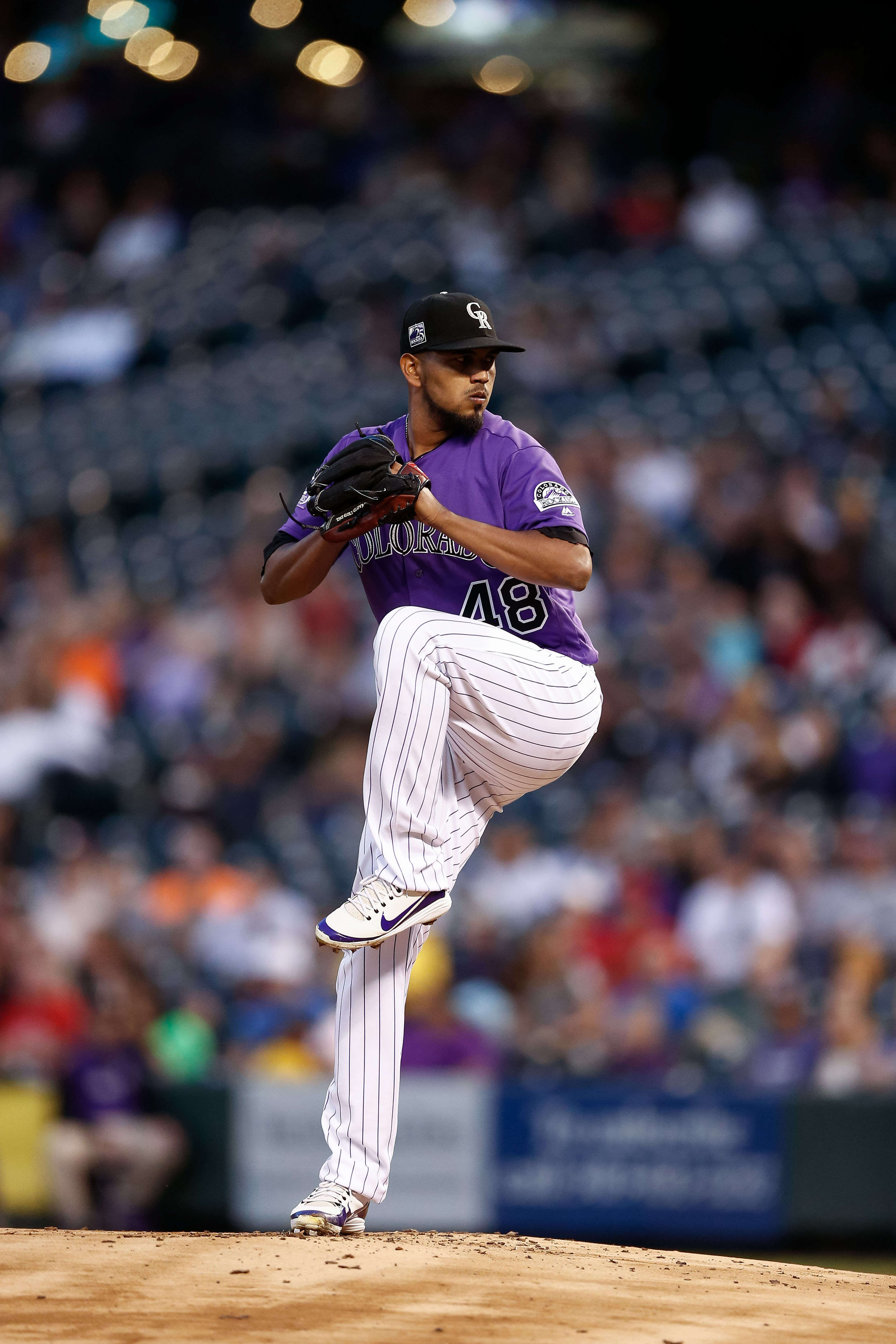
The $43MM figure promised to Marquez is the second-largest guarantee ever received by an arbitration-eligible pitcher with between two and three years of MLB service time. Rays lefty Blake Snell recently set a new precedent in that regard by landing a $50MM sum over the same five-year term, which may have helped to move the market forward a bit for Marquez.
Marquez, who turned 24 in February, was not yet eligible for arbitration and will now forgo that entire process. The new contract includes the current season as well as three arbitration years and what would have been Marquez’s first season of free agency. The club option covers a second would-be free-agent season. Marquez would’ve been on track to reach free agency heading into his age-28 season, but he’ll now be controlled by the Rockies through age 29 and reach the market in advance of his age-30 campaign.
While Marquez didn’t generate the most attention among Rockies starters last year — teammate Kyle Freeland placed fourth in National League Cy Young voting — he did break out as a high-quality mid-rotation piece with the potential upside to become more. Over the life of a career-high 196 innings, Marquez posted a 3.77 ERA with 10.6 K/, 2.6 BB/9, 1.10 HR/9 and a 47.3 percent ground-ball rate. Metrics such as FIP (3.40), xFIP (3.10) and SIERA (3.31) all felt that Marquez handily outperformed an earned run average that already appeared solid (particularly when accounting for the fact that his home games are played at Coors Field).
Marquez complemented those numbers with a fastball that averaged 95.2 mph, a 12.5 percent swinging-strike rate and a 30.7 percent opponents’ chase rate on pitches outside the strike zone. Dating back to Opening Day 2017 (and including the lone start he’s made in 2019), Marquez has a 4.01 ERA with 384 strikeouts against 109 walks across 364 innings for the Rox.
Moving forward, the Rockies will count on Marquez and Freeland to anchor a rotation that also features lefty Tyler Anderson, the talented but wildly inconsistent Jon Gray and veteran righty Chad Bettis. There’s a chance that Marquez proves to be the best of that bunch, though the rates at which he’s being paid would be a bargain even for a mid-rotation starter (as is the inherent nature of pre-arbitration contract extensions).
The Rockies now control Marquez longer than any player on the roster other than their other spring extension recipient, Nolan Arenado, who is signed through the 2026 season (albeit with an opt-out after 2021). The Rockies aren’t in any real proximity to the luxury tax threshold, so any ramifications of the deal’s impact on Colorado’s luxury payroll are negligible. Colorado already had $116.75MM on the books for the 2020 season, and the Marquez contract will nudge that forward by a few million dollars.
Marquez’s agreement continues an unprecedented barrage of long-term extensions for players who are already under club control — many of whom have signed on the dotted line just months before what would’ve been their first foray into free agency (e.g. Arenado). The onslaught of long-term deals has manifested against the backdrop of significant tension labor tensions stemming from a deteriorating middle class among MLB free agents and questions surrounding the increasing number of tanking (“rebuilding”) teams throughout the league.
As shown in MLBTR’s Extension Tracker, Marquez’s deal is, stunningly, the 25th extension of the calendar year. In past offseasons, it was commonplace for a handful of players to ink long-term deals each spring, but this is the first time in league history that the equivalent of an entire team’s active roster has signed extensions. While it’s hard to fault any player for signing on board for a life-changing sum of money, the increased number of pre-market deals also serves to suppress the age at which players reach free agency, leading to more free agents in their early 30s and creating potential for additional strife down the line. Of course, the league and MLBPA are already in the process of discussing changes well in advance of the current Basic Agreement’s expiration at the end of the 2021 season, so perhaps there’ll be changes that mitigate much of that tension as we move ahead.
Cubs Extend David Bote
The Cubs announced Tuesday that they’ve agreed to a contract extension with infielder David Bote. The contract will cover the 2020-24 seasons and also contain a pair of club options.
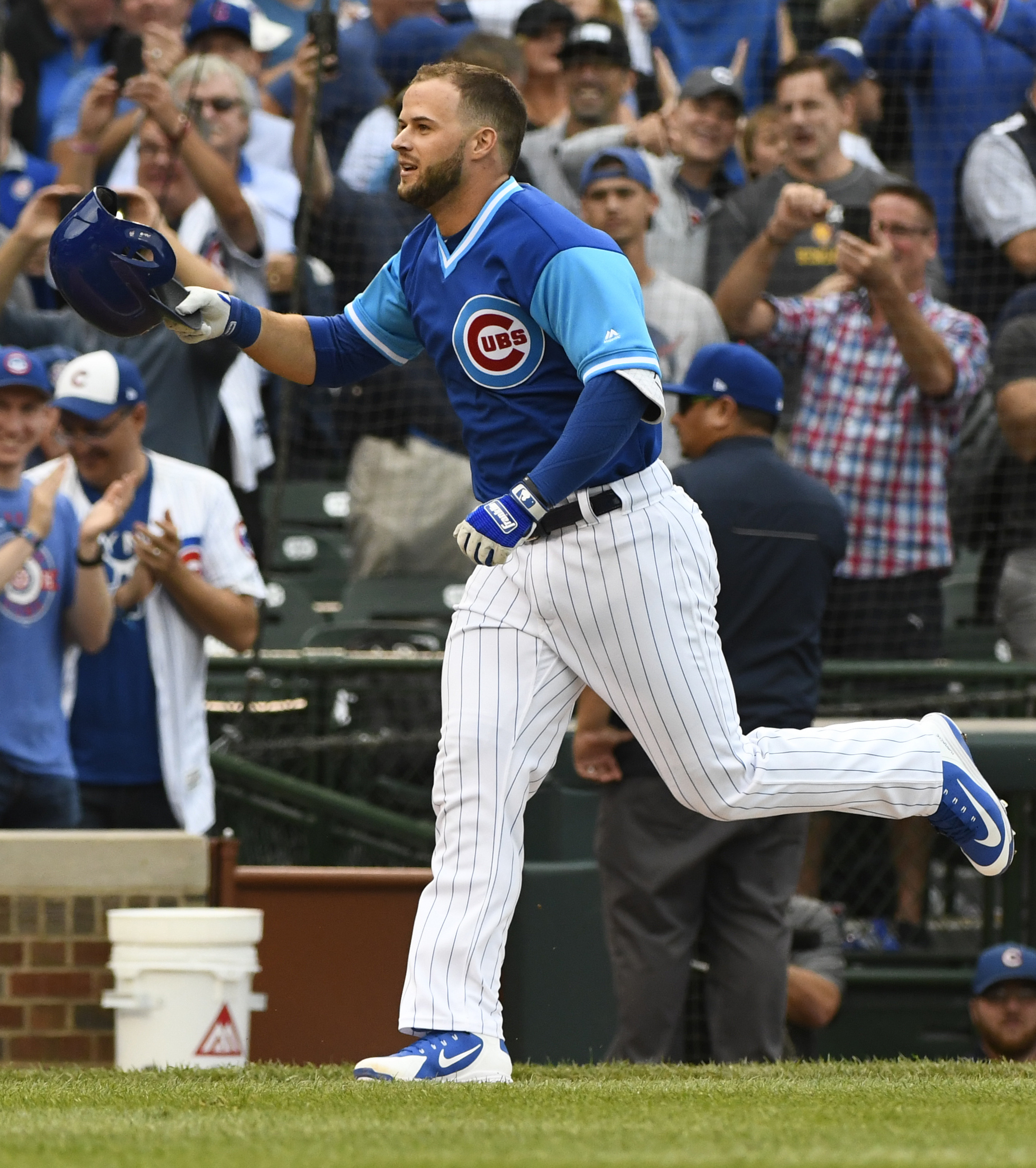
Bote will be guaranteed $15.003MM over that 2020-24 span, Gordon Wittenmyer of the Chicago Sun Times reports (on Twitter). MLB Network’s Jon Heyman tweets that the two option years are valued $7MM and $7.6MM. According to the Chicago Tribune’s Mark Gonzales (also on Twitter), Bote will receive a $50K signing bonus and earn $950K next season. He’ll then earn $1MM in 2021, $2.5MM in 2022, $4MM in 2023 and $5.5MM in 2024. The first option season comes with a $1MM buyout, and the second carries a $500K buyout.
Bote recently approached the Cubs to initiate the talks, president of baseball operations Theo Epstein tells reporters (Twitter link via ESPN Chicago’s Jesse Rogers). He was already under club control through the 2024 season, but the Cubs will now obtain some cost certainty and also secure control over what would have been his first two free-agent seasons.
Though he never rated as one of the organization’s top prospects, Bote made his way to the big leagues last season and now looks the part of a useful bench option capable of backing up at multiple infield spots and perhaps in the outfield corners. His primary positions have been third base and second base, but Bote also logged 10 innings at short in 2018 as well as seven in left field and two at first base. He’s a .246/.327/.410 hitter to this point in his big league career (223 plate appearances).
That defensive versatility surely appealed to the Cubs, as did the quality of Bote’s defense at his most frequent position: third base. In just 375 innings there last season, Bote was credited with +5 Defensive Runs Saved and a 4.4 Ultimate Zone Rating. Whether that type of rating is sustainable over a larger period remains to be seen; Fangraphs Eric Longenhagen wrote after the 2017 season that Bote lacked a true position, calling him a potential bat-first utility option if all panned out. Based on Bote’s .281/.355/.502 slash through 299 Triple-A plate appearances and last season’s small sample of exit velocity readings, perhaps he’ll live up to that billing.
Bote’s extension is a surprising move in that he isn’t viewed as any sort of key player for the Cubs at the moment. However, the modest price tag on the deal carries minimal risk — particularly for a large-market team like the Cubs — and the $15MM guarantee seems to suggest that the organization eventually feels Bote could take on a larger role. Generally, utility players don’t earn quite this much over the course of arbitration; Boston’s Brock Holt, for instance, will earn $3.575MM this season in his final year of arbitration eligibility and stands to reach free agency having earned a bit shy of $9MM.
The contract could prove to be a bargain if Bote can settle in as any sort of semi-regular contributor, though for a nearly 26-year-old former 18th-round pick who was never heralded as a top prospect and is still three years from arbitration, it’s easy to see the appeal of being guaranteed any financial security. Frankly, there’s little precedent for an extension along these lines. As shown in MLBTR’s Extension Tracker, extensions for players with under one year of service time have generally been reserved for players who’ve broken out as stars (e.g. Ronald Acuna) or quality regulars (e.g. Paul DeJong), or for top-tier prospects who are on the cusp of the Majors or very early on in their big league careers (e.g. Eloy Jimenez, Evan Longoria, Matt Moore, Scott Kingery). It’s possible that Bote’s deal will set something of a precedent for role players seeking some early-career stability — particularly given the deluge of long-term deals that have been signed during the recent “extension season.” Bote’s deal now stands out as the 27th multi-year contract extension signed by a player since mid-January.
Trea Turner Diagnosed With Fractured Index Finger
TODAY: Turner is officially going on the 10-day injured list. Infielder Adrian Sanchez will take his spot on the active roster for the time being. Since Sanchez already has a 40-man spot, no further moves will be necessary.
YESTERDAY: The Nationals received bad news on shortstop Trea Turner tonight, as X-rays revealed that he sustained a fractured right index finger on a bunt attempt, manager Dave Martinez revealed following tonight’s loss (Twitter link via ESPN’s Buster Olney). He’ll be out for a yet-to-be-determined period of time.
Turner, looking to bunt his way aboard in the first inning of tonight’s game, left too much of his hand exposed and caught the brunt of a 92 mph Zach Eflin fastball on his right index finger. He was replaced by Wilmer Difo without finishing the at-bat and could very well be replaced by Difo for the foreseeable future with a trip to the injured list surely around the corner. Alternatively, the Nats have one of the game’s best infield prospects in Carter Kieboom, though the 21-year-old is not yet on the 40-man roster and has only played in 62 games above A-ball.
The loss of Turner comes at time when the Nats have opened the season 1-3 and been outscored by opponents at a 26-16 clip. Swapping out Turner, one of the team’s best offensive players, for the light-hitting Difo won’t do the lineup any favors. There’s little available on the open market at present, though the A’s did just cut veteran middle infielder Cliff Pennington loose if Washington is eyeing some veteran minor league depth from outside the organization.
Indians Extend Terry Francona
The Indians have announced a two-year contract extension with skipper Terry Francona. He’ll be at the helm through the 2022 season.
Francona has already managed six full seasons in Cleveland, so he’ll have run the dugout for nine in total by the end of this contract. That would top his eight-season tenure with the Red Sox and four-year stint with the Phillies.
To this point, the arrangement has been quite successful. Under Francona’s leadership, the club has a .562 winning percentage — which is actually a bit shy of the .574 mark his charges in Boston managed during his run there.
The Indians haven’t yet gotten over the hump, but have come achingly close to a World Series under Francona. They’ve run off three-straight division titles and have been to the postseason four times in six seasons. The club pushed the Cubs to the brink in 2016, narrowly losing a memorable World Series.
Blue Jays Extend Randal Grichuk
8:20pm: USA Today’s Bob Nightengale tweets that there are some escalators in the contract as well. Grichuk’s 2023 salary would jump by $1MM if he makes a combined 1200 plate appearances from 2021-22. It’ll increase by $1.5MM if Grichuk makes 1250 PAs over that same time period and by $2MM if he tallies 1300 PAs between those two seasons.
6:12pm: The Blue Jays and outfielder Randal Grichuk are in agreement on a five-year contract worth a guaranteed $52MM, Shi Davidi of Sportsnet reports. Toronto announced the extension shortly after that report. The deal increases Grichuk’s current salary from $5MM to $7MM and pays him a $5MM signing bonus as well. The 27-year-old will then earn $12MM in 2020 before scaling back to a $9.333MM annual salary from 2021-23. Grichuk is a client of Excel Sports Management.

In all, Grichuk is securing a additional four years and $47MM in guaranteed money with the new arrangement. And while it’s impossible to know precisely what he’d have earned in his final season of arbitration eligibility in 2020, the $5MM base at which he was slated to play this season provides a reasonable window into what he might’ve earned.
If we put down a theoretical $3MM raise for what would’ve been Grichuk’s final arb year, the Blue Jays are effectively valuing his trio of free-agent seasons at about $39MM — a rough contract template that has been common among free agents in recent years (e.g. Jay Bruce, Zack Cozart, Mark Trumbo, Daniel Murphy pre-2016).
Grichuk would’ve been a free agent upon conclusion of his age-28 campaign in 2020 but will instead be signed through his age-31 season. He’ll presumably take over as Toronto’s primary center fielder for the next half decade now that the Jays have traded Kevin Pillar to the Giants (though he’s certainly capable of playing a corner as well). Other potential long-term pieces in the Toronto outfield include Teoscar Hernandez and Anthony Alford.
As a career .247/.297/.490 hitter, Grichuk may not immediately stand out as an extension candidate, but the Jays feel they have reason to be optimistic regarding his long-term value. Grichuk has a strong defensive track record according to each of Defensive Runs Saved, Ultimate Zone Rating and Outs Above Average, and he belted a career-best 25 home runs in just 462 plate appearances last season. Statcast ranks his sprint speed in the 88th percentile of active players, so Toronto surely feels that while Grichuk may never be an on-base threat, he’ll provide quality defense and plenty of power over the next five seasons.
That said, the deal carries more risk than some of the other extensions we’ve seen for players with less service time. Grichuk’s walk rate has hovered between 5.8 percent and 6.3 percent in each of his full MLB seasons, and his strikeout rate has never dipped lower than last year’s 26.4 percent. It’s possible that that mark was a prelude to future improvement, but it’s also worth noting that the improved contact rate didn’t necessarily lead to improved contact all the time; Grichuk popped up at a career-high rate in 2018, which largely counteracted the dropoff in strikeouts.
Unless he can find a way to boost his on-base percentage into league-average territory, Grichuk will have less margin for error with regards to his power and defensive proficiency. A step back in either of those categories at any point over the five-year deal would make it difficult for him to provide adequate value. Similarly, because his on-base skills lag well below the league average, his ceiling is curbed to the point that it’s difficult to envision this contract looking like a true bargain at any point.
The approximately $13MM rate at which this contract appears to value Grichuk’s would-be free-agent seasons has been the going rate for players older than him for awhile now. In addition to Bruce, Josh Reddick, Shane Victorino, Chase Headley and A.J. Pollock were all valued in that range on an annual basis on their own free-agent deals. It seems like the Blue Jays believe Grichuk to be capable of elevating his value beyond that $13MM price point in the coming two seasons, otherwise they wouldn’t have felt it necessary to commit this far in advance. If he can continue to barrel 14.4 percent of the balls he puts in play (as measured by Statcast), perhaps that is indeed the case.
However, the possibility also exists that the Blue Jays paid market prices for a player whose earning power isn’t likely to increase dramatically, and did so two seasons before they’d have been contractually forced to make the call. Having already made a trade to acquire Grichuk from the Cardinals, the Ross Atkins/Mark Shapiro-led Toronto front office clearly believes in the player, and today’s extension underscores that faith.
Grichuk’s contract, remarkably, is the 26th extension of the calendar year and the 25th that buys out what would have been free-agent seasons for the player signing the pact. He’ll now join Lourdes Gurriel Jr. as the only player on the Blue Jays’ roster who is guaranteed any money beyond the 2019 season. The Jays have as much payroll flexibility as anyone in the game moving forward, and the manner in which they leverage that advantage will help to determine how quickly they’re able to return to contention in a stacked American League East division.
Francisco Lindor Out Until At Least Late April
The Indians don’t expect to have star shortstop Francisco Lindor back until at least the end of April, president of baseball operations Chris Antonetti revealed in a radio appearance on WTAM 1100 this afternoon (Twitter link via WKYC-TV’s Nick Camino). Paul Hoynes of the Cleveland Plain Dealer tweets that Lindor has been diagnosed with a “mild” high left ankle sprain and won’t resume running for another week to 10 days. The Indians are expected to provide a more concrete timetable on Lindor’s return as soon as tomorrow, Hoynes noted earlier.
Lindor’s injury troubles began in February when the team announced that a calf strain would shelve him for seven to nine weeks, thus putting his availability for Opening Day in jeopardy. The 25-year-old appeared to have a chance to return on the low end of that timetable, but the team announced just prior to Opening Day that Lindor had incurred a new ankle injury in a baserunning mishap during a game on March 26.
The absence of Lindor, one of baseball’s premier all-around talents, is a brutal blow to an Indians lineup that has looked punchless thus far in the young season. Cleveland opened the 2019 campaign with Eric Stamets and Brad Miller lined up in the middle infield, Roberto Perez behind the plate and bounceback hopeful Hanley Ramirez at designated hitter.
Cleveland still has the dangerous Jose Ramirez near the top of the batting order, but they’ve struck out at a 32.6 percent clip as a team and plated just 10 runs through their first four games. Obviously, that’s a microscopic sample and not cause for panic, but the lack of proven bats around the diamond for the Indians is nevertheless glaring. With Lindor sidelined, they’ll need some combination of Jake Bauers, Tyler Naquin, Carlos Santana and the elder Ramirez to step up in the middle portion of the order. It’s possible that longtime Rockies slugger Carlos Gonzalez, currently with the Indians’ Triple-A affiliate, could also emerge as a candidate to join the big league roster.
Offensive question marks aside, Cleveland’s brilliant rotation and a generally weak division should still keep the club in the playoff mix. Cleveland is also fortunate to face a light schedule this month, with the only matchups against expected contenders coming in the form of a three-game set against the Braves from April 19-21 and a four-game set in Houston from April 25-28. Beyond those two series, the Indians will face the Blue Jays, Tigers, Royals, Mariners and Marlins this month.
Braves Extend Ronald Acuna
3:34pm: The Braves have formally announced the extension.
Acuna will earn $1MM in both 2019 and 2020, $5MM in 2021, $15MM in 2022 and $17MM annually from 2023-26, Heyman tweets. There’s a $10MM buyout on his first $17MM option for the 2027 season.
11:27am: In an exclamation point on a spring full of extensions, the Braves are finalizing a $100MM deal with elite youngster Ronald Acuna, according to Jeff Passan of ESPN.com (Twitter links). The eight-year contract comes with two option years, priced at $17MM apiece with a $10MM buyout, per the report. Acuna is represented by Alex Salazar of Gatemore Sports & Entertainment.
The agreement will begin with the present season, per Jon Heyman of MLB Network (Twitter link). It’ll therefore run through at least the 2026 season, with options for the 2027 and 2028 campaigns. Acuna, who entered the current campaign at 21 years of age and with 159 days of MLB service, was on track to qualify for arbitration in 2021 (as a Super Two) and reach free agency after the 2024 campaign. Accordingly, the new deal guarantees two would-be free-agent campaigns and gives the Atlanta organization control over two more.
Acuna won the National League’s Rookie of the Year Award last season at twenty years of age. The multi-dimensional young star launched 26 home runs and slashed .293/.366/.552 in 487 plate appearances. He also swiped 16 bags and is considered a quality outfield defender, making him one of the highest-upside players in all of baseball.
Taking this sort of financial security is understandable for a player who didn’t secure a large bonus and still was several years removed from arbitration. But it took a massive bite out of his potential earning power as a professional ballplayer. Acuna will now be under team control through his age-30 season, with the deal maxing out at $124MM if both options are exercised.
There’s obviously very real risk in any deal of this magnitude, but the contract is laden with upside for the Atlanta organization. Excellent young players always deliver huge surplus value during the earlier portion of their careers, when they’re earning relative peanuts; that’s the nature of the system. But locking up Acuna now also delivers the potential for the gravy train to continue into the future.
Acuna might reasonably have anticipated something in the range of $50MM in arbitration earnings, with potential for more if he enjoys good health. If he keeps anything like his current pace, he’d have been in line for a monstrous free-agent contract in advance of his age-27 season. Instead, the Braves now have control over four more of Acuna’s mid-prime seasons — campaigns that could otherwise have been sold to the highest bidder at prices we can’t really even foresee at this point in time.
Unsurprisingly, given his excellence, Acuna has commanded a larger guarantee than the few other players who’ve done deals this early in their careers. Eloy Jimenez just received a $43MM promise from the White Sox, more than any sub-1.000 service player, before making his debut. The Acuna deal blows that guarantee out of the water. That was inevitable: Acuna has much greater upside as an all-around performer, has already established himself in the majors, and is still younger than Jimenez.
But it’s fair to ask whether Acuna’s contract structure is really preferable to that of Jimenez. If both of their contracts are maxed out through options, the former will have earned $124MM over ten years and sacrificed four free-agent seasons, while the latter will have received $75MM for eight years but will in effect have given up only one open-market campaign (as we explained in the post on his signing). What the Braves were willing to do obviously isn’t known, but Acuna might have been better served to have sought a lesser guarantee (with Jimenez as a presumptive floor) that secured his financial future while leaving more future free-agent seasons available to work with in the long run.
There was never really any doubt that Acuna was a central part of the Braves’ long-term plans, but that’s now all the more clear. The club will hope that Acuna functions as an affordable superstar for the decade to come, keeping open a lengthy contention window.
Photo courtesy of USA Today Sports Images.
Giants Acquire Kevin Pillar From Blue Jays In Four-Player Swap
The Giants and Blue Jays have announced a trade that will send outfielder Kevin Pillar to San Francisco. Heading back to Toronto in return are righty Derek Law, recently designated infielder Alen Hanson, and righty Juan De Paula.
The Giants designated outfielder Michael Reed to create roster space. He joins both Law and Hanson as recent 40-man roster casualties. Law had already been outrighted prior to this move, while Hanson was still in DFA limbo.
It’s not immediately clear how the Giants will line up in the outfield. Youngster Steven Duggar is likely in line for most of the time in center, but Pillar would offer a platoon match there — the former hits from the left side, the latter from the right — and could also spend time in the corners. He was obviously preferred to the untested Reed, who was added to the mix via late in camp.
Pillar, 30, has some pop but struggles in the on-base department. He’s a lifetime .260/.297/.396 hitter, but has been better (100 wRC+) against left-handed pitching. Pillar’s appeal lies in his glovework and baserunning. While metrics dimmed on his overall defensive work last year, Pillar has a history of outstanding work up the middle and has one of the game’s most impressive highlight reels on the outfield grass. He could end up being moved at the deadline, kept as a one-year fill-in piece, or kept for 2020 via arbitration (his final season of control).
For the Jays, Pillar simply wasn’t part of the long-term plans. This transaction is the latest that clears out roster space and sheds some payroll. The club could have held onto Pillar in hopes that he’d turn in a quality first half and become a mid-season trade chip, but will instead drop his $5.8MM salary and open the door for Anthony Alford to get a shot at the majors.
The Toronto organization does pick up a few potentially helpful roster assets in Law and Hanson. The former had a nice 2016 debut but has struggled since. Law will be available as a depth relief piece if a need arises. Hanson, 26, was a major contributor least year in San Francisco but faded down the stretch. He could take up a utility role, though the Jays have several such players on the roster already.
But the only player with notable potential future value is De Paula, a 21-year-old who has had some success in the minors. He reached the Class A level last year, making one start there. Over 233 innings in parts of four seasons in the low minors, he carries a 2.47 ERA with 8.8 K/9 and 3.0 BB/9.
De Paula originally came to the Giants last year in the swap that sent Andrew McCutchen to the Yankees. As JJ Cooper of Baseball America notes on Twitter, he has now been swapped three times already in his still-nascent career.
Photo courtesy of USA Today Sports Images.
Giants, Blue Jays Discussing Potential Kevin Pillar Swap
10:49am: The clubs are close on some kind of trade, Henry Schulman of the San Francisco Chronicle reports on Twitter.
It’s frankly possible to imagine a variety of scenarios. Speculatively, the Giants could send some veteran pitching to Toronto, or the potential transaction could involve prospects or even other teams.
10:45am: The Giants are engaged with the Blue Jays in trade talks regarding Toronto outfielder Kevin Pillar, according to Jon Heyman of MLB Network (Twitter link). It’s not clear how likely a deal is at this point.
This is hardly a typical time of year for swaps to come together, except in cases of 40-man roster casualties. But there may yet be some unfinished business around the league. These two organizations are among several that could conceivably allow the offseason to drag into the 2019 campaign. Neither figures to contend this year, but both have significant resources and are surely interested in finding creative ways to improve their outlook for the near future.
Pillar has been on the Giants’ radar for some time now. He’s a defensive standout who hasn’t managed to produce consistently at the plate. With a $5.8MM salary, Pillar isn’t cheap but is also a rather affordable asset for teams in these tax brackets. He’s controllable via arbitration for one more season to come.