
Tigers Will Not Retain Brad Ausmus
The Tigers and Brad Ausmus will part ways after the end of the current season, as Anthony Fenech of the Detroit Free Press reports on Twitter that the club won’t extend his contract. Ausmus, 48, has been at the helm of the Detroit dugout for the last four seasons.
Detroit had exercised a club option to retain Ausmus for the current campaign. But it did not further address his contract situation last winter, leaving the skipper facing an uncertain future. Now, his tenure will end as the ballclub itself faces its own uncertainty as it carries out a rebuilding effort.
GM Al Avila says he’s looking for a “new approach and a fresh start” in that leadership role (via ESPN.com’s Jerry Crasnick, on Twitter). It’s not yet known, though, just what candidates the club will consider. The Tigers will have a head start on the rest of the managerial market, though, as they are the first organization to announce a chance.
Ausmus, a long-time big league catcher, was hired when the organization was pushing hard to contend. The Tigers won ninety games in his first year at the helm, but were swept out of the postseason and haven’t made it back since. Then-GM Dave Dombrowski was cut loose in the midst of a disappointing 2015 season, giving way to Avila. Detroit managed 86 wins last year, but the outlook wasn’t all that optimistic heading into the current campaign and the club has staggered to a 62-91 record to this point.
Notable change has come at many levels of the Tigers organization of late. That includes player turnover, of course, with J.D. Martinez and longtime star Justin Verlander departing via trade over the summer. Long-time owner Mike Ilitch passed away in February, leaving the team to his son, Chris. Of course, there’s also continuity in that transition; the younger Ilitch says his family plans to continue to own the ballclub for a long time to come (via MLB.com’s Jason Beck, on Twitter).
Reds Sign Tucker Barnhart To Four-Year Extension
The Reds announced on Friday morning that they’ve signed catcher Tucker Barnhart to a four-year contract extension that will keep him around through at least the 2021 season. Barnhart’s new contract also contains a club option for the 2022 season.
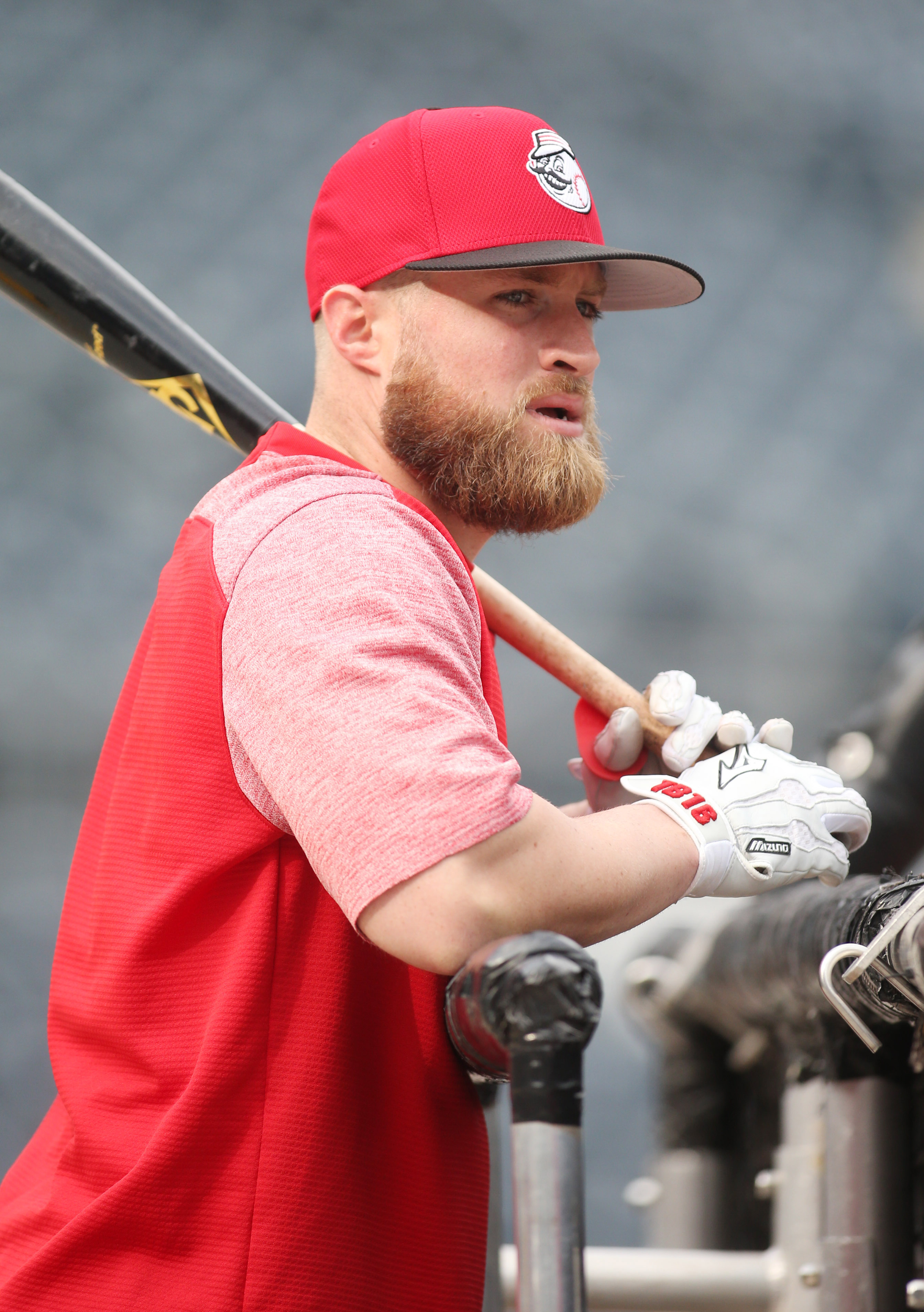 Zach Buchanan of the Cincinnati Enquirer reports that Barnhart will be guaranteed $16MM (Twitter link). That sum will paid out in the form of a $1.75MM signing bonus and annual salaries of $4MM (2018), $2.5MM (2019), $3.5MM (2020) and $3.75MM (2021). The 2022 option is valued at $7.5MM and comes with a $500K buyout, per Buchanan.
If the option is exercised, Barnhart would reach the open market in advance of his age-32 season having earned at least $23MM over the life of his new contract. Escalators could push the maximum value of the deal to as much as $24.5MM over five seasons.
“Tucker has made us proud on the field with his play and off the field with his community involvement,” said Reds president of baseball operations Dick Williams in a statement announcing the contract. “He worked his way up through our system, improving every step of the way, and has established himself as an elite defensive catcher and a productive offensive player. Switch-hitting catchers who can impact the game defensively are tough to find.”
Barnhart, a client of the Ballengee Group, was slated to reach free agency upon completion of the 2020 campaign, so this deal will lock in one of his free-agent seasons and give the Reds control over a second would-be free-agent year. He’d have been eligible for arbitration for the first time this winter, so Barnhart’s contract will also allow him to ever avoid needing to deal with said process.
While Barnhart is far from a household name, he’s quietly produced a quality 2017 season after emerging as the Reds’ primary catcher in 2016 due to Devin Mesoraco‘s persistent injury issues. Barnhart batted a respectable .257/.323/.379 for the Reds in a career-high 115 games/420 plate appearances last season, and he’s elevated his offensive profile in 2017 with a .272/.349/.399 slash. While some of his OBP is undoubtedly a product of batting eighth in a National League lineup, Barnhart typically demonstrated keen plate discipline throughout his minor league career (10.7 percent minor league walk rate) and has struck out in just 16.4 percent of his plate appearances this season.
Looking at the defensive side of his game, Barnhart has been nothing short of sensational when it comes to controlling the running game. He caught a well-above-average 33 percent of potential base thieves in the 2016 campaign and currently leads the National League with a gaudy 44 percent caught-stealing rate in 2017. Baseball Prospectus feels that he’s been the most valuable catcher in terms of throwing arm and one of the three best in terms of blocking pitches in the dirt this season. However, both B-Pro and Statcorner.com peg Barnhart’s pitch framing as well below the league average.
The Barnhart extension gives the Reds four players under contract through at least the 2019 season, although Raisel Iglesias figures to opt into arbitration this winter and, in doing so, forgo his guaranteed salaries for more sizable year-to-year paydays. Cincinnati also has Joey Votto and Homer Bailey earning a combined $48MM in 2019, and Barnhart will now join Votto as the only Reds player signed to a guaranteed deal in 2020 and in 2021.
While there’s very limited financial risk for the team in the first place, the front-loaded nature of the contract further reduces some of that risk. Barnhart seems likely to handle the bulk of catching duties next year, given the uncertainty surrounding Mesoraco’s health, or at the very least split the load in a fairly even timeshare. But, he’ll earn closer to backup catcher salaries as the contract wears on, should the Reds look to augment their catching situation with a more formidable offensive backstop.
As for Barnhart himself, he’ll lock in the first significant payday of his professional career. The former 10th-round pick signed a $250K bonus out of the draft and has earned at scarcely more than a pro-rated league-minimum rate to this point in the Majors. That his value comes more from controlling the running game and getting on base than accruing counting stats (homers, RBIs, etc.) would also likely have suppressed his earning potential in arbitration, giving Barnhart extra incentive to lock in his first fortune as a big leaguer.
Photo courtesy of USA Today Sports Images.
Padres Extend Clayton Richard
The Padres have announced an extension with lefty Clayton Richard, who had been slated to return to free agency. It’s a two-year deal with a $6MM guarantee and “minor” incentives, MLB.com’s AJ Cassavell reports on Twitter.

Since signing a one-year, $1.75MM deal over the winter, the 34-year-old Richard has operated as a full-time starter for the first time since 2012. While he carries only a 4.82 ERA, some underlying metrics suggest he has deserved better. Richard has recorded 6.6 K/9 and 2.7 BB/9 to go with a stellar 59.1% groundball rate. He has likely been at least a bit unfortunate to surrender a .348 batting average on balls put in play against him. And while Richard has been hurt by the long ball — he’s coughing up dingers on 19.7% of the flyballs hit against him — he has typically fared much better in that regard.
It’s uncertain whether Richard can sustain his promising showing, but he seems like a pretty reasonable pitcher to take a slight risk on. Richard’s two-seamer has averaged 90.7 mph, not far off his career average. And he has maintained last year’s surge in swinging-strike rate despite becoming a full-time starter; his 8.3% mark sits well above his 7.2% career level. Richard was quite productive while working mostly as a reliever in 2016 and certainly has shown an ability to succeed as a starter in the past; he posted sub-4.00 earned run averages for the Pads in that role in the 2010-12 seasons. Of course, Richard also has a history of shoulder problems that required surgical treatment.
For the Pads, locking up Richard now accounts for another rotation spot heading into the 2018 season. Youngsters Luis Perdomo and Dinelson Lamet seem quite likely to remain in the MLB staff and Travis Wood could still be an option despite his struggles. But with Jhoulys Chacin heading back to free agency, the Pads were looking at filling at least two openings.
Even with today’s move, the team could still add two rotation pieces over the offseason. Last year’s pursuit of budget-friendly veterans could be reprised; really, the Friars did quite well with Richard, Chacin, and Trevor Cahill, even if Jered Weaver proved to be a miss.
Whether or not it’ll make sense for the Padres to keep Richard in the rotation throughout the life of the deal will have to be seen. But he could have plenty of function regardless. The veteran southpaw could always slide back into a long relief or situational lefty role if others ultimately prove to be better starting options.
Photo courtesy of USA Today Sports Images.
Blue Jays Extend Marco Estrada Through 2018
It’s been previously reported on multiple occasions that the Blue Jays and right-hander Marco Estrada had mutual interest in a reunion, and that interest came to fruition on Wednesday. The 34-year-old Estrada, who was slated to hit free agency at season’s end, will instead forgo that opportunity in order to return to the Jays on a one-year, $13MM extension, the team announced. Estrada is represented by TWC Sports.
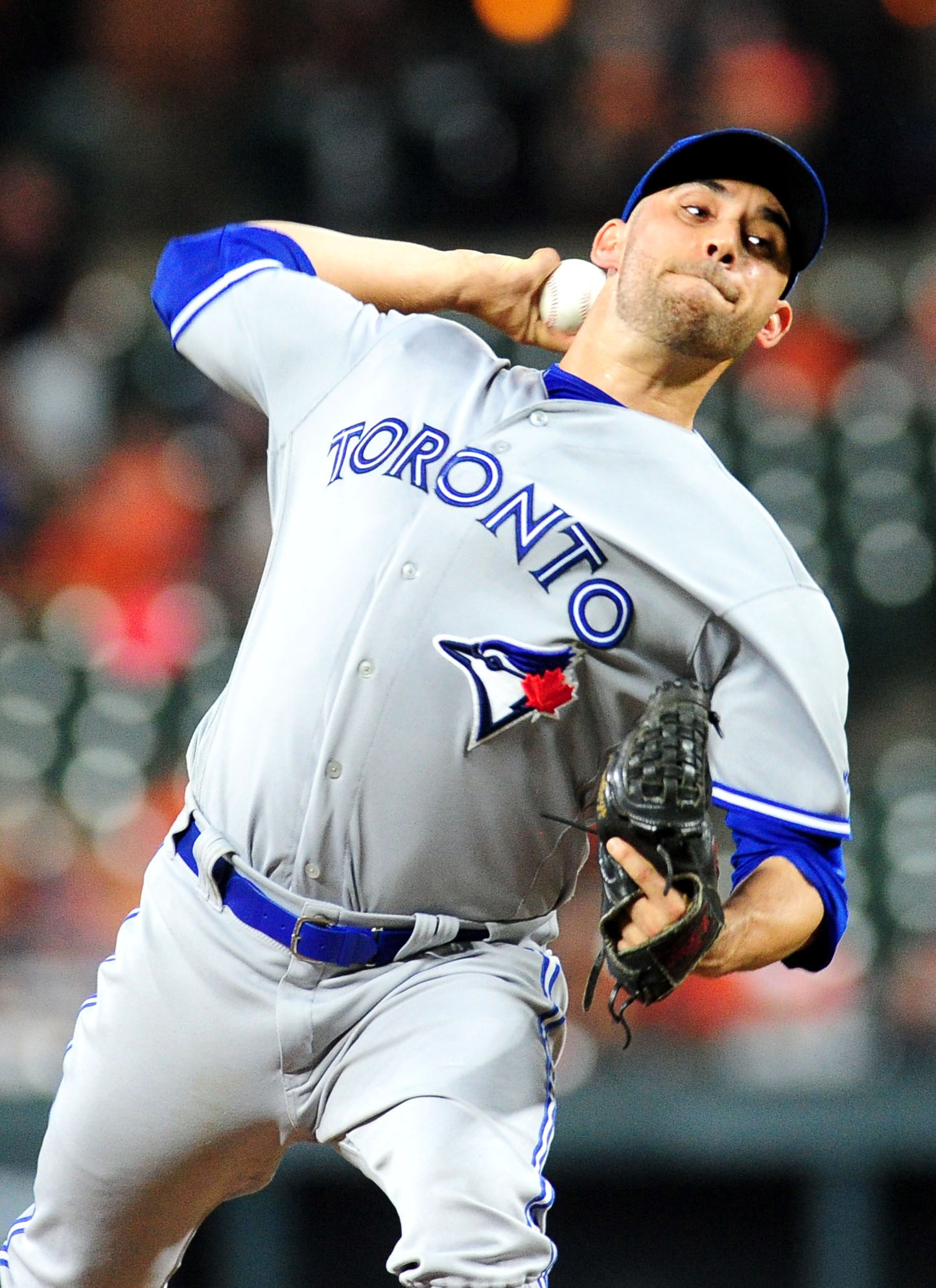 It’s been an up-and-down season for Estrada, who stormed out of the gates with a 3.15 ERA, 10.2 K/9 and 2.2 BB/9 through his first 11 starts before falling into a prolonged slump. Estrada would go on to yield 43 earned runs over his next 40 2/3 innings (nine starts) before once again largely righting the ship. In his past 11 outings, Estrada has turned in 3.74 ERA with 7.0 K/9 against 2.8 BB/9.
On the whole, Estrada’s ERA hasn’t fully recovered from the brutal stretch of starts spanning June to mid-July. He’s sitting on a 4.84 ERA with 8.7 K/9, 3.4 BB/9, 1.48 HR/9 and a 29.7 percent ground-ball rate. That grounder rate is the lowest of his career — a dangerous pairing with his lofty HR/9 rate. However, Estrada’s 31 starts are already a career-high, and he seems likely to top his previous career-high of 181 innings in 2017 as well. That’s no small feat for a player that was slowed tremendously in 2016 by a herniated disk in his back.
Estrada will slot back into the starting five behind Marcus Stroman, Aaron Sanchez and J.A. Happ next season, as the Jays hope for better health from their rotation (specifically, Sanchez and Happ). There’s no clear in-house option for the fifth slot in the rotation, as righty Joe Biagini has struggled in his first chance as a big league starter. Prospect Ryan Borucki posted quality numbers across three minor league levels, and veteran Brett Anderson has looked sharp in four starts as he auditions for a 2018 job. If none of those options entice president Mark Shapiro and GM Ross Atkins, the Jays will have myriad options from which to choose on the offseason free-agent market and trade market.
It’s been a disappointing overall year for the Jays, who opened the season with just one win in their first 10 games and never fully recovered. However, despite their poor performance, the Blue Jays never seemed intent to listen to trade offers for anyone controlled beyond the 2017 season. While Josh Donaldson and J.A. Happ drew plenty of trade speculation, the Blue Jays indicated that their intent is to field a contending team in 2018. Their lone trades involved Francisco Liriano (whose contract they ate, along with that of Nori Aoki, in order to effectively purchase young outfielder Teoscar Hernandez from the Astros) and setup man Joe Smith — both impending free agents.
Estrada, like Liriano and Smith, was set to be a free agent following the season and was a speculative August trade candidate. However, the Jays were only three games out of the AL Wild Card race when Estrada was claimed off revocable trade waivers, and they ultimately pulled the righty back after the claiming team (reportedly the Yankees) was more interested in blocking other contending clubs from getting their hands on Estrada.
Certainly, the team may alter its contention-oriented trajectory in 2018 if it stumbles out of the gates and finds itself similarly out of the postseason picture come July. At that point, there’d be plenty of sense in aggressively shopping Donaldson, Happ and Estrada as well, assuming each is healthy and performing reasonably well. For the time being, however, the Estrada extension serves as further proof that Toronto won’t be looking to market Donaldson this offseason and will instead try to supplement its core with an eye toward returning to the postseason for the third time in four years.
Jon Morosi of MLB.com reported that the two sides were nearing the deal and then that an agreement had been reached, as well as the terms of the contract (all links via Twitter).
Photo courtesy of USA Today Sports Images.
Drew Storen To Undergo Tommy John Surgery
Reds reliever Drew Storen will undergo Tommy John surgery, C. Trent Rosecrans of the Cincinnati Enquirer reports (on Twitter). A right elbow strain has prevented Storen from taking the mound since Sept. 1, which will go down as his final appearance of the year, and the injury led the Reds to place him on the disabled list a week ago.
In addition to ending his 2017 campaign early, the procedure is all but guaranteed to take Storen out of play for next season. The 30-year-old is due to hit free agency during the upcoming winter, but both the injury and his underwhelming production in recent seasons will work against him on the open market.
Storen, whom the Reds signed to a one-year, $3MM deal last January, pitched to a 4.45 ERA in 54 2/3 innings this season and posted some of the worst strikeout and walk rates of his career (7.9 K/9 and 3.79 BB/9). He also saw his velocity dip for the second straight year, which happened to be his second subpar season in a row. As a member of the Blue Jays and Mariners in 2016, Storen combined for 51 2/3 frames of 5.23 ERA ball. Only five qualified relievers have prevented runs at a worse rate than Storen’s 4.82 ERA over the past two years.
At his best, Storen was one of the game’s most effective relievers from 2010-15, when he worked as a setup man and a closer in Washington. Storen, whom the Nationals chose 10th overall in the 2009 draft, amassed 334 innings of 3.02 ERA pitching in D.C. and recorded 8.65 K/9 against 2.59 BB/9.
Reports From Japan Suggest Shohei Otani Will Request To Be Posted
Japanese star pitcher/outfielder Shohei Otani has long been on the radar as one of the most talented players on the planet who isn’t already with a MLB organization. He stoked expectations before the season that he might ask his current team — the Nippon Ham Fighters — to make him available to major league clubs through the posting system. Now, reports out of Japan tonight suggest that’s just what will occur (see, e.g., here).
Of course, given the indications given by Otani himself earlier this year, that news doesn’t come as a major surprise. Indeed, the expectation among major league teams has remained that Otani would become available, as ESPN.com’s Buster Olney recently reported.
It’s also worth bearing in mind that nothing is yet official, though the reports seemingly indicate that Otani has already made his wishes clear with club officials. We learned earlier this year that the Nippon Ham organization had largely committed to granting Otani his wish to leave for the majors whenever he requested it, even though the club can’t receive more than $20MM as a transfer fee and could have maintained control over the fascinating talent for a few more years under Nippon Professional Baseball’s system. That $20MM sum may change, Jeff Passan of Yahoo Sports reports, though he adds that the posting process is expected to continue operating in essentially the same manner — allowing any teams that are willing to pay the maximum fee to negotiate with the player.
Though Otani has not pitched much this year due to injury, perhaps that won’t have much of an impact. For one thing, he is considered an immense talent; if you’re interested in learning more about his projected abilities in the majors, be sure to check out this outstanding post from MLBTR contributor Chuck Wasserstrom. Further, the Japanese star isn’t really going to be looking for top dollar. At 23 years of age, he’s still two years shy of breaking free of the hard international signing limitations found in the new collective bargaining agreement, which effectively caps his potential bonus in the seven-figure range — a laughably small sum for a player who’d surely command nine figures were he available in a free market.
Otani, though, made clear in his prior comments that salary isn’t his chief consideration in pondering a move to the majors. Passan notes that MLB intends to be vigilant in enforcing the rules and will scrutinize any efforts to skirt them. Instead, he’ll weigh other factors, including his evident desire not only to pitch (where he’s considered most talented) but also to see action as a hitter. That’s not to say money won’t enter the equation at all; Otani’s precise approach remains to be seen. Notably, some teams will be able to offer quite a bit more money than others, with some capped at a meager $300K as a penalty under the prior system. And surely organizations will have different ideas on how they can help Otani earn more from endorsements and other sources. Regardless, as I wrote back in April, this sets up a fascinating potential market situation:
Should Otani become available, however, it would likely make for an unprecedented effort by major league organizations to woo him. That’s due not only to his unusual dual capabilities (and wishes), but also his young age and the unique circumstances of the rules limiting what he can be paid. Literally every team in the game would have cause to pursue him vigorously, particularly if the financial commitment is as meager as it seemingly must be.
That all remains true today, even as many of the league’s teams have begun sending emissaries over to Japan — in many cases, top baseball operations decisionmakers — to begin the unusual recruitment process. Any comparably talented young player would require a top draft choice or immense trade return to acquire. But for Otani — who, it’s worth bearing in mind, is considered ready to step directly into a major league rotation — a team need only be willing to pay the $20MM posting fee and whatever sum of international spending money it has available. Simply put, Otani could represent the most unique opportunity in contemporary hot stove history.
Rangers Release Tyson Ross
The Rangers announced Tuesday that they’ve released right-hander Tyson Ross in order to clear a spot on the roster for Willie Calhoun, whose previously reported promotion to the Majors has now been formally announced. The Rangers also activated Adrian Beltre from the 10-day DL, though Evan Grant of the Dallas Morning News tweets that he’s not yet ready to play. Calhoun is in the Rangers lineup tonight, playing left field and batting seventh in his MLB debut.
Ross, 30, was non-tendered by the Padres last offseason after shoulder troubles limited him to just one appearance in 2016. The right-hander spent much of the season attempting to rehab but was unable to get back to a big league mound after experiencing multiple setbacks. Ultimately, Ross was found to have the difficult-to-diagnosis thoracic outlet syndrome; he ultimately underwent surgery to alleviate the issue in October.
Texas signed both Ross and Andrew Cashner to one-year deals this past offseason, hoping that the pair of former Padres teammates could eventually solidify the final two spots in a contending rotation behind the likes of Yu Darvish, Cole Hamels and Martin Perez. Ross made his way back to the Majors early in the summer, right around the team’s projected timeline, but he’s looked like a shell of his former self through 49 innings in a Rangers uniform. In that time, Ross has more walks (37) than strikeouts (36), which has been the primary reason for his unsightly 7.71 earned run average.
The struggles of Ross and injuries elsewhere on the roster led the Texas front office to make the difficult decision to trade Darvish with just seconds to go as the non-waiver trade deadline loomed on July 31. That trade netted the Rangers Calhoun (in addition to minor leaguers A.J. Alexy and Brendon Davis), and Calhoun will now join a team that has somewhat improbably hung around the Wild Card race after trading away its ace back on July 31.
Rangers To Promote Willie Calhoun
The Rangers have given notice to prospect Willie Calhoun that he will be called up, as his brother and girlfriend announced on Twitter and Evan Grant of the Dallas Morning News confirms in a tweet. Calhoun came to Texas as the headliner in the deadline blockbuster that sent ace Yu Darvish to the Dodgers.
Calhoun, 22, entered the season as a top-100 prospect leaguewide and has steadily raised his stock throughout the year. He’s carrying a .300/.355/.572 batting line with 31 home runs over 534 plate appearances at Triple-A in his first attempt at the highest level of the minors. While he doesn’t draw all that many walks, Calhoun has struck out only 61 times all season.
Predominantly a second baseman in the Los Angeles system, Calhoun has shifted to the outfield since arriving at Round Rock. It seems reasonably likely that he’ll line up there at the MLB level both now and into the future, though that’ll be determined by his play on the field.
It’s not immediately clear how Calhoun will be used over the next couple of weeks, but he could provide instant offense with his potent left-handed bat. As Grant explains, the Rangers have recently lots several key players to injury. While there’s plenty of depth around with rosters having expanded, none of the team’s fill-in options possess Calhoun’s potential as a hitter.
Despite selling at the deadline, the Rangers have held on in a messy race race for the second AL Wild Card that still features seven clubs (including Texas) within three and a half games of the berth. Beyond the need to create room on the 40-man roster, there’s little downside to calling upon Calhoun, who likely would’ve forced his way into the MLB picture in 2018 regardless.
At this stage of the season, of course, the youngster won’t have much opportunity to build up MLB service time (just 18 days, in fact). But he could well find himself in a position to force his way into the team’s plans for early next season — and might well be a strong possibility to appear on a postseason roster if the Rangers can sneak in.
Alex Meyer To Undergo Shoulder Surgery
Angels righty Alex Meyer is set to undergo surgery to repair a torn shoulder labrum, the club announced. He is expected to be sidelined for approximately twelve months, making it unlikely that he’ll be able to pitch in the 2018 season.
Needless to say, the Halos continue to endure miserable luck when it comes to pitching injuries. A variety of other promising young hurlers have required major surgeries in recent years, too. While most of the earlier injuries are now resolved, Meyer joins Matt Shoemaker and JC Ramirez in going down for the remainder of the 2017 season.
Unfortunately, Meyer’s injury also appears to be the most serious. Labral tears can be overcome, but frequently aren’t. While the anticipated time off makes Meyer’s procedure seem something like Tommy John surgery, the odds that he’ll make a full return aren’t nearly as high as those of a typical TJ patient. Of course, there’s also an immense amount that we don’t known (and likely wouldn’t fully understand) about the nature of Meyer’s particular case.
Ultimately, it’s far too soon to know how this’ll all turn out, but it’s awful news for the 6’9 righty. Meyer has long dealt with problems with his shoulder, even while struggling to iron out a repeatable delivery that would allow him to harness his compelling raw stuff. The Angels acquired him in an interesting, four-player swap at last year’s trade deadline in hopes that Meyer could still make good on his talent.
Though he had largely struggled in the majors in prior action with the Twins, Meyer finally put together a run of success this year in Los Angeles. Over 67 1/3 innings across 13 starts, he worked to a 3.74 ERA. While he still dealt with control problems, handing out 42 free passes, he also racked up 75 strikeouts and limited opposing hitters to just 48 base knocks and six long balls.
There were plenty of encouraging signs for the former top prospect before he was knocked out with what was then described as shoulder inflammation. Meyer worked at his typical 96.5 mph average four-seam velocity and boosted his swinging-strike rate to a solid 10.7%. He also carried slightly above-average groundball (46.5%) and infield-fly (11.3%) rates. Meyer was never better than in his last outing, a one-hit gem against the Nationals — the team that originally drafted him out of the University of Kentucky.
From this point forward, Meyer faces a long road. Beyond the immediate surgery and rehab, he’ll be battling against a longer trend of health problems. Indeed, Meyer hasn’t thrown more than a hundred innings in a season (at all levels) since 2014. At this point, it’s fair to wonder whether Meyer will even look to return as a starter, or instead move into a relief role once he’s back to health.
In the end, though, there’s still hope that Meyer can return — and do so with the Halos. He will enter the 2019 season with just over two full years of MLB service, so Los Angeles can wait and see how things go without making any financial commitments. And if Meyer can indeed make it back, he’ll still have at least four years of team control remaining.
Michael Fulmer To Undergo Ulnar Nerve Transposition Surgery
Top Tigers starter Michael Fulmer will undergo ulnar nerve transposition surgery in his right elbow tomorrow, manager Brad Ausmus told reporters (Twitter link via Anthony Fenech of the Detroit Free Press). Katie Stang of the Athletic reported earlier today that the procedure was a possibility for Fulmer (Twitter link). MLB.com’s Jason Beck tweets that the procedure comes with a three- to four-month recovery period, which should put Fulmer on track to be back up to strength prior to Spring Training 2018.
Fulmer, 24, won American League Rookie of the Year honors in 2016 on the heels of a tremendous 3.03 ERA with 7.5 K/9, 2.4 BB/9 and a 49.1 percent ground-ball rate in 159 innings out of the Tigers’ rotation. The former Mets farmhand — Fulmer was acquired in the 2015 Yoenis Cespedes swap with New York — largely replicated that success to open the 2017 campaign. However, over his final seven starts of the season, Fulmer allowed five or more runs on five occasions, causing his earned run average to balloon from to 3.06 to its now season-ending mark of 3.83. The injury certainly explains that rough stretch, as Fulmer himself has recently cited numbness and tingling in his fingers when describing the reasons for a DL placement.
While an arm-related surgical procedure for a top young starter always carries a certain level of concern, there’s no indication at present that there’s a significant level of worry moving forward. Fulmer has time to get ready for Spring Training, and the Tigers certainly aren’t playing for much in 2017 after trading away the majority of their veteran core over the past year. For comparison, Mets right-hander Jacob deGrom also had surgery to re-position the ulnar nerve in his right arm last September and has returned to toss 188 1/3 innings thus far in 2018 (though certainly every injury situation has its own intricacies).
Fulmer had been a speculative trade piece for the rebuilding Tigers, though the chances of that have long seemed somewhat slim. News of an arm operation seems to further dampen that possibility, as Detroit is unlikely to sell a player that it controls for another five seasons when his value is at a relatively diminished level. Fulmer won’t be eligible for arbitration this winter, though he’ll very likely qualify as a Super Two player following the 2018 campaign.