
A.J. Minter Could Require Season-Ending Surgery
The Mets placed lefty A.J. Minter on the 15-day injured list due to a left lat strain this weekend, but he’ll be out far longer than 15 days. Manager Carlos Mendoza tells the Mets beat that Minter’s injury is “pretty significant” and could require surgery (video link via SNY). A final decision on surgery hasn’t been made yet, as Minter is receiving a wave of additional opinions. However, if the lefty does go under the knife, Mendoza acknowledged that the procedure would end his 2025 campaign.
It’s a brutal development for Minter, who spent the offseason rehabbing hip surgery and has been outstanding in his first 11 innings as a Met. The longtime Braves lefty has allowed only two runs on six hits and five walks with 14 strikeouts so far in 2025. That’s good for a huge 31.8% strikeout rate, albeit against a bloated 11.4% walk rate. Minter has kept a strong 48% of his opponents’ batted balls on the ground and turned in an above-average 12.4% swinging-strike rate.
Minter is one of four Mets relievers with a sub-3.00 ERA on the season (and three with a sub-2.00 mark). The Mets have seen closer Edwin Diaz struggle with command issues even as he’s gone 7-for-7 in save opportunities. Righty Ryne Stanek has also struggled with his command. The group of Reed Garrett, Jose Butto and Huascar Brazoban has been sharp thus far, but on the whole the Mets are lacking in established veterans to set up for Diaz.
More generally, the Mets are also light on lefties with Minter’s season now in jeopardy. Danny Young is the only currently healthy left-handed reliever in Mendoza’s bullpen (or on the 40-man roster). Brooks Raley just signed a one-year deal, but he’s still on the mend from last year’s Tommy John surgery. Genesis Cabrera is in Triple-A but is not on the 40-man roster and has not pitched well to begin the season.
Minter’s injury also comes with notable contractual ramifications for the Mets. A healthy version of Minter would surely have turned down the player option he faces at season’s end. He signed a two-year, $22MM deal over the winter even while recovering from hip surgery. If he’d been healthy and pitched anywhere close to his current level, he’d have been a lock to opt back into free agency.
If Minter undergoes season-ending surgery, he’d almost certainly decide to forgo that out opportunity in his contract. Even if he avoids surgery, it seems like he’ll be facing a monthslong absence, which significantly increases the chances of him exercising his $11MM player option. RosterResource already projects the Mets for $206MM of tax obligations in 2026, and that’s before factoring in player options (Minter, Frankie Montas, Pete Alonso), club options (Raley, Drew Smith) or arbitration raises (Francisco Alvarez, David Peterson and Tylor Megill, to name a few).
Braves Sign Eddie Rosario, Option Jarred Kelenic
The Braves announced Monday that they’ve signed veteran outfielder Eddie Rosario to a major league contract and optioned fellow outfielder Jarred Kelenic to Triple-A Gwinnett. In order to clear a spot on the 40-man roster, Atlanta designated righty Zach Thompson for assignment.
Kelenic’s demotion comes amid a calamitously poor start for the 25-year-old former top prospect. He’s opened the season with a .167/.231/.300 batting line and a massive 23 strikeouts in his first 65 plate appearances (35.4%). Those struggles come despite Kelenic being shielded almost entirely from left-handed pitching. The Braves have let him face a southpaw just six times in 2025. He’s hitless in those six plate appearances and has gone down on strikes in four of them.
Atlanta took on a series of underwater contracts through a convoluted sequence of trades in the 2023-24 offseason, effectively eating all of that dead money in order to purchase Kelenic from the Mariners. Seattle unloaded the remainder of its commitments to first baseman Evan White and left-hander Marco Gonzales in the original trade. Atlanta flipped Gonzales to the Pirates for a bit of cash and shipped White to Anaheim while taking back the unwanted contracts of David Fletcher and Max Stassi (the latter of whom was sold off to the White Sox). Atlanta took on more than $20MM in that sequence, and that’s before factoring in the luxury tax penalties required to do so.
It was an expensive gambit, and thus far, it simply hasn’t paid off. Kelenic had a below-average offensive output in 2024 and has clearly taken a further step back in 2025. Since coming to Atlanta, he’s turned in a .222/.279/.381 line with a 30.4% strikeout rate. The Braves, sitting last place in the NL East after a surprisingly poor start, cannot afford the luxury of a more patient approach with Kelenic. They’ve also seen Alex Verdugo and Eli White handily outperform Kelenic on the young season. That pairing will join Michael Harris II, Stuart Fairchild and the newly signed Rosario in the outfield mix while Kelenic hopes to benefit from a reset in Triple-A.
The 33-year-old Rosario will head to Atlanta’s big league roster for a fifth straight season. The Braves originally acquired him from the Guardians in a salary-dump deal at the 2021 trade deadline and watched the longtime Twins outfielder catch fire down the stretch. Rosario played a major role in the Braves’ 2021 World Series run, and they rewarded him with a two-year, $18MM deal to return to Atlanta that offseason. It didn’t pay dividends. Rosario had a brutal 2022 season and was league average at the plate in 2023. He signed with the Nationals as a free agent and wound up back in Atlanta after Washington cut him loose.
The Braves will be Rosario’s second big league stop this year. He very briefly played with the Dodgers, going hitless in four plate appearances before being designated for assignment. Rosario hasn’t had a full above-average season at the plate since 2020, his final year in Minnesota. In 1521 plate appearances for four teams since that time, he’s slashed .232/.278/.396 (82 wRC+). He could conceivably platoon with the righty-swinging White in one corner spot while the Braves await Ronald Acuña Jr.’s return from the injured list.
As for the 31-year-old Thompson, he’ll now be traded or placed on waivers within the next five days. Waivers would be a 48-hour process, if the Braves choose to go that route. Within a week’s time, Thompson will know the outcome of his DFA.
He’s appeared in two big league games with the Braves in 2025 and tossed 3 2/3 shutout innings. In 4 1/3 Triple-A frames, Thompson has allowed six runs (three earned) on seven hits and three walks with a pair of strikeouts. That’s his first action on a mound since 2023. The righty missed all of the 2024 campaign after undergoing surgery to repair a torn flexor tendon.
Thompson has seen major league time in two other seasons. From 2021-22, he pitched 196 2/3 innings, working primarily as a starter, between the Marlins and Pirates. He was sharp in his 2021 MLB debut with Miami but struggled after being traded to Pittsburgh in the Jacob Stallings deal that offseason. On the whole, Thompson carries a 4.36 ERA in the majors. He’s fanned 18.3% of his opponents against an 8.6% walk rate. Thompson doesn’t throw hard, sitting just 91.2 mph with his four-seamer, but he has a full slate of minor league options remaining and could make some sense for a team seeking affordable depth at the fifth spot in its rotation.
Walt Jocketty Passes Away
Former Cardinals and Reds general manager Walt Jocketty has passed away at age 74, as initially reported by USA Today’s Bob Nightengale. Jocketty was a fixture within baseball front offices for more than four decades, and he was the architect of the St. Louis team that won the 2006 World Series.
Cardinals chairman and CEO Bill DeWitt Jr. issued a statement in memory of Jocketty, stating “On behalf of the entire St. Louis Cardinals organization, I would like to offer our condolences to Walt’s family and his many friends. Walt was our first GM when we purchased the ball club, and he helped to lead our baseball operations through some of the franchise’s most successful and memorable years. He will be sorely missed, but long remembered for his distinguished career in baseball.”
Jocketty began his career working in the Athletics’ front office in 1980 as their director of minor league operations, and soon moved into another role as the director of baseball administration. During Jocketty’s 14-year run in Oakland, he helped draft and develop the core group of players that led the A’s to three straight AL pennants from 1988-90, as well as the 1989 World Series title. Jocketty moved on from the A’s to work with the Rockies in an assistant GM role for part of the 1994 season, but in October of that year, he received his first GM job when the Cardinals hired him to run their baseball operations department.
Tony La Russa was the Athletics’ manager for much of the team’s successful run in the late ’80s and early ’90s, and Jocketty’s past relationship with the skipper led to La Russa being hired as the Cardinals’ new manager prior to the 1996 season. That year saw the Cards win the NL Central and fall just short of the pennant with a seven-game loss to the Braves in the NLCS. 1996 was also one of only two winning seasons in Jocketty’s first five years with the Cardinals, though the team continued to amass talent — most notably another ex-Oakland staple in Mark McGwire, who launched his then-record 70 home runs in a St. Louis uniform in 1998.
Known for being a canny trader, Jocketty brought McGwire and many other star names to St. Louis during his 13-year run as the Cardinals’ general manager. Franchise icons Albert Pujols and Yadier Molina were also drafted and developed during Jocketty’s tenure, and this combination of both internal and external production again turned the Cardinals into a perennial contender. The Cards reached the playoffs six times in seven years from 2000-06, capturing two NL pennants and winning it all in 2006 for the Cardinals’ first championship since 1982.
Ironically, the 2006 team might have been one of the weaker Cardinals teams Jocketty put together, as the club won only 83 games in the regular season before catching fire in the playoffs. After the Cards posted only a 78-win season in 2007, Jocketty was fired following the season, as Derrick Goold of the St. Louis Post-Dispatch noted that there was something of a clash within the front office between Jocketty’s more old-school approach and the more analytical approach of then-Cardinals VP and future Astros general manager Jeff Luhnow.
It took Jocketty only a few months to land with the Reds in an advisory role, and just a few months after being hired, Jocketty was promoted to the GM job barely a month into the 2008 season. The Reds had losing records in every season from 2001-09, but in Jocketty’s third year on the job, Cincinnati got back on track by winning the NL Central crown. That was the first of two division titles and three overall playoff appearances for the Reds from 2010-13, as Jocketty again relied on an experienced veteran manager (Dusty Baker) and a homegrown star first baseman (Joey Votto).
Jocketty’s title changed to president of baseball operations following the 2015 season, as Dick Williams was promoted to the GM job as the first step in the Reds’ succession plan. A year later, Williams became Cincinnati’s PBO and Jocketty moved into an advisory role, and continued in various advisory capacities within the organization through the 2024 season.
We at MLB Trade Rumors extend our condolences to Jocketty’s family, friends, and colleagues.
Guardians Designate Triston McKenzie For Assignment
The Guardians announced that right-hander Triston McKenzie has been designated for assignment. They’ve selected the contract of righty Zak Kent from Triple-A Columbus in his place. The DFA marks the culmination of a lengthy period of struggle that dates back to 2023 for McKenzie, who once looked like a potential building block in Cleveland’s rotation.
McKenzie missed significant time in 2023 with a UCL injury that never wound up requiring surgery. He struggled before and after a pair of lengthy IL stints that season and has yet to regain his footing. He’s also out of minor league options, so the Guards couldn’t send him to Triple-A. McKenzie was one of a handful of notable out-of-options players we highlighted as a potential change-of-scenery candidate this spring. Given his pre-injury track record, it seems likely that another club will take a chance on him, presumably via a minor trade but at the very least via waivers.
Back in 2022, a then-24-year-old McKenzie broke out with 191 1/3 innings of 2.96 ERA ball. He punched out 25.6% of his opponents against a terrific 5.9% walk rate. That ostensible breakout came on the heels of a four-year run in which McKenzie ranked among the sport’s top-100 prospects. He didn’t throw hard, sitting 92.5 mph with his four-seamer, but he generated swinging strikes and chases on pitches off the plate at rates well north of the average pitcher. Given the right-hander’s prospect status and Cleveland’s penchant for churning out quality pitchers on a near-annual basis, McKenzie looked like the next in a long line of homegrown rotation arms to call Progressive Field home.
The previously mentioned UCL injury limited McKenzie to only four starts in 2023, however, and he looked like a completely different pitcher in 2024. The lanky 6’5″, 175-pound righty saw his average fastball freefall to 91.1 mph last year. His once-plus command was gone. He walked 14.4% of his opponents in 75 2/3 innings after having dished out free passes at a grisly 17.8% clip during that injury-ruined 2023 season. He allowed an average of 1.18 homers per nine innings during his standout 2022 season but saw that mark skyrocket to 2.26 per nine frames in ’24.
No longer able to entrust McKenzie with a rotation spot, the Guardians looked elsewhere to fill in the starting staff this winter. They acquired righty Luis Ortiz from the Pirates and re-signed Shane Bieber to a two-year deal (with an opt-out) while he mends from last year’s Tommy John surgery.
McKenzie opened the 2025 season in the bullpen. The Guards surely hoped that he could either find his footing as a reliever or pitch his way back into consideration for a starting role. Neither has happened. While McKenzie’s velocity is back up to an average of 93.7 mph on his heater, that’s likely due to him working in short-relief stints as opposed to being asked to face a lineup two to three times per outing. He’s pitched only 5 2/3 innings this season and been clobbered for seven runs. Command is still a glaring issue; he’s served up seven hits (including a homer), walked seven of his 30 opponents (23.3%) and already been charged with three wild pitches. McKenzie has only set down four batters on strikes.
Any team to claim McKenzie or acquire him via trade will at this point be rolling the dice on a reclamation project. McKenzie hasn’t worked more than 1 2/3 innings in a single appearance this season, so he’s also not presently stretched out enough to join someone’s rotation even if they want to take a look at him as a starter. He could be built back up on the fly, but that’s a tough task when already asking a player to switch teams and go through all the inherent, associated changes (learning new coaches and catchers, making tweaks to delivery and pitch selection, etc.).
The Guardians can trade McKenzie or place him on outright waivers at any point in the next five days. Waivers themselves are a 48-hour process, meaning his DFA will be resolved within a week’s time at most. He’s earning $1.95MM this season. An acquiring club would be on the hook for about $1.69MM as of this writing (or a bit less depending on when he’s claimed/traded). He’s controllable for two additional seasons beyond the current campaign.
Turning to Kent, he’s a former Rangers farmhand whom Cleveland acquired in a March 2024 trade that sent international bonus pool space back to Texas. He missed the majority of the 2024 season due to an elbow strain, however. The Guards designated Kent for assignment last summer, released him and quickly re-signed him on a new minor league pact. (Injured players cannot be placed on outright waivers.)
Today’s promotion puts Kent in line for his MLB debut. He’s healthy again and pitching well in Columbus, where he’s tossed 7 2/3 frames of relief and held opponents to a pair of runs. Kent has allowed three hits and fanned 10, though his four walks are higher than he or the team would prefer, and he’s also plunked a batter.
Kent ranked in the Rangers’ top 30 prospects from 2022-24, per Baseball America, and he’ll head to MLB with a solid track record at the top minor league level. Kent carries a lifetime 4.00 ERA in 92 innings across parts of four seasons there, although that number is skewed a bit by last year’s injury-marred season. Kent was rocked for an ERA north of 7.00 in 23 innings there, though it seems fair to suggest his elbow injury contributed to those struggles. He’s posted strong numbers in each of his other partial Triple-A seasons. Subtracting the injury-plagued ’24 campaign, Kent has a 2.88 ERA in 68 2/3 Triple-A frames.
Athletics To Promote Nick Kurtz
The Athletics are going to promote top prospect Nick Kurtz, reports Martín Gallegos of MLB.com. The A’s already have a 40-man vacancy, so they will only have to make a corresponding active roster move to make this official. Alden González of ESPN reports that Kurtz actually won’t be activated until Wednesday since he’s a left-handed hitter and the club is facing a lefty starter tomorrow, after today’s off-day.
Kurtz, 22, is one of the top prospects in baseball. He put up a .333/.510/.725 line in three seasons for Wake Forest, which led the A’s to select him fourth overall in last year’s draft. Since going pro, Kurtz has continued to mash.
He has appeared in 32 minor league games thus far, with appearances at Single-A and Double-A last year, followed by a jump to Triple-A this year. Combined, he has 147 plate appearances. His 24.5% strikeout rate is a bit high but he’s also drawn walks at a huge 15% clip and launched 11 home runs. He has a combined .336/.432/.689 line across those levels with a 171 wRC+, indicating he’s been 71% better than league average.
Coming into this year, before he even started mashing at Triple-A, Kurtz was considered one of the top prospects in the league. Baseball America initially gave him the #34 spot, though he has since jumped up to #32. FanGraphs put him at #31, MLB Pipeline has him at #35, ESPN at #52 and Keith Law of The Athletic at #35. All outlets generally heap praise on his combination of power and his work covering the plate. While he’s only capable of playing first base, he is considered likely to be a strong defender at that spot.
It’s a pretty aggressive promotion, with Kurtz having just been drafted less than a year ago, but his numbers certainly suggest he’s ready for the show. The question is now is how the A’s will line up defensively. Tyler Soderstrom has been the regular at first base so far this year and he’s having a great campaign. He and Cal Raleigh are tied atop the major league home run leaderboard with nine. That has helped him produce a .298/.362/.643 line and 191 wRC+ so far this year.
Using the designated hitter spot would be an easy way to get both Kurtz and Soderstrom into the lineup on a regular basis, except that Brent Rooker is the DH most days. Rooker has been a huge power bat for over two years now, launching 30 homers in 2023 and 39 last year. He already has six so far this year. He does strike out a lot but the overall contributions are still huge. The A’s clearly agree, as they signed him to a five-year, $60MM extension in January.
Rooker does have 955 career innings in the outfield corners but with poor numbers out there. He has tallied -17 Defensive Runs Saved and -16 Outs Above Average in that time, which is why the A’s have used him as the DH so often.
Soderstrom came up as a catcher but there were questions about whether he could stick back there defensively. The A’s haven’t shown much interest in moving him back behind the plate, especially with Shea Langeliers performing well back there.
Gallegos recently suggested that the A’s have considered putting Soderstrom at third, though that would be a pretty bold in-season move since he’s never played the position. The simplest solution for now would be to live with Rooker’s defense in left field, cutting into the playing time of Seth Brown and Miguel Andujar out there, with JJ Bleday in center and Lawrence Butler in right.
Time will tell how the A’s line it up. There are no guarantees that Kurtz will hit the ground running, as even the top prospects sometimes struggle when first promoted to the majors. For now, it seems to be the latest exciting development in a gradually coalescing position player core for the A’s. Recent years have seen guys like Rooker, Butler and Langeliers cement themselves as solid core pieces. This year, Soderstrom seems to be doing the same, alongside Jacob Wilson. The group has been coming together nicely, which made the A’s a somewhat trendy underdog pick for a playoff spot coming into 2025. If Kurtz is able to thrive quickly, that would obviously help.
The pitching group is perhaps a bit behind the hitters and the rebuild is still a bit of a work in progress, with the club currently 10-12. That puts them last in the American League West but it’s still early and they’re only three games back of the lead. It’s been a dreary stretch in the club’s history, with three straight losing seasons from 2022-24 and the agonizing bolt from Oakland. But there are now reasons for optimism during their detour in West Sacramento, so things seem to generally be trending well as the club gets ready to make a new home in Las Vegas in a few years.
At this stage of the season, Kurtz can’t earn a full year of major league service time, at least not the traditional way. That means the A’s will not be in position to earn an extra draft pick via the prospect promotion incentive, regardless of how Kurtz performs in awards voting. But as a top prospect, Kurtz can be retroactively awarded a full service year if he’s able to finish in the top two in American League Rookie of the Year voting this year.
Assuming for now that he doesn’t pull that off, the A’s will be able to control him for six seasons after this one, meaning he won’t be slated for free agency until after 2031. If he stays up from now on, he would be a lock for Super Two status after 2027, meaning he would have four passes through arbitration instead of three.
Photo courtesy of Rick Scuteri, Imagn Images
Rays Select Chandler Simpson
The Rays announced that they have selected the contract of outfielder Chandler Simpson. Outfielder Richie Palacios is heading back to the injured list with a right knee sprain. Right-hander Alex Faedo has been transferred to the 60-day IL as the corresponding move to get Simpson onto the 40-man. Faedo started the season on the 15-day IL due to shoulder inflammation. His current status is unclear but he’s now ineligible to return until late May at the earliest. Marc Topkin of The Tampa Bay Times reported the moves prior to the official announcement.
Simpson, 24, is one of the most interesting prospects in baseball on account of his base-stealing acumen. The Rays drafted him with the 70th overall pick in 2022, a Competitive Balance Round B selection. In his first full professional season in 2023, he stole 81 bases in 93 attempts, appearing in just 91 games. Last year, he got into 110 minor league games and swiped 104 bags in 121 attempts. He is 8 for 11 so far here in 2025.
His work at the plate has been competent enough, in a powerless sort of way. He has 1,120 minor league plate appearances thus far across various levels. He has just one home run, which was of the inside-the-park variety. But has walked more than he has struck out, a 9.6% rate of free passes compared to an 8.8% rate of punchouts. That has helped him produce a bizarrely level slash line of .324/.389/.371. That translates to a 123 wRC+, indicating he’s been 23% above league average overall.
It’s a very intriguing combination. Many recent speed specialists have had their production undercut by an inability to put the bat on the ball and/or get on base. Billy Hamilton spent many years as baseball’s fastest man but he hit just .239/.292/.325 in his big league career. While he was a good bet for 50-plus steals annually and some highlight-reel catches, the lack of offense made him difficult to roster. Guys like Juan Pierre, Rajai Davis and Dee Strange-Gordon were somewhat similar, swiping hundreds of bags but with subpar hitting.
If Simpson can get on base a bit more than guys in that group, perhaps he can be a bit more of a difference maker. Though even if not, a player with elite speed and can still be plenty valuable on the basepaths and in the outfield.
Prospect evaluators are a bit split on what kind of big league impact Simpson can make. FanGraphs is one outlet that is especially bullish, as they ranked him the #72 prospect in all of baseball heading into this season. They noted that his contact ability is almost at the level of guys like Luis Arráez and Steven Kwan, though a smidge below. However, they also caution that speed-and-defense players like Myles Straw and Nick Madrigal offer a sort of cautionary tale of how things could go wrong for Simpson with little offensive impact.
The report from FanGraphs also adds that the defense is a work in progress. Simpson was a second baseman in college and is still getting used to the outfield. They note that his routes aren’t always great but his speed gives him a lot of room for error. If he can continue to develop his routes, there’s a tremendous ceiling there.
ESPN gave Simpson the #91 spot heading into the season but Simpson didn’t crack the top 100 with Baseball America, MLB Pipeline or Keith Law of The Athletic. BA ranked him #8 in the Rays’ system coming into the year, seemingly with a bit more concern about the defense and lack of power.
The divisive scouting reports mean that the prospect promotion incentive is not at play here. To be PPI eligible, a player must be on two of the BA/ESPN/MLB Pipeline lists and Simpson only cracked one. It’s too late in the season now for Simpson to get a full year of service time. Even if he’s up for good, he won’t be able to qualify for free agency until after 2031, though he has a chance to reach arbitration after 2027 as a Super Two player.
The Rays have three outfielders on the IL in Palacios, Jonny DeLuca and Josh Lowe. Their outfield playing time has been going to Kameron Misner, Christopher Morel, Jake Mangum and José Caballero lately. Simpson will slot into that group and test his mettle against big league pitching.
Photo courtesy of Kim Klement Neitzel, Imagn Images
Twins To Promote Luke Keaschall
The Twins are going to promote prospect Luke Keaschall, reports Aaron Gleeman of The Athletic. He is not yet on the 40-man roster, so the club will need to open a spot for him. The club is off today, so that corresponding move might not be reported until tomorrow.

Keaschall, 22, was selected by the Twins in the second round of the 2023 draft. Since then, he has been cruising through the minors, showing strong plate discipline. He has taken 662 plate appearances across 147 games for multiple minor league clubs since being drafted. In that time, his 13.6% walk rate is almost as high as his 17.5% strikeout rate. That has helped him produce a combined .297/.415/.470 batting line and 151 wRC+.
He has shown other attributes as well. He has 38 stolen bases in 45 tries. Defensively, he has played the three non-shortstop infield positions as well as center field. He required Tommy John surgery in August but has already returned to the field, since position players can return from that procedure much faster than pitchers.
That performance has made him a consensus top 100 prospect. Baseball America has him at #43, FanGraphs at #56, MLB Pipeline at #57, ESPN at #43 and Keith Law of The Athletic at #62. Scouting reports on him generally heap praise on his abilities at the plate, with bigger questions about his defense. He isn’t considered especially strong anywhere in the field. If he can stick at second, there will be less pressure on him to hit, whereas eventually getting bumped to first base or an outfield corner will give him a higher bar to clear offensively.
Despite his obvious skills, it’s a bit of an aggressive promotion, probably faster than the Twins had initially planned on. As mentioned, he just had Tommy John surgery not too long ago. He has been back on the field, playing second base and serving as the designated hitter, but has yet to play his other possible positions.
In an ideal world, the Twins probably would have given him more time to build up his post-surgery repertoire but the injury bug has hit them hard, particularly in the infield. Royce Lewis is on the major league injured list while Austin Martin and José Miranda are each on the minor league IL. Carlos Correa and Willi Castro are each still on the active roster but both are banged up. Correa didn’t start yesterday due to some wrist soreness, with Castro getting the nod at shortstop. However, Castro was removed with some oblique tightness, forcing Correa to sub in defensively. In addition to all those infield injuries, outfielder Matt Wallner also landed on the IL today.
Those injury issues have left the Twins scrambling a bit. They acquired infielder Jonah Bride, who had been designated for assignment by the Marlins, in a cash deal. He has experience at all the non-shortstop infield positions. The Twins have Ty France and Edouard Julien getting regular playing time at first and second base, respectively. Brooks Lee should be able to cover shortstop or third. If Correa or Castro feel better soon, they would obviously be in the mix.
There’s also the designated hitter spot, which has mostly been filled by Trevor Larnach this year. However, Wallner’s injury might push him into the outfield more regularly, alongside Byron Buxton and Harrison Bader, with DaShawn Keirsey Jr. around as well.
Time will tell exactly how the Twins want to arrange the defensive alignments, but with so many key contributors on the shelf or banged up, they can use all the help they can get. Perhaps Keaschall and Julien will platoon a bit at second, since Keaschall is a righty and Julien a lefty, though the Twins presumably prefer to have a key prospect like Keaschall playing more regularly than in a short-side platoon role.
At this point, it’s too late in the season for Keaschall to earn a full year of service time, at least in the traditional way. That means the Twins will not be eligible to receive an extra draft pick via the prospect promotion incentive. It will be possible for Keaschall to retroactively earn a full year if he finishes in the top two of Rookie of the Year voting, though guys like Kristian Campbell and Jacob Wilson already have a headstart on him. It’s also possible that the Twins get some guys healthy again in the coming weeks and return Keaschall to the minors. Though if he continues hitting the way he has on the farm, he might make that a tough call for them.
Photos courtesy of Chris Tilley, Imagn Images
2025-26 MLB Free Agent Power Rankings: April Edition
The 2025 season is well underway, which for most baseball fans means there’s five-plus months of highlights, daily transactions, trade deadline drama, postseason races and an eventual World Series all still to come. That’s true for us at MLBTR as well, but we’re nothing if not offseason enthusiasts (or, put another way, sickos) — so this also presents a good opportunity to take a look ahead to the upcoming 2025-26 class of MLB free agents. Myself, Anthony Franco, Darragh McDonald and MLBTR founder Tim Dierkes (the aforementioned sickos) consulted with each other to form these rankings.
The top name long expected to headline the 202526 market actually won’t be on the market at all. Vladimir Guerrero Jr. already put pen to paper on a historic $500MM extension that will keep him in Toronto for an additional 14 seasons, from 2026-39. That might remove some of the drama from the top of next year’s class, but it’s nevertheless a star-studded group that could feature one of the ten or even five largest contracts in MLB history, depending on how the 2025 season plays out. There will also be at least one very high-profile star posted from Japan’s Nippon Professional Baseball, plus a pair of frequent Cy Young contenders and several other marquee names who have the ability to opt out of their current contracts.
As a reminder for longtime readers or an explanation for newcomers to MLBTR, our rankings are not necessarily a ranking of who the “best” players are in free agency. Rather, we sort our lists by perceived earning power. For instance, no matter how good a season 42-year-old Justin Verlander has, he’s not likely to rank ahead of a 30-year-old mid-rotation starter on our list, because the younger pitcher will be able to secure a larger guarantee on a long-term pact that won’t be available to a future Hall of Famer in the twilight of his career. Kirby Yates could have the best season of any reliever in MLB — but as someone who’ll be 39 in 2026, he won’t place all that highly because the length of his contract will be capped by his age.
As Guerrero and Juan Soto have recently proven, age is king when it comes to earning power. Major league front offices and owners will shell out for players in their mid-20s in a way they simply won’t for someone who reaches free agency at the more typical 30 or 31 years old. Teams want to be buying prime years, and while there are rare exceptions like Aaron Judge, most free agents who hit the market after already having turned 30 (and certainly after having turned 31) are viewed relatively tepidly — even coming off big seasons.
We’re quite early in the process right now, so this list will change as the year progresses. We’ll have multiple updates to our rankings over the course of the season, as injuries, breakouts and/or poor performances from potential top free agents impact the calculus. Note that players with club options are not included, but players with player options/opt-outs are included. Any player with a club option is going to have that option exercised if he plays well enough to otherwise be considered for this list.
With all of that in mind, let’s dive into the list.
1. Kyle Tucker, OF, Cubs
The Cubs traded a significant package of young talent for the final year of control over Tucker, shipping infielder Isaac Paredes, young starter Hayden Wesneski and 2024 first-round pick Cam Smith to the Astros in that headline-grabbing December swap. By all accounts, it was a weighty return for Houston even at the time — and that looks all the more true following the improbable scenario that saw all three of Paredes, Wesneski and — incredibly — Smith break camp with the team.
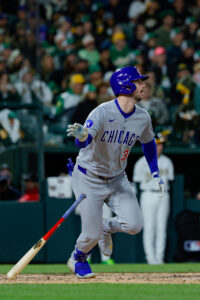
Chicago had good reason to pay a steep price. Tucker may not draw as much national fanfare as longtime teammates like Bregman, Jose Altuve and Yordan Alvarez, but when he’s healthy he’s among the best all-around players on the planet. The understated Tucker was selected just three picks after Bregman in 2016, going to Houston fifth overall. Like so much of the now-departed Astros core, he was a top prospect who graduated to the majors at a young age (21). It took a couple years for Tucker to truly cement himself in the Houston lineup, but he never looked back following a breakout in the shortened 2020 season.
From the time of a September call-up in 2019 through 2023, Tucker was consistently excellent. His “worst” full season in that time saw him deliver offense that was 22% better than league average, by measure of wRC+. His cumulative batting line of .277/.349/.517 checked in 36% better than par. Tucker continually bolstered his walk rate while reducing his strikeouts, hitting for power and chipping in quality baserunning and plus corner defense along the way.
Tucker was already a star heading into 2024, but he broke out as a full-fledged MVP candidate in a half-season’s worth of games last year. A fracture in his shin limited him to only 78 games, but when he was on the field, Tucker delivered a preposterous .289/.408/.585 batting line with 23 homers in just 338 turns at the plate. He walked in a career-best 16.5% of his plate appearances and fanned at a career-low 15.9% clip. He continued posting elite batted-ball metrics. Simply put, there were no holes in Tucker’s game — other than that untimely injury that truncated his sensational showing.
Cubs fans fretted this spring when Tucker struggled and Smith lit up Cactus League pitching, but now that the regular season is underway, the roles have reversed. Tucker looks as good as he ever has, while Smith looks very much like a 22-year-old who was rushed to the majors after just 32 minor league games. That’s not to say Smith’s future isn’t overwhelmingly bright, but as is often the case, spring narratives tend to look like a distant memory in a hurry.
Tucker is slashing a comical .324/.442/.648. He’s improved in nearly every season of his career and now stands as a 28-year-old MVP candidate with plus-plus offense, plus right field defense and deceptive baserunning acumen. Statcast only credits Tucker with 33rd percentile sprint speed, but he had an identical percentile ranking in 2023 when he nevertheless swiped 30 bases in 35 tries. He’s 97-for-110 in career stolen base attempts — a massive 88.1% success rate that proves you don’t have to be a burner to be excellent on the bases.
The icing on the cake for Tucker is that he won’t turn 29 until next January. He’ll play all of 2026 at that age. Most of the other bats on the market will be entering their age-30 seasons or later. Tucker is selling an extra year of his prime, and that will reward him handsomely. If he can sustain his 2024 pace over a full season, he could sign the fourth $400MM+ contract in major league history next winter, and at the very least, he’ll be in position to surpass Mookie Betts‘ 12-year, $365MM deal in Los Angeles. Tucker will receive and reject a qualifying offer, but he’s so clearly above the rest of the class that said QO will be a non-factor in his market.
2. Dylan Cease, RHP, Padres
Among the starting pitchers on this list, Cease boasts the best combination of youth, stuff and track record. His season clearly hasn’t started as hoped, though his 7.98 ERA is attributable to one bludgeoning at the hands of the A’s, who tagged him for nine runs. Cease has had relatively uneven results on a year-to-year basis, but he’s been baseball’s most durable starter since 2020 and the collective body of work is excellent. No one in MLB has topped Cease’s 145 starts since Opening Day 2020, and he sports a combined 3.64 ERA along the way.
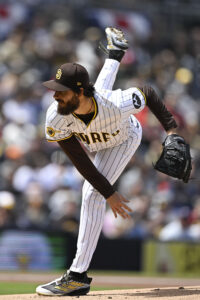
That earned run average is good, not great, but it’s skewed by a 2023 season in which Cease was tagged for a 4.58 ERA despite running his typically excellent strikeout numbers. Playing in front of a terrible White Sox defense that year, Cease was tagged for a career-worst .330 average on balls in play, which contributed to a career-worst 69.4% strand rate. It wasn’t all bad luck, as Cease also surrendered the most hard contact of his career, but metrics like FIP (3.72) and SIERA (4.10) thought he was quite misfortunate all the same.
On the other side of the spectrum, Cease’s 2022 season was utterly dominant. He finished runner-up to Justin Verlander in AL Cy Young voting on the back of a pristine 2.20 ERA with a massive 30.4% strikeout rate. At his best, Cease is an ace-caliber arm whose arsenal is headlined by a sharp bat-missing slider in the 88 mph range and a plus four-seamer that sits 96-97 mph annually. Cease will also mix in a knuckle curve and a changeup, but those are more show-me offerings complementing his dominant one-two heater/slider punch.
Cease is the youngest pitcher on these rankings, albeit only by a matter of a couple months in one case. He’ll pitch all of the 2026 season at 30 years old, however, meaning a seven-year deal would “only” run through his age-36 season. Eight years would take him through age-37. That’s the point at which most free agent mega-contracts for pitchers halt, though Max Fried notably signed through his age-38 season with the Yankees (an atypical stopping point, though arguably he received six- or seven-year money spread across eight seasons for luxury purposes).
With a strong season, Cease will have the best shot at cracking $200MM of any pitcher on this list. He should command at least six years, with a good chance at seven and an outside possibility of eight. If he’s not traded, he’ll receive and reject a QO, which should have little (if any) impact on his market.
3. Bo Bichette, SS, Blue Jays
Bichette’s 2024 season was a mess. He struggled through the season’s first two-plus months before a pair of summer calf strains landed him on the shelf — first for three weeks and then, a second time, for nearly two months. He returned for one game in September, suffered a broken finger in a freak accident during fielding drills, and required season-ending surgery. The end result? A 78-game season in which he hit just .225/.277/.322. Woof.
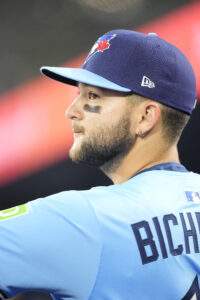
So far in 2025, Bichette is doing his best to put that injury-wrecked season behind him. He surprisingly hasn’t homered yet, but the 27-year-old is slashing .314/.364/.386 and absolutely stinging the ball. Bichette’s huge 52.5% hard-hit rate would be a career-best. His 91.7 mph average exit velocity and 9.8% barrel rate would be the second-best marks in his excellent young career. Bichette may not be hitting for power yet, but he’s blistering the ball and elevating it at career-high levels. His 41% grounder rate is a career low, and a comical 34.4% of his batted balls have been line drives. A 13% strikeout rate and 84.3% contact rate (95.1% in the zone) are career-best marks.
Any player seeing the ball this well and hitting the ball so authoritatively is going to see the power come around eventually. Statcast credits Bichette with an “expected” .365 average and .601 slugging percentage. Those numbers won’t hold over a full season, but Bichette is showing plenty of strong indicators that he’s playing at a level much closer to his 2019-23 form (.299/.340/.487, 126 wRC+) than his 2024 form.
Defense will continue to be a question mark. Bichette has never graded as a particularly strong shortstop, and he doesn’t display the sort of plus arm you’d see from someone who could seamlessly slide over to third base. He’d certainly have the range and hands for the position, but throwing-wise, it may not be an ideal fit.
That’ll be a point to consider for any club, but most will view Bichette as a young free agent who can handle shortstop for at least the first few seasons of his next contract. He may not be a plus defender, but he’s also not presently a liability who requires an immediate shift to another spot on the diamond. And, with Bichette playing the entire 2025 season at just 27 years old, he’s a much, much younger bat than any other prominent free agent this winter.
If Bichette’s early positive signs at the plate ultimately yield a rebound to his prior form, that age and production from a shortstop-capable middle infielder will likely push him north of $200MM. Even if he has only a partial rebound at the plate, his age, position and offensive upside should land him in the $140-175MM range we saw with other shortstops on the right side of 30 (Javier Baez, Trevor Story, Dansby Swanson).
4. Munetaka Murakami, 1B/3B, NPB (Yakult)
Some readers might be surprised to see Murakami’s name this high. Some may not be familiar with him at all. The 25-year-old slugger has been a star for Japan’s Yakult Swallows since he debuted at age 18, but he hasn’t necessarily garnered the international fanfare of countrymen Roki Sasaki, Yoshinobu Yamamoto and Shohei Ohtani — at least not yet.
That’ll likely change this year, so long as he remains a highly productive slugger. Murakami’s three-year deal with Yakult reportedly stipulates that he be posted following the 2025 campaign. He turned 25 just over two months ago, meaning that under MLB’s international free agent system, he’ll now be considered a professional who can sign with any team for any amount.
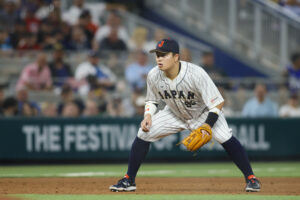
As previously mentioned, age is king in free agency. But if there’s a co-ruler, so to speak, it’s power and/or perceived upside. Murakami offers both in spades. The third baseman’s peak season came in 2022, when he posted a Herculean .318/.458/.711 batting line with a colossal 56 home runs and nearly as many walks (19.3%) as strikeouts (20.9%). He hasn’t replicated that absurd stat line since, and he’s become more strikeout prone in the two subsequent seasons. That includes a career-worst 29.8% rate in 2024.
Be that as it may, Murakami has been no worse than 53% better than average at the plate in Japan in each season dating back to 2020. Even as his offense “declined” in 2023-24, he popped 31 and 33 homers, respectively. Even if his 2022 season is an outlier, he’s slashed .250/.377/.486 with 64 homers during his age-23 and age-24 campaigns.
Murakami has been a third baseman in Japan, but the general expectation is that he’ll need to move to first base at some point down the road. Back in 2023, Baseball America’s Kyle Glaser rated Murakami as the No. 3 prospect in that year’s World Baseball Classic, trailing only Sasaki and Yamamoto. Glaser wrote that he can hit both high-velocity fastballs and quality breaking pitches while showing power to all fields. Listed at 6’2″ and 213 pounds, he’s credited with plenty of arm for third base but more limited range that could eventually force him across the diamond.
FanGraphs’ Eric Longenhagen has differing opinions in an updated report that’s reflective of Murakami’s 2023-24 downturn at the plate. Longenhagen points out that Murakami has hit just .154 on fastballs topping 93 mph in recent years but has outstanding recognition of breaking balls and “titanic pole-to-pole power.” He also credits him with enough improvements to stick at third base, even if he doesn’t project as a plus defender there.
Clearly, there are potential areas for improvement. But this list is based on earning potential, and if Murakami can cut improve his recent struggles against velocity, cut down on strikeouts and/or return to his 2022 level of power output, the defensive gains he’s made and his extreme youth could make him the most coveted non-Tucker player on this list. There’s a broad range of outcomes with Murakami, more so than any player on this list, but if everything clicks it’s feasible that he could sign one of the largest contracts of any player to make the jump from NPB to MLB. His performance will be well worth keeping an eye on. He’s already a two-time Nippon Professional Baseball MVP. Age and track record alone make him a candidate for a nine-figure deal, and a big enough performance could see him push for $200MM+ or even $300MM+, following in Yamamoto’s footsteps.
5. Alex Bregman, 3B, Red Sox
The mega-contract Bregman sought wasn’t quite there in free agency this past offseason. He reportedly received offers worth $156MM and $172MM from Houston and Detroit, respectively, before (by Bregman’s own telling) the Red Sox stepped up late with a hearty $40MM AAV on an opt-out-laden contract of three years. Heavy deferrals knock the net-present AAV down below $30MM, but Bregman opted for the short-term pact in hopes that a different market, a more steady performance than his uneven 2024 output, and a lack of a qualifying offer would bring him more compelling offers next winter. The $172MM offer from the Tigers reportedly deferred $40MM as well, though it’s unclear how far into the future that money would have been pushed and how the net present value would have been impacted.
So far, Bregman is out to a fine start, slashing .290/.342/.464 with a pair of homers in 76 plate appearances. Some of the same red flags that applied to his slow start last year are present again, however. His 5.3% walk rate is a career-low and nowhere near the 13.8% he posted from 2018-23. After his walk rate plummeted to 6.9% last year, it’d be more encouraging to see him showing a more disciplined approach. Bregman’s 21.1% strikeout rate would also be a career-worst over a full season. He has plenty of time to whittle that down, and a paltry 4.3% swinging-strike rate and career-high 88.9% contact rate suggest that might just be some small-sample smoke. From 2018-24, Bregman fanned in only 12.5% of his plate appearances.
Those superlative contact skills play a large role in Bregman’s overall appeal. At his best, he sported a plus walk rate and elite contact skills with good defense at third base and plenty of power. Detractors often point to the short left field porch from which Bregman benefited during his Houston days, but he was every bit as productive and powerful on the road as he was at the now-former Minute Maid Park (which was renamed to Daikin Park in 2025).
Bregman and the Boras Corporation can and likely will point to anything north of $160MM next offseason combining with year one in Boston to earn a net sum topping $200MM for his free agent years. That type of offer was present last winter, and with a typical Bregman season it ought to be once again. Bregman will turn 32 next March, which puts him on the old side for a top-end free agent, but that’s the same age at which Matt Chapman signed a six-year, $151MM extension — and did so without the benefit of the open market. Bregman is the most consistent offensive player and should reach or exceed that, so long as he stays healthy and productive this year. If he doesn’t, he has a safety net of two years and $80MM in Boston (plus another opt-out opportunity following the 2026 season).
6. Zac Gallen, RHP, Diamondbacks
Gallen is older than Cease but only by a matter of four months. He’s nearly two full years younger than Framber Valdez, as he’ll turn 31 in August of his next contract’s first year. He’s been durable himself, but not quite to Cease’s level; Gallen’s 132 starts since 2020 trail Cease by 13, and while he’s worked a bit deeper per start on average, he’s still 33 innings shy of Cease dating back to 2020.
The results, of course, are perpetually great. Gallen carries a combined 3.38 ERA through 756 2/3 innings since 2020. He misses bats at a slightly lower level (26.3% strikeout rate) but still sits comfortably above average. He also boasts better command than his current division rival, having walked a solid 7.5% of his opponents in this span.
Gallen, however, doesn’t have the same power arsenal as many of the pitchers on this list, which could hamper some of the interest. He’s going to be highly coveted, of course, but pitchers who average 93.5 mph on their heater aren’t going to have the same earning power as those who average three miles harder if all else is relatively similar. Modern front offices are drawn to velocity and strikeouts like moths to a flame. A healthy Gallen is all but a lock to cash in on a nine-figure deal, but he might come in a year under Cease and/or a few million dollars lighter in terms of average annual salary. Like Cease, he’s a slam-dunk QO recipient who’ll reject it without a second thought.
7. Framber Valdez, LHP, Astros
Before sharing and discussing our own personal, initial rankings of the top 10, Anthony Franco, Darragh McDonald and I had Valdez ranging everywhere from eighth to third. It’s fair to quibble and suggest that among pitchers specifically, he should land anywhere from No. 2-5 on these rankings since he’ll turn 32 shortly after the season and this is based on earning power. Age won’t be on his side. Very few free agents heading into their age-32 season can command five-plus years. Over the past decade, the only starting pitchers to command five or more years heading into their age-32 season or later are Blake Snell, Yu Darvish, Jacob deGrom and Zack Greinke (six, for Greinke).
Valdez may not immediately jump out as someone who should be mentioned in the same breath as that group of arms, but his results indicate otherwise. The left-hander truly broke out in 2020, solidifying himself in Houston’s rotation with a dozen starts of 3.57 ERA ball. He’s never looked back. Heck, he’s only gotten better.
Since 2020, Valdez touts a 3.11 ERA, 24% strikeout rate and 8% walk rate in 125 starts. That’s 20 fewer starts than Cease and seven fewer than Gallen over the same span, but innings-wise he’s ahead of both. Valdez is the rare 2025 pitcher who averages better than six frames per start, sitting just over 6 1/3 innings per appearance. He had a big jump in stuff over the course of that stretch, too. After averaging a bit better than 93 mph on his sinker from 2020-22, he’s sitting 94.7 mph on the pitch dating back to 2023. He had similar gains on his curveball and changeup, which now sit 79.9 mph and 90 mph, respectively.
Because Valdez has such a good changeup, he has virtually no platoon split of which to speak. Lefties have hit him at an awful .215/.313/.318 clip, while righties are just as feeble at .227/.300/.340. Valdez’s power sinker also makes him the sport’s premier ground-ball starter. The only pitcher with a higher ground-ball rate since 2020 (min. 300 innings) is St. Louis righty Andre Pallante, though he’s shuttled between the rotation and bullpen for the Cards. Valdez’s 62% clip since 2020 tops Logan Webb, who’s next on the list, by nearly four percentage points.
Valdez will be a 32-year-old starter with a qualifying offer, barring a midseason trade. Typically, that’s an unfavorable package. However, he’s one of baseball’s top innings eaters and top ground-ball pitchers. He has better-than-average strikeout and walk numbers, and he’s a lefty with mid-90s velocity. Valdez posted a 3.57 ERA or better in five straight seasons from 2020-24. He’s out to a brilliant start. If he can manage a sub-3.00 ERA, it’d be his third in four years. If he were 30 with this exact same track record and statistical profile, he’d probably be second on this list. As it stands, he could still reach or exceed $150MM even if his age caps him at five years.
8. Michael King, RHP, Padres
There are plenty of similarities between King and Gallen, as recently explored by MLBTR’s Anthony Franco in a piece for Trade Rumors Front Office subscribers. Next year is technically King’s age-31 season, compared to Gallen’s age-30, but the age gap is scarcely more than two months. July 1 is the cutoff point used in those distinctions; King turns 31 on May 25, while Gallen would follow on Aug. 3. Because King spent so much time as a reliever, he can credibly claim to have fewer “miles” (i.e. innings) on that right arm.
More importantly and more simply, King can just point out that he’s been outstanding over the past four seasons. He posted a sub-3.00 ERA in relief in 2022, went sub-3.00 in 2023 between the bullpen and rotation, and repeated the feat as a full-time starter in 2024. Since Opening Day in ’22, King touts a 2.76 earned run average with a terrific 28.9% strikeout rate against a solid 8.2% walk rate. He’s kept the ball on the ground at a roughly average 42.3% rate. Metrics like FIP (3.11) and SIERA (3.35) agree that he’s been excellent.
King’s track record in the rotation isn’t especially long, but two seasons of top-notch starting pitching will be more than enough to convince teams he’s a viable rotation cog. Given his recent track record and his strong start, there’s little reason to think he’s in for any kind of collapse. The main knocks against him will be pedestrian velocity — 93.7 mph on his four-seamer and 92.9 mph on his sinker since Opening Day ’24 — age and qualifying offer. King’s contract technically has a mutual option, but there’s no chance it’ll be picked up. He’s going to turn that down, reject a qualifying offer, and justifiably seek a nine-figure contract. He’ll have a comparable case to Gallen, and both have a clear case to move beyond the $115-120MM range previously established by Robbie Ray and Kevin Gausman.
9. Ranger Suarez, LHP, Phillies
Another currently 29-year-old starter who’ll pitch most of next year at 30, Suarez is down the list a bit because he’s currently on the mend from a back injury. When he’s healthy, he’s been a consistently above-average starter for the Phillies. From 2021-24, Suarez holds a 3.27 ERA, 22.3% strikeout rate, 8% walk rate and 53.4% ground-ball rate. He’s averaged 93 mph on his four-seamer and 92.2 mph on his sinker in that time, though both were down in 2024, when he missed a month due to a different back injury.
Consecutive seasons impacted by back troubles will be difficult to ignore, and as someone with closer to average velocity, the margin for error becomes thinner. Suarez won’t stick on the list if he struggles or sees further declines in his stuff upon returning, but a healthy Suarez is a playoff-caliber arm with better-than-average strikeout, walk and ground-ball numbers. He also keeps the ball in the yard despite playing his home games in a bandbox; in the past four years, Suarez has averaged just 0.77 homers per nine frames. He consistently limits hard contact, and his ground-ball rate is a perennial plus.
The track record isn’t as long, but there are some parallels with Max Fried. The former Braves and current Yankees ace has better command, but both are lefties who lack plus velocity, have closer-to-average strikeout rates than most top starters and offset those “flaws” with heaps of grounders and a penchant for weak contact.
Suarez needs to get healthy and hold up over his final 27 to 28 starts of the season. If he does, he’ll have a chance to crack $100MM in free agency. The track record here is stronger than that of Eduardo Rodriguez, who’s twice landed free agent deals in the range of $80MM. Suarez is clearly a better pitcher than either Jameson Taillon (four years, $68MM) or Taijuan Walker (four years, $72MM) at the time of those respective free agent agreements. He could push into the Ray/Gausman range.
10. Pete Alonso, 1B, Mets
It’s hard to draw up a better start to year one of a pillow contract than the Polar Bear’s .321/.431/.660 slash through 15 games. Alonso has gone deep four times in 65 plate appearances. We’re still firmly in small sample territory, but he’s walked at what would be a career-best 13.8% clip and has the same strikeout rate (nine walks, nine strikeouts thus far).
We can take those rates with a grain of salt, given that we’re talking about two weeks’ worth of games here, but Alonso’s approach has looked quite a bit better this year. He’s chasing off the plate at a career-low 20.1% rate, per Statcast. His overall 84.4% contact rate would be a career-best mark by a huge six percentage points. More specifically, Alonso isn’t whiffing when he does chase off the plate; his 69.7% contact rate on pitches off the plate is miles ahead of his career 55.8% clip.
Batted-ball data paints Alonso in a more favorable light than ever. He’s averaging a comical 95.5 mph off the bat and has struck 62.2% of his batted balls at an exit velo of at least 95 mph. In virtually every way possible, Alonso just looks like a monster through the first two-plus weeks of the season. There’s no telling if he can sustain those gains over the remaining 90% of the season, but he could scarcely be performing better.
When Alonso hit the market this past offseason, he did so coming off a pair of all-or-nothing campaigns at the plate. His strikeout rate had climbed in consecutive years, and his previously elite offense had settled in as more good than great. From 2023-24, Alonso hit .229/.324/.480. The power was still elite, but the rest of his offensive profile was far more pedestrian. By measure of wRC+, he’d been 21% better than average over a span of two years. Again, that’s quite good — it’s just not superstar-caliber offense. And, for a first-base-only slugger who could move to DH over the course of a long-term deal, “good-not-great” offense isn’t going to cut it. The market seemingly agreed.
If Alonso can sustain even 75% of this ludicrous start to his season, he’ll be in a much stronger position this time around. He’d hit the market on the heels of a stronger platform year and do so without a qualifying offer. He already rejected one last winter, and a player can only receive one QO in his career. Alonso banked $20.5MM in his final arbitration season and will earn $30MM this year. He’d be $106.5MM shy of the $157MM guarantee he reportedly rejected on the Mets’ extension offer in 2023. If he’s hitting anywhere close to this level, that’d be attainable on even a four-year deal.
Alonso’s appetite for leaving Queens could come into play here. By all accounts, he hopes to stay with the Mets in free agency last time around. The Mets took a measured approach and eventually kept him on a two-year deal with an opt-out. If their preference is again a shorter term, would Alonso be open to it? One would imagine he’d be more willing to take a high-AAV three-year pact for the Mets than for any other club, at the very least. With Vladimir Guerrero Jr. off the market, there’s no longer a clearly better and younger first base option for the Mets to pursue.
A lot of factors will influence Alonso’s earning power and whether he remains a Met long term, but the outrageous strength of his start has him back in the top-10 on our rankings, even though there are quite a few players who could push into this mix as the year goes on.
Honorable Mentions (listed alphabetically): Luis Arraez, Cody Bellinger, Shane Bieber, Walker Buehler, Zach Eflin, Erick Fedde, Jack Flaherty, Ryan Helsley, Ha-Seong Kim, Cedric Mullins, Josh Naylor, Tyler O’Neill, J.T. Realmuto, Kyle Schwarber, Lane Thomas, Gleyber Torres, Devin Williams
Justin Steele To Undergo Season-Ending Elbow Surgery
Cubs southpaw Justin Steele is slated to undergo season-ending surgery on his left elbow, manager Craig Counsell told reporters (including Patrick Mooney of The Athletic) this afternoon. Steele was placed on the injured list with elbow tendinitis shortly after his most recent start against the Rangers and was sent to receive a second opinion on the issue after undergoing an initial MRI on Thursday. Whether or not Steele will require a full Tommy John surgery or instead undergo an internal brace procedure is not yet clear. He won’t pitch again in 2025 in either case, but internal brace procedures typically come with a shorter recovery timeline of around twelve months, as opposed to the timeline for Tommy John, which can stretch up to 18 months and would likely impact much of his 2026 campaign as well.
It’s a gut punch for the Cubs and their fans, particularly given initial indications that Steele’s injury wasn’t especially significant. The southpaw told reporters after his placement on the IL last week that he was expecting a minimum stint on the shelf, and the injury did not initially appear dissimilar from the relatively minor elbow issue that caused him to spend two weeks on the shelf last September. When the club opted to seek a second opinion on Steele’s elbow, they suggested that recurring nature of the tendinitis was the impetus behind their decision to seek a second opinion in hopes of putting a stop to the problem in a more permanent fashion. Evidently, that will require the southpaw to go under the knife.
For at least the rest of 2025, that will leave Chicago without perhaps their most talented pitcher overall. Steele has drawn criticism over the years for his repertoire, which is generally limited to just a fastball and a slider aside from a handful of rarely-used tertiary offerings. Starting pitchers can rarely survive in the majors without at least three average pitches they can lean on, but Steele has managed to buck that trend. The unique properties of his fastball have allowed him to not only survive as a starter, but thrive. From the time he earned a job as a full-time starter in 2022 through the end of the 2024 season, Steele’s 3.10 ERA was sandwiched between Justin Verlander and Sandy Alcantara for the ninth-best figure in baseball. His 3.14 FIP also placed him within the top ten, and his 3.46 SIERA was good for 19th and placed him ahead of well-regarded aces such as Logan Gilbert, George Kirby, and Zac Gallen.
The southpaw wasn’t quite pitching up to that elite level in his first starts of the season. He was lit up to an ugly 6.89 ERA with a 19.4% strikeout rate in his first three starts of the year and, even as he mostly looked like his usual self in his latest start when he struck out eight Rangers across seven scoreless innings, his velocity has been down all year and averaged just barely 90 mph in that start against Texas. For a pitcher who usually sits around 92 mph, that’s a notable and concerning drop in velocity, but it’s nonetheless surely frustrating for the southpaw to be shut down just when he was beginning to turn a corner this year.
With Steele now out for at least the remainder of the year, the Cubs will need to hope for strong health from the remainder of their starting pitching options. Fellow southpaw Shota Imanaga will be leaned on heavily to step in as the team’s ace after a dominant rookie season in the majors where the 31-year-old managed a fifth-place finish in NL Cy Young voting and received an All-Star nod. Looking beyond Imanaga, fans in Chicago are left to hope that veteran Matthew Boyd‘s brilliant performance (1.59 ERA, 3.34 FIP) across his first three starts in a Cubs uniform are a signal that he’ll be able to remain healthy and effective this year after four consecutive seasons of injury woes. Righty Jameson Taillon looking anything like he did last season, when he posted a 3.27 ERA and 3.92 FIP in 28 starts, would also go a long way to helping make up for the loss of Steele.
Outside of that veteran trio, the Cubs have little certainty in the rotation. Youngster Ben Brown looked good against the Dodgers in his start against the club yesterday, but carries a 5.09 ERA on the year despite a 3.89 FIP. Veteran swingman Colin Rea has looked good in three scoreless appearances as a long relief arm this year and is filling in for Steele as a spot starter today, though whether that’s Chicago’s long-term plan or just what they’ve decided on for today’s game remains to be seen. Right-hander Javier Assad is presently on the injured list due to an oblique issue but could start a minor league rehab assignment at some point this month.
Aside from those big league options, the club has some pitching depth in the minors as well. Southpaw Jordan Wicks was scratched from his start with Triple-A Iowa last week, though it’s unclear if that was to preserve him as a possible option to start today’s game or due to an injury of his own. Brandon Birdsell was on the radar for a possible big league debut at some point this year, though a shoulder issue has kept him out of action since February with no timetable for return. Top pitching prospect Cade Horton has a 1.23 ERA and 38.7% strikeout rate in his first two starts with Iowa this year, but has not yet fully built up to five inning starts after missing most of last year with his own injury issues. Veteran righty Chris Flexen signed a minor league deal with Chicago over the offseason and remains at Triple-A with the organization as a potential innings-eater, if necessary.
That’s enough depth that the Cubs should be able to get by in the rotation for the time being without much issue, as long as they avoid another major injury. Even so, the eyes of fans in Chicago are surely already turning to the trade deadline this summer. It’s unlikely the Cubs would jump the market and swing a major trade for a starting pitcher this far from July 31, but if the club remains in a strong position to contend this summer it would hardly be a surprise to see them involved in the trade market. Marlins ace Sandy Alcantara is widely expected to be the top arm available, but Tyler Anderson, Chris Bassitt, and Michael Lorenzen are among a number of lesser arms on expiring contracts who could theoretically be available this summer depending on where their respective clubs find themselves in the standings come July.
Ryan Bliss To Miss 4-5 Months Due To Biceps Surgery
The Mariners today provided an update on infielder Ryan Bliss, who was placed on the 10-day injured list yesterday with a torn left biceps. Today’s announcement relays that an MRI confirmed the severity of the tear and the need for surgery, with an expected recovery timeline of four to five months.
It’s obviously a frustrating development for Bliss and the club. It’s unclear if that timeline includes an eventual rehab assignment or if it will take that long just to begin rehabbing. Either way, he will miss the majority of the campaign even in a best-case scenario and it seems possible that he won’t return in 2025 at all.
For the team, it’s the second big blow to their position player group in the past few days. Víctor Robles has a shoulder fracture and is expected to miss about three months while avoiding surgery, though that timeline could change if surgery eventually is required. Now Bliss is also going to be sidelined for multiple months.
Lack of offense was an issue for them last year and their infield was particularly concerning. Justin Turner and Jorge Polanco became free agents at season’s end, with Josh Rojas non-tendered as well. That left them with J.P. Crawford at shortstop and a few role players or unestablished young guys as candidates for the other spots. There were many offseason rumors surrounding their infield pursuits but they only made a couple of modest moves, bringing back Polanco to play third and signing Donovan Solano to chip in at the corners in a part-time/platoon role.
That left second base open for internal options, including Bliss, a nice opportunity for him. He came into 2025 with just 33 major league games under his belt but some intriguing minor league numbers. Over 2023 and 2024, he produced a combined line of .290/.378/.497 for various minor league clubs. That production led to a wRC+ of 120, indicating he was 20% above league average. He also stole 105 bases in 133 tries. The M’s acquired him from the Diamondbacks as part of the July 2023 trade that sent Paul Sewald to the desert.
Bliss hit just .200/.282/.314 to start this year but in a small sample of just ten games. He won’t be able to adjust that line any time soon. Between him and Robles, the club has to improvise a new lineup around two vacancies. Polanco is battling some knee issues and has been serving as the designated hitter lately. Luke Raley has moved from first base to right field to replace Robles, with Rowdy Tellez taking over at first, platooning with Solano. Dylan Moore, Miles Mastrobuoni and Leo Rivas figure to cover third and second base, at least until Polanco can take the field again. Cole Young is one of the top prospects in the league and could take over the keystone at some point but he is hitting .171/.292/.244 through 11 Triple-A games to start the year.
All clubs deal with injuries but it’s perhaps a little more concerning for Seattle. They didn’t have many resources available for upgrading their lineup this winter, giving them a somewhat narrow margin for error to begin the year. They have now limped out to a 5-8 start and will be without two lineup regulars for multiple months. Bliss should be moved to the 60-day IL whenever the Mariners need a roster spot.
Photo courtesy of Joe Nicholson, Imagn Images