
Blue Jays Extend Vladimir Guerrero Jr.
Vladimir Guerrero Jr. isn’t going anywhere. The Blue Jays have formally announced a 14-year contract extension for their superstar first baseman, one that guarantees the four-time All-Star a whopping $500MM from 2026-39. He’d previously been slated to become a free agent following the 2025 season. The contract does not contain any deferred money or opt-out opportunities but does provide Guerrero with a full no-trade clause, setting the stage for him to spend his entire career in Toronto. Guerrero is represented by PRIME.
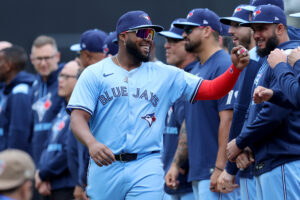
Notably, Ken Rosenthal of The Athletic reports that the $500MM will come in the form of a whopping $325MM signing bonus, paid out in annual installments over his contract’s 14-year term, with the remaining $175MM constituting his salary. That doesn’t change the luxury-tax picture for the Blue Jays, but it does provide tax benefits to Guerrero. Signing bonuses are taxed based on a player’s official residence, and although Guerrero plays his home games in Toronto, he’s legally a Florida resident, where there’s no state income tax. Further, Rosenthal rightly points out that signing bonuses are paid out even in the event of a potential labor stoppage, whereas player salaries could be withheld or prorated. Effectively, the mammoth signing bonus provides Guerrero an avenue and safety net to take home as much of that mammoth guarantee as possible.
It’s the second-largest deal in MLB history by measure of net present value, trailing only Juan Soto‘s 15-year, $765MM contract with the Mets. While Shohei Ohtani‘s deal with the Dodgers was originally reported as a historic 10-year, $700MM deal, the overwhelming slate of deferred money — $68MM annually — knocked the contract’s present-day value down to between $438MM and $461MM. Guerrero’s $35.714MM average annual value is technically the 12th-largest AAV in baseball history, although once factoring in deferrals in the contracts of Alex Bregman and Blake Snell, Guerrero could sneak into the top 10 with that hefty mark.
Guerrero rather famously set a deadline of the start of spring training that came and went without a deal. He left the door cracked for an agreement, however, stating that while he no longer planned to participate in back-and-forth negotiations, he’d listen to any offers the team presented and leave any contract talk to his agents. In the aftermath of that soft deadline, specifics regarding Guerrero’s asking price and a new, stronger offer from the Blue Jays came to light.
It’s not entirely uncommon for contract talks to continue beyond self-imposed deadlines if the sides are close enough, with Garrett Crochet standing as a notable recent example of a player who set a deadline (in his case, Opening Day) for extension talks before ultimately signing after said deadline had passed. Jackson Merrill, Ketel Marte, Brandon Pfaadt, and Kristian Campbell are among the other players to have signed extensions since the season began who presumably opened negotiations with their clubs during spring training.
Both previous talks between the sides and reports regarding the latest framework have centered around a 14-year pact. That’s a reflection of Guerrero’s youth, as he only just turned 26 years old last month. It’s a somewhat similar situation to that of Soto, who hit free agency right around his 26th birthday. Given his youth and talent, he was able to parlay a frenzied free agency into a record-shattering 15-year deal worth $765MM.
Prior to Soto moving the goalposts, the reported $500MM value of the deal Guerrero and the Jays are discussing would have been a record-breaking deal. As already noted, Ohtani’s ten-year deal is valued quite differently when weighing for deferred money; the MLBPA pegs his net-present annual value at $43.78MM, while the league itself posits a $46.06MM number. Ballparking the guarantee around $450MM was still a record at the time, with Mookie Betts and his $365MM holding the previous top guarantee. Ohtani’s overall guarantee and AAV both fell to a distant second with the Soto deal, and now Guerrero can now lay claim to passing him as well, given the lack of deferred money in his half-billion-dollar guarantee.
Guerrero’s track record isn’t quite as elite as that of Soto, who is in a class all his own as an offensive talent with a career wRC+ (158) in the same ballpark as Guerrero’s peak seasons. Even so, his numbers are excellent and he’s only a year older. When Guerrero is at his best, he’s the closest comparison to Soto in the game in terms of age and overall offensive ability.
For the Jays, Guerrero has been the face of the franchise for a long time. After the club’s postseason appearances in 2015 and 2016, they entered a quick rebuild period that saw them post losing records for the next three years. As such, many fans rested their hopes on an emerging core headlined by young prospects like Guerrero and Bo Bichette.
Guerrero’s initial major league work was good but not great, though it came at an age when most prospects are still playing in college or in the minors. He hit .269/.336/.442 over the 2019 and 2020 seasons for a 107 wRC+, indicating he was 7% better than league average at the plate. To be holding his own in the big leagues during his age-20 and -21 seasons was still a notable accomplishment, even if he wasn’t immediately playing at All-Star levels.
Any doubts about Guerrero’s ability to reach the ceiling he flashed as a prospect were quelled in 2021, as he hit 48 home runs, drew walks at a 12.3% clip and only struck out 15.8% of the time. His .311/.401/.601 batting line led to a wRC+ of 166. He would have won the American League Most Valuable Player award that year, if not for an absurd two-way season from Ohtani. Instead, he finished runner-up.
Guerrero couldn’t quite carry that MVP-caliber offensive output over into his next two seasons. He hit a combined .269/.341/.462 in 2022 and 2023 for a 125 wRC+. While that’s still strong production, it’s obviously a drop from his 2021 campaign, and 2023 in particular cast him as closer to pedestrian than superstar as he posted a 118 wRC+ with just 1.3 fWAR. Fortunately, Guerrero helped to quell his doubters when he cranked things back up last year, slashing .323/.396/.544 for a 165 wRC+ and finishing sixth in a crowded AL MVP field.
Taken in totality, the four years beginning with Guerrero’s 2021 breakout saw him produce a .293/.370/.517 batting line with a 10.2% walk rate and just a 15.2% strikeout rate. That’s 45% better than league-average after weighting for home park and league run-scoring environment, by measure of wRC+. And, as Guerrero’s minuscule strikeout rate indicates, he’s hardly just a one-dimensional slugger. He has some of the game’s best contact skills and pitch recognition, and he consistently delivers elite rankings in batted-ball metrics like exit velocity, hard-hit rate and barrel rate.
That’s not to say that there is no risk. Despite a 2022 Gold Glove Award, Guerrero’s defense is generally viewed as questionable and he’s not a burner on the basepaths. On any kind of massive deal like this, the signing club probably knows it won’t look pristine all the way to the final season, as the Tigers and Angels could tell you about their deals for Miguel Cabrera and Albert Pujols. The Jays will be hoping that they get piles of value from Guerrero’s prime years, both in terms of on-field and off-field value, in order to ease the pain of his eventual decline phase.
Certainly, it would have been cheaper to extend Guerrero earlier in his career, as players generally gain earning power as they get closer to free agency. However, Guerrero’s oscillating results perhaps gave the Jays pause about making a significant commitment to him. From Guerrero’s perspective, he was an incredibly talented prospect who received a hefty signing bonus and quickly put himself on track to reach free agency at such a young age. That gave him ample incentive to bet on himself, which presumably made finding a price amenable to both sides rather challenging.
The stars have aligned recently. Guerrero’s 2024 season seemed to prove that 2021 wasn’t a fluke. Meanwhile, the Jays have attempted to secure mega deals with other players and fallen short. They were heavily tied to Ohtani, Soto, Roki Sasaki and plenty of other players who would have been headline-grabbing acquisitions, but none on those pursuits panned out. Prior to today’s extension of Guerrero, the largest deal in franchise history was George Springer‘s $150MM guarantee on a six-year pact, which is now more than four years old. With president/CEO Mark Shapiro and general manager Ross Atkins both nearing the ends of their respective contracts and the Jays disappointing in 2024, it has been suggested they are under pressure for a big public relations victory.
The inability to close deals with marquee free agents like Soto, Ohtani and Corbin Burnes (among others) left the Jays with plenty of future payroll space to commit to Guerrero. Bichette, Chris Bassitt, Max Scherzer and Chad Green are all free agents at season’s end. After 2026, Springer, Kevin Gausman and Daulton Varsho are slated to hit the open market. José Berríos is under contract through 2028, but has an opt-out after 2026. Anthony Santander will have an opt-out chance after 2027. Andrés Giménez and Alejandro Kirk could be the two players making notable money still on the team by 2028 if those opt-out clauses are exercised, and Guerrero is the only player on the books beyond 2030.
The Guerrero extension takes the projected top free agent off next year’s market, leaving Kyle Tucker as the clear top bat available. Japanese slugger Munetaka Murakami will reportedly be posted ahead of his age-26 season, adding an interesting and likely very expensive wild card to the position-player market.
On the pitching side, Dylan Cease, Zac Gallen and Michael King will be some of the most attractive names. That will be a tough development for fans of other clubs but it could be a huge benefit to those other free agents, especially Tucker, who will become the uncontested best free agent hitter available in a market that looks increasingly starved for impact offense without Guerrero at the top.
Dominican journalist Mike Rodriguez first broke the news that the two sides were closing in on a deal worth at least $500MM. USA Today’s Bob Nightengale added that it was over a term of 14 years. Shi Davidi of Sportsnet first reported that an agreement was in place and that there were no deferrals, while his colleague Ben Nicholson-Smith added that the contract did not contain opt-out language. Jon Heyman of the New York Post reported Guerrero’s no-trade clause.
Photo courtesy of Brad Penner, Imagn Images.
Braves Acquire Rafael Montero From Astros
April 9: Houston is covering $7.7MM of Montero’s remaining salary, Charles Odum of the Associated Press reports. That’s on top of the $804K they’ve already paid him this year. In total, the Astros are paying about $8.5MM of Montero’s $11.5MM salary, leaving Atlanta on the hook for just a hair under $3MM. Montero joined the team today, per a club announcement, with Thompson optioned to open an active roster spot.
April 8: The Astros announced a trade sending reliever Rafael Montero and an undisclosed amount of cash to the Braves for a player to be named later. Houston recalled lefty reliever Bennett Sousa to take the vacated bullpen spot. Atlanta has not announced any corresponding moves. They had an opening on their 40-man roster after waiving Chadwick Tromp and do not need to make an active roster transaction until Montero reports to the team.
Montero, 34, is in the final season of a three-year free agent deal. He’s playing on an $11.5MM salary. The Astros are surely paying down the majority of that contract, though specifics on the cash have not been reported. Owner Jim Crane struck early in the 2022-23 offseason to re-sign Montero on a $34.5MM investment. That was in between the dismissal of former general manager James Click and the hiring of current GM Dana Brown. It did not work out.

The veteran right-hander was rocked for a 5.08 earned run average over 67 1/3 innings in the first season. He posted a 4.70 ERA while walking nearly as many hitters as he struck out last year. The Astros designated him for assignment around the trade deadline. That seemed like it would officially end his tenure in the organization. Montero had more than enough service time to elect free agency while collecting the rest of his contract.
Montero instead accepted an assignment to Triple-A after clearing waivers. He tossed 16 1/3 frames of four-run ball there to finish the season. Houston didn’t call him up last season but brought him back to Spring Training as a non-roster invitee. Montero allowed six runs (five earned) with 10 strikeouts and seven walks across 8 2/3 innings to earn his way back onto the MLB roster. He has made three regular season appearances, working four frames of two-run ball with five punchouts.
The 11-year big league veteran sits in the 95-96 MPH range with his four-seam fastball. He tweaked his pitch mix this year, according to Statcast. Montero added a mid-80s splitter while scrapping his low-90s changeup. That’s now his top offspeed pitch against lefty hitters. It’s too early to glean much from the results, but opponents have whiffed on five of 12 swings against it.
Atlanta evaluators were intrigued enough by Montero’s form to plug him into the middle innings. Daysbel Hernández and long man Zach Thompson each have options remaining. Lefty José Suarez is out of options but has a pedestrian 5:4 strikeout-to-walk ratio through his first four appearances. Montero figures to displace someone from that group — most likely Thompson — once he joins the team.
It’s purely a salary dump for Houston. They were never going to be able to shed the majority of Montero’s contract. Getting out from under even a small portion of the deal should give them more flexibility for deadline acquisitions. They’re within a few million dollars of the $241MM luxury tax threshold, which they seem disinclined to surpass. Whatever portion of Montero’s salary that the Braves assume will come off the Astros’ tax bill.
Image courtesy of Erik Williams, Imagn Images.
Octavio Dotel Dies In Roof Collapse Tragedy
Former major leaguer Octavio Dotel has died in a tragic accident, Major League Baseball confirmed. The news was first reported by multiple outlets in the Dominican Republic, including Diario Libre. The roof of the Jet Set club in Santo Domingo collapsed in the early hours of Tuesday morning. As of Tuesday night, at least 98 people have lost their lives while nearly 200 more were injured, according to The Associated Press. Dotel was 51 years old.
Exact details of the tragic situation are difficult to pin down, but it appears hundreds of people were in the venue for a concert when the collapse happened. Dozens of people have been pulled out alive but many have died and the figures are likely to change. Dotel was reportedly trapped for about 11 hours before being rescued and initially survived, but was declared dead after being taken to a hospital.
Dotel was well known to baseball fans because he pitched in the majors for over a decade and bounced around to various teams. He made his major league debut with the Mets in 1999, working in a swing role. He was traded to the Astros ahead of the 2000 season and continued to work both out of the rotation and the bullpen for a while.
He eventually moved into a primary relief role and had more success. Though his earned run average was over 5.00 in both 1999 and 2000, he posted a 2.66 ERA in 2001. He tossed 105 innings over 61 appearances, only four of those being starts.
He continued working as a solid reliever for years after that, bouncing to the Athletics, Yankees, Royals, Braves, White Sox, Pirates, Dodgers, Rockies, Blue Jays, Cardinals and Tigers. He finished his career with a 3.78 ERA in 758 games. He recorded 109 saves and 127 holds. He won the World Series with the Cardinals in 2011. He was a part of a combined no-hitter with the Astros in 2003. He retired in 2014.
We at MLB Trade Rumors send our deepest condolences to Dotel’s family, friends and fans, as well as the hundreds of others who have been impacted by this awful event.
Photo courtesy of Kelley L Cox, Imagn Images
Reynaldo López To Be Shut Down For 12 Weeks
Braves right-hander Reynaldo López underwent arthroscopic surgery on his right shoulder today. The club had previously said they wouldn’t know his timeline until the procedure was complete. David O’Brien of The Athletic reports today that manager Brian Snitker described it as a “clean up” procedure. The righty will be shut down from throwing for 12 weeks, which will take him into July, before being reexamined. Even if he is declared healthy at that point, he would need several weeks to ramp back up, meaning a return in August or September is perhaps the best-case scenario.
The news is obviously less than ideal, as López was a key member of last year’s rotation and was slated to be in that role again this year. Atlanta signed him going into 2024 and moved him to the rotation, even though he had been pitching in relief for a while. The gambit paid off, with López posting a 1.99 earned run average over 135 2/3 innings.
Making the move from the bullpen to the rotation still presented some challenges. He had a couple of stints on the injured list last year, one due to forearm inflammation and another due to shoulder inflammation. However, he was off the IL by the end of the season and seemed fine during this year’s Spring Training. But after just one start in the regular season, he landed on the IL again with more inflammation in that shoulder.
Shortly thereafter, the club announced that the arthroscopic procedure would be required. As mentioned, they didn’t expect to have a firm timeline until it was done, though they transferred him to the 60-day IL last week when they acquired Jason Delay. That suggested they didn’t expect him back before late May, but it seems he will actually be out well beyond that.
It appears there’s still a window for López to return late in the year though it appears to be a somewhat narrow one. His rehab could perhaps become an important development this summer, as the front office will have to decide how aggressively to pursue pitching at the deadline. As they are deciding on their plan of attack, López could be working his way back to the mound if he doesn’t experience any setbacks.
For now, the club is left with Chris Sale and Spencer Schwellenbach as the core members of the rotation. Grant Holmes and AJ Smith-Shawver earned the final two spots out of camp. When López hit the IL, Bryce Elder was recalled to replace him.
Spencer Strider seems to be getting very close to a return from last year’s UCL surgery. He tossed 5 1/3 scoreless innings in his most recent rehab start. That will likely push one of Elder or Smith-Shawver into a Triple-A optional assignment. Holmes is out of options but could get bumped to a long relief role, with current long man Zach Thompson then being optioned. Hurston Waldrep, Davis Daniel and Dylan Dodd are also on the 40-man.
The team is presumably operating with a bit less room for error than they were expecting. They entered the season as contenders but have gotten out to a dreary 1-8 start, the worst record in baseball. They will have to climb out of that hole without their big offseason addition, as Jurickson Profar received an 80-game PED suspension. López will be on the shelf even longer than that.
Photo courtesy of Denis Poroy, Imagn Images
Víctor Robles Likely To Miss About 12 Weeks
The Mariners today provided an update on outfielder Víctor Robles, who was placed on the 10-day injured list yesterday due to a left shoulder dislocation. Today’s update says that the dislocation caused a small fracture in the humeral head in his left shoulder. The club believes that the fracture will heal without surgery, though Robles will be continually monitored to ensure that is the case. Even if he does continue to avoid surgery, the club estimates it will take him six weeks to heal, followed by a six-week rehab process. That suggests he will miss about 12 weeks even in a best-case scenario.
Of course, if there are any setbacks along the way or if it’s determined that Robles will instead require surgical intervention, that timeline would change. In either scenario, given that Robles is already looking at an absence that would extend to around the All-Star break, doubts about his ability to return this season could arise. For now, however, the Mariners are surely relieved that the injury doesn’t look to be season-ending in nature.
Robles, 27, was a longtime top prospect with the Nationals who debuted in as a 20-year-old in 2017 but never quite found his footing as a regular in Washington. He looked on the cusp of a breakout when he hit .258/.328/.430 with plus defense in 2018-19, his age-21 and age-22 seasons, but in 1124 plate appearances from 2020 through the time of his release last May, he batted only .222/.301/.308.
The Mariners signed Robles to a big league deal early last June and were almost immediately rewarded for their show of faith. He filled a bench role early on but played so well in a limited role that he forced himself into the everyday lineup before long. In 77 games with Seattle, Robles turned in a superlative .322/.393/.467 batting line with four homers, 20 doubles and an eye-catching 30 steals in just 31 tries.
Robles was never going to sustain the .388 average on balls in play that propped up his batting line, but he also showed vastly improved contact skills, cutting the 24% strikeout rate he’d displayed from 2020-24 (27.3% with the Nats last year) all the way to 16.8% as a Mariner.
With Seattle, Robles proved much more aggressive, increasing his swing rate at pitches over the plate by several percentage points and also improving his contact rate on said swings. He swung at only 49% of pitches over the plate up through the 2023 season and made contact on 84.5% of those swings; with the Mariners, he offered at 53% of pitches in the zone and made contact at an 87.1% clip.
Even with some expected regression, the Mariners’ version of Robles looked like a more balanced hitter than the one who’d spent several years struggling in D.C. The Mariner front office clearly believed that to be the case, as Robles inked a two-year, $9.75MM contract covering his first two free agent years last summer. The deal spans the 2025-26 campaigns and includes a club option for 2027.
Now, Robles will spend around half of that contract’s first season (at least) on the shelf. He’d been slotted in as the everyday right fielder with Randy Arozarena in left field and Julio Rodriguez in center field. The Robles injury likely paves the way for more Luke Raley to see more outfield time. He’d originally been expected to play more first base in 2025, but a big performance in spring training from Rowdy Tellez forced the Mariners to reevalute. Seattle released Mitch Haniger and committed to Tellez and Raley splitting the load between first base and DH.
Raley and Dominic Canzone figure to get more time in the outfield. It’s also possible that utilitymen Miles Mastrobuoni and Dylan Moore could log some reps there. All three of Raley, Canzone and Mastrobuoni are left-handed hitters, so a platoon arrangement among them isn’t likely. Raley and the righty-hitting Moore could make sense as an on-paper platoon, but Moore has been used as an infielder exclusively thus far and played a career-low 138 innings in the outfield last year.
However it shakes out, the Robles injury is a significant setback for a Mariners club that currently ranks 21st in the majors in runs scored (36). It’s also likely to result in a defensive downturn; the early marks from Robles this season have been uncharacteristically below average, but he’s generally graded as a strong defender in center and is viewed as a potential plus defender in a corner.
No Structural Damage In Blake Snell’s Shoulder; Dodgers Hoping For Short-Term Absence
April 8: An MRI confirmed that Snell is not facing any structural damage in his shoulder, per the Orange County Register’s Bill Plunkett. His treatment will likely include an injection of some sort, but the team is hopeful the two-time Cy Young winner will only require a short-term absence.
April 6: The Dodgers have placed left-hander Blake Snell on the 15-day injured list due to inflammation in his throwing shoulder. The placement is retroactive to April 3. Right-hander Matt Sauer was called up from Triple-A to take Snell’s spot on the active roster.
Despite allowing eight walks in nine innings of work this season, Snell emerged with a 2.00 ERA over his first two starts of the season. It seems as if this shoulder issue developed in between Snell’s last outing on April 2 and a bullpen session today, as Jack Harris of the L.A. Times reports that Snell talked with GM Brandon Gomes and team trainer Thomas Albert in the aftermath of the bullpen.
This is the tenth visit to the injured list Snell has taken over his 10 MLB seasons, and today’s news continues his career-long theme of both health concerns and early-season issues. Snell is somewhat infamously a slow starter, with a 3.95 ERA over 555 2/3 career innings prior to the All-Star break, and then a 2.32 ERA in 500 innings over the second halves of seasons.
These splits notwithstanding, there are few pitchers in the game better than Snell when he’s in top form, as evidenced by his two Cy Young Awards. The 2024 campaign was another example of Snell’s hot-and-cold tendencies, as he signed with the Giants late in Spring Training and subsequently spent much of the first three months either injured or struggling, until the switch flipped and Snell posted a 1.23 ERA over his final 80 1/3 frames of the season.
Snell was encouraged enough by this spectacular finish to opt out of the final season (and $30MM) of his contract with the Giants, and that decision proved to be wise, as Los Angeles signed Snell to a five-year, $182MM free agent deal. The contract is worth “only” around $160MM-$165MM in current value since $65MM of Snell’s salary is deferred, yet it still represented the big long-term payday that eluded Snell in his previous trip to free agency.
The fact that Snell has already gone on the IL will bring some fresh questions about the Dodgers’ investment, yet there isn’t any indication that Snell’s shoulder inflammation is anything serious. It does leave the Dodgers in a bit of a tricky spot when it comes to filling Snell’s rotation spot, as Yoshinobu Yamamoto and Roki Sasaki are both only being used once per week, replicating the standard usage of a Japanese pitching rotation. Landon Knack, Justin Wrobleski, and Bobby Miller are the likeliest candidates to receive a Triple-A call-up and at least one spot start in Snell’s place.
In the bigger picture, Tony Gonsolin is on a Triple-A rehab assignment, and Clayton Kershaw (toe/knee surgeries) and Emmet Sheehan (Tommy John surgery) are expected to be available later in the season. Shohei Ohtani is also slowly ramping up his pitching workload in preparation of his mound debut in a Dodgers uniform, though it will still be at least a couple of months before Ohtani becomes available from a pitching perspective. In theory, Los Angeles has enough pitching depth available or eventually available to withstand another injury-riddled year like 2024, though Snell’s injury underlines the difficulty the Dodgers face in trying to maintain and preserve a staff of so many pitchers with significant durability questions.
Brewers Acquire Quinn Priester
The Brewers and Red Sox have announced a trade sending right-hander Quinn Priester from Boston to Milwaukee. In return, the Sox receive prospect Yophery Rodriguez, a Competitive Balance Round A draft pick in this year’s draft and a player to be named later or cash considerations. Milwaukee cleared a roster spot by designating left-hander Grant Wolfram for assignment and subsequently dealing him to the Orioles.

Priester, 24, is a former first-round pick and notable prospect. The Pirates took him 18th overall in 2019. As he climbed the minor league ladder, he was considered one of the top young players in the league. Baseball America ranked him the #58 prospect in baseball in 2022 and #88 in 2023. He was flipped to Boston at last summer’s deadline, a straight one-for-one swap which sent Nick Yorke the other way.
Despite his pedigree, he hasn’t broken through at the major league level yet. Between the Pirates and Red Sox, he has 99 2/3 innings pitched in the big leagues with a 6.23 earned run average. His 15.2% strikeout rate is well below par and his 9% walk rate is close to average, though his 55.2% ground ball rate is quite strong.
The minor league work has been stronger. He has thrown 184 Triple-A innings since the start of 2023 to the present. His 4.16 ERA isn’t especially impressive but he underlying numbers are better. He has a 25.8% strikeout rate in that sample and an 8.5% walk rate. He’s kept more than half of balls in play on the ground. His .318 batting average on balls in play and 66.9% strand rate are both on the unfortunate side, which is why his 3.44 FIP looks far more palatable than his ERA.
The Brewers have a strong reputation for working with pitchers, having helped many to reach their full potentials. Given Priester’s background and intriguing minor league numbers, it wouldn’t be a surprise to see him take notable steps forward in Milwaukee. He has less than a year of service time, so there will be long-term benefits if they can help him out.
On the other hand, it also seems like a hefty price to pay and a reflection of the current pitching predicament in Milwaukee. They currently have seven starting pitchers on the injured list, some of them unlikely to return in the short term. Brandon Woodruff missed the entire 2024 surgery recovering from shoulder surgery and is still working his way back. Robert Gasser had Tommy John surgery in June and won’t be available in the first half. DL Hall has a strained lat and is also on the 60-day injured list alongside Gasser, meaning he’s not close to a return. Tobias Myers and Aaron Ashby are both on the shelf with oblique strains. Aaron Civale has a hamstring strain. Nestor Cortes landed on the IL yesterday with a flexor strain.
That all leaves Freddy Peralta as the only healthy member of the club’s projected rotation. To patch together a staff around him, the club has had to reach deep into its alternatives. Tyler Alexander was to start the season in a swing role but has moved way up the chart. Elvin Rodríguez was pitching in Japan last year, mostly in relief. He signed with the Brewers in the winter but has options and was slated to start the season in the minors before the injuries. Chad Patrick just got added to the 40-man in November and was also projected for the Triple-A rotation until the bodies kept dropping.
As the injuries were piling up in the spring, the Brewers signed Jose Quintana, though he hasn’t been able to help them yet. Due to his late start, he agreed to be optioned in order to effectively do a delayed spring training and is still getting built up. Priester could jump right into the big league rotation this week, as his last outing was throwing four Triple-A innings on April 7th. He has one option year left, so he could be sent to the minors if other pitchers get healthy in the coming months and he gets pushed down the pecking order.
Getting immediate rotation help on the trade block is usually difficult at this time of year. Most clubs still think they have a shot at competing, especially in the age of expanded playoffs, and likely want to keep a robust stable of arms on hand. The high rate of pitching injuries in the modern game only enhances the need, as teams know they will need far more than five starters to get through a season.
But the Red Sox seemingly need Priester far less than they did when they acquired him. In the offseason, they made a few notable additions to the rotation mix. They acquired Garrett Crochet from the White Sox and signed Walker Buehler. They also signed Patrick Sandoval, though he’s recovering from UCL surgery and is still a few months away from joining their rotation.
The Sox had to start 2025 with Brayan Bello, Lucas Giolito and Kutter Crawford on the injured list, but that wasn’t enough to get Priester to the big leagues. They started the season with Crochet, Buehler, Tanner Houck, Richard Fitts and Sean Newcomb in the rotation. Cooper Criswell and Hunter Dobbins are also on the 40-man roster and capable of working in long relief roles or in the Triple-A rotation.
Both Bello and Giolito are on rehab assignments and should be with the big league club in the next week or two. They should slot in next two Crochet, Buehler and Houck. Dobbins is already back in Triple-A after serving as the 27th man in yesterday’s double-header. If the Sox want to keep Newcomb, they could move him to the bullpen while optioning Fitts and Criswell. As mentioned, Sandoval could be in the mix later in the year.
That’s a fairly healthy amount of rotation depth even without Priester in it, which seemingly allowed the Sox to feel comfortable moving on, even with the risk that further injuries throughout the season could cut into that depth.
As mentioned, most clubs aren’t very willing to part with notable starting depth this early in the season, so the Brewers have paid up to get some from Boston. The draft pick the Sox receive will be the 33rd overall selection this summer. That comes with a slot value of around $2.77MM, per Carlos Collazo of Baseball America. That’s a pretty nice chance to add some young talent to the system in a few months.

They are also adding young talent to the system today, getting Rodriguez and perhaps another player later. As for Rodriguez, he was a noteworthy international signing out of the Dominic Republic, with the Brewers giving him a $1.5MM signing bonus. He has played 165 professional games thus far between the Dominican Summer League, Single-A and High-A. He has a combined batting line of .254/.361/.408 in that time.
Baseball America ranked him Milwaukee’s #14 prospect coming into the year. They note that he’s likely to be moved off center field into a corner over time, which will put more pressure on his bat to carry the profile.
Still, from the Sox perspective, it looks like a nice bit of business. Priester didn’t appear to be in their short-term plans. He was on pace to be out of options next year and may have been on track to getting squeezed off the roster. By pulling the trigger today, they have subtracted a depth piece but added some notable future talent.
For the Brewers, despite all their injuries, they’re hanging in the race with a 5-5 record. Priester can hopefully help them stay afloat and has some future ceiling, given his past pedigree. If he clicks, he can be a long-term solution for them as well. Cortes, Civale, Woodruff, Alexander and Quintana are slated for free agency after this year. Peralta has a club option for 2026 but will be a free agent after that.
Wolfram, 28, was a somewhat surprising signing in the winter. He had previously spent his career in the minors with the Rangers, but reached free agency after 2024. The Brewers gave him a 40-man spot in December, though he’s still looking for his major league debut. He was called up yesterday when Cortes landed on the IL but optioned back down after the game.
The Brewers will now have a week of DFA limbo to figure out what’s next for him. The waiver process takes 48 hours, so any trade interest would need to be gauged in the next five days. Perhaps some club could be interested based on his minor league work, which is presumably what caught the eye of the Brewers. In the years since the minors were cancelled in 2020, Wolfram has thrown 249 minor league innings with a 3.94 ERA. He has a high 12.2% walk rate in that time but has also punched out 29.6% of opponents.
Hunter Noll of Beyond the Monster and BoSox Injection first reported the terms of the trade.
Photos courtesy of Kim Klement Neitzel, John E. Sokolowski and William Glasheen, Imagn Images
Rockies Promote Chase Dollander
TODAY: The Rockies officially selected Dollander’s contract, and optioned Bradley Blalock to Triple-A in the corresponding move.
APRIL 4: The Rockies are going to promote their top pitching prospect, reports Patrick Lyons of Just Baseball. Right-hander Chase Dollander will make his major league debut when he starts for the club on Sunday. There’s already an opening on the 40-man roster, so the club will only need to make a corresponding active roster move.
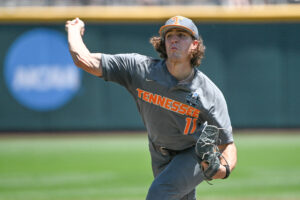
Dollander, now 23, has been a hyped-up name for a while now. He put up big numbers for Tennessee and was ranked as one of the top players available in the 2023 draft. The Rockies selected him with the ninth overall pick and then signed him to a slot-value bonus of $5,716,900.
He made his professional debut last year in impressive fashion. He tossed 118 innings over 23 starts, going from High-A to Double-A in the process. He allowed just 2.59 earned runs per nine, striking out 33.9% of batters faced while giving out walks at a 9.4% clip.
Going into 2025, the industry consensus is that he’s one of the top prospects in the league. Baseball America currently lists him #7 overall and MLB Pipeline #24. FanGraphs had him at #12 to start the season, but with the now-graduated Dylan Crews as one of the guys ahead of him. ESPN had Dollander at #14, though also behind Crews. Keith Law of The Athletic was more bearish, putting Dollander down at #75, with concerns about some of his results in Tennessee.
The Rockies reportedly gave some consideration to having Dollander in the season-opening rotation. They sent him to Triple-A Albuquerque instead, where he made one start, allowing one earned run over four innings. The big league club started the season with just four games before their first off-day, having Kyle Freeland, Antonio Senzatela, Ryan Feltner and Germán Márquez start those.
Austin Gomber likely would have had a fifth spot but he started the season on the 15-day injured list with shoulder soreness. He made a rehab start for Albuquerque but was scratched from making a second due to inflammation in that shoulder, per Thomas Harding of MLB.com. Perhaps due to Gomber’s setback, Dollander will get an early-season call-up.
The big unknown will be how Dollander handles the challenges of pitching at Coors Field, the most hitter-friendly venue in the big leagues. Geoff Pontes of Baseball America believes Dollander is well-positioned to succeed, even though plenty of other talented arms have struggled there. Pontes points out that pitchers with low release heights, such as Dollander, have previously fared well at Coors. The piece also cites the spin efficiency of Dollander’s fastball, which sits between 96 and 98 miles per hour, as a factor that could work in his favor. In addition that fastball, he throws a changeup, a curveball and another breaking ball that is characterized as either a slider or a cutter by various sources.
If Dollander can thrive at Coors, he could become the most important arm in the rotation for their next competitive window. The club has been losing for a long time now but have seen some young players come up and establish themselves as building blocks, such as Ezequiel Tovar at shortstop and Brenton Doyle in center field.
In the rotation, there’s little long-term certainty. Márquez and Gomber are impending free agents while the contracts for Senzatela and Freeland are only guaranteed through 2026, with options for 2027. It’s possible the Rockies sign new deals with those pitchers but they’re all in their 30s now regardless. At 23 years old, Dollander could potentially be the rock of the group for many years to come, if everything breaks right.
Though he wasn’t on the Opening Day roster, he is getting called up early enough to potentially earn a full service year in 2025. A baseball season is 187 days long but a player needs only 172 days on the active roster or injured list to get a full year. If he’s not optioned down to the minors at any point, he would be on track to qualify for free agency after the 2030 campaign, though a notable optional assignment would push that trajectory by one year.
If he does stay up, the Rockies would be eligible to potentially receive an extra draft pick. The current collective bargaining agreement introduced measures to combat service time manipulation. One such measure is that a team can earn an extra draft if they promote a top prospect early enough to earn a full service year. To qualify, a player must be on two of the three Top 100 lists of BA, ESPN and MLB Pipeline. The player must then win Rookie of the Year or place in the top three of MVP or Cy Young voting in their pre-arbitration seasons.
Those will perhaps be factors later in the year. For now, one of the best young pitchers in the game is coming up to the majors. Facing big league hitters for the first time is always a fascinating challenge for any pitching prospect but the interest level is arguably even higher in this case, given the unique circumstances of Coors Field and Dollander’s potential importance to the franchise.
Photo courtesy of Rick Scuteri and Steven Branscombe, Imagn Images
Diamondbacks Sign Ketel Marte To Extension
The Diamondbacks announced a new seven-year contract with star second baseman Ketel Marte. It’s a reported $116.5MM guarantee that comes with $64MM in new money. Marte, who had already been under contract for three seasons, is now signed through 2031. He can opt out of the deal after the 2030 season, when there’ll be at least $11.5MM remaining. There are also $33MM in escalators and performance bonuses for the QC Sports client. Marte receives a five-team no-trade clause, though that’ll become moot when he gets 10-and-5 rights early in the 2026 season.
The contract takes effect this year and breaks down as follows: $14MM in 2025 ($5MM of which is deferred), $15MM in ’26, $12MM in ’27, $20MM in ’28, and $22MMM per season between 2029-30. Each top-three MVP finish would boost the following year’s salary by $3MM; it’d go up by $2MM if he finishes between fourth and seventh in MVP voting. The deal also includes $2.5MM annually from 2026-31 in plate appearance incentives.
The news surely comes as a delight to fans in Arizona. The face of the Diamondbacks franchise first flashed superstar potential back in 2019, when he was an All-Star and finished fourth in NL MVP voting after slashing .329/.389/.592 (150 wRC+) in 144 games. In the years since then, he’s generally been an above-average player but not necessarily a superstar, slashing .275/.347/.462 with a wRC+ of 118 from 2020 to 2023. That narrative changed in 2024, however, as Marte rediscovered his MVP-caliber form during his age-30 season with a phenomenal .292/.372/.560 (151 wRC+) slash line that earned Marte his first career Silver Slugger award, a second All-Star appearance, and a third place finish in MVP voting behind Shohei Ohtani and Francisco Lindor.
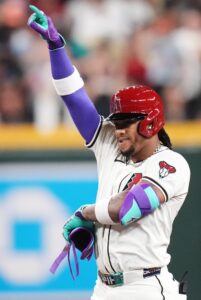
That’s the sort of elite production that makes for a phenomenal building block, so it’s not exactly a surprise that Arizona brass were interested in extending Marte’s stay with the club and making him a Diamondback for life. The club has often been aggressive about extending its top players under Mike Hazen, with this latest deal for Marte standing as the tenth extension agreed upon since he took over baseball operations in fall of 2016. It’s also the fourth of 2025, joining agreements the club reached with shortstop Geraldo Perdomo, reliever Justin Martinez, and right-hander Brandon Pfaadt.
More notably, it’s also the third extension of Marte’s career. His first came back in 2018 when he was a pre-arbitration player. The switch-hitter was guaranteed $24MM by that first deal, which ran through the end of his expected team control window but also afforded the Diamondbacks two option years on what otherwise would’ve been Marte’s first two years of free agency. Marte’s second deal came about just before the 2022 season began, ahead of his final year before those options would’ve kicked in. That deal overwrote those two option years and guaranteed Marte $76MM for the 2023-27 seasons, and also included a club option for 2028.
The second deal ended up covering just two seasons, as it has now already been overwritten to extend Marte’s stay in Arizona through at least 2030, with a player option that could push the deal into 2031. Given the fact that Marte was already under team control through the end of his age-34 season, it’s at least somewhat surprising that the Diamondbacks would decide to commit to their second baseman’s mid-30s this far ahead of time. After all, the club very easily could’ve waited to see how Marte would perform over the next two or three seasons before opening discussions with Marte prior to the 2028 season, when they would likely exercise their club option over his services.
With that being said, the deal not only extends Arizona’s years of control over their star, but also restructures his existing contract. Marte was slated to earn $50.8MM over the next three seasons on his existing contract. That number drops to just $41MM with his new deal, saving the club nearly $10MM over the next three seasons and $5MM in 2025 alone. That also does not factor in the $46MM in deferred money in the deal, which cuts down the amount of money owed to Marte in the short-term even further.
That the Diamondbacks would seek a restructured deal with Marte in order to save a bit of money in the short-term is understandable considering that the team is deep into uncharted financial waters. According to Cot’s Baseball Contracts, the club opened the 2025 season with a payroll of nearly $187MM. That’s an increase of $24MM over 2024, which was already the highest payroll in franchise history by more than $30MM. The club’s aggressiveness this winter in adding Corbin Burnes and swinging a trade for Josh Naylor was certainly admirable, but it’s long appeared likely that the Diamondbacks were likely stretching the limits of owner Ken Kendrick’s comfort zone.
If Arizona is facing the upper limits of its baseball operations budget, that could also explain the club’s reported insistence on suitors for struggling southpaw Jordan Montgomery eating at least $13MM of his $25MM salary for 2025 in trade talks as well as the club falling short in its pursuit of a top-flight closer this winter. Perhaps this restructured deal with Marte will offer them a bit more breathing room to work with at the trade deadline during an important 2025 season. After the current campaign, Montgomery and Naylor are slated to be joined by Zac Gallen, Merrill Kelly, and Eugenio Suarez in departing for free agency. That’s a lot of significant players who will need to be re-signed or replaced to avoid a step back in 2026, and it’s possible today’s restructuring of Marte’s deal could help the club fill those upcoming holes as well.
Mike Rodriguez first reported last night that the D-Backs and Marte were working on a new nine-figure contract. Nick Piecoro of the Arizona Republic was first on the $116.5MM guarantee, the $46MM in deferrals, the 2031 player option, and the salary structure. ESPN’s Jesse Rogers had the $11.5MM option value and the $149.5MM maximum after escalators. Piecoro had the escalator specifics.
Image courtesy of Imagn Images.
Red Sox Sign Kristian Campbell To Eight-Year Extension
The Red Sox announced that they have signed prospect Kristian Campbell to an eight-year contract extension which runs from 2025 to 2032 with club options for 2033 and 2034. It is reportedly a $60MM guarantee which breaks down as follows: Campbell, a Beverly Hills Sports Council client, gets a $2MM signing bonus and a $1MM salary this year. He will then make $2MM, $3MM, $4MM, $6MM, $9MM, $13MM and $16MM in the next seven seasons. The first club option is valued at $19MM and has a $4MM buyout, then the second option is worth $21MM. There are also escalators based on awards voting and All-Star selections. The Sox are buying out two of Campbell’s free agent seasons with the options allowing them to extend their window by two more years after that.
 Campbell’s stock has been shooting up for quite a while now. The Sox selected him with the 132nd overall pick in 2023, giving him a signing bonus of just under $500K. He played 22 minor league games just after that signing with a strong .309/.440/.471 line.
His success continued in his first full season. Last year, he vaulted from Single-A to Double-A and Triple-A, hitting a combined .330/.439/.558. That production led to a wRC+ of 180. He drew walks in 14.3% of his plate appearances while only striking out 19.9% of the time. He also stole 24 bases while lining up defensively at second base, third base, shortstop and in the outfield.
That huge season shot him up prospect lists heading into 2025. Each of Baseball America, MLB Pipeline, FanGraphs and Keith Law of The Athletic had Campbell among the top ten prospects in the entire league this winter.
That also got Campbell in line to make the majors this year, with second base eventually emerging as the best path. The outfield is already fairly crowded, with Jarren Duran, Ceddanne Rafaela and Wilyer Abreu in there now. Roman Anthony will join that group at some point soon. Then there’s Masataka Yoshida, who largely slotted in as the designated hitter last year. But with the Sox going with Alex Bregman at third and Rafael Devers as the DH, there’s no room for Yoshida in there. Bregman could perhaps opt-out after this year but the Sox could have Marcelo Mayer take over that spot, since Trevor Story has shortstop spoken for.
There are lots of moving pieces but Campbell nonetheless got the second base job to start the year. He actually had a fairly tepid spring showing but the club showed faith in him and he has hit .375/.500/.688 in his first five big league contests.
Though he has made his major league debut, this is effectively comparable to pre-debut extensions. As shown in MLBTR’s Contract Tracker, the benchmark for a guy with no service time is Jackson Chourio‘s eight-year, $82MM extension from just over a year ago. That topped the previous record, which was $50MM for Luis Robert Jr., a deal that’s a few years in the past. Campbell got past Robert but didn’t quite get to Chourio’s level but that’s fairly understandable. Campbell is turning 23 in June while Chourio was just about to turn 20 years old in March of last year, with that difference giving Chourio some extra earning power.
It’s perhaps not an accident that the club waited until after Opening Day to get this deal done. It was reported last March that players who sign pre-debut extensions, like Chourio, aren’t eligible for the prospect promotion incentive. To discourage service time manipulation, the current collective bargaining agreement put measures in place to encourage teams to carry top prospects on Opening Day rosters. One of those measures is that top prospects who are called up early enough to earn a full service year can earn their clubs an extra draft pick via awards voting.
Campbell came into this year as a consensus top prospect and cracked the Opening Day roster. That means he can earn the Sox an extra pick by winning Rookie of the Year or finishing top three in MVP voting during his pre-arb years. That would have come off the table if this contract were signed prior to the start of the season but is still in play for Boston now that they’ve waited a few days into the campaign.
For Campbell, it’s easy to see why he preferred to lock up this kind of money earlier in his career. As mentioned, he wasn’t a huge name going into the draft. While some players can earn multiple millions on their signing bonuses, Campbell was limited to under $500K. Even though he cracked this year’s Opening Day roster, he wasn’t going to qualify for arbitration until after 2027. This deal allows him to put some life-changing money in the bank ahead of schedule.
Even the top prospects will sometimes struggle in the big leagues and Campbell was a sort of surprise surger last year. If he hits any speed bumps in the coming years, he is financially secure. He is potentially limited himself in the future, though. If the two options are picked up, he won’t hit free agency until he’s going into his age-33 season.
For the Sox, they clearly believe the future is bright and have gained some cost certainty and control over essentially Campbell’s entire prime. Should he continue to thrive on the field in the coming years, he’ll be a relative bargain. Even when he’s making eight-figure salaries in the later years of the deal, that’s still well below what top players get on the open market.
It’s the second significant extension they’ve given out in recent days. They inked left-hander Garrett Crochet to a $170MM deal earlier this week. That was a different animal as Crochet is far closer to free agency and more established as a big leaguer.
Another key difference between the two is that Crochet’s deal doesn’t start until 2026 and therefore doesn’t impact Boston’s competitive balance tax number here in 2025, but the Campbell deal does. RosterResource calculates the club’s CBT number at $249MM, beyond the $241MM base threshold. Back in February, president Sam Kennedy said the club was already over the line and planned to stay there.
Christopher Smith of MassLive first relayed the $60MM guarantee. Julian McWilliams of CBS Sports first reported the option values. Alex Speier of The Boston Globe, reported the full annual breakdown and escalators.
Photos courtesy of Kevin Jairaj and Nathan Ray Seebeck, Imagn Images