
Report: Marlins Likely To Buy At Deadline, Keep Sandy Alcantara
The Marlins are the hottest team in baseball and they apparently want to keep it that way. Ken Rosenthal of The Athletic reports that the club is likely to make some additions ahead of the August 3 deadline and plans to keep right-hander Sandy Alcantara. The report mentions third base, the rotation and the bullpen as places where Miami will probably look to add.
The Fish have been ostensibly rebuilding since Peter Bendix took over as president of baseball operations, though that began in a slightly unusual way. Miami snuck into the playoffs in 2023 with 84 wins. Despite that, owner Bruce Sherman didn’t have faith in the long-term prospects of the club, given their weak farm system. He parted ways with general manager Kim Ng and hired Bendix.
After getting the job, Bendix had a very quiet offseason. Going into 2024, his biggest free agent signing was a $5MM deal for Tim Anderson. Even though the Marlins were coming off a postseason appearance, he didn’t hesitate to act as a seller. They got out to a slow start in 2024 and Luis Arraez was traded to the Padres on May 4. They ended up losing 100 games that year. They were more respectable in 2025, finishing at 79-83.
The most recent offseason didn’t suggest the club was moving out of rebuild mode. Their biggest free agent signing was a $13MM deal for Pete Fairbanks. They made some sell-side moves, flipping out pitchers Edward Cabrera and Ryan Weathers for prospects.
The early part of this season didn’t point to an end of the rebuild either. On June 7th, the Marlins were 31-35 and 14 games back of Atlanta in the National League East. But since then, as mentioned, they have been the best team in baseball. They are now 52-42 and only three games back. They are in possession of a Wild Card spot, at least three games clear of all the clubs below them.
That still doesn’t mean the Marlins are ready to fully commit to contention. Per Rosenthal’s report, the Marlins still don’t think their farm system is as strong as they would like it to be. Baseball America updated their farm system rankings this week and had Miami 20th. As such, the Fish probably aren’t going to throw a bunch of prospects on the table in order to make splashy trades. Rather, they might make more strategic additions. Rosenthal suggests the club could even trade from the big league roster in order to keep more prospects.
Bendix worked for the Rays for many years before coming to Miami. The Tampa club is known for often walking a fine line of buying and selling, as they balance short- and long-term needs. For instance, at last year’s deadline, they traded away big league players like Danny Jansen, Taj Bradley, Zack Littell and Curtis Mead while picking up Griffin Jax, Adrian Houser, Nick Fortes and Hunter Feduccia. This winter, they traded away Shane Baz, Brandon Lowe, Josh Lowe and others but also added Cedric Mullins, Ryan Vilade, Nick Martinez and more. Perhaps we will see Miami try to strike a similar balance, adding in some areas but subtracting in others, ideally helping in 2026 but without meaningfully hurting the club’s long-term trajectory.
It seems this approach will involve Alcantara staying in Miami. He has been in trade rumors for years, which is understandable since the Marlins have been willing to trade away so many starting pitchers over the years. However, there have been some reasons to expect him to stay. Rosenthal reported in May that the righty is a personal favorite of Sherman and is a leader in the clubhouse. Sherman effectively confirmed that report last week. As relayed by Jordan McPherson of The Miami Herald, Sherman appeared on Marlins Radio and spoke glowingly of the righty. “He’s our franchise icon,” Sherman said, “and for us, I look forward to many years in the future and what this all becomes.”
There is also the financial aspect to consider. Per MLBTR’s Payroll Tracker, the Marlins have the second-lowest cash payroll in the league this year at $83MM, ahead of only the Guardians. Miami’s $84MM competitive balance tax figure is last in the league. Alcantara is the highest paid player on the team, making $17MM this year. There’s a $21MM club option for next year with a $2MM buyout. That would be solid value even if he’s not quite the ace he was a few years ago.
There’s a nonzero chance the Marlins can’t have their payroll so low again next year. With the ongoing collective bargaining negotiations, the league is pushing for a cap/floor system. Their initial proposal had the floor at $171.2MM, more than double what the Marlins are currently paying. The MLBPA won’t agree to that system but even their proposal included a soft floor and other measures designed to get smaller clubs to spend more.
It’s too early to tell how those negotiations will play out but the Marlins have to at least plan on what they will do if they are forced to spend more money in the future. In that scenario, it makes more sense to extend Alcantara than to trade him, since removing him from the books would put them even further away from a solution.
Rosenthal floats the possibility of the Marlins taking on some money at this year’s deadline, as that would be a way to minimize the prospect capital needed to acquire players. However, he also suggests the Marlins aren’t likely to go after a big commitment such as that of Matt Chapman. The Giants would surely love to find a taker for Chapman since he is owed $100MM over the next four years, on top of his remaining salary this year. But while the Marlins are still waiting to see what the next CBA looks like, they aren’t likely to be interested in something like that, even if Chapman were willing to waive his no-trade clause and move to Miami.
It’s possible the club could take on money in smaller ways, perhaps on impending free agents. The Giants have Robbie Ray and Tyler Mahle, both making eight-figure salaries. If they want to just dump those contracts, perhaps the Marlins could agree to take them on while sending marginal prospects the other way. It’s unclear if the Giants would be open to that. They certainly want to open up long-term payroll capacity, but for short-term deals, they might be willing to eat money in order to secure better prospect returns.
Turning to the possibility of the Marlins trading from the big league roster, Rosenthal floats catcher/first baseman Liam Hicks as someone who would garner interest from other clubs. A Rule 5 pick last year, he produced league average offense in 2025 while playing competent defense at his two positions. He has been even better at the plate this year, with a .286/.358/.459 line and 123 wRC+.
That kind of production is useful for the Marlins but they also have other options for the spots Hicks plays. Kyle Stowers came up as an outfielder but has become Miami’s regular first baseman lately. He is hitting .243/.327/.467 on the year for a 114 wRC+. Catcher Joe Mack began this year in the minors but has now put 50 big league games under his belt with roughly league average offense and really strong defense.
Hicks has been occasionally playing those two spots while mostly serving as the designated hitter. If the Marlins were willing to move on from Hicks, they could keep Stowers at first with Mack behind the plate. Brian Navarreto is already on the roster as a backup catcher. The DH spot could then be used to rotate various guys through, or the Marlins could pick up another bat in trade. Rosenthal mentions Agustín Ramírez, who is currently on optional assignment. He’s a poor defensive catcher but decent hitter, so perhaps he could replace Hicks in the role of a guy who mostly hits but can catch occasionally. They would surely get plenty of interest in Hicks, given his production. He is also still pre-arbitration and controlled for four more seasons, which only adds to the appeal.
Turning to the needs, Rosenthal mentions a back-end starter, which makes sense for the club. They have a strong front-end of their rotation with Alcantara, Eury Pérez and Max Meyer, but things get shaky from there. They lost Robby Snelling to Tommy John surgery after just one start. Prospect Thomas White has a capsular strain and might miss the remainder of the season. Tyler Phillips and Janson Junk are doing serviceable work in back-end jobs but the depth isn’t strong at the moment. Pérez and Meyer also have workload concerns, so bolstering this area makes plenty of sense.
Earlier this week, as part of MLBTR’s Trade Deadline Outlook series for Front Office Subscribers, Anthony Franco threw out Mahle, Eric Lauer and Brady Singer as theoretical targets for back-end starters who wouldn’t cost much. Those are just a few of many possibilities.
Rosenthal also mentions a leverage reliever as a possible addition. The Miami bullpen has actually been good overall, with a collective 3.73 ERA that puts them seventh in the league. But they recently lost Anthony Bender and John King to the injured list.
Also, Fairbanks is struggling, with a 6.75 ERA on the year. It’s possible that’s just bad luck, as his .328 batting average on balls in play and 54.9% strand rate are both to the unfortunate side while his 30.2% strikeout rate is quite good and his 9.5% walk rate close to average. His 4.79 FIP and 3.34 SIERA suggests he has deserved far better, but it’s understandable that the Marlins would look to bolster their late-game mix regardless. There are dozens of relievers who could be available, including Luke Weaver, Kirby Yates and more.
At third base, Javier Sanoja is getting most of the playing time these days. He is having a decent season but he can play all over the diamond, so the Marlins could bring in an external addition and then have Sanoja in a super utility role. Rosenthal throws out Blaze Alexander, Ezequiel Durán, Gabriel Arias and Oswald Peraza as a speculative possibilities.
Time will tell who the Marlins target but their general position is a notable one. Broadly speaking, there are very few teams who are clear sellers in the wide open playoff races, making it a seller’s market. As of a few months ago, the Marlins were trending towards doing some selling but have played well enough to flip the script. With Alcantara seemingly off the market, that could impact the prices of other arms. For the Marlins, it’s already been an exciting season and perhaps the front office can keep the momentum going.
Photo courtesy of Mike Watters, Imagn Images
Marlins Place Anthony Bender On Injured List
The Marlins placed reliever Anthony Bender on the 15-day injured list with a stress reaction in his right shin. Zach Brzykcy is up from Triple-A Jacksonville to take his place in the bullpen. Miami also optioned Graham Pauley to open a spot for Liam Hicks, who returns from the 10-day injured list.
It’s a tough loss for the Miami bullpen. Bender is having arguably the best season of his career, working to a 2.62 earned run average across 34 1/3 innings. He has fanned a personal-high 29.3% of opponents against an 8.6% walk rate, recording eight holds and a pair of saves. Bender has been particularly effective after a middling April, allowing just three runs across 22 1/3 frames going back to May 1.
That strong run has deservedly pressed Bender into more meaningful situations. He pitched mostly in middle relief for the first two months. Bender has entered in the highest-leverage spots of any Miami reliever in June. He’s third on the team in holds behind Michael Petersen and Calvin Faucher.
Miami’s relief group doesn’t have a ton of big names outside of closer Pete Fairbanks, who hasn’t had a good season. They’ve nevertheless been one of the better bullpens in the league, ranking fifth in ERA (3.25) and fourth in strikeout rate (24.2%). They’re one of four teams with a bullpen ERA under 3.00 this month, a big factor in their 19-6 showing that has pulled them right back into the NL Wild Card picture.
The Marlins didn’t provide a timeline on Bender’s return. He suffered this same injury in the middle of August last year and was immediately ruled out for the season. The Fish were more or less out of the playoff picture at that point (though they’d technically remain alive into the regular season’s final weekend), so it’s possible last season’s shutdown was an abundance of caution. Petersen, Faucher, Lake Bachar and southpaw John King profile as Miami’s setup group in the interim.
Marlins Place Liam Hicks On 10-Day Injured List
The Marlins announced that catcher/first baseman Liam Hicks has been placed on the 10-day injured list (retroactive to June 20) due to a lower back strain. Catcher Brian Navarreto was selected from Triple-A to take Hicks’ spot on the active roster, and Miami moved Josh Ekness from the 15-day IL to the 60-day IL to open a spot for Navaretto on the 40-man roster.
Hicks’ bad back made him a late scratch from Saturday’s lineup, and the Marlins waited until within a half-hour of their first pitch against the Giants today to announce Hicks’ IL placement. That could be a mechanic of needing to confirm that Navarreto could get to Miami in time, or perhaps a sign that the Marlins were still weighing whether or not Hicks would be okay to play. It seems like caution won out, and Hicks will now get over a week to fully heal up.
After hitting a respectable .247/.346/.346 over 390 plate appearances in his 2025 rookie season, Hicks’ breakout has been one of the bright spots of Miami’s 2026 campaign. Hicks is batting .278/.359/.472 with 13 homers over 288 PA, for a 128 wRC+. It seemed like Hicks was coming back to earth in May, but he resumed crushing the ball in June, as Hicks had a .993 OPS over his last 43 trips to the plate.
Since top prospect Joe Mack was called up to the majors, the Marlins have frequently been using Hicks at first baseman and DH in order to keep his bat in the lineup, as Mack has been getting more of the reps behind the plate. Navarreto should take on a more standard backup role behind Mack, and the returning Griffin Conine could get some extra time at DH or even at first base in Hicks’ absence.
Navarreto made his MLB debut in the form of two games with the Marlins in 2020, and he didn’t make it back to the Show until he got into eight games with Miami last year. In between those two cups of coffee, Navarreto played in the Brewers’ farm system when he wasn’t in the Marlins’ affiliates. Navarreto has three minor league options remaining, so Miami could just send him down to Triple-A (rather than designating him assignment) once Hicks is able to return.
Ekness was placed on the 15-day IL at the start of June, and today’s news indicates that Ekness’ calf strain is a more severe type that will require a lengthy recovery period. The right-hander now won’t be eligible to return until the start of August at the earliest. Ekness made his Major League debut this season, and he has a 1.69 ERA (though five walks and five strikeouts) over his first 5 1/3 innings as a big leaguer.
Marlins Notes: Alcantara, Rotation, Ramirez
Sandy Alcantara‘s name is all but perpetually ingrained on the rumor mill. The Marlins are always in a state of needing to keep an open mind to trade offers regarding their stars, and he’s currently one of two members of the roster earning more than $4MM. (Closer Pete Fairbanks is earning $13MM on a one-year deal.)
Alcantara is earning $17MM in the final season of his contract, though the team holds a $21MM club option (or $2MM buyout) on the 30-year-old for the 2027 season. After a shaky 2025 campaign — his first season back from Tommy John surgery — Alcantara looks a bit more like his old self. His 3.04 ERA is quite strong, but his rate stats are less encouraging.
Alcantara’s 16.1% strikeout rate is about six points shy of average. His 7.8% walk rate is better than average but still up a ways from his 5.6% peak. Ditto his 47.2% grounder rate — it’s about five points higher than par but about six points shy of his previous top levels. On the plus side, Alcantara’s 97.3 mph average four-seamer remains strong, he’s getting good results on a new 90.1 mph cutter, and his overall 11.2% swinging-strike rate is right in line with the league average, thereby suggesting his strikeout rate could climb up in the weeks ahead.
It’s still been a strong start overall, and other clubs would surely love to get their hands on Alcantara in hopes of restoring some whiffs and adding a former Cy Young winner to their playoff rotations. However, Ken Rosenthal of The Athletic cautions that Alcantara isn’t a lock to be traded. Beyond being a leader in the clubhouse, he’s a personal favorite of owner Bruce Sherman.
It’s not as though the Marlins, who opened the season with a comically low payroll in the $73-74MM range, feel financial pressure to trade Alcantara. If anything, the opposite might hold true. The Major League Baseball Players Association has filed grievances against the Marlins and a few other bottom-of-the-barrel payroll clubs in recent years, arguing that said teams aren’t sufficiently spending the money they receive from larger clubs via MLB’s revenue-sharing system.
In all likelihood, Alcantara will again command plenty of headlines this summer as the Aug. 3 trade deadline approaches. Miami is currently in second place in the NL East, but that’s a nominal feat in a generally disappointing division. The Fish are 8.5 games behind the Braves for first place. They’re technically only four games out in the Wild Card chase, but at 16-19 overall with a -28 run differential, the outlook isn’t especially rosy.
Rosenthal suggests that the Marlins could instead listen on righties Janson Junk and Max Meyer this summer, but Junk is a journeyman with a similarly low strikeout rate (17.4%) and a swinging-strike rate (8.4%) that sits considerably shy of league average. It’s doubtful another team’s going to part with much to acquire him, although given that he was a minor league free agent pickup in the 2024-25 offseason, any return would be considered found money. Meyer would make a far more compelling trade target (37 innings, 2.68 ERA/3.60 SIERA, 26 K%, 8.4 BB%), but the Marlins control the former No. 3 overall pick for three more years beyond the current season. If he’s pitching like this in July/August, the Marlins should have an even higher ask for him than they would Alcantara.
Miami probably hoped that free-agent pickup Chris Paddack would pitch well enough to make himself a deadline candidate as well, but that didn’t happen. The Fish designated him for assignment this morning, cutting bait on a $4MM contract and opening a spot in the rotation in the process. Reliever William Kempner is up from Triple-A Jacksonville to give the bullpen a fresh arm, but the Marlins will need a starting pitcher this Friday.
Braxton Garrett and top prospect Robby Snelling have been mentioned as candidates, but Fish On First reports that Garrett is still slated to make his scheduled start for Jacksonville tonight. If Garrett indeed takes the mound, he won’t be an option to start Friday. That’d be Snelling’s natural turn in the rotation. He’s been starting once every seven days in Triple-A, and his last start came on Friday, May 1.
Snelling, 22, is a former No. 39 overall pick who came to Miami from the Padres as part of the Tanner Scott trade. His stock was down a bit at the time of the swap, but he’s rebounded nicely and now ranks among the sport’s 100 best prospects. So far in six Triple-A starts, he’s posted a 1.86 ERA, a mammoth 40% strikeout rate and a concerning 13.6% walk rate. He has kept 57% of batted balls against him on the ground. He looks to have little left to prove in Triple-A after also posting a 1.27 ERA there in 11 starts last year (2.51 ERA overall in 25 starts between Double-A and Triple-A). He’s not on the 40-man roster, but the Fish have an open spot after Paddack’s DFA.
While the Marlins’ ability to develop young pitching always makes their rotation a point of focus, their catching situation has been a long-running point of focus for the opposite reasons. Miami has struggled to find a solution behind the plate since trading J.T. Realmuto to the Phillies nearly a decade ago. They’ve cycled through Jorge Alfaro, Jacob Stallings, Nick Fortes with cameos from veteran backups like Sandy Leon, Chad Wallach and Bryan Holaday.
There’s more hope on the Marlins’ catcher horizon than at any point in recent memory. Liam Hicks is enjoying a breakout showing at the plate, and Miami just called up top prospect Joe Mack for his major league debut. If Mack hits the ground running, Miami could shift from that revolving-door setup to suddenly having a pair of solid catchers on the roster — a luxury they haven’t enjoyed at any point in recent history.
Mack’s promotion coincided with a demotion for former top prospect Agustin Ramirez, but despite Ramirez’s immense defensive struggles behind the dish, the Marlins aren’t giving up on him as a catcher. Manager Clayton McCullough told the Marlins beat this week that his message to Ramirez was simple (link via MLB.com’s Christina De Nicola): “You’re going to go down to Triple-A, and you’re going to continue to catch. You’re not the first young player that has come up and had bouts of struggle and had to get optioned.”
Ramirez caught only 605 innings last year but was still dinged for a remarkable -14 Defensive Runs Saved. Statcast pegged him as the game’s least-effective catcher in terms of both throwing out would-be base thieves and even more so at blocking balls in the dirt. His minus-28 “blocks above average” was nearly double the second-worst player on the list (a 35-year-old Salvador Perez). Things haven’t improved in 2026, and Ramirez’s bat wilted as well; he hit just .230/.318/.345 in 129 plate appearances.
Ramirez was always a bat-first catcher, and the Marlins don’t have clear long-term options at first base or designated hitter. If he can get his swing back on track, there could yet be a path to seeing semi-regular time between first base, designated hitter (where he’d presumably share times with Hicks) and perhaps some occasional starts behind the plate. It’ll be Mack and Hicks getting the major league opportunities right now, but Mack is just getting his feet wet and Hicks has already cooled a bit after a blistering start to the season.
The Marlins Should Make A Change Behind The Plate
Agustín Ramírez was the worst defensive catcher in the majors last year. The Marlins haven’t yet given up on him but perhaps they should. They have one of the top catching prospects knocking on the door and there’s an open path for them to surge into contention this year.
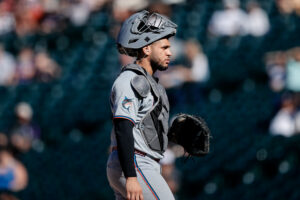
31 different catchers caught at least 600 innings in 2025. J.T. Realmuto led the way with 1151 1/3, almost double the 605 2/3 caught by Ramírez. Despite catching notably fewer innings than most of the catchers in this sample, Ramírez led the pack with ten errors. He allowed 19 passed balls, which was more than twice as much as the next person on that list, as no one else allowed more than nine. He was also behind the plate for 36 wild pitches, which are technically the fault of pitchers, but a good catcher can occasionally save his teammates from those. Four of those 31 catchers allowed a few more wild pitches but all in larger sample sizes. In short, if Ramírez was catching, the ball was at the backstop a lot.
Those traditional stats aligned with more advanced ones. Ramírez was credited with minus-14 Defensive Runs Saved. Only Salvador Perez, at minus-15, was worse than him in that column. The Fielding Run Value stat at FanGraphs had him last at minus-12. Statcast credited him with minus-13 catching runs, ahead of only Edgar Quero. Baseball Prospectus was less down on him overall, having him merely as one of the 13 worst catchers, but they were the one outlet that didn’t like his framing work.
Presumably, the Marlins have been willing to tolerate this in the hopes that there’s a path to improvement. Ramírez has been a very strong hitter in the minors and could be an asset if his defense got to more passable levels. He put up a combined line of .268/.357/.473 at various rungs of the minors from 2023 to 2025, leading to a 128 wRC+. His 11.5% walk rate and 18.4% strikeout rate were both strong figures and he hit 46 home runs in 1,120 plate appearances.
But his bat hasn’t quite clicked in the majors yet, perhaps due to him focusing so much on trying to improve his defense. Ramírez did hit 21 home runs last year but with a low batting average and poor walk rate, leading to a lopsided line of .231/.287/.413. That resulted in a 91 wRC+, indicating he was nine percent below league average. That’s not bad for a catcher since backstops tend to be about ten points below par, but it’s not great when considering his glovework.
Going into 2026, there was an argument for moving Ramírez to a role as a first baseman and designated hitter. Moving to first would require some work but Ramírez did play the position some in the minors. Though Ron Washington will tell you moving to first is not easy, catching is considered the most rigorous position on the field and playing anywhere else would afford Ramírez more ability to focus on his hitting.
All of that is especially true when considering the presence of Joe Mack, who is one of the top catching prospects in the league. He is considered to be a very strong defender behind the plate. He reached the Triple-A level in 2025, getting into 99 games. His offense is considered more questionable than his defense but he slashed .250/.320/.459 for a 107 wRC+ with the Jumbo Shrimp last year. He was added to the 40-man roster in November to keep him out of the Rule 5 draft.
The Fish could have gone with Mack and bumped Ramírez to first base, a position that was fairly open. They didn’t go that way. They have continued to stick with Liam Hicks and Ramírez as their catching duo, splitting the time almost equally. Ramírez has been behind the plate for 122 innings, compared to 123 for Hicks. Hicks is doing fine, pairing adequate defense with a .314/.354/.523 line in the early going this year, though he’s not great with the running game.
Ramírez, on the other hand, hasn’t shown many signs of improvement. His 122 innings caught this year are about a fifth of last year’s 605 2/3. He already has four errors, almost half the ten he had last year. That’s tied with Quero for the league lead. He has allowed three passed balls, a better pace than last year but not by much. Francisco Alvarez is the only guy with more, at four. Ramírez has been behind the plate for nine wild pitches already, a worse pace than last year. Only Logan O’Hoppe and Drew Millas have allowed more. FanGraphs and Statcast have soured on his framing a bit, though in a very small sample.
The Ramírez/Hicks pairing impacts their pitchers in other ways as well, as neither is great as controlling the running game. The Fish allowed 191 stolen bases last year, easily the most in the majors. The Astros were a distant second on that list with 157. Miami only caught 24 attempted steals on the year. Technically, that was higher than the 23 that the Royals nabbed, but that was because K.C.’s catchers were run on far less, only allowing 47 steals. So far in 2026, the Marlins have allowed 37 steals, again the most in the majors. They’ve only caught three.
Catchers can sometimes provide value in other ways which are difficult to measure, such as working with a pitching staff. Even there, it’s hard to give the Ramírez and Hicks much credit. Starting last year, the Marlins began calling pitches from the dugout. Ramírez and Hicks might still be doing something in terms of communication and providing confidence but it’s fair to say they’re impacting intangibles less than catchers on other teams.
The offense from Ramírez also continues to lag, as he is currently sporting a .235/.303/.367 line and 84 wRC+ this year. It’s a small sample but he’s now up to 694 career plate appearances with a .231/.290/.406 line and 90 wRC+.
Mack, meanwhile, continues to do well in Jacksonville. In his first 83 plate appearances for the Jumbo Shrimp this year, he has three home runs and a huge 19.3% walk rate. Even with a subpar .267 batting average on balls in play, he has a .224/.373/.388 line and 115 wRC+ this year.
Perhaps there are service time considerations at play. Mack is a consensus top 100 prospect in the league. The Fish could have put him on the Opening Day roster and made him eligible to earn the club a bonus draft pick as part of the prospect promotion incentive. They opted not to do that. At this point, they probably are thinking about the flip side of the PPI. Eligible players who are not promoted in the first few weeks of the season can be awarded a full year of service retroactively if they finish in the top two of rookie of the year voting.
If that were to happen, it would be the worst of both worlds for the Marlins, in a sense. They would not get a bonus pick and their window of club control over Mack would be a standard six, as opposed to being juiced to six-plus. From the team’s perspective, you’d ideally not be in that middle spot.
But the downside of keeping Mack down is that the major league club is likely worse off. With prospects, there are no guarantees of immediate success, so it can’t just be assumed that Mack will boost the big league squad. But since a big part of his appeal is his defense, he should be a lock to at least be an upgrade over Ramírez in that regard. On offense, perhaps he would struggle with the promotion, but it’s not as though Ramírez is crushing the ball so far this year.
The Marlins have received a combined .192/.248/.279 line from the DH spot this year, resulting in a 47 wRC+ which places them ahead of just the Pirates and Rockies. Putting Ramírez in there, and having him focus less on catching, could theoretically be good for the lineup.
And turning back to the PPI situation, there’s also some space opening up. Sal Stewart has nine home runs, a .291/.385/.602 line and 1.2 wins above replacement, in the eyes of FanGraphs. JJ Wetherholt is at 1.1 fWAR and Moises Ballesteros at 0.9. On the pitching side, Nolan McLean is at 1.3 fWAR and Rhett Lowder 1.0. It’s theoretically possible for Mack to come up and have a monster finish while some of those other guys struggle, but getting into the top two of voting is going to be tough when those guys already have a decent head-start.
On top of all that, there’s a window for the Marlins to have a special season. On paper, they came into the year as the fourth-best team in the division, in the eyes of most evaluators. But the Phillies and Mets are both out to awful starts. It’s still early, and the Marlins are only four games clear of those two clubs. But since the Mets and Phillies are 9-19 right now, there’s a real chance they can’t climb back into contention and end up selling at the deadline. In that situation, the Marlins would still have to battle the other N.L. clubs for a wild card spot, since it feels like Atlanta will run away with the division, but Miami’s chances feel a bit better than a few weeks ago even if they’re only 13-15.
Even putting aside the early-season standings, which could change in a hurry, this feels like a move the Marlins should make. All signs point to Mack being the long-term answer behind the plate. Ramírez, meanwhile, would seemingly be better served as a bat-first player. Perhaps the Marlins are hoping that another club will take a chance on Ramírez as a catching project, which would allow them to use him in a deadline deal, but it’s hard to envision that when progress isn’t really being made.
Photo courtesy of Mady Mertens, Isaiah J. Downing, Jim Rassol, Imagn Images
Marlins Option Joe Mack, Ryan Gusto
The Marlins announced their latest round of camp cuts this morning, and the most notable among that group were the decisions to option top catching prospect Joe Mack and right-hander Ryan Gusto to the minor leagues.
Mack, 23, is a consensus top-100 prospect and a first rounder from Miami’s 2021 draft class. After setting Double-A on fire for 13 games to open the year last season, Mack was promoted to Triple-A and hit a solid .250/.320/.459 with 18 homers, 18 doubles, and 2 triples in 100 games at the level. That was good for a 107 wRC+ at the level, which isn’t quite up to par for the typical top prospect but is nonetheless impressive considering his age and position. A 27.9% strikeout rate at Triple-A last year exacerbates concerns from scouts about Mack’s contact abilities, but the overall package is undoubtedly impressive.
Those questions are perhaps why it was reported last month that, while Mack would get the opportunity to fight his way onto the MLB roster, the team’s preference was for him to begin the season at Triple-A and hand catching duties over to the combination of Liam Hicks and Agustin Ramirez. Hicks was a pick in the 2024 Rule 5 draft who enjoyed a solid rookie season for the Marlins last year. He turned in a 98 wRC+ in 119 games behind the plate, though lackluster defensive metrics left him to be worth just 1.0 fWAR and 1.3 bWAR. Ramirez was also a rookie last year, and was the prize of the team’s Jazz Chisholm Jr. trade with the Yankees at the 2024 trade deadline. Ramirez slugged 21 homers in 136 games but got on base at just a .287 clip, leaving him with a 91 wRC+. He split time between catcher, first base, and DH in his first year as a big leaguer without showing strong defense at any of those positions.
There’s little doubt that Mack will be the long-term answer for the Marlins behind the plate as long as he hits at an even close to league average clip. He’s a well-regarded defender behind the plate who has been lauded for his strong arm and is far and a way the best defender of the team’s three young catchers according to scouts. With that being said, Mack is still young enough with enough questions about his hitting that it’s somewhat understandable that the Marlins would be interested in giving him more time to develop in the minor leagues. That’s all the more true after a tough spring at the plate, where he went just 3-for-24 with seven strikeouts. There’s little doubt that Mack will make his MLB debut at some point this year so long as he stays healthy, but in the meantime Christina De Nicola of MLB.com writes that the Marlins are encouraging him to work on his approach at the plate and spend more time getting familiar with the ABS strike zone while he waits for that opportunity at Triple-A.
As for Gusto, the right-hander was a key piece of the return for Jesus Sanchez at last year’s trade deadline. Gusto made his big league debut with the Astros just last year and was a solid swing man for Houston, posting a 4.92 ERA with a 4.16 FIP in 86 innings split between ten starts and 14 relief appearances. After being dealt to the Marlins, however, Gusto struggled badly. He made three starts in Miami and allowed 17 runs on 19 hits (including four home runs) and walked (8) nearly as many batters as he struck out (10), ending with a 9.77 ERA in 15 2/3 innings of work. He struggled just as badly at Triple-A, and while he looked a bit better this spring he’s still ultimately squeezed out of a crowded Marlins rotation and better serves the Marlins as stretched-out depth than converting to a short relief role in the bullpen.
Marlins Notes: Meyer, Garrett, First Base
With Spring Training on the horizon, the Marlins are hosting their annual FanFest today at LoanDepot Park. The club’s rotation was underwhelming last year outside of Eury Pérez and the since-traded Edward Cabrera, but today’s events offered updates on two key figures for 2026 in Max Meyer and Braxton Garrett.
Meyer spoke to reporters about his rehab from left hip surgery (link via Kevin Barral of Fish On First). He underwent the procedure for a labrum tear back in June. In October, general manager Peter Bendix told reporters that Meyer would be ready for Spring Training. That is indeed the case, as Meyer told reporters, “Everything feels good, how it should feel.” He added that he was able to start running halfway through his rehab and more or less followed a normal throwing program this offseason. Per manager Clayton McCullough, the team is committed to using Meyer as a starter rather than a reliever (link via Barry Jackson of the Miami Herald).
The 26-year-old right-hander was the Marlins’ first-round draft pick in 2020. Since debuting in 2022, he has thrown 127 2/3 innings over 25 starts with a 5.29 ERA, a 21.5% strikeout rate, and a 7.3% walk rate. While his 49.4% groundball rate is strong, Meyer also allows a lot of hard contact. His average exit velocity of 91.2 MPH and 47.8% hard-hit rate are both worse than average. He’s particularly struggled to keep the ball in the yard, allowing 1.97 home runs per nine innings in his career.
Meyer’s 2025 consisted of a 4.73 ERA in 64 2/3 innings before the aforementioned hip surgery. That workload was actually a career-high for Meyer, who missed the latter half of 2022 and all of 2023 due to Tommy John surgery. That said, he is still young, inexpensive, and a former Top-100 prospect. He’ll continue to get his chances in the rotation, though a full starter’s workload would be quite a reach even if he stays healthy.
The 28-year-old Garrett underwent an internal brace procedure on his throwing elbow in January 2025 and missed the entire season. He previously made just seven starts in 2024 before missing most of that season with a flexor strain and general elbow soreness. Per Jackson, Garrett is now healthy and will compete for a mid-rotation spot, with Sandy Alcantara and Pérez being locks at the front of the rotation.
Like Meyer, Garrett is a former first-round draft pick – No. 7 overall in 2016. Garrett has the more impressive track record of the two, having established himself as a mid-rotation arm from 2022-23. He threw 247 2/3 innings in that time over 48 appearances (47 starts), posting a 3.63 ERA with a 23.8% strikeout rate and an exceptional 5.1% walk rate. Garrett also induces groundballs 48.2% of the time and excels at getting hitters to chase, ranking in at least the 76th percentile in chase rate in 2022 and 2023.
That quality production came before two injury-ruined seasons, so it is fair to wonder if Garrett can return to his previous form. Like Meyer, he probably won’t be counted on for 150+ innings. That said, just having a healthy season will be a good outcome for the Marlins, who have traded Cabrera and Ryan Weathers and are counting on a separate return to form from Alcantara. Garrett has one option year remaining, so in the worst case scenario, he can be sent to Triple-A if he needs more time after a year off.
Turning now to the position players, McCullough implied that the Marlins will have “a lot of competition for playing time” at first base in 2026 (link via Barral). He specifically mentioned that Christopher Morel is “open to giving it a shot,” with Griffin Conine and Liam Hicks also being options. Morel and Conine are surprising candidates, as neither has played first base in the majors or minors. Hicks is the only one of the three with experience at the cold corner. Eric Wagaman was the team’s primary first baseman in 2025, though he was traded to the Twins last month.
Morel was signed by the Marlins in December after being non-tendered by the Rays. He was an above-average hitter in his first two seasons from 2022-23 but has struggled more recently, grading out 10% below average by wRC+ in 2025. He has bounced around at multiple positions and hasn’t graded out well at any of them. Conine debuted in 2024 and has exclusively played the outfield. McCullough merely described him as “open-minded” about first base, so it’s possible the club will give Conine reps in Spring Training but only consider him an emergency option. The left-handed hitting Hicks batted .247/.346/.346 with a 98 wRC+ last year but was 4% better than average against righties. The club could consider a timeshare with Hicks starting against righties and the right-handed hitting Morel against southpaws.
Photo courtesy of Denis Poroy, Imagn Images
The Marlins’ Catching Conundrum
Miami has struggled to find a viable option behind the plate since trading away J.T. Realmuto ahead of the 2019 season. After Jorge Alfaro, who returned in the Realmuto deal, failed to provide consistent results, the Marlins have shuffled through a mix of veterans and fringe MLBers over the past few seasons. Miami backstops finished 29th in OPS at the position in both 2023 and 2024.
Agustin Ramirez seems like the answer, at least on offense. Acquired in the Jazz Chisholm Jr. trade, the top prospect popped 21 homers and stole 16 bases in his first taste of MLB action. Ramirez paced the team in doubles and total bases. He was a fixture in the heart of the lineup since getting promoted in late April.
The problem with Ramirez as Miami’s solution at catcher was the catching part. He led the league with 19 passed balls, more than twice as many as the next-closest player (Shea Langeliers at nine). Ramirez also led all catchers with 10 errors, despite only making 71 starts at the position. The throwing aspect of the job didn’t go much better. Ramirez allowed 83 steals and threw out just 8 base runners, good for a paltry 8.8% caught stealing rate. He ranked dead last in Statcast’s CS Above Average metric, which compares the number of extra caught stealings to the expectation of an average catcher.
Ramirez made 61 starts at DH in his rookie season. While that may be his ultimate home, president of baseball operations Peter Bendix hasn’t given up on Ramirez in the field. Speaking to reporters on Wednesday, Bendix said Ramirez still has “the ability to be a major league catcher and also needs to improve a lot to be able to consistently achieve that level” (link via Kevin Barral of Fish on First). It isn’t the strongest endorsement, but it’s enough to keep the door ajar on Ramirez’s future at the position.
Liam Hicks functioned as Miami’s backup catcher for the majority of the 2025 season. He started 49 games behind the plate, while also making 23 starts at first base and 20 at DH. Hicks joined the team as a Rule 5 selection from Detroit. He posted a solid 98 wRC+ across 390 plate appearances, though the power was lacking. Hicks hit just a half dozen home runs and finished with a .099 ISO. He doesn’t have the type of thump typically associated with 1B/DH types, so sticking at catcher might be his only avenue to consistent playing time.
The main issue with Hicks as a long-term option is the same one that plagues Ramirez. Hicks allowed 51 stolen bases last season, while catching just six would-be thieves. He had the fifth-worst mark in Statcast’s CS Above Average metric.
The real answer at catcher might be waiting in the wings at Triple-A. Joe Mack is the organization’s fourth-ranked prospect according to MLB.com. FanGraphs ranked Mack third among Miami prospects in their midseason update. Mack was a first-round pick in 2021. He’s put up strong offensive numbers at each minor league stop, including a 129 wRC+ in 112 games at Double-A in 2024. Mack torched Double-A pitching once again to begin 2025 and was quickly bumped to Triple-A. He hit 18 home runs with a solid .250/.320/.459 slash line in 412 plate appearances with the Jacksonville Jumbo Shrimp. The 22-year-old has an elite arm, which will provide some much-needed help in slowing down the run game. Mack has a shot to break camp with the team in 2026 after hitting .298/.382/.766 with six homers in 14 games in September.
Whether or not Mack is with the big-league club next season, the team could use a glove-first veteran option. Victor Caratini, Austin Hedges, and James McCann would be viable options that shouldn’t be overly expensive. Old friend Jacob Stallings could also be a candidate to soak up innings behind the plate for a low investment. Ironically, Nick Fortes would’ve fit the bill as a veteran caddy to Mack. Fortes led the Marlins in starts behind the plate in 2023 and 2024, but was shipped out at the trade deadline this past season.
Rule 5 Draft Update: June Edition
Last winter’s Rule 5 draft was relatively busy, as 15 players were selected across 14 teams. Just under half remain with their new organizations. Only three are currently healthy, but that trio has been productive to varying degrees. It has been a couple months since our last look at the class, so let’s check back in to see how the players who have stuck are handling their first taste of the big leagues.
A quick refresh for those unfamiliar with the process: the Rule 5 draft is a means of getting MLB opportunities to players who might be blocked with their current organization. Teams can draft certain players who are left off their original club’s 40-man roster. The drafting team needs to keep that player on the MLB roster or injured list for their entire first season. If they do so, they’d gain the player’s contractual rights permanently. A team can keep an injured Rule 5 pick on the major league IL, but they’d eventually need to carry him on the active roster for 90 days. If the player misses the entire season, the Rule 5 restriction carries over to the following year.
If the drafting team decides not to carry the player on the roster at any point during the year, they need to place him on waivers. If he goes unclaimed, the player is offered back to his original organization — which does not need to carry him on either the MLB or 40-man rosters to take him back.
On An Active Roster
Shane Smith, White Sox RHP (selected from Brewers)
Smith not only made Chicago’s roster, he cracked the Opening Day rotation for the rebuilding club. Most of the time, teams keep Rule 5 pitchers in low-leverage relief until they build enough of a regular season track record to be entrusted with more meaningful innings. The White Sox gave Smith a rare amount of responsibility right out of the gate.
The 6’3″ righty is running with the opportunity. Smith has turned in a 2.68 earned run average through his first 11 starts in the big leagues. He’s striking out a decent 22.3% of opponents behind a 12.2% swinging strike rate — nearly two points higher than the league mark for starters. He leads a five-pitch arsenal with a 95 MPH heater, while opponents are batting .098 in 51 at-bats that end with his changeup.
That changeup has seemingly taken a massive step forward. Baseball America’s offseason scouting report called it a below-average pitch that Smith almost never threw. In mid-April, Eric Longenhagen and James Fegan of FanGraphs wrote that the White Sox had more or less added the pitch to his arsenal, and it’s already a plus offering. They ranked him the #7 prospect in the Chicago farm system at the time, placing him not far outside their overall Top 100. That’s essentially unheard of for a Rule 5 pick.
Smith is going to stick on the roster all season. He looks quite likely to be the Sox’s All-Star representative. They might scale back his workload in the second half, as he only started 16 of 32 appearances and logged 94 1/3 innings last season in the minors. He profiles as a long-term rotation piece, even if he might land in the middle or back end by the next time the White Sox are competitive. The developmental focus now is probably on honing his command. His 9.5% walk rate is a little higher than ideal, and only Nick Lodolo has hit more batters than Smith’s seven. Those are relatively small quibbles. He looks like one of the best Rule 5 finds in recent memory.
Liam Hicks, Marlins C (selected from Tigers)
Hicks, a lefty-swinging catcher, went from the Rangers to the Tigers in last summer’s Carson Kelly deal. While he reached base at a .414 clip in Double-A after the trade, Detroit opted not to add him to the 40-man roster. The rebuilding Marlins grabbed him to back up Nick Fortes, buying more time for highly-regarded prospect Agustín Ramírez to play at Triple-A.
Ramírez hit his way to the big leagues by the middle of April. He’s tied for the rookie lead with seven home runs through his first 34 games, so he’s unlikely to head back down anytime soon. Fortes returned from an oblique strain in early May. The Fish have operated with three catchers on the active roster for the past month, mixing in plenty of designated hitter work for Ramírez along the way.
The 26-year-old Hicks has played far less frequently, but he has been productive of late. At the time of our first Rule 5 update on April 14, he was batting .214 over 35 plate appearances. He’s batting .292 with eight extra-base hits and an equal number of walks and strikeouts (eight apiece) in 73 trips to the dish since then. The Marlins gave him his first major league start as a first baseman yesterday.
Carrying three catchers all season may not be ideal for roster flexibility, but the Fish have ample first base/DH at-bats to go around. Hicks is playing far too well right now to offer back to Detroit. Fortes, who has limited offensive upside and projects as a long-term backup, still has minor league options. The Marlins may not want to have a pair of rookies splitting time behind the plate, but sending Fortes to Triple-A could be an option if they feel they need more defensive flexibility off the bench.
Mike Vasil, White Sox RHP (selected from Mets via Rays and Phillies)
Vasil landed with the Rays via a Rule 5 draft day trade with Philadelphia. Tampa Bay waived the UVA product a couple weeks into Spring Training. The White Sox claimed him to prevent him from being returned to the Mets organization. He’s been pitching out of Will Venable’s bullpen for the season.
The 6’5″ righty has been a solid contributor to the Sox’s pitching staff in his own right. He owns a 2.10 ERA over 17 appearances, usually working 2-3 innings at a time. He’s walking nearly as many batters as he’s striking out, so it’s fair to question how long he’ll be able to keep this up. Vasil sits in the mid-90s over multi-inning stints and is getting ground-balls at a solid 52.5% clip, though. There’s no reason for the Sox to move on right now.
Currently On Major League Injured List
Garrett McDaniels, Angels LHP (selected from Dodgers)
Biceps tendinitis has shelved McDaniels since May 2. The Halos sent him to their Arizona complex on a rehab assignment last Tuesday. They’re allowed to keep him in the minors while he’s building up, but rehab assignments for pitchers can last a maximum of 30 days. Unless McDaniels suffers a setback, the Angels need to decide by June 26 whether to put him back in the MLB bullpen or move on from him.
The Angels bullpen has been an absolute disaster. They’re one of two teams (joining the A’s) whose relief group has an ERA beginning with a 6. There’s not a single Halos reliever who has worked at least six innings with an ERA better than 4.76. The opportunity is wide open, but the 25-year-old McDaniels has been a part of that showing. He has allowed eight runs (seven earned) on 13 hits and eight walks over his first 10 2/3 MLB frames. He’s getting ground-balls at an incredible 74.3% rate, but he’s not missing bats and has allowed home runs on two of the five fly-balls he surrendered.
Angel Bastardo, Blue Jays RHP (selected from Red Sox)
Bastardo underwent Tommy John surgery last June while he was in the Boston system. The Jays selected him knowing they’d stash him on the 60-day injured list for most or all of this season. That delays the decision on whether to keep him in the MLB bullpen, but he’d need to stick on the 40-man roster throughout next offseason and log at least 90 days on the active roster between this season and next for the Jays to get his contractual rights.
Nate Lavender, Rays LHP (selected from Mets)
It’s basically an identical scenario with Lavender, who underwent Tommy John surgery last May when he was pitching for the Mets. He’s more likely than Bastardo to make his return in the second half of this season. In any case, the Rays won’t need to make the decision for at least another month.
Connor Thomas, Brewers LHP (selected from Cardinals)
Behind a 53.5% ground-ball rate, the soft-tossing Thomas managed a sub-3.00 ERA over 56 Triple-A appearances a year ago. He had a solid spring, throwing 11 1/3 innings of four-run ball with 11 strikeouts and five walks. Thomas broke camp in low-leverage relief. He was hit hard in his first two MLB appearances. The Yankees teed off for eight runs (including a trio of homers) over two innings in his debut. Thomas gave up four runs in 3 1/3 frames against the Reds a week later.
The Brewers placed him on the IL with elbow arthritis after the latter appearance. They moved him to the 60-day IL in the middle of May, ruling him out into the first week of June. He’s seemingly a few weeks from making his return, as Milwaukee assigned him to their Arizona complex last week. As was the case with McDaniels, the team will have a few more weeks before they need to make a decision.
Returned To Original Organization
Noah Murdock, RHP (returned to Royals from A’s)
Murdock broke camp with the A’s and made 14 MLB appearances. He was hit hard, though, giving up 25 runs across 17 innings. He was the first Rule 5 pick to be returned to his original club during the season. The Royals assigned him to Triple-A Omaha after he cleared waivers in mid-May. He has given up eight runs over his first 6 1/3 innings there. Murdock was effective in the minors a year ago, when he combined for a 3.16 ERA through 62 2/3 innings between the top two levels.
Evan Reifert, RHP (returned to Rays from Nationals)
Refiert is a slider specialist with well below-average command. He walked 12 batters in 6 1/3 innings during Spring Training, so the Nats returned him to the Rays a couple weeks before Opening Day. Tampa Bay assigned him to Triple-A Durham for his first stint at that level. He’s been fantastic, racking up 29 strikeouts against five walks across 14 1/3 frames. There’s a decent chance he’ll get a look from the Rays at some point this year.
Cooper Bowman, 2B (returned to A’s from Reds)
A righty-hitting second baseman, Bowman got a brief look in camp from the Reds. He had three hits, all singles, in 25 Spring Training at-bats before Cincinnati decided he wouldn’t make the team. The A’s assigned him to Triple-A Las Vegas, where he opened the season on the injured list. He was reinstated in mid-April and has gotten out to a poor start (.229/.343/.349 in 99 plate appearances). Bowman struggled in Triple-A last season but has hit well up through Double-A.
Eiberson Castellano, RHP (returned to Phillies by Twins)
Castellano was trying to make the jump directly from Double-A, where he’d turned in a sub-4.00 ERA with a 31.3% strikeout rate last season. He didn’t command the ball well enough in camp to crack the Twins’ pitching staff, however. Castellano walked 10 batters and surrendered 10 runs over 10 2/3 innings. Minnesota returned him to the Phillies, who assigned him back to Double-A Reading. He fired 10 innings of one-run ball over his first three outings but went on the injured list after his fourth appearance. He’s back from that IL stint but hasn’t been able to find the strike zone in his two post-injury appearances, walking five in a combined 2 1/3 innings.
Gage Workman, IF (returned to Tigers by Cubs and White Sox)
Workman had never played above Double-A, where he struck out at a lofty 27.5% rate. His combination of power, speed and defensive ability nevertheless led the Cubs to select him in the Rule 5 draft. Workman mashed his way onto the Opening Day roster with a .364/.420/.705 line and four homers over 20 games this spring.
The Cubs weren’t able to find much regular season playing time. They gave him all of four starts at third base before moving on. The White Sox gave him an even briefer look after grabbing him in a small trade. Workman suffered a right hip injury within days of landing with the ChiSox. They waived him rather than put him back on the MLB roster once he was healthy.
Workman has been back with the Tigers since May 14. They sent him to Triple-A for the first time. He’s hitting .244/.333/.511 with four homers and a 27.5% strikeout rate in 13 games.
Anderson Pilar, RHP (returned to Marlins by Braves)
Pilar is another Rule 5 pick whose command was an issue in camp. He walked six batters over 5 2/3 innings, giving up nine runs in the process. Atlanta returned him to the Marlins, who assigned him to Triple-A Jacksonville. He’s pitching well, turning in a 3.91 ERA with a near-27% strikeout rate against a manageable 8.2% walk percentage. He could get a look from the Fish, especially if they move players like Calvin Faucher and Anthony Bender by the deadline.
Juan Nuñez, RHP (returned to Orioles by Padres)
Nuñez, who had never pitched above High-A when he was selected, always had an uphill battle to cracking a win-now roster in San Diego. Six walks over five Spring Training innings ensured he’d be offered back to the Orioles. He has an ERA north of 7.00 over his first 14 Double-A innings. Nuñez has fanned nearly 40% of opponents but is walking more than 18%. He has been on the injured list for the past two weeks.
Christian Cairo, SS (returned to Guardians by Braves)
Atlanta was the only team to make two Rule 5 selections. They returned Cairo to Cleveland at the same time they offered Pilar back to the Marlins. Cairo is one of a number of contact-oriented middle infielders in the Guardians’ system. He hit .179 without a home run in 16 Spring Training games. Cleveland assigned him back to Triple-A Columbus, where he finished last season. He’s batting .226 with no homers.
Rule 5 Draft Update: April Edition
Last winter’s Rule 5 draft was relatively busy, as 15 players were selected across 14 teams. Not all of those players broke camp, so we’ll check in on the class to see which draftees impressed enough in Spring Training to make their major league debuts.
A quick refresh for those unfamiliar with the process: the Rule 5 draft is a means of getting MLB opportunities to players who might be blocked with their current organization. Teams can draft certain players who are left off their original club’s 40-man roster. The drafting team needs to keep that player on the MLB roster or injured list for their entire first season. If they do so, they’d gain the player’s contractual rights permanently. A team can keep an injured Rule 5 pick on the major league IL, but they’d eventually need to carry him on the active roster for 90 days. If the player misses the entire season, the Rule 5 restriction carries over to the following year.
If the drafting team decides not to carry the player on the roster at any point during the year, they need to place him on waivers. If he goes unclaimed, the player is offered back to his original organization — which does not need to carry him on either the MLB or 40-man rosters to take him back.
On An Active Roster
Shane Smith, White Sox RHP (selected from Brewers)
Smith not only made Chicago’s roster, he cracked the Opening Day rotation for the rebuilding club. Most of the time, teams keep Rule 5 pitchers in low-leverage relief until they build enough of a regular season track record to be entrusted with more meaningful innings. The White Sox are giving Smith a rare amount of responsibility right out of the gate.
Some of that is on the team, of course. They’re coming off the worst season in modern history and expected to be one of the three worst teams in MLB this year. Their Opening Day starter, Sean Burke, entered the year with 20 days of major league service. Still, Smith has put his best foot forward in securing that rotation spot. He worked 10 2/3 innings of four-run ball during Spring Training, striking out 11 against four walks. Smith has managed a pair of quality starts within his first three regular season outings. He has only given up four runs across 17 2/3 frames, a 2.04 earned run average.
The 6’3″ righty will need to improve upon his 12:7 strikeout-to-walk ratio. He’s getting ground-balls at an excellent 52.1% clip, though, and a four-pitch mix led by a 94-95 MPH fastball is intriguing. He’s not in any danger of losing his roster spot anytime soon.
Liam Hicks, Marlins C (selected from Tigers)
Hicks, a lefty-swinging catcher, went from the Rangers to the Tigers in last summer’s Carson Kelly deal. While he reached base at a .414 clip in Double-A after the trade, Detroit opted not to add him to the 40-man roster. The rebuilding Marlins grabbed him to back up Nick Fortes, buying more time for highly-regarded prospect Agustín Ramírez to play at Triple-A.
Plate discipline has been Hicks’ calling card in the minors. He had more walks (seven) than strikeouts (six) during Spring Training, though he only hit .200 with one extra-base hit in 40 plate appearances. He broke camp and has hit .214 with two walks and six strikeouts in 35 trips to the plate. His lone extra-base knock is a double. Opponents have stolen seven bases in eight attempts over his 74 innings behind the dish.
It hasn’t been a great start, but Hicks doesn’t seem in jeopardy of getting squeezed off the roster in the near future. Fortes, who is probably better suited as a backup himself, went on the injured list with an oblique strain last week. The Fish called up journeyman Rob Brantly in his place. Hicks got the start in two of the three games over the weekend. He’s the primary catcher for now. Ramírez should get a look fairly soon, but Hicks has a bit of run to show he should stick around as the backup.
Garrett McDaniels, Angels LHP (selected from Dodgers)
McDaniels had made two appearances above A-ball — totaling three innings at Double-A — when the Angels plucked him out of the Dodgers’ system. He showed an impressive combination of strikeouts and ground-balls in the lower minors that intrigued the Halos. The grounders have remained against high-level hitters, though the whiffs have not. McDaniels got grounders on more than two-thirds of batted balls over nine Spring Training innings. He jumped a couple more experienced southpaws on the bullpen depth chart to break camp despite four strikeouts and walks apiece.
The 6’2″ lefty has been hit hard through his first few MLB appearances. McDaniels has allowed four runs (three earned) over 5 2/3 innings. He has given up seven hits and issued five walks while recording five punchouts. He’s still getting a ton of worm-burners. Twelve of the 17 batted balls he’s allowed have been grounders. They’ve mostly been hit hard, though, and one of the two fly-balls he has given up was a Yainer Diaz grand slam.
Noah Murdock, Athletics RHP (selected from Royals)
Murdock, a 6’8″ righty, has been a ground-ball machine throughout his minor league career. He got grounders at a huge 59.7% clip over 62 2/3 innings between the top two minor league levels last season. That continued into Spring Training, as he kept the ball on the ground at a 70.4% rate en route to a 3.86 ERA over 11 2/3 innings.
That earned Murdock a bullpen spot and a handful of relatively high-leverage assignments from skipper Mark Kotsay. It’s been a shaky start. Murdock has allowed eight runs through 8 2/3 frames, largely because of 10 walks. Most of the damage came in one dreadful appearance against the Cubs, where he gave up six runs in one inning. Murdock has managed scoreless appearances in four of his five other outings, but he has walked at least one hitter in all but one of those games. He’ll need to find the strike zone more consistently to stick all season.
Gage Workman, Cubs IF (selected from Tigers)
Workman had never played above Double-A, where he struck out at a lofty 27.5% rate. His combination of power, speed and defensive ability nevertheless led the Cubs to add him. Workman mashed his way onto the Opening Day roster with a .364/.420/.705 line and four homers over 20 games this spring.
The Cubs haven’t been able to find him much playing time. He has started only started two of their first 19 games, both at third base. Workman has two hits and a walk with five strikeouts over 10 plate appearances. The Cubs might not be able to use a bench spot like this all season.
Mike Vasil, White Sox RHP (selected from Mets via Rays and Phillies)
Vasil landed with the Rays via a Rule 5 draft day trade with Philadelphia. Tampa Bay waived the UVA product a couple weeks into Spring Training. The White Sox claimed him to prevent him from being returned to the Mets organization. Vasil joined Smith as the second Rule 5 pick on the Sox’s roster. He’s working in the mop-up spots typically associated with Rule 5 draftees. In four appearances, Vasil has reeled off nine scoreless innings. He has only managed six strikeouts against four walks and a hit batter. He’s coming off a 6.04 ERA over 134 innings in Triple-A.
Currently On Major League Injured List
Angel Bastardo, Blue Jays RHP (selected from Red Sox)
Bastardo underwent Tommy John surgery last June while he was in the Boston system. The Jays selected him knowing they’d stash him on the 60-day injured list for most or all of this season. That delays the decision on whether to keep him in the MLB bullpen, but he’d need to stick on the 40-man roster throughout next offseason and log at least 90 days on the active roster between this season and next for the Jays to get his contractual rights.
Nate Lavender, Rays LHP (selected from Mets)
It’s basically an identical scenario with Lavender, who underwent Tommy John surgery last May when he was pitching for the Mets. He’s perhaps a little more likely than Bastardo to make his return in the second half of this season. In any case, the Rays won’t need to make the decision for at least a few more months.
Connor Thomas, Brewers LHP (selected from Cardinals)
Behind a 53.5% ground-ball rate, the soft-tossing Thomas managed a sub-3.00 ERA over 56 Triple-A appearances a year ago. He had a solid spring, throwing 11 1/3 innings of four-run ball with 11 strikeouts and five walks. Thomas broke camp in low-leverage relief. He was hit hard in his first two MLB appearances. The Yankees teed off for eight runs (including a trio of homers) over two innings in his debut. Thomas gave up four runs in 3 1/3 frames against the Reds a week later. The Brewers placed him on the IL with elbow arthritis after the latter appearance. A return timeline is unclear.
Returned To Original Organization
Evan Reifert, RHP (returned to Rays from Nationals)
Refiert is a slider specialist with well below-average command. He walked 12 batters in 6 1/3 innings during Spring Training, so the Nats returned him to the Rays a couple weeks before Opening Day. Tampa Bay assigned him to Triple-A Durham for his first stint at that level.
Cooper Bowman, 2B (returned to A’s from Reds)
A righty-hitting second baseman, Bowman got a brief look in camp from the Reds. He had three hits (all singles) in 25 Spring Training at-bats before Cincinnati decided he wouldn’t make the team. The A’s assigned him to Triple-A Las Vegas, where he has begun the season on the injured list. Bowman struggled in Triple-A last season but has hit well up through Double-A.
Eiberson Castellano, RHP (returned to Phillies by Twins)
Castellano was trying to make the jump directly from Double-A, where he’d turned in a sub-4.00 ERA with a 31.3% strikeout rate last season. He didn’t command the ball well enough in camp to crack the Twins’ pitching staff, however. Castellano walked 10 batters and surrendered 10 runs over 10 2/3 innings. Minnesota returned him to the Phillies, who assigned him back to Double-A Reading. He’s pitched there once so far, firing three perfect innings with five strikeouts.
Anderson Pilar, RHP (returned to Marlins by Braves)
Pilar is another Rule 5 pick whose command was an issue in camp. He walked six batters over 5 2/3 innings, giving up nine runs in the process. Atlanta returned him to the Marlins, who assigned him to Triple-A Jacksonville. Pilar has been fantastic in the early going there, striking out nine without issuing a walk over 5 2/3 scoreless innings. If he continues at anything like that pace, he should get a look in Miami’s bullpen before much longer.
Juan Nuñez, RHP (returned to Orioles by Padres)
Nuñez, who had never pitched above High-A when he was selected, always had an uphill battle to cracking a win-now roster in San Diego. Six walks over five Spring Training innings ensured he’d be offered back to the Orioles. He’s making his Double-A debut this season. Nuñez has fanned three in two scoreless innings.
Christian Cairo, SS (returned to Guardians by Braves)
Atlanta was the only team to make two Rule 5 selections. They returned Cairo to Cleveland at the same time they offered Pilar back to the Marlins. Cairo is one of a number of contact-oriented middle infielders in the Guardians’ system. He hit .179 without a home run in 16 Spring Training games. Cleveland assigned him back to Triple-A Columbus, where he finished last season. He’s batting .250 with 12 strikeouts and four walks over his first 10 contests.