
Trade Candidate: Evan Gattis
Once just a fascinating story, Braves catcher Evan Gattis is now unquestionably a legitimate big league piece. He is only just 28, has just two years on his service clock, and is probably one of the ten or so best-hitting catchers in baseball (if not, arguably, somewhat better).
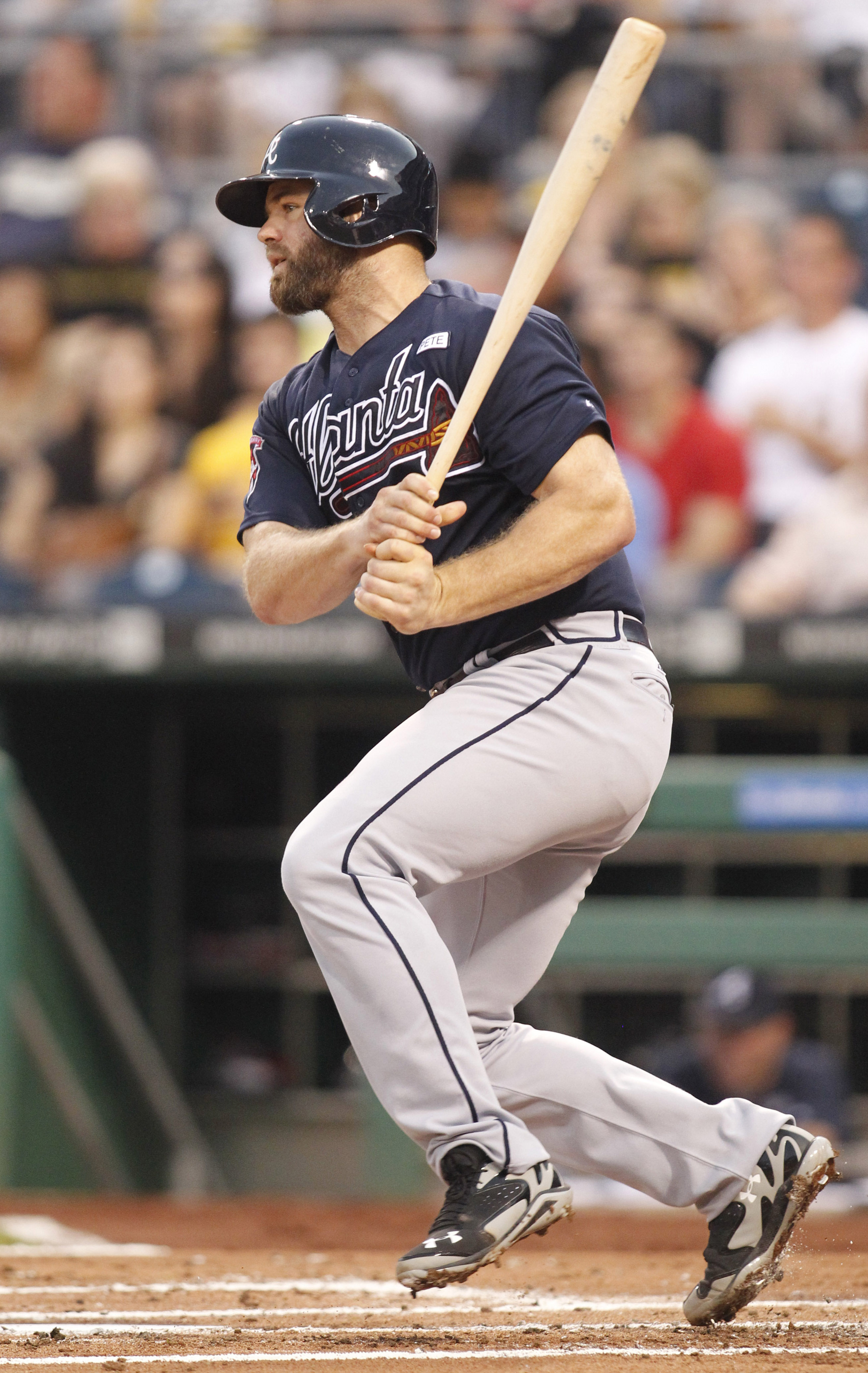 For a Braves team looking to improve but seemingly lacking the present payroll capacity to do it, Gattis seems at first glance to be an obvious keeper. But a look below the surface reveals why recent rumors have labeled him a possible trade chip. Specifically, Atlanta has already groomed (and promoted) an even cheaper, probably more defensively-reliable replacement in 23-year-old Christian Bethancourt.
So, if the Braves choose to shop Gattis, what might he be worth, and what kinds of teams might be interested? The bat certainly has played. Gattis introduced himself to the league with a .243/.291/.480 slash and 21 home runs over 382 plate appearances in 2013, leading some to suggest that he would never make enough contact for his power to be valuable. But Gattis answered with a .263/.317/.493 line and 22 long balls while taking 19 more trips to the plate. His walk and strikeout numbers were similar (5.5% walk rate with a K% in the low-20’s), while his BABIP jumped from .255 to .298.
While there is certainly some risk that Gattis slides back to his rookie numbers, Atlanta would doubtless be loath to deal him were that the complete story. While he is a decent enough baserunner considering his size (he is listed at 6’4/260), Gattis does not enjoy the best defensive reputation and may perhaps not be far off from deteriorating further in the field.
Let’s take a closer look at his defensive work. Gattis threw out just 13 runners while allowing 53 swipes. Though that .197 caught-stealing rate actually rated just ahead of other bat-first catchers like Rosario, Derek Norris, and Jarrod Saltalamacchia, it is not good. And Gattis fell well behind Bethancourt and backup Gerald Laird, so perhaps we cannot pin the blame on the Atlanta staff. And Baseball Prospectus figures indicate that Gattis is one of the very worst blockers in the game, costing the Braves about 18 additional wild pitches or passed balls over his 93 games of action behind the plate.
While these aspects of the catcher’s job description are perhaps the most visible, however, they are probably not the most impactful. Indeed, the gap between Gattis and Bethancourt/Laird in gunning down would-be basestealers pales in comparison to the separation observed among that trio in pitch framing. Only here, Gattis comes out ahead, profiling as an average or better strike-winner while Bethancourt (slightly below average) and Laird (well below average) do not. (Stat Corner and Baseball Prospectus concur on this general ordering, though the latter is more bullish on this group as a whole.) Pitch-calling and staff-handling are much more subjective, of course, but I am not aware of any reports painting him as a disaster in those areas.
In the aggregate, BP tabbed Gattis as the league’s 8th most-valuable backstop last year. Despite pinning him with one of the worst overall defensive WAR tabs among his peers (with statistics that do not account for pitch framing), Fangraphs still valued Gattis as the league’s 14th-most productive catcher.
While it is generally assumed that Gattis would hold most of his appeal to an American League club, then, it could be that talk of Gattis’s impending shift from intriguing, power hitting catcher to slightly above-average DH are premature. And that expands his market, because it is at least plausible for acquiring teams to believe that Gattis will provide serviceable-enough innings behind the plate for at least a portion of his control. (All while comfortable in the knowledge that a shift to DH or a non-tender can prevent the kind of long-term burden that a free agent contract could bring.)
It remains somewhat unlikely that another National League team would top the bidding, though it is at least possible to imagine a team like the Pirates having interest. More likely, Gattis would draw the most attention from American League teams that saw the Athletics extract plenty of value from a defensively-deficient group of backstops who were good enough on offense to DH or play elsewhere. The Astros, Orioles, Tigers, White Sox, Blue Jays, and perhaps even the Mariners and Rangers could at least be imagined as landing spots, depending upon how the rest of their offseasons shake out. None of these is a slam dunk, of course, and on the whole Gattis’s market is not terribly clear.
As always, it is hard to forecast a return on a trade. But there is one fairly recent, fairly solid comp: the pre-2013 John Jaso deal. Jaso, a (lefty) bat-first catcher then entering his age-29 season and coming off of a huge campaign, was shipped to the Athletics in a three-team swap that saw Michael Morse go from the Nationals to the Mariners and prospects move back to D.C. from Oakland. While the arms that moved in that trade — A.J. Cole, Blake Treinen, and Ian Krol — have seen their stock rise rather significantly since that deal, at the time it was considered a substantial-but-fair price for the A’s to pay to acquire Jaso. (The Morse element of the deal, of course, has been the subject of plenty of criticism.)
In some ways Gattis is less useful than Jaso, who kills righties and has a clear, if limited role. On the other, he has more potential as an everyday option, as he not only mashes lefties but puts up good numbers against same-handed pitchers and is perhaps a better all-around defender. And Gattis possesses a power-based skillset that many teams still desire, especially as it continues to diminish in availability.
So, can Atlanta improve on the Jaso return — a legitimate outlay of talent, to be sure, but one that had plenty of risk and did not contribute immediately to the MLB roster — or will it face the tough choice of taking a potentially significant hit to its likelihood of contention in the next year or two in exchange for speculative future value? That probably depends on how many teams have interest in Gattis as at least a semi-regular backstop.
Diamondbacks Hire Chip Hale As Manager
5:57pm: Hale’s contract also contains a club option for a third season, according to John Gambadoro of Arizona Sports 98.7 (Twitter link).
9:04am: The Diamondbacks have announced the hiring of Athletics bench coach Chip Hale as their new manager. Contract terms weren’t announced, though CBS Sports’ Jon Heyman reported (via Twitter) that Hale signed a two-year deal to manage the club. The D’Backs were rumored to be deciding on their new skipper today, and USA Today’s Bob Nightengale was the first to report that Hale has been hired.
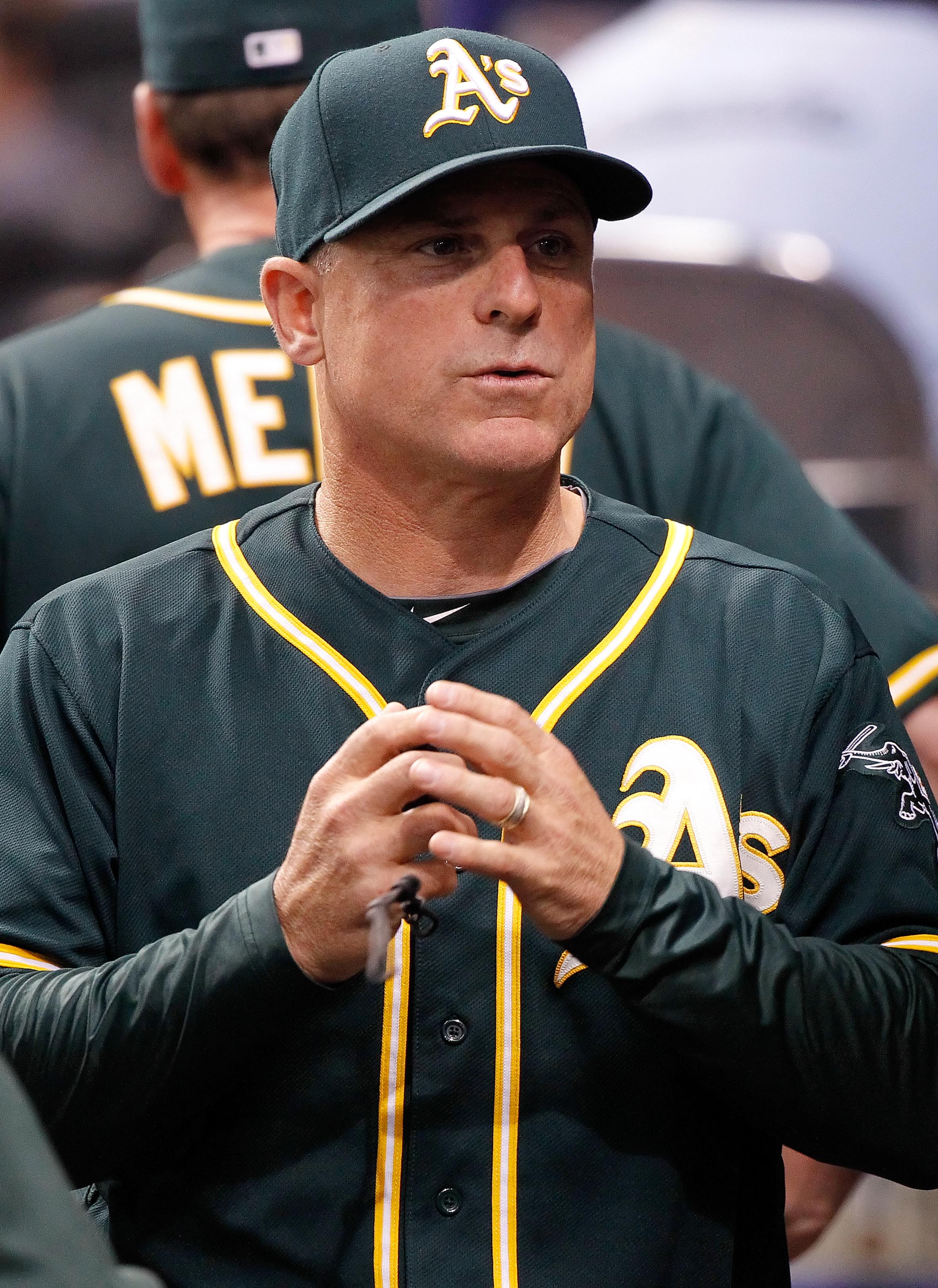
It is something of a homecoming for the 49-year-old Hale, who played college ball at the University of Arizona and began his coaching career in the D’Backs organization, working both as a minor league manager and as a Major League third base coach. He has also worked as the Mets’ third base coach and has spent the last three years in Oakland under Bob Melvin.
Hale has been a contender for several open managerial positions over the last few offseasons, and was reportedly a finalist for the Mets (before they hired Terry Collins) and Mariners (before they hired Lloyd McClendon). Most recently, the Twins sought to interview him during their manager search, though Hale reportedly canceled that interview in order “to see through this chance” at the D’Backs job, according to Nick Piecoro of the Arizona Republic (Twitter link).
Hale is the first hire for D’Backs GM Dave Stewart and chief baseball officer Tony La Russa as they look to turn around the last-place Snakes and move on from the Kirk Gibson/Kevin Towers era. The club interviewed at least nine men for the manager’s job and had narrowed the field to Hale, former Rockies manager Jim Tracy, Indians first base coach Sandy Alomar Jr. and two internal choices in assistant hitting coach Turner Ward and triple-A manager Phil Nevin.
Photo courtesy of USA Today Sports Images.
Offseason Outlook: Cincinnati Reds
The Reds took a big step backward in their first season under manager Bryan Price, and they now face a number of worrisome contracts and an uncertain future.
Guaranteed Contracts
- Joey Votto, 1B: $213MM through 2023
- Homer Bailey, SP: $96MM through 2019
- Brandon Phillips, 2B: $39MM through 2017
- Jay Bruce, OF: $25.5MM through 2016
- Raisel Iglesias, P: ~$20MM through 2020*
- Sean Marshall, RP: $6.5MM through 2015
- Manny Parra, RP: $3.5MM through 2015
- Skip Schumaker, UT: $3MM through 2015
- Sam LeCure, RP: $1.85MM through 2015
- Brayan Pena, C: $1.4MM through 2015
*The exact details of Iglesias’ seven-year, $27MM contract have not been reported, although it reportedly included a large signing bonus.
Options
- Johnny Cueto, P: $10MM club option ($800K buyout)
- Ryan Ludwick, OF: $9MM mutual option ($4.5MM buyout)
- Jack Hannahan, 3B: $4MM club option ($2MM buyout)
Arbitration Eligible Players (service time in parentheses; projections via Matt Swartz)
- Alfredo Simon, SP (5.142): $5.1MM projected salary
- Mat Latos, SP (5.079): $8.4MM
- Mike Leake, SP (5.000): $9.5MM
- Chris Heisey, OF (4.157): $2.2MM
- Logan Ondrusek, RP (4.125): $2.3MM
- Aroldis Chapman, RP (4.034): $8.3MM
- Zack Cozart, SS (3.084): $2.3MM
- Todd Frazier, 3B (3.071): $4.6MM
- Devin Mesoraco, C (3.028): $2.8MM
- Non-tender candidates: Ondrusek
Free Agents
2014 was a disappointing season for the Reds, who followed a 2013 Wild Card appearance with a sub-.500 finish in a year marred by injuries to Joey Votto, Brandon Phillips, Mat Latos, Homer Bailey and others. Going forward, they’re in a tough spot, and looking at the list of salaries and arbitration cases above, it’s not hard to see why. The Reds are a veteran team. They’re not old, exactly, but many of their stars are reaching, or have reached, that nexus where the Reds have to pay them what they’re worth, or even more than that.
It may be painful for the Reds to decisively address their payroll issue. They owe Votto, Phillips, Bruce and Bailey a total of about $48MM in 2015. In 2016, that number jumps to about $65MM, an enormous figure for a team that has never had an Opening Day payroll over $115MM.
So what can the Reds do? With the guaranteed salaries they already have in place for next season, and the raises they’ll have to pay key arbitration-eligible players like Aroldis Chapman and Mike Leake, it’s hard to imagine they’ll be serious bidders for top free agents.
They could make a few minor tweaks, hope for healthier and more productive seasons from their core players, and take one more run at contention. Beyond 2015, though, the Reds’ future becomes murkier, since Cueto, Latos, Leake and Alfredo Simon are all eligible for free agency. The Reds have a fairly good crop of starting pitching prospects led by a very strong one in Robert Stephenson, but replacing all their departing talent will be tough. It’s difficult, then, to see them fielding a competitive team in 2016 without getting very creative or lucky.
Another possible route for them this winter, therefore, might be to get a head start on their tricky 2016 season by trading Cueto for youth. Cueto’s $10MM option is a bargain in 2015, and he ought to be able to fetch a terrific return as a much cheaper and lower-risk alternative to Max Scherzer, Jon Lester or James Shields. Dealing Cueto for, say, an outfielder and two pitching prospects would allow the Reds to head into 2016 with those prospects supplementing a new-look rotation centered around Stephenson, Bailey, Raisel Iglesias, Tony Cingrani and perhaps one of Latos, Leake and Simon. Judging from the recent returns for pitchers like Jeff Samardzija (who had a year and a half of control before free agency but is a lesser pitcher) and R.A. Dickey (who had a year remaining before free agency and fetched two top prospects), a year of Cueto at a team-friendly salary could return two top-50 prospects or talented young big-leaguers. Another possibility, as ESPN’s Buster Olney suggests (Insider-only), is for the Reds to trade Cueto along with someone like Phillips to give their payroll some breathing room for the next few seasons.
The Reds could consider trades involving other starters as well, and MLBTR’s Mark Polishuk recently explored those possibilities. Bailey, who finished the year on the disabled list and has five years remaining on his contract, almost surely will not be traded. FOX Sports’ Ken Rosenthal recently cited Latos as the Reds pitcher most likely to be dealt, although that’s probably much less likely now than it was in August, since Latos missed most of September with an elbow injury. His diminished velocity in 2014 will likely also be an obstacle. Trading Simon, who’s coming off a very strong 2014 season, might provide the Reds with good return value, although it would only do so much to save them money. Dealing Leake, who projects to make $9.5MM in 2014 and doesn’t have a worrisome injury history, might make the most sense.
The Reds already began shedding salary for 2015 when they traded Jonathan Broxton to the Brewers in August, but it’s hard to get a read on their level of interest in more radical moves. GM Walt Jocketty (whose contract the Reds recently extended) told Joel Sherman of the New York Post that he still sees his team as a potentially competitive one. “This year is disappointing because of the injuries,” he said. “From the very beginning, we had 11 DL guys and eight were key. … I feel we still have a small window if the guys come back healthy.” While the Reds will keep Jocketty, though, they’re expected to make significant changes to their front office, so it’s hard to say whether Jocketty’s outlook might be swayed by whoever else the Reds end up hiring.
The Reds’ core of position players is mostly set for 2015, if only because most of their starters are either cost effective or difficult to move. The Reds were the worst offensive team in baseball in the second half of the season, hitting a paltry .221/.277/.326 since the All-Star break, with Billy Hamilton, Ryan Ludwick, Bruce, Phillips, Skip Schumaker and Brayan Pena all struggling. Hamilton, Bruce and Phillips appear likely to return, however. Hamilton provides most of his value in the field and on the bases, and the Reds probably have little choice but to either stick with Bruce and Phillips or trade them for meager returns.
The Reds are also set at catcher (with Devin Mesoraco posting a breakout season, and Pena signed through 2015), first base (where Votto’s contract will likely be impossible to move) and third base (where Todd Frazier quietly had a terrific year). That leaves shortstop and left field. Shortstop Zack Cozart is an awful hitter, but he provides plenty of value in the field, and he ended up with 1.4 fWAR in 2014 despite a .223/.269/.302 line. It might be possible for the Reds to upgrade at the position, perhaps with someone like Jed Lowrie. But given Cozart’s .256 BABIP this season, it would also be defensible if they hoped for a modest offensive rebound and kept him at shortstop in 2015, particularly given that the free agent market doesn’t have much to offer and Cozart should be fairly cheap in his first season of arbitration eligibility.
In left field, Ryan Ludwick has struggled through his two-year contract, and the Reds probably ought to pass on their end of his $9MM mutual option, even given the steep $4.5MM buyout cost. Chris Heisey can be an effective bench piece, but he probably shouldn’t be considered a starter. The Reds could also move Frazier to left field and pursue a free agent third baseman like Aramis Ramirez, although such a strategy seems like a waste of Frazier’s good glove. The Reds will probably be fairly limited in their ability to sign a left fielder as a free agent, and top outfield prospects Jesse Winker and Phil Ervin are each at least a year away, so the Reds’ best path might be to acquire an outfielder if they trade one of their starting pitchers. A deal with a team like the Red Sox, who have plenty of outfielders and are in need of good starting pitching, might make sense, and someone like Daniel Nava might be a good target as part of a larger deal.
With Heisey, Pena and Kristopher Negron, the Reds have the beginnings of a reasonable bench. They’ll likely decline their option on Jack Hannahan, who didn’t play much in 2014 and didn’t hit at all when he did. But upgrading the bench likely won’t be a big priority for the Reds, particularly given that they already have the light-hitting Schumaker to fill one of the remaining spots.
Other than the extraordinary Chapman, the 2014 bullpen was not a strength, and it became weaker when the Reds shipped Broxton to Milwaukee. The Broxton trade suggests, however, that the Reds understand that when there’s a budget crunch, highly paid relievers ought to be the first luxury item to go. So it wouldn’t be a surprise if they didn’t spend much on bullpen help this offseason, instead sifting through arms they already control, like Manny Parra, J.J. Hoover, Sam LeCure, Curtis Partch, Jumbo Diaz, Pedro Villareal, Carlos Contreras, and Sean Marshall (who will be returning from a shoulder injury). Iglesias might be another possibility. Logan Ondrusek, who had a poor season in 2014, is a non-tender candidate.
One outside-the-box idea might be for the Reds to trade Chapman. He’s so good that it would be difficult to get fair value for him, but it’s worth considering, since he’s only under team control through 2016, and he won’t be cheap by then. The Reds might be able to get a couple potential regulars in return for Chapman, which would dramatically improve them as they build for 2016 and beyond. There haven’t been many rumors yet about a potential Chapman trade, and perhaps there won’t be. But if the Reds make any surprising moves, that’s the kind they’ll likely make, with the big names on the way out of town rather than on the way in.
D’backs “Hope” To Have Decision On Manager Monday
Here’s the latest on the Diamondbacks’ managerial situation:
OCT. 12:
- Sources tell CBSSports.com’s Jon Heyman Turner Ward, the Diamondbacks’ assistant hitting coach, is a finalist in addition to the previously reported Jim Tracy, Phil Nevin, Chip Hale, and Sandy Alomar Jr.
- Diamondbacks President/CEO Derrick Hall, Chief Baseball Officer Tony La Russa, GM Dave Stewart, and Senior Vice President of Baseball Operations De Jon Watson will meet tonight to discuss the new manager hire and Stewart says “we should have this thing done, probably we hope, by [Monday],“ reports MLB.com’s Steve Gilbert. Gilbert adds the Diamondbacks would need permission from MLB to announce a new manager this week because of baseball’s preference for the focus to be on the playoffs.
OCT. 11:
- The D’Backs appear to have completed their interview process, meaning that Wakamatsu and Bundy won’t receive interviews as previously scheduled, MLB.com’s Steve Gilbert reports. The two coaches’ busier schedules (the Royals are still going in the playoffs and the Dodgers were just eliminated) seem to be to blame, and Arizona is eager to get moving on the hiring process from within the pool of nine candidates who have already been interviewed. A team official tells Gilbert that, contrary to Nightengale’s earlier report, no finalists have been identified from the nine candidates.
- Tracy and Nevin could both be hired by the Diamondbacks, Nightengale tweets. One would serve as manager and the other as bench coach in this scenario.
OCT. 10:
- Jim Tracy, Phil Nevin, Chip Hale, and Sandy Alomar are the finalists, reports Bob Nightengale of USA Today. A decision will be announced on Monday.
OCT. 3:
- Jim Tracy’s interview with the D’Backs was yesterday and went well, sources tell Nick Cafardo of the Boston Globe (Twitter link).
- Jon Heyman of CBS Sports reports that the Rangers have granted the D’Backs permission to interview Bogar. As he notes, this is a bit curious, as Bogar is seen as one of the favorites in Texas’ own managerial search.
OCT. 2:
- The Diamondbacks have now also received permission to interview A’s bench coach Chip Hale and Dodgers third base coach Lorenzo Bundy, the team announced. They also announced that they’ve asked the Rangers for permission to interview interim manager Tim Bogar.
OCT. 1:
- The D’Backs now announce that they’ve received permission to interview Royals bench coach Don Wakamatsu for the position as well. Wakamatsu formerly managed the Mariners and recently interviewed for the Astros’ managerial opening before Houston hired A.J. Hinch.
- McEwing has also been officially cleared to interview, as Jon Heyman of CBSSports.com tweeted and the club confirmed on Twitter.
- The club has announced (Twitter links) an initial candidate list that includes Sandy Alomar Jr. and Jim Tracy in addition to Bell, Green, Nevin, and Ward. That list will be added to once interview consents are received for personnel under contract with other clubs.
Offseason Outlook: Arizona Diamondbacks
During their third consecutive season without a playoff appearance, the Diamondbacks shook things up from top to bottom. With a very different regime in place, Arizona figures to make some serious changes this winter.
Guaranteed Contracts
- Miguel Montero, C: $40MM through 2017
- Paul Goldschmidt, 1B: $30.5MM through 2018
- Trevor Cahill, SP: $25MM through 2015 (including buyouts of 2016 & 2017 options)
- Aaron Hill, 2B: $24MM through 2016
- Bronson Arroyo, SP: $14MM through 2015
- Cody Ross, OF: $9.5MM through 2015
- Brad Ziegler, RP: $6MM through 2015
- Oliver Perez, RP: $2.5MM through 2015
- Josh Collmenter, RP: $1.4MM through 2015
Arbitration Eligible Players (Service time in parentheses; projections via Matt Swartz)
- Cliff Pennington (5.114): $3.3MM
- David Hernandez (5.095): $2.125MM
- Mark Trumbo (4.027): $5.7MM
- Wade Miley (3.044): $4.3MM
- Addison Reed (3.027): $3.8MM
- Jordan Pacheco (3.005): $1.0MM
- Non-tender candidates: Pacheco
Contract Options
- Daniel Hudson: $800K club option
- Matt Reynolds: $600K club option
Free Agents
- Nolan Reimold, Bobby Wilson
The writing was probably on the wall for General Manager Kevin Towers when the Diamondbacks hired Tony La Russa to oversee the front office in the spring. Towers, of course, got the ax last month and weeks later La Russa appointed his former ace Dave Stewart as GM and plucked De Jon Watson away from the Dodgers to serve as the senior VP of baseball operations. While some expect the Diamondbacks to take a step back before moving forward, Watson says that won’t be the case.
“I don’t see this as a complete rebuild,” said Watson, according to MLB.com’s Steve Gilbert. “I think we had some bad health, a little bad luck. This club is going to be better than most people are thinking they’re going to be going into next year. So I’m excited about coming back into Spring Training, I’m excited about this upcoming winter and going out and try to find upgraded talent to add to what we currently have in-house.”
Watson isn’t just being a sunny optimist – the Diamondbacks really did get hit hard by the injury bug in 2013. Left-hander Patrick Corbin was one of several young, talented starters who underwent Tommy John surgery in March, ending his season before it started. Reliever David Hernandez, who was looking to build off a strong finish to the 2013 season, also underwent Tommy John surgery prior to Opening Day. Star first baseman Paul Goldschmidt‘s season ended in early August when a fastball from Pirates reliever Ernesto Frieri fractured his left hand. When considering those injuries plus the ones suffered by Mark Trumbo, A.J. Pollock, and pricey winter addition Bronson Arroyo, it’s easy to see how the Diamondbacks wound up losing 98 games.
The D’Backs now need to figure out who will lead the turnaround effort from the dugout. The club is casting a wide net in their managerial search with out-of-house options like Jim Tracy, Rangers interim manager Tim Bogar, and Sandy Alomar. Jr. alongside internal candidates Triple-A Reno manager Phil Nevin, Double-A Mobile manager Andy Green, and big-league hitting coach Turner Ward. If there are bonus points to be had for La Russa ties, someone like McEwing could have an advantage in the process.
After that, the Diamondbacks’ first order of business will probably be to address their starting rotation which has plenty of candidates but a greater number of question marks. Corbin may not be back in action until June and Arroyo will probably be sidelined for a few months thanks to his July Tommy John operation. As it stands now, the D’Backs have Wade Miley to head the rotation alongside rising sophomore Chase Anderson and Vidal Nuno. Josh Collmenter could be a consideration as well, though he may wind up in the bullpen rather than the starting five. Trevor Cahill will look to get back on track, though that is far from a given after his disappointing season. Prospects Archie Bradley and Andrew Chafin also figure to get long looks but how ready they are remains to be seen.
The best fix, arguably, would be to go after top free agent arms like Jon Lester, Max Scherzer, and James Shields. However, Stewart and Watson expressed doubt that they can work those kinds of guys into the budget in a recent chat with Nick Piecoro of The Arizona Republic. Don’t count on a blockbuster, either. Stewart doesn’t seem to have the trading bug like his predecessor did and he indicated that a trade of minor league talent to acquire an established pitcher is unlikely.
So, where does that leave us? With a bevy of young starting pitching talent and a limited budget, the D’Backs could look to sign veteran arms to short, affordable deals. Thanks to his age and a career path that has been anything but linear, Aaron Harang might be available at a reasonable price. As I wrote earlier this week, Harang has some similarities with Arroyo including age and the ability to eat up a lot of innings, though he should cost a lot less than Arroyo did at $23.5MM guaranteed over two years. Names like Roberto Hernandez and Kyle Kendrick could also get a look if the D’Backs are looking for affordable pitching, and on a one-year deal, they could be moved come summertime when the staff should be back to full health. If Arizona is willing to take on more pitchers coming back from injury, Chad Billingsley, Brett Anderson and Gavin Floyd shouldn’t cost much, and each offers some upside.
While it’s lower on the to-do list than the rotation, the D’Backs may also look to add a piece or two to their bullpen. The Diamondbacks aren’t expected to target top relievers, but notable names like Jason Frasor, Matt Lindstrom, and Matt Belisle could get looks as the D’Backs seek to improve on their 3.92 bullpen ERA from last season, the eighth-highest in the majors. Stewart unfortunately faces the unenviable task of trying to lure free agent pitchers to a one of the game’s most hitter-friendly environments just months after his team finished with the worst record in baseball. Because of that, it wouldn’t be surprising to see their bullpen signing come down after the New Year when some relievers are left hanging.
While Towers wanted to add an outfield bat, that’s one area that we can safely expect Stewart & Co. to leave alone. “I think that A.J. (Pollock) in center, (David) Peralta played well, (Mark) Trumbo will probably be in the outfield mix with (Paul) Goldschmidt being at first base and being healthy again,” the GM explained to The Arizona Republic’s Zach Buchanan. “It’s a pretty solid outfield, in my opinion.” Like it or lump it, outfielder Cody Ross will also be there in support thanks to his $8.5MM salary.
Arizona will leave their depleted farm system alone, but there are trade chips to work with on the varsity squad, particularly in the infield. Second baseman Aaron Hill is no stranger to the pages of MLBTR and he could, in theory, be moved this offseason. Hill will be 33 come Opening Day and is still owed $24MM through 2016, but he plays a position of need for many other clubs. Shortstops Cliff Pennington and Nick Ahmed could also be trade candidates. Pennington posted a .253/.346/.358 batting line to go with his usually solid defense but they might choose to move him and his $3.3MM projected salary. With several teams looking for a shortstop, including the Mets, Arizona could find a ripe market for their shortstop surplus. If Arizona installs Chris Owings and Didi Gregorius in the middle infield full-time and reallocates that money elsewhere, it’ll give them much more flexibility.
All in all, it’s hard to say how much breathing room the D’Backs will have this winter as they survey the free agent market. Arizona already has ~$67MM committed to the roster with arbitration raises due for Miley, Pennington (if tendered an offer), David Hernandez, Addison Reed and Mark Trumbo. One month ago, Diamondbacks CEO Derrick Hall said that he payroll will likely scale back from $112MM to about $100MM, but La Russa has since said that it could be anywhere between $80-110MM, depending on whether or not there is value to be found. Value or no value, it’d be a surprise to see the team under $90MM if they truly want to compete next year.
It’ll take some creativity for the D’Backs to get back into contention in 2015, but then again, this is the franchise that was creative enough to invent the title of “chief baseball officer.”
Offseason Outlook: Texas Rangers
Prior to the season, pundits expected the Rangers to be in the thick of the AL West. Instead, they finished with fewer than 70 wins for the first time since 1985. Injuries are the most commonly cited culprit for the poor season. The organization could experience a quick turnaround with better health, but several questionable long term commitments put the franchise outlook in jeopardy.
Guaranteed Contracts
- Prince Fielder, 1B: $144MM through 2020
- Adrian Beltre, 3B: $18MM through 2015 (plus $16MM voidable option for 2016)
- Shin-Soo Choo, OF: $116MM through 2020
- Yu Darvish, SP: $31MM through 2017 (2017 could become player option based on Cy Young voting)
- Matt Harrison, SP: $39MM through 2017 (plus $13.25MM club option for 2018)
- Elvis Andrus, SS: $120MM through 2022 (plus $15MM club option for 2023)
- Derek Holland, SP: $18.4MM through 2016 (plus $11MM club option for 2017 and $11.5MM club option for 2018)
- Leonys Martin, OF: $3.75MM through 2015
- Martin Perez, SP: $10.75MM through 2017 (plus $6MM club option for 2018, $7.5MM club option for 2019, and $9MM club option for 2020)
Arbitration Eligible Players (service time in parentheses; projections via Matt Swartz)
- Neftali Feliz, RP: (4.164): $4.1MM projected salary
- Mitch Moreland, 1B: (4.151): $2.8MM
- Alexi Ogando, RP: (4.114):$2.63MM
- Adam Rosales, INF: (4.067): $1MM
Contract Options
- Alex Rios, OF: $13.5MM club option ($1MM buyout)
Free Agents
In addition to the many injuries suffered in Texas, former manager Ron Washington left the team in early September for personal reasons. MLBTR will continue to track the latest from the Rangers ongoing managerial search. Presently, the field is wide open with as many as eight candidates.
Once a manager is selected, GM Jon Daniels has a tough road ahead of him this offseason. He’s said he doesn’t “expect to play at the top end of free agency this year,” so it’s unclear how much payroll the club has available. Currently, $107.15MM is guaranteed to nine players. Arbitration expenses shouldn’t be unwieldy, but may tie up around $12MM. Assuming payroll stays steady after the losing season, Daniels will have about $15MM to $25MM with which to work.
As noted, injuries contributed heavily to the team’s 95 losses. Of the regulars, only Andrus survived the season unscathed, and he turned in a disappointing .263/.314/.333 line. Over 2,000 player days were lost to injury. It’s the biggest injury burden since data has been collected on the topic, and they also lost the most salary to injury.
Aside from this season, Texas has recently done well with injuries. It’s hard to pin blame on the training staff. Some players suffered fluky injuries like Holland (dog tripping incident). Others were lost for extended periods with difficult-to-prevent problems like Jurickson Profar, Harrison, and Perez. It’s not worth digging into the entire list of injured Rangers – it suffices to say the list is long.
So where is the club headed? Three players are contracted through 2020, and those deals already look like potential burdens. As mentioned, Andrus disappointed offensively for a second straight season. Fielder struggled leading up to his season-ending injury. Choo was decent early, but slumped on his way to the doctor. It’s unclear how long Choo played through injury, so there is at least some room for optimism with him.
Two of the club’s best position players – Beltre and Martin – may become free agents after the 2015 season. Beltre possesses an option for 2016 that can be voided if he fails to reach 586 plate appearances next season. The club’s best pitcher, Darvish, has an interesting provision that could allow him to convert his 2017 season into a player option. It will trigger if he either wins the Cy Young award once in the next two seasons or finishes between second and fourth in both years.
The farm system isn’t particularly deep, with Joey Gallo and Jorge Alfaro representing the top prospects. Gallo is a high strikeout corner infielder while Alfaro is a well-rounded catcher. No matter how optimistic you are about the Rangers system, it’s not positioned to bail out the major league club in the next couple seasons.
Therein lies the rub. Texas exists in a weird state between contending and rebuilding. Several injured players like Profar, Harrison, and Perez may be unavailable at the start of the season. Additionally, Darvish, Ogando, and Tanner Scheppers were all sidelined with elbow inflammation. We’ve seen elbow issues recur in other pitchers, most recently Cliff Lee.
Texas is expected to decline Alex Rios‘ $13.5MM club option. That leaves potential openings for a starting outfielder, second baseman, and catcher. The latter two positions will probably be solved internally. Profar may man second if healthy or Rougned Odor, 21 next season, could be given another extended look. With the catching market so thin, the club is thought to be leaning towards using Robinson Chirinos as their primary backstop. Unfortunately, internal options in the outfield are limited. The 2014 club used Jake Smolinski, Jim Adduci, Daniel Robertson, Michael Choice, and Ryan Rua to patch the outfield. It’s unclear if any of them can handle more than a supporting role.
While outfield is a problem area, the free agent market offers few solutions. Rather than trying Colby Rasmus, Michael Cuddyer, or a return engagement with Nelson Cruz, the Rangers may want to explore a trade. We’ll know more about that marketplace in the coming months, but trade candidates like Justin Ruggiano could work as a means of fortifying those internal band aids. Yasmany Tomas is another option who could fit well for a semi-rebuilding club.
The rotation is a major area of concern. Darvish has an upcoming doctor’s appointment in November which will determine his offseason schedule. Harrison may or may not be available to start the season as he recovers from spinal fusion surgery. Perez had Tommy John surgery in May, so he’ll be out at least the first month. Assuming Darvish is healthy, he’ll be joined by Holland. Veteran Colby Lewis is reportedly expected to be re-signed. Despite an unsightly 5.18 ERA, the soft-tossing righty posted typically decent peripherals which improved late in the season. Nick Tepesch and Nick Martinez were the most successful of the internal options. Others like Miles Mikolas and Lisalverto Bonilla appear better suited as minor league depth.
In total, assuming Lewis is re-signed, the Rangers have plenty of arms, but lack in health and proven quality. That’s where a free agent hire or two could really pay off. If the club is looking for an affordable innings eater, Roberto Hernandez could fit their offense friendly stadium with his ground ball profile. Potential mid-market targets include Ervin Santana, Justin Masterson, and Edinson Volquez. Some may recall that Volquez was once traded by the Rangers for Josh Hamilton.
The bullpen is yet another area of uncertainty. A whopping 30 relievers were used this season, counting position player appearances from Moreland and J.P. Arencibia. The club’s best reliever was Joakim Soria. He’s now with Detroit. The second best reliever was Cotts, and he’s headed to free agency. Neftali Feliz regained his previous role as closer in the waning months of the season. He gained strength late in the year, running his fastball up to 98 mph at times. Now that he’s further removed from Tommy John surgery, the Rangers have to hope he can provide a stabilizing influence in the bullpen. However, it would be risky to rely solely on Feliz and other internal options.
The closer market is fairly robust. A candidate like Jason Grilli might be willing to serve as a competition for Feliz. The club should probably look to hire at least a couple relievers – you can view the full list of available names here. Jesse Crain, Luke Hochevar, and Andrew Bailey are among the low-risk, high-reward crowd.
Rather than just patching holes and hoping the ship doesn’t sink for a second consecutive season, Texas does have the option to kick off a thorough rebuilding process. Of their long term assets, only Harrison appears impossible to trade at this moment and only because his career is uncertain at this time. Any contract dump of Fielder, Choo, or Andrus would be selling low, but an opportunistic partner with money to spare might be willing to bet on any of the three. Certainly, a deal for Choo or Fielder is especially unlikely. Darvish and Holland offer substantially more value, although their recent injury history probably dampens their market too.
That leaves just Beltre and Martin as sell-high candidates, and they have the shortest commitments. As such, I think it’s more likely that Texas will take the current roster into the season. Even if the club doesn’t compete, better performance from their big names along with the constricted in-season market for talent should help with trading.
Ultimately, Rangers fans may want to see a big change after a dreadful season, but a steady course appears to be the forecast. Daniels is in a poor position to make sweeping changes. His trade assets are at a low point in value, and he admittedly doesn’t have much to work with for free agent acquisitions. Any future pivot to rebuilding will likely be the result of early season performance.
Brewers Retain Ron Roenicke For 2015 Season
Brewers manager Ron Roenicke will remain in his position with the team for 2015, the team announced in a press release. This puts an end to speculation that Roenicke could be fired in the wake of the team’s late-season collapse.
Roenicke led the Crew to the 2011 NL Central title and a berth in the NLCS in his first year as manager in 2011, and he has a 335-313 overall record in four seasons running the club. The Brewers have yet to return to the postseason since 2011, however, and went 9-17 last September to fall out of playoff contention despite leading the NL Central for much of the year.
Back in March, the Brewers exercised their team option on Roenicke’s services for 2015 while also adding another option year for the 2016 campaign. With no job security beyond next season, it’s fair to speculate that Roenicke could be on the hot seat if the Brewers get off to a slow start next season.
The team also announced that hitting coach Johnny Narron and first base/infield coach Garth Iorg will not be offered contracts for 2015. The Brewers have posted a collective 93 wRC+ over the last two seasons (ranking 17th in baseball), and posted only an 85 wRC+ (fifth-worst in baseball) after the All-Star break last season, which likely led to Narron’s departure. The rest of Milwaukee’s coaching staff will remain intact.
“Over the course of the last few weeks, we have evaluated the work of Ron and his coaches and believe that this is the best course of action to take,” general manager Doug Melvin said in the press release. “We appreciate the work that Johnny and Garth did for us through the years, and moves like these are never easy to make. We have already started reviewing our player personnel and will continue to address the factors that led to our disappointing finish to the season.”
Free Agent Profile: Colby Rasmus
Colby Rasmus entered the year as one of the more intriguing pending free agents. Coming off of a big 2013 campaign, he rated eighth among all expected free agents in MLBTR’s first Free Agent Power Rankings installment back in March.
While his upside remains tantalizing, however, the Excel Sports Management client has yet to establish himself as a consistent presence. And the 2014 season magnified some of his weaknesses, serving as a poor platform for free agency.
Strengths/Pros
Power from a capable center fielder is a rare commodity, and Rasmus is certainly the only free agent-to-be who offers that package. Despite seeing only 376 plate appearances in 2014, Rasmus managed to swat 18 long balls and post an excellent .223 ISO (slightly better than players like Justin Upton, Matt Kemp, and Miguel Cabrera). That is rare air, indeed, for an up-the-middle outfielder: in terms of ISO, only Mike Trout and Andrew McCutchen posted higher marks among center fielders.
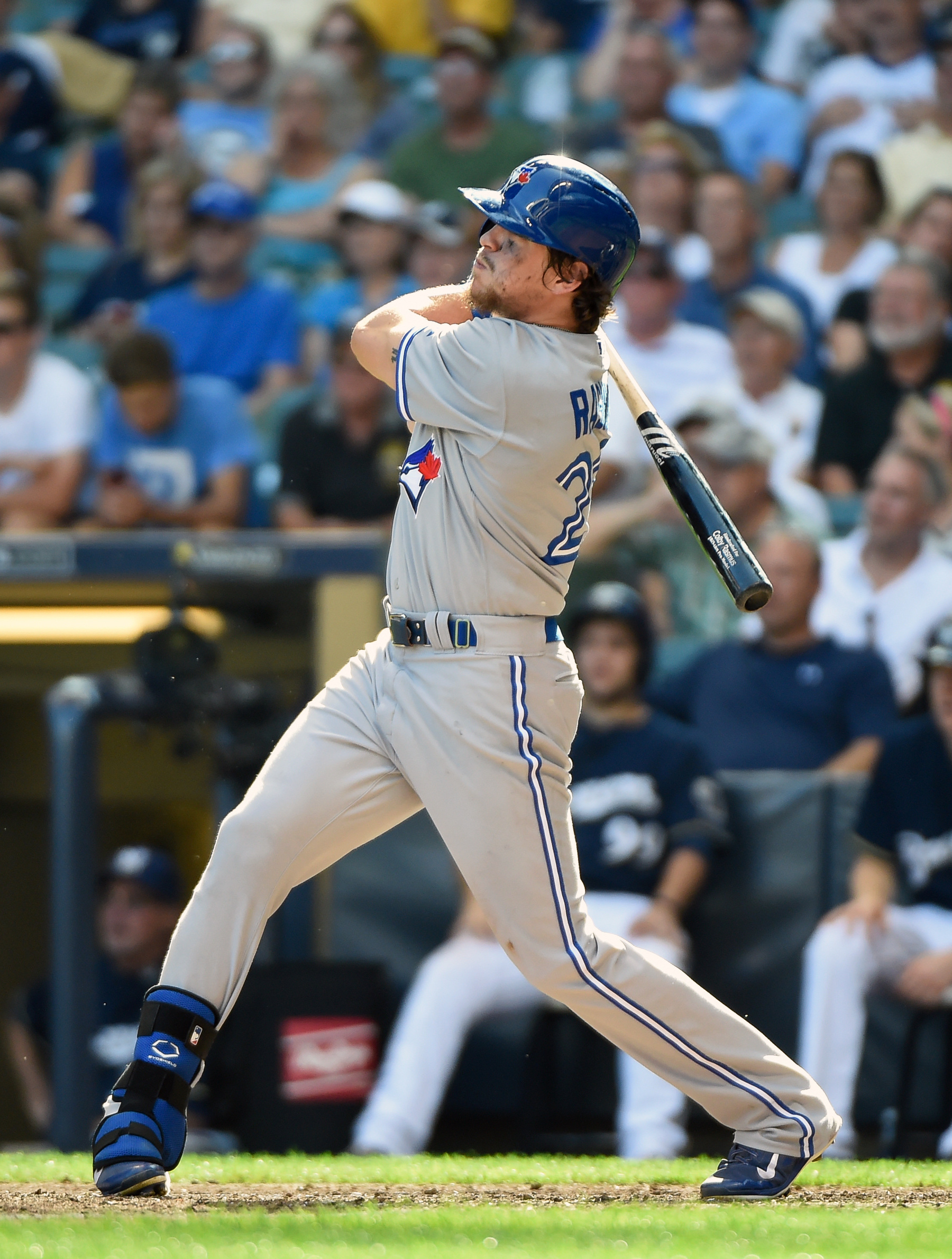 If there were any doubts whether Rasmus could remain a consistent source of power, he answered them. Indeed, Rasmus’s 2014 campaign landed right alongside his two excellent overall seasons of 2010 and 2013 in terms of ISO. Likewise, his line drive rate (23.3%) and home run to flyball ratio (19.4%) reached new career highs, while his infield fly ball ratio declined for the fourth consecutive year.
Generally, then, when Rasmus makes contact, it has been good contact. (More on that below.) To an extent, his variations in batting average and on-base numbers over the years can be attributed to BABIP. Last year, for instance, he hit .276 and reached base at a .338 clip on the back of a .356 BABIP. When his average on balls in play dropped to .294 this year, his average fell to .225 and his OBP dropped to .287.
As Rasmus noted in a fascinating interview with Scott MacArthur of TSN.ca, he believes that he sent a lot of hard-hit balls into newly-aggressive shifts, accounting for some of the decline. Shi Davidi of Sportsnet.ca explored that idea, and other possible explanations for Rasmus’s enigmatic bat, in a late-season piece. As Davidi notes, Rasmus suffered significant BABIP drops on both line drives and ground balls. Another oft-noted change was the departure of Jays hitting coach Chad Mottola, with whom Rasmus thrived. Though Rasmus has good things to say about replacement Kevin Seitzer, he has not seemed to mesh in working to counteract the league’s adjustments.
Despite struggling in some other ways at the plate, Rasmus still managed to produce at a better than league average clip this year (103 wRC+) thanks to his pop. He has been a consistently solid baserunner, though he is not much of a threat to steal. And while his defensive ratings have had their ups and downs, the total package is appealing. At his best, Rasmus has logged two seasons as one of the better center fielders in baseball: 2010 (4.0 fWAR, 3.6 rWAR) and 2013 (4.8 fWAR, 4.6 rWAR). And even in the rough campaigns of late — 2012 (1.0 fWAR, 1.8 rWAR over 625 plate appearances) and 2014 (0.6 fWAR, 0.9 rWAR over 376 plate appearances) – he has been at least serviceable, if not the kind of player that first-division club would hope to field.
Of course, it is critical to bear in mind that Rasmus only just turned 28 in August. That is an unusually young age to reach free agency, and could be enough to keep hopes alive for a return to the fairly impressive ceiling that he has shown in the past. Needless to say, youth, athleticism, and power are excellent attributes in any free agent.
Another key factor is that Rasmus is all but certain not to come with draft compensation attached. Teams will be much more inclined to take a chance on his talent without the need to sacrifice future assets.
Weaknesses/Cons
Defensively, advanced metrics were less kind to Rasmus this year than in the past. One year after being credited with saving his team 11 runs by Defensive Runs Saved, Rasmus checked in at a negative 7 tally in 2014. And his UZR/150 figures likewise reversed course, going from +15.2 to -15.3.
This is not the first time that those measures viewed Rasmus as a hindrance in the field, though he has tended to bounce up and down over the years and remains an average to slightly above average contributor over his career. Rasmus has explained that he was also slowed by cumulative injuries – he mentioned his hips and hamstrings – that could have had an impact.
Most worryingly, perhaps, are the changes in Rasmus’s strikeout figures. He has set career highs in each of the last two years, moving from a 29.5% strikeout ratio last year to a 33.0% clip this time around. Of course, he did succeed at that level last year, and posted his third-highest career K rate in his excellent 2010 season. As Drew Fairservice of Fangraphs wrote in exploring the “enigma” of Rasmus, he has a fairly unusual skillset with few obvious comps. Though B.J. Upton and Chris Young offer warning signs, Fairservice notes some routes to upside scenarios, even if they are arguably less likely.
Also up for debate is whether Rasmus would be better served in a platoon situation. As a left-handed bat, he generally has performed better against righties. For his career, Rasmus owns a 112 wRC+ against righties, which drops to a score of 77 against same-handed pitchers. In spite of his struggles in 2014, he actually reduced his splits to a more manageable 14-point gap.
It is also worth pointing out that Rasmus has a not-unblemished injury history. In fairness, most of the issues are not much more than typical bumps and bruises, but he has missed time over recent years with wrist, oblique, and hamstring injuries. This could, of course, be spun in either of two ways: on the one hand, some have suggested that Rasmus is injury-prone; on the other, he could be said to play the game hard and his nicks could explain some of his inconsistency.
Then, there is the fact that Rasmus sat a good bit at the tail end of 2014. Though that was obviously a reflection of a complicated situation — involving his performance, that of the Blue Jays, and the presence of younger players who had a future with the organization — it certainly did not help. If nothing else, the benching held down his stats, prevented him from showing much late in the year, and may not have sent the best signal to prospective new employers.
Personal
Rasmus grew up in Alabama and still lives there in the offseason. He is married with one child. Rasmus grew up in a very baseball-focused family, and appeared in the 1999 Little League World Series along with brother Cory, who now pitches for the Angels, on a team coached by his father.
In the above-linked interview, Rasmus intimated that he has struggled at points in his career with maintaining his love for the game. Saying that he is by nature relaxed but hard-working, Rasmus says that over-aggressive coaching has at times had the opposite of the intended effect on him. On the whole, Rasmus leaves the impression that his production on the field and enjoyment of the game tend to go hand-in-hand, and that he hopes to find an environment in which both can thrive.
Market
Rasmus is in a unique position in the market. On the one hand, he occupies the always-enviable status of being the best player available at his position, center field. In fact, it’s not even close: players like Emilio Bonifacio, Grady Sizemore, and Chris Young fall next in the pecking order.
In spite of that, it is questionable whether a club with expectations to contend would pursue the up-and-down Rasmus as an everyday option. As MLBTR’s Tim Dierkes has suggested (via Twitter), teams like the Tigers and Braves are in need of added production up the middle. But they might prefer to explore a trade market that could include options such as Drew Stubbs, Dexter Fowler, Jon Jay or Peter Bourjos, and perhaps Desmond Jennings. That figures to be the real competition for Rasmus.
On the other hand, there are still plenty of landing spots that might make sense. Dierkes also suggested the Cubs, and the Twins are also unsettled in center. Though Rasmus has little experience in the corners — less than 100 big league innings, in fact, all coming in his rookie year — a host of other teams might like the idea of deploying him there. It is possible to imagine interest from the Mets, Reds, Rays, White Sox, Royals, Giants, Padres, Pirates, Rangers, and Athletics. Depending on what shakes out with their current options, the Orioles, Astros, and Phillies are certainly plausible bidders as well. (Of course, unlike the center field market, there are more viable alternatives to contend with as well.)
All said, Rasmus should have a fairly broad market given his upside and defensive flexibility. Things will really open up if, as I suspect, he prioritizes fit with the clubhouse and coaching staff over contract particulars and position (if, in other words, he is amenable to taking a corner job).
Expected Contract
Ultimately, Rasmus is one of the most difficult free agents to pick a price tag for. His upside – given his age, center field capability, and power – is perhaps unmatched among this year’s crop of outfielders. Indeed, it was not long ago that it seemed likely, as MLB.com’s Gregor Chisholm wrote in late 2013, that Rasmus would top the B.J. Upton contract (five years, $75MM) when he hit the market. Yet it is not plausible now, with another year of information in the books. to put him in that range.
There would appear to be two approaches that Rasmus – and interested teams – could take. First is the traditional pillow contract. In that case, Rasmus would surely look to prioritize fit, hoping to find both regular playing time and a situation that would lead to a good platform season. Position player comps are somewhat wanting: Young signed for one year and $7.25MM last year in a somewhat similar situation, though that deal emerged out of a much more crowded outfield market, and Young was both somewhat older and coming off of a rougher offensive year. And Kevin Youkilis went for $12MM over one year, though he had a significantly longer track record of consistent production but was a much older player. With market inflation and a lack of competition, I believe Rasmus would be able to reach eight figures on a one-year deal.
On the other hand, the following year’s market includes increased competition in the form of players like Fowler and Austin Jackson. And it is not hard to imagine a team that believes in Rasmus looking to take advantage of his depressed value to lock in an attractive contract, much as the Twins did last year with Phil Hughes. For a club that can tolerate his strikeout tendencies, and believes in him as an at least average defender up the middle, a three-year offer cannot be ruled out, especially given Rasmus’s age. (Remember, the Red Sox just committed $72MM to unproven 27-year-old Rusney Castillo.) Clubs could be tempted to take the risk for a chance at his upside since he is a reasonably flexible roster piece, given his left-handed bat and center field capabilities.
It is hard to gauge just how high the price could go in that scenario, but it should be noted that Rasmus can wait to re-enter the market at a young 29 and has already earned something like $17MM in his career. Given that, it is somewhat difficult to imagine him seriously considering a deal that falls shy of a $10MM AAV over a term of three years. (And it might well take more to convince him to go that route; remember, he can look to rebuild his value and hit the market again at a still-youthful 29. Two years seems undesirable from Rasmus’s perspective, though he could field such offers.) One other factor to bear in mind is that Rasmus should be able to take his time seeing how interest develops in a multi-year scenario, fairly confident that a solid one-year option will be around at the end of the day.
Ultimately, I believe Rasmus will prioritize finding the right fit over maxing his earnings, whether on a one-year or multi-year deal. I do find a make-good contract to be the likelier outcome, and think that Rasmus will be able to reach $12MM on a one-year deal. But I would not be surprised if he ultimately scores a three-year pact.
Russell Martin Declined Pirates’ Mid-Season Extension Offer
Pirates catcher Russell Martin rejected an extension offer made by the team at some point during the season, Jon Heyman of CBSSports.com reports. Terms of the offer (or its precise timing) are not known. There are no indications that the sides are close on a late-breaking deal to keep Martin off the market, Heyman adds.
Pittsburgh reportedly has continued interest in bringing back Martin, and this reported mid-season effort lends credence to the idea that they will be serious in pursuit. On the other hand, of course, Martin stands alone among free agent backstops, and plenty of other clubs figure to make a run at him.
The Bucs had preliminary discussions with Martin in the spring, but held off on making an offer. That may have cost the team its window to reach a deal. Martin has delivered plenty of value on the two-year, $17MM deal he signed with Pittsburgh before the 2013 season, and his .290/.402/.430 line in 2014 brought him into a new performance tier. MLBTR’s Charlie Wilmoth profiled Martin’s rising standing in August.
Rangers Claim Ed Lucas
The Rangers have claimed infielder Ed Lucas off waivers from the Marlins, according to Rangers executive VP of communications John Blake (on Twitter). Lucas, 32, will be controllable at league minimum next year.
It took some time for Lucas to reach the big leagues, but he’s seen a good bit of action over the past two years. In total, he has a .255/.302/.323 slash and five home runs over 573 plate appearances. Those numbers looked better after 2013, but a .580 OPS campaign saw Lucas land under replacement value last year.
Clearly, Lucas’s value lies in his defensive flexibility. Over that limited stretch of time, he has seen significant time at third, second, first, and even short. Lucas has also played some innings in the corner outfield.