
The Reds’ hopes of challenging in the NL Central were dimmed by several major injuries this year, and this visit from the injury bug was particularly damaging to a team who already faced some big decisions in the offseason. With just over $71MM committed to 10 players on the 2015 payroll, the mid-market Reds may be forced to save some money by moving a starting pitcher. Though Cincinnati’s durable and deep rotation has been a big part of the club’s success in recent years, pitching seems like a natural area for payroll reduction simply due to the fact that three starters will enter their third year of arbitration eligibility.
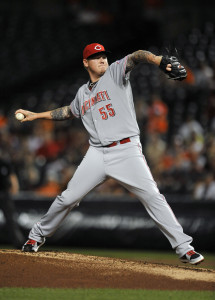 Two pitchers who won’t be dealt are Homer Bailey and Tony Cingrani. The Reds have already committed to Bailey in the form of a six-year, $105MM extension, and wouldn’t have been likely to move him even if Bailey hadn’t recently undergone forearm surgery. Cingrani has also had injury problems, spending most of 2014 on the DL with shoulder problems. Had Cingrani been able to build off of his impressive 2013 rookie season, the Reds would’ve felt at least a bit better about trading one of their more established starters (Bronson Arroyo wasn’t re-signed last winter in part because the Reds were comfortable with Cingrani).
It’s possible Cincinnati could trade multiple starters, though I’d suspect that the team wouldn’t want to lose too much pitching depth until they know Bailey and Cingrani are fully healthy. The Reds would probably rather not have David Holmberg or Dylan Axelrod as full-time rotation members next year, top prospect Robert Stephenson still needs some seasoning (a 4.74 ERA in 136 2/3 IP at Double-A in 2014) and the newly-signed Raisel Iglesias could still wind up in the bullpen.
The Reds’ other four pitchers are all controlled only through 2015, so the team likely wouldn’t score a truly huge return in a trade but all carry value even as one-year pitchers. The candidates…
Johnny Cueto: The Reds have a $10MM option on Cueto for 2015 that is sure to be exercised given how well Cueto has pitched. After an injury-shorted 2013, Cueto bounced back in a major way by posting a 2.15 ERA, 8.9 K/9 and 3.73 K/BB rate over a league-leading 222 innings.
Cueto’s next contract will be in the nine-figure range, and it’s unclear if the Reds would be willing ink another major extension given how much money has been tied up in recent deals with Bailey, Joey Votto and Brandon Phillips. Cueto would net the biggest return in a trade, though moving their ace would seem to hint that the Reds are punting on 2015, which I doubt they’re prepared to do. On the other hand, the Reds could trade Cueto for Major League parts (such what the Rays and Red Sox received for David Price, John Lackey and Jon Lester before last July’s trade deadline) and use a Cueto deal to reload rather than rebuild.
Keeping Cueto would give the Reds stability at the top of their rotation, and they could still explore dealing Cueto at next year’s trade deadline if they fall out of the race. If they’re contending and wanted to keep Cueto, Cincinnati could then get a compensatory draft pick via the qualifying offer if he leaves in free agency after the 2015 season.
In a recent Insider-only piece, ESPN’s Buster Olney recently explored Cueto’s trade market and raised the possibility that the Reds could clear some payroll space by attaching Phillips, for example, to Cueto in a trade package. With several notable starters available as free agents this winter, Olney believes some teams might prefer trading for a year of Cueto rather than making an expensive multiyear commitment for an ace on the open market. Also, a contending team that potentially loses their ace in free agency (such as if Max Scherzer leaves the Tigers or James Shields leaves the Royals) could look to Cueto as a short-term replacement to keep their rotation strong for another run in 2015.
Mat Latos: Ken Rosenthal of FOX Sports recently cited Latos as perhaps the likeliest of the Reds’ starters to be dealt, as both Latos and Cueto can make a case for commanding an extension larger than Bailey’s deal. While Cueto is two years older than Latos, presumably the Reds would be more inclined to extend their homegrown product than they would Latos, who missed part of 2014 with an elbow injury. Latos has a 3.25 ERA in 102 1/3 IP this year, though ERA indicators show that he hasn’t pitched quite that well (3.64 FIP, 4.00 xFIP, 4.08 SIERA) and both his ground ball and strikeout rates dropped significantly below his career averages. The right-hander’s average fastball velocity also dropped to 90.7 mph, down from 92.5 mph in 2013.
The Reds already tested the market for Latos at the trade deadline, so I tend to agree with Rosenthal that if a Cincy starter is moved, it’ll probably be Latos. His declined numbers could be explained by his elbow issues, and if fully healthy, Latos could be a standout front-of-the-rotation starter for several teams. He earned $7.25MM in 2014 in the last year of a two-year extension, and he’ll be eligible for arbitration for a third and final time this winter.
Mike Leake: Another pitcher with a third arb year remaining, Leake will get a raise from his $5.925MM salary in 2014. The right-hander has been a reliable rotation piece over his five Major League seasons, not missing many bats (career 6.1 K/9) but inducing a lot of grounders (49.8% ground ball rate) and eating a lot of innings, averaging 191 IP over the last three years.
Leake comes with the fewest question marks of any Cincinnati starter, lacking the injury histories of Cueto and Latos but also never pitching nearly as well as those two have at their peaks. While Leake’s ceiling in the bigs may never surpass the “solid” level (he has an even 100 ERA+ over his career), this also means that the Reds could extend him at a much lower price than Cueto or Latos. A Leake extension could look something like the five-year, $65MM deal the White Sox gave John Danks a few years ago, as Leake and Danks are decent comparables in terms of age and career numbers to that point in their careers, plus both had one arb year left before free agency.
The Reds put Leake and Latos on revocable waivers in August, possibly in a move to gauge trade interest for the upcoming offseason. I’d guess there’s a better chance Leake stays in Cincinnati than goes, though the Reds will certainly get interest in the durable 26-year-old.
Alfredo Simon: The big surprise of the group, the 33-year-old Simon moved from the bullpen to the rotation as an injury fill-in and wound up making his first All-Star team. Though his performance has very much come back to earth in the second half, Simon still has a 3.48 ERA through 178 1/3 innings on the season despite a middling 5.9 K/9.
Simon is arb-eligible for the third time this winter and he’ll earn a healthy raise over his $1.5MM salary, though the raise will hardly break the bank. Simon’s age and career track record give him a very modest amount of trade value, so it’s likely he stays with the Reds and competes for the fifth starter’s job (or returns to the pen) if and when a rotation spot opens up via trade.
With this variety of available starters and a wide variance in asking prices for each of the four pitchers, many teams could fit as potential trade partners for the Reds under the “you can never have too much pitching” argument. If the Reds look to deal a starter and fill an everyday lineup hole at the same time, they’ll likely target a left fielder or a shortstop as upgrades on Ryan Ludwick and Zack Cozart, respectively. Ludwick has a $9MM mutual option for 2015 but after two negative fWAR seasons, the Reds might instead buy him out (for a deferred $4.5MM) and look for other options.
Using these needs to speculate about trade partners, the Cubs, Diamondbacks and possibly the Indians stand out as teams with a shortstop surplus. The Red Sox have a glut of outfielders and are known to be looking for starting pitching. The Dodgers could finally solve their long-standing logjam in the outfield and, if it meant getting back Cueto or Latos, would be willing to eat a lot of salary on one of their high-priced outfield bats.
As Ken Rosenthal noted (video link), the Reds could employ some gamesmanship with their starters and perhaps leverage them against each other in figuring out which (if any) pitchers they want to sign over the long term. Between these negotiations and waiting for the free agent pitching market to play out, Cincinnati might wait until January or even February to move a starter. At this point, the only thing that seems certain about the Reds’ 2015 rotation is that at least one of Cueto, Latos, Leake or Simon won’t be on the roster come Opening Day.
Photo courtesy of Joy R. Absalon/USA Today Sports Images
If the Red Sox were willing to deal from their major league OF depth (Jackie Bradley Jr, Yoenis Cespedes, Allen Craig, Daniel Nava, Shane Victorino etc.) could there be a match here?
Could there be a match? Maybe. But Boston has been vocal about keeping their young pitching to control costs. That plan may change pretty quickly if they get some value on trades but right I would say no.
The Red Sox have a ton of young pitching. They cannot keep it all. They presumable need a number one and a number two starter as that is what they traded at the deadline this year. That leaves Buchholz as a number 3, Kelly as a number 4 and one spot open for De La Rosa, Workman, Ranaudo, Barnes, Webster, or Wright. That leaves Owens, Johnson and Rodriguez to spend the year at AAA and most likely be ready some time next year or in 2016. All of the guys competing for the fifth spot in the rotation next year are at the point where they are either ready to take the next step or be relegated to the bullpen or AAA. You can’t keep them all, particularly with the Rule 5 coming up. Some of them have to be moved.
Bullpen helps keep most of them.
I’m not opposed to trading them. I’m opposed to giving them away while holding onto a Weeks or something of that nature.
Not really. You’re not going to put all five of them in the bullpen. Layne looks like he’ll be in the pen next season, Tazawa’s still team property, Mujica’s signed for another season, that’s half the bullpen right there. If they bring back Koji that only leave two openings, one of which should be for a lefty. So out of the five guys that will not be the number five starter that leaves spots for 2 or 3 in the bullpen (if they don’t resign Koji). No one is endorsing giving players away. We’re talking about packaging a few. and some position prospects in a deal for a legitimate major league starter. And the guys they have to find spots for next year are just the tip of the iceberg, because the real prospects are the three that are playing in AAA next year, Owens, Rodriguez and to a lesser extent Johnson.
I know a couple of them are going to be exposed. I certainly want to keep De La Rosa for now. I’m not sure of how I would even prioritize Workman, Barnes, Ranaudo, Webster. I live up in Maine and saw a lot of Johnson and Owens this year and both were excellent. I actually like Johnson’s advanced feel for the game even if he does not have the same “stuff” as Owens. He has excellent command and I am curious how that will translate to AAA and eventually the big leagues.
None of them in particular will be exposed. They are already on the 40 man roster. The marginal guys in the minors like Travis Shaw, Henry Ramos, who have played professional baseball for four years already and were drafted at 19 or older and guys who have played for 5 years or longer and were drafted at 18 who aren’t on the 40 man roster. Either they make a trade of several prospects for one player or they lose players. But the main concern is there is no point in holding onto all this talent if you’re not going to use it. They have too many young pitchers to use all of them.
Agreed, they have to many young arms, I just hope they get included in a deal that brings the Sox back some value. How the 40 man roster works out depends on the rules you put forth. I see them adding Swiihart, Coyle, De La Cruz and Eduardo Rodriguez as they all need to be protected by November 20th. They may look to add Shaw as well.
Didn’t you and I have this debate at the trade deadline and you were opposed to acquiring both a number 1 and 2?
Boston is probably a match, but I don’t see how from their OF depth. Bradley is a bust, Craig is a reclamation project, and guys like Cespedes and Victorino have one year left, like the pitchers mentioned in the article, and cost about as much, so the Reds wouldn’t really be saving anything by acquiring them. Sox are going to have to dip into the minors.
Craig hasn’t hit his body weight this year, Victorino is old and slowing rapidly, Cespedes is a free agent after next year, Nave solid player not a impact player, and Bradley has yet to show it in the bigs. I don’t like any of those players not for Latos or Cueto. Maybe Bradley and another prospect for Cueto and Phillips contract. I know you have a 2nd basemen in Dustin P. but the sox could move him for a prospect and eat that contract.
Red Sox could be a match, but it would mean mortgaging off several pieces from the upper minors. If Latos/Cueto was my target, it would most likely take Betts and Workman/Ranaudo/Webster. But if Boston want to keep the big 3 they have in tact, it will probably cost JBJ, 2 of the starters we have in the upper minors/majors and a flier prospect or 2… Both of those are hefty prices but if it means competing next year I would do it in a heartbeat
It better be Cueto and not Latos if the offer is Betts.
Because Sox prospects are such sure things that they never bust and their blocked 2nd baseman is worth more than a 26 year old 6 foot 6 front of the rotation work horse.
No, that’s not it at all. It’s because Betts has succeeded at every levels with great peripherals like K/BB ratio along the way. It’s been more of the same in nearly 50 games and 200 plate appearances in the big leagues. He looks more like one of the better players on the team as both his offense and defense have graded out well in the big leagues. I hope they do not trade him for Cueto or Latos to be honest. 6 years of cost controlled Betts is better than 1-2 years of Latos or Cueto. The Sox have the money to spend for pitching on the free agent market. Why trade Betts?
Agreed, Betts is pretty valuable and although Pedroia is at second there is a TON of value in Betts being the next Zobrist. There was a fangraphs article recently on this issue and truthfully I would make Betts untradable at this point and explore the pitching market like Cueto, Latos, and more.
I totally agree. I may be a Red Sox fan and I have been extremely vocal about not trading Betts. I read the Cameron article and he raised a number of good points. I just think he is cost controlled with a bright future as a leadoff hitter. I think he might even be able to produce a little more offensive value if he attacks within the zone a little more. Trading him for one year of Lagos or Cuetto makes very little sense to me.
Craig, Brentz, Coyle, Swiihart for Cueto……. done deal if im Cherington. With Nava showing he is the same player he was last year (since being recalled) and Victorino coming back and Betts surly going to play RF, Craig wouldnt be seeing much time their and he would just be taking time away from Napoli at 1st and Cespedes in LF. Craig could be that middle of the order bat to play LF for the reds. Brentz is a 25 year old with loads of power and a great arm who may just need an opportunity to play. An opportunity, he wont get in a crowded boston OF. Coyle is slowly becoming one of the top young infield prospects around and well, Swiihart is a young catcher with tremendous upside
Offensively SS is a major problem, but Cozart is one of the best in the league defensively. They can live with a light hitting elite defender in the 8 hole. What they really need is a left fielder with some pop.
Whatever happened to giving Billy Hamilton the reins at SS? He was basically a career minor league SS and only switched to CF right before the majors, just to get him in the lineup. I think they have to at least look at that as an option but then CF is a hole again. Give/Take.
He is much more of a weapon in CF, have you seen the amount of field he can cover?
His best defensive seasons are ahead of him should he stay healthy, decent arm, incredible speed. I think he can maintain those skills while his instincts and situational skills improve.
He’s crazy good in CF, and moving him to SS may not be wise (I’m not sure of his reputation there though). The thing you are worried with him though is hitting. The defensive value can only do so much when his hitting is as bad as it was in the second half.
Reds need a LF with power. Yasmani Tomas should be target #1. Cozart is one of the best defensive SS in baseball, he’s fine in the 8 hole. The keys to the Reds will be HEALTH, Votto especially. Bruce and BP should bounce back in 2015.
Nice article, let’s see how it goes
Isn’t Colorado a tempting trade target. They have a glut of outfielders and no clear major league 2nd baseman. Maybe latosPhillipscash gets a starting outfielder and some high prospects?
Latos alone is hardly worth a starting outfielder and high prospects.
Latos is far from driftwood. He is only 26 and his comparables through 25 y/o are: 1.Jake Peavy* (975), 2.Sid Fernandez (974), 3.Steve Busby (968), 4.Don Wilson (965), 5.Chad Billingsley (964), 6.Bob Welch* (963), 7.Yovani Gallardo (963), 8.Scott Sanderson (963), 9.Bill Gullickson (961), 10.Jim Nash (961). *s indicate CY awards.
Cueto for one of the Cubs’ shortstops?
I think the Cubs would only be interested if Cueto was willing to discuss an extension before the trade happened. That is possible, though.
I would like this idea if the Cubs are confident in their team’s success in the near future. As mentioned an extension would almost assuredly have to be part of the trade so that the prospects can come up while he’s there.
Straight up??
You’re dreaming,it will take a lot more than a shortstop to get one of the best pitchers in the league
Angels would probably be in on one, if they had a farm system.
Well, they have some outfielders to trade, but the Angels really need to lose the anchor around their necks known as Josh Hamilton, and unfortunately, there is no way they can trade that contract.
It’s amazing that Hamilton has done nothing of note this season, been “injured” the last few weeks and the halos have excelled.
The contract looks bad, but there’s many anchors around their necks including CJ Wilson, Albert Pujols, and the aforementioned Hamilton. They haven’t succeeded much in contract talks except for Trout, which was basically guaranteed to be good as long as it got done.
Reds are a very interesting team to watch this off-season. They are a contender next season as-is. But if they don’t trade some expiring contracts for younger pieces, their window pretty much closes after 2015. A big off-season for the future of the organization.
The Red Sox should be interested in Cuetto. Craig does not really fit for them since they already are paying Ludwig the next two years and have Heisey under cost control. I hate to give rid of Betts but if they would bite on Betts and one of Workman, Ranaudo, Barnes, Webster. Given 6 years of cost controlled Mookie Betts is Plenty fair for 2 years Cuetto. Especially when what is likely to be at least a useful pitcher on the cheap for the next few years is involved.
Cueto is only under control one more season. Can’t picture the Sox giving up Betts for 1 year of Cueto with plenty of pitching options on the free-agent market.
Every team would be biting on Betts after 2.0 bWAR/1.7 fWAR in ~1/3 of a season and his status as an every position player. I don’t know if I would be good to make a trade for the Dodgers, but I would work on making a package for him. I may even give up Pederson if I feel the stats and scouting reports are in favor of this.