
Latest On A.J. Burnett
A.J. Burnett has a $12.75MM player option for the 2015 season, but he’s also debated retirement on multiple occasions over the past two seasons, so whether or not he picks it up remains uncertain. Jon Heyman of CBS Sports hears, however, that Burnett is leaning toward pitching again in 2015. Heyman spoke to people close to Burnett and got the sense that given the righty’s love of pitching and the solid $12.75MM payday, there’s a “good chance” that he’ll pitch in 2015.
The news may bring about mixed reactions among Phillies faithful, as Burnett unquestionably struggled this season. Though the 37-year-old posted his highest innings total since 2008 (213 2/3) and made an NL-leading 34 starts, he also posted a disappointing 4.59 ERA with 8.0 K/9, 4.0 BB/9 and a 50.6 percent ground-ball rate. Burnett posted an NL-worst 18 losses as well, though clearly that total is also reflective of his defense and a lack of run support. Beyond that, Burnett also pitched through a hernia for much of the season, an injury that, as Burnett told MLB.com’s Todd Zolecki, will require offseason surgery.
However, the prospect of a healthy Burnett in 2015 would improve the Phillies’ outlook. Currently, the team has little certainty in the rotation beyond ace Cole Hamels and righty David Buchanan (117 2/3 innings of 3.75 ERA in 2014), as it’s impossible to know what to expect of Cliff Lee next season as he recovers from a flexor tendon injury. Kyle Kendrick and Jerome Williams, each of whom occupied a rotation spot late in the 2014 season, are both free agents. Aaron Nola, the team’s first-round selection from 2014, could eventually factor into the equation. Other in-house options include Jonathan Pettibone and Jesse Biddle, though the latter certainly figures to need some more time to develop in the minors, and the former missed much of 2014 following shoulder surgery.
Yankees Sign Brian Cashman To Three-Year Extension
The Yankees have announced a three-year contract extension for general manager Brian Cashman. The new contract runs through the 2017 season.
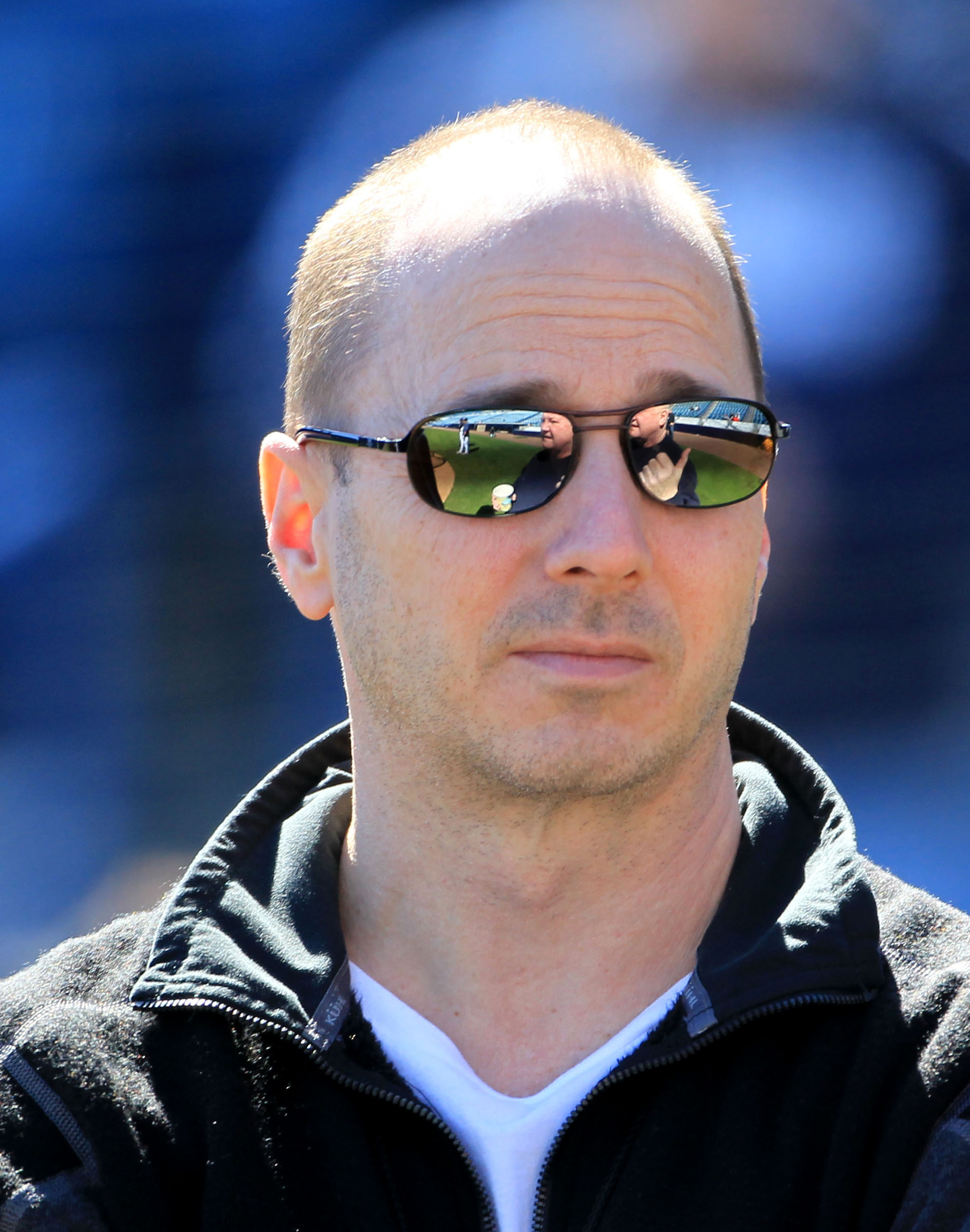
Cashman, 47, will return to a post which he has held since 1998 in spite of the fact that the Yankees missed the playoffs for consecutive seasons for the first time in his tenure in 2013-14. That two-year absence also marks the first time in which the Yankees have failed to reach the postseason in consecutive seasons since 1992-93. However, in spite of that fact, ESPN’s Buster Olney reported in late September that the two sides were working on a new contract.
While it’s perfectly fair to question the team’s decision to invest hundreds of millions of dollars in aging players, the Yankees can point to the fact that the signings of CC Sabathia, Mark Teixeira and A.J. Burnett (now with the Phillies) led to a 2009 World Series championship. Of course, investments since that time have failed to pay off. The lauded Brian McCann signing of last offseason was a disappointment, and the additions of low-cost veterans Brian Roberts, Brendan Ryan, Stephen Drew, Kelly Johnson and Matt Thornton did not round out the roster as hoped. Jacoby Ellsbury made good on the first year of his seven-year, $153MM pact, and Masahiro Tanaka looked to be worth every penny of the $175MM total investment the Yankees made in order to secure his services prior to suffering a partially torn ulnar collateral ligament.
Midseason additions of Chase Headley, Martin Prado and, in particular, Brandon McCarthy each proved to be wise maneuvers that bolstered the team’s roster, even if the ultimate result did not pan out. Prado, who hit .316/.336/.541 for the Yankees, remains under team control for two more seasons, while McCarthy and Headley are free agents.
Cashman now faces the daunting task of trying to bring the Yankees back to the postseason in the near future despite having more than $168MM in payroll already committed to both the 2015 and 2016 rosters. That number does not include arbitration raises to players such as Michael Pineda, Ivan Nova, Shawn Kelley, Francisco Cervelli and David Phelps — each of which will further add to payroll and complicate the team’s short-term outlook.
Photo courtesy of USA Today Sports Images.
Orioles Extend J.J. Hardy
OCT. 10: Dan Connolly of the Baltimore Sun has the breakdown of Hardy’s contract (Twitter links). Hardy will earn $11.5MM in 2015, $12.5MM in 2016 and $14MM in 2017, per Connolly. He adds that the vesting option is valued at $14MM as well and comes with a $2MM buyout. The option will vest based on a certain number of plate appearances but will also automatically vest if Hardy is traded. Hardy can also earn up to $700K per season in performance incentives, according to Connolly, who also tweets that the deal does contain some deferred money.
OCT. 9: Shaking up the free agent market before it opens, and boldly looking to the future even as they prepare to open play in the ALCS, the Orioles have officially announced a three-year extension with shortstop J.J. Hardy.
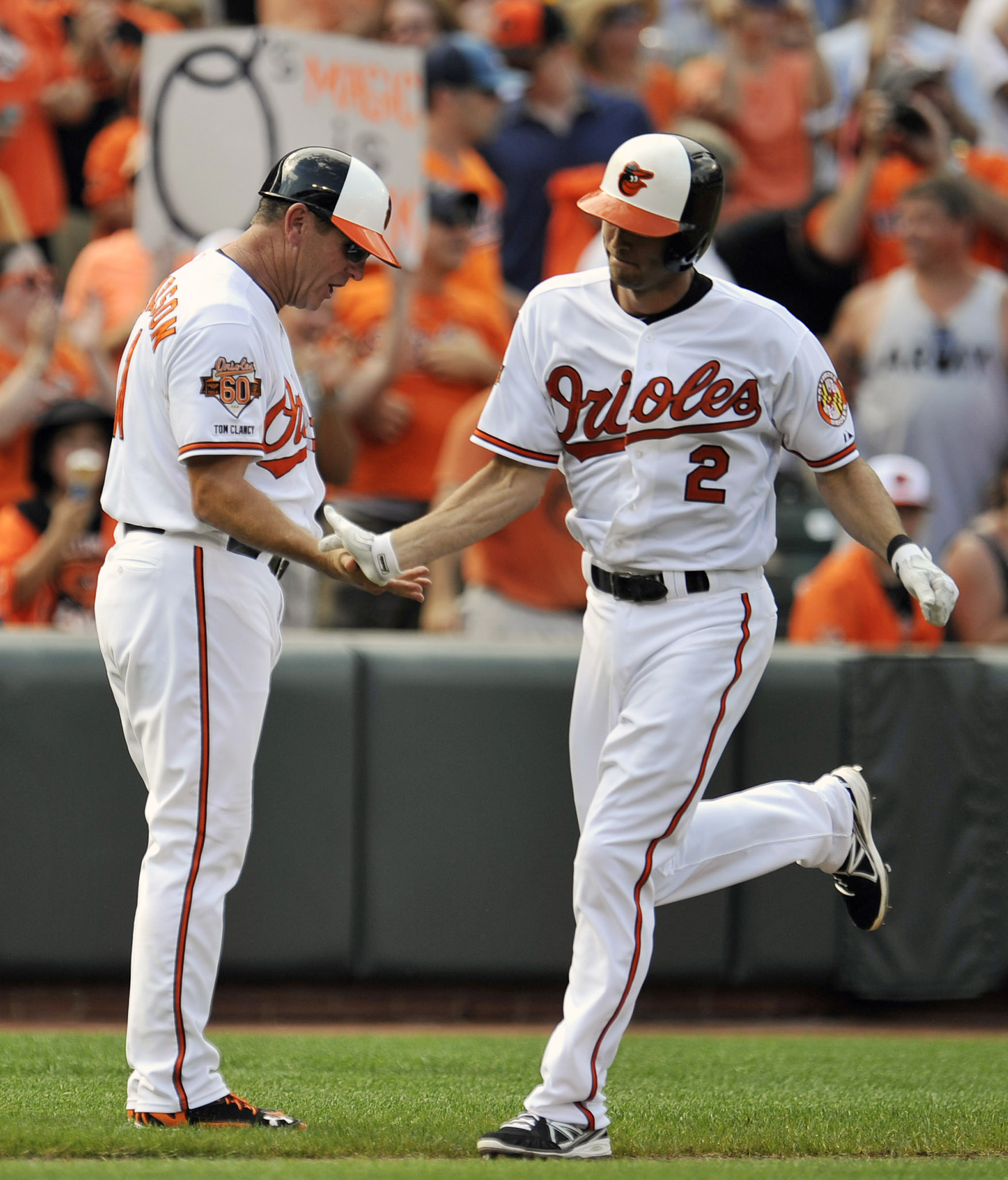
Hardy will receive $40MM over a guaranteed three year term, representing a $13.3MM average annual value, though that must be discounted somewhat to reflect the deal’s inclusion of $6.5MM in deferred money. Hardy also gets a fourth-year vesting option, based upon plate appearances.
With the new deal, Baltimore will keep its key cog up the middle under team control through at least 2017, his age-34 season. And the free agent market has now lost one of its most appealing everyday position players.
Looking first at Hardy, who just celebrated his 32nd birthday, one finds a player whose profile has changed, but who nevertheless remains consistently productive. Manager Buck Showalter is said to have had a hand in encouraging an early reunion of Hardy and the O’s, reflecting the veteran’s respected standing in the organization.
Since coming to Baltimore in a lopsided trade with the Twins, Hardy has been a steady three-to-four win player, whether one prefers fWAR or rWAR. But how he’s reached those overall levels of production have changed dramatically.
In his first (and best) year in Baltimore, Hardy racked up 30 home runs and a .491 slugging percentage. Over the next two seasons, he steadily contributed twenty or more long balls, but saw his overall power numbers drop. His glove remained sharp, however, and a declining strikeout percentage offered promise. But things swung in 2014, when Hardy suddenly suffered a power outage (he recovered to hit 9 bombs by season’s end, but ended with a career-low .104 ISO) and saw his strikeout rate leap to a career high of 18.3%.
Obviously, those offensive numbers have swung rather widely, with Hardy posting anything from a 78 to a 113 wRC+. But what has not changed much has been his glove. Indeed, in his two down years at the plate (2012 and 2014), Hardy’s even upped his game in the field — at least according to UZR and Defensive Runs Saved. This year, Hardy rated a close second to Andrelton Simmons in overall defensive value among shortstops.
For Baltimore, then, Hardy’s work up the middle sets the floor while his power bat provides the upside in his new extension. While it had been expected, and perhaps hoped, that Manny Machado would slide over from third after this season, that option waned after Machado suffered a second-straight season-ending knee injury. If he can return to health, however, he’ll join Hardy to form the game’s best left-side infield defense.
The deal is not without its risks for the O’s, but few are. And limiting the terms to three years, with the fourth coming via a vesting provision, does reduce the magnitude of the risk somewhat.
More importantly, perhaps, it may have been more challenging to retain Hardy — or find an able replacement — had the team not struck during a brief lull in the postseason action. After all, while, the upcoming free agent market includes several shortstops who have at times been every bit as good as Hardy, none — excepting Hanley Ramirez, who may not stay at the position — has been as consistent. Those that remain, including Asdrubal Cabrera, Jed Lowrie, and Stephen Drew, should benefit from Hardy’s absence, if only because they would have had to wait to sign until he found a home. But the Orioles were likely to find a veteran shortstop one way or another, so the real impact may be on clubs that were hoping to make a run at Hardy.
Ultimately, while Baltimore does not look to have achieved any huge bargain, the club probably saved money against what Hardy might have cost to take back from the open market. Though he would have had to deal with qualifying offer-related draft compensation, Hardy no doubt would have looked to land a new contract somewhere in the realm of Jhonny Peralta‘s four-year, $53MM pact from last year.
Jeremy Conn of 105.7 The Fan was first to report that an extension was close (Twitter link), while Ken Rosenthal of FOX Sports first reported the deal’s parameters on Twitter. Roch Kubatko of MASNSports.com was first to tweet the final financial terms. MLB.com’s Britt Ghiroli (via Twitter) and Jon Heyman of CBSSports.com (also via Twitter) reported that the deal was done.
Offseason Outlook: Miami Marlins
Before the 2013 season, Miami aggressively cut its future obligations to zero, dealing away its best players in a series of moves that drew fire from around the baseball world. But those moves now seem prescient after a campaign in which the Marlins improved by 15 wins and saw several youngsters make impressive strides.
Guaranteed Contracts
- Jarrod Saltalamacchia, C: $15MM through 2016
- Garrett Jones, 1B: $5MM through 2015
- Jeff Baker, 1B/2B: $2.1MM through 2015
Arbitration Eligible Players (service time in parentheses; projections via Matt Swartz)
- Casey McGehee, 3B (5.028): $3.5MM projected salary
- Giancarlo Stanton, OF (4.118): $13.0MM
- Mike Dunn, RP (4.079): $2.3MM
- Steve Cishek, RP (3.143): $6.9MM
- Henderson Alvarez, SP (3.051): $4.5MM
- Nathan Eovaldi, SP (3.013): $3.1MM
Contract Options
- Jeff Mathis, C: $1.5MM club option (no buyout)
Free Agents
Overview
After so much upheaval in recent years, the Marlins’ first order of business in 2014 will be healing. The club’s two young superstars both saw their seasons cut short in dramatic fashion. Starter Jose Fernandez went down early to Tommy John surgery, possibly snuffing out the club’s efforts to compete for a Wild Card, and his return to health will have widespread implications for the franchise.
Then, in the midst of an MVP-caliber year, slugger Giancarlo Stanton was cut down by a fastball to the jaw. While his recovery seems a matter of course, his long-term future remains a topic of intense interest around the game. The Fish are said to be preparing a run at locking up Stanton for the long haul, with intentions of offering him the largest contract in team history. Of course, that is a foregone conclusion if the team hopes to have any chance of striking a deal: Stanton is projected to double his arb earnings (to $13MM) next year before his final season of eligibility. As Stanton enters just his age-25 season as perhaps the game’s most-feared pure power source, getting his signature on a contract might require breaking other records – such as the eight-year, $248MM pact that Miguel Cabrera signed before his age-31 season, two years in advance of his own free agency. Extension or not, team president David Samson has gone on-record as saying that Stanton will be on next year’s team.
While it could be said that locking down Stanton is Miami’s top priority, convincing him to sign away his prime may well require other moves towards contention. There are several areas that the team could look to improve, but navigating the risky realm of free agency on a budget will require care.
On the position-player front, there are plenty of certainties and several question marks. The starting outfield appears to be set for the foreseeable future. Stanton, Christian Yelich, and Marcell Ozuna combined to form one of the game’s most productive units. The latter two are even younger than Stanton, and are still a year or more away from arbitration. Fellow youngster Jake Marisnick was parted with at the trade deadline, and reserve Reed Johnson is a free agent, leaving Jordany Valdespin and Enrique Hernandez as reserve options. If the team hopes to make a run at a postseason berth, a veteran fourth outfield addition would make sense; players like Chris Denorfia, Scott Hairston, and Nate Schierholtz could be fits, with the latter making particular sense as a left-handed bench bat to complement the right-handed-swinging Jeff Baker. Much-hyped Cuban free agent Yasmany Tomas has been floated as a possibility, but it is somewhat hard to see the logic in topping the market for him only to shift him to first base.
The infield is less settled. Third baseman Casey McGehee seems an easy arb tender for Miami, which is so impressed with his bounceback year that an extension has even been suggested. Though the club is said to have interest in free agent Pablo Sandoval, that would require a commitment to a much higher payroll and may not be the best way to allocate resources. At first, Garrett Jones is under contract for one more year. He continues to hit righties at a reasonable clip, making for a serviceable platoon situation with the lefty-mashing Baker. While there are rumblings that Miami could be interested in upgrading at the position, it is far from certaain that a clear upgrade can be had at a price that does not bust the budget – especially since Jones and Baker are still under contract. Though the options are limited by Miami’s lack of a DH spot, it is perhaps possible to imagine the team looking again to buy low on a player of Jones’s ilk, such as Corey Hart. A pricier option like Adam LaRoche would not only require some convincing, but would tie up most of the team’s apparently free payroll capacity.
Miami has a variety of young options up the middle. Adeiny Hechevarria figures to keep his job at short, though he continues to be a well-below-average contributor. At the keystone, the Fish have any number of in-house options, including Donovan Solano, Derek Dietrich, Ed Lucas, and the already-noted trio of Hernandez, Valdespin, and Baker. None of these players seems to represent a single solution, though the club could take that group to the spring and hope that Dietrich or Hernandez grab hold of the job, with Solano serving as an insurance policy. (If Dietrich cannot stick at second, he might also be moved to another position to clear a path for his bat.) Ultimately, Miami’s free agent dollars could have the greatest impact if they are dedicated to a middle infielder. This year’s market features several players – Jed Lowrie, Asdrubal Cabrera, and Stephen Drew being the primary examples — who would bring a veteran presence and the hope of a return to past form, though J.J. Hardy‘s late-breaking extension could boost their demand. Signing someone of that ilk would afford an everyday possibility at second as well as insurance for Hechevarria. Another possibility is Cuban defector Hector Olivera, if he can qualify for free agency in time, though reports conflict on the team’s interest.
Starting pitching is said to be on Miami’s offseason wish list, with some reports even indicating that the club hopes to land a top-flight arm. As things stand, if Fernandez returns relatively early in the year, Miami can look ahead to a rotation that features a true ace backed by Henderson Alvarez and Jarred Cosart. Behind that group, Nathan Eovaldi showed encouraging peripherals, while Tom Koehler and/or Brad Hand might be looked upon as solid-enough innings eaters. Andrew Heaney, Anthony DeSclafani, and Brian Flynn all struggled in brief first stints at the major league level but offer plenty of promise (Heaney in particular). Justin Nicolino is also nearing readiness. Miami gave up on Jacob Turner in order to give a few starts to the ineffective Brad Penny, so he is no longer an option, but young arms abound.
While that group provides a good deal of promise, it makes sense for the Fish to consider adding an established pitcher to round out that group, especially since Fernandez is likely to miss a month or two and may not quite be his former self from the jump. But the top of the market – Max Scherzer, Jon Lester, and James Shields – will probably require a commitment approaching or exceeding $20MM annually just to join the conversation on years. And would any of those hurlers choose to go to a Miami club with a history of dealing away expensive veterans? Adding one of a deep group of mid-level starters, on the other hand, would be a viable aim. With a bare minimum in future commitments, Miami could look to back-load a deal for a pitcher like Francisco Liriano or Edinson Volquez. The trade market is also a possibility, of course, and the current Marlins administration already showed its willingness to deal for young arms when it gave up Marisnick and recent first-rounder Colin Moran to acquire Cosart (along with Hernandez).
The bullpen, too, looks to be a solid unit in its current state. Steve Cishek and Mike Dunn remain entrenched at the back end, though there is at least some merit to the idea of dealing Cishek to a closer-needy team that is not afraid of his skyrocketing arbitration salary. Certainly, now would be the time to maximize his value, though that may send the wrong message to Stanton and take away a key cog. The club also received solid, if in some cases surprising production from controllable arms like Bryan Morris, Chris Hatcher, and A.J. Ramos (the latter, in spite of a ballooning walk rate). With only the disappointing, little-used Kevin Gregg set to reach free agency, Miami could just roll this group forward, using the leftovers from the rotation (Koehler and Eovaldi, in particular, has been mentioned as a possibility) to round out the relief corps. But a relatively cheap veteran addition would certainly make some sense.
Ultimately, for president of baseball operations Michael Hill and GM Dan Jennings, this offseason represents a chance to seize on opportunity. With many pieces in place, a few carefully-conceived signings or wise trades might not only lead to immediate contention but could set the stage for longer-term success.
The question, of course, is how much cash the front office will have to work with. It has been suggested that payroll may land in the $60MM range for 2015, after starting at $45MM last year, but could move up to $75MM. Either way, that’s a pittance compared to the rest of the league. But the higher mark, at least, would give some room: the team will start with around $47MM on the books (salary guarantees plus projected arb earnings) and does not have any obvious means to dump salary while building towards contention. Unless the team gets creative, then, it will not have much to spend unless owner Jeffrey Loria decides to crack the war chest. (On that topic, it’s worth noting that attendance did rise this year over 2013, though it lags the Marlins Park-opening 2012 gate.)
One other limitation to consider is that several of the top free agents are sure to come with draft compensation attached. Picking 12th overall, the Marlins have the game’s highest non-protected choice. While the team has shown a willingness to deal away its valuable competitive balance picks, sacrificing such a lofty draft choice would be a costly proposition.
Tomas? A solid veteran first base upgrade? A “big three” starter? It’s not clear that any of those moves is plausible absent a commitment to adding cash to the hopper. And more importantly, perhaps, it’s not clear that any is strictly necessary. Barring the presentation of a sterling opportunity to buy low on an impact player that does not represent a true need, Miami could field a fairly compelling club merely by adding some short-term veterans in the right places — the middle infield and rotation being the most fruitful possibilities — and hoping that its impressive youngsters continue to develop.
Orioles Working To Extend Cruz, Possibly Markakis
3:26pm: Markakis, too, says he is unaware of any current extension talks, tweets Connolly. He quotes the right fielder: “Nothing. Unless my agent hasn’t been telling me everything, because I haven’t heard anything.”
2:53pm: Cruz says that there are no talks at present, though he had some discussions with the Orioles earlier in the year, MLB.com’s Britt Ghiroli reports on Twitter.
1:37pm: The Orioles have interest in reaching a late-breaking extension with outfielder Nick Markakis as well, Dan Connolly of the Baltimore Sun suggests on Twitter. He does note that deals do not appear imminent with either Markakis or Cruz.
Earlier, Roch Kubatko of MASNsports.com tweeted that he would not be surprised to see the club try to open talks with Markakis.
12:08pm: After seemingly reaching terms on a deal with J.J. Hardy, the Orioles are now “pushing” to get a contract done with fellow free agent-to-be Nelson Cruz, Ken Rosenthal of FOX Sports reports on Twitter.
Cruz, 34, enjoyed a monster season at the plate in his first year with the O’s, hitting an MLB-best 40 home runs while working his way to a strong .271/.333/.525 batting line. While he’s been known to have injury problems in the past, Cruz tied a career-best with 159 games played this season.
Cruz is currently playing on a one-year, $8MM contract after struggling to find a suitable multi-year deal last offseason on the heels of a PED suspension and a qualifying offer. The slugging DH/outfielder recently switched agents, signing on with Diego Bentz of Relativity Sports, so he’ll have different representation this time around than he did when negotiating his last contract.
If the two sides do indeed reach a deal, the free agent market will take a significant hit today. Hardy was arguably the best pure shortstop on the market, and Cruz represented perhaps the best power bat for teams looking to add some thump to their lineup. An extension for Cruz would be unquestionably good news for the likes of Victor Martinez, Melky Cabrera and Yasmany Tomas, as there will now be less competition on the open market.
Free Agent Profile: Luke Gregerson
Luke Gregerson has been one of baseball’s top setup men since his 2009 rookie season, and he posted a career-best 2.12 ERA this year. Interest will be strong on the 30-year-old, who will be seeking the first multiyear deal of his career.
Strengths/Pros
Among American League relievers with at least 60 innings, Gregerson’s 2.12 ERA this year ranked 12th. Among free agents, only Pat Neshek and Andrew Miller did better. In Gregerson’s six big league seasons, his highest ERA was 3.24 in his rookie campaign. He’s posted an ERA of 2.75 or lower in each of the past four seasons. From 2009-14 among relievers with at least 350 innings, Gregerson’s 2.75 ERA ranks fourth in baseball. He’s been a model of consistent excellence in the late innings, using his slider often to stymie hitters even if they know it’s coming.
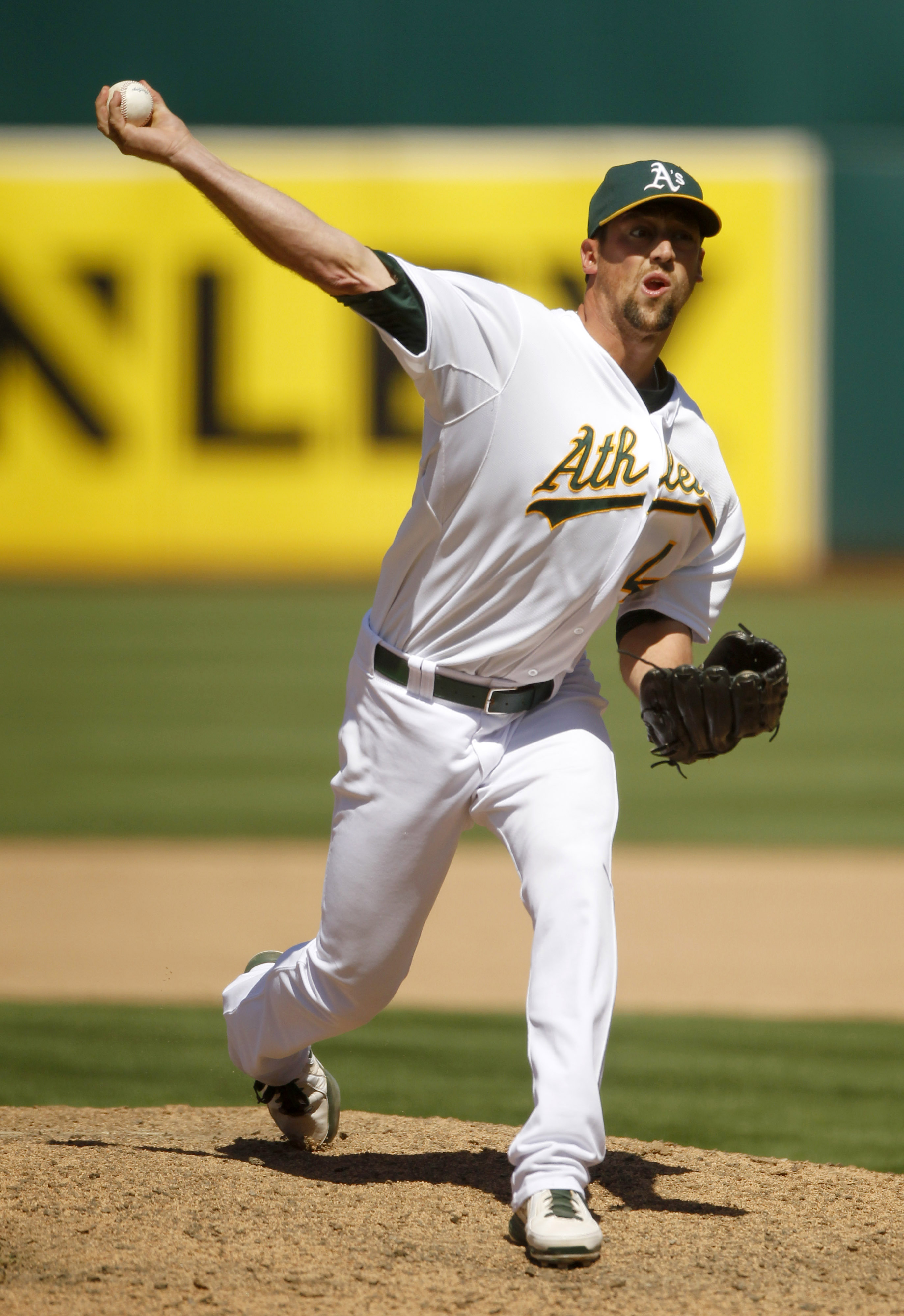 In San Diego, Gregerson paired up with closers Heath Bell and Huston Street for five years, and he’s never received more than 13 save opportunities in a season. Instead, he racks up holds like no other. According to MLB.com, a hold is given if “a reliever comes into a game to protect a lead, gets at least one out and leaves without giving up that lead.” Gregerson led all of baseball from 2009-14 with 154 holds.
Gregerson walked only 5.3% of the batters he faced this year, a career best. Only 13 relievers showed better control this year, and only Neshek and Koji Uehara are free agents. Gregerson’s 52.2% groundball rate was also a career-best, and the figure ranked 11th in the AL. Gregerson has been consistently tough to hit throughout his career, allowing fewer than 7.5 hits per nine innings in every season except 2011. His career batting average on balls in play of .267 is a big part of his success (more on that later).
Gregerson will not turn 31 until May next year. Only a handful of Gregerson’s fellow relievers on the free agent market are that young, and none of them have a track record close to his. One benefit Gregerson should have over free agent reliever David Robertson: he’s not going to receive a qualifying offer.
Gregerson comes with a remarkably clean bill of health, having only hit the DL twice in his career. He missed 25 games in 2009 for shoulder inflammation and another 25 in 2011 for an oblique strain. His 419 1/3 relief innings from 2009-14 rank second in baseball, behind only Tyler Clippard.
Weaknesses/Cons
Drafted in the 28th round in 2006 by the Cardinals, velocity has never been Gregerson’s calling card. He broke in throwing around 91 miles per hour, and now he’s down to 88.4. Only three relievers threw slower in 2014, and two of them are sidearmers.
Gregerson struck out 7.3 batters per nine innings in 2014, his worst mark aside from his 2011 season, which was marred by an oblique strain. The average AL reliever this year whiffed 8.3 per nine. It should also be noted that Gregerson’s success has come in both leagues, but always in pitcher-friendly home parks. For his career, he has a 2.02 ERA at home and a 3.60 mark on the road. The key differences are a much higher home run per flyball rate and batting average on balls in play on the road.
Gregerson threw his famed slider about 46% of the time in 2014, a rate topped by only three relievers. He was the game’s most slider-dependent regular reliever in 2012-13, throwing it 63% of the time. It’s possible heavy slider usage leads to increased injury risk. However, Gregerson has a strong track record of health, and noted to Susan Slusser of the San Francisco Chronicle in March that he turns his wrist less than most pitchers and his elbow has never bothered him.
Personal
Born in Park Ridge, Illinois, Gregerson resides in Chicago in the offseason. He attended St. Xavier University in Chicago and grew up rooting for the Cubs and White Sox, according to a 2009 interview. For a look at how the 28th round pick found his way to the Majors, check out Jeff Passan’s article for Yahoo from 2010.
Gregerson is a board member of Struggling Youth Equals Successful Adults, which aids foster kids in transitioning to adulthood. In September 2012, Gregerson was the Padres’ nominee for the Roberto Clemente Award for all his volunteer efforts.
Market
As a Chicago guy, Gregerson might welcome a chance to pitch for the White Sox if they make a competitive offer. Sox GM Rick Hahn made it clear in September that he aims to “acquire multiple options” for his pen this winter. Other speculative suitors: the Tigers, Dodgers, Astros, Rockies, Rangers, Nationals, Yankees, and Red Sox. It is certainly possible that Gregerson could be signed to take on a closer role.
Aside from Gregerson, the best names on the free agent relief market are David Robertson, Andrew Miller, Jason Grilli, Sergio Romo, Francisco Rodriguez, Koji Uehara, Casey Janssen, Rafael Soriano, and Pat Neshek. That’s a lot of competition, and you don’t want to be the reliever left standing in January after the music has stopped.
Expected Contract
From last offseason, three contracts come to mind as comparables for Gregerson: Javier Lopez ($13MM), Joe Smith ($15.75MM), and Boone Logan ($16.5MM). From the previous offseason, notable deals include Brandon League ($22.5MM), Jeremy Affeldt ($18MM), and Jonathan Broxton ($21MM). All of those deals were for three years, and that is the expectation for Gregerson. Five of the six were signed before December, so it would be wise for Gregerson’s agent Tom O’Connell to act early.
You’ll notice that the average annual values from last offseason were about 20% lower than the 2012-13 period, even if we exclude Lopez on account of being older and an extreme lefty specialist. Some of that may be a function of Broxton and League having 111 and 60 career saves, respectively, but it could be a sign that teams backed off on reliever salaries. Plus, League isn’t the best example, as that deal was viewed as questionable for the Dodgers before the ink had dried. On the other hand, Gregerson’s consistent success led to him setting the arbitration market for his ilk, along with Robertson, so it’s possible a team could like him enough to set a new setup man precedent by giving an $8MM AAV or a fourth year. The four-year deal for setup men seems to have died out with Scott Linebrink and Justin Speier six to seven years ago.
Ultimately, I think Gregerson will sign a three-year, $20MM deal.
Orioles, J.J. Hardy Nearing Extension
The Orioles are closing in on an extension with shortstop J.J. Hardy and could announce an agreement this afternoon, Jeremy Conn of 105.7 The Fan reports on Twitter. Terms are expected to land at three years and over $40MM, with an option of some kind included on the back end, according to a tweet from Ken Rosenthal of FOX Sports.
An extension has long been rumored to be a possibility. But reports indicated that talks never really got started over the winter and early portion of the season.
Things have changed since that time, of course. For one, Manny Machado — long considered the eventual replacement for Hardy at short — suffered a second consecutive season-ending knee surgery and has in any event established himself as a premier defensive third baseman. On top of that, as you might have noticed, the O’s cruised to the American League East crown and into the ALCS. While it is hard to know whether that had any role in Baltimore’s thinking, the added current and future revenue stream surely did not hurt.
Of course, Hardy’s performance has had its ups and downs this year. While his power numbers are down, and he was fairly inconsistent at the plate on the whole, Hardy continues to provide immense value with his glove. In the aggregate, Hardy was once again about a 3-and-a-half win player in the regular season.
While several other useful shortstop options are present on the upcoming free agent market, Hardy seemed to be the prize — at least for clubs looking for an option that promises to stick at the position over the duration of the contract. (Hanley Ramirez, it seems fair to say, does not fit that description.) His absence from the market would be a boon to the likes of Asdrubal Cabrera, Jed Lowrie, and Stephen Drew.
O’Dowd Declined Rockies’ Extension Offer Before Resigning
Before resigning yesterday from his long-time post as general manager of the Rockies, Dan O’Dowd declined an offer of a multi-year extension from the team, MLB.com’s Tracy Ringolsby reports. The offer, in fact, was made just last week, according to Ringolsby.
Needless to say, this report puts a new spin on the club’s surprising decision yesterday to promote Jeff Bridich to the GM role without undergoing any publicly-reported hiring process. Colorado also announced yesterday that O’Dowd and fellow key baseball decisionmaker Bill Geivett would be leaving the organization.
Ringolsby says that O’Dowd was not pleased with the power-sharing structure that emerged after a front office shakeup in 2012. Though O’Dowd retained the GM title, Geivett — whose title was senior VP of major league operations — kept an office in the clubhouse and was charged with running the major league club.
In yesterday’s press conference announcing the hiring (story via Nick Groke and Patrick Saunders of the Denver Post), team owner Dick Monfort said he was “excited about a fresh start.” But he did not offer substantive comments about how the changing of the guard came about, and was not made available for questions from the media. (Note that the Rockies do not presently employ a team president.)
Today’s news regarding O’Dowd also seemingly makes sense of recent reports that suggested no major changes were afoot in Colorado. But it raises yet more questions about what manner of authority Bridich will have in his new role, with Monfort having come under fire from internal sources for inserting himself into baseball decisionmaking. While Bridich is by all accounts a well-regarded young executive, it remains to be seen — as Paul Klee of the Colorado Springs Gazette explains — what kind of decisionmaking structure Monfort will set up around him.
Royals Will Attempt To Re-Sign James Shields
The Royals will make an effort to bring back top starter James Shields through free agency, Jon Heyman of CBSSports.com reports. Shields, 32, has given Kansas City 455 2/3 innings of 3.18 ERA ball over the last two regular seasons, and is still pitching for the team in October.
While the club’s run to the ALCS has made that a return a more plausible scenario, Heyman says that the starting point for the decision came around the trade deadline. At that point in the middle of the summer, the club informed Shields’s agent, Page Odle, that it would be in touch after the season — a sign which seemingly indicated that a run at Shields was at least a possibility.
As I wrote back in March, landing Shields figures to be quite an expensive proposition, but perhaps will not be prohibitive even for the small-budget Royals. If past comps are any indication, even adjusted for inflation, Shields may not be able to exceed nine figures (if he gets five years at all) unless a true bidding war emerges. That could bode well for Kansas City’s chances.
Also helping the Royals’ cause is the qualifying offer that the team will make and Shields will surely decline. While he is an expensive enough player that the impact may not be too substantial, other clubs will need to weigh the cost of giving up a draft choice to sign him. (Of course, as a practical matter, so will Kansas City.)
As Heyman notes, the substantial revenue boost that the club should see from its postseason run will certainly play a role in determining whether the payroll space can be found for Shields. Not only will the team benefit from a playoff gate, merchandise sales, and the like, but should see increases in future streams through mechanisms such as season ticket sales.
All that being said, Shields will have plenty of suitors to choose from. After all, he is attractive to plenty of other clubs for largely the same reason he is to the Royals: in theory, he could represent a more achievable, less-risky investment on a shorter/smaller deal than other top free agent starters Max Scherzer and Jon Lester. Of course, if that kind of reasoning attracts enough bidders, it could drive Shields’s price tag up significantly.
Offseason Outlook: Houston Astros
It was a tumultuous season for the Astros, to say the least. A security breach led to a large number of trade notes being leaked to the public, the team failed to sign No. 1 overall pick Brady Aiken and manager Bo Porter was dismissed in September after apparent communications problems with the front office and possibly some players. GM Jeff Luhnow and his staff will need to work to move past that bad press and focus on furthering the rebuilding efforts.
Guaranteed Contracts
- Scott Feldman, RHP: $18MM through 2016
- Jose Altuve, 2B: $10.5MM through 2017
- Jon Singleton, 1B: $8.5MM through 2018
- Chad Qualls, RHP: $3.25MM through 2015
Arbitration Eligible Players (Service time in parentheses; projections via Matt Swartz)
- Dexter Fowler, CF (5.168): $9MM projected salary
- Jason Castro, C (4.104): $3.9MM
- Chris Carter, 1B/DH (2.159): $3.5MM
- Tony Sipp, LHP (5.100): $1.5MM
- Alex Presley, OF (2.162): $1.2MM
- Carlos Corporan, C (3.019): $1MM
- Marwin Gonzalez, SS (2.133): $1MM
- Anthony Bass, RHP (2.148): $600K
- Non-tender candidates: Bass, Presley
Contract Options
- Matt Albers, RHP: $3MM club option with a $200K buyout
Free Agents
Houston’s offseason began while the season was still underway, to some degree, as the team fired Porter and began the search for a new manager. A.J. Hinch — a statistically inclined 40-year-old with previous experience as a big league skipper and front office exec — was selected for the job and seems to be a good fit with the team’s unorthodox philosophies. As for the payroll, that figure almost doubled from 2013 to 2014, though it still sat at just $50MM to open the year. Nonetheless, owner Jim Crane told the Houston Chronicle’s Evan Drellich that payroll could go up by another $20MM and noted that Luhnow could look to “add some cornerstones” as long as it makes baseball sense. That’ll be addressed in more depth later, but first, a quick look back at the season that was.
Lost in many of the negative narratives surrounding the 2014 Astros was the fact that the team took a large step in the right direction in terms of results. The team made a 19-game improvement over its 2013 performance, and the much-hyped future began to emerge on the field. George Springer debuted and hit .231/.336/.468 with 20 homers in just 345 plate appearances, although his season was cut short by an injured quadriceps muscle. Unheralded hurlers Dallas Keuchel and Collin McHugh stepped out of obscurity and into the spotlight not only as reliable arms, but as potential front-line options. Each was worth more than three wins above replacement, per Fangraphs, and more than four WAR according to Baseball-Reference. The only player in baseball who hit more home runs than Carter was Nelson Cruz. Mike Foltynewicz and his 100 mph fastball made a bullpen cameo at season’s end, though the team hopes that his future is alongside Keuchel and McHugh in the rotation. And of course, Altuve hit .341/.377/.453 and captured his first batting title. The second baseman led all of Major League Baseball with 225 hits and swiped 56 bases — tops in the AL — in addition to his excellent work at the plate.
One much-ballyhooed name that didn’t contribute this season, however, was Singleton. His contract extension was widely considered a loss for the player and a steal for the Astros seemingly before the ink dried, but five months later, it’s hard to blame him for taking his first fortune. Singleton batted just .168/.285/.335 with a 37 percent strikeout rate, and while he may be Houston’s first baseman of the future, I’d imagine he’ll have to earn a roster spot next year. Carter can assume the first base duties if Singleton is ticketed for Triple-A to open the year.
Houston may feel set at catcher with Castro, even if he didn’t live up to the high standard he set with an elite 2013 campaign. The Stanford product hit .222/.286/.366 with 14 homers — numbers that, while unspectacular, aren’t vastly inferior to the .244/.309/.376 that MLB catchers averaged in 2014. The outfield, too, figures to be more or less locked in with Springer in right, Fowler in center and a combination of Jake Marisnick (acquired in July’s Jarred Cosart trade) and Robbie Grossman. Top prospect Domingo Santana is another option.
One player they could make an exception for would be Yasmany Tomas. Last offseason, Houston made serious runs at both Jose Abreu and Masahiro Tanaka, falling a few million shy with their bid for Abreu and reportedly bidding over $100MM for Tanaka. Both were seen as more certain investments than Tomas, so it’s possible that Houston won’t be as interested this time around. However, one can also envision a scenario in which the team steadfastly refuses to miss out on a third international superstar and goes the extra mile for Tomas, especially if they’re convinced of his star potential. He could certainly qualify as one of the aforementioned “cornerstones,” and it does seem likely that the Astros will be involved. Were they to sign Tomas, Santana and Grossman could become trade chips, while Marisnick and Springer rounded out the long-term outfield mix. Of course, that’s all highly speculative.
Where else can Houston look to upgrade? The left side of the infield is a prime spot for Luhnow to target. Opening Day starters Matt Dominguez and Jonathan Villar flopped, as the former hit just .215/.256/.330 and the latter was every bit as feeble before eventually being demoted to the minors. Houston might not have to wait long until the future at each position arrives, however, as a pair of Top 6 draft picks from 2012-13 are looming. The Astros selected Carlos Correa — ranked as the game’s No. 3 prospect midseason by Baseball America and ESPN, and ranked second by MLB.com — with the first overall pick in 2012, and he dominated Class-A Advanced before a fractured fibula ended his season. Colin Moran, the UNC third baseman selected sixth overall by Miami in 2013, was acquired alongside Marisnick and hit .304/.350/.411 with Houston’s Double-A affiliate in 29 games at a young age for that level (21).
With Moran and Correa not terribly far off, stopgaps are an attractive and logical concept for the Astros. Houston could be a nice low-pressure environment for someone like Stephen Drew to attempt to rebuild his value on a one-year deal. He’d provide sound defense even if his bat didn’t fully recover despite a full Spring Training, and if he performed well, he would of course be a logical trade chip. The same could be said of Alberto Callaspo, who entered 2014 as a lifetime .273/.335/.381 hitter with a solid defensive reputation but batted just .223/.290/.290 this year. Neither option is elite, but both are bounceback candidates that could be had at relatively inexpensive levels. If Houston wants to look more long-term at third base for a potential mainstay, they could try to make the highest bid on a multi-year deal for Chase Headley, whom Tim Dierkes profiled earlier today.
As far as the rotation is concerned, Houston has a pair of potential stalwarts, as previously noted, in addition to the veteran Feldman as a solid rotation cog. Mark Appel‘s Class-A struggles were highly publicized, but rumors of his demise as a prospect looked to have been greatly exaggerated as soon as he reached Double-A. In 39 frames at that level, he posted a solid 3.69 ERA with a strong 38-to-13 K/BB ratio. He may not be a factor next year, but he’s firmly in the organization’s plans, along with Foltynewicz, Keuchel and McHugh. One-year, upside plays such as Brett Anderson, Brandon Morrow, Justin Masterson and Gavin Floyd all make some degree of sense. If the team wants to expand its search to include multi-year candidates, it may have to go the route it did with Feldman in 2013-14 — offer an extra year at a solid annual rate in order to secure the deal. (I speculated in my recent free agent profile on Brandon McCarthy that some clubs may go that route with him, for example.)
The bullpen presents perhaps the most glaring weakness on the team, and Luhnow has indicated that it will be a priority. Rolling the dice on Albers would be a $2.8MM gamble coming off some serious health issues, so I’d expect him to be bought out for $200K. After that decision, the remaining options aren’t inspiring. Beyond Qualls, Sipp and perhaps Josh Fields, there was little continuity and little reason to expect significantly better performance from the arms that were present. The team did claim Sam Deduno from the Twins in late August, so perhaps the plan is for him to serve as a swingman. Still there appears to be room for at least two veteran upgrades.
Throwing a lot of money at David Robertson doesn’t seem like something the club is likely to do, but there’s some upside to rolling the dice on a former closer who struggled a bit in 2014, such as Sergio Romo. Another avenue perhaps worth exploring would be to sign a setup man with a strong track record such as Luke Gregerson and promise him the ninth inning as a means of enticement. Some buy-low, late-inning options could include Andrew Bailey, Jason Motte and Luke Hochevar, though Houston may want more certainty after being burned by Crain in 2014. I like Jason Grilli, Casey Janssen and Burke Badenhop as fits for the Astros as well.
We’ve learned in past years that it’s tough to rule out the Astros trading anyone — just ask Cosart — and they do have some players that seem like candidates this coming winter. Fowler has just one year remaining before free agency and is projected to earn a fairly hefty $9MM. Castro could be an attractive trade chip for rival clubs given the paper-thin free agent market for catchers. Houston does have an in-house alternative at catcher in the form of the cost-controlled Max Stassi, who a year ago was their No. 12 prospect (per Baseball America) and ranked 19th among Astros farmhands on MLB.com’s midseason Top 20 list. The team reportedly shopped Carter this past July, although that was before he batted .253/.336/.526 with 16 homers in his final 52 contests. That impressive showing, especially given the difficulty of finding offense in today’s game, may have swayed their thinking. Then again, they may think that success unrepeatable and look to sell at peak value.
The Astros are staunchly unafraid of being nontraditional, and right or wrong, that often renders them as little more than a punchline in many circles. However, the team has an impressive farm system that is slowly crossing the threshold to the Major League roster, and it’s easy to envision a group that resembles a contender in the not-too-distant future. That time almost certainly won’t be 2015, however, unless the ‘Stros catch a large number of breaks. A few well-calculated stopgaps could help bridge the gap to the next wave of talent — Correa, Moran, Appel, Foltynewicz, Santana, Josh Hader and others — and potentially lead to a further influx of talent into the Houston pipeline. A veteran “cornerstone,” as Crane alluded to, isn’t out of the question, but aside from a run at a young talent like Tomas, it’s difficult to envision the Astros playing at the top of the free agent market.