
Phil Maton Done For The Season Due To Hand Surgery
Astros right-hander Phil Maton told reporters today, including Chandler Rome of the Houston Chronicle, that he fractured the fifth metacarpal in his right pinkie finger after punching his locker on Wednesday. He has already had surgery and won’t be able to return this season.
Maton, 29, has just finished his sixth MLB season, throwing 65 2/3 innings out of Houston’s bullpen. He registered a 3.84 ERA along with a 26% strikeout rate, 8.5% walk rate and 38.2% ground ball rate. He moved into higher leverage positions this season, earning 14 holds after never previously cracking double digits.
Brian McTaggart of MLB.com tweeted video of Maton’s comments, where the reliever relays that he punched his locker because he was upset with how his outing went. It’s unknown if it’s related, but Wednesday was the final game of the season wherein his brother, Nick Maton of the Phillies, singled off him. Phil goes on to describe his actions as “short-sighted” and “selfish” before hoping that his absence doesn’t hurt the team. He says he’s expected to be in a cast for the next eight weeks but will be ready for Spring Training.
The Astros are set to begin their ALDS series against the Mariners and will now do so without Maton. He had a strong showing with Houston in the playoffs last year, throwing 12 1/3 innings with a 0.73 ERA, though he won’t be able to contribute this time around. Maton is earning $1.55MM this year and can be retained for one more season via arbitration. MLBTR contributor Matt Swartz projects that Maton would earn a raise into the vicinity of $2.5MM for next year.
Mariners Announce ALDS Roster
The Mariners announced their roster for their ALDS matchup against the division-rival Astros, keeping the exact same group that they used against the Blue Jays in the Wild Card round.
Right-Handed Pitchers
- Matt Brash
- Diego Castillo
- Luis Castillo (Game 2 starter)
- Matt Festa
- Logan Gilbert (Game 1 starter)
- George Kirby
- Andrés Muñoz
- Penn Murfee
- Paul Sewald
- Erik Swanson
Left-Handed Pitchers
Catchers
Infielders
Outfielders
With the club moving from a best-of-three series into a best-of-five series, they have decided to keep the same squad and not add another starting pitcher. Jon Morosi of MLB Network relays that lefty Marco Gonzales and righty Chris Flexen are with the team but not on the roster.
Gilbert was slated to start the third game of the Wild Card round but will now be able to start this series due to the Mariners sweeping the Blue Jays. This year’s ALDS features an unusual schedule, with off-days after Game 1 and Game 2, followed by three consecutive games after that, if necessary. That means that Gilbert could potentially start Game 4 on regular rest and Castillo could start Game 5 on short rest. Alternatively, they could turn to Kirby for a start or some bulk innings at some point. Regardless of how it plays out, the club evidently feels good enough about its options to proceed without Gonzales or Flexen.
Scott Effross To Undergo Tommy John Surgery
Yankees right-hander Scott Effross will require Tommy John surgery, reports Jack Curry of the YES Network. The news is an ill-timed blow to the Yankees, who are just about to begin the ALDS and will be without a key piece of their bullpen.
Effross, 28, made his MLB debut last year, throwing 14 2/3 innings with the Cubs with a 3.68 ERA. Here in 2022, he took his game to another level, throwing 44 more frames with Chicago, registering a 2.66 ERA, 28.1% strikeout rate, 6.2% walk rate and 45.6% ground ball rate. The Yankees were impressed enough by that showing to acquire him at the deadline, sending pitching prospect Hayden Wesneski the other way.
Effross continued to be effective once coming to the Bronx, adding another 12 2/3 innings with a 2.13 ERA, earning three saves and three holds while pitching in high-leverage situations despite missing about a month with a shoulder strain. He would have been in line to be an important member of the club’s relief corps in the postseason but will now miss the remainder of the playoffs and the entirety of the 2023 season as well.
This certainly isn’t the first hit that the Yankee bullpen has taken this year, as Chad Green also required Tommy John back in May. Zack Britton was placed on the 60-day IL earlier this month due to shoulder fatigue. Michael King suffered a season-ending elbow fracture in July. Ron Marinaccio was placed on the 15-day IL a week ago and won’t be an option for the ALDS, though he could potentially return later in the postseason if the Yankees advance. In addition to all of those injury woes, Aroldis Chapman has been struggling this season and then skipped a team workout last week. Due to his truancy, the team fined him and left him off the ALDS roster. The Yanks will now have to try to navigate the remainder of the postseason with a depleted bullpen group.
Going forward, Effross will miss the entirety of his age-29 season. He has just over one year of MLB service time and won’t be arbitration eligible until after the 2024 season. The Yankees can keep him on their 60-day IL all of next season, although there’s no injured list between the end of the season and the start of Spring Training, meaning Effross will be need a roster spot from November to February.
Phillies Announce NLDS Roster
The Phillies broke their decade-plus postseason drought, then went to St. Louis and swept the Cardinals in the Wild Card round. Now they square off against their divisional rivals in Atlanta in the NLDS. They’ve made a few changes for this series, swapping out right-hander David Robertson for fellow righty Nick Nelson, while subbing in outfielder Dalton Guthrie for infielder Nick Maton.
Right-Handed Pitchers
- Andrew Bellatti
- Connor Brogdon
- Seranthony Dominguez
- Zach Eflin
- Kyle Gibson
- Nick Nelson
- Aaron Nola (Game 3 starter)
- Noah Syndergaard
- Zack Wheeler (Game 2 starter)
Left-Handed Pitchers
- Jose Alvarado
- Bailey Falter
- Brad Hand
- Ranger Suarez (Game 1 starter)
Catchers
Infielders
Outfielders
- Nick Castellanos
- Dalton Guthrie
- Bryce Harper
- Brandon Marsh
- Kyle Schwarber
- Matt Vierling
The absence of Robertson is the most notable difference from the Wild Card round, as he has been a key component of the club’s bullpen this year. Manager Rob Thomson tells reporters, including Todd Zolecki of MLB.com, that Robertson strained his calf when he jumped in celebration of Harper’s home run in Game 2 this weekend. Robertson has received an injection of platelet-rich plasma in Philadelphia and is still there.
Robertson, 37, missed a good chunk of the past few seasons due to Tommy John surgery. He only threw 6 2/3 innings in 2019 before getting shut down and then missed the entirety of the 2020 season. He returned in 2021 and was able to log 12 innings with the Rays, along with four more in the postseason. He signed with the Cubs here in 2022 and looked like his old self for the first time in a while, getting traded to the Phillies at the deadline. Between the two clubs, he threw 63 2/3 innings this year with a 2.40 ERA, 30.7% strikeout rate and 46.5% ground ball rate. The walks were on the high side at 13.3%, but he still succeeded in high leverage situations, earning 20 saves and three holds.
Starting pitching was a key ingredient for the Phils in the first round, as Wheeler threw 6 1/3 scoreless innings in Game 1 and Nola following up with 6 2/3 scoreless in Game 2. Suárez would have gotten the ball in game three but wasn’t needed, allowing him to start this series. While not as good as Philadelphia’s top two, he still had a very good season. Throwing 155 1/3 innings over 29 starts, he registered a 3.65 ERA despite a subpar 19.5% strikeout rate, thanks to getting grounders on 55.4% of balls in play. The Phillies will need to think about who starts Game 4, as Suárez would be on short rest.
Braves Announce NLDS Roster
Although the Mets were atop the NL East for the vast majority of the season, Atlanta charged hard down the stretch and surged past them (via a tiebreaker). They earned their fifth consecutive division crown and also earned a bye past the Wild Card round under this year’s new expanded playoff format. They will now square off against a divisional rival, facing the Phillies in the NLDS. The roster for the series is as follows…
Right-Handed Pitchers
- Jesse Chavez
- Raisel Iglesias
- Kenley Jansen
- Collin McHugh
- Charlie Morton
- Jake Odorizzi
- Jackson Stephens
- Spencer Strider
- Kyle Wright
Left-Handed Pitchers
- Max Fried (Game 1 starter)
- Dylan Lee
- A.J. Minter
Catchers
Infielders
Outfielders
The most notable name on the list is Strider, as his status was uncertain for the series. His last appearance was September 18, after which he went on the injured list due to a left oblique strain. It seems there’s a chance he could return in the next week, based on his placement on this roster. Jeff Schultz of The Athletic relays word from manager Brian Snitker that the club hasn’t yet decided on a Game 3 starter, with Strider and Morton both under consideration. Yesterday, Mark Bowman of MLB.com said that the club was leaning towards Wright for Game 2.
Prior to landing on the injured list, Strider was enjoying a spectacular rookie season. He started in the bullpen but eventually made his way into the rotation and dominated the whole way. He threw 131 2/3 innings with a 2.67 ERA, 40.3% ground ball rate, 8.5% walk rate and an absurd 38.3% strikeout rate. The club was so impressed that they gave him a six-year, $75MM extension, announced just yesterday.
What role he can play in this series is something that is still to be determined. He is throwing a bullpen today and won’t be an option for relief work in Game 1, per Justin Toscano of the Atlanta Journal-Constitution. How his body responds to today’s session will likely determine how the club proceeds with regards to Strider’s workload.
As for who is not on the list, the most noteworthy omission is that of Tyler Matzek. Toscano relays that Matzek felt some elbow discomfort recently and is being evaluated in Texas. The southpaw was a key component of the club’s World Series run last year, throwing 15 2/3 innings in the postseason with a 1.72 ERA. In the regular season this year, he posted a 3.50 ERA over 43 2/3 innings. The fact that he’s been left off this roster suggests the club isn’t expecting him back in short order, though he could return to the club down the line if he gets good news in Texas and the club stays alive.
Braves Extend Spencer Strider
The Braves have extended yet another key member of their impressive young core, this time announcing a six-year, $75MM contract for right-hander Spencer Strider. The contract, which covers the 2023-28 seasons, also contains a $22MM club option for the 2029 season. The six-year guarantee buys out Strider’s final two pre-arbitration seasons, all three arbitration years and what would have been his first free-agent season. The 2029 club option gives the Braves control over what would’ve been Strider’s second free-agent campaign. Strider is represented by Frontline.
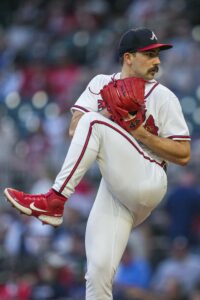
Strider, 24 later this month, will earn $1MM both in 2023 and 2024. He’ll be paid a $4MM salary in 2025 before jumping to $20MM in 2026 and $22MM in 2027 and 2028. The 2029 option comes with a $5MM buyout, which is factored into the guaranteed portion of the contract. If the Braves pick up that net $17MM option for the ’29 campaign, Strider will earn a total of $92MM over seven years.
Strider becomes the fourth young Braves star to be extended this season alone, joining first baseman Matt Olson (eight years, $168MM), center fielder Michael Harris II (eight years, $72MM) and star third baseman Austin Riley (ten years, $212MM). Atlanta, of course, had previously already signed outfielder Ronald Acuna Jr. and second baseman Ozzie Albies to club-friendly extensions. All six of those players are now under club control through at least the 2027 season, giving the Braves a level of continuity and cost certainty that is unparalleled throughout the league.
A fourth-round gem in the extremely truncated 2020 draft (five rounds), Strider skyrocketed through the Braves’ system despite a lack of minor league games in 2020, ultimately making his Major League debut late in the 2021 season. The Clemson product cracked the Braves’ Opening Day roster in 2022, initially working multi-inning stints out of the bullpen before ascending to the starting staff, where he not only found success but emerged as a bona fide front-of-the-rotation arm.
Overall, Strider broke out with 131 2/3 innings of 2.67 ERA ball and a 38.3% strikeout rate that paced all big leaguers who pitched at least 100 innings. Command was an issue at times in the minors and early in the season, but Strider markedly scaled back on the number of free passes he yielded as the season wore on, finishing out the year with an 8.5% walk rate that was scarcely north of the league average. For someone who walked 13.5% of his opponents over the first two months of the season, the improvement was as remarkable as it was rapid; from June 10 onward, Strider walked just 6.8% of his opponents.
Strider’s dominance has positioned him as one of the two favorites for National League Rookie of the Year honors, as he and teammate Harris are widely viewed as the presumptive first- and second-place finishers in an extremely strong year for rookies (both in the NL and in MLB as a whole).
The $75MM guarantee for Strider shatters any prior precedent for pitchers with such limited experience. Prior to this deal, the five-year, $35MM contract Madison Bumgarner signed with the Giants more than a decade ago stood as the record extension for a pitcher with between one and two years of service time. (Strider is currently at 1.003 years.) This new contract not only finally topples that dated mark (in decisive fashion), it also surpasses the established extension records for pitchers with two to three years of service time (Blake Snell‘s five-year, $50MM deal) and even with three to four years of service (Sandy Alcantara‘s five-year, $56MM deal).
Because extensions, more so than free-agent contracts, draw heavily from recent comparables, the Strider deal in many ways paves the way for new precedent to be established in multiple service classes. That’s not to say every pitcher with between one and four years of service time will now require $75MM+ to sign an extension, of course; Strider’s case as a Rookie of the Year frontrunner and budding ace is far from the norm.
Nonetheless, as we’ve seen with young position players in recent years, the market for these types of extensions can still advance rapidly. Back when Acuna signed his eight-year, $100MM extension, that was the largest deal ever for a position player with under a year of big league service. That mark was quickly smashed by Wander Franco (11 years, $182MM) and further surpassed this summer by Julio Rodriguez (12 years, $210MM).
With Strider’s salaries now set through the 2028 season, the Braves, incredibly, already have $76MM on the books six years down the line. That’s more than any other team in baseball. The Padres have about $57MM on the ’28 books between Manny Machado and Fernando Tatis Jr., while the Rangers have about $51MM on the books between Corey Seager and Marcus Semien. (Machado can opt out of his deal with the Friars after next year, so the Padres’ 2028 commitments may not end up being quite so large.) Obviously, $76MM in 2028 will carry less weight than $76MM in 2022, but it’s still a hefty commitment to have so far down the line.
There’s some degree of risk for the Braves in laying out such lengthy commitments, even if each looks quite team friendly in a vacuum. Injuries and regression could always push any of these extensions from “bargain” to “burden” — particularly in the later stages of the deals, when the salaries are come with more heft. Still, given the general excellence of this group, it’s impossible not to be bullish on the team’s future.
Looking more immediately down the line, the Braves already have $153MM on next year’s payroll and nearly $110MM on the 2024 payroll. That’s before considering a slate of arbitration-eligible players headlined by lefty Max Fried, who’s projected by MLBTR contributor Matt Swartz to earn more than $12MM in 2023. Atlanta would have a franchise-record payroll in 2023 even if the only moves made by the front office were to simply tender arbitration contracts to their eligible players.
Of course, that’s certainly not all the Braves will do this winter. First and foremost on the agenda will be negotiations with shortstop Dansby Swanson, who’ll be a free agent once the postseason concludes. The Braves and Swanson have publicly expressed mutual interest in a new contract, but getting something done would likely send the Braves soaring over the $200MM mark in terms of their bottom-line payroll while also pushing them into the general vicinity of the first luxury tax threshold for the first time ever. The Braves also surely are still hopeful of extending Fried, who’s controlled through the 2024 season. If they succeed in signing both Swanson and Fried, there’s virtually no path to avoiding the luxury tax.
On the one hand, while contracts like this Strider extension are cause to celebrate in the long-term, they do also create some shorter-term considerations. Strider would’ve only counted around $750K toward the luxury tax in 2023, had he not signed this extension. He’ll instead now carry a sizable $12.5MM luxury hit — the average annual value of his new contract. It’s still a win for both player and team, but the glut of long-term deals does inflate the Braves’ luxury ledger more quickly than a year-by-year approach would.
On the other hand, that’s a trivial concern when juxtaposed with the benefit of having so many high-end players signed for the next six-plus seasons. And with a World Series win in 2021 and another postseason run forthcoming, the NL East-champion Braves will no doubt see a boost to their revenues, lessening the sting of any luxury penalties that may arise in the next couple years. Atlanta already arguably boasted the best cost-controlled core of any team in baseball over the next half decade, and adding Strider to the preexisting quintet of Harris, Olson, Riley, Albies and Acuna only furthers their case. Waves of injuries can derail any team at any time, but health-permitting, the Braves are going to be good for a long, long time.
Giants Hire Pete Putila As General Manager
The Giants announced Monday night they’ve hired Pete Putila as their new general manager. Putila, formerly an Astros assistant GM, steps in as the #2 in the front office hierarchy under president of baseball operations Farhan Zaidi. Previous GM Scott Harris departed a few weeks ago to take over baseball operations with the Tigers.
Zaidi informed reporters last week the team was hoping to have a GM in place by early November. San Francisco struck far earlier than that, nabbing the well-regarded Putila away from Houston. “Being where we are and facing a big offseason, I think it’s going to be a great thing for us to have some fresh perspectives in the organization,” Zaidi said at the time. “A new general manager could certainly bring a fresh perspective on our roster, player development and evaluation philosophies.”
A West Virginia graduate, Putila spent more than a decade in the Houston front office. Originally hired as an intern in 2011, he quickly moved through the front office under former GM Jeff Lunhow. He spent a fair amount of time working in the build-up of the Houston farm system during the Astros rebuild, earning a promotion to director of player development by 2016. Towards the end of the 2019 campaign, Putila earned a bump to assistant GM.
The following offseason, the Astros parted ways with Lunhow in the wake of the public revelation of the extent of the 2017 sign-stealing operation. New GM James Click kept Putila in a high-ranking front office position, however, reflecting the value a pair of baseball operations leaders placed on his input.
Putila was a candidate for the Giants GM search back in 2019. San Francisco ended up poaching Harris from the Cubs front office that time around, but Putila apparently made a favorable impression on Zaidi and his high-ranking staff at the time. He also garnered some consideration in the Pirates GM search that winter, but Pittsburgh eventually tabbed Ben Cherington to lead baseball ops.
It’s a pivotal offseason for the Giants, who disappointed with an 81-81 season this year. Last winter, San Francisco mostly focused on retaining the core of a team that claimed 107 wins and an NL West title in 2021, aside from replacing Kevin Gausman with Carlos Rodón in free agency. There figures to be a fair bit more turnover this winter, with Zaidi on the record about his desire to get a younger, more athletic position player group. Putila will step into the biggest role of his career, helping Zaidi oversee that likely aggressive winter.
Dustin Garneau Announces Retirement
Former major league catcher Dustin Garneau took to Twitter this afternoon to announce his retirement. “Hanging them up. Thank you to everyone who had an impact on my career,” Garneau wrote. “To my wife for always being by my side through the ups and downs. To my agent (Marc Kligman) for always being there and making me a part of your family as well. And to my friends and family who were by my side.”
A 19th-round pick of the Rockies in the 2009 draft, Garneau reached the majors for the first time six years later. The Cal State Fullerton product broke into the big leagues just after his 28th birthday in August 2015. It marked the first of eight straight years in which he’d get to the highest level. Garneau was a prototypical depth catcher, never appearing in more than 41 MLB games in a season but donning six different uniforms along the way.
After two seasons in Colorado, Garneau bounced to the A’s on waivers. He’d find himself in the transactions logs fairly frequently thereafter, moving to the White Sox, Angels, back to the A’s and Astros through 2020. He returned to the Rockies on a minor league deal in 2021 but was dealt to the Tigers, with whom he spent the past couple seasons. That included eight games early this season, but he spent most of the year in Triple-A before reaching minor league free agency last week.
Altogether, Garneau appeared in 168 major league games. He hit .205/.285/.373 over 506 plate appearances, connecting on 15 home runs and 28 doubles. Six of those longballs came in a 20-game stint with Detroit in 2021. Over parts of eight Triple-A campaigns, the righty-swinging backstop was a .248/.329/.480 hitter. He played parts of 14 professional seasons. Best wishes to Garneau in all the best in his post-playing endeavors.
Orioles Outright Anthony Castro
The Orioles announced this afternoon that reliever Anthony Castro has gone unclaimed on waivers and been sent outright to Triple-A Norfolk. The right-hander has previously cleared outright waivers in his career, giving him the right to refuse the assignment and elect minor league free agency.
It’s likely the 27-year-old will indeed set out onto the open market in search of a new opportunity. Castro never suited up at the big league level with the Orioles, with Baltimore nabbing him off waivers from the Guardians in early September. He spent the final month of the season on optional assignment to Norfolk, making eight appearances with the Tides without getting an MLB look. Baltimore designated him for assignment last week to free a 40-man spot for catcher Anthony Bemboom, who otherwise would’ve qualified for minor league free agency.
Castro did make 13 MLB outings with Cleveland this year, but the results weren’t what the club envisioned when they acquired him in an Opening Day swap with the Blue Jays. Castro allowed 15 runs (11 earned) in 13 1/3 innings, surrendering five home runs while walking ten batters. He averaged 94.8 MPH on his four-seam and 84.4 MPH on a slider that served as his primary pitch, but the home runs and control issues plagued him at the big league level. He only surrendered two longballs in 38 innings of Triple-A work this year, but he walked an untenable 15.4% of batters faced there.
The control issues were worrisome enough Castro went unclaimed on waivers, but he’s likely to find some minor league offers this winter (assuming he indeed elects free agency). He’s punched out more than a quarter of opponents in 39 career big league innings, and he owns a 3.19 ERA through 48 Triple-A frames. The Venezuela native figures to get a Spring Training opportunity heading into 2023.
Cubs, Drew Smyly To Discuss Possible Contract Extension
The Cubs are facing the potential free agent departures of a pair of veteran starters, with both Drew Smyly and Wade Miley headed towards the open market a month from now. Miley will be a free agent, while Smyly’s contract contains a $10MM mutual option with a $1MM buyout for the 2023 campaign.
Theoretically, a team will only exercise its end of a mutual option if it feels the price is at or below the player’s market value. The player, conversely, will typically only trigger his end if he feels the option price is at or above what he could find on the open market. Thus, mutual options are almost never exercised by both parties. In the vast majority of cases, players with mutual options are essentially impending free agents.
That’s the case for Smyly, but there’s a chance he doesn’t remain unsigned until free agency. Maddie Lee of the Chicago Sun-Times reports the Cubs are planning to meet with the left-hander’s representatives at Frontline later this month to discuss a potential new contract. Lee notes it’s unlikely Smyly will return on the terms of the mutual option itself but it’s possible the sides can line up on a new deal. As is the case with all impending free agents, the Cubs will have an exclusive negotiating window with Smyly until five days after the end of the World Series.
Smyly has technically had a pair of stints as a Cub, although he didn’t throw a pitch with Chicago until 2022. He signed a two-year deal heading into the 2018 season, with the Cubs aware he’d miss all of that season rehabbing from Tommy John surgery. After the ’18 campaign, Chicago dealt him to the Rangers. Smyly pitched for four different teams from 2019-21 before returning to the Cubs on a one-year deal this spring. He received a $4.25MM salary for this past season and will be guaranteed another $1MM on the option buyout.
The 33-year-old had a generally solid return season to the North Siders. He missed a month mid-summer with a right oblique strain, but he otherwise stayed healthy enough to take the ball 22 times. Across 106 1/3 innings, Smyly posted a 3.47 ERA. He struck out a career-worst 20.4% of opponents, leading to less favorable reviews from fielding independent estimators. On the plus side, he only walked 5.8% of batters faced (below the 7.5% league average for starters) and held opponents to a meager 86.7 MPH average exit velocity. Smyly’s 12.4% swinging strike rate was an above-average mark that suggests he was somewhat unfortunate to generate his mediocre strikeout percentage, and he absolutely stifled left-handed opponents to the tune of a .191/.277/.326 line through 101 plate appearances.
Smyly doesn’t have eye-popping velocity, and his below-average ground-ball numbers have contributed to home run troubles in prior years. The longball wasn’t much of an issue this season, though, and he’s generally posted solid strikeout and walk numbers throughout his career. He’s spent time on the injured list each year since 2016, failing to reach 130 innings in any of the past six seasons. He’s not been a prototypical innings eater, but he’s pitched to a decent 3.96 ERA in 259 1/3 frames going back to the start of 2020.
The Cubs didn’t seem to aggressively market and/or find much trade interest in Smyly this summer. Despite his being a rental on a non-competitive team, there weren’t many public trade rumors leading up to the deadline. Smyly pitched to a sparkling 2.28 ERA in nine starts after the deadline, however, sending him towards free agency on the heels of a strong final couple months.
Whether that’ll be enough for the Arkansas product to find a multi-year deal heading into his age-34 season remains to be seen. Alex Cobb received a two-year, $20MM pact at the same age last winter. Cobb was coming off 98 1/3 innings of 3.76 ERA ball through 18 starts. He had a similar swinging strike rate in 2021 as Smyly did this season, but Cobb finished off more strikeouts and had an excellent 53.3% grounder rate. It seems unlikely Smyly will get quite to that level as a result, but there’s recent precedent for a multi-year deal for a pitcher coming off a broadly similar showing at the same age.
As another recent comparison point, Corey Kluber landed a one-year, $8MM guarantee (with incentives that could take the deal’s value to $13MM) after pitching 80 innings with a 3.83 ERA and a 12.5% swinging strike percentage last year. Kluber, a two-time Cy Young winner, has had a far more accomplished career than Smyly, but his 2021 production wasn’t far off Smyly’s 2022 numbers.
President of baseball operations Jed Hoyer didn’t address contract specifics, but he did broadly suggest the Cubs would have interest in retaining both Smyly and Miley. “With both guys, in the right setup, we’d love to have them back,” Hoyer told reporters this afternoon (via Lee). “They both have a really positive impact on the organization. And there’s no finish line when it comes to adding guys that can make starts in the big leagues and that can add to your culture.”
Among in-house options, the Cubs are certain to pencil Marcus Stroman and Kyle Hendricks into the Opening Day rotation. Left-hander Justin Steele pitched well enough through 24 starts to likely earn a spot as well, but the back of the rotation is mostly up for grabs. Hayden Wesneski, acquired from the Yankees in the Scott Effross deadline deal, pitched well through his first four big league starts. He’s in the mix with Keegan Thompson and journeyman Adrian Sampson for back-end roles, but there’s certainly an opportunity for Hoyer and his staff to bolster the group this offseason.