
Red Sox Prospect Noah Song’s Career Put On Hold
Red Sox right-handed pitching prospect Noah Song‘s professional baseball career has been put on hold for at least a year. The Department of Defense has ordered Song, who graduated from the United States Naval Academy in 2019, to report to flight school in Pensacola, Fla., by June 26, according to Bill Wagner of the Capital Gazette. The training usually lasts 18 months, per Wagner, who adds that Song will be able to apply for early release by May 2021. However, Wagner hears that it’s atypical for such a request to be granted at the midpoint of training.
A fourth-round pick of the Red Sox last June, the hard-throwing, 23-year-old Song got off to an excellent start in his first action as a pro – albeit over a small sample of just 17 innings. Pitching at the Low-A level, Song logged a minuscule 1.06 ERA with 19 strikeouts against five walks. Song now ranks fifth among Red Sox prospects at FanGraphs, sixth at MLB.com and 10th at Baseball America. He may have been a first-rounder if not for his military committment, per FanGraphs, while MLB.com opines that he was the top senior in his draft class.
In regards to his future, Song wrote in a statement (via Wagner): “I am fortunate to have two ‘Plan As’ in life: I want to serve my country as a naval aviator and play baseball for the Red Sox. I will continue to do all I can to accomplish both, and I sincerely appreciate the support I have received from the Navy and the Red Sox in reaching those goals.”
Vice Admiral Sean Buck, Superintendent of the Naval Academy, wrote, “The Naval Academy is proud of what Ensign Song has accomplished and is hopeful he will achieve his goals as a naval officer and professional baseball player.”
Manfred: “Jointly Developed Framework” On 2020 Season Agreement
MLB commissioner Rob Manfred has issued a statement regarding recent developments in negotiations between the league and player’s union. He says that he and union chief Tony Clark worked out “a jointly developed framework that we agreed could form the basis of an agreement.”
Manfred’s tone is certainly a bit different from that of the MLBPA, which recently issued a short statement making clear there’s no deal yet. That could represent an indication that the league wishes to seize some positive momentum while the players prefer to avoid a perception of a fait accompli. Or, perhaps, both sides will henceforth take a more optimistic tone and begin working in earnest towards a resumption of play.
It’s all still reading tea leaves at this point, though it surely sounds as if real progress has been made. If nothing else, it would be an even greater embarrassment for all involved if negotiations ultimately break down.
Manfred says he summarized his broad agreement with Clark and sent it in writing to the players’ side today. There’s no indication that the sides see eye to eye on all the key details, but it appears the players will get pro rata pay for the regular season while the owners will get an expanded, 16-team postseason.
MLBPA Denies “Reports Of An Agreement”
There may well be a breakthrough, but the Major League Baseball Players Association left no doubt that there isn’t yet a deal on a 2020 season. The MLBPA’s official Twitter account just issued a rather terse statement: “Reports of an agreement are false.”
It’s understandable that the union doesn’t wish to allow a perception of a done deal when it just received a proposal for Major League Baseball. No doubt there are quite a few important aspects of the negotiations still to be handled.
At the same time, it’s important to bear in mind that there really hasn’t been a clear report indicating that the sides do have a deal — even in spirit.
Creative Playoff Expansion Can Get a Deal Done
Dr. Matt Swartz is a Labor Economist who has researched and published on MLB labor markets for over a decade at websites including The Hardball Times, FanGraphs, and Baseball Prospectus, as well as at MLB Trade Rumors. Matt created the arbitration salary projection model for MLB Trade Rumors, and co-created the SIERA pitching statistic available at FanGraphs. He has consulted for a Major League team since 2013, in addition to working in his day job as an economist in the cable industry. This article reflects his own opinion and not that of any of his employers or clients.
Previous posts: Resolving This Player-Owner Dispute Should Be Easy; MLB Collective Bargaining and Risk Sharing.
There is a way that players can get prorated salaries for a 72-game regular season and the owners can make enough money to only pay the equivalent of 68% of prorated salaries. We know the way that owners will agree to a deal with prorated salaries for 2020; they insist they need the revenue to make up for losses incurred during the regular season. While both owners and players have proposed expanded playoffs as a way to increase that revenue, they have been unable to create enough revenue for the owners to bite. I have a solution for this problem—start the playoffs earlier, add playoff teams, make the series longer, and reap the extra television revenue. There is more than enough there to get a deal done.
The biggest roadblock to completing a deal is the combination of the union’s insistence that players be paid on a prorated basis per regular season game, and the owners’ insistence that players take less than their prorated salaries due to absence of fans in the stands. Players have shown a willingness to extend the playoffs—effectively playing some games for free. Owners have shown some willingness to put on a 50-game shortened season with typical playoff structure, but have balked apparently at the risk of the players filing a grievance for not putting on as long a season as possible.
Eugene Freedman tweeted to me earlier in this series that the reason players were so insistent on prorated salaries is to avoid precedent. If this is true, the only way around this is finding more revenue sources—something the player proposals have hinted at, but not provided adequately to appease owners.
The owners have repeatedly centered on completing the regular season by September 27 and the World Series by the end of October, fearing that a second wave of COVID-19 in the fall could preclude the playoffs.
Fans have an additional concern that my proposal would resolve—they want to make sure that the World Series Champion deserves their title. A shortened season, combined with expanded playoffs, naturally increases the possibility that a mediocre team could walk away with the crown.
They could solve this by ending the regular season 10 days early to end on September 17, using doubleheaders and other ways to get to 72 games (or just shrinking the season further if the players are amenable). Then they would have 10 extra days to get in a lot more playoff games.
My proposal is that playoffs are expanded to 16 teams, but that all 15 series are Best-of-Seven series. On average, this will increase the expected number of nationally broadcast playoff games from 36 to 90 – a whopping increase of 150%. With $787 million reportedly at stake in television revenue for those 36 playoff games, it stands to reason that networks would pay at least half as much for the addition 54 games as the original 36, which brings in something like a whopping $590 million in extra revenue.
If players are content to simply get by on prorated salaries for 72 regular season games, they would receive about $1.84 billion in revenue. The owners’ extra playoff revenue places them in the equivalent position of 68% of prorated salaries. Marginal costs of operating these games are probably small enough to keep this only a couple percent higher. The owners almost certainly need the players to take a haircut smaller than 32%, so there is plenty of room for give in this approach. Even if networks were only willing to pay a third of the per-playoff-game rate, that would still be enough revenue to get owners to effectively pay the equivalent of 79% of prorated salaries. There is probably even room in there to give the players some playoff share, cover some marginal costs of games, and other things that could be required for this to be profitable to owners and acceptable to players.
As a result, the odds that an inferior team wins a given series are lower, and it becomes more likely that a deserving champion is crowned. The league could even take further advantage of the empty-stadium format by tilting home field advantage entirely towards the team with the superior regular season record.
I have researched home field advantage extensively, and have learned that rather than home crowd support or even last at-bats, the real reason home field advantage exists is that players are more familiar with their own parks. Teams who are home for a 7-game series will have a 59% chance of winning an evenly matched series already. A superior team certainly could easily have a 70% chance of winning a series in many cases.
This seems to be something that would accomplish the requisite situation for all parties, and there are many other ways that players could help teams add revenue without sacrificing their prorated salary demand. But the key is many more playoff games, since that is the only way owners make back losses they claim from the regular season, and the only way players do not have to surrender their principle of prorated salaries.
Manfred, Clark Held “Productive” In-Person Meeting
MLB commissioner Rob Manfred and union chief Tony Clark have held an in-person meeting in an effort to break a long-running stalemate on the resumption of the 2020 season, according to Jon Heyman of MLB Network (Twitter link). The substance of the talks isn’t yet known, but it was said to be a “productive” undertaking.
Manfred had indicated previously that the sides had not even engaged in real-time negotiations since June 7th. This unquestionably represents a big step up in communication, at a minimum. The pair’s in-person meetings began last night and continued today, according to Bob Nightengale of USA Today (via Twitter).
Mets Agree To Terms With Second-Rounder Isaiah Greene
The Mets have agreed to terms on a bonus with second round selection Isaiah Greene, according to MLB.com’s Jonathan Mayo (via Twitter). He’ll receive $850K.
The 69th overall selection used to nab Greene came with a $929,800 pool allocation. Accordingly, the New York organization will actually save some funds to apply to other drafted players.
That seems like a solid result for the Mets, given that they had to convince Greene to turn pro rather than attending the University of Missouri. The club has yet to lock up its first two selections, high school outfielder Pete Crow-Armstrong and Mississippi State hurler J.T. Ginn.
Entering the draft, Greene was on the rise. He reached 62nd on the MLB.com board and 49th on the ranking of Baseball America. Greene is said to have strong existing hit and speed tools, real potential to stick in center field, and some power projection.
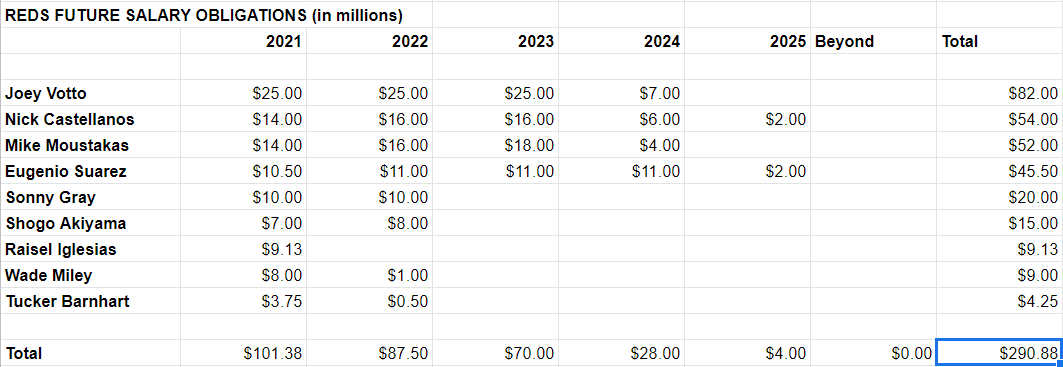
Reds Have Nearly $300MM In Post-2020 Payroll Promises
2020 salary terms still need to be hammered out. But what about what’s owed to players beyond that point? The near-term economic picture remains questionable at best. That’ll make teams all the more cautious with guaranteed future salaries.
Every organization has some amount of future cash committed to players, all of it done before the coronavirus pandemic swept the globe. There are several different ways to look at salaries; for instance, for purposes of calculating the luxury tax, the average annual value is the touchstone, with up-front bonuses spread over the life of the deal. For this exercise, we’ll focus on actual cash outlays that still have yet to be paid.
We’ll run through every team, with a big assist from the Cot’s Baseball Contracts database. Prior entries can be found here. Next up is the Reds:
*Includes buyouts on club options over Joey Votto, Mike Moustakas, Eugenio Suarez, Wade Miley, and Tucker Barnhart
*Includes deferrals and buyout on mutual option in Nick Castellanos contract; Castellanos may opt out after 2020 or 2021
(click to expand/view detail list)
Some Teams Are Offering 2021 Contracts To Incoming Amateur Players
It’s important to remember that the vast majority of ballplayers don’t earn millions and likely never will. Non-blue-chip minor leaguers and incoming professionals have long been disadvantaged relative to established big leaguers, and that’s true all the more now.
The re-worked Rule 4 draft drastically curtailed the amount of money available to draft-eligible amateur players. In addition to deferring payouts and cutting the forty-round process to just five rounds, the draft capped signing bonuses for undrafted players at just $20K.
Now, some teams are looking to carve out yet further concessions from amateur talent, as Kyle Glaser of Baseball America reports. Glaser reports, based upon sources at top agencies, that “at least four teams were offering nondrafted players, as well as a few drafted players, contracts for 2021 rather than 2020.”
The idea here is evidently to obtain the rights to the player while delaying his entry to the team’s system. That means pushing back the point at which a player would reach minor-league free agency — a rule designed to create upward pressure in a farm system. (Notably, Glaser corrects the initial report, clarifying that the timing of eventual Rule 5 eligibility would remain unchanged.)
In essence, this is another form of service manipulation. While the potential lack of a 2020 minor-league campaign provides some theoretical cover, it seems hard to justify this approach — particularly for players that are now bound to a given team because they were selected in the draft.
It’s certainly worth reading Glaser’s story for his account of the early stages of the undrafted free agent process. The dizzying recruitment period has mostly resulted in deals for collegiate seniors, as you’d expect. And as he explains, it isn’t over, as players that weren’t selected will remain eligible to sign as free agents until the week before the 2021 draft (if they haven’t already chosen to suit up in the collegiate ranks).
Yankees President Levine Calls For Resumption Of MLB-MLBPA Negotiations
While his own history on the job includes some less-than-friendly interactions with labor, Yankees president Randy Levine believes ownership and the players can and should reach an amicable resolution of their present standoff regarding a resumption of the 2020 season. He tells David Lennon of Newsday that a deal “can get done,” calling players “the heart and soul of the game” and saying he believes both sides still have the will to get play underway.
So, what’s the path? As Lennon explains, it seems Levine — and perhaps the upper reaches of the league office — are accepting that players will stand on their demand for pro rata pay. Working from that premise, says Levine, removes “the contentious issues” and creates space for the sides to “get in a room and negotiate.”
The MLBPA’s “when and where” bargaining tactic — and associated public relations blitz — seems at least to have succeeded in gaining some level of clarity. Per Levine: “The commissioner now has the right, as long as the players get to 100% pro rata [salaries], to put a schedule together. So I don’t think that the money and the schedule — the number of games — is the issue anymore.”
While there are still important points to be negotiated regarding the way a 2020 season would function, Levine says he thinks they all can be managed in talks. And what of the suggestion we’ve seen floated that some substantial number of owners will balk at playing a season at all? Levine says he hasn’t heard that message in his talks with other clubs.
It’s far from clear that Levine’s general optimism and outlook are shared in the upper reaches of other organizations. Certainly, the league’s most prominent and valuable franchise may have a different outlook than other organizations. But the Yankees hold quite a lot of sway, both within and without league circles, so it seems rather a notable development that Levine — who says he’s in communication daily with commissioner Rob Manfred — holds these views and is willing to communicate them publicly.
MLB Collective Bargaining and Risk Sharing
Dr. Matt Swartz is a Labor Economist who has researched and published on MLB labor markets for over a decade at websites including The Hardball Times, FanGraphs, and Baseball Prospectus, as well as at MLB Trade Rumors. Matt created the arbitration salary projection model for MLB Trade Rumors, and co-created the SIERA pitching statistic available at FanGraphs. He has consulted for a Major League team since 2013, in addition to working in his day job as an economist in the cable industry. This article reflects his own opinion and not that of any of his employers or clients.
In essence, every proposal floated by the owners has requested that players assume the downside risk associated with lower ticket revenue. Part of the reason I suspect this is offensive to players is that owners have benefited substantially in recent years from upside risk associated with television revenue, and little to none has found its way into player salaries.
To understand why, all we need is a superficial understanding of labor economics. Baseball’s free agent market follows those models better than perhaps either side realizes. Owners offer free agents certain salaries because they believe that their labor will generate as much money in revenue. Yet owners primarily get their revenue from two sources: tickets and television.
Since what free agents are actually selling is wins, the translation from ticket revenue to free agent salaries is obvious. Teams sell more tickets when they win more games. Especially if those wins push them further in the playoffs, they sell substantially more season tickets in subsequent seasons. Teams readily pay free agents with this in mind.
Yet the translation from television revenue to free agents is virtually nonexistent. National television deals with ESPN, TBS, and FOX are distributed to all teams, regardless of how many games they win. Regional Sports Networks often sign multi-decade contracts with teams to broadcast their games, which also are unaltered by win totals in a given season.
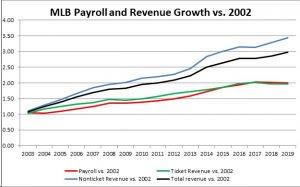
The reason this matters, and the reason this is a source of acrimony between the owners and players now, is that television revenue has grown far more quickly than ticket revenue. Player salaries have grown in magnitude about as much as ticket revenues have— suggesting this theory is likely true. Owners have seen higher profits from faster growing television revenue.
Consider my rough estimates in the graph below. Here I have used Baseball Prospectus payroll totals, approximate average ticket prices from various sources, average attendance from Baseball Reference, and Maury Brown’s (now unavailable) BizOfBaseball.com website and Forbes articles for total revenue. None of these figures are exact but they are certainly close enough that the message and pattern is obvious. Players have seen salary growth (red) almost exactly in accordance with the growth rate of ticket revenues (green), while owners’ profits have grown more quickly as they pocket the faster-growing television revenue (blue). This is not the owners pulling the wool over the union’s eyes—it is just the structure of their agreements in which the payroll share of revenue is not fixed as it is in other sports, but tied to owner incentives that have not kept up with total revenue.
If the owners want the players to accept the downside risk associated with low ticket revenue, they need to find a way to share the upside risk associated with higher television revenue.
A starting point is simple. Instead of minimum salaries defined exactly by the CBA, let free agent and arbitration prices be set in excess of the salary minimums, and set future salary minimums distributed to all players. Let those minimums represent some fixed X% of the cumulative national television deals. Bargain about that percentage, but when TBS offers 40% more in their next deal than their current deal, players will see that upside. In exchange, when future identifiable events lower ticket revenue— e.g. say government regulations of Y% reduced capacity in stadiums due to COVID-19 in 2021– the players will accept lower salaries by Z%. This gives players exposure to upside and gives owners protection from downside. Everything else is bargaining around X, Y, and Z%.
Now is the time for the players to request this. Now is the time for the owners to offer this. It need not even be for 2020– that ship may have sailed already. By right now, there is downside risk associated with empty seats associated with 2021. If owners want players to assume lower salaries in such a situation, they should make an offer to give the players a piece of future television revenue growth now. Otherwise, the players will again be asking the owners the same question next year: “Why should we accept this downside risk?”