
Additional Amateur Draft Signings: 6/16/20
We caught up on draft signings earlier today, but a few more trickled out this evening …
- The Tigers have a deal with third-rounder Trei Cruz, per MLB.com’s Jim Callis (via Twitter). A shortstop out of Rice University, Cruz will secure a $900K bonus that lands just over the slot value of $857,400. None of the major draft pundits ranked Cruz among the hundred best draft-eligible prospects, but the Detroit organization was obviously intrigued. If you’re a believer in bloodlines, you can’t do much better than this. Cruz will aim to follow his father, grandfather, and great uncles in appearing in the majors.
- Mets fourth-rounder Matthew Dyer is on board with a $350K bonus, per MLB.com’s Jonathan Mayo (Twitter link). That’ll save the New York org nearly $230K to apply to other draftees. Dyer, an Arizona product, ranked 333rd on Baseball America’s final draft board. Mayo credits him with a strong throwing arm and good athleticism for a backstop.
- The Blue Jays have added Zach Britton — not to be confused with Yankees reliever Zack (formerly Zach) Britton. This new Zach Britton landed $97,500 from the Toronto organization, freeing the club to allocate the rest of the $410,100 slot value elsewhere. Britton spent time in the outfield and behind the dish at Louisville. BA graded him just inside the top 200 prospects available for selection this year. Britton was slashing .322/.446/.542 when the season was cut short.
- Fifth rounder Jeff Hakanson is in agreement with the Rays on a bonus, per Marc Topkin of the Tampa Bay Times (via Twitter). Dollar values aren’t yet known publicly, but it seems likely to be an under-slot deal. Hakanson, a righty out of Central Florida, wasn’t ranked on any of the major boards. His slot comes with a $340K bonus pool allocation.
- The Cardinals announced an agreement with their own fifth-round selection, Long Beach State outfielder LJ Jones IV. MLB.com’s Jonathan Mayo tweets that Jones has picked up a $100K bonus, meaning the Cards have another $250,300 to work with in signing other players. Jones didn’t merit mention in any rankings either, though the redshirt sophomore never really got a chance to showcase himself in college owing to injuries and the coronavirus situation.
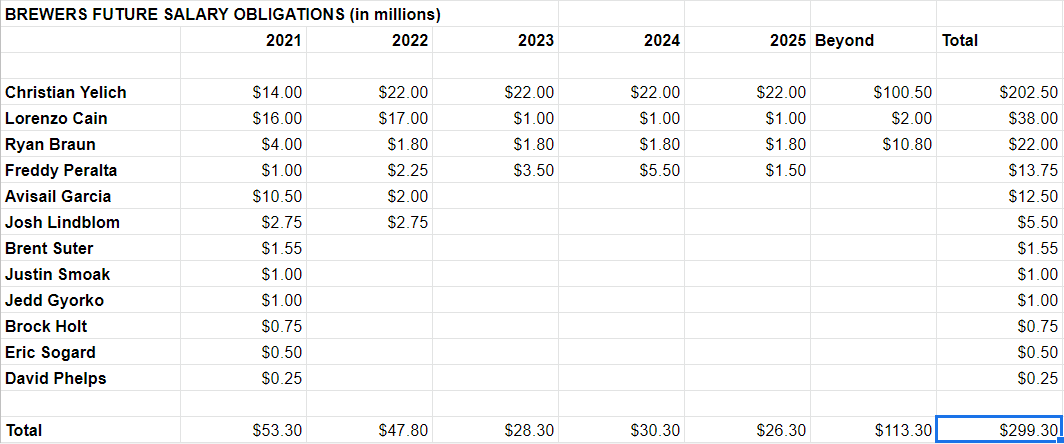
Breaking Down The Brewers’ Interesting Slate Of Future Contracts
2020 salary terms still need to be hammered out. But what about what’s owed to players beyond that point? The near-term economic picture remains questionable at best. That’ll make teams all the more cautious with guaranteed future salaries.
Every organization has some amount of future cash committed to players, all of it done before the coronavirus pandemic swept the globe. There are several different ways to look at salaries; for instance, for purposes of calculating the luxury tax, the average annual value is the touchstone, with up-front bonuses spread over the life of the deal. For this exercise, we’ll focus on actual cash outlays that still have yet to be paid.
We’ll run through every team, with a big assist from the Cot’s Baseball Contracts database. Prior entries can be found here. Next up is the Brewers:
*Includes deferrals in Christian Yelich and Lorenzo Cain contracts
*Includes deferrals and buyout on mutual option in Ryan Braun contract
*Includes buyouts on club options over Freddy Peralta, Avisail Garcia, Justin Smoak, Jedd Gyorko, Brock Holt, Eric Sogard, and David Phelps
(click to expand/view detail list)
Fauci “Would Avoid” Late-October Baseball
As if the already convoluted 2020 season bargaining situation needed further complication, another potential curveball was spun this evening. Dr. Anthony Fauci, the director of the National Institute of Allergy and Infectious Diseases, tells Bill Shaikin of the Los Angeles Times that playing baseball in the month of October may pose unwarranted risks.
Here’s the specific phrasing attributed to Fauci, who is one of the most visible authorities on the coronavirus: “If the question is time, I would try to keep it in the core summer months and end it not with the way we play the World Series, until the end of October when it’s cold. I would avoid that.”
Fauci emphasized that he wasn’t able to offer any certainties, saying that “this virus is one that keeps fooling us.” There’s obviously still quite a lot of science to be done on COVID-19.
But he made clear that he believes it likely the pandemic will worsen as the weather gets chillier. “Under most circumstances — but we don’t know for sure here — viruses do better when the weather starts to get colder and people start spending more time inside, as opposed to outside,” Fauci explains. “The community has a greater chance of getting infected.” There’d be added concern, he said, because of the potential “overlap between influenza and the possibility of a fall second [coronavirus] wave.”
This makes for an especially intriguing development given the ongoing grappling between the league and union over how long the 2020 season ought to extend. MLB has cited the very same concerns as Fauci now highlights in arguing against attempting play deep into the fall. But even its proposals have been premised on a typical October postseason. The player side hasn’t insisted on playing into November and beyond, telling the league of late that it’s ready to play “when and where” commissioner Rob Manfred orders. But the MLBPA position has generally been to offer up as much play as MLB wants to arrange (with full pro rata salary).
While Fauci’s viewpoints don’t represent specific constraints on the staging of ballgames, they’re sure to factor into the fraught public relations battle between ownership and labor. He has generally been supportive of resuming play, at least without fans in attendance, and has made clear he’s a big baseball fan who would love to see a 2020 campaign. It’s notable, too, that several key baseball states — Arizona, Texas, Florida, California — have already begun to exhibit worrying rises in COVID cases even at the outset of summer.
Undrafted Free Agent Signings: 6/16/20
This year’s five-round draft left a lot of deserving players looking for deals on the open market. Here’s a roundup of some of the many recent undrafted players who have reached agreements with MLB organizations:
- White Sox (link)
- Ty Madrigal, LHP, St. Mary’s
- Rangers (link)
- Fernando Amaro, C, HS (PR)
- Nick Krauth, RHP, Connecticut
- DJ McCarty, RHP, HS (CA)
- Connor Sechler, RHP, Drury
- Brady Smith, C, Florida
- Colton Snyder, RHP, Concordia
- Josh Stephan, RHP, South Grand Prairie
- Mets (link)
- Austin Faith, RHP, Lamar
- Dylan Hall, RHP, Central Oklahoma
- Brandon McIlwain, OF, California
- Drake Nightengale, RHP, South Alabama
- Joe Suozzi, OF, Boston College
- Nationals (link)
- Jackson Coutts, 1B/OF, Rhode Island
- Gio Diaz, INF, Saint Mary’s
- Raymond Torres Jr., C, San Jacinto JC
- Astros (link)
- Peter Zimmermann, Missouri
- Cesar Gomez, Texas
- Jimmy Endersby, RHP, Concordia
- Justin Dirden, OF, Southeast Missouri State
- Kyle Gruller, RHP, Houston Baptist
- Jonathan Sprinkle, RHP, Central Missouri
- Zack Matthews, RHP, Oklahoma
- Cody Orr, OF, Tiffin
- Yankees (link)
- Carson Coleman, RHP, Kentucky
- Ocean Gabonia, RHP, Everett Community College
- Trevor Holloway, RHP, Central Florida
- Jarod Lessar, RHP, BYU
- Phillies (team announcement)
- Chase Antle, RHP, Coastal Carolina
- Jordan Fowler, LHP Central Missouri
- Jonathan Hughes, RHP, Georgia Tech
- Sam Jacobsak, RHP, Northeastern
- Jake McKenna, LHP, Ocean City HS (NJ)
- Noah Skirrow, RHP, Liberty University
- Billy Sullivan, RHP, Delaware
- JP Woodward, LHP, Lafayette College
- Orioles (link 1; link 2)
- Ryan Watson, RHP, Auburn
- JD Mundy, 1B, Radford
- Brandon Young, RHP, UL-Lafayette
- Thomas Girard, RHP, Duke
- Isaiah Kearns, RHP, Pitt-Johnstown
- Cubs (link)
- Matt Mervis, 1B/RHP, Duke
- Marlins (link)
- Antonio Velez, RHP, Florida State
- Cardinals (link)
- Jacob Buchberger, RHP, Davenport
- Matt Chamberlain, OF, New Haven HS (CT)
- Gianluca Dalatri, RHP, North Carolina
- Matt Koperniak, 3B/OF, Trinity
- Mac Lardner, LHP, Gonzaga
- Nick Raposo, C, Wheaton
- Omar Sanchez, LHP, B-You Prospects Academy (PR)
- Nick Trogrlic-Iverson, RHP, Gonzaga
- Indians (link)
- Joe Donovan, C, Michigan
- Twins (link)
- Lucas Sweany, LHP, University of the Pacific
- Allante Hall, C, Pensacola State JuCo
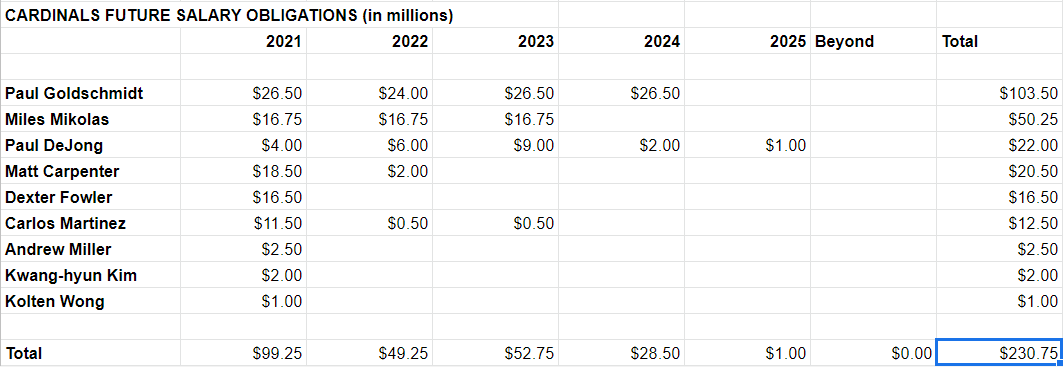
Calculating The Cards’ Future Contract Guarantees
2020 salary terms still need to be hammered out. But what about what’s owed to players beyond that point? The near-term economic picture remains questionable at best. That’ll make teams all the more cautious with guaranteed future salaries.
Every organization has some amount of future cash committed to players, all of it done before the coronavirus pandemic swept the globe. There are several different ways to look at salaries; for instance, for purposes of calculating the luxury tax, the average annual value is the touchstone, with up-front bonuses spread over the life of the deal. For this exercise, we’ll focus on actual cash outlays that still have yet to be paid.
We’ll run through every team, with a big assist from the Cot’s Baseball Contracts database. Prior entries can be found here. Next up is the Cardinals:
*Includes remaining bonus payments owed to Paul Goldschmidt, Miles Mikolas, and Dexter Fowler
*Includes buyouts on club options in Carlos Martinez, Paul DeJong, Matt Carpenter, Andrew Miller, and Kolten Wong contracts
(click to expand/view detail list)
Pirates, 2nd-Rounder Jared Jones Agree To Deal
The Pirates have agreed to terms with second-round pick Jared Jones, Kevin Gorman of the Pittsburgh Tribune-Review was among those to report. Financial details of the deal aren’t known yet, but Jones’ pick, No. 44, comes with a recommended slot value of $1,689,500. The Pirates are fifth in the majors in available bonus pool space at $11,154,500.
The high school right-hander from California had a fallback in the University of Texas – to which he committed before the draft – had he been unable to reach an agreement with the team that picked him. Jones will instead continue his development as a pro after a dominant run as a high school pitcher and hitter. The 18-year-old logged a 0.89 ERA with 255 strikeouts and 78 walks in 180 1/3 innings, and he slashed .394/.473/.566 at the plate, according to Gorman.
Prior to the draft, Jones came in 41st at Baseball America, 51st in the rankings of ESPN’s Kiley McDaniel, 55th at MLB.com, 85th in the rankings of Keith Law of The Athletic, and 91st at FanGraphs. Despite his prowess as a two-way player, MLB.com writes that Jones’ “future is definitely on the mound,” as he owns a repertoire that consists of a high-90s fastball with a promising slider and changeup.
AL Notes: Sox, Astros, Yankees
Checking in on a few American League franchises…
- White Sox first-round pick Garrett Crochet will arrive in Chicago sometime this week for a physical, Scott Merkin of MLB.com tweets. Crochet fully intends to sign with the club. “After we get the contract all buttoned up, I should be signing. Yeah, it’s not completely official, but should be here in a few days’ time,” said Crochet, a left-hander from Tennessee whom the White Sox chose 11th overall. His pick carries a recommended slot value of $4,547,500.
- The Red Sox turned to one of their most valuable players to help lure an undrafted free agent, Chris Cotillo of MassLive.com details. In an effort to land St. Joseph’s University right-hander Jordan DiValerio, Boston enlisted the help of ace Chris Sale. DiValerio told Cotillo he received a text Sunday from his agent, who said, ‘”Hey, expect a call from Chris Sale.’ I was like, ‘No way. Are you serious?’ And then, he told me if I got a call from a random number, to pick it up.” While DiValerio was already leaning toward the Red Sox at that point, the call from Sale only helped the club’s cause. “He said it’s one of the best, if not the best organization in baseball,” DiValerio stated. “He said once you get in, the family environment is really just incredible. He’s so happy to be a part of it. He told me I’m going to be happy to be in it as well.”
- Owner Jim Crane informed Astros employees Tuesday that the team will not lay off or furlough anyone through the end of October, Jake Kaplan of The Athletic tweets. However, any member of the staff who makes $100K or more will have to take a pay cut.
- The Yankees, meanwhile, have told their staff that they’ll continue with the status quo in terms of employment and pay, per James Wagner of the New York Times. The team had previously only committed to them through June 15.
Amateur Draft Signings: 6/16/20
We’ll keep track of the latest amateur draft signings here…
- The Cardinals announced the signing of outfielder Alec Burleson, whom they drafted 70th overall. He’ll earn $700K, quite a bit less than the $906,800 value of his pick, according Jim Callis of MLB.com. The Cards landed the choice they used on Burleson as compensation for the departure of outfielder Marcell Ozuna in free agency. An East Carolina University product, Burleson topped out as FanGraphs’ 108th-ranked prospect before the draft. Burleson was a successful first baseman and left-handed pitcher in college, but he’s regarded as a much better hitting prospect, MLB.com notes.
- The Mets have signed third-round pick Anthony Walters for $20K, Jonathan Mayo of MLB.com tweets. It’s a stunningly low amount for a player whose pick, No. 91, was said to be worth $647,300. The total Walters received only matches the maximum sum an undrafted player can get this year. Walters, a former San Diego State shortstop, didn’t rank among Baseball America’s top 500 before the draft. However, Mayo observes that Walters brings “good hands” as a defender and “sneaky pop” at the plate.
- The Padres have inked fourth-rounder Levi Thomas for $80K, far below the $533K slot value of the 109th pick, Jim Callis of MLB.com reports. The right-hander from Troy “has an impressive history of throwing strikes and his fastball seems to have qualities that teams love,” Baseball America wrote in ranking Thomas as the 224th-best prospect in the 2020 class.
- The Nationals have reached a $20K agreement with fourth-round catcher Brady Lindsly, per Callis. The University of Oklahoma product, who was not one of BA’s top 500 prospects, did not expect to get drafted.
Latest On Potential 2020 Season
Under the agreement the owners and players made in March, Major League Baseball has the ability to implement as long or short of a regular season as it wants. There are some notable conditions, though, including: The league must pay players full prorated salaries, it must act in good faith to play as many games as possible, and commissioner Rob Manfred would need approval from 23 of the game’s 30 owners. It’s in question whether he would receive that amount of support, Ken Rosenthal and Evan Drellich of The Athletic report (subscription link).
“There are definitely more than eight owners who don’t want to play,” one player agent told Rosenthal and Drellich.
It may be a moot point. Manfred is not required to force the start of a season, and according to Rosenthal and Drellich, it doesn’t appear his office will do so over fears of a potential billion-dollar grievance from the union. In a letter to the union Monday, deputy commissioner Dan Halem left the players with three choices: 1. Waive your right to file a grievance in regards to the March agreement; 2. Go to arbitration; 3. Keep negotiating.
A quick arbitration case may not be desirable to the union or even possible because of the money at stake and the number of witnesses who would be involved, per Rosenthal and Drellich. That means the only chance for a season may be for the owners and players to finally put their vast differences aside and hammer out a deal that works for both sides. It’s difficult to imagine that happening with the way talks have gone so far. Both sides have accused the other of acting in bad faith during their negotiations, which took yet another negative turn Monday when Manfred did a 180 from last week and expressed doubt in regards to a potential 2020 season.
Manfred’s comments led to a heated response from union chief Tony Clark, who said, “Players are disgusted that after Rob Manfred unequivocally told Players and fans that there would “100%” be a 2020 season, he has decided to go back on his word and is now threatening to cancel the entire season.”
Many of those players, including Nationals ace and influential union member Max Scherzer, joined Clark in voicing their disgust Monday.
Resolving This Player-Owner Dispute Should Be Easy
Dr. Matt Swartz is a Labor Economist who has researched and published on MLB labor markets for over a decade at websites including The Hardball Times, FanGraphs, and Baseball Prospectus, as well as at MLB Trade Rumors. Matt created the arbitration salary projection model for MLB Trade Rumors, and co-created the SIERA pitching statistic available at FanGraphs. He has consulted for a Major League team since 2013, in addition to working in his day job as an economist in the cable industry. This article reflects his own opinion and not that of any of his employers or clients.
The MLB Owners and MLB Players Association have been unable to reach an agreement for the financial terms of the 2020 season, and at this point they may not reach one at all. Both sides have focused publicly on the morality of their case, each believing they have the ethical upper hand. Neither has made proposals that reflect their actual negotiating position. That the arguments have primarily focused on morality is perhaps not surprising, but it doesn’t create fertile ground for an actual substantive negotiation. I studied bargaining theory, and I don’t remember anything about how to win a moral argument. The ethics are what they are, and any reasonable person could make either side’s case if they really tried. The union seems to be winning the PR war thus far, as fans seem to mostly blame owners, but supportive tweets from fans are not convertible into currency.
At its core, what we have is the following set up: The presumptive default position, if no agreement is reached, is that commissioner Rob Manfred will order a roughly 50-game season with full prorated salaries. If the sides do reach an agreement, they may play as many as 80 games, and be able to split the associated revenue. They also may be able to add revenue through other avenues like expanded playoffs, and they could split that revenue too. Those are the gains from a negotiated agreement. They can be split in a way to make both parties better off.
Both sides have accused the other of not bargaining in good faith, but neither side has offered the other side anything they would plausibly accept. Instead we have seen the owners repeatedly try to offer players only slightly more than the same salary total as they would with a 50-game season, effectively asking for all the gains that would accrue from a negotiated agreement while leaving the players to absorb greater output and greater risk (both from the usual risk of playing baseball and the additional risk attendant to the global pandemic). The players similarly have failed to offer the owners anything that would lead to more profit than they would accrue in the event of a 50-game season with unexpanded playoffs. It is not surprising negotiations have gone nowhere.
At this point, an agreement for a better, longer season in 2020 is doubtful. But 2021 is right around the corner, and there is no vaccine for COVID-19 yet. We may not see fans in the seats in 2021, or at least we may not see stadiums filled to capacity. So we may see a replay of this argument in 2021 as well. It’s imperative that both sides recognize their position and negotiate accordingly. This acknowledgement could easily flip the script and lead to an expedited deal for 2020 already.
Let’s start with what should be obvious and unarguable.
Unarguable Point A:
Any agreement should see the players earn substantially more than they would have in a 50-game season.
Unarguable Point B:
Any agreement should see owners make more profit than they would in a 50-game season.
Nothing floated publicly has even come close to meeting these simple criteria.
The starting point here is actually fairly simple. Forget about inching towards a middle ground when neither side is willing to budge. Instead, begin by figuring out just how much extra revenue is associated with 30 extra games and an expanded postseason. Then, split it in half. The players’ salary total is equal to that half plus their prorated salaries for 50 games. Both sides may try to argue for a bigger piece of the pie, but either side would be crazy to say no to half of this revenue—which is much more than the zero extra revenue they would see otherwise. The players don’t need the owners to open their books on any more than is necessary to estimate this amount. The owners don’t need to ask the players to sign any waivers or anything else that isn’t already negotiated. Anything on top of this baseline can be negotiated after setting the above in writing and shaking hands (but not actually).
Offers could get more complicated and cover more territory. This is especially true with the risk of no fans or fewer fans in 2021, and with the CBA expiring after 2021. But the essential 2020 issue can be resolved in a fairly simple manner that makes each side better off in the short term while limiting the long-term damage to the sport. In subsequent pieces, I’ll discuss the fundamentals of baseball’s free agent market and how players might want to approach the inequities that have arguably developed over the last couple years. But for now, let’s just agree that owners, players, and fans can all be made much better off very quickly. Get it done before dinnertime.