
MLBTR Mailbag: Indians, Phils, Giants, Pads, Tigers, Braves
Time for another edition of the MLBTR Mailbag. As always, apologies if we couldn’t get to your questions and thanks for sending them in!
Here are this week’s questions, with a reminder that you can submit questions for the mailbag at any time throughout the week via email (mlbtrmailbag@gmail.com) …
With Cleveland unloading contracts of Swisher and Bourn, will they have the resources to go after the high-profile middle of the order bat that they desperately need? — Eric C.
They’ll have some increased flexibility, but they paid $15MM in that trade and also took on Chris Johnson‘s salary, so they’re not likely to add a significant amount of money. We took a look at their upcoming offseason last week and suggested that trades were the likelier route. Names like Marcell Ozuna and, more improbably, Todd Frazier, make plenty of sense in theory. Going the free-agent route, they’re not going to afford the Justin Upton and Yoenis Cespedes caliber players, but some under-the-radar adds like John Jaso, Mike Napoli or Justin Morneau could pay dividends.
On their current trajectory, the Phillies are looking at 2018 or 2019 (at the earliest) before they are back in contention. Given the tremendous drop in attendance over the last 3 years, do you think that ownership may attempt to hurry things along by plugging some of their larger holes (RF, LF, SP, bullpen) with high to midrange priced free agents starting this off-season? They certainly have the money to spend, and can’t be very happy with all the empty seats (and lost merchandise sales) at Citizens Bank Park. — Rod S.
It’s probably wise not to expect the Phils to be in the playoff hunt before 2018, but that may not end up being the case. Sure, the organization’s current “trajectory” is one of shedding obligations and adding young, unproven talent. But it won’t be long before a new GM will be looking to plug in MLB pieces that have current and future use, whether to speculate on upside or in the way that the Astros signed Scott Feldman and the Cubs inked Edwin Jackson in recent years.
In this case, an earlier turn back toward contention could make sense. Win-now moves obviously aren’t to be expected, but there’s no reason not to begin looking at quality big league additions with more than fill-in capacity in mind — so long as the club isn’t sacrificing its future flexibility or giving up young talent to do so. That wouldn’t necessarily be an attempt to “hurry things along” so much as to best leverage this particular team’s resources (i.e., its ample payroll space). Possible targets include players who have age and upside, whose market has failed to match their ability, or who offer high-risk/high-reward profiles.
Clearly the Giants must get at least one top of the rotation starter to pair with Madison Bumgarner. But who makes the most sense? And what other #2 or #3 starter might be available to also join the rotation given the Giants’ payroll? The assumption is that Jake Peavy and either Matt Cain or Chris Heston would fill out the #4 and #5 spots. — Peter L.
Adding two starters of that ability level — without breaking the bank, at least — is never easy. We’ve heard plenty about their interest in a reunion with Mike Leake, and he would presumably fit as the second type of arm that you mention. Presumably, the club could look at him as a solid mid-rotation piece who would eventually slot toward the back of the rotation as other pitchers age and depart the organization. That might not happen, of course, but we know the Giants like him.
So, would they need to add an even better pitcher, as well, to contend with the Dodgers? That’s not entirely clear, but GM Bobby Evans did say recently that he wants his club’s staff to surpass that of their rivals to the south. Leake won’t be cheap, though, so it might be too much to ask to add him and a guy like David Price or Zack Greinke. If you want two high-end arms, maybe they could look to get better value from Johnny Cueto or Jordan Zimmermann, given that both failed to maximize their market positions heading into the winter. Or, San Francisco could roll the dice on someone like Scott Kazmir (long-term health) or Jeff Samardzija (recent performance).
Do you think the Padres have a realistic chance of signing Ian Desmond and acquiring a big, left-handed power bat in order to make waves in the west? — Ryan D.
Sure, that could make sense. The team needs to add a shortstop of some kind and A.J. Preller (along with ownership) aren’t afraid to make bold moves. Desmond offers quite a bit of upside even after a rough season. He still won’t be cheap, of course, but he’s probably the only long-term shortstop available via free agency and ought to be affordable for San Diego. (That might not have been the case if he had returned to his 2012 levels of output.)
But wait, you want a lefty slugger, too? This market really has just one of those — Chris Davis — and it’s questionable whether the Friars can squeeze in both him and Desmond into their payroll. They were at about $108MM to start 2015, and have around $75MM promised already for each of the next two seasons — before accounting for arbitration raises and options. Your plan might have to involve a trade for a left-handed bat to be financially viable, but that then raises the concern of giving up yet more young talent.
What route do you think Al Avila will go. Will he go for the really expensive, name-oriented closer, a la Nathan, or maybe someone under the radar like Darren O’Day? — William S.
Avila said recently that he doesn’t see any ace closers on the market, and he’s right. O’Day is probably the best reliever available, with Tyler Clippard and Joakim Soria among the others in that mix. So, no, a free agent signing of even a Joe Nathan-type does not seem terribly likely, and the club could look to add one or more quality set-up men instead. There could also be some buy-low arms with closing experience; a guy like Addison Reed might hold some appeal if he’s non-tendered.
Of course, two of the very best arms in all of baseball — Aroldis Chapman and Craig Kimbrel — could well be had. Detroit would have to at least start a conversation if either of those names hits the trade market.
I’m wondering what type of starting pitcher you think the Braves will go after? Do you think a Jordan Zimmermann is too much too soon? Is maybe Doug Fister more likely? — Tristan W.
It’s not too soon for Atlanta to pursue a guy like Zimmermann, in large part because next year’s free agent pitching market is nowhere near as deep as this one. To an extent, you need to get your shopping done early.
But I’m not sure that the Braves will see a need for that, this year or next. It’s more likely that the Braves look for value than chase a top-end player. Now, if Zimmermann or another excellent pitcher languishes due to excess supply, Atlanta could jump. After all, they’ve shown a predilection to act opportunistically. That being said, if the Braves decide to go after a guy and pay a market rate, it might be more likely to occur on the position player side.
Atlanta has compiled quite a few interesting arms, and may be content allowing them to develop while filling in with veterans of Fister’s ilk. But as the acquisition of Hector Olivera and the earlier signing of Nick Markakis show, the club realizes that it has more work to do in assembling a group of capable position players.
Predictions would be foolish, but there are actually a fair number of buy-low type candidates among position players on this year’s free agent market. Likewise, some teams are going to cash in on starting pitching, and it wouldn’t be at all surprising to see Atlanta look to deepen its staff on the cheap while also opening more flexibility to pursue the creative trades that have become the organization’s calling card in recent years.
NL Notes: Nats Coaches, Rox Bullpen, Tejada, Braun
The Nationals announced today that several of the coaches that were reassigned last week when Matt Williams was fired have been given new roles in the organization. Bench coach Randy Knorr will join the front office as a senior assistant to GM Mike Rizzo, focusing on player development. Third base coach Bobby Henley has been named a senior advisor of player development. Bullpen coach Matthew LeCroy will be the manager of the team’s Double-A affiliate, while former Double-A skipper Brian Daubach will become the hitting coach for the Nationals’ Triple-A affiliate. The rest of Williams’ staff was fired last Monday.
Some more notes from around the NL as the Royals and Astros do battle in the ALDS…
- Though the Rockies finished the season with an NL-worst 4.70 ERA from their relief corps, Patrick Saunders of the Denver Post points out that there are some arms to be excited about for the future. Most notably, right-hander Jairo Diaz, whom the Rockies acquired from Anaheim in exchange for Josh Rutledge last offseason, has made huge strides with his slider and control. Paired with a heater that averaged 97.2 mph and touched 100 mph at times, he could eventually be a dominant pairing with Adam Ottavino, though Ottavino is recovering from early May Tommy John surgery. Also worth watching are Scott Oberg, who had a strong finish, and Justin Miller, whose 38-to-11 K/BB ratio in 33 1/3 innings is certainly cause for some optimism. As Saunders and colleague Nick Groke note in a video breakdown of the ‘pen, John Axford will return in 2016 via the arbitration process after falling just two days shy of qualifying for free agency (he has five years, 170 days of MLB service). Last week’s arbitration projections from MLBTR contributor Matt Swartz pegged Axford at $6.5MM.
- Mets shortstop Ruben Tejada won’t need surgery to repair his fractured fibula, the Mets told reporters today (Twitter link via Mike Vorkunov of the New Jersey Star-Ledger). Tejada will be in a case for the next six to eight weeks but is expected to be ready for Spring Training.
- Brewers right fielder Ryan Braun underwent lower back surgery today, tweets Tom Haudricourt of the Milwaukee Journal-Sentinel. Reports that Braun would require an operation to address his back surfaced late last month, though the specifics surrounding his back surgery aren’t known. Haudricourt adds that everything went well, and Braun has previously said that his expectation is a relatively quick recovery that will allow him to be back up speed in plenty of time for Spring Training.
Mets Designate Tim Stauffer For Assignment
The Mets have designated right-hander Tim Stauffer for assignment in order to clear space on the 40-man roster for infielder Matt Reynolds, the team told reporters, including the Record’s Matt Ehalt (Twitter link). The Mets needed to add Reynolds to bolster their shortstop depth after Ruben Tejada suffered a broken leg on a takeout slide from Chase Utley.
Stauffer began the season with the Twins after signing a $2.2MM free-agent contract but struggled greatly before being released in May. The longtime Padres hurler went the indy ball route following his dismissal from Minnesota, and his sharp work with the Sugar Land Skeeters led to a look with the Mets. Stauffer was excellent at Triple-A with the Mets, but his Major League struggles were even more exaggerated upon being recalled (admittedly, in a smaller sample).
All told, he’ll finish the season with a 6.97 ERA, 6.1 K/9 and 3.9 BB/9 in 20 2/3 innings between Minneapolis and Queens. Stauffer was a free agent again at season’s end anyhow and wasn’t on the NLDS roster, so his removal from the 40-man roster is more or less a formality at this point.
Offseason Outlook: Cincinnati Reds
The Reds might not have been certain they’d contend in 2015, but they probably didn’t expect their season to go quite as badly as it did. While the Reds’ struggles this year (and particularly down the stretch) were hard to watch, there’s a kind of freedom in knowing for sure that you’re bad. This offseason, we’ll see what the Reds do with that freedom.
Guaranteed Contracts
- Joey Votto, 1B: $199MM through 2023 (including buyout of 2024 club option)
- Homer Bailey, SP: $86MM through 2019 (including buyout of 2020 mutual option)
- Brandon Phillips, 2B: $27MM through 2017
- Devin Mesoraco, C: $25.1MM through 2018
- Raisel Iglesias, SP: $22MM through 2020 (includes $1.5MM of signing bonus to be paid in November 2016)
- Jay Bruce, OF: $13.5MM through 2016 (including buyout of 2017 club option)
- Todd Frazier, 3B: $7.5MM through 2016 (eligible for arbitration for 2017 season)
Arbitration Eligible Players (Service time in parentheses; projections by MLB Trade Rumors)
- Aroldis Chapman, CL (5.034): $12.9MM
- Sam LeCure, RP (4.119): $2.1MM
- Zack Cozart, SS (4.084): $2.9MM
- Brennan Boesch, OF (4.002): $1.3MM
- Ryan Mattheus, RP (3.123): $1.3MM
- Jason Bourgeois, OF (3.121): $900K
- J.J. Hoover, RP (3.102): $1.1MM
- Non-tender candidates: LeCure, Boesch, Bourgeois, Mattheus
Contract Options
- Burke Badenhop, RP: $4MM 2016 mutual option, $1.5MM buyout
- Skip Schumaker, OF: $2.5MM 2016 option, $500K buyout
Free Agents
The Reds’ 98-loss 2015 season didn’t come completely out of nowhere. In 2014, the Reds finished with just a 76-86 record. They had a well-compensated core, and most of their rotation was set for free agency following the 2015 season. In response, they made some moves to reduce payroll and look ahead, dealing Mat Latos to the Marlins and Alfredo Simon to the Tigers. But those moves were relatively small and tentative, and the Reds waited to make some bigger moves this summer with their trades of Johnny Cueto and Mike Leake. Now, with a sketchy big-league roster, little short-term payroll space, and incredibly tough divisional competition, there’s no obvious way for the Reds to contend next year, and little to do but to keep rebuilding.
But the best reason for the Reds to continue their rebuild (a label GM Walt Jocketty doesn’t like, but that already accurately describes what they’re doing) is that they do have good assets to trade, beginning with Todd Frazier and Aroldis Chapman. Frazier is signed to a reasonable deal through 2016, after which he’ll be arbitration eligible for one more season. He’ll be 30 in February, so it’s unlikely he’ll be part of the next good Reds team. Given his exceptional power (35 home runs in 2015) and strong defense, he should attract a ton of interest, even though he faded badly down the stretch. The Reds should expect to get a nice return for him, including at least one top 100-type prospect. There aren’t many recent offseason trades involving players of Frazier’s talent with two years of service time remaining, but suffice it to say that Frazier’s value ought to be significant. The Angels or perhaps a surprise team like the Indians or White Sox could make sense as trade partners.
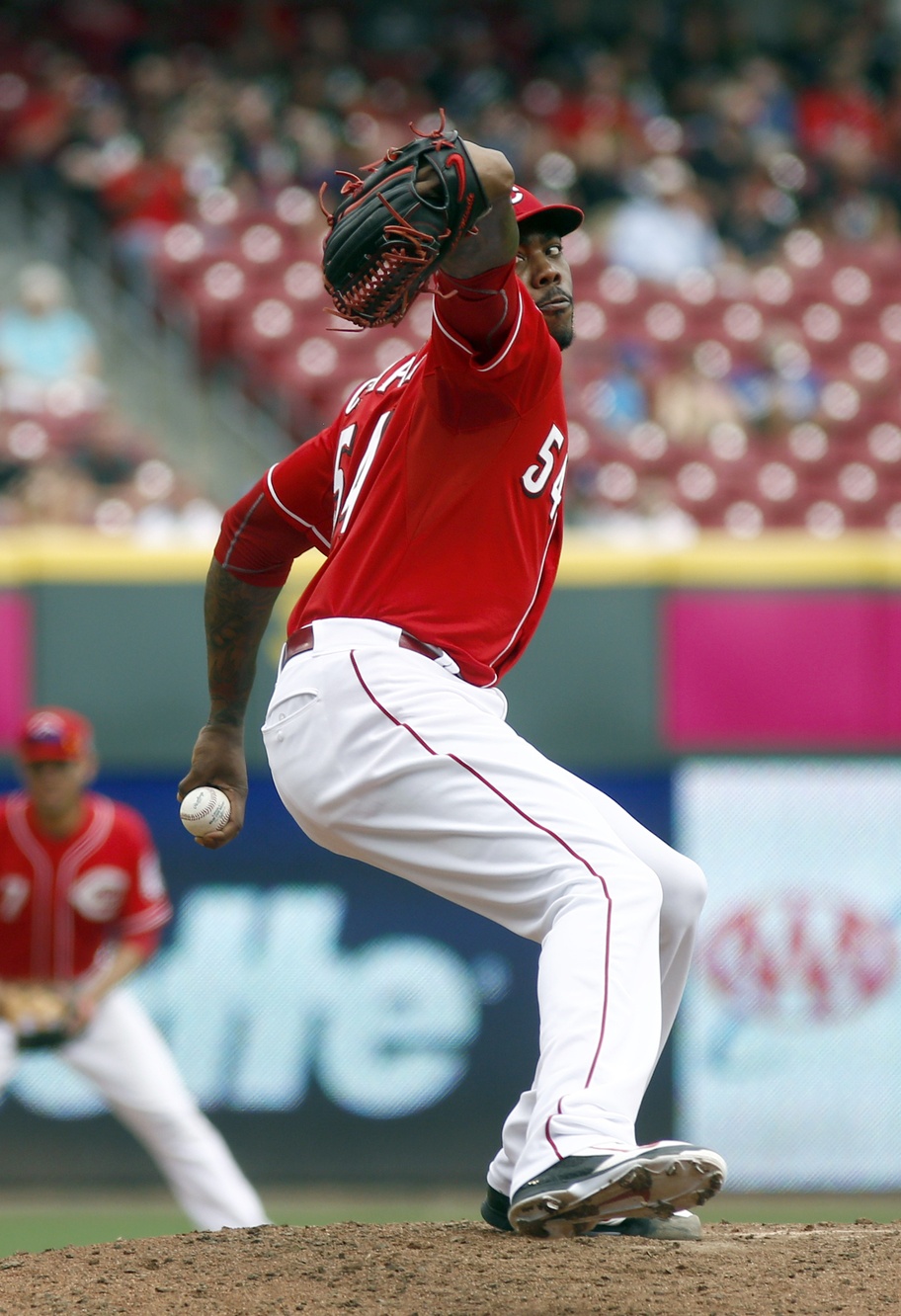 As for Chapman, closers with one year of service time remaining are traded quite frequently, but Chapman is so blindingly great that his value is should be closer to that of, say, a no. 2-type starter than a closer. The Mariners and other teams could be possible trade partners, and the Diamondbacks have shown interest in the past. The Reds should have little trouble finding a market, although their path to a trade could be complicated, if only slightly, by the availability of excellent relievers like Craig Kimbrel and Darren O’Day through either trade or free agency. If the Reds can’t find an offer they like, perhaps they could really roll the dice and try to use Chapman as a starter, hoping to market him as an ace in July, but that might be overly ambitious, since he’s already more valuable than most starters anyway.
The Reds also ought to consider trading Brandon Phillips if there are any takers (and if he’ll accept a trade — he has ten-and-five rights). Phillips is coming off a solid 2.6-fWAR season, but at 34, he might not have many good years left. The Yankees, Angels, Orioles, Royals and White Sox could all be potential trade partners.
The Braves’ trade of Kimbrel to the Padres illustrates one approach the Reds could take to dealing Frazier or Chapman. The Braves used Kimbrel, in part, to clear future salary, getting rid of Melvin Upton Jr.‘s contract in the deal. The Reds could take a similar approach by packaging Frazier along with Homer Bailey, who has four expensive years remaining on his contract and won’t be back until at least next summer after having Tommy John surgery last May. That would give the Reds greater payroll flexibility, which should come in handy next time they’re ready to contend.
Then again, that would be selling low on Bailey, who is only 29 and seems likely to recover. And while the Reds have about $82MM already on the books for 2016, that number drops to about $67MM in 2017, with about a third of that going to Joey Votto. Two of the Reds’ highest-paid players in 2015, Votto and Phillips, performed well. Another, Jay Bruce, can become a free agent after 2016 if the Reds let him. (Bruce might have been a more interesting trade candidate this winter if he’d hit better than .226/.294/.434 in 2015; perhaps the Reds could get the most value for him by waiting and hoping he gets off to a good start next season.) And two more, Bailey and Devin Mesoraco, ought to recover from their injuries and eventually provide value. Beyond Frazier, Chapman and Phillips, then, the Reds need not be in any rush to trade their veterans until they get the right offers.
Assuming the Reds do consider trading Frazier, Chapman, Phillips and perhaps others, they could pursue any number of player types in return. The only positions where the Reds appear relatively set for the medium-term future are catcher (Mesoraco), first base (Votto) and center field (Billy Hamilton, whose running and fielding give him plenty of value despite a second consecutive disappointing season at the plate). That’s not to say there aren’t other potentially helpful players, just that none of them are obviously set at any one position. Left fielder Adam Duvall, for example, hit reasonably well for the Reds after they acquired him in the Mike Leake trade, but he’s 27; playing him every day need not be a priority. And Eugenio Suarez hits well enough to play somewhere, although he might not be a shortstop in the long term.
There’s even less certainty in the rotation. The team did well to add Brandon Finnegan and John Lamb when it traded Cueto, but the Reds’ all-rookie rotation did the team few favors down the stretch. Anthony DeSclafani and Raisel Iglesias look set to contribute in 2016, but beyond that, the Reds have a lot of sorting out to do with Finnegan, Lamb, Keyvius Sampson, David Holmberg, Josh Smith, Michael Lorenzen, Jon Moscot and, eventually, top prospect Robert Stephenson. Given the attrition rates of young pitchers, and the fact that some of their existing talent looks a bit fringy, the Reds could easily stand to add more pitching in upcoming trades.
Of course, while the Reds’ most obvious course of action at this point is to trade veterans for young players, they still have to put a team on the field in 2016. They can use a starting pitcher to soak up 150 innings — a cheap deal for someone like Bud Norris, Kyle Kendrick or former Reds Aaron Harang or Simon might make sense. They could also sign a buy-low pitcher like Doug Fister and hope he regains enough value to land good talent at the deadline.
Bullpen help will also likely be a priority, given the possible departures of Chapman and Manny Parra. If Chapman heads elsewhere, the team could probably move J.J. Hoover or Jumbo Diaz into the closer’s role, and it shouldn’t spend heavily on a closer. Bringing back Burke Badenhop at an effective cost of $2.5MM ($4MM minus a $1.5MM buyout) might make sense for the Reds, and Badenhop could pick up his end of the option, since he would sacrifice the buyout if he rejected it. And either re-signing Parra or adding a Neal Cotts lefty type would also help, particularly if the Reds are committed to using Finnegan as a starter.
The Reds could also pursue position players, but it’s difficult to say what type of player they might be interested in until we see which position players they trade, if any, and whether anyone from those trades can step in right away. They’re set to lose two bench players in Brayan Pena and Skip Schumaker (whose option they shouldn’t exercise), but they likely won’t miss either one. Tucker Barnhart is a decent replacement for Pena, and Schumaker was a drain on the Reds both offensively and defensively, especially now that he’s more of a poor defensive corner outfielder than a poor defensive second baseman.
The key question for the Reds, then, is exactly how far they want their rebuilding effort to go. Of all the veterans the Reds could trade, the most intriguing one might be Votto, who seems likely to stay. Votto has full no-trade protection, and his enormous contract would make trading him a logistical headache, but let’s consider what dealing him might do for the organization. Votto just finished an exceptional .314/.459/.541 season that might have been the best of his career. However, he’s already 32, and as great as he is now, the Reds’ $199MM commitment to him through his age-39 season borders on the absurd, and his value might never be higher. Votto’s contract is highly likely to go south at some point. He’s clearly underpaid right now, and probably also will be next year, but he likely won’t be by the time the Reds are ready to contend.
So what should the Reds do? The fantasy-baseball answer is that they should trade him, but it’s obviously rare for teams to trade excellent players they still control for nine more years. Surely, the Reds might argue, there’s a way to build for the future without trading a star who can still be with the team for almost a decade more. Players like Votto are hard to find, and even in a rebuilding year, he’ll have value for the Reds, in that he’s a popular homegrown player who would make an otherwise young team worth watching. An aggressive executive like Billy Beane or Jeff Luhnow would surely consider trading Votto, assuming he were to waive his no-trade clause. But it’s unclear whether Jocketty, who hasn’t rebuilt a team recently, might take a similar path.
In any case, the Reds will spend the 2016 season regrouping, and if they end up grabbing headlines this offseason, it will probably be because of who they’re trading away, not who they’re getting. In early October, the Reds announced that they would keep manager Bryan Price for next season, despite the team’s struggles this year. And why not? Price was already under contract, and as long as the Reds believed him capable of nurturing their younger players, there was little point in replacing him. Maybe if they were a bit closer to turning a corner, they would have given a new manager a chance. As it stands, maybe they want to wait until their rebuild is a little further along before they make a change.
Photo courtesy of USA Today Sports Images.
Chase Utley Appealing Two-Game NLDS Suspension
OCT. 12: MLB wants Utley’s appeal hearing to take place today, tweets Jon Heyman of CBS Sports, but the MLBPA would like more time than that to prepare. Rosenthal adds (also via Twitter) that a pair of sources expressed doubt that a hearing would take place today, so Utley could very well be available for tonight’s contest. Bill Shaikin of the L.A. Times hears the same (Twitter link), with a source calling a Monday appeal hearing “highly unlikely.”
OCT. 11: Major League Baseball has suspended Dodgers infielder Chase Utley for Game Three and Game Four of the NLDS for what the league has deemed as an “illegal slide” during Saturday’s Game Two win over the Mets, according to a statement released today. Here is the full text from MLB Chief Baseball Officer Joe Torre:
“I recognize that there has been much commentary and many questions regarding the unfortunate play in last night’s game in which Ruben Tejada was injured. As I said after the game, the determination of whether a baserunner has intentionally interfered with a player attempting to turn a double play is left to the judgment of the Umpire on the field, and that judgment call is not subject to review. I should add that determining where to draw the line between an illegal slide and a legitimate hard play is an extremely difficult call for our Umpires.
“However, after thoroughly reviewing the play from all conceivable angles, I have concluded that Mr. Utley’s action warrants discipline. While I sincerely believe that Mr. Utley had no intention of injuring Ruben Tejada, and was attempting to help his Club in a critical situation, I believe his slide was in violation of Official Baseball Rule 5.09 (a)(13), which is designed to protect fielders from precisely this type of rolling block that occurs away from the base.
“We have been in discussions with the Players Association throughout the year regarding potential rule changes to better protect middle infielders, and we intend to continue those discussions this offseason.”
Utley is appealing the suspension, FOX Sports’ Ken Rosenthal reports, and Joel Sherman of the New York Post reports that the league will try to have Utley’s hearing tomorrow so he could potentially play in Game Three that evening (both links to Twitter).
During the seventh inning of last night’s game, Utley’s hard slide into second base not only broke up a double play and allowed the tying run to score, but Tejada also suffered a fractured fibula on the play. The Dodgers scored three more runs in the inning and went on to even the NLDS at 1-1 after their 5-2 victory in Game Two. As per the rule cited by Torre, since Utley’s slide was in violation, the batter (Howie Kendrick) should’ve also been called out and the inning should’ve been over.
Needless to say, the play has generated an immense amount of controversy over the last 24 hours over whether Utley’s slide was dirty pool or a hard-nosed attempt to break up a double play. Former big leaguer C.J. Nitkowski, writing for FOX Sports, polled 65 current and former players about Utley’s play, with the majority agreeing that it was legal but “legal and dirty.” Interestingly, 55 of the 65 players didn’t think Utley should be suspended for the slide, an opinion obviously not shared by the league. In his latest Insider-only post, ESPN’s Buster Olney believes that Utley’s play will lead to a rule change preventing runners from making contact with fielders, akin to the rule instituted a few years ago barring collisions at home plate.
Submit Your Questions For The MLBTR Mailbag
Another Monday means another mailbag day at MLBTR. The most recent edition looked at possible pitching targets for the Pirates, Carlos Beltran‘s Hall of Fame candidacy, the Tigers’ bullpen, and the disappointing campaigns of both the Padres and White Sox.
If you have a question and would like to hear our take on it, let us know via email: mlbtrmailbag@gmail.com. Please note that we can’t possibly address every question, though we’ll try to get to a good chunk of the more popular topics. Feel free to send in questions throughout the week, and remember that you can ask anything we don’t get to here in one of two weekly chats (Tuesday with me and now also Thursdays with Jeff Todd).
Poll: Should Daniel Murphy Receive A Qualifying Offer?
This year’s qualifying offer will be set at $15.8MM for one year, which is a hefty sum even considering the old adage that “there’s no such thing as a bad one-year deal.” As we’ve seen in the past three seasons since the QO was instituted, however, no player has actually accepted such an offer, instead preferring to seek out a multi-year free agent deal. This has led to issues for some free agents, as having draft pick compensation attached to their services has greatly diminished their markets and delayed their signings, in some cases (as with Kendrys Morales or Stephen Drew) into the actual next season itself.
With this all in mind, the qualifying offer is still an interesting wrinkle for mid-tier free agents like Mets second baseman Daniel Murphy. He’ll hit the open market on the heels of a .281/.322/.449 line and 14 homers over 538 plate appearances, and the 2.5 fWAR generated gives him 12.2 fWAR since the start of the 2011 season. That’s a pretty nice total for a middle infielder, especially given the lack of depth in the second and third base free agent market.
So in theory, Murphy should be set up for a nice payday this offseason. After speaking to various executives and agents, Joel Sherman of the New York Post hears that Murphy could be in line for a three-year deal in the $30-$40MM range, though an AL team may be his best fit so his shaky defense could be offset by some DH at-bats. Murphy will turn 31 in April so it’s pretty unlikely that he would pass up what could be his only chance at a major multi-year contract by accepting one-year QO to return to New York.
Sherman outlines why the Mets should make Murphy a qualifying offer, as while he isn’t an elite player, he’s not a bad player to get back in the fold should he accept the $15.8MM. Letting him hit free agency without the QO attached would not just cost the Mets a draft pick, but it would be yet another problem caused by the team’s limited budget. Passing up a first-rounder just based on a slight chance Murphy could accept the QO seems like an unnecessarily cautious move.
This all being said, if payroll is still an issue for the Mets, then they have better ways of spending $15.8MM, especially when Dilson Herrera may be waiting in the wings to take over second base. If Herrera isn’t ready for an everyday role yet, a platoon of Herrera and a lower-cost veteran could replace Murphy’s 2.5 fWAR (perhaps based on defense rather than hitting) at a fraction of the price. The Mets have a number of free agents so quite a bit of money will be coming off the books, yet keeping in mind their budget, every dollar may count if the club plans to re-sign Yoenis Cespedes or make a play for a similarly top-tier free agent.
I’d like to add another possible scenario for the Mets. If Murphy did happen to accept the qualifying offer, they could trade him. New York might not want Murphy on a one-year, $15.8MM deal but I suspect several other teams would.
How do you think the Mets should handle Murphy this offseason? (MLBTR app users can weigh in here)
Should The Mets Issue A Qualifying Offer To Daniel Murphy?
-
Yes 54% (2,778)
-
No 28% (1,433)
-
Yes, but if he accepts, try to trade him 19% (980)
Total votes: 5,191
Quick Hits: Martin, Fowler, Phillies, Padres, D’Backs
It was on this day in 1948 that the Cleveland Indians clinched the World Series with a Game Six victory over the Boston Braves. This marks the Tribe’s last Series championship, the second-longest title drought in baseball behind only the Cubs (who still have a shot at breaking their curse this year). Here’s some news from around baseball as we head into another four-game day of postseason action on Monday…
- Leonys Martin has declined to report to the Rangers‘ instructional league team, Gerry Fraley of the Dallas Morning News reports. The club kept some players in training should they be needed for a postseason call-up, though GM Jon Daniels said that Martin “apparently was miffed” over being left off the playoff roster in the first place. Given how Martin struggled this season and lost the center field job to Delino DeShields, you wonder if this incident could lead to the Rangers non-tendering Martin; the outfielder is projected by MLBTR to earn $1.6MM in his first year of arbitration eligibility.
- Dexter Fowler is focused on the NLDS and isn’t thinking about his pending free agency, and Cubs GM Jed Hoyer agrees that “it’s not the right time to talk about it.” Still, Hoyer tells the Chicago Tribune’s Paul Sullivan that “we’d love to have him (back). We’ve loved everything about his game and the way he has gone about his business for us.” Fowler hit .250/.346/.411 with 17 homers, 102 runs and 20 steals over 690 plate appearances for the Cubs in 2015, though his center field defense was below-average according to the UZR/150 (-1.9) and Defensive Runs Saved (-12) metrics.
- The seven players outrighted off the Phillies roster earlier this week aren’t necessarily out of the club’s plans, interim GM Scott Proefrock tells MLB.com’s Todd Zolecki. “I can’t tell you we would rule out resigning any of these guys,” Proefrock said. “We’re just trying to clear up space on the roster. These guys were the first group that we decided to take off.” Ken Roberts is the only one of the seven who will automatically remain in Philadelphia’s system; Jordan Danks, Chase d’Arnaud, Justin De Fratus, Erik Kratz, Adam Loewen and Jonathan Pettibone can all elect to become either Major League or minor league free agents.
- The Padres will add a left-handed bat this winter or else MLB.com’s Corey Brock “would be stunned” (Twitter link). San Diego’s lineup tilted heavily to the right last season and the paid for it, finishing at or near the bottom of several offensive categories against right-handed pitching.
- The Diamondbacks are expected to target a front-line starting pitcher and a back-end reliever this offseason, MLB.com’s Steve Gilbert writes in a position-by-position look at the team. The club has to step carefully with regard to top-tier free agents like David Price due to budget concerns, but they have plenty of trade pieces available if they preferred dealing for an ace. (It has already been reported that Mike Leake could be a D’Backs target this winter.) Gilbert notes Patrick Corbin as the lone lock for a rotation spot but there are a lot of players competing for spots behind him.
- The Diamondbacks are happy with Brad Ziegler (who’s likely to see his club option exercised) in a late-inning role but they want more depth around him, Gilbert writes. A trade for Reds closer Aroldis Chapman remains a possibility for if the Snakes want to make a big upgrade to the bullpen.
MLBTR’s Brad Johnson also contributed to this post
AL Central Notes: Atkins, Picollo, Mauer, Tribe
The Royals’ backs are against the wall after losing Game Three of their ALDS matchup with the Astros today, and Houston now holds a 2-1 edge in the series. Dallas Keuchel continued his Minute Maid Park dominance by holding K.C. to one run (on five hits and three walks) over seven innings, striking out seven. Solo homers from Lorenzo Cain and Alex Gordon accounted for all of the Royals’ offense in the 4-2 defeat. Yordano Ventura will take the mound against Lance McCullers tomorrow as the Royals hope to force a fifth game on Wednesday back in Kansas City.
Some news from around the AL Central…
- Indians VP of player personnel Ross Atkins will interview for the Phillies GM job this week, Jon Heyman reports in his latest notes column (which contained several other interesting hot stove items). Atkins has worked in various capacities within Cleveland’s organization over the last 15 years, and he also interviewed for the Angels’ open GM position last month before the Halos hired Billy Eppler. Atkins is the third known candidate to interview for the job, along with Kim Ng and Larry Beinfest.
- Royals assistant GM J.J. Picollo has also been mentioned as a contender for the Phillies position, and one talent evaluator predicts to ESPN’s Buster Olney (Twitter link) that Picollo will indeed be Philadelphia’s next general manager. Picollo has worked with the Royals since 2006 and spent seven years in the Braves front office prior his arrival in Kansas City.
- The time has come for Joe Mauer to be moved as both as No. 3 hitter in the Twins‘ lineup and as an everyday first baseman, Jim Souhan of the Minneapolis Star Tribune opines. Souhan suggests that Mauer could best help the Twins in a super-sub role (rotating between first, third, left field, right field and DH in five starts per week) and his declining production is better suited for hitting seventh or perhaps occasionally at second since he still takes a lot of pitches. While I agree with Souhan that a drop in the batting order is probably needed at this point, I’m not sure the position switching is a good plan. It’s a lot to ask of a long-time catcher/first baseman who turns 33 in April to suddenly learn two new brand-new positions, and added versatility won’t help anyone if Mauer is a defensive liability.
- Indians backup catcher Roberto Perez could be an interesting piece to be shopped as part of a trade package this offseason, Paul Hoynes of the Cleveland Plain Dealer writes. That said, Hoynes notes that Perez is well-liked by the Indians braintrust and “Perez is probably more valuable to the Indians than to any other team.” Perez had a solid .228/.348/.402 slash line and seven homers in 226 PA for Cleveland in 2015, seeing quite a bit of playing time with Yan Gomes on the DL.
- Also from Hoynes’ mailbag piece, he thinks the Indians will test Carlos Santana‘s trade value this winter. A deal may not be too likely given that the Tribe is already hurting for bats, however, and a better move might be to acquire a solid hitter to help complement Santana in the lineup.
AL West Notes: Chance, Gattis, Castro, Mariners
Former Cy Young Award winner Dean Chance passed away today at age 74. Chance began his career as a member of the inaugural Angels team in 1961 and went on to pitch six of his 11 Major League seasons with the Halos. Chance is best remembered for his outstanding 1964 season that saw him win the Cy Young (just one was awarded for all of baseball) after posting a league-leading 1.65 ERA, 278 1/3 innings and 11 shutouts. The right-hander also pitched for the Twins, Indians, Mets and Tigers in his career, notably winning 20 games and throwing a no-hitter for Minnesota in 1967. Jeff Fletcher of the Orange County Register has a more thorough account of Chance’s career and personal life, and all of us at MLBTR pass on our condolences to Chance’s loved ones.
Some news from around the AL West…
- Could Evan Gattis be a non-tender candidate? ESPN’s Keith Law (Twitter link), believes it could happen since the Astros have prospect A.J. Reed and others who could replace Gattis’ production at a fraction of his next salary. MLBTR projects Gattis will earn $3.4MM in 2016 in his first year of arbitration eligibility. While the slugger posted 27 homers and 88 RBI over 604 plate appearances, he only slashed .246/.285/.463 and his lack of defensive value as a near full-time DH put Gattis at or near replacement-level value (0.5 rWAR, 0.0 fWAR). This means Gattis might not even have much trade value around the league, Law opines in response to a sub-tweeted question asking if Houston would look to deal Gattis rather than just not tender him a deal. I’m not sure I agree with Law about Gattis’ trade value; right-handed power is a valuable enough commodity that I’m sure the Astros could interest at least a few teams if Gattis was shopped.
- While Jason Castro is no longer much of a threat at the plate, his defensive ability and relationship with the pitchers makes him a valued member of the Astros roster, Evan Drellich of the Houston Chronicle writes. Castro is Houston’s longest-tenured player and is projected to earn $4.6MM in his final year of arbitration this winter. He tells Drellich that he is just focusing on the present rather than consider his future with the Astros, as he will be a free agent after the 2016 season.
- The Mariners are replacing at least 10 minor league coaches and staff members, Bob Dutton of the Tacoma News Tribune reports. The list includes two Triple-A coaches (pitching coach Jaime Navarro and hitting coach Cory Snyder) and one Mariners insider called the firings “an absolute bloodletting.” Changes were expected under new GM Jerry Dipoto, especially since Seattle’s lackluster player development in recent years was a key reason his predecessor Jack Zduriencik was fired in the first place.
- Tim Bogar has been cited as the favorite to be the next Mariners manager, and the Seattle Times’ Larry Stone provides some background on the former player, coach and minor league manager and his ties to Dipoto. Bogar had been working as an Angels special assistant, and Stone notes that Bogar was considered to be Dipoto’s choice to replace Mike Scioscia had a change at manager been needed (possibly if Scioscia had opted out of his contract).